
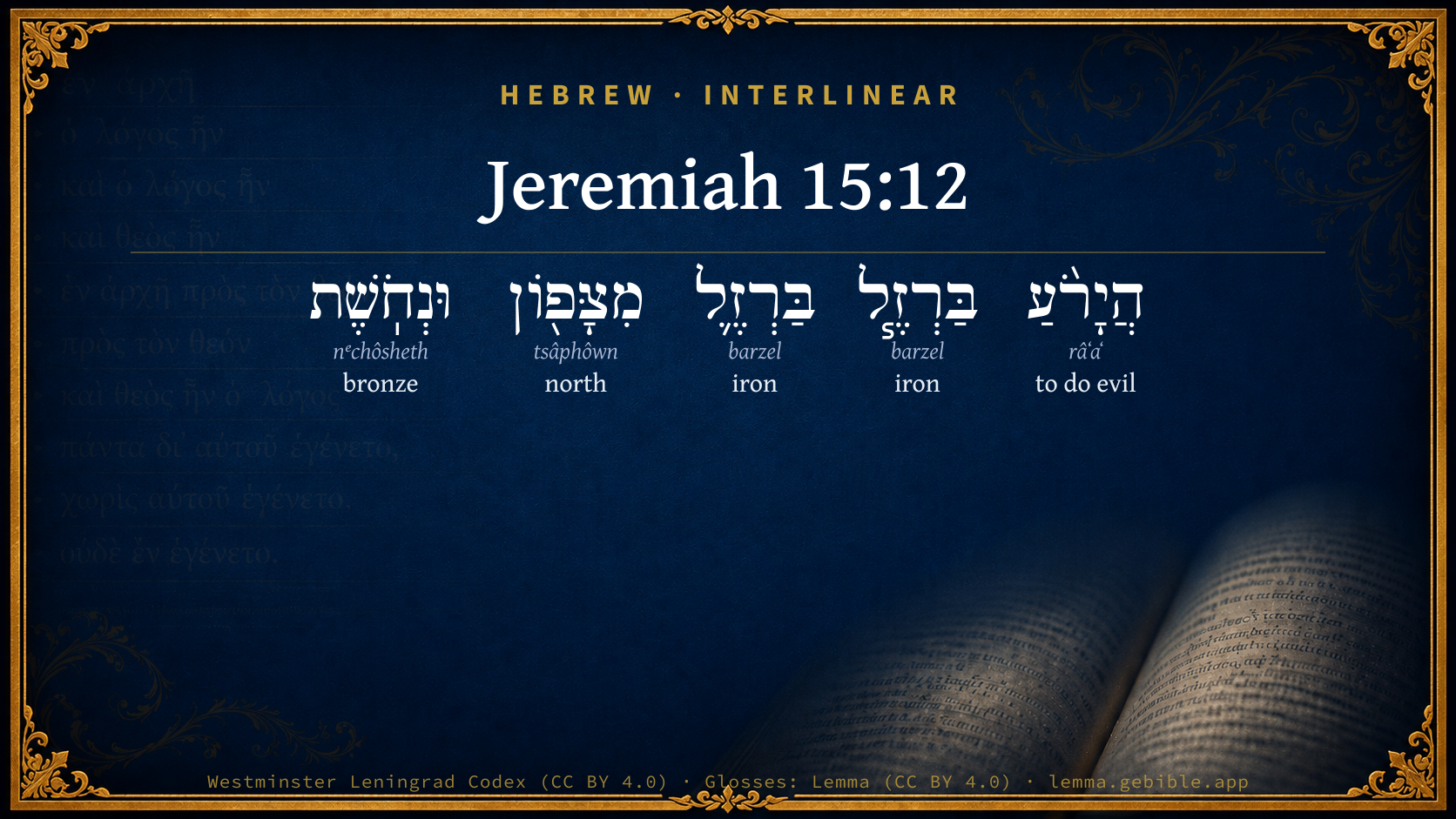
Jeremiah 15:12

Hebrew (Westminster Leningrad Codex) Jeremiah 15:12 appears in the Hebrew Old Testament. The text above is from the Westminster Leningrad Codex. Each word links to its Strong’s number, a concise gloss, and parsing drawn from the Open Scriptures Hebrew Bible morphology. Click any word for its full Brown-Driver-Briggs (BDB) entry.
Download image
Cite this verse

Jeremiah 15:12 (World English Bible). Public Domain. Lemma interlinear Bible study tool, https://lemma.gebible.app/v/jeremiah/15/12.

Show BibTeX & RIS
BibTeX
RIS
English Translation
Can one break iron, even iron from the north, and brass?
World English Bible · Public Domain
Download a study sheet

One document with this verse’s original text, its word-by-word gloss line, the meaning frame, cross-references with their text, attributed commentary, and full source and license credits — printable, and it pastes into notes with its structure intact.

This verse Autodidact and up

Study sheet (.html) Plain text (.txt)

A passage Seminary Student

Up to 50 verses in one chapter. A passage sheet keeps up to 6 commentary sources and 12 cross-references per verse, in the order this page ranks them, and says so on the sheet whenever that leaves anything out. Ask for a single verse and you get the Autodidact verse sheet above.

Everything on this page stays free to read, with no account — the sheet is a download of what is already on screen, not access to it.

Want to remove ads? Support Godless Engineer
Compare translations 3

The same verse in 3 English versions, stacked beneath the original-language interlinear above. Click any original word for its lexicon entry.

Each is an independent rendering of the whole verse — the interlinear is not word-aligned to these translations.

Highlighted words mark where these versions differ — a whole-verse word diff, not a word-by-word alignment.

  • World English Bible Public Domain
    Can one break iron, even iron from the north, and brass?
  • King James Version Public Domain
    Shall iron break the northern iron and the steel?
  • unfoldingWord Literal Text CC BY-SA 4.0
    Can one break iron, iron from the north, or bronze?

unfoldingWord Literal Text — © unfoldingWord, licensed CC BY-SA 4.0. Word-aligned USFM3 via Door43 (git.door43.org/unfoldingWord/en_ult).

Versions to compare (up to 4)

3 of 4 selected

Show all 18 translations

Every available English version of this verse, each an independent rendering of the whole verse.

  • World English Bible Public Domain
    Can one break iron, even iron from the north, and brass?
  • Berean Standard Bible Public Domain
    Can anyone smash iron—iron from the north—or bronze?
  • Majority Standard Bible Public Domain
    Can anyone smash iron—iron from the north—or bronze?
  • King James Version Public Domain
    Shall iron break the northern iron and the steel?
  • American Standard Version (1901) Public Domain
    Can one break iron, even iron from the north, and brass?
  • Revised Version (1885) Public Domain
    Can one break iron, even iron from the north, and brass?
  • Geneva Bible (1599) Public Domain
    Shall the yron breake the yron, and the brasse that commeth from the North?
  • Douay-Rheims (1899) Public Domain
    Shall iron be allied with the iron from the north, and the brass?
  • Young's Literal Translation Public Domain
    Doth one break iron -- northern iron, and brass?
  • Literal Standard Version CC BY-SA 4.0
    Does one break iron, || Northern iron and bronze?
  • Unlocked Literal Bible CC BY-SA 4.0
    Can one smash iron? Especially iron from the north that is mixed with bronze?
  • unfoldingWord Literal Text CC BY-SA 4.0
    Can one break iron, iron from the north, or bronze?
  • Darby Bible Public Domain
    Will iron break? iron from the north? and bronze?
  • World Messianic Bible Public Domain
    Can one break iron, even iron from the north, and bronze?
  • Webster's Bible Public Domain
    Shall iron break the northern iron and the steel?
  • Free Bible Version CC BY-SA 4.0
    Can anyone break iron, iron from the north, or bronze?
  • Bible in Basic English Public Domain
    Is it possible for iron to be broken; even iron from the north, and brass?
  • JPS Tanakh (1917) Public Domain
    Can iron break iron from the north and brass?

Literal Standard Version (2020), Covenant Press — licensed CC BY-SA 4.0. Text via the HelloAO Bible API (eBible.org). Unlocked Literal Bible (unfoldingWord) — licensed CC BY-SA 4.0. Text via the HelloAO Bible API (eBible.org). unfoldingWord Literal Text — © unfoldingWord, licensed CC BY-SA 4.0. Word-aligned USFM3 via Door43 (git.door43.org/unfoldingWord/en_ult). Free Bible Version, Dr. Jonathan Gallagher — licensed CC BY-SA 4.0. Text via the HelloAO Bible API (eBible.org).

Word by word

More ways to search: Search by grammar → Find every occurrence → Compare this word →

Practice this passage: Drill this verse → Learn its vocabulary →

About this verse

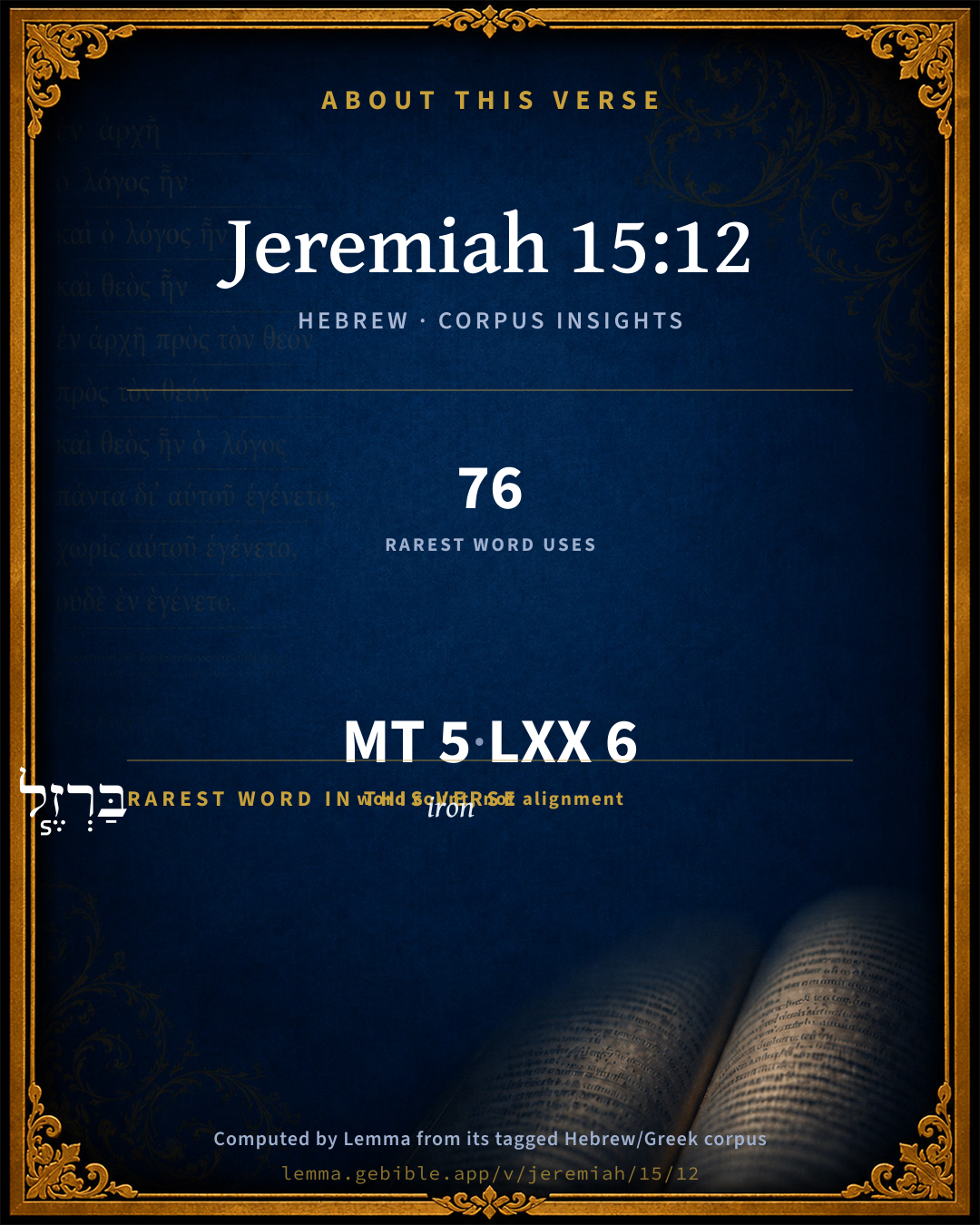
These counts appear in no published source. They are computed here, from the morphology-tagged text and Lemma’s own curated glosses. What Lemma adds →

5
words
4
distinct lemmas
Prophets
section

Grammatical profile

  • 1 verb
  • 4 nouns

Verb forms

  • הֲיָרֹ֨עַ Qal · Imperfect

Repetition

A word recurs within this verse — often emphatic in Hebrew:

  • בַּרְזֶ֧ל iron H1270 ×2

Hebrew & Septuagint length

In the original languages it is 5 Hebrew tokens and 6 Greek tokens — but the two are counted differently (Hebrew bundles its prefixes and suffixes into one token; the Greek is in lemma form), so that isn’t a like-for-like length.

Cross-references

6

Topical passages linked to Jeremiah 15:12 in the Treasury of Scripture Knowledge — connected by theme and wording, ordered by reader-vote popularity; previews shown in the World English Bible.

  • Job 40:9 Or have you an arm like God? Can you thunder with a voice like him?
  • Isaiah 45:9 Woe to him who strives with his Maker--a potsherd among the potsherds of the earth! Shall the clay ask him who fashions it, "What are you making?" or your work, "He has no hands?"
  • Jeremiah 1:18–19 For, behold, I have made you this day a fortified city, and an iron pillar, and brazen walls, against the whole land, against the kings of Judah, against the princes of it, against the priests of it, and against the people of the land.
  • Jeremiah 21:4–5 Thus says Yahweh, the God of Israel, Behold, I will turn back the weapons of war that are in your hands, with which you fight against the king of Babylon, and against the Chaldeans who besiege you, without the walls; and I will gather them into the midst of this city.
  • Jeremiah 28:14 For thus says Yahweh of Hosts, the God of Israel: I have put a yoke of iron on the neck of all these nations, that they may serve Nebuchadnezzar king of Babylon; and they shall serve him: and I have given him the animals of the field also.
  • Habakkuk 1:5–10 "Look among the nations, watch, and wonder marvelously; for I am working a work in your days, which you will not believe though it is told you.

Cross-references courtesy of OpenBible.info (CC BY 4.0).

Hebrew and Greek witnesses Masoretic Hebrew ↔ Greek Septuagint

The same verse in the two great witnesses to the Old Testament, shown verse-for-verse.

These are two independent witnesses, not word-aligned to each other, and the Septuagint is shown in lemma (dictionary) form.

Hebrew Jeremiah 15:12 Masoretic · Westminster Leningrad Codex

הֲיָרֹ֨עַ בַּרְזֶ֧ל בַּרְזֶ֛ל מִצָּפ֖וֹן וּנְחֹֽשֶׁת

Can one break iron, even iron from the north, and brass?

World English Bible · Public Domain

Greek LXX Structure differs

In the Septuagint, Jeremiah is about an eighth shorter than the Hebrew and arranges its material differently — the Oracles Against the Nations (Hebrew chapters 46–51) appear in the middle of the Greek book, after 25:13. Because the chapter and verse boundaries do not line up, a verse-for-verse comparison with the Hebrew is not shown.

A verse-for-verse comparison isn’t shown here because the chapters and verses don’t line up. Switch to the LXX edition with the MT / LXX toggle above to read the Greek directly.

Hebrew: Westminster Leningrad Codex (CC BY 4.0). Greek: Septuagint (public domain); English from a public-domain English Septuagint. How the Septuagint differs from the Hebrew →

Targum (Aramaic paraphrase)

1

The Targum is the ancient Jewish Aramaic paraphrase of the Hebrew Scriptures — an interpretive translation, not the Hebrew text itself. Onkelos (literal) and Pseudo-Jonathan (expansive) render the Torah, and Jonathan the Prophets. Coverage is partial: where no permissively-licensed English translation exists for a verse, only the Aramaic is shown. This is verse-level text, not a word-by-word alignment to the Hebrew.

  1. Targum Jonathan Prophets (Joshua–Malachi)
    מְלַךְ דְתַקִיף כְּבַרְזְלָא יִסַק לְסָעֵיר מְלַךְ דְתַקִיף כְּבַרְזְלָא וְכִנְחָשָׁא יֵתֵי מִצִפּוֹנָא עֲלָהּ לְמִתְבָּרָא:

    (no public-domain English translation for this verse)

    Targum Jonathan — Aramaic: “Mikraot Gedolot” (public domain). English: “Sefaria Community Translation” (CC0 1.0 (public-domain dedication)); “London "Chaldee Paraphrase," 1871” (public domain). Text via Sefaria.

Commentary

Notes on Jeremiah 15:12 from classic Christian and Jewish commentators (each source and its license shown beneath its notes). The classic Christian expositions comment on the surrounding passage and are grouped to its opening verse, so a note may address several verses; the Jewish commentaries on the Tanakh (Rashi and others) are per-verse, so they appear only where the commentator wrote on this verse.

Lemma curates 59 commentaries, every one of them public domain or Creative Commons licensed, each selected and text-cleaned for this edition rather than reprinted as found. About our sources →

Trapp's Complete Commentary

John Trapp

Jer 15:12 Shall iron break the northern iron and the steel?

Ver. 12. Shall iron break the northern iron and the steel?] That is, say some, shall these hardhearted Jews be too hard for me? or, for thee, Jeremiah, whom I have made an "iron pillar and brazen walls" against the whole land {Jer 1:18} Never think it. Brighten thee they may, but not break thee. The northern iron is noted for the best and toughest.

John Trapp, A Commentary or Exposition upon All the Books of the Old and New Testament (1647–1656) — public domain. Text from a community e-Sword module.

The Biblical Illustrator

Joseph S. Exell

Jer_15:12

Shall iron break the northern iron and the steel?

The northern iron and steel

In order to achieve a purpose there must be sufficient force. The weaker cannot overcome the stronger. In a general clash the firmest will win. You cannot cut granite with a pen knife, nor drill a hole in a rock with an anger of silk. We shall apply this proverb--

I. To the people of God individually.

1. Many Christians are subjected to great temptations and persecutions; mocked, ridiculed, called by evil names. Persecuted one, will you deny the faith? If so, you are not made of the same stuff as the true disciple of Jesus Christ; for when the grace of God is in them, if the world be iron, they are northern iron and steel.

2. We are frequently called to serve God amid great difficulties. Will you say, there is no converting these dark and obdurate souls? Is the iron to break the northern iron and steel? Look at Mont Cenis Tunnel, made through one of the hardest rocks; with a sharp tool, edged with diamond, they have pierced the Alps. As St. Bernard says: Is thy work hard? set a harder resolution against it; for there is nothing so hard that cannot be cut with something harder still.

3. To labour with non-success, and to wait, is hard work. It is a grand thing for a Christian to continue patiently in well-doing.

II. Applicable to the cause of God in the world--to the Church. What power, however like to iron, shall suffice to break the kingdom of Jesus, which is comparable to steel?

1. We hear it said that Romanism will again vanquish England; that the Gospel light, which Latimer helped to kindle, will be extinguished. Atrocious nonsense, if not partial blasphemy. If this thing were of men, it would come to nought; but if it be of God, who shall overthrow it?

2. Others foretell the triumph of infidelity. That the gates of hell are to prevail against the Church; that the pleasure of the Lord is not to prosper in His hand. Who but a lying spirit would thus lay low the faith and confidence of Gods people?

III. Apply the principle to the self-righteous efforts which men make for their own salvation.

1. The bonds of guilt are not to be snapped by a merely human power.

2. Yet that were an easy task compared with a man renewing his own heart.

3. Do you think you can force your way to heaven by ceremony? Come, sinner, with thy fetters; lay thy wrist at the cross foot, where Christ can break the iron at once.

IV. Applicable to all persons who are making self-reliant efforts for the good of others.

1. Our preaching--we try to make it forcible--how powerless it is of itself! We plead, reason, seek goodly words, etc., but the northern iron and steel remain immovable. Though all the apostles reasoned with them, they would turn a deaf ear.

2. The best adapted means cannot succeed. A mothers tears, as she spoke to you of Jesus; the pleadings of a grey-headed father over you--no power to change your heart! The Gospel, though put to you very tenderly by those you love best, leaves you unsaved still! You have been sick, near death, within an inch of doom; yet even the judgments of God have not aroused you.

V. This text has a very solemn application to all those who are rebels against God. Fight against God, would you? Measure your adversary, I charge you. The wax is about to wrestle with the flame, the tow to contend with the fire. (C. H. Spurgeon.)

Nothing more to be done

It is impossible to explain these words to the satisfaction of all. The general explanation, according to a large consensus of opinion, is that the prayer of the prophet cannot break the inflexible purpose of Jehovah. Jeremiah is still concerned for his countrymen, and he will still pray, though he has been told that if the mightiest intercessors that ever lived were to lift up their heads in devoutest argument they would not be listened to, for heaven was offended, and mighty in just indignation. Now the question is put, not by Jeremiah, but by another: Shall iron break the northern iron and the steel? Is there any iron in the south that can stand against the iron of the north? Has not the iron of the north been proved in a thousand controversies, and has it ever failed t Who will smite that northern iron with straw? Who will break it with a weapon of wood? Who will set his own frail hand against an instrument so tremendous? The argument, then, would seem to be--Why pray to me for these people? It is as iron applied to the iron of the north, which has been seen to fail in innumerable instances: all the prayers that can now be offered to heaven would be broken upon the threshold of that sanctuary and fall back in fragments upon the weary intercessor; the day has closed, the door is shut, the offended angel of grace has flown away on eagle pinions, and the sister angel of mercy can no longer be found: pray no more for Jerusalem. Thus the Lord dramatically represents Himself; and in all this dramatic reply to the interrogations and pleadings of earth there is a great principle indicated; that principle is that the day closes--My Spirit shall not always strive with men. These are awful words. If a man had invented them, we should have denied their truthfulness and their force; but when we hear them as from above we confirm them, we say, It is right, we do not deserve to be heard; if we had to assign ourselves to a fate, we dare not plant ha the wilderness of our solitude one single flower; we have done the things we ought not to have done, we have left undone the things we ought to have done; all we like sheep have gone astray, we have turned everyone to his own way. (J. Parker, D. D.)

The Biblical Illustrator, edited by Joseph S. Exell (c. 1880s–1900s) — public domain. Text from a community e-Sword module.

Joseph Benson's Commentary

Jer 15:12. Shall iron break the northern iron? — The northern iron is the hardest of any. “It is here,” says Blaney, “justly supposed to denote, in a primary sense, that species of hardened iron, or steel, called in Greek χαλυψ, from the Chalybes, a people bordering on the Euxine sea, and consequently lying to the north of Judea, by whom the art of tempering steel is said to have been discovered. Strabo speaks of this people as known in former times by the name of Chalybes, but afterward called Chaldæi, and mentions their iron mines, lib. 12. p. 549. These, however, were a different people from the Chaldeans who were united with the Babylonians.” “The words, if applied to Jeremiah, import thus much, that, as common iron cannot contend for hardness with the northern iron, or with steel, so the opposition which the Jews made against him should be easily vanquished and disappointed, because the Lord was with him to save him, Jer 15:20. If the words relate to the Jews, as the following verses plainly do, the sense is, that the Chaldeans coming from the north would be as much too hard for them to engage with, as the northern iron was superior in strength to the common metal of that kind.” — Lowth. But perhaps the expression is not merely metaphorical: it is not unlikely that the Babylonians had their armour from the Chalybes, and that therefore it was made of iron much harder, and of much better proof, than that of which the armour of the Jews was formed.

Joseph Benson's Commentary on the Old and New Testaments (1811–1818) — public domain. Text from a community e-Sword module.

Tyndale Open Study Notes

Tyndale Open Resources

15:12 Iron and bronze are metaphors for the strong resolve that the Lord would give to Jeremiah (1:18).

Tyndale Open Study Notes — © Tyndale Open Resources, licensed CC BY-SA 4.0. Text via the HelloAO Bible API.

Geneva Bible (1599)

Geneva Bible translators

As for the people, though they seemed strong as iron, yet should they not be able to resist the hard iron of Babylon, but should be led captives.

Geneva Bible (1599) marginal notes — public domain. Text via Bolls.life.

Jamieson, Fausset & Brown

Robert Jamieson, A. R. Fausset & David Brown

steel--rather, brass or copper, which mixed with "iron" (by the Chalybes near the Euxine Pontus, far north of Palestine), formed the hardest metal, like our steel. Can the Jews, hardy like common iron though they be, break the still hardier Chaldees of the north (Jer 1:14), who resemble the Chalybian iron hardened with copper? Certainly not [CALVIN]. HENDERSON translates. "Can one break iron, (even) the northern iron, and brass," on the ground that English Version makes ordinary iron not so hard as brass. But it is not brass, but a particular mixture of iron and brass, which is represented as harder than common iron, which was probably then of inferior texture, owing to ignorance of modern modes of preparation.

Jamieson, Fausset & Brown — Commentary Critical and Explanatory on the Whole Bible (1871) — public domain (CC PDM 1.0). Text via the HelloAO Bible API.

Adam Clarke's Commentary

Verse 12. Shall iron break the northern iron and the steel?] Shall our weak forces be able to oppose and overcome the powers of the Chaldeans? נחשת nechasheth, which we here translate steel, property signifies brass or copper united with tin, which gives it much hardness, and enables it to bear a good edge.

Adam Clarke's Commentary on the Bible (1810–1826) — public domain. Text from a community e-Sword/MySword module.

John Calvin's Commentaries

This verse also has been taken in different ways by interpreters: some take the word iron, when repeated in a different case, “Will iron break iron?” but others think the subject wanting in the clause, and consider people to be understood, “Will the Jews break the iron, even the iron from the north, and not only the iron but the brass also, or, the the brass mixed with iron?” There is in reality no difference, but in words only. If we read, “Will the iron break the iron from the north?” the meaning will be, “Though there be great hardness in you, can it yet break that which is in the Assyrians? but ye are not equal to them: make your strength as great as you please, still the Chaldeans will be harder to break you; for if ye are iron, they are brass or steel, and so it will not be possible for you to sustain their violent attacks.”

As the meaning of the Prophet is sufficiently evident, I will not insist on words, though the rendering I most approve is this, “Will iron break the iron (the repetition is emphatical) from the north and the brass?”

We here also see that the design of the holy man was, to divest the Jews of that false confidence in which they boasted: for how was it, that they were so refractory, except that they did not dread any misfortune? As then they were secure, predictions had but little weight with them. Hence the Prophet, in order to beat down this ferocity, says, that there would be greater hardness in the Chaldeans, for they would be like iron, yea, and steel also. It follows —

John Calvin's Commentaries (1540-1563) — public domain. Text from the Calvin Translation Society English edition (1840s-50s) via the Christian Classics Ethereal Library (ccel.org). Calvin's coverage is partial (roughly two-thirds of the Bible); uncommented books and verses are honest gaps, never fabricated. The 19th-century editor's footnotes and remarks are omitted so the notes are faithfully Calvin's own voice.

Ellicott's Commentary for English Readers

(12) Shall iron break . . .?—The abruptness of the question and the boldness of the imagery make the interpretation difficult. That which most harmonises with the context (assuming this verse to carry on the thought of Jer_15:1-9, after the interruption, possibly the interpolation, of Jer_15:10-11) is, that the prayer of the prophet, strong though it may be, cannot change the inflexible purpose of Jehovah to chastise His people’s sins. Some have, however, taken the words as declaring (1) the powerlessness of Judah to resist the titanic strength of the Chaldaeans, or (2) the impotence of the prophet’s enemies to deter him from his work, or (3) the prophet’s want of power against the obdurate evil of the people, or (4) the weakness of Pharaoh-nechoh as compared with Nebuchadnezzar. Of these (3) has a show of plausibility from Jer_1:18; Jer_15:20, but does not harmonise so well with what precedes and follows. The “northern iron” is probably that of the Chalybes of Pontus, mentioned as the “artificers in iron” by Æschylus (Prom. Bound, 733), as the coast of the Euxine is called by him the land which is “the mother of iron” (Ibid. 309), famous for being harder than all others. For “steel” we should read bronze. The word is commonly translated “brass,” but that compound, in its modern sense, was unknown to the metallurgy of Israel.

A Bible Commentary for English Readers, edited by Charles John Ellicott (1878–1897) — public domain. Text from a community e-Sword module.

The Cambridge Bible for Schools and Colleges

gen. ed. J. J. S. Perowne

12. Also very difficult. No satisfactory emendation has been proposed. If, which is very doubtful, the v. is to be retained as it stands, the speaker is either (a) Jehovah, declaring that the Chaldaean foe shall prevail, or (b) better, Jeremiah, as mg. Can iron break iron from, etc., i.e. can my strength be a match for the overwhelming force of my enemies? “The point of reference to iron from the North is that the best and hardest iron came from the Black Sea.” Pe.

The Cambridge Bible for Schools and Colleges (gen. ed. J. J. S. Perowne; Cambridge University Press, 1878–1918) — public domain. Text from a community e-Sword module.

John Gill's Exposition

Shall iron break the northern iron and the steel? Can iron break iron, especially that which comes from the north, which was harder than the common iron; or steel, the hardest of all? though the Jews were hard as iron, they could not prevail against and overcome Jeremiah, who was made an iron pillar and brasen walls against them, Jer 1:18, and so these words are spoken for his comfort and encouragement: or they may respect the Jews and the Chaldeans; and the sense be, that the Jews, as mighty and as strong as they fancied themselves to be, and boasted that they were, they could not find themselves a match for the Chaldean army, which came out of the north; and may be said to be as hard as the northern iron, which came from the Chalybes, a people in the north, near Pontus, from whom steel has its name in the Latin tongue; and this sense agrees with what follows.

, and so these words are spoken for his comfort and encouragement: or they may respect the Jews and the Chaldeans; and the sense be, that the Jews, as mighty and as strong as they fancied themselves to be, and boasted that they were, they could not find themselves a match for the Chaldean army, which came out of the north; and may be said to be as hard as the northern iron, which came from the Chalybes, a people in the north, near Pontus, from whom steel has its name in the Latin tongue; and this sense agrees with what follows.

Jeremiah 15:13

jer 15:13

jer 15:13

jer 15:13Thy substance and thy treasures will I give to the spoil without price,.... Not the prophet's substance and treasure; for it does not appear that he had any, at least to require so much notice; but the substance and treasure of the people of the Jews, to whom these words are directed; these the Lord threatened should be delivered into the hands of their enemies, and become a spoil and free booty to them, for which they should give nothing, and which should never be redeemed again:

and that for all thy sins, even in all thy borders; this spoiling of their substance should befall them because of their sins, which they had committed in all the borders of their land, where they had built their high places, and had set up idolatrous worship; or else the meaning is, that their substance and treasure in all their borders, in every part of the land, should be the plunder of their enemies, because of their sins.

John Gill's Exposition of the Whole Bible (1746–1763) — public domain (CC PDM 1.0). Text via the HelloAO Bible API.

Albert Barnes' Notes on the Bible

The steel - “brass,” i. e., bronze. By the “iron” is meant Jeremiah’s intercession; but this cannot alter the divine purpose to send Judah into exile, which is firm as steel and brass. For “brass” see Exo 25:3 note. The alloy of copper and zinc now called brass was entirely unknown to the ancients.

Albert Barnes' Notes on the Bible (1834–1885) — public domain. Text from a community e-Sword/MySword module.

Haydock's Catholic Bible Commentary

Iron. Shall the iron (that is, the strength of Juda) stand against the stronger iron of the north, (that is, of Babylon) or enter into an alliance upon equal footing with it? No, certainly; but it must be broken by it. (Challoner) --- Iron is not easily united with brass, though Pliny ([Natural History?] xxxiv. 4.) mentions a statue of this nature. Neither iron nor brass can stand against steel, which is meant by the iron from the north. The Jews shall not hurt Jeremias, ver. 20., and chap. i. 17. (Calmet) --- Protestants, "shall iron break the northern iron and the steel?" The riches of Juda shall become a prey, ver. 13. (Haydock) --- Stronger kingdoms easily oppress their weak allies. (Worthington)

George Leo Haydock (1774–1849), Haydock's Catholic Family Bible and Commentary, 1859 edition — public domain. Excludes Psalms (Douay-Rheims chapter numbering differs from Protestant) and Deuterocanonical books (Catholic canon only).

Matthew Poole's English Annotations

There is a great variety among interpreters as to this verse also, some interpreting this as a prophecy that none should break the prophet, whom God would make

as the northern iron and steel, which was the hardest of all iron, the Chalybes (from whom steel had its name Chalybs) being northern people, and the most famous of any then known in the world for tempering iron to make it hard and tough; others interpreting it, as denying that there should ever be an agreement betwixt the Jews and the Chaldeans: but to me the words of the next verse seem to give us the sense, that the Jews should certainly be overrun and conquered by the Babylonians; for as the northern iron and steel is the hardest, and no iron could break that, so God having edged and hardened their enemies the Chaldeans, all their opposition to them would signify nothing.

Matthew Poole's English Annotations on the Holy Bible (1683–1685) — public domain. Text from a community e-Sword/MySword module.

Whedon's Commentary on the Bible

Daniel D. Whedon

12. Steel — Rather, brass. Making this change, the Authorized Version, as to words, faithfully represents the original: but as to the meaning there have been different opinions. Taking the construction of the English Version, the question is: Can one kind of iron break another? Can the iron of Jeremiah’s intercession break the iron of Jehovah’s purpose to send his people into exile? But this does not satisfactorily explain the phrase northern iron. To refer the epithet “northern” to Jehovah’s purpose to send his people into the north country is harsh in the extreme, not to say puerile. Better is it to regard northern iron as a mere repetition for the purpose of identification of the term iron, and break as intransitive. The meaning, then, will be: Shall iron break — northern iron and brass? Is there any probability or possibility that the power of the north country will break, any more than that iron itself will break?

Daniel D. Whedon (gen. ed.), Commentary on the Old and New Testaments (1874–1909) — public domain. Text from a community e-Sword module.

The Pulpit Commentary

Shall iron break, etc.? Again an enigmatical saying. The rendering of the Authorized Version assumes that by the northern iron Jeremiah means the Babylonian empire. But the "breaking" of the Babylonian empire was not a subject which lay within the thoughts of the prophet. It was not the fate of Babylon, but his own troubled existence, and the possibility that his foes would ultimately succeed in crushing him, which disquieted this conscientious but timid spokesman of Jehovah. The Divine interlocutor has reminded him in the preceding verse of the mercy which has been already extended to him, and now recalls to his recollection the encouraging assurances given him in his inaugural vision. (Jer_1:18, Jer_1:19) Render, therefore, Can one break iron, northern iron, and bronze? The steel of the Authorized Version is evidently a slip. The Hebrew word is n"khosheth, which means sometimes (e.g. Deu_8:9 Deu_33:25 Job_28:2) copper, but more commonly bronze, since "copper unalloyed seems to have been but rarely used after its alloys with tin became known" (Professor Maskelyne). "Steel" would have been more fitly introduced as the second of the three names of metals. "Northern iron" at once suggests the Chalybes, famous in antiquity for their skill in hardening iron, and, according to classical authors (e.g. Stephanus the geographer), the neighbors of the Tibareni, in the country adjoining the Euxine Sea, the Tibareni being, of course, the people of Tubal, whom Ezekiel mentions (Eze_27:13) as trafficking in vessels of bronze. Any Jew, familiar with the wares of the bazaar, would at once appreciate the force of such a question as this. Even if iron could be broken, yet surely not steel nor bronze. Thus the verse simply reaffirms the original promises to Jeremiah, and prepares the way for Vers. 20, 21.

A vain contest.

"Shall iron break the northern iron and the steel?" So asks the Lord God of his, at this time not simply lamenting prophet, he was rarely anything but that, but also his complaining prophet. And as we read these verses with which the striking inquiry contained in this verse is connected, we cannot help feeling that his lamentations become him far more than his complaints. Still, who are we, to criticize a great hero of the faith such as Jeremiah undoubtedly was? These verses, from the tenth onwards, are no doubt on a lower, a less spiritual and less self-forgetful level than that which the common strain of his prophecies and prayers maintain. It will be seen that these verses come at the close of a long and most earnest appeal addressed by him to God on behalf of his countrymen. They were suffering fearfully from the dearth of which the opening of the fourteenth chapter tells. Now, all this was then present before the prophet"s mind, and these chapters record the expostulations, the pathetic appeals, and the almost agonized prayers which he pours forth on behalf of his suffering land and people. He makes full confession of their sins, but pleads the all-merciful Name of the Lord, and when that did not suffice, he urges the evil teaching that they had received from their prophets and that therefore they may be held guiltless or far less guilty, and when that plea also was rejected he returns to his confessions and earnest entreaties; but it is all of no avail. At the opening of this chapter God says, "Though Moses and Samuel men who had once and again proved themselves mighty intercessors for the people, yet even if they before me, my mind could not be toward this people." The crimes of Manasseh, King of Judah, that king who reigned so long, so disgracefully, and with such disastrous results over Judah, had never been repented of, and never really forsaken. They were rampant still, and therefore the Lord declares this judgment which he had sent upon them must go on no prayers of his faithful servant could avail to stay its execution. Upon this the prophet pours out a piteous lamentation over the woes of his people, and then, turning to his own position, he complains bitterly of the hatred which was felt towards him by those whom he had sought to bless. "Woe is me, my mother, that thou hast borne me a man of strife and a man of contention to the whole earth!" He had been no usurer nor fraudulent debtor, "yet every one," he cries, "curses me." Then to him the Lord replies, promising him deliverance in the time of evil, and asks the question, "Shall iron break.., steel?" The ancients knew comparatively little of the manufactures of iron and steel. Amongst the Israelites it was very coarsely wrought, but the best iron was from the north. So bad was their own that an admixture of brass, which among us would be rather thought to lessen its value, was regarded as in improvement. But the iron and steel procured from the people who lived in the far north, on the shores of the Black Sea, was the most celebrated for its tenacity and hardness. Against it the common iron of every-day use could offer but little resistance, and when opposed to it could make little or no impression; it could not "break the northern iron and the steel." And the question of this verse is a proverb denoting the impossibility of any force, though great in itself, overcoming one which by its very nature and by its effects had been proved to be greater still. Our Lord teaches the same truth when he speaks of the folly of that king who thought, with his army of ten thousand, to encounter and overcome another king who came against him with twenty thousand. But whilst the meaning of this verse is plain enough, its application is not so clear. If we connect it with the verses that immediately precede, as many do, then it is a question whose tone is bright, cheerful, and reassuring. But if we connect it with those that immediately follow, its tone is altered and is full of solemn admonition and serious warning. In the first case it refers to Jeremiah himself, and is for his comfort and confidence. It tells him that the enemies who are against him, however iron like they might be-cold, hard, fierce, strong and however much they may oppress and afflict him, yet assuredly they shall not prevail against him; for God will make him as the northern iron and the steel, against which all their might shall be in vain. God had promised at the very outset of the prophet"s ministry that he would thus strengthen him. Behold, he says, in the first chapter, "I have made thee this day a defensed city, and an iron pillar, and brazen walls against the whole land... and they shall fight against thee, but they shall not prevail against thee; for I am with thee, saith the Lord, to deliver thee." And in the twentieth verse of this chapter the like promise is given over again. So that they have much reason on their side who regard these words as a heart-cheering assurance conveyed to the prophet under the form of a question, and assuring him that, let the power of those who hated him be what it might as iron like as it would the grace of God which would be given him would make him stronger still, would make him as the northern iron and the steel. Let us, then, view these words

I AS A REASSURING PROMISE, and make two or three applications of them.

1. And first, to such as Jeremiah himself was at this time a faithful servant of God, but muck troubled and tried. What right have we to expect that all things will go smoothly with us in this world, or to be surprised when sore troubles come? Did not our Lord say, "Behold, I send you forth as sheep amongst wolves"? Well, it would be strange if the sheep were to find all things just as they wished amid such surroundings as that. But, as one has said, the sheep have beaten the wolves after all. There are today tens of thousands of sheep for every wolf prowling on the face of the earth. It did seem very likely, when the sheep were so few, that the wolves would most certainly have quickly made a clearance of them. But, though here and there one like Saul "made havoc of the Church," the flock, the Lord"s fold, went on increasing and multiplying in a marvelous way. Spiritually as well as literally the sheep outnumber the wolves who would destroy them. And what is the explanation but this, that to those who have no might the Lord has increased strength? He has let the wolves be indeed like iron, but his sheep he has strengthened as the northern iron, etc. And this he will ever do. God can temper our souls to such degree of hardness and tenacity that they shall blunt and beat back every weapon that is formed against them. The arrows hurled against us shall fall pointless to the ground, and the armor of God wherein we stand engirt shall more than defend us from the adversary"s power. The shield of faith is made, not of our enemies" untempered iron, but of the northern iron and steel told of here. Oh, then, child of God, how is it with thee? Is the world frowning upon thee? are circumstances adverse and involved, and thy way hedged with difficulties? Has death invaded thy home or is it about to do so, and is thy heart saddened thereby? Does disappointment dog thy steps and baffle all thy best-meant endeavors? Is anxiety creeping over thee and filling thee with foreboding fear? Hearken to this word of God, "Can iron," etc.? Can these things, hard and terrible as they are, break down thy defense or break through thy shield? Oh, bring thy soul to Christ, tell him how weak, how defenseless, in thyself, thou art; come to him for the armor of proof thou needest; ask him to give thee good courage and to strengthen thine heart; and then, as thou comest off more than conqueror over all these things, thou shalt triumphantly ask this question for thyself.

2. And we may ask it again in reference to the opposition of the world against the Church of God. For that Church is girt with invincible power, and stands like a rock amid the raging of the sea. In vain the tempests hurl the mighty waves against it, in vain do they fiercely smite it as with force sufficient to make it stagger and fall; but whilst you look expecting to see it overthrown, lo, the huge seas that smote it are shivered into clouds of spray, and multitudes of foaming cataracts are seen rushing down its sides but leaving it unharmed and immovable still. And to return to the metaphor of this verse the iron of its adversary"s weapon has broken against the steel of its impenetrable shield, and the Church of God is unconquered still. Heresy has sought with insidious power to turn it from the truth. Persecution with its fires and all manner of deadly cruelties has threatened every member of its communion, and slain thousands upon thousands of them. Superstition has come with its priest-craft and pretended supernatural powers and taught men to worship idols in the name of God. Infidelity, the sure offspring of Superstition, disgusted with the miserable shams and the mass of wretched fables which Superstition has taught men for truth, has thrown off all belief, and denied the very existence of God and the whole of the precious faith that the Church has received. The world, a more deadly foe still, with her soft blandishments and her mighty bribes, has done more to pervert the right ways of the Lord than perhaps all the other enemies of the Church altogether; just as on the mass of iron used in the construction of the great railway bridges which span so many of the valleys, straits, and rivers of our land, it is found that a warm morning"s sunshine does more to deflect them from their true horizontal line than is accomplished by the ponderous weight of the heaviest engines and trains rushing over them at their highest speed. The soft warmth does more than the heaviest weight. And again and again in the history of the Church of God it has been found that when the world is most smiling then is it most deadly to the best interests of the Church. And in our day, fresh forms of unbelief or disbelief are gathering round the Church, and like a mist enwrapping the minds and hearts of not a few, so that the blessed firmness of faith which once was the common characteristic of the Church is giving way to a general doubt, vagueness, and uncertainty, upon which no firm foothold can be had. But what is our confidence in view of all this? Is it not in the truth, made sure to us by the experience of all the ages, that the Church of God is his especial care, and that therefore his omnipotence is around it, and all the powers of hell shall not prevail against it. Here the Church of God is today, in numbers, zeal, faith, charity, not one whit behind the former days. Here in this direction and that there may be loss, but if so, then in other directions we find gain. And the witness of all the history of the Church is this, that the forces that oppose her are but as untempered iron, whilst the power that defends her is as the northern, etc. And should there be any anxious heart who is in much doubt and fear as to his own personal salvation because of the multitude and magnitude of his sins, we would bid such a one take home to him the truth of our text. For although his sins be all he thinks them, and even more of strength like iron yet the Savior"s will to save is as the northern iron and the steel. True, the retrospect over the past may be grievous, and since that was forgiven it may have been too often reproduced again. "Thy backslidings," as God told Israel, "have been many;" but art thou hoping in God? dost thou grieve and mourn over sin and truly desire to be made whole? Then it shall be so with thee; thy salvation shall be accomplished, for thine accusers" power is but as the iron, whilst thy Savior"s is as the northern, etc. Therefore yield not to doubt, still less to despair, but go to him who is mighty to save, and ask him to give thee of his strength that thou mayst now conquer thy sin; so shalt thou no more doubt of his grace or of thine interest therein. Such are some of the applications of this question which, taking it as an implied promise, we are justified in making. But as we said at the outset, if we connect our text with the verses that follow, it will rather supply lessons of serious warning and admonition. For thus understood, the iron tells of the power of Israel and "the northern.., steel" of the invincible power of the Chaldean armies that were so soon to come against them, and therefore this question is a declaration of the sure overthrow of Israel when the time of conflict came. The power of God was against Israel, and then what hope could there be? Their poor defense would be soon broken, and they would lie at the mercy of their foe. It is, therefore

II A SAMPLE OF THE FATE THAT ATTENDS ALL RANGING OF MERE HUMAN POWERS AGAINST THE WILL OF GOD. Whenever any such unequal contest is contemplated or being carried on, this question may be fitly asked. And therefore we ask it:

1. Of all these, and they are very many, who think that they can, unarmed of God, successfully wage the war with sin. We would be unfeignedly thankful that there is felt the desire to wage this war at all, that there is no fatal apathy or content with sin, but that there is a real purpose to subdue it and keep it under and to live in all righteousness. Yes, wherever that purpose is, let thanks be given to God. But what all such need to remember, yet what they very often do not remember, is that the evil of their own hearts is as "the northern steel," whilst all the strength of their own resolves is but as common "iron," and when these two come in collision we know the result. Remember that first of all there is the guilt of sin to be provided for, and even supposing you were to contract no further sin, what is to be said of all the past? How can your own right resolves and correct future conduct if it be indeed correct atone for that? But supposing it were true that in an amended life there is atonement for the past, as we overlook the sins of youth, if the mature life be what it should be supposing that were true, which it is not, even amongst men, if the past crimes have been of a serious kind but supposing it were, and that if a man really turned over a new leaf all the records of the foregoing leaves should be destroyed, no matter what those records were have you any guarantee that the future leaves will be altogether different from those that went before? The Word of God, and experience also, teach us that we have not. No doubt some sins may be given up, some evil actions forsaken, especially if they be such as bring upon us the reproach of man, but the true nature of the man remains unchanged he is in himself what he was. "Can the Ethiopian change his skin," etc.? "then may ye also do good, that are accustomed to do evil." So speaks the prophet of God; so, too, speaks the experience of life. Of course we do not affirm all this in regard to the coming up to the standard of society, or of maintaining an external decency of life, but we do affirm it in regard to the attainment of that renewed and alone morally excellent character to which God calls us and of which our Lord Jesus Christ set us the example. You cannot bore through rock with wooden tools; you cannot with soft iron cut or pierce the hardened steel. And so you cannot, by the power of your own resolves, break that heart of evil, hardened like very steel, which every man carries about in him until it is regenerated by the Spirit of God. The grace of God alone can help you. It is at the cross of Christ, where you gain forgiveness from all the guilt of the past, that you gain also strength for the better life of the future; and it is in daily coming to that cross, daily looking unto Jesus, that blessed Lord who is both your Redeemer and your perfect Pattern, that you become changed into the same image and made like him. Iron is striving to "break the... steel," whilst you are endeavoring of yourself to save yourself from the past results and the present power of sin. You cannot do it, and in view of the gracious help the Lord Jesus Christ offers you it is a sin and an insult to him to persist in the attempt.

2. Finally, I think of another hopeless contest in which also many are still engaged, in which the iron is thinking to "break... steel." It is the contest with God, the combat with the Most High. God has made us all for himself, Now, he himself so obeys the law of truth and righteousness and goodness that we say he is righteousness. "The Lord is righteous in all his ways and holy in all his works" God is love." Therefore he bids us surrender our hearts, our wills, to him, to obey, love, and serve him. It is not simply right, but most blessed for us as for all his creatures to do this, and the vast majority of them do, and are blessed in consequence. But man has the power of saying "Nay" to God"s "Yea," and "Yea" to God"s "Nay," and that power he has chosen to exercise. In other words, he has set up his will against the Divine will, and refuses obedience where the will of God and his own are opposed. This is the contest that is ever going on God seeking to win man"s will, his heart to himself, and man persistently refusing. Man wants to have his own way, believing and insisting that it is the good way for him, whilst God knows well that it is a way of evil and of evil only. Therefore by all means God is seeking to draw us from that way to his own. By the voice of conscience and of his Spirit pleading within us, by his providences, his Word, his ordinances, and in other ways still, mostly gentle and gracious, others of them of a sterner kind, but by them all he is aiming at but one result this, of inducing us to yield to him, to acknowledge his authority, and confess him Lord. And remember this will of his is no passing wish, one which, when he finds he cannot have it, he will cease to care for. Oh no, but it is his steadfast purpose, that upon which his heart is set. "As I live, saith the Lord, all the earth shall be filled with my glory." "To Jesus every knee shall bow, and... Father." Can we think, then, that instead of this, God will be content with simply destroying man? That would be to confess failure on his part, and so would also the mere infliction of vengeance. Therefore we feel sure that the rebel will have to yield, and the stoutest heart to bow. The iron cannot "break... steel" Shall the will of man forever defy God, and hold out against him? But ah! what of agony and woe will not the rebel will have to go through ere it will own itself wrong! All the awful words of Christ about the quenchless fire and the undying worm those dreadful sayings of his at which the soul shudders still are his setting forth thereof. Oh, you whose hearts are still unsurrendered to him, will you provoke him to this? will you force him to hold you down to the consequences of your own doings until you come to see them as he sees them? Then not alone because of the sorrow that must attend the refusal to yield to him, but because such yielding is so right, so blessed, let us cease from the vain and sinful conflict; let the iron no more foolishly think to "break the northern iron and steel," But "let us come and worship and bow down not with the knee alone, but in heart "before the Lord our Maker" and our Redeemer. C.

The Pulpit Commentary (1880–1919), ed. H.D.M. Spence-Jones & Joseph S. Exell — public domain. Text from a community e-Sword module.

John Wesley's Explanatory Notes

The northern iron - As the northern iron and steel is the hardest, and no iron could break that, so God having edged and hardened their enemies, the Chaldeans, all opposition to them would signify nothing.

John Wesley, Explanatory Notes Upon the Whole Bible (1754–1765) — public domain. Text via the GEBible commentary corpus.

Rashi

Rabbi Shlomo Yitzchaki (Rashi)

Will iron break iron from the north I say that iron that comes from the north is harder than other iron, and this is its interpretation: They were compared to iron (above 6:28), “Going tale bearing like copper and iron.” And concerning Jeremiah it is stated (above 1:18): “I have made you... into an iron pillar and into copper walls,” and his is stronger than theirs, for Nebuchadnezzar will come upon them according to his words.

Will…break Will their iron break yours? Another explanation: Will Pharaoh who comes in your aid, who is as hard as iron, break Nebuchadnezzar, who is iron that comes from the north and copper? Targum Jonathan is inclined toward this direction.

Rashi on the Tanakh — English translations: “The Judaica Press complete Tanach with Rashi, translated by A. J. Rosenberg” (CC BY 4.0); “Pentateuch with Rashi's commentary by M. Rosenbaum and A.M. Silbermann, 1929-1934” (public domain); “The Metsudah Tanach series, Lakewood, N.J” (CC BY 4.0); and “The Book of Joshua, Metsudah Publications, 1997” (CC BY 4.0). Text via Sefaria.

Lesson kit

Teaching starters — assembled from the data on this page, not authored interpretation. Every prompt links to the verse data it draws on. Edit before teaching.

Jeremiah, in the Prophets, opens this verse with 5 words (4 distinct Hebrew lemmas). Its most distinctive word is barzel (“iron”). A historical commentator’s framing appears above. Read the whole chapter for the surrounding context.

Discussion questions

  1. The word barzel carries the sense “iron.” How does it shape the verse?
  2. Job 40:9 shares this passage’s theme. How do the two illuminate each other?
  3. “iron” occurs 2× in this one verse. What is the effect of the repetition?
  4. These translations render this verse differently. What is at stake in choosing one wording over another?
  5. The verb «הֲיָרֹ֨עַ» is Qal Imperfect. How does its form color the action?
  6. Reading how Trapp's Complete Commentary and The Biblical Illustrator read this verse, where do the two commentators agree and where do they part?

Things to notice

Reading settings

Reading text

Shown beneath each verse's original-language words.

Old Testament
Old Testament edition

Read the OT as the Masoretic Hebrew (MT) or the Greek Septuagint (LXX).

English shown for the Greek Septuagint (in the Hebrew ↔ Greek comparison).

Comparing translations? Open the Compare panel on any verse page to stack up to four side by side.