
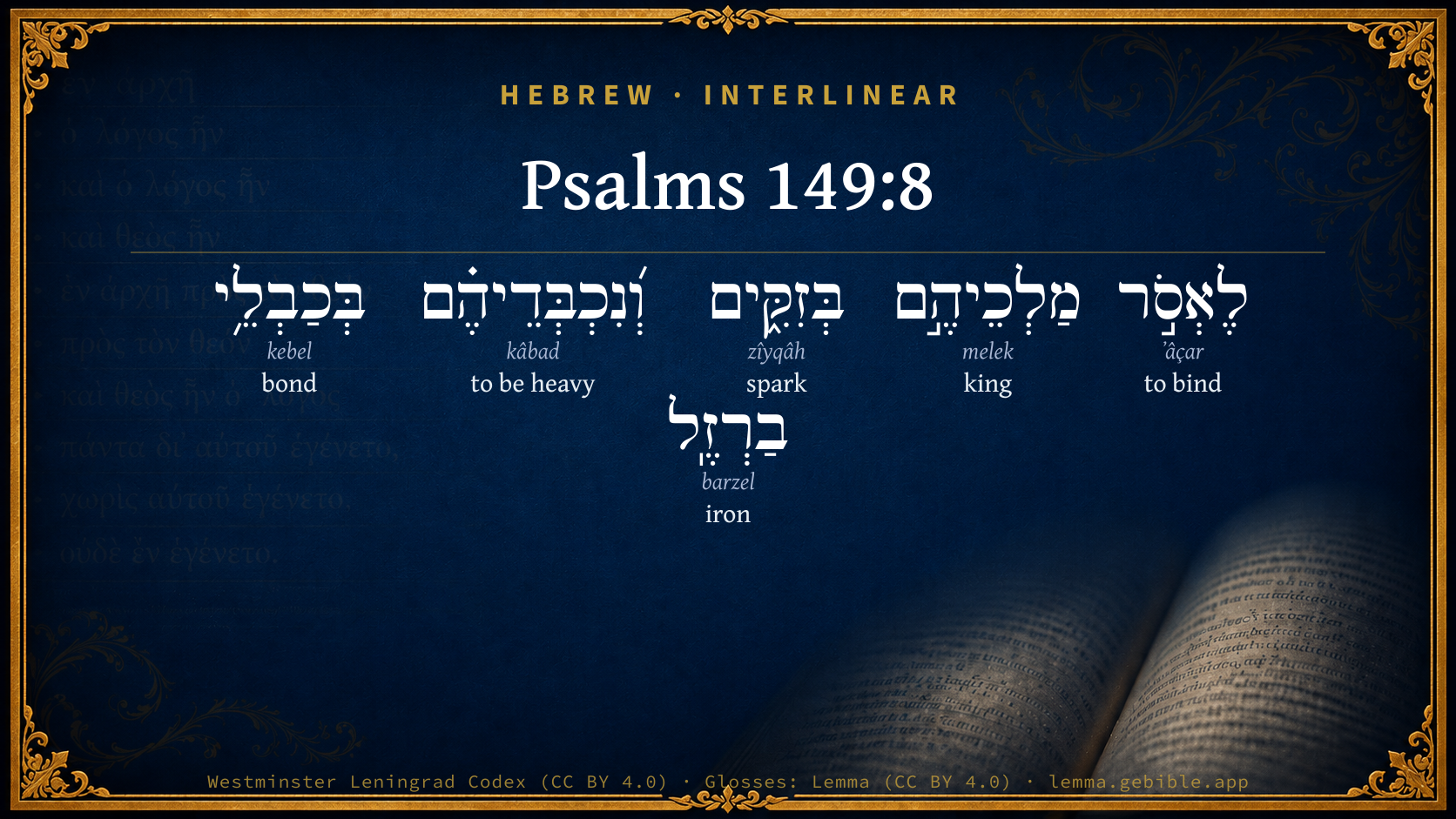
Psalms 149:8

Hebrew (Westminster Leningrad Codex) Psalms 149:8 appears in the Hebrew Old Testament. The text above is from the Westminster Leningrad Codex. Each word links to its Strong’s number, a concise gloss, and parsing drawn from the Open Scriptures Hebrew Bible morphology. Click any word for its full Brown-Driver-Briggs (BDB) entry.
Download image
Cite this verse

Psalms 149:8 (World English Bible). Public Domain. Lemma interlinear Bible study tool, https://lemma.gebible.app/v/psalms/149/8.

Show BibTeX & RIS
BibTeX
RIS
English Translation
To bind their kings with chains, And their nobles with fetters of iron;
World English Bible · Public Domain
Download a study sheet

One document with this verse’s original text, its word-by-word gloss line, the meaning frame, cross-references with their text, attributed commentary, and full source and license credits — printable, and it pastes into notes with its structure intact.

This verse Autodidact and up

Study sheet (.html) Plain text (.txt)

A passage Seminary Student

Up to 50 verses in one chapter. A passage sheet keeps up to 6 commentary sources and 12 cross-references per verse, in the order this page ranks them, and says so on the sheet whenever that leaves anything out. Ask for a single verse and you get the Autodidact verse sheet above.

Everything on this page stays free to read, with no account — the sheet is a download of what is already on screen, not access to it.

Want to remove ads? Support Godless Engineer
Compare translations 3

The same verse in 3 English versions, stacked beneath the original-language interlinear above. Click any original word for its lexicon entry.

Each is an independent rendering of the whole verse — the interlinear is not word-aligned to these translations.

Highlighted words mark where these versions differ — a whole-verse word diff, not a word-by-word alignment.

  • World English Bible Public Domain
    To bind their kings with chains, And their nobles with fetters of iron;
  • King James Version Public Domain
    To bind their kings with chains, and their nobles with fetters of iron;
  • unfoldingWord Literal Text CC BY-SA 4.0
    to bind their kings with chains and their nobles with shackles of iron,

unfoldingWord Literal Text — © unfoldingWord, licensed CC BY-SA 4.0. Word-aligned USFM3 via Door43 (git.door43.org/unfoldingWord/en_ult).

Versions to compare (up to 4)

3 of 4 selected

Show all 17 translations

Every available English version of this verse, each an independent rendering of the whole verse.

  • World English Bible Public Domain
    To bind their kings with chains, And their nobles with fetters of iron;
  • Berean Standard Bible Public Domain
    to bind their kings with chains and their nobles with shackles of iron,
  • Majority Standard Bible Public Domain
    to bind their kings with chains and their nobles with shackles of iron,
  • King James Version Public Domain
    To bind their kings with chains, and their nobles with fetters of iron;
  • American Standard Version (1901) Public Domain
    To bind their kings with chains, And their nobles with fetters of iron;
  • Revised Version (1885) Public Domain
    To bind their king’s with chains, and their nobles with fetters of iron;
  • Geneva Bible (1599) Public Domain
    To binde their Kings in chaines, and their nobles with fetters of yron,
  • Young's Literal Translation Public Domain
    To bind their kings with chains, And their honoured ones with fetters of iron,
  • Literal Standard Version CC BY-SA 4.0
    To bind their kings with chains, || And their honored ones with chains of iron,
  • Unlocked Literal Bible CC BY-SA 4.0
    They will bind their kings with chains and their nobles with iron shackles.
  • unfoldingWord Literal Text CC BY-SA 4.0
    to bind their kings with chains and their nobles with shackles of iron,
  • Darby Bible Public Domain
    To bind their kings with chains, and their nobles with fetters of iron;
  • World Messianic Bible Public Domain
    to bind their kings with chains, and their nobles with fetters of iron;
  • Webster's Bible Public Domain
    To bind their kings with chains, and their nobles with fetters of iron;
  • Free Bible Version CC BY-SA 4.0
    to imprison their kings in shackles and their leaders in iron chains,
  • Bible in Basic English Public Domain
    To put their kings in chains, and their rulers in bands of iron;
  • JPS Tanakh (1917) Public Domain
    To bind their kings with chains, and their nobles with fetters of iron;

Literal Standard Version (2020), Covenant Press — licensed CC BY-SA 4.0. Text via the HelloAO Bible API (eBible.org). Unlocked Literal Bible (unfoldingWord) — licensed CC BY-SA 4.0. Text via the HelloAO Bible API (eBible.org). unfoldingWord Literal Text — © unfoldingWord, licensed CC BY-SA 4.0. Word-aligned USFM3 via Door43 (git.door43.org/unfoldingWord/en_ult). Free Bible Version, Dr. Jonathan Gallagher — licensed CC BY-SA 4.0. Text via the HelloAO Bible API (eBible.org).

Word by word

More ways to search: Search by grammar → Find every occurrence → Compare this word →

Practice this passage: Drill this verse → Learn its vocabulary →

About this verse

These counts appear in no published source. They are computed here, from the morphology-tagged text and Lemma’s own curated glosses. What Lemma adds →

6
words
6
distinct lemmas
Wisdom
section

Notable vocabulary

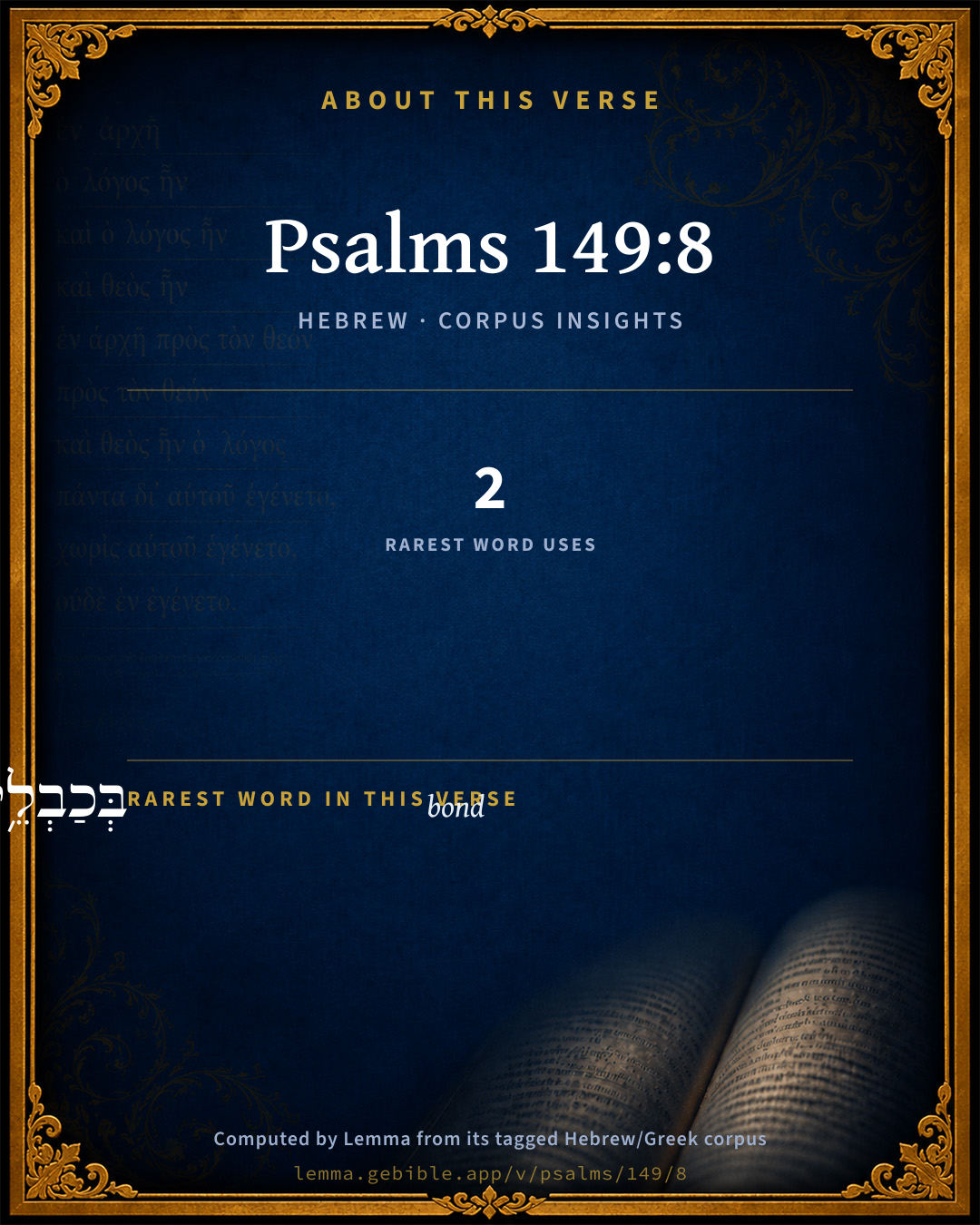
The rarest word here is בְּכַבְלֵ֥י bond H3525 — appearing just 2 times in the whole Hebrew Bible.

Shared distinctive vocabulary

בְּכַבְלֵ֥י bond H3525 occurs in 2 verses of the Hebrew Bible. Also found in:

Grammatical profile

  • 2 verbs
  • 4 nouns

Verb forms

  • לֶאְסֹ֣ר Qal · Infinitive Construct
  • וְ֝נִכְבְּדֵיהֶ֗ם Niphal · Participle Active

Hebrew & Septuagint length

In English translation the verse runs 13 words from the Hebrew and 26 from the Septuagint (LXX English) — closely comparable.

A rough comparison of the two English renderings, which tokenize alike — not a word-level alignment.

Word counts can differ between the Hebrew and the Greek without any difference in meaning — e.g. the Hebrew direct-object marker אֵת has no separate Greek word, and Greek often adds the article ὁ.

Cross-references

4

Topical passages linked to Psalms 149:8 in the Treasury of Scripture Knowledge — connected by theme and wording, ordered by reader-vote popularity; previews shown in the World English Bible.

  • Joshua 10:23–24 They did so, and brought forth those five kings to him out of the cave, the king of Jerusalem, the king of Hebron, the king of Jarmuth, the king of Lachish, the king of Eglon.
  • Judges 1:6–7 But Adoni-bezek fled; and they pursued after him, and caught him, and cut off his thumbs and his great toes.
  • Joshua 12:7 These are the kings of the land whom Joshua and the children of Israel struck beyond the Jordan westward, from Baal Gad in the valley of Lebanon even to Mount Halak, that goes up to Seir; and Joshua gave it to the tribes of Israel for a possession according to their divisions;
  • Job 36:8 If they are bound in fetters, And are taken in the cords of afflictions,

Cross-references courtesy of OpenBible.info (CC BY 4.0).

Hebrew and Greek witnesses Masoretic Hebrew ↔ Greek Septuagint

The same verse in the two great witnesses to the Old Testament, shown verse-for-verse.

You’re reading Greek Psalm 149 (Hebrew Psalm 149). The Septuagint counts the superscription, so verse numbers can differ from the Hebrew — chapter-level alignment, not verse-by-verse. Numbering follows Rahlfs.

These are two independent witnesses, not word-aligned to each other, and the Septuagint is shown in lemma (dictionary) form.

Hebrew Psalms 149:8 Masoretic · Westminster Leningrad Codex

לֶאְסֹ֣ר מַלְכֵיהֶ֣ם בְּזִקִּ֑ים וְ֝נִכְבְּדֵיהֶ֗ם בְּכַבְלֵ֥י בַרְזֶֽל

To bind their kings with chains, And their nobles with fetters of iron;

World English Bible · Public Domain

Greek LXX Greek Psalm 149:8 Septuagint · lemma form

ὁ δέω ὁ βασιλεύς αὐτός ἐν πέδη καί ὁ ἔνδοξος αὐτός ἐν χειροπέδη σιδηροῦς

to bind their kings with fetters, and their nobles with manacles of iron; to execute on them the judgment written: this honor have all his saints.

LXX2012 (modern English Septuagint) · Public Domain

Hebrew: Westminster Leningrad Codex (CC BY 4.0). Greek: Septuagint (public domain); English from LXX2012 (modern English Septuagint) (Public Domain). How the Septuagint differs from the Hebrew →

Commentary

Notes on Psalms 149:8 from classic Christian and Jewish commentators (each source and its license shown beneath its notes). The classic Christian expositions comment on the surrounding passage and are grouped to its opening verse, so a note may address several verses; the Jewish commentaries on the Tanakh (Rashi and others) are per-verse, so they appear only where the commentator wrote on this verse.

Lemma curates 59 commentaries, every one of them public domain or Creative Commons licensed, each selected and text-cleaned for this edition rather than reprinted as found. About our sources →

Trapp's Complete Commentary

John Trapp

Psa 149:8 To bind their kings with chains, and their nobles with fetters of iron;

Ver. 8. To bind their kings with chains] Restraining their vices, and bringing them to the obedience of faith. See Isa 45:14. This is doubtless a desirable servitude, or rather freedom; this is not as chains and fetters, but as girdles and garters, to gird up their loins, and to expedite their course the better.

John Trapp, A Commentary or Exposition upon All the Books of the Old and New Testament (1647–1656) — public domain. Text from a community e-Sword module.

J. A. Alexander on Psalms

Joseph Addison Alexander

8. (Psa 149:8) To bind their kings with chains, their nobles with fetters of iron. The word translated nobles is properly a participle, meaning honoured (ones). The verse simply carries out the idea of the one before it, that of the subjugation of the gentiles by the true religion. The objection to this, as a spiritualising explanation of the text, springs from a narrow and erroneous view of the very end for which Israel existed as a nation. Those promises to Israel, which are not still available for us, were but of temporary local value.

Joseph Addison Alexander, The Psalms Translated and Explained (1850) — public domain. Text from a community e-Sword module.

Geneva Bible (1599)

Geneva Bible translators

Not only the people, but the kings that were their enemies should be destroyed.

Geneva Bible (1599) marginal notes — public domain. Text via Bolls.life.

Adam Clarke's Commentary

Verse 8. To bind their kings with chains, and their nobles with fetters of iron] That is, if these kings, governors of provinces, and chiefs among the people, had attacked them, God would have enabled them to defeat them, take their generals prisoners, and lead them in triumph to Jerusalem. It is certain also that in the times of the Maccabees the Jews had many signal victories over the Samaritans, Philistines, and Moabites; and over Antiochus, king of Syria. See the Books of the Maccabees. To these the psalmist may here refer in a hyperbolical way, not unusual in poetry and in songs of triumph.

Adam Clarke's Commentary on the Bible (1810–1826) — public domain. Text from a community e-Sword/MySword module.

John Calvin's Commentaries

The next verse, where mention is made of kings and nobles, is an amplification; for had he only spoken of peoples and nations, this might have been restricted to the common people and men of low condition. Here is something much greater — that kings and others of noble rank would be dragged to punishment in chains. But it is to be remembered, as I have just hinted, that but a small part of this splendid prospect was realized until Christ appeared; for any small increase of prosperity which the people enjoyed under the Machabaei was not worthy of any consideration, except in so far as by this help God sustained the drooping spirits of the people up to Christ’s advent. Here the prediction of Jacob is to be noticed —

“the scepter shall not depart from Judah, until Shiloh come.” (Genesis 49:10.)

But the Machabaei sprung from another tribe. We must, infer, therefore, that the regular order was then interrupted, and that to make the prosperous state of the people to have been based upon their victories, is building a castle in the air. And God would appear designedly to have removed the government from the tribe of Judah, lest this success should intoxicate the minds of his people; for most of them, through pride in these signal victories, overlooked the true and substantial deliverance. As the Psalmist treats here of the perfection of the prosperity of the people, it follows that he refers to the Messiah, that their expectation and desire of him might never cease either in their prosperity or adversity.

John Calvin's Commentaries (1540-1563) — public domain. Text from the Calvin Translation Society English edition (1840s-50s) via the Christian Classics Ethereal Library (ccel.org). Calvin's coverage is partial (roughly two-thirds of the Bible); uncommented books and verses are honest gaps, never fabricated. The 19th-century editor's footnotes and remarks are omitted so the notes are faithfully Calvin's own voice.

The Cambridge Bible for Schools and Colleges

gen. ed. J. J. S. Perowne

8. The subjection and homage of the nations to Israel are repeatedly anticipated in the later chapters of Isaiah (Isa_45:14; Isa_49:7; Isa_49:23; Isa_60:3 ff.). In Psalms 2 the Messianic king, here the Messianic people, subjugates the nations.

their nobles] Their honourable men, as Isa_23:8-9; Nah_3:10.

The Cambridge Bible for Schools and Colleges (gen. ed. J. J. S. Perowne; Cambridge University Press, 1878–1918) — public domain. Text from a community e-Sword module.

John Gill's Exposition

To bind their kings with chains, and their nobles with fetters of iron. Which is thought to allude to what was done to the Canaanitish kings, in the times of Joshua; and to the princes of Midian by Gideon; and to Agag by Saul; and to the Ammonites, Syrians, and others, by David: but it refers either to the first times of the Gospel, and the influence of the sword of the Spirit over the hearts of men; and on some very great personages, as kings and nobles, brought to Christ and his churches, in chains of powerful and efficacious grace, declaring a ready and cheerful subjection to his Gospel and ordinances; such as Constantine, Theodosius, and others; and who were instruments in subduing, conquering, and destroying tyrannical and persecuting emperors and princes, as Maximilian, Licinius, and others; see Isa 45:14; and more instances of the power of the Gospel, and the influence of divine grace on such persons, there will be in the latter day; see Isa 49:23. It may also respect the use of the Gospel ministry, compared to a twoedged sword on the hearts of men in common; whereby Satan, the strong man armed, who keeps the palace as a king or prince, is dispossessed; and sin, which reigns like a king unto death, is dethroned, and grace is set up as a governing principle. But it may chiefly regard the destruction of antichristian kings and nobles, and their states, through the prevalence of the Gospel and the power of Christ, and the twoedged sword coming out of his mouth, Rev 17:14.

Psalms 149:9

John Gill's Exposition of the Whole Bible (1746–1763) — public domain (CC PDM 1.0). Text via the HelloAO Bible API.

Albert Barnes' Notes on the Bible

To bind their kings with chains - To make them prisoners and captives. This is but carrying out the idea in the previous verses, of inflicting punishment upon them for the wrongs which they had done to the people of God. There is no evidence that this refers to a spiritual conquest, or to a spiritual subjection of those nations to the true religion. The whole idea is in accordance with what is so often expressed in the Psalms - that of inflicting just punishment on the wicked. See the General Introduction, Section 6.

And their nobles with fetters of iron - To make them prisoners. That is, to subdue them. Captives in war, even those of elevated rank, were often led in chains to grace the triumph of conquerors.

Albert Barnes' Notes on the Bible (1834–1885) — public domain. Text from a community e-Sword/MySword module.

Matthew Poole's English Annotations

See Poole "Psa 149:7".

Matthew Poole's English Annotations on the Holy Bible (1683–1685) — public domain. Text from a community e-Sword/MySword module.

The Treasury of David

Charles H. Spurgeon

Ver. 8. To bind their kings with chains, and their nobles with fetters of iron. Thus are the greatest enemies of Jehovah and his people reduced to shame, rendered helpless, and themselves punished. This was Israel's boast in actual fact, it is ours spiritually. The chief powers of evil shall be restrained and ultimately destroyed. Those who made captives of the godly shall themselves be made captive. The powers of evil cannot bind our King, but by his power their king shall be bound with a great chain, and shut up in the bottomless pit, that he may at length be trodden under the feet of saints.

Ver. 8. To bind their kings with chains, etc. Agrippa was captive to Paul. The word had him in bands like a prisoner, and made him confess against himself before Festus that he was "almost persuaded to be a Christian." Then it was verified which before was prophesied, They shall bind kings in chains, and nobles in fetters of iron. Oh, the majesty and force of the word! Henry Smith.

Ver. 8. It was once the saying of Pompey, that with one stamp of his foot he could raise all Italy up in arms; and the mighty men of the world may have nations, kingdoms, and commonwealths at their command, but yet God is more powerful than they all. If he do but arise, they shall all of them fly before him. If he once fall to fettering of princes, it shall be done so sure, that no flesh shall be able to knock off their bolts again. Stephen Gosson, 1554-1623.

Ver. 8. The restraining and subduing power of the gospel.

Psalms 149:9*

Charles H. Spurgeon's The Treasury of David (1869–1885) — public domain. Psalms only. Text from a community e-Sword/MySword module.

The Pulpit Commentary

To bind their kings with chains. Even royal captives were thus treated in the ancient world. Assyrian and Babylonian monarchs always represent their captives, even when kings, as fettered. Nebuchadnezzar "bound Zedekiah with fetters of brass". (2Ki_25:7) Parthia, and later Persia, and even Rome, followed the same practice. And their nobles with fetters of iron. On the monuments, cap-fives below the rank of kings are not often seen "fettered." Their arms, however, are frequently tied together with a cord, and they are fastened one to another by a stout rope.

The Pulpit Commentary (1880–1919), ed. H.D.M. Spence-Jones & Joseph S. Exell — public domain. Text from a community e-Sword module.

unfoldingWord translationNotes

Door43 World Missions Community

chains

These are made of heavy metal and restrict the movement of prisoners.

shackles

a pair of chains or bands with a chain between that limits the movement of both a person's hands or feet.

They will execute the judgment that is written

The abstract noun "judgment" can be stated as "judge." AT: "They will judge and punish the people of those nations as God wrote should be done" (See: Abstract Nouns)

translationWords

bind

noble

judge

written

honor

faithful

unfoldingWord translationNotes — © Distant Shores Media and the Door43 World Missions Community, licensed CC BY-SA 4.0. Source: git.door43.org/Door43/en_tn.

Rashi

Rabbi Shlomo Yitzchaki (Rashi)

with chains Heb. בזקים, chains.

Rashi on the Tanakh — English translations: “The Judaica Press complete Tanach with Rashi, translated by A. J. Rosenberg” (CC BY 4.0); “Pentateuch with Rashi's commentary by M. Rosenbaum and A.M. Silbermann, 1929-1934” (public domain); “The Metsudah Tanach series, Lakewood, N.J” (CC BY 4.0); and “The Book of Joshua, Metsudah Publications, 1997” (CC BY 4.0). Text via Sefaria.

Lesson kit

Teaching starters — assembled from the data on this page, not authored interpretation. Every prompt links to the verse data it draws on. Edit before teaching.

Psalms, in the Wisdom, opens this verse with 6 words (6 distinct Hebrew lemmas). Its most distinctive word is kebel (“bond”). A historical commentator’s framing appears above. Read the whole chapter for the surrounding context.

Discussion questions

  1. How does “bond” (kebel) shape what this verse is saying?
  2. Psalms 105:18 shares the word «bond» with this verse. How do the two illuminate each other?
  3. These translations render this verse differently. What is at stake in choosing one wording over another?
  4. The verb «לֶאְסֹ֣ר» is Qal Infinitive Construct. How does its form color the action?
  5. Reading how Trapp's Complete Commentary and J. A. Alexander on Psalms read this verse, where do the two commentators agree and where do they part?

Things to notice

Reading settings

Reading text

Shown beneath each verse's original-language words.

Old Testament
Old Testament edition

Read the OT as the Masoretic Hebrew (MT) or the Greek Septuagint (LXX).

English shown for the Greek Septuagint (in the Hebrew ↔ Greek comparison).

Comparing translations? Open the Compare panel on any verse page to stack up to four side by side.