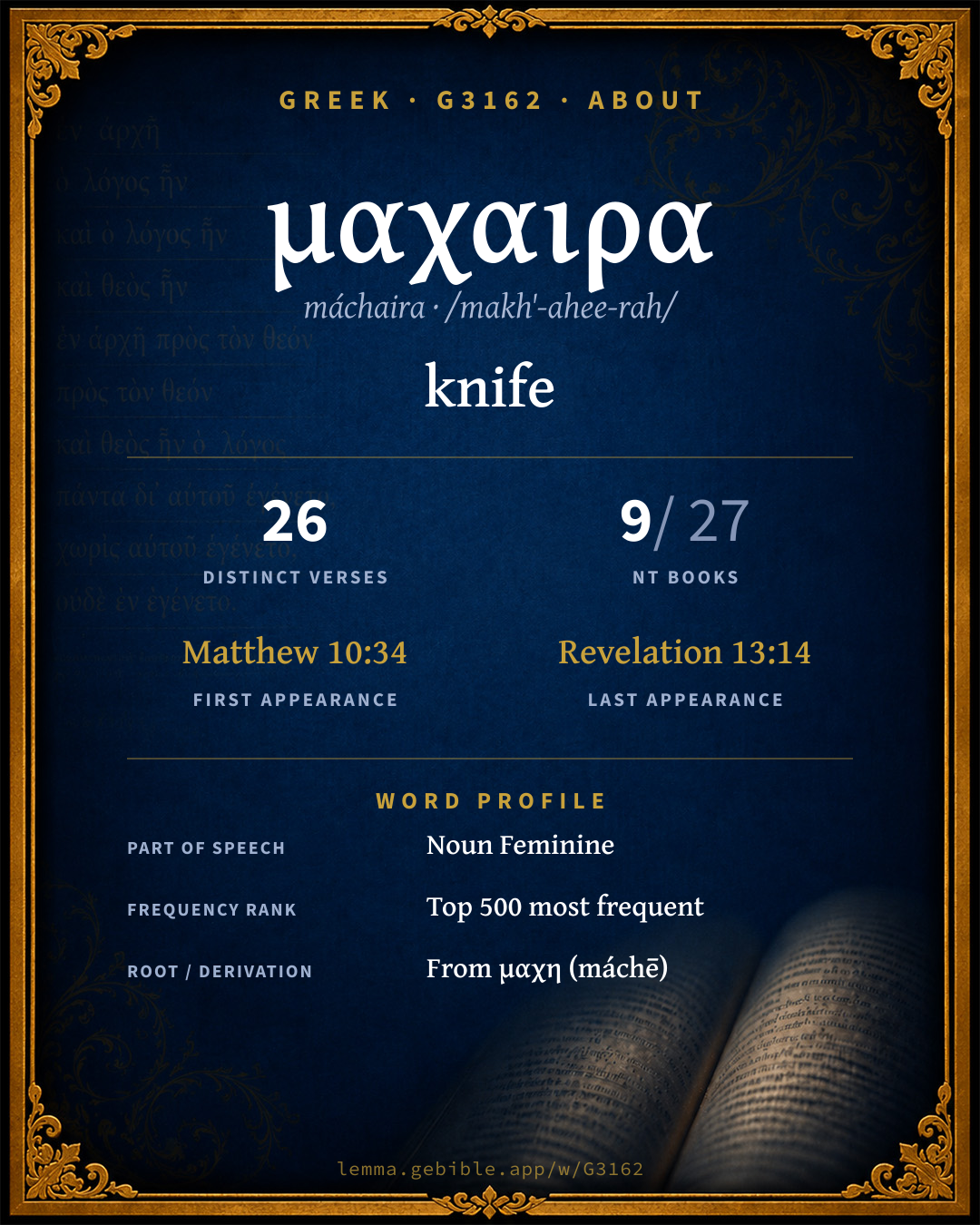
μάχαιρα
knife
‘knife’ is one of 2 main senses fuller range ↓
Full lexicon entry — Thayer's Greek Lexicon
From Thayer's Greek Lexicon
Where this word appears
See every Accusative-case word in the Greek New Testament →
Grammar key — what these labels mean
Part of speech
- Noun
- A naming word — a person, place, thing, or idea.
Case
- Accusative
- The case of the direct object and of extent.
- Dative
- The case of the indirect object, means, or location — “to / for / with / in.”
- Genitive
- The case of source, possession, or “of” — answers “whose / from what.”
- Nominative
- The case of the subject (and the predicate nominative).
Gender
- Feminine
- Grammatically feminine.
Number
- Singular
- One.
- Plural
- More than one.
Grammatical forms
- Noun, Accusative, Singular, Feminine 12 times (41%)
- Noun, Dative, Singular, Feminine 5 times (17%)
- Noun, Genitive, Plural, Feminine 5 times (17%)
- Noun, Genitive, Singular, Feminine 4 times (14%)
- Noun, Nominative, Singular, Feminine 2 times (7%)
- Noun, Nominative, Plural, Feminine 1 time (3%)
Parsed forms decoded from the imported morphology (Robinson–Tischendorf, public domain), counted across 29 parsed occurrences — not distinct verses.
Every verse where G3162 appears — 26 distinct verses across 9 books. Click any verse to open its interlinear word-by-word view. Verse text shown in the World English Bible for context — . Each verse’s Greek form is shown with its reference; the English is not keyword-highlighted, since the data carries no word-level English alignment. Use “Compare translations” on any verse to read it across multiple English versions. This concordance covers the Greek New Testament; Septuagint (Greek Old Testament) occurrences of this word are not indexed here.
Matthew 5 verses
- Matthew 10:34 μάχαιραν n acc sg fem "Don't think that I came to send peace on the earth. I didn't come to send peace, but a sword.
- Matthew 26:47 μαχαιρῶν n gen pl fem While he was still speaking, behold, Judas, one of the twelve, came, and with him a great multitude with swords and clubs, from the chief priest and elders of the people.
- Matthew 26:51 μάχαιραν n acc sg fem Behold, one of those who were with Jesus stretched out his hand, and drew his sword, and struck the servant of the high priest, and struck off his ear.
- Matthew 26:52 μάχαιράν μάχαιραν μαχαίρῃ n acc sg fem n acc sg fem n dat sg fem Then Jesus said to him, "Put your sword back into its place, for all those who take the sword will die by the sword.
- Matthew 26:55 μαχαιρῶν n gen pl fem In that hour Jesus said to the multitudes, "Have you come out as against a robber with swords and clubs to seize me? I sat daily in the temple teaching, and you didn't arrest me.
Mark 3 verses
- Mark 14:43 μαχαιρῶν n gen pl fem Immediately, while he was still speaking, Judas, one of the twelve, came--and with him a multitude with swords and clubs, from the chief priests, the scribes, and the elders.
- Mark 14:47 μάχαιραν n acc sg fem But a certain one of those who stood by drew his sword, and struck the servant of the high priest, and cut off his ear.
- Mark 14:48 μαχαιρῶν n gen pl fem Jesus answered them, "Have you come out, as against a robber, with swords and clubs to seize me?
Luke 5 verses
- Luke 21:24 μαχαίρης n gen sg fem They will fall by the edge of the sword, and will be led captive into all the nations. Jerusalem will be trampled down by the Gentiles, until the times of the Gentiles are fulfilled.
- Luke 22:36 μάχαιραν n acc sg fem Then he said to them, "But now, whoever has a purse, let him take it, and likewise a wallet. Whoever has none, let him sell his cloak, and buy a sword.
- Luke 22:38 μάχαιραι n nom pl fem They said, "Lord, behold, here are two swords." He said to them, "That is enough."
- Luke 22:49 μαχαίρῃ n dat sg fem When those who were around him saw what was about to happen, they said to him, "Lord, shall we strike with the sword?"
- Luke 22:52 μαχαιρῶν n gen pl fem Jesus said to the chief priests, captains of the temple, and elders, who had come against him, "Have you come out as against a robber, with swords and clubs?
John 2 verses
- John 18:10 μάχαιραν n acc sg fem Simon Peter therefore, having a sword, drew it, and struck the high priest's servant, and cut off his right ear. The servant's name was Malchus.
- John 18:11 μάχαιραν n acc sg fem Jesus therefore said to Peter, "Put the sword into its sheath. The cup which the Father has given me, shall I not surely drink it?"
Acts 2 verses
Romans 2 verses
- Romans 8:35 μάχαιρα n nom sg fem Who shall separate us from the love of Christ? Could oppression, or anguish, or persecution, or famine, or nakedness, or peril, or sword?
- Romans 13:4 μάχαιραν n acc sg fem for he is a servant of God to you for good. But if you do that which is evil, be afraid, for he doesn't bear the sword in vain; for he is a minister of God, an avenger for wrath to him who does evil.
Ephesians 1 verse
Hebrews 3 verses
- Hebrews 4:12 μάχαιραν n acc sg fem For the word of God is living, and active, and sharper than any two-edged sword, and piercing even to the dividing of soul and spirit, of both joints and marrow, and is able to discern the thoughts and intentions of the heart.
- Hebrews 11:34 μαχαίρης n gen sg fem quenched the power of fire, escaped the edge of the sword, from weakness were made strong, grew mighty in war, and turned to flight armies of aliens.
- Hebrews 11:37 μαχαίρης n gen sg fem They were stoned. They were sawn apart. They were tempted. They were slain with the sword. They went around in sheep skins and in goat skins; being destitute, afflicted, ill-treated
Revelation 3 verses
- Revelation 6:4 μάχαιρα n nom sg fem Another came forth, a red horse. To him who sat on it was given power to take peace from the earth, and that they should kill one another. There was given to him a great sword.
- Revelation 13:10 μαχαίρῃ μαχαίρῃ n dat sg fem n dat sg fem If anyone has captivity, he will go. If anyone is with the sword, he must be killed. Here is the endurance and the faith of the saints.
- Revelation 13:14 μαχαίρης n gen sg fem He deceives my own people who dwell on the earth because of the signs he was granted to do in front of the beast; saying to those who dwell on the earth, that they should make an image to the beast who had the sword wound and lived.
About this entry
At a glance — auto-summarized from this page’s data, not written by a person. Every figure links to its source below. This summary describes the numbers; it doesn’t interpret them.
μαχαιρα (máchaira) is a Greek noun most often rendered “knife.” Scripture first uses it in Matthew 10:34. Spanning 26 verses in 9 books, it ranks among the moderately common words of the Greek New Testament. Ranging over 2 senses, it is not a single-sense word. For the data behind this summary, explore the sense tree and the renderings breakdown below.
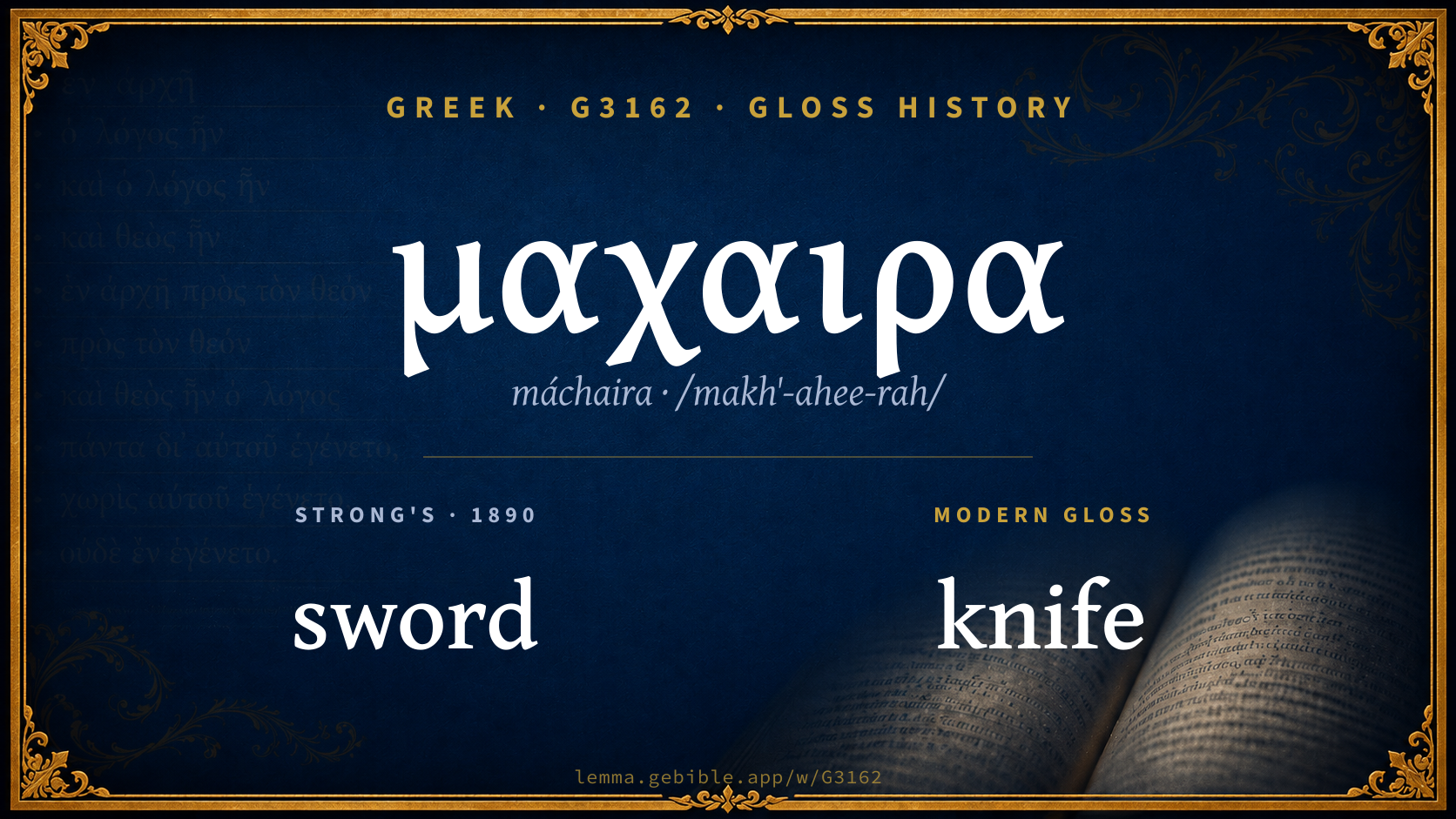
Gloss history
Strong's 1890 vs modern scholarship
About this word
Strong's G3162 catalogs a Greek word from the Greek New Testament.
These counts are not copied from any lexicon or concordance. They are computed here, from the morphology-tagged Greek New Testament. What Lemma adds →
- 26
- distinct verses
- The word appears in 26 distinct verses.
- 9 / 27
- NT books
- The word appears in 9 of 27 New Testament books.
- #471
- by frequency
- Top 500 most frequent Greek words (rank 471 of 5,347 Greek words by occurrence).
View all 26 occurrences in the concordance →
By section of the New Testament
By traditional corpus
Conventional, traditional groupings — biblical authorship is debated, so this is a traditional corpus grouping, not an authorship claim. Some books belong to more than one corpus (Luke is in both the Gospels and the Lukan corpus, and so on), so these shares overlap and need not total 100%. Each figure is a share of the word’s 26 distinct verses.
- Gospels 15 verses · 58%
- Lukan (Luke–Acts) 7 verses · 27%
- Johannine 5 verses · 19%
- Pauline corpus 3 verses · 12%
- Hebrews 3 verses · 12%
- Revelation 3 verses · 12%
How translations render this word
Counts come from each version’s own published word-to-Strong’s tagging or interlinear alignment — an approximate guide to how each version renders this word, not a word-level alignment the data otherwise carries. Because each total is that version’s own tagged count, the per-version totals vary from one another and need not match the appearance or distinct-verse counts above. These counts may also differ from a printed concordance because Lemma counts each distinctly tagged rendering and does not collapse phrase taggings into a single head-word total. This is a fixed set of word-tagged versions (KJV, ASV, BSB, ULT) and does not change with the reading translation you choose elsewhere. Each version’s license is shown beside its name below (and on Sources).
- King James Version: Sword 22×, Swords 6×
- American Standard Version: Sword 22×, Swords 6×
- Berean Standard Bible: Sword 22×, Swords 7×
- unfoldingWord Literal Text: Sword 23×, Swords 6×
King James Version Public Domain
Renders G3162 across 28 tagged occurrences — most commonly:
Not rendered by a distinct English word in 1 further occurrence.
American Standard Version Public Domain
Renders G3162 across 29 tagged occurrences — most commonly:
Plus 1 rendering that appears only once — usually multi-word phrases or single function words the recovered tagging swept in, not distinct renderings.
Berean Standard Bible Public Domain
Renders G3162 across 29 tagged occurrences — most commonly:
unfoldingWord Literal Text CC BY-SA 4.0
Renders G3162 across 30 tagged occurrences — most commonly:
Plus 1 rendering that appears only once — usually multi-word phrases or single function words the recovered tagging swept in, not distinct renderings.
Senses in Thayer's
The 2 senses Thayer's distinguishes for this word, in lexicon order (not ranked by frequency or importance). The full entry — with sub-senses — is in the Lexicon Entry tab.
- a large knife, used for killing animals and cutting up flesh
- a small sword, as distinguished from a large sword
Word origin
Derived from μαχη (máchē) (G3163) — fight.
Probably feminine of a presumed derivative of G3163 ; a knife that is dirk ; figuratively war judicial punishment : - sword.
— Strong’s Exhaustive Concordance (1890), public domain.
Forms in the corpus
The 7 distinct written forms G3162 takes in the Greek New Testament, most frequent first — each parse links to that case’s occurrences in the concordance.
| Form | Parsing | Example | Uses |
|---|---|---|---|
| μάχαιραν máchairan | Noun, Accusative, Singular, Feminine | Matthew 10:34 | 11 |
| μαχαίρῃ machaírē | Noun, Dative, Singular, Feminine | Matthew 26:52 | 5 |
| μαχαιρῶν machairō̂n | Noun, Genitive, Plural, Feminine | Matthew 26:47 | 5 |
| μαχαίρης machaírēs | Noun, Genitive, Singular, Feminine | Luke 21:24 | 4 |
| μάχαιρα máchaira | Noun, Nominative, Singular, Feminine | Romans 8:35 | 2 |
| μάχαιράν máchairán | Noun, Accusative, Singular, Feminine | Matthew 26:52 | 1 |
| μάχαιραι máchairai | Noun, Nominative, Plural, Feminine | Luke 22:38 | 1 |
Septuagint usage
The same Greek word μαχαιρα appears 172 times in the Greek Old Testament (Septuagint), across 159 verses in 20 books.
- 172
- LXX occurrences
- Tagged occurrences of this Greek word in the Septuagint.
- 159
- verses
- Distinct Septuagint verses containing this word.
- 20 / 39
- OT books
- The word appears in 20 of the 39 Old Testament books.
Sample Septuagint occurrences
- Genesis 22:6 μάχαιρα
- Exodus 15:9 μάχαιρα
- Leviticus 26:8 μάχαιρα
- Numbers 14:43 μάχαιρα
- Deuteronomy 13:16 μάχαιρα
- Joshua 5:2 μάχαιρα
- Judges 3:16 μάχαιρα
- 2 Samuel 2:16 μάχαιρα
- 1 Kings 3:24 μάχαιρα
- 2 Kings 19:37 μάχαιρα
- 1 Chronicles 5:18 μάχαιρα
- 2 Chronicles 23:9 μάχαιρα
Septuagint occurrences (same lexeme)
Every verse where the same Strong’s number (G3162) appears in the Greek Septuagint — showing the first 50 of 159. Verse text shown in the World English Bible for context; the Greek form is the matched word — the English is not keyword-highlighted.
- Genesis 22:6 μάχαιρα Abraham took the wood of the burnt offering and laid it on Isaac his son. He took in his hand the fire and the knife. They both went together.
- Genesis 22:10 μάχαιρα Abraham stretched forth his hand, and took the knife to kill his son.
- Genesis 27:40 μάχαιρα By your sword will you live, and you will serve your brother. It will happen, when you will break loose, That you shall shake his yoke from off your neck."
- Genesis 31:26 μάχαιρα Laban said to Jacob, "What have you done, that you have deceived me, and carried away my daughters like captives of the sword?
- Genesis 34:25 μάχαιρα It happened on the third day, when they were sore, that two of Jacob's sons, Simeon and Levi, Dinah's brothers, each took his sword, came upon the unsuspecting city, and killed all the males.
- Genesis 34:26 μάχαιρα They killed Hamor and Shechem, his son, with the edge of the sword, and took Dinah out of Shechem's house, and went away.
- Genesis 48:22 μάχαιρα Moreover I have given to you one portion above your brothers, which I took out of the hand of the Amorite with my sword and with my bow."
- Exodus 15:9 μάχαιρα The enemy said, 'I will pursue, I will overtake, I will divide the spoil. My desire shall be satisfied on them. I will draw my sword, my hand shall destroy them.'
- Exodus 17:13 μάχαιρα Joshua defeated Amalek and his people with the edge of the sword.
- Exodus 22:23 μάχαιρα If you take advantage of them at all, and they cry at all to me, I will surely hear their cry;
- Leviticus 26:8 μάχαιρα Five of you shall chase a hundred, and a hundred of you shall chase ten thousand; and your enemies shall fall before you by the sword.
- Leviticus 26:25 μάχαιρα I will bring a sword upon you, that will execute the vengeance of the covenant; and you will be gathered together within your cities: and I will send the pestilence among you; and you will be delivered into the hand of the enemy.
- Leviticus 26:33 μάχαιρα I will scatter you among the nations, and I will draw out the sword after you: and your land will be a desolation, and your cities shall be a waste.
- Numbers 14:43 μάχαιρα For there the Amalekite and the Canaanite are before you, and you shall fall by the sword: because you are turned back from following Yahweh, therefore Yahweh will not be with you.
- Numbers 21:24 μάχαιρα Israel struck him with the edge of the sword, and possessed his land from the Arnon to the Jabbok, even to the children of Ammon; for the border of the children of Ammon was strong.
- Numbers 22:29 μάχαιρα Balaam said to the donkey, Because you have mocked me, I would there were a sword in my hand, for now I had killed you.
- Numbers 22:31 μάχαιρα Then Yahweh opened the eyes of Balaam, and he saw the angel of Yahweh standing in the way, with his sword drawn in his hand; and he bowed his head, and fell on his face.
- Deuteronomy 13:16 μάχαιρα You shall gather all the spoil of it into the midst of the street of it, and shall burn with fire the city, and all the spoil of it every whit, to Yahweh your God: and it shall be a heap forever; it shall not be built again.
- Deuteronomy 20:13 μάχαιρα and when Yahweh your God delivers it into your hand, you shall strike every male of it with the edge of the sword:
- Deuteronomy 32:25 μάχαιρα Outside shall the sword bereave, In the chambers terror; [It shall destroy] both young man and virgin, The suckling with the man of gray hairs.
- Deuteronomy 32:41 μάχαιρα If I whet my glittering sword, My hand take hold on judgment; I will render vengeance to my adversaries, Will recompense those who hate me.
- Deuteronomy 32:42 μάχαιρα I will make my arrows drunk with blood, My sword shall devour flesh; With the blood of the slain and the captives, From the head of the leaders of the enemy.
- Deuteronomy 33:29 μάχαιρα Happy are you, Israel: Who is like you, a people saved by Yahweh, The shield of your help, The sword of your excellency! Your enemies shall submit themselves to you; You shall tread on their high places.
- Joshua 5:2 μάχαιρα At that time Yahweh said to Joshua, Make you flint knives, and circumcise again the children of Israel the second time.
- Joshua 5:3 μάχαιρα Joshua made himself flint knives, and circumcised the children of Israel at the hill of the foreskins.
- Joshua 10:11 μάχαιρα It happened, as they fled from before Israel, while they were at the descent of Beth Horon, that Yahweh cast down great stones from the sky on them to Azekah, and they died: they were more who died with the hailstones than they whom the children of Israel killed with the sword.
- Joshua 19:48 μάχαιρα This is the inheritance of the tribe of the children of Dan according to their families, these cities with their villages.
- Joshua 21:42 μάχαιρα These cities were every one with their suburbs round about them: thus it was with all these cities.
- Joshua 24:31 μάχαιρα Israel served Yahweh all the days of Joshua, and all the days of the elders who outlived Joshua, and had known all the work of Yahweh, that he had worked for Israel.
- Judges 3:16 μάχαιρα Ehud made him a sword which had two edges, a cubit in length; and he girded it under his clothing on his right thigh.
- Judges 3:21 μάχαιρα Ehud put forth his left hand, and took the sword from his right thigh, and thrust it into his body:
- Judges 3:22 μάχαιρα and the haft also went in after the blade; and the fat closed on the blade, for he didn't draw the sword out of his body; and it came out behind.
- 2 Samuel 2:16 μάχαιρα They caught everyone his fellow by the head, and [thrust] his sword in his fellow's side; so they fell down together: therefore that place was called Helkath Hazzurim, which is in Gibeon.
- 2 Samuel 11:25 μάχαιρα Then David said to the messenger, Thus shall you tell Joab, Don't let this thing displease you, for the sword devours one as well as another; make your battle more strong against the city, and overthrow it: and encourage you him.
- 2 Samuel 15:14 μάχαιρα David said to all his servants who were with him at Jerusalem, Arise, and let us flee; for else none of us shall escape from Absalom: make speed to depart, lest he overtake us quickly, and bring down evil on us, and strike the city with the edge of the sword.
- 2 Samuel 18:8 μάχαιρα For the battle was there spread over the surface of all the country; and the forest devoured more people that day than the sword devoured.
- 2 Samuel 20:8 μάχαιρα When they were at the great stone which is in Gibeon, Amasa came to meet them. Joab was girded with his apparel of war that he had put on, and thereon was a sash with a sword fastened on his loins in the sheath of it; and as he went forth it fell out.
- 2 Samuel 20:10 μάχαιρα But Amasa took no heed to the sword that was in Joab's hand: so he struck him therewith in the body, and shed out his bowels to the ground, and didn't strike him again; and he died. Joab and Abishai his brother pursued after Sheba the son of Bichri.
- 2 Samuel 23:10 μάχαιρα He arose, and struck the Philistines until his hand was weary, and his hand froze to the sword; and Yahweh worked a great victory that day; and the people returned after him only to take spoil.
- 1 Kings 3:24 μάχαιρα The king said, Get me a sword. They brought a sword before the king.
- 1 Kings 18:28 μάχαιρα They cried aloud, and cut themselves after their manner with knives and lances, until the blood gushed out on them.
- 2 Kings 19:37 μάχαιρα It happened, as he was worshipping in the house of Nisroch his god, that Adrammelech and Sharezer struck him with the sword: and they escaped into the land of Ararat. Esar Haddon his son reigned in his place.
- 1 Chronicles 5:18 μάχαιρα The sons of Reuben, and the Gadites, and the half-tribe of Manasseh, of valiant men, men able to bear buckler and sword, and to shoot with bow, and skillful in war, were forty-four thousand seven hundred and sixty, that were able to go forth to war.
- 1 Chronicles 21:5 μάχαιρα Joab gave up the sum of the numbering of the people to David. All those of Israel were one million one hundred thousand men who drew sword: and in Judah were four hundred seventy thousand men who drew sword.
- 1 Chronicles 21:12 μάχαιρα either three years of famine; or three months to be consumed before your foes, while the sword of your enemies overtakes you; or else three days the sword of Yahweh, even pestilence in the land, and the angel of Yahweh destroying throughout all the borders of Israel. Now therefore consider what answer I shall return to him who sent me.
- 2 Chronicles 23:9 μάχαιρα Jehoiada the priest delivered to the captains of hundreds the spears, and bucklers, and shields, that had been king David's, which were in the house of God.
- 2 Chronicles 23:14 μάχαιρα Jehoiada the priest brought out the captains of hundreds who were set over the host, and said to them, Have her forth between the ranks; and whoever follows her, let him be slain with the sword: for the priest said, Don't kill her in the house of Yahweh.
- 2 Chronicles 23:21 μάχαιρα So all the people of the land rejoiced, and the city was quiet. Athaliah they had slain with the sword.
- 2 Chronicles 29:9 μάχαιρα For, behold, our fathers have fallen by the sword, and our sons and our daughters and our wives are in captivity for this.
- Job 1:15 μάχαιρα and the Sabeans attacked, and took them away. Yes, they have killed the servants with the edge of the sword, and I alone have escaped to tell you."
These are occurrences of the same Greek lexeme (G3162) in the Septuagint — not a translation of any one Hebrew word. The store carries no word-level Hebrew↔Greek alignment, so no Hebrew original is asserted here. Counts come from the recovered LXX Strong's tagging — high-frequency vocabulary is well covered, while rare or late forms may be untagged — so they reflect tagged occurrences and may slightly undercount.