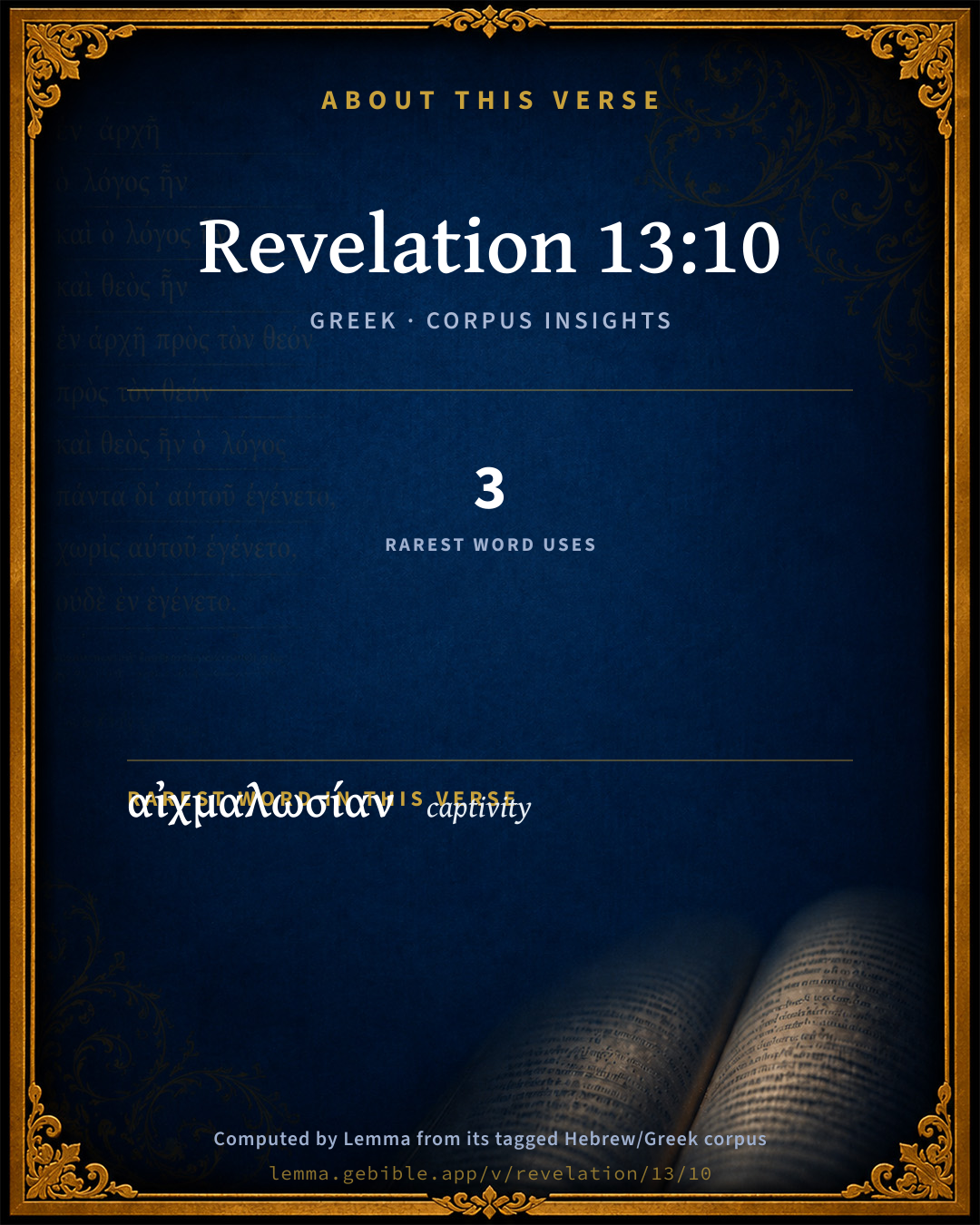
Revelation 13:10

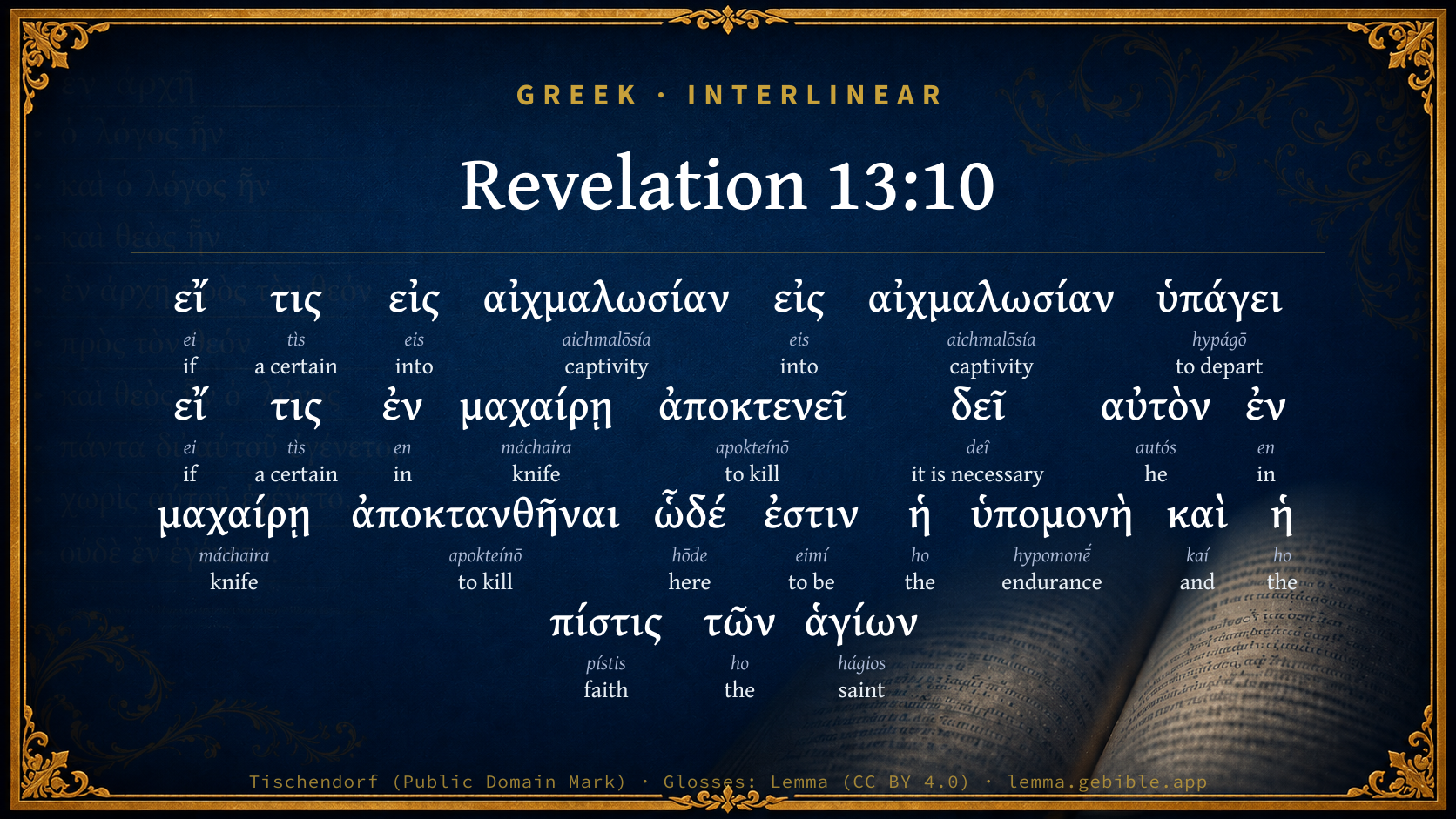
Greek (Tischendorf 8th ed.) Revelation 13:10 appears in the Greek New Testament. The text above is from the Tischendorf 8th edition. Each word links to its Strong’s number and a concise gloss. Click any word for its full Thayer’s Greek Lexicon entry.
Download image
Cite this verse

Revelation 13:10 (World English Bible). Public Domain. Lemma interlinear Bible study tool, https://lemma.gebible.app/v/revelation/13/10.

Show BibTeX & RIS
BibTeX
RIS
English Translation
If anyone has captivity, he will go. If anyone is with the sword, he must be killed. Here is the endurance and the faith of the saints.
World English Bible · Public Domain
Download a study sheet

One document with this verse’s original text, its word-by-word gloss line, the meaning frame, cross-references with their text, attributed commentary, and full source and license credits — printable, and it pastes into notes with its structure intact.

This verse Autodidact and up

Study sheet (.html) Plain text (.txt)

A passage Seminary Student

Up to 50 verses in one chapter. A passage sheet keeps up to 6 commentary sources and 12 cross-references per verse, in the order this page ranks them, and says so on the sheet whenever that leaves anything out. Ask for a single verse and you get the Autodidact verse sheet above.

Everything on this page stays free to read, with no account — the sheet is a download of what is already on screen, not access to it.

Want to remove ads? Support Godless Engineer
Compare translations 3

The same verse in 3 English versions, stacked beneath the original-language interlinear above. Click any original word for its lexicon entry.

Each is an independent rendering of the whole verse — the interlinear is not word-aligned to these translations.

Highlighted words mark where these versions differ — a whole-verse word diff, not a word-by-word alignment.

  • World English Bible Public Domain
    If anyone has captivity, he will go. If anyone is with the sword, he must be killed. Here is the endurance and the faith of the saints.
  • King James Version Public Domain
    He that leadeth into captivity shall go into captivity: he that killeth with the sword must be killed with the sword. Here is the patience and the faith of the saints.
  • unfoldingWord Literal Text CC BY-SA 4.0
    If anyone for captivity, he departs; if anyone will be killed by the sword, it is necessary for him to be killed by the sword. Here is the endurance and the faith of the saints.

unfoldingWord Literal Text — © unfoldingWord, licensed CC BY-SA 4.0. Word-aligned USFM3 via Door43 (git.door43.org/unfoldingWord/en_ult).

Versions to compare (up to 4)

3 of 4 selected

Show all 19 translations

Every available English version of this verse, each an independent rendering of the whole verse.

  • World English Bible Public Domain
    If anyone has captivity, he will go. If anyone is with the sword, he must be killed. Here is the endurance and the faith of the saints.
  • Berean Standard Bible Public Domain
    “If anyone is destined for captivity, into captivity he will go; if anyone is to die by the sword, by the sword he must be killed.” Here is a call for the perseverance and faith of the saints.
  • Majority Standard Bible Public Domain
    “If anyone is destined for captivity, there he will go; if anyone kills by the sword, by the sword he must be killed.” Here is a call for the perseverance and faith of the saints.
  • King James Version Public Domain
    He that leadeth into captivity shall go into captivity: he that killeth with the sword must be killed with the sword. Here is the patience and the faith of the saints.
  • American Standard Version (1901) Public Domain
    If any man `is' for captivity, into captivity he goeth: if any man shall kill with the sword, with the sword must he be killed. Here is the patience and the faith of the saints.
  • Revised Version (1885) Public Domain
    If any man is for captivity, into captivity he goeth: if any man shall kill with the sword, with the sword must he be killed. Here is the patience and the faith of the saints.
  • Geneva Bible (1599) Public Domain
    If any leade into captiuitie, hee shall go into captiuitie: if any kill with a sword, he must be killed by a sword: here is the patience and the faith of the Saints.
  • Douay-Rheims (1899) Public Domain
    He that shall lead into captivity, shall go into captivity: he that shall kill by the sword, must be killed by the sword. Here is the patience and the faith of the saints.
  • Young's Literal Translation Public Domain
    if any one a captivity doth gather, into captivity he doth go away; if any one by sword doth kill, it behoveth him by sword to be killed; here is the endurance and the faith of the saints.
  • Literal Standard Version CC BY-SA 4.0
    if anyone [goes] into captivity, into captivity he goes; if anyone is to be killed with sword, it is necessary of him by sword to be killed; here is the endurance and the faith of the holy ones.
  • Unlocked Literal Bible CC BY-SA 4.0
    If anyone is to be taken into captivity, into captivity he will go. If anyone is to be killed with the sword, with the sword he will be killed. Here is a call for the patient endurance and faith of the saints.
  • unfoldingWord Literal Text CC BY-SA 4.0
    If anyone for captivity, he departs; if anyone will be killed by the sword, it is necessary for him to be killed by the sword. Here is the endurance and the faith of the saints.
  • Darby Bible Public Domain
    If any one [leads] into captivity, he goes into captivity. If any one shall kill with [the] sword, he must with [the] sword be killed. Here is the endurance and the faith of the saints.
  • World Messianic Bible Public Domain
    If anyone is to go into captivity, he will go into captivity. If anyone is to be killed with the sword, he must be killed. Here is the endurance and the faith of the holy ones.
  • Webster's Bible Public Domain
    He that leadeth into captivity shall go into captivity: he that killeth with the sword must be killed with the sword. Here is the patience and the faith of the saints.
  • Free Bible Version CC BY-SA 4.0
    Anyone who has to go into captivity will go into captivity; anyone who has to die by the sword will die by the sword. This demonstrates the patient endurance and confidence in God of the believers.
  • Bible in Basic English Public Domain
    If any man sends others into prison, into prison he will go: if any man puts to death with the sword, with the sword will he be put to death. Here is the quiet strength and the faith of the saints.
  • Text-Critical English NT CC BY 4.0
    “If anyone has captivity as his lot, away he goes; if anyone kills with the sword, with the sword he must be killed.” This calls for the endurance and the faith of the saints.
  • Tyndale New Testament (1534) Public Domain
    He that leadeth into captivite shall goo into captivite: he that kylleth with a swearde must be kylled with a swearde. Heare is the pacience and the fayth of the saynctes.

Literal Standard Version (2020), Covenant Press — licensed CC BY-SA 4.0. Text via the HelloAO Bible API (eBible.org). Unlocked Literal Bible (unfoldingWord) — licensed CC BY-SA 4.0. Text via the HelloAO Bible API (eBible.org). unfoldingWord Literal Text — © unfoldingWord, licensed CC BY-SA 4.0. Word-aligned USFM3 via Door43 (git.door43.org/unfoldingWord/en_ult). Free Bible Version, Dr. Jonathan Gallagher — licensed CC BY-SA 4.0. Text via the HelloAO Bible API (eBible.org).

Word by word

More ways to search: Search by grammar → Find every occurrence → Compare this word →

Practice this passage: Drill this verse → Learn its vocabulary →

αἰχμαλωσίαν
aichmalōsía
G161
“captivity”
Noun, Accusative, Singular, Feminine
Part of Speech
Noun
Case
Accusative
Number
Singular
Gender
Feminine
Full Thayer's Definition

Origin: from G164

TDNT: 04:15,3

1. captivity
  1. εἴ ei G1487 “if” Conditional
  2. τις tìs G5100 “a certain” Indefinite pronoun, Nominative, Singular, Masculine
  3. εἰς eis G1519 “into” Preposition
  4. εἰς eis G1519 “into” Preposition
  5. αἰχμαλωσίαν aichmalōsía G161 “captivity” Noun, Accusative, Singular, Feminine
  6. ὑπάγει hypágō G5217 “to depart” Verb, Present, Active, Indicative, 3rd person, Singular
  7. εἴ ei G1487 “if” Conditional
  8. τις tìs G5100 “a certain” Indefinite pronoun, Nominative, Singular, Masculine
  9. ἐν en G1722 “in” Preposition
  10. μαχαίρῃ máchaira G3162 “knife” Noun, Dative, Singular, Feminine
  11. ἀποκτενεῖ apokteínō G615 “to kill” Verb, Present, Active, Indicative, 3rd person, Singular
  12. δεῖ deî G1163 “it is necessary” Verb, Present, Active, Indicative, 3rd person, Singular
  13. αὐτὸν autós G846 “he” Personal pronoun, Accusative, Singular, Masculine
  14. ἐν en G1722 “in” Preposition
  15. μαχαίρῃ máchaira G3162 “knife” Noun, Dative, Singular, Feminine
  16. ἀποκτανθῆναι apokteínō G615 “to kill” Verb, Aorist, Passive, Infinitive
  17. ὧδέ hōde G5602 “here” Adverb
  18. ἐστιν eimí G1510 “to be” Verb, Present, Active, Indicative, 3rd person, Singular
  19. ἡ ho G3588 “the” Article, Nominative, Singular, Feminine
  20. ὑπομονὴ hypomonḗ G5281 “endurance” Noun, Nominative, Singular, Feminine
  21. καὶ kaí G2532 “and” Conjunction
  22. ἡ ho G3588 “the” Article, Nominative, Singular, Feminine
  23. πίστις pístis G4102 “faith” Noun, Nominative, Singular, Feminine
  24. τῶν ho G3588 “the” Article, Genitive, Plural, Masculine
  25. ἁγίων hágios G40 “saint” Adjective, Genitive, Plural, Masculine

About this verse

These counts appear in no published source. They are computed here, from the morphology-tagged text and Lemma’s own curated glosses. What Lemma adds →

26
words
17
distinct lemmas
Revelation
section

Notable vocabulary

The rarest word here is αἰχμαλωσίαν captivity G161 — appearing just 3 times in the whole Greek New Testament.

Shared distinctive vocabulary

αἰχμαλωσίαν captivity G161 occurs in 2 verses of the Greek New Testament. Also found in:

Repetition

Words recur within this verse:

  • τις a certain G5100 ×2
  • εἰς into G1519 ×2
  • αἰχμαλωσίαν captivity G161 ×2
  • μαχαίρῃ knife G3162 ×2
  • ἀποκτενεῖ to kill G615 ×2
  • ἡ the G3588 ×3
  • εἴ if G1487 ×2
  • ἐν in G1722 ×2

Cross-references

26

Topical passages linked to Revelation 13:10 in the Treasury of Scripture Knowledge — connected by theme and wording, ordered by reader-vote popularity; previews shown in the World English Bible.

  • Jeremiah 15:2 It shall happen, when they tell you, Where shall we go forth? then you shall tell them, Thus says Yahweh: Such as are for death, to death; and such as are for the sword, to the sword; and such as are for the famine, to the famine; and such as are for captivity, to captivity.
  • Isaiah 33:1 Woe to you who destroy, and you weren't destroyed; and deal treacherously, and they didn't deal treacherously with you! When you have ceased to destroy, you shall be destroyed; and when you have made an end of dealing treacherously, they shall deal treacherously with you.
  • Revelation 14:12 Here is the patience of the saints, those who keep the commandments of God, and the faith of Jesus."
  • Revelation 3:10 Because you kept my command to endure, I also will keep you from the hour of testing, which is to come on the whole world, to test those who dwell on the earth.
  • Luke 21:19 By your endurance you will win your lives.
  • Hebrews 6:12 that you won't be sluggish, but imitators of those who through faith and patience inherited the promises.
  • James 5:7–8 Be patient therefore, brothers, until the coming of the Lord. Behold, the farmer waits for the precious fruit of the earth, being patient over it, until it receives the early and late rain.
  • Revelation 2:2 "I know your works, and your toil and perseverance, and that you can't tolerate evil men, and have tested those who call themselves apostles, and they are not, and found them false.
  • Matthew 26:52 Then Jesus said to him, "Put your sword back into its place, for all those who take the sword will die by the sword.
  • Luke 18:1–8 He also spoke a parable to them that they must always pray, and not give up,
  • James 1:2–4 Count it all joy, my brothers, when you fall into various temptations,
  • Jeremiah 43:11 He shall come, and shall strike the land of Egypt; such as are for death [shall be given] to death, and such as are for captivity to captivity, and such as are for the sword to the sword.
  • Lamentations 3:26 It is good that a man should hope and quietly wait for the salvation of Yahweh.
  • Habakkuk 2:3 For the vision is yet for the appointed time, and it hurries toward the end, and won't prove false. Though it takes time, wait for it; because it will surely come. It won't delay.
  • Hebrews 10:36–37 For you need endurance so that, having done the will of God, you may receive the promise.
  • Genesis 9:5–6 I will surely require your blood of your lives. At the hand of every animal I will require it. At the hand of man, even at the hand of every man's brother, I will require the life of man.
  • Revelation 1:9 I John, your brother and partner with you in oppression, Kingdom, and perseverance in Christ Jesus, was on the isle that is called Patmos because of God's Word and the testimony of Jesus Christ.
  • Revelation 16:6 For they poured out the blood of the saints and the prophets, and you have given them blood to drink. They deserve this."
  • Isaiah 14:2 The peoples shall take them, and bring them to their place; and the house of Israel shall possess them in the land of Yahweh for servants and for handmaids: and they shall take them captive whose captives they were; and they shall rule over their oppressors.
  • Colossians 1:11 strengthened with all power, according to the might of his glory, for all endurance and perseverance with joy;
  • Revelation 2:19 I know your works, your love, faith, service, patient endurance, and that your last works are more than the first.
  • Revelation 3:3 Remember therefore how you have received and heard. Keep it, and repent. If therefore you won't watch, I will come as a thief, and you won't know what hour I will come upon you.
  • Matthew 7:2 For with whatever judgment you judge, you will be judged; and with whatever measure you measure, it will be measured to you.
  • Exodus 21:23–25 But if any harm follows, then you must take life for life,
  • Isaiah 26:21 For, behold, Yahweh comes forth out of his place to punish the inhabitants of the earth for their iniquity: the earth also shall disclose her blood, and shall no more cover her slain.
  • Hebrews 12:3–4 For consider him who has endured such contradiction of sinners against himself, that you don't grow weary, fainting in your souls.

Cross-references courtesy of OpenBible.info (CC BY 4.0).

Where the printed editions differ

1 variant

Places in this verse where the major printed Greek editions disagree on the wording in a way that affects the translation — a comparison of editions, not a manuscript-by-manuscript collation. The editions are the modern critical texts (Nestlé-Aland 28/27, SBL, Westcott-Hort, Tregelles, Tyndale House) and the traditional texts behind the KJV (the Textus Receptus and the Byzantine/Majority text). It is not a claim about which reading is original.

  1. Extra text
    συνάγει

    “gathers”

    In TR Not in NA28NA27TynSBLWHTregByz

    συνάγει (sunagei) 'gathers' is only in traditional manuscripts (TR)

Textual data: Translators Amalgamated Greek New Testament (STEPBible TAGNT) · CC BY 4.0.

Commentary

Notes on Revelation 13:10 from classic Christian and Jewish commentators (each source and its license shown beneath its notes). The classic Christian expositions comment on the surrounding passage and are grouped to its opening verse, so a note may address several verses; the Jewish commentaries on the Tanakh (Rashi and others) are per-verse, so they appear only where the commentator wrote on this verse.

Lemma curates 59 commentaries, every one of them public domain or Creative Commons licensed, each selected and text-cleaned for this edition rather than reprinted as found. About our sources →

Jamieson, Fausset & Brown

Robert Jamieson, A. R. Fausset & David Brown

He that leadeth into captivity--A, B, C, and Vulgate read, "if any one (be) for captivity."

shall go into captivity--Greek present, "goeth into captivity." Compare Jer 15:2, which is alluded to here. Aleph, B, and C read simply, "he goeth away," and omit "into captivity." But A and Vulgate support the words.

he that killeth with the sword, must be killed with the sword--So B and C read. But A reads, "if any (is for) being (literally, 'to be') killed with the sword." As of old, so now, those to be persecuted by the beast in various ways, have their trials severally appointed them by God's fixed counsel. English Version is quite a different sense, namely, a warning to the persecutors that they shall be punished with retribution in kind.

Here--"Herein": in bearing their appointed sufferings lies the patient endurance . . . of the saints. This is to be the motto and watchword of the elect during the period of the world kingdom. As the first beast is to be met by patience and faith (Rev 13:10), the second beast must be opposed by true wisdom (Rev 13:18).

Jamieson, Fausset & Brown — Commentary Critical and Explanatory on the Whole Bible (1871) — public domain (CC PDM 1.0). Text via the HelloAO Bible API.

The Biblical Illustrator

Joseph S. Exell

Rev_13:10

He that leadeth into captivity shall go into captivity.

Retribution on the enemies of the Church

Observe here--

1. That this acclamation, It any man have an ear, let him hear, is added in Scripture when something required s spiritual understanding to discern the meaning. Let him consider what is here revealed concerning this beast, and take heed that he be not found amongst the number of the worshippers of it.

2. The consolation here given to the saints from the consideration of Gods just retribution to His and their enemies, He that leadeth into captivity shall go into captivity, that is, the beast who has brought many of the saints into captivity shall himself at length be taken captive (Rev_19:20). With what measure antichrist metes to others it shall be measured to him again; God has as many ways to hurt His Churchs enemies as they have to hurt His people.

3. The end and design of God in suffering antichrists rage to break forth against the Church; it is for the trial of the Churchs faith and patience. Note--

(1) That none can stand under or bear up under sufferings like saints.

(2) That under great sufferings saints themselves will have great occasion for the exercise of faith and patience.

(3) That the faith and patience of the saints will be made very conspicuous by great and sharp sufferings.

(4) That faith and patience must accompany each other in suffering times. Patience is the souls shoulder to hear what is afflictive at present: faith is the Christians eye to discover a glorious deliverance to come; where no patience is it is a token of no faith; and where no faith is there will appear great impatience. Behold, then, the faith and patience of the saints. (W. Burkitt, M. A.)

The Biblical Illustrator, edited by Joseph S. Exell (c. 1880s–1900s) — public domain. Text from a community e-Sword module.

Tyndale Open Study Notes

Tyndale Open Resources

13:10 God’s holy people are summoned to endure and remain faithful while experiencing temporary persecution.

Tyndale Open Study Notes — © Tyndale Open Resources, licensed CC BY-SA 4.0. Text via the HelloAO Bible API.

Bengel's Gnomon

Johann Albrecht Bengel

Rev 13:10. Αἰχμαλωσίαν συνάγει) The LXX. have συγκλείειν αἰχμαλωσίαν, εἰσάγειν αἰχμαλωσίαν, ἄγειν αἰχμαλωσίαν, respecting the vanquished who are led away into captivity: but in 1 Maccab. Rev 14:7, it is said, συνήγαγεν αἰχμαλωσίαν πολλήν· that is, Simon freed and brought together many, who had been captives. Also 1 Maccab. Rev 3:9; Rev 3:13, συνήγαγεν ἀπολλυμένους, ἤθροισεν ἄθροισμα. And this notion agrees with this passage, in this sense: if any one supplies and equips captives, he will be taken captive.—ὑπάγει, goes away) being easily led away.—ἀποκτένει) The present, as συνάγει. Κτένω, κτέννω, and κτείνω, are the same.

Bengel's Gnomon of the New Testament — English translation (T&T Clark, Edinburgh, 1860) — public domain. Text from a community e-Sword module.

Adam Clarke's Commentary

Verse 10. He that leadeth into captivity shall go into captivity] The Latin empire here spoken of must go into captivity, because it has led into captivity, by not only propagating among the various nations its abominable antichristian system, but also in compelling them to embrace it under the penalty of forfeiting the protection of the empire.

He that killeth with the sword must be killed with the sword.] The Latin empire must be also broken to pieces by the sword, because it has killed the saints of God. This prophecy will not receive its full accomplishment till the kingdoms of this world become the kingdoms of our Lord and of his Christ.

Here is the patience and the faith of the saints.] By these words, as Dr. Mitchell observes, "God calls upon his saints to keep in view, under all their persecutions, his retributive justice; there is no violence that has been exercised upon them but what shall be retaliated upon the cruel and persecuting government and governors of the Latin empire."

Adam Clarke's Commentary on the Bible (1810–1826) — public domain. Text from a community e-Sword/MySword module.

Ellicott's Commentary for English Readers

(10) This verse may read: If any one (is) for captivity, into captivity he goeth; if any one to be hilled by the sword, he should by the sword be killed. If we read the verse thus, it is generally understood to be a caution to the suffering saints that there is nothing for them but to endure, just as Jeremiah told his countrymen that those who were for death must go out to meet it, and those who were for sword or captivity must face them (Jer_15:2). But is not this a warning to them that the way of the Church’s victory lay through suffering captivity and meeting sword, and that the temptation to take the sword or seize the weapons of their foes would be fatal to their true success? The spirit of the words reminds them that their weapons are the weapons of faith and patience, of truth and righteousness; and they must accept the tribulation, as their Lord did His cross, because thus it must be. At the same time, their very doing so is a witness to their foes that “all those who take the sword will perish with the sword;” and that the sword, from which the saints do not shrink, will assuredly turn against those who use it. Here (i.e., in the enduring of these persecutions, and amid so many temptations, not seizing easy, world-like methods of saving themselves) is the endurance and faith of the saints.

A Bible Commentary for English Readers, edited by Charles John Ellicott (1878–1897) — public domain. Text from a community e-Sword module.

The Cambridge Bible for Schools and Colleges

gen. ed. J. J. S. Perowne

10. He that leadeth into captivity] Decidedly the best attested reading is, “If any into captivity, into captivity he goeth:” and there being no verb expressed in the first clause, it is a question what verb is to be supplied. This will depend on the sense given to the rest of the sentence, and this on the reading adopted there. If the received text be right (it is, more literally than in the A. V., “if any will kill with the sword, he must be killed with the sword:” cf. St Mat_26:52), its reading in the earlier clause must be accepted as a correct gloss. But there is a reading—not so well attested, and which might have arisen accidentally—“if any to be killed by the sword, [he must]” (one important MS. omits this) “be killed by the sword.” Inferior as this reading is in external evidence, it is supported by the parallel with Jer_15:2; Jer_43:11. We have therefore the choice between the two versions, “If any man [be] for captivity, he goeth into captivity: if any [be] to be slain by the sword, he must be slain by the sword,” and that of the A. V. with the word “leadeth” put in italics: and we shall choose between them, according as we think that St John is likelier to have had in his mind the text in Jeremiah or our Lord’s saying. Perhaps the former suits the context best—“the patience and the faith of the saints” is to be shewn in submitting to death or captivity. But the other view, that their patience and faith is to be sustained by remembering the certainty of God’s vengeance on their oppressors, is supported by the parallel passage, Rev_14:12.

The Cambridge Bible for Schools and Colleges (gen. ed. J. J. S. Perowne; Cambridge University Press, 1878–1918) — public domain. Text from a community e-Sword module.

John Gill's Exposition

And I beheld another beast,.... The same with the first, only in another form; the same for being and person, but under a different consideration; the same antichrist, but appearing in another light and view: the first beast is the pope of Rome, at the head of the ten kingdoms, of which the Roman empire consisted; this other beast is the same pope of Rome, with his clergy, cardinals, archbishops, bishops, priests, &c. before he is described as a temporal monarch, now as a spiritual lord; there he is represented in his secular character, as having the seat, power, and authority of the dragon, of Rome Pagan, engaging the attention and wonder of the whole world, and striking terror into them, and as making war with the saints, and ruling over all nations and tongues; here in his ecclesiastic character, pretending great humility and holiness, showing signs and lying wonders, obliging to idolatry, and exercising tyranny and cruelty on all that will not profess his religion: that this is the same beast with the first in substance, though not in show, appears from his exercising the same power, causing all to worship the first beast, or himself as a temporal lord, by which he is supported in his spiritual dignity; and by mention being made only of one beast, at the close of this account, and of his mark, name, and number being but one; nor is there any other but one hereafter spoken, of in this book, either as ruling, or as conquered, and as taken, and as going into perdition, and as cast into the lake: this beast is described by his original,

coming up out of the earth; either from under it, out of the bottomless pit, from hell; or out of, a low condition, a poor crawling earthworm; the extracts of many of the popes, cardinals, and religious orders, have been very mean: or this may represent the secret and private manner, and slow degrees by which this monster of iniquity rose; as things gradually rise up out of the earth unobserved; this man of sin was springing up in the apostles' time, and by degrees rose up to the power and authority he is here said to have: or rather, as this beast, in his other form, rose up out of the sea, out of the commotions raised in the empire by the barbarous nations, by whom he was lifted up to his imperial dignity; so he is described in this form, and is represented as rising up out of the earth, out of the earthly part of the church, or out of the apostasy which the visible church was sunk into, through the outward riches and honours bestowed on it by the Christian emperors, which made way for the rising of this beast; and this shows the nature of his kingdom, which is worldly and earthly, and so truly antichristian, being diametrically opposite to the kingdom of Christ, which is not of this world:

and he had two horns like a lamb; or "like to the Lamb"; the Lord Jesus Christ, the Lamb of God; though he has seven horns, denoting fulness of power, this but two; he stands on Mount Zion, with the 144,000, having his Father's name on their foreheads, this upon the earth, with his followers, having his own mark and name upon them. The Ethiopic version renders it, "and he had two horns, and he seemed as a lamb"; he affected a lamb like disposition, pretended to great humility and meekness, calling himself "servus servorum", the servant of servants, to cover his pride, ambition, and tyranny; and would be thought to be a lamb without spot and blemish, ascribing to himself infallibility, and suffering himself to be called his Holiness, when he is the man of sin, and mystery of iniquity: by his "two horns" some understand his two fold power, secular and ecclesiastic; but as these are separately represented by two beasts, rather these two horns intend the two parts of the empire, eastern and western, into which it was divided, when this beast arose, and by which the Papacy was raised to its power, had supported in it; and the two supreme pontiffs, the bishop of Rome, and the bishop of Constantinople; or else the beast's power of binding and loosing, of dispensing with the laws of God, and of imposing his own laws on the consciences of men.

And he spake as a dragon; like the devil himself, affirming as he did, Luk 4:6; that the power of disposing of the kingdoms of this world, and the glory of them, was delivered to him, and he could give it to whom he would: he spake arrogantly, as if he was above all that is called God, and as if he was God himself; and he spake like a dragon cruelly, like the great red dragon, like the devil, who was a murderer from the beginning, breathing out slaughter, and threatenings against the saints, as Rome Pagan; and he spake lies in hypocrisy, blasphemies, idolatries, and doctrines of devils.

John Gill's Exposition of the Whole Bible (1746–1763) — public domain (CC PDM 1.0). Text via the HelloAO Bible API.

Trapp's Complete Commentary

John Trapp

10 He that leadeth into captivity shall go into captivity: he that killeth with the sword must be killed with the sword. Here is the patience and the faith of the saints.

Ver. 10. He that leadeth into captivity] q.d. Be of good cheer; Antichrist shall one day meet with his match, drink as he brewed, be paid in his own coin, filled with his own ways, have blood again to drink, for he is worthy. See Isa 33:1; 2Th 1:6.

Here is the patience] q.d. Here is matter for the trial exercise and increase of the saints’ graces. Hard weather tries what health. The walnut tree is most fruitful when most beaten. Or, here is support for the saints, and that which may well make them to hold out faith and patience.

John Trapp, A Commentary or Exposition upon All the Books of the Old and New Testament (1647–1656) — public domain. Text from a community e-Sword module.

Albert Barnes' Notes on the Bible

He that leadeth into captivity - This is clearly intended to refer to the power or government which is denoted by the beast. The form of expression here in the Greek is special - “If anyone leadeth into captivity,” etc. - Εἴ τις αἰχμαλωσίαν συνάγει Ei tis aichmalōsian sunagei. The statement is general, and is intended to make use of a general or prevalent truth with reference to this particular case. The general truth is, that people will, in the course of things, be dealt with according to their character and their treatment of others; that nations characterized by war and conquests will be subject to the evils of war and conquest - or that they may expect to share the same lot which they have brought on others. This general statement accords with what the Saviour says in Mat 26:52; “All they that take the sword shall perish with the sword.” This has been abundantly illustrated in the world; and it is a very important admonition to nations not to indulge in the purposes of conquest and to individuals not to engage in strife and litigation. The particular idea here is, that it would be a characteristic of the power here referred to that it would “lead others into captivity.” This would be fulfilled if it was the characteristic of this power to invade other countries and to make their inhabitants prisoners of war; if it made slaves of other people; if it set up an unjust dominion over other people; or if it was distinguished for persecuting and imprisoning the innocent, or for depriving the nations of liberty. It is unnecessary to say that this is strikingly descriptive of Rome, considered in any and every point of view, whether under the republic or the empire, whether secular or ecclesiastical, whether pagan or papal. In the following forms there has been a complete fulfillment under that mighty power of what is here said:

In the desire of conquest or of extending its dominion, and, of course, leading others captive as prisoners of war or subjecting them to slavery. In its persecutions of true Christians, alike pursued under the pagan and the papal form of the administration. Especially in the imprisonments practiced under the Inquisition, where tens of thousands have been reduced to the worst kind of captivity. In every way this description is applicable to Rome, as seeking to lead the world captive or to subject it to its own absolute sway.

Shall go into captivity - As a just recompense for subjecting others to bondage, and as an illustration of a general principle of the divine administration. This is yet, in a great measure, to be fulfilled; and, as I understand it, it discloses the manner in which the papal secular power will come to an end. It will be by being subdued, so that it might seem to be made captive and led off by some victorious host. Rome now is practically held in subjection by foreign arms, and has no true independence; perhaps this will be more and more so as its ultimate fall approaches.

He that killeth with the sword - See the notes as above, on Mat 26:52. There can be no doubt that this is applicable to Rome in all the forms of its administration considered as a pagan power; or considered as a nominally Christian power, either with reference to its secular or its spiritual dominion. Compute the numbers of human beings that have been put to death by that Roman power, and no better language could have been chosen to characterize it than what is used here - “killed with the sword.” Compare the notes on Dan 7:24-28, II. (3), (g).

Must be killed with the sword - This domination must be brought to an end by war and slaughter. Nothing is more probable than this in itself; nothing could be more in accordance with the principles of the divine dealings in the world. Such a power as that of Rome will not be likely to be overcome but by the force of arms; and the probability is that it will ultimately be overthrown in a bloody revolution, or by foreign conquest. Indeed, there are not a few intimations now that this result is hastening on. Italy is becoming impatient of the secular power swayed in connection with the papacy, and sighs for freedom; and it is every way probable that that land would have been free, and that the secular power of the papacy, if not every form of the papacy itself, would have come to an end in the late convulsion (1848), if it had not been for the intervention of France and Austria. The period designated by prophecy for the final overthrow of that power had not arrived; but nothing can secure its continuance for any very considerable period longer.

Here is the patience and the faith of the saints - That is, the trial of their patience and of their faith. Nowhere on earth have the patience and the faith of the saints been put to a severer test than under the Roman persecutions. The same idea occurs in Rev 14:12.

Albert Barnes' Notes on the Bible (1834–1885) — public domain. Text from a community e-Sword/MySword module.

Haydock's Catholic Bible Commentary

Here is the patience, &c. Here is the motive of the patience and the faith of the saints, or the servants of God in this world. By faith they rely on the promises of God for the reward of their patience, and leave him to vindicate as he may judge fit their cause with respect to their persecutors. (Pastorini)

George Leo Haydock (1774–1849), Haydock's Catholic Family Bible and Commentary, 1859 edition — public domain. Excludes Psalms (Douay-Rheims chapter numbering differs from Protestant) and Deuterocanonical books (Catholic canon only).

Matthew Poole's English Annotations

As it was God’s manner by the prophets of old, when he had denounced judgments against his people, to comfort them by a prediction of the ruin of their enemies; so here, by this his New Testament prophet, he assureth his church, that antichrist also should have his period, and have the same measure meted to him which he had meted out to others, by leading into captivity, and killing with the sword: and indeed, there are no sins which God doth so ordinarily punish by retaliation, as sins against justice and mercy, (of which nature persecutions are the most eminent), Isa 33:1,2.

Here is the patience and the faith of the saints; that is, there is a time for God’s people to exercise their faith and patience: patience, because they are like to wait for deliverance a long time, and to suffer many sharp things in the mean time; and faith, because their deliverance will be a thing out of sight, of which they will have no security but from the promise of God.

Matthew Poole's English Annotations on the Holy Bible (1683–1685) — public domain. Text from a community e-Sword/MySword module.

Whedon's Commentary on the Bible

Daniel D. Whedon

10. He that leadeth—This verse is very incorrectly translated. It should be: He that is (destined) into captivity goeth into captivity; he that is (destined) to be slain by the sword must be slain by the sword. For the despot is relentless, and the martyr must suffer. And so it is well added, Here is the patience and the faith of the saints.

The second (earth-born) or two-horned beast=The hierarchy of the spiritual empire=Clergy, 11-14.

Daniel D. Whedon (gen. ed.), Commentary on the Old and New Testaments (1874–1909) — public domain. Text from a community e-Sword module.

The Pulpit Commentary

He that leadeth into captivity shall go into captivity: he that killeth with the sword must be killed with the sword. Here is the patience and the faith of the saints. There is a twofold difficulty in this verse: first, as to the correct text; secondly, as to the meaning. There are two chief readings. Codex: A has Ei tiv eiv aicmalwsian eiv aicmalwsion upagei ; literally, if any one late captivity, into captivity he goeth; which probably means, "If any one is ordained unto captivity, into captivity he goeth." The reading of the Textus Receptus looks like an attempt to amplify and make clear the above reading: Ei tiv aicmalwsian sunagei eiv aicmalwsian upagei . XXX, B, C, have the reading of A, omitting the repetition of aicmalwsian . This omission is easily explained by homoeoteleuton, and accordingly the majority of critical editors follow Codex A. There are two passages in Jeremiah which are suggested by these words. Jer_15:2 reads, "Such as are for death, to death; and such as are for the sword, to the sword; and such as are for the famine, to the famine; and such as are for the captivity, to the captivity;" Jer_43:11, "And deliver such as are for death, to death; and such as are for captivity, to captivity; and such as are for the sword, to the sword." Mat_26:52 may also be referred to: "All they that take the sword shall perish with the sword." The verse in the text appears to contain both the meanings of the passages referred to. The first half seems to point out that there are woes foreordained for Christians which they must undergo: "He for whom captivity is appointed must be content to suffer captivity." The next part extends the meaning, adding a warning: "You Christians must suffer these things; not only not relinquishing your faith, but also not meeting three with force; remembering always your Master"s saying, "They that take the sword shall perish with the sword. Then the verse concludes, "Here is the proof of the patience and the faith of the saints." St. John has just described to his hearers the extensive nature of the power of the world (vers. 3, 7, 8); the obvious conclusion was that captivity, etc., was the lot appointed for some of them. He has also told them of the war waged by the world against Christians, and now he adds the necessary caution against any attempt to defend themselves by the use of the sword. And thus not only their patience but their faith was to be tested. They were not only to bear patiently evils which they could not avoid, but they must have sufficient faith to enable them voluntarily to forego any opportunities which might occur to prevent their sufferings by force of arms.

The Pulpit Commentary (1880–1919), ed. H.D.M. Spence-Jones & Joseph S. Exell — public domain. Text from a community e-Sword module.

John Wesley's Explanatory Notes

If any man leadeth into captivity - God will in due time repay the followers of the beast in their own kind. Meanwhile, here is the patience and faithfulness of the saints exercised: their patience, by enduring captivity or imprisonment; their faithfulness, by resisting unto blood.

John Wesley, Explanatory Notes Upon the Whole Bible (1754–1765) — public domain. Text via the GEBible commentary corpus.

The People's New Testament

B. W. Johnson

10. If any man is for captivity, into captivity he goeth. The meaning is “Whatsoever a man soweth, that shall he also reap.” “With what measure a man metes, it shall be measured to him again.” If the beast and his adherents lead the saints captive, they shall finally be made captive; if they slay with the sword, so shall they be slain. Here is the patience and the faith of the saints. The assurance that God will, in the end, right all their wrongs gives them faith and patience.

THE MEANING.

As the monster with seven heads and ten horns is introduced three times in Revelation, in 12:3, in 13:1, and in 17:3, one explanation of the meaning of these symbols will suffice for all. Though the form varies somewhat, the ten-horned monster of Dan. chapter 7 is without doubt the same. Comparing the accounts we learn that “the seven heads are seven mountains, on which the woman sitteth” (the harlot of chapter 17), and they are also seven kings or kingdoms. In 12:3, these heads have upon them diadems, the crown that always signifies royalty, but in 13:1 there are no diadems upon the heads. This may imply that the heads that had once worn the crowns were uncrowned in the period which is now pointed out. The ten horns, however, have diadems. In 17:12 they are said to be ten kings or kingdoms which had not yet, when John wrote, received power, but shall receive it in the period pointed forward to in the symbols. Still another fact is pointed out in 17:10. Of the seven kings five were fallen when John wrote; that is, had passed away; one of them then existed; one was yet to come; the beast himself was composed of all the seven and yet assumed such a form that he became an eighth.

These facts will enable us to point out what is signified. It is some power that fights against God, that is a deadly enemy of the Church, that oppresses the Israel of God, that is used as Satan's instrument, that overcomes the Church for 1260 years, that is blasphemous; that has existed as seven kings, or kingdoms, for such may be the meaning of the word, and that shall reappear again to be ten kingdoms. It will be seen that the form of this beast varies at different times, and we must expect the power meant to assume various forms. Let us note the great world powers which have arrayed themselves against God in oppressing his people during their history. I. Egypt enslaved the Israel of God, those whom he called “My People,” with a grievous bondage. At that period Egypt was the greatest of the world powers. II. Next Assyria, many hundred years later, carries the Ten Tribes into captivity, from whence they never returned. Assyria was the destroyer of the kingdom of Israel and the oppressor of the kingdom of Judah. III. Babylon, the great Empire of Nebuchadnezzar, erected on the ruins of Assyria, conquered Judah, destroyed Jerusalem and the temple, and carried the people into captivity. IV. Persia overthrew Babylon, and succeeded to the sway over the remnant of Israel and Palestine. V. Greece, or rather the Macedonian Empire of Alexander, overthrew Persia, and the fifth of the great world powers became the ruler and the oppressor of God's people. Under the successors of Alexander their sufferings were terrible. Here, then, we have Five Kingdoms, or great world monarchies, which had been used by the dragon for oppression, and which had passed away before John wrote. VI. One now is. Rome had overthrown all before her and occupied their dominion. The Roman monarchy existed when John was on Patmos, and he was seen there by the edict of a Roman Emperor. VII. One was yet to come. There was to be still another of these world powers, which should appear after John's time. It is to be an anti-Christian world power. My opinion is that it refers to the Eastern or Greek Empire, the Roman Empire in the East, continuing to exist as an Oriental despotism after the fall of Rome. This Empire was a persecutor also. No Emperor persecuted more cruelly than Justinian. In 17:11 we are also told that there is an “eighth head who is of the seven.” This is the beast. This means that the spirit and power of the whole beast, embracing all the seven heads, passes to an eighth kingdom or rule. Wherever we find this rule we find the beast fully manifested. This signifies the temporal dominion of the Papal power, a sway that derived its power from the kingdoms of the earth.

The beast with seven heads and ten horns is, then, the great world power in its opposition to God's people, manifesting itself in the various great worldly states which have fought against the saints. Of the heads of the beast Rome was the greatest and the most terrible of persecutors. Hence, while all the opposing world powers are generally signified, Rome, Pagan and Papal, is specially pointed out. There can be no doubt about the allusion of John to the heads signifying also seven mountains on which the harlot sitteth (17:9). No phrase was oftener applied to Rome by Pagan poets and writers, as well as Christian Fathers than “the seven hilled city.” The eighth head (17:11) is stated also to be an embodiment of the whole beast. Hence, I believe we are justified in declaring that Rome is the seat of the beast.

THE MORTAL WOUND THAT WAS HEALED.

It is shown, however, that the beast received a wound on one of its heads that was mortal. One of the kingdoms was overcome by the sword. This blow would, in the ordinary nature of things, destroy it and the beast. In some remarkable way this wound was healed. This was wonderfully fulfilled. In a.d. 476, the last of the Roman Emperors of the West was hurled from his throne, and Italy became the prey of contending barbarian hordes. It seem seem as though the fate of Rome was forever sealed. Nineveh fell, but it was to rise no more. Babylon fell before the armies of Cyrus, and after a few generations it became the abode of “doleful creatures.” Tyre fell, and on the bare rock, which was once the seat of a mighty city, “the fisherman spreads his nets.” Other cities have fallen and lost their glory, their dominion, their existence, and have been converted into heaps of ruins, where wild beasts have lurked, serpents hidden, and desert winds howled; but in the case of Rome, the deadly wound was healed. Mysteriously, wonderfully, the captive city, by the development of a new power, binds her conquerors in the chains of superstition, and by establishing a spiritual dominion over the souls of men, she yet succeeds in holding the secular authority over a vast portion of the world. The sway of Rome under the Popes became, in spite of her conquest, mightier than her sway under the Cæsars.

FORTY-TWO MONTHS.

It yet remains to consider the period during which it shall be given this dominion to have power over the saints. We have found that this period of 1260 years, since a day is a symbol of a year, has been several times mentioned. The “Holy City,” the true Church, is trodden down by the Gentiles for forty-two months; the two witnesses prophesy in sackcloth for one thousand two hundred and three score days; the woman, or the true Church, is driven by the dragon into the wilderness for twelve hundred and sixty days, and the beast exercises power for forty-two months, which is the same period once more. There can be no doubt that the treading down of the Holy City, the two witnesses in sackcloth, the flight and sojourn of the Church in the wilderness, and the power of the beast, all take place during the same period, begin at the same time, are different parts of the same history, and end at the same epoch. It has been already found (chapter 12) that this period began in 533. The period, then, of the greatest power and glory of this “eighth head,” which is the beast himself, would end about 1793, or about the beginning of this century. At this time there is certainly an exaltation of the two witnesses, a return of the Church from the wilderness. There is also a fatal shock to the temporal power of Rome. In 1798 Napoleon Bonaparte effected the conquest of Italy, and the Pope, a prisoner, was a supplicant at his feet. In 1804, he ordered the Pope, who was now his puppet, to come France to crown him emperor of the French. In 1805, he assumed the title of King of Italy. During the years of his power he ruled the Pope with an iron hand, broke up the old European system, emancipated the nations from the terror of Rome, and when he fell, the temporal authority of Rome had received a fatal wound. The influence of the Pope in the politics of the world was broken. Since then Rome has been occupied as the capital of free Italy, and the Pope has become “The Prisoner of the Vatican.”

THE LAMB-LIKE DRAGON.

B. W. Johnson's The People's New Testament with Notes (1889–1891) — public domain. Electronic text from the Christian Classics Ethereal Library (CCEL) ThML edition.

Cambridge Greek Testament for Schools and Colleges

10. εἴ τις εἰς αἰχμαλωσίαν, εἰς αἰχμαλωσίαν ὕπαγει. אB2CP omit the second εἰς αἰχμαλωσίαν. Primas[449] qui captivum duxerit et ipse capietur. Most MSS. of vulgate, and syr[450], support Text. Rec[451] εἴ τις αἰχμαλωσίαν συνάγει εἰς αἰχμαλωσίαν ὑπάγει which is found in Areth[452] 1 stops short at εἴ τις αἰχμ. συνάγει.

[449] Primasius, edited by Haussleiter.

[450] Syriac.

[451] Rec. Textus Receptus as printed by Scrivener.

[452] Arethas, Archbishop of Caesarea.

ἀποκτενεῖ, δεῖ. A has ἀποκτανθῆναι alone. W. H[453] suggest ἀποκτείνειν or ἀποκτεῖναι; א reads ἀποκτείνει.

[453] H. Westcott aud Hort.

10. εἴ τις αἰχμαλωσίαν, εἰς αἰχμαλωσίαν ὑπάγει. This is decidedly the best attested reading; and, there being no verb expressed in the first clause, it is a question what verb is to be supplied. This will depend on the sense given to the rest of the sentence, and this on the reading adopted there. If the received text be right (it is, more literally than in the A. V[464], “if any will kill with the sword, he must be killed with the sword”: cf. St Mat 26:52), its reading in the earlier clause must be accepted as a correct gloss. But there is a reading—not so well attested, and which might have arisen accidentally—“if any to be killed by the sword, [he must]” (one important MS. omits this) “be killed by the sword.” Inferior as this reading is in external evidence, it is supported by the parallel with Jer 15:2; Jer 43:11. We have therefore the choice between the two versions, “If any man [be] for captivity, he goeth into captivity: if any [be] to be slain by the sword, he must be slain by the sword,” and that of the A. V[465] with the word “leadeth” put in italics: and we shall choose between them, according as we think that St John is likelier to have had in his mind the text in Jeremiah or our Lord’s saying. Perhaps the former suits the context best—“the patience and the faith of the saints “is to be shewn in submitting to death or captivity. But the other view, that their patience and faith is to be sustained by remembering the certainty of God’s vengeance on their oppressors, is supported by the parallel passage, Rev 14:12.

[464] Authorised Version.

[465] Authorised Version.

Cambridge Greek Testament for Schools and Colleges (Cambridge University Press, 1896; 21 vols, various authors incl. Carr, Maclear, Plummer, Farrar, Lumby, Moule, M. R. James, Simcox) — public domain. Text from a community e-Sword module.

Alford’s Greek Testament

Henry Alford

10.] These verses bear various meanings, according to the reading which we adopt. If the rec. be taken, they express a consolation to the persecuted saints in the form of a jus talionis: the judgment of God will overtake the persecutors, and in that form in which their persecution was exercised. If we take the reading in the text, they form a prophetic declaration how it shall fare with the saints in the day of persecution, and declare also that in holy suffering of captivity and death consists their faith and patience. The latter appears to me, both from critical and contextual considerations, by far the more eligible. Thus we have what is so frequent in this book, an O. T. citation (see below): and all falls into its place in connexion with the victorious war of the beast against the saints: whereas the other declaration is at least out of place in the context. If any man hath an ear, let him hear (see reff. This notice is given to bespeak solemn attention to what follows, as warning Christians of their fate in the days of the beast’s persecution). If any one is for captivity, into captivity he goeth: if any to be slain (ἀποκτανθῆναι = εἰς τὸ ἀποκτανθῆναι) with (see reff. and note on ch. 6:8) the sword, that (i. e. it is necessary that: δεῖ, as the other reading supplies) he should be slain with the sword (so ref. Jer., “Such as are for death, to death: and such as are for the sword, to the sword: and such as are for the famine, to the famine: and such as are for captivity, to captivity:” cf. also Jer 43:11 and Zec 11:9. As that was the order and process of God’s anger in his judgments on his people of old, so shall the issue be with the saints in the war of persecution which the beast shall wage with them). Here is (reff., viz. in the endurance of these persecutions) the endurance and the faith of the saints.

Henry Alford, The Greek Testament (1849–1861) — public domain. Text from a community e-Sword module.

Vincent's Word Studies in the New Testament

Marvin R. Vincent

He that leadeth into captivity shall go into captivity [ει τις αιχμαλωσιαν συναγει, εις αιχμαλωσιαν υπαγει] . Lit., if any one assemble captivity (i. e., bring together captives) into captivity he goeth away. The best texts insert eijv into before the first captivity, and omit assemble, thus reading if any man is for captivity into captivity he goeth. So Rev. See on dispersion, Joh 7:35. Compare Jer 14:2; Jer 43:11. The persecutors of the Church shall suffer that which they inflict on the saints.

Sword [μαχαιρη] . See on ch. Rev 6:4.

Here. In the thought that God judgeth in the earth.

Marvin R. Vincent, Word Studies in the New Testament (1887–1900) — public domain. Text from a community e-Sword/MySword module.

Lesson kit

Teaching starters — assembled from the data on this page, not authored interpretation. Every prompt links to the verse data it draws on. Edit before teaching.

Revelation, in the Revelation, opens this verse with 26 words (17 distinct Greek lemmas). Its most distinctive word is aichmalōsía (“captivity”). A historical commentator’s framing appears above. Read the whole chapter for the surrounding context.

Discussion questions

  1. How does “captivity” (aichmalōsía) shape what this verse is saying?
  2. Ephesians 4:8 shares the word «captivity» with this verse. How do the two illuminate each other?
  3. “a certain” occurs 2× in this one verse. What is the effect of the repetition?
  4. These translations render this verse differently; the difference is in the English rendering, not the original. What questions does that raise?
  5. Reading how Jamieson, Fausset & Brown and The Biblical Illustrator read this verse, where do the two commentators agree and where do they part?

Things to notice

  • These translations choose different wording for 14 words in this verse.
  • “a certain” occurs 2× in this single verse.
  • 17 distinct Greek lemmas span 26 words in this verse.

Reading settings

Reading text

Shown beneath each verse's original-language words.

Old Testament
Old Testament edition

Read the OT as the Masoretic Hebrew (MT) or the Greek Septuagint (LXX).

English shown for the Greek Septuagint (in the Hebrew ↔ Greek comparison).

Comparing translations? Open the Compare panel on any verse page to stack up to four side by side.