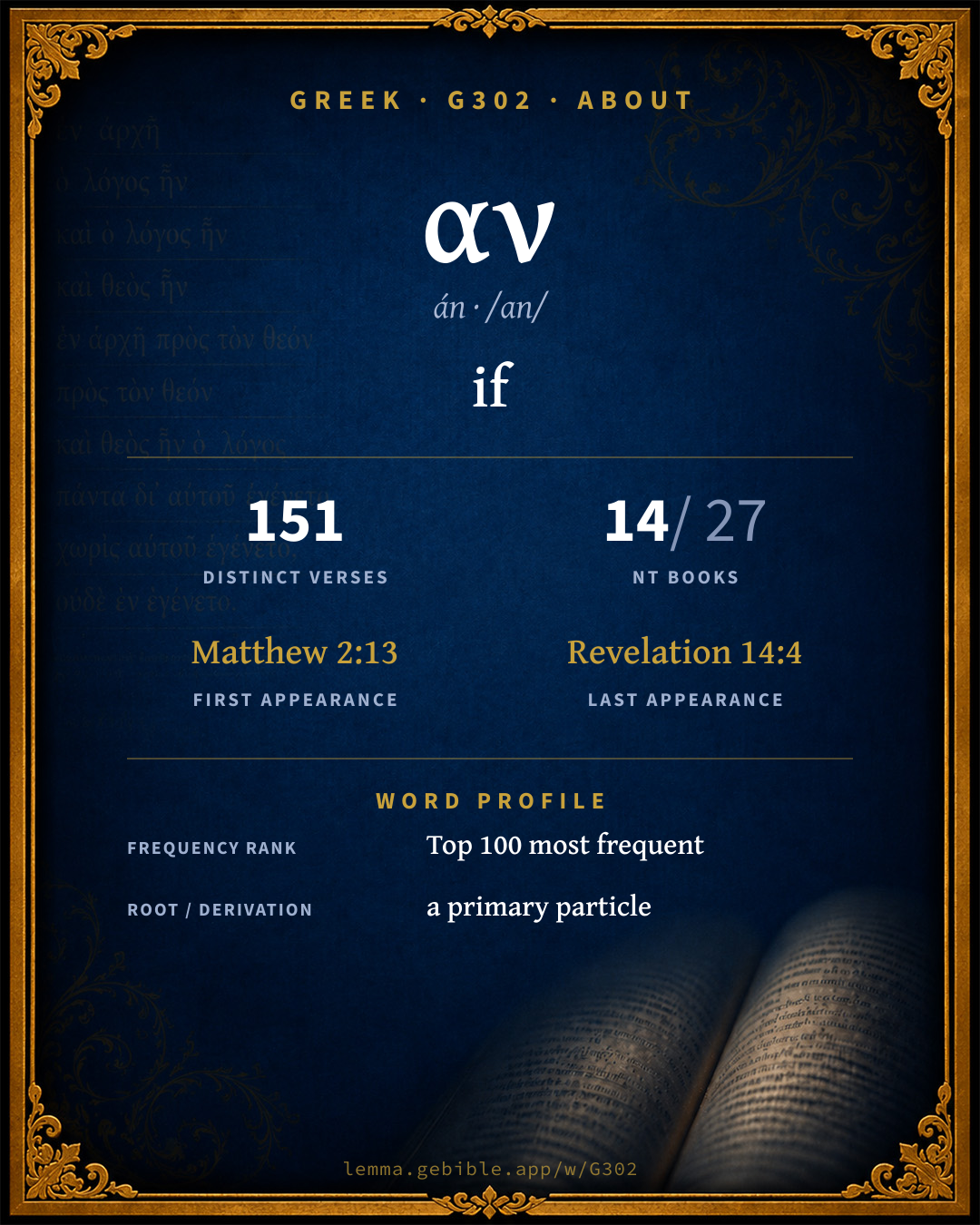
ἄν
if
Full lexicon entry — Thayer's Greek Lexicon
From Thayer's Greek Lexicon
Where this word appears
Grammar key — what these labels mean
Part of speech
- Particle
- A short, often untranslatable function word adding nuance or connection.
Every verse where G302 appears in the Book of Hebrews — 6 distinct verses. Click any verse to open its interlinear word-by-word view. Verse text shown in the World English Bible for context — . Each verse’s Greek form is shown with its reference; the English is not keyword-highlighted, since the data carries no word-level English alignment. Use “Compare translations” on any verse to read it across multiple English versions. This concordance covers the Greek New Testament; Septuagint (Greek Old Testament) occurrences of this word are not indexed here.
Hebrews
- Hebrews 1:13 ἂν ptcl But of which of the angels has he said at any time, "Sit at my right hand, Until I make your enemies the footstool of your feet?"
- Hebrews 4:8 ἂν ptcl For if Joshua had given them rest, he would not have spoken afterward of another day.
- Hebrews 8:4 ἂν ptcl For if he were on earth, he would not be a priest at all, seeing there are priests who offer the gifts according to the law;
- Hebrews 8:7 ἂν ptcl For if that first covenant had been faultless, then no place would have been sought for a second.
- Hebrews 10:2 ἂν ptcl Or else wouldn't they have ceased to be offered, because the worshippers, having been once cleansed, would have had no more consciousness of sins?
- Hebrews 11:15 ἂν ptcl If indeed they had been thinking of that country from which they went out, they would have had enough time to return.
About this entry
At a glance — auto-summarized from this page’s data, not written by a person. Every figure links to its source below. This summary describes the numbers; it doesn’t interpret them.
The Greek word αν centers on the idea of “if.” Translators differ — “should” in the King James Version, then “whoever” (unfoldingWord Literal Text), as the renderings breakdown shows. It turns up in 151 verses across 14 books, a common footprint. First canonically at Matthew 2:13, it enters the text early. For the data behind this summary, explore the sense tree and the renderings breakdown below.
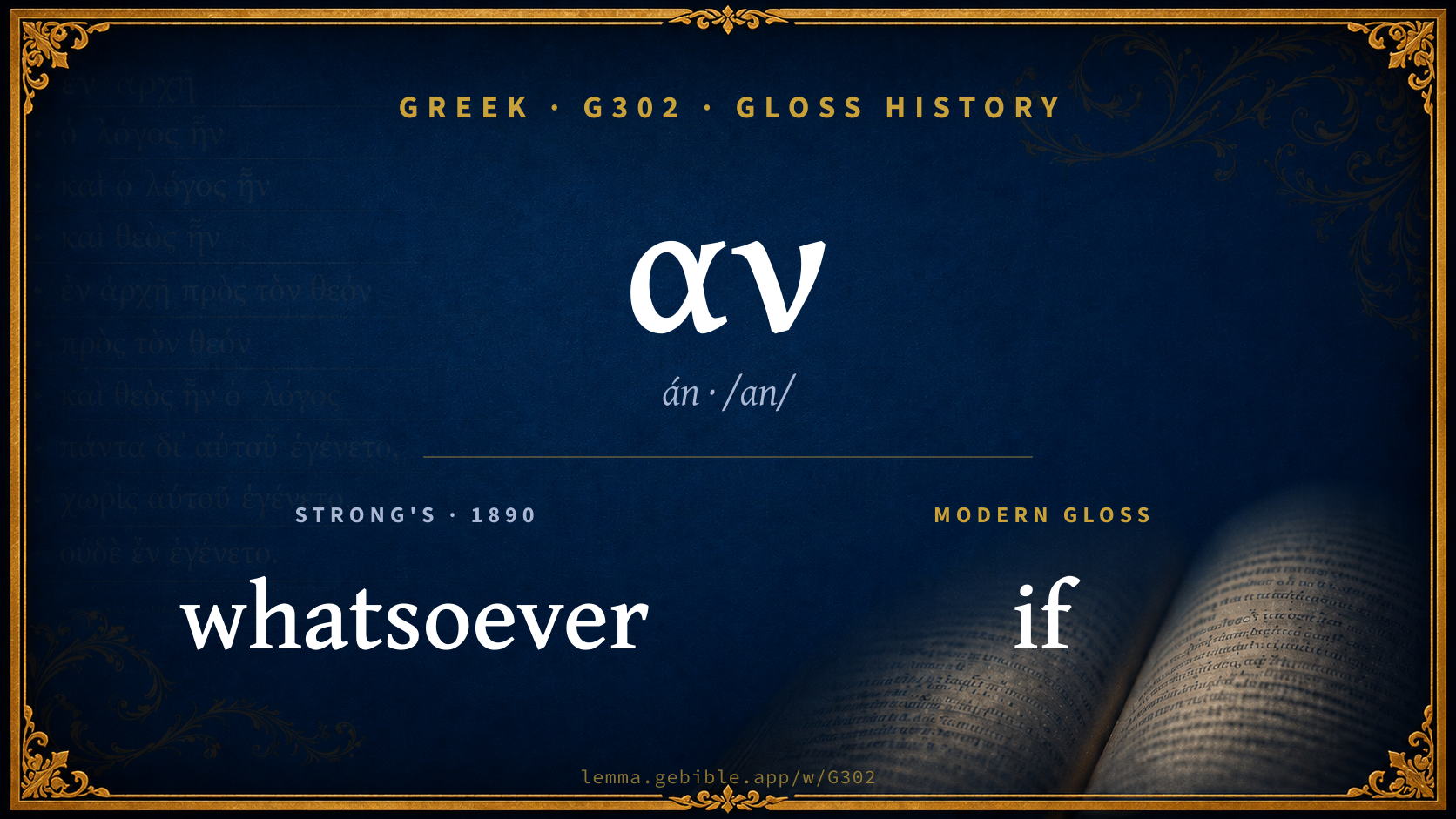
Gloss history
Strong's 1890 vs modern scholarship
About this word
Strong's G302 catalogs a Greek word from the Greek New Testament.
These counts are not copied from any lexicon or concordance. They are computed here, from the morphology-tagged Greek New Testament. What Lemma adds →
- 151
- distinct verses
- The word appears in 151 distinct verses.
- 14 / 27
- NT books
- The word appears in 14 of 27 New Testament books.
- #96
- by frequency
- Top 100 most frequent Greek words (rank 96 of 5,347 Greek words by occurrence).
View all 151 occurrences in the concordance →
By section of the New Testament
By traditional corpus
Conventional, traditional groupings — biblical authorship is debated, so this is a traditional corpus grouping, not an authorship claim. Some books belong to more than one corpus (Luke is in both the Gospels and the Lukan corpus, and so on), so these shares overlap and need not total 100%. Each figure is a share of the word’s 151 distinct verses.
- Gospels 101 verses · 67%
- Lukan (Luke–Acts) 44 verses · 29%
- Johannine 28 verses · 19%
- Pauline corpus 22 verses · 15%
- Hebrews 6 verses · 4%
- General (Catholic) Epistles 4 verses · 3%
- Revelation 2 verses · 1%
How translations render this word
Counts come from each version’s own published word-to-Strong’s tagging or interlinear alignment — an approximate guide to how each version renders this word, not a word-level alignment the data otherwise carries. Because each total is that version’s own tagged count, the per-version totals vary from one another and need not match the appearance or distinct-verse counts above. These counts may also differ from a printed concordance because Lemma counts each distinctly tagged rendering and does not collapse phrase taggings into a single head-word total. This is a fixed set of word-tagged versions (KJV, ASV, BSB, ULT) and does not change with the reading translation you choose elsewhere. Each version’s license is shown beside its name below (and on Sources).
- King James Version: Should 6×, Would 5×, Soever 4×
- American Standard Version: I 16×, Whosoever 10×, Shall 6×
- Berean Standard Bible: If 4×, That 2×
- unfoldingWord Literal Text: Whoever 36×, Whatever 14×, Until 9×
King James Version Public Domain
Renders G302 across 79 tagged occurrences — most commonly:
Plus 45 renderings that appear only once — usually multi-word phrases or single function words the recovered tagging swept in, not distinct renderings. Not rendered by a distinct English word in 111 further occurrences.
American Standard Version Public Domain
Renders G302 across 95 tagged occurrences — most commonly:
Plus other, less common renderings. Plus 29 renderings that appear only once — usually multi-word phrases or single function words the recovered tagging swept in, not distinct renderings. Not rendered by a distinct English word in 4 further occurrences.
Berean Standard Bible Public Domain
Renders G302 across 12 tagged occurrences — most commonly:
Plus 6 renderings that appear only once — usually multi-word phrases or single function words the recovered tagging swept in, not distinct renderings. Not rendered by a distinct English word in 112 further occurrences.
unfoldingWord Literal Text CC BY-SA 4.0
Renders G302 across 184 tagged occurrences — most commonly:
Plus other, less common renderings. Plus 79 renderings that appear only once — usually multi-word phrases or single function words the recovered tagging swept in, not distinct renderings.
Senses in Thayer's
The 1 sense Thayer's distinguishes for this word, in lexicon order (not ranked by frequency or importance). The full entry — with sub-senses — is in the Lexicon Entry tab.
- has no exact English equivalent, see definitions under AV
Word origin
Origin: a primary particle
A primary particle denoting a supposition wish possibility or uncertainty : - [what- where- whither- who-] soever. Usually unexpressed except by the subjunctive or potential mood. Also contraction for G1437 .
— Strong’s Exhaustive Concordance (1890), public domain.
Forms in the corpus
The 2 distinct written forms G302 takes in the Greek New Testament, most frequent first — each parse links to that case’s occurrences in the concordance.
| Form | Parsing | Example | Uses |
|---|---|---|---|
| ἂν àn | Particle | Matthew 2:13 | 152 |
| ἄν án | Particle | John 4:10 | 13 |
Septuagint usage
The same Greek word αν appears 537 times in the Greek Old Testament (Septuagint), across 491 verses in 28 books.
- 537
- LXX occurrences
- Tagged occurrences of this Greek word in the Septuagint.
- 491
- verses
- Distinct Septuagint verses containing this word.
- 28 / 39
- OT books
- The word appears in 28 of the 39 Old Testament books.
Sample Septuagint occurrences
- Genesis 2:17 ἄν
- Exodus 1:10 ἄν
- Leviticus 2:8 ἄν
- Numbers 5:9 ἄν
- Deuteronomy 3:20 ἄν
- Joshua 1:3 ἄν
- Judges 7:5 ἄν
- Ruth 2:9 ἄν
- 1 Samuel 1:23 ἄν
- 2 Samuel 7:3 ἄν
- 1 Kings 1:21 ἄν
- 2 Kings 5:6 ἄν
Septuagint occurrences (same lexeme)
Every verse where the same Strong’s number (G302) appears in the Greek Septuagint — showing the first 50 of 491. Verse text shown in the World English Bible for context; the Greek form is the matched word — the English is not keyword-highlighted.
- Genesis 2:17 ἄν but of the tree of the knowledge of good and evil, you shall not eat of it: for in the day that you eat of it you will surely die."
- Genesis 3:5 ἄν for God knows that in the day you eat it, your eyes will be opened, and you will be like God, knowing good and evil."
- Genesis 6:4 ἄν The Nephilim were in the earth in those days, and also after that, when God's sons came to men's daughters. They bore children to them: the same were the mighty men who were of old, men of renown.
- Genesis 11:6 ἄν Yahweh said, "Behold, they are one people, and they have all one language; and this is what they begin to do. Now nothing will be withheld from them, which they intend to do.
- Genesis 12:1 ἄν Now Yahweh said to Abram, "Get out of your country, and from your relatives, and from your father's house, to the land that I will show you.
- Genesis 12:12 ἄν It will happen, when the Egyptians will see you, that they will say, 'This is his wife.' They will kill me, but they will save you alive.
- Genesis 12:13 ἄν Please say that you are my sister, that it may be well with me for your sake, and that my soul may live because of you."
- Genesis 16:6 ἄν But Abram said to Sarai, "Behold, your maid is in your hand. Do to her whatever is good in your eyes." Sarai dealt harshly with her, and she fled from her face.
- Genesis 18:19 ἄν For I have known him, to the end that he may command his children and his household after him, that they may keep the way of Yahweh, to do righteousness and justice; to the end that Yahweh may bring on Abraham that which he has spoken of him."
- Genesis 19:8 ἄν See now, I have two virgin daughters. Please let me bring them out to you, and do you to them as is good in your eyes. Only don't do anything to these men, because they have come under the shadow of my roof."
- Genesis 21:6 ἄν Sarah said, "God has made me laugh. Everyone who hears will laugh with me."
- Genesis 22:2 ἄν He said, "Now take your son, your only son, whom you love, even Isaac, and go into the land of Moriah. Offer him there for a burnt offering on one of the mountains which I will tell you of."
- Genesis 23:15 ἄν "My lord, listen to me. What is a piece of land worth four hundred shekels of silver between me and you? Therefore bury your dead."
- Genesis 24:14 ἄν Let it happen, that the young lady to whom I will say, 'Please let down your pitcher, that I may drink.' She will say, 'Drink, and I will also give your camels a drink.' Let the same be she who you have appointed for your servant Isaac. Thereby will I know that you have shown kindness to my master."
- Genesis 24:19 ἄν When she had done giving him drink, she said, "I will also draw for your camels, until they have done drinking."
- Genesis 24:43 ἄν Behold, I am standing by the spring of water. Let it happen, that the maiden who comes forth to draw, to whom I will say, Give me, I pray you, a little water from your pitcher to drink.
- Genesis 26:2 ἄν Yahweh appeared to him, and said, "Don't go down into Egypt. Dwell in the land which I will tell you of.
- Genesis 30:27 ἄν Laban said to him, "If now I have found favor in your eyes, stay here, for I have divined that Yahweh has blessed me for your sake."
- Genesis 30:38 ἄν He set the rods which he had peeled opposite the flocks in the gutters in the watering-troughs where the flocks came to drink. They conceived when they came to drink.
- Genesis 30:42 ἄν but when the flock were feeble, he didn't put them in. So the feebler were Laban's, and the stronger Jacob's.
- Genesis 31:27 ἄν Why did you flee secretly, and deceive me, and didn't tell me, that I might have sent you away with mirth and with songs, with tambourine and with harp;
- Genesis 31:42 ἄν Unless the God of my father, the God of Abraham, and the fear of Isaac, had been with me, surely now you would have sent me away empty. God has seen my affliction and the labor of my hands, and rebuked you last night."
- Genesis 33:10 ἄν Jacob said, "Please, no, if I have now found favor in your sight, then receive my present at my hand, because I have seen your face, as one sees the face of God, and you were pleased with me.
- Genesis 34:12 ἄν Ask me a great amount for a dowry, and I will give whatever you ask of me, but give me the young lady as a wife."
- Genesis 39:3 ἄν His master saw that Yahweh was with him, and that Yahweh made all that he did prosper in his hand.
- Genesis 42:38 ἄν He said, "My son shall not go down with you; for his brother is dead, and he only is left. If harm happens to him by the way in which you go, then you will bring down my gray hairs with sorrow to Sheol."
- Genesis 43:10 ἄν for unless we had lingered, surely we would have returned a second time by now."
- Genesis 44:8 ἄν Behold, the money, which we found in our sacks' mouths, we brought again to you out of the land of Canaan. How then should we steal silver or gold out of your lord's house?
- Genesis 44:9 ἄν With whoever of your servants it be found, let him die, and we also will be my lord's bondservants."
- Genesis 44:10 ἄν He said, "Now also let it be according to your words: he with whom it is found will be my bondservant; and you will be blameless."
- Genesis 49:10 ἄν The scepter will not depart from Judah, Nor the ruler's staff from between his feet, Until he comes to whom it belongs. To him will the obedience of the peoples be.
- Genesis 50:20 ἄν As for you, you meant evil against me, but God meant it for good, to bring to pass, as it is this day, to save many people alive.
- Exodus 1:10 ἄν Come, let us deal wisely with them, lest they multiply, and it happen that when any war breaks out, they also join themselves to our enemies, and fight against us, and escape out of the land."
- Exodus 9:19 ἄν Now therefore command that all of your cattle and all that you have in the field be brought into shelter. Every man and animal that is found in the field, and isn't brought home, the hail shall come down on them, and they shall die."'"
- Exodus 9:29 ἄν Moses said to him, "As soon as I have gone out of the city, I will spread abroad my hands to Yahweh. The thunders shall cease, neither shall there be any more hail; that you may know that the earth is Yahweh's.
- Exodus 10:28 ἄν Pharaoh said to him, "Get away from me! Be careful to see my face no more; for in the day you see my face you shall die!"
- Exodus 12:15 ἄν Seven days shall you eat unleavened bread; even the first day you shall put away yeast out of your houses, for whoever eats leavened bread from the first day until the seventh day, that soul shall be cut off from Israel.
- Exodus 12:19 ἄν Seven days shall there be no yeast found in your houses, for whoever eats that which is leavened, that soul shall be cut off from the congregation of Israel, whether he be a foreigner, or one who is born in the land.
- Exodus 12:25 ἄν It shall happen when you have come to the land which Yahweh will give you, according as he has promised, that you shall keep this service.
- Exodus 13:9 ἄν It shall be for a sign to you on your hand, and for a memorial between your eyes, that the law of Yahweh may be in your mouth; for with a strong hand Yahweh has brought you out of Egypt.
- Exodus 13:11 ἄν "It shall be, when Yahweh shall bring you into the land of the Canaanite, as he swore to you and to your fathers, and shall give it you,
- Exodus 15:16 ἄν Terror and dread falls on them. By the greatness of your arm they are as still as a stone; Until your people pass over, Yahweh, Until the people pass over who you have purchased.
- Exodus 20:20 ἄν Moses said to the people, "Don't be afraid, for God has come to test you, and that his fear may be before you, that you won't sin."
- Exodus 20:26 ἄν Neither shall you go up by steps to my altar, that your nakedness may not be exposed to it.'
- Exodus 21:22 ἄν "If men fight and hurt a pregnant woman so that she gives birth prematurely, and yet no harm follows, he shall be surely fined as much as the woman's husband demands and the judges allow.
- Exodus 22:8 ἄν If the thief isn't found, then the master of the house shall come near to God, to find out if he hasn't put his hand to his neighbor's goods.
- Exodus 23:22 ἄν But if you indeed listen to his voice, and do all that I speak, then I will be an enemy to your enemies, and an adversary to your adversaries.
- Exodus 23:30 ἄν Little by little I will drive them out from before you, until you have increased and inherit the land.
- Exodus 25:2 ἄν "Speak to the children of Israel, that they take an offering for me. From everyone whose heart makes him willing you shall take my offering.
- Exodus 25:16 ἄν You shall put the testimony which I shall give you into the ark.
These are occurrences of the same Greek lexeme (G302) in the Septuagint — not a translation of any one Hebrew word. The store carries no word-level Hebrew↔Greek alignment, so no Hebrew original is asserted here. Counts come from the recovered LXX Strong's tagging — high-frequency vocabulary is well covered, while rare or late forms may be untagged — so they reflect tagged occurrences and may slightly undercount.