Hebrews 4:8

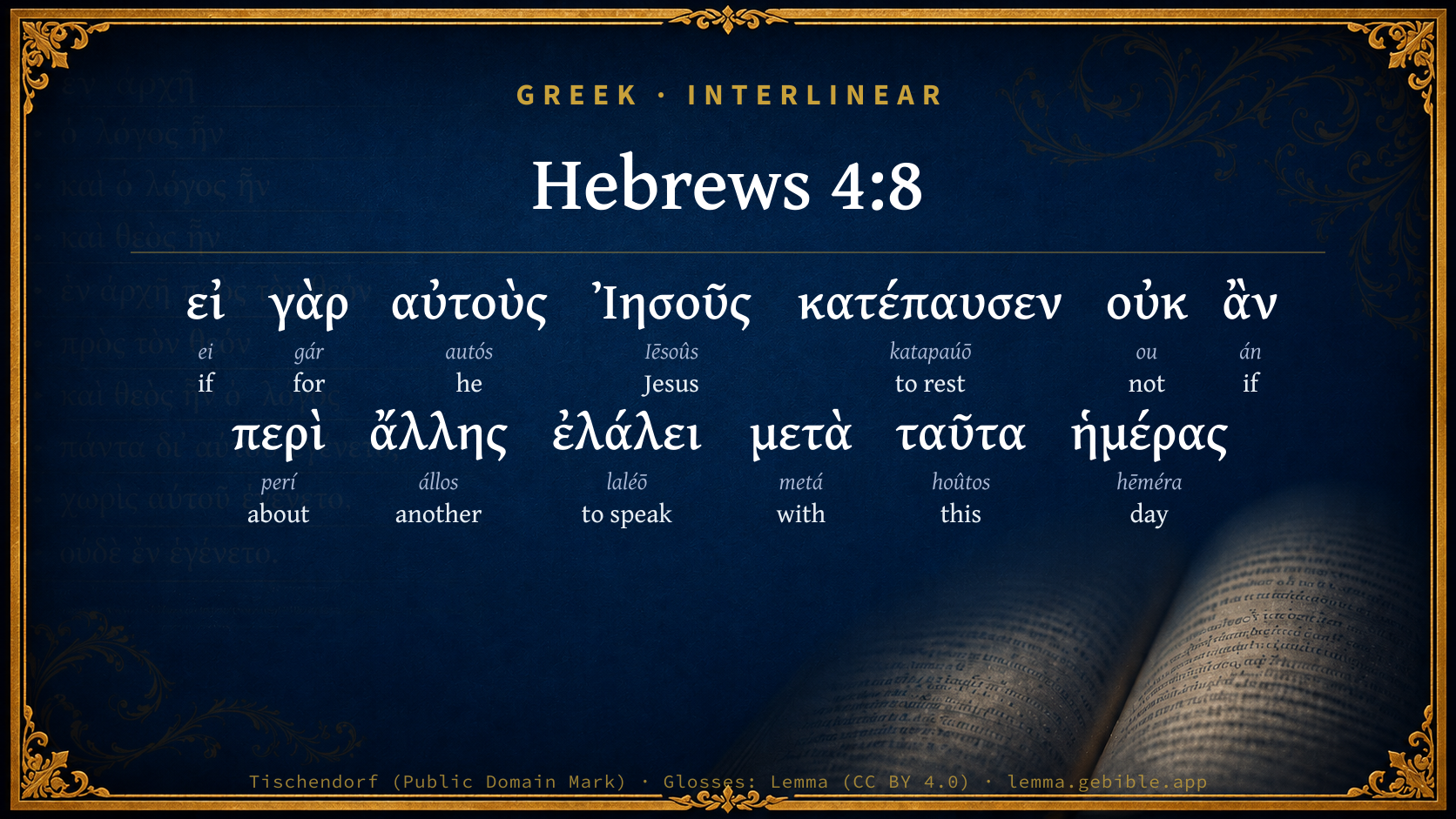
Greek (Tischendorf 8th ed.) Hebrews 4:8 appears in the Greek New Testament. The text above is from the Tischendorf 8th edition. Each word links to its Strong’s number and a concise gloss. Click any word for its full Thayer’s Greek Lexicon entry.
Download image
Cite this verse

Hebrews 4:8 (World English Bible). Public Domain. Lemma interlinear Bible study tool, https://lemma.gebible.app/v/hebrews/4/8.

Show BibTeX & RIS
BibTeX
RIS
English Translation
For if Joshua had given them rest, he would not have spoken afterward of another day.
World English Bible · Public Domain
Download a study sheet

One document with this verse’s original text, its word-by-word gloss line, the meaning frame, cross-references with their text, attributed commentary, and full source and license credits — printable, and it pastes into notes with its structure intact.

This verse Autodidact and up

Study sheet (.html) Plain text (.txt)

A passage Seminary Student

Up to 50 verses in one chapter. A passage sheet keeps up to 6 commentary sources and 12 cross-references per verse, in the order this page ranks them, and says so on the sheet whenever that leaves anything out. Ask for a single verse and you get the Autodidact verse sheet above.

Everything on this page stays free to read, with no account — the sheet is a download of what is already on screen, not access to it.

Want to remove ads? Support Godless Engineer
Compare translations 3

The same verse in 3 English versions, stacked beneath the original-language interlinear above. Click any original word for its lexicon entry.

Each is an independent rendering of the whole verse — the interlinear is not word-aligned to these translations.

Highlighted words mark where these versions differ — a whole-verse word diff, not a word-by-word alignment.

  • World English Bible Public Domain
    For if Joshua had given them rest, he would not have spoken afterward of another day.
  • King James Version Public Domain
    For if Jesus had given them rest, then would he not afterward have spoken of another day.
  • unfoldingWord Literal Text CC BY-SA 4.0
    For if Joshua gave them rest, he would not have spoken about another day after these things.

unfoldingWord Literal Text — © unfoldingWord, licensed CC BY-SA 4.0. Word-aligned USFM3 via Door43 (git.door43.org/unfoldingWord/en_ult).

Versions to compare (up to 4)

3 of 4 selected

Show all 19 translations

Every available English version of this verse, each an independent rendering of the whole verse.

  • World English Bible Public Domain
    For if Joshua had given them rest, he would not have spoken afterward of another day.
  • Berean Standard Bible Public Domain
    For if Joshua had given them rest, God would not have spoken later about another day.
  • Majority Standard Bible Public Domain
    For if Joshua had given them rest, God would not have spoken later about another day.
  • King James Version Public Domain
    For if Jesus had given them rest, then would he not afterward have spoken of another day.
  • American Standard Version (1901) Public Domain
    For if Joshua had given them rest, he would not have spoken afterward of another day.
  • Revised Version (1885) Public Domain
    For if Joshua had given them rest, he would not have spoken afterward of another day.
  • Geneva Bible (1599) Public Domain
    For if Iesus had giuen them rest, then would he not after this haue spoke of an other day.
  • Douay-Rheims (1899) Public Domain
    For if Jesus had given them rest, he would never have afterwards spoken of another day.
  • Young's Literal Translation Public Domain
    for if Joshua had given them rest, He would not concerning another day have spoken after these things;
  • Literal Standard Version CC BY-SA 4.0
    for if Joshua had given them rest, He would not have spoken after these things concerning another day;
  • Unlocked Literal Bible CC BY-SA 4.0
    For if Joshua had given them rest, God would not have spoken about another day.
  • unfoldingWord Literal Text CC BY-SA 4.0
    For if Joshua gave them rest, he would not have spoken about another day after these things.
  • Darby Bible Public Domain
    For if Jesus had brought them into rest, he would not have spoken afterwards about another day.
  • World Messianic Bible Public Domain
    For if Joshua had given them rest, he would not have spoken afterward of another day.
  • Webster's Bible Public Domain
    For if Jesus had given them rest, then he would not afterward have spoken of another day.
  • Free Bible Version CC BY-SA 4.0
    For if Joshua had been able to give them rest, God wouldn't have spoken later about another day.
  • Bible in Basic English Public Domain
    For if Joshua had given them rest, he would not have said anything about another day.
  • Text-Critical English NT CC BY 4.0
    For if Joshua had given them rest, God would not have spoken later about another day.
  • Tyndale New Testament (1534) Public Domain
    For if Iosue had geven them rest then wolde he not afterwarde have spoke of another daye.

Literal Standard Version (2020), Covenant Press — licensed CC BY-SA 4.0. Text via the HelloAO Bible API (eBible.org). Unlocked Literal Bible (unfoldingWord) — licensed CC BY-SA 4.0. Text via the HelloAO Bible API (eBible.org). unfoldingWord Literal Text — © unfoldingWord, licensed CC BY-SA 4.0. Word-aligned USFM3 via Door43 (git.door43.org/unfoldingWord/en_ult). Free Bible Version, Dr. Jonathan Gallagher — licensed CC BY-SA 4.0. Text via the HelloAO Bible API (eBible.org).

Word by word

More ways to search: Search by grammar → Find every occurrence → Compare this word →

Practice this passage: Drill this verse → Learn its vocabulary →

κατέπαυσεν
katapaúō
G2664
“to rest”
Verb, Aorist, Active, Indicative, 3rd person, Singular
Part of Speech
Verb
Tense
Aorist
Voice
Active
Mood
Indicative
Person
3rd person
Number
Singular
Full Thayer's Definition

Origin: from G2596 and G3973

TDNT: 13:27,4

1. to make quiet, to cause to be at rest, to grant rest a. to lead to a quiet abode b. to still, restrain, to cause (one striving to do something) to desist 2. to rest, take rest
  1. εἰ ei G1487 “if” Conditional
  2. γὰρ gár G1063 “for” Conjunction
  3. αὐτοὺς autós G846 “he” Personal pronoun, Accusative, Plural, Masculine
  4. Ἰησοῦς Iēsoûs G2424 “Jesus” Noun, Nominative, Singular, Masculine
  5. οὐκ ou G3756 “not” Particle, Negative
  6. ἂν án G302 “if” Particle
  7. περὶ perí G4012 “about” Preposition
  8. ἄλλης állos G243 “another” Adjective, Genitive, Singular, Feminine
  9. ἐλάλει laléō G2980 “to speak” Verb, Imperfect, Active, Indicative, 3rd person, Singular
  10. μετὰ metá G3326 “with” Preposition
  11. ταῦτα hoûtos G3778 “this” Demonstrative pronoun, Accusative, Plural, Neuter
  12. ἡμέρας hēméra G2250 “day” Noun, Genitive, Singular, Feminine

About this verse

These counts appear in no published source. They are computed here, from the morphology-tagged text and Lemma’s own curated glosses. What Lemma adds →

13
words
13
distinct lemmas
General Epistles
section

Notable vocabulary

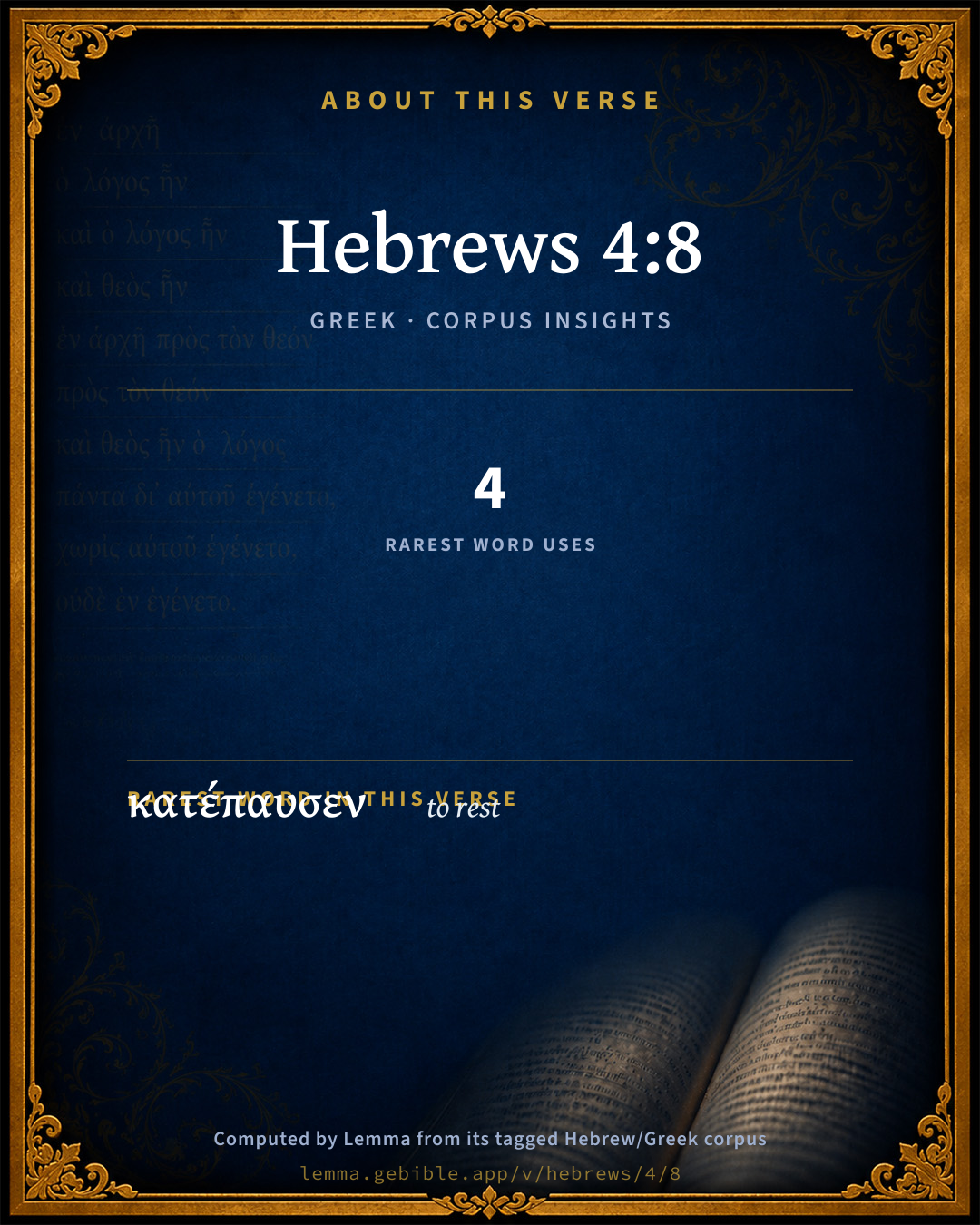
The rarest word here is κατέπαυσεν to rest G2664 — appearing just 4 times in the whole Greek New Testament.

Shared distinctive vocabulary

κατέπαυσεν to rest G2664 occurs in 4 verses of the Greek New Testament. Also found in:

Cross-references

9

Topical passages linked to Hebrews 4:8 in the Treasury of Scripture Knowledge — connected by theme and wording, ordered by reader-vote popularity; previews shown in the World English Bible.

  • Joshua 1:15 until Yahweh have given your brothers rest, as [he has given] you, and they also have possessed the land which Yahweh your God gives them: then you shall return to the land of your possession, and possess it, which Moses the servant of Yahweh gave you beyond the Jordan toward the sunrise.
  • Joshua 22:4 Now Yahweh your God has given rest to your brothers, as he spoke to them: therefore now turn you, and get you to your tents, to the land of your possession, which Moses the servant of Yahweh gave you beyond the Jordan.
  • Deuteronomy 12:9 for you haven't yet come to the rest and to the inheritance, which Yahweh your God gives you.
  • Joshua 23:1 It happened after many days, when Yahweh had given rest to Israel from all their enemies round about, and Joshua was old and well stricken in years;
  • Hebrews 11:13–15 These all died in faith, not having received the promises, but having seen them and embraced them from afar, and having confessed that they were strangers and pilgrims on the earth.
  • Psalms 78:55 He also drove out the nations before them, Allotted them for an inheritance by line, And made the tribes of Israel to dwell in their tents.
  • Acts 7:45 which also our fathers, in their turn, brought in with Joshua when they entered into the possession of the nations, whom God drove out before the face of our fathers, to the days of David,
  • Deuteronomy 25:19 Therefore it shall be, when Yahweh your God has given you rest from all your enemies round about, in the land which Yahweh your God gives you for an inheritance to possess it, that you shall blot out the memory of Amalek from under the sky; you shall not forget.
  • Psalms 105:44 He gave them the lands of the nations. They took the labor of the peoples in possession,

Cross-references courtesy of OpenBible.info (CC BY 4.0).

Commentary

Notes on Hebrews 4:8 from classic Christian and Jewish commentators (each source and its license shown beneath its notes). The classic Christian expositions comment on the surrounding passage and are grouped to its opening verse, so a note may address several verses; the Jewish commentaries on the Tanakh (Rashi and others) are per-verse, so they appear only where the commentator wrote on this verse.

Lemma curates 59 commentaries, every one of them public domain or Creative Commons licensed, each selected and text-cleaned for this edition rather than reprinted as found. About our sources →

The Biblical Illustrator

Joseph S. Exell

Heb_4:8

If Jesus [Joshua] had given them rest

Disparity between Joshua and Jesus

1.

The first is in this difference, that Joshua conquered Canaan not only for the people of Israel, but also for himself, that he might have his part and portion with them for him and his posterity (Jos_19:49-50). But our Lord Jesus hath purchased that heavenly Canaan only for our sakes, having had the possession of it before His incarnation Himself by the right of inheritance. He had a glory with God before the world was (Joh_17:5).

2. The second difference is, Joshua did not conquer Canaan by himself alone, but had all the tribes of Israel to assist as his auxiliaries in his conquest; but our Lord Jesus hath by Himself alone purchased that heavenly inheritance. He saith, I have trodden the winepress alone, and none were with Me (Isa_63:3).

3. The third disparity is, the conquest of Canaan did not cost Joshua bloodshed or death; but our eternal inheritance cost Christ both His bloodshed and death (Heb_9:26; 1Pe_1:18-19).

4. The fourth is, Joshua could not quite expel the Canaanites out of Canaan Jos_15:63; Jos_16:10, dec.). But our blessed Jesus hath perfectly subdued Satan, sin, and death to us, that nothing shall eternally harm us Joh_16:33; 1Jn_5:4 : Rev_12:11). (C. Ness.)

Rest

We are told in a certain legend that one day Rabbi Judah and his brethren, the seven pillars of wisdom, sat in the Temple on a feast day, disputing about rest. One said that it was to have attained sufficient wealth, yet without sin. The second, that it was fame and praise of all men. The third, that it was the possession of power to rule the state. The fourth, that it consisted only in a happy home. The fifth, that it must be in the old age of one who is rich, powerful, famous, surrounded by childrens children. The sixth said that all that were vain, unless a man kept all the ritual law of Moses. And Rabbi Judah, the venerable, the tallest of the brothers, said, Ye have all spoken wisely, but one thing more is necessary: he can only find rest who to all these things addeth this, that he keepeth the tradition of the elders. There sat in the court a fair-haired boy, playing with his lilies in his lap, and hearing the talk, dropped them with astonishment from his hands and looked up--that boy of twelve, and said, Nay, nay, fathers, he only loveth rest who loves his brother as himself, and God with his whole heart and soul! He is greater than wealth and fame and power, happier than a happy home, happy without it, better than honoured age, he is a law to himself, and above all tradition. The doctors were astonished. They said, When Christ cometh, shall He tell us greater things? And they thanked God; for, they said, old men are not always wise; yet God be praised, that out of the mouth of this young suckling has His praise become perfect. (T. Parker.)

Wanting rest

There is a rebelliousness against himself in man--a disgust with himself. We are weary: give us rest, said a tribe to one of their missionaries; and that tribe expresses the feeling of every human being.

The Biblical Illustrator, edited by Joseph S. Exell (c. 1880s–1900s) — public domain. Text from a community e-Sword module.

Tyndale Open Study Notes

Tyndale Open Resources

4:8 Joshua is the same name as Jesus (Greek Iēsous, Hebrew Yehoshua‘). It is normally translated Joshua in the Old Testament and Jesus in the New Testament (see also study note on Exod 17:9). The author is making a word play on Jesus’ and Joshua’s shared name. Joshua did lead God’s people into the Promised Land (Josh 3–4), but God had more in mind when he promised his people rest. God’s ultimate rest is provided by Jesus (Heb 3:13-14; 4:3, 9-11, 14-16).

Tyndale Open Study Notes — © Tyndale Open Resources, licensed CC BY-SA 4.0. Text via the HelloAO Bible API.

Bengel's Gnomon

Johann Albrecht Bengel

Heb 4:8. Ἰησοῦς) Joshua.—οὐκ ἂν) There is a similar mode of reasoning, ch. Heb 7:11, Heb 8:4; Heb 8:7, Heb 11:15.—περὶ ἄλλης ἡμέρας, of another day) By observing which an access would be opened also to another rest.

Bengel's Gnomon of the New Testament — English translation (T&T Clark, Edinburgh, 1860) — public domain. Text from a community e-Sword module.

Meyer's Critical & Exegetical Commentary

Heinrich August Wilhelm Meyer

Heb_4:8. Justification of the πάλιν τινὰ ὁρίζει ἡμέραν, Heb_4:7. If Joshua had already introduced into the rest of God, God would not still have spoken in the time after Joshua of a term (period) of entrance into the same.

αὐτούς] sc. τοὺς πρότερον εὐαγγελισθέντας, Heb_4:6.

καταπαύειν] here (in accordance with the classic usage) transitive, as Exo_33:14, Deu_3:20; Deu_5:33, al.: to lead into the rest.

ἐλάλει] sc. ὁ θεός.

μετὰ ταῦτα] belongs not to ἄλλης ἡμέρας (Hofmann, al.), but to ἐλάλει, and corresponds to the μετὰ τοσοῦτον χρόνον, Heb_4:7.

Meyer — Critical and Exegetical Commentary on the New Testament — English translation by Peter Christie, edited by Frederick Crombie (T&T Clark, 1880) — public domain. Text from a community e-Sword module.

Geneva Bible (1599)

Geneva Bible translators

He speaketh of Joshua the son of Nun: and as the land of Canaan was a figure of our true rest, so was Joshua a figure of Christ.

Geneva Bible (1599) marginal notes — public domain. Text via Bolls.life.

Jamieson, Fausset & Brown

Robert Jamieson, A. R. Fausset & David Brown

Answer to the objection which might be made to his reasoning, namely, that those brought into Canaan by Joshua (so "Jesus" here means, as in Act 7:45) did enter the rest of God. If the rest of God meant Canaan, God would not after their entrance into that land, have spoken (or speak [ALFORD]) of another (future) day of entering the rest.

Jamieson, Fausset & Brown — Commentary Critical and Explanatory on the Whole Bible (1871) — public domain (CC PDM 1.0). Text via the HelloAO Bible API.

Adam Clarke's Commentary

Verse 8. For if Jesus had given them rest] It is truly surprising that our translators should have rendered the Ιησους of the text Jesus, and not Joshua, who is most clearly intended. They must have known that the יהושע Yehoshua of the Hebrew, which we write Joshua, is everywhere rendered ιησους, Jesus, by the Septuagint; and it is their reading which the apostle follows. It is true the Septuagint generally write Ιησους Ναυη, or Υἱος Ναυη, Jesus Nave, or Jesus, son of Nave, for it is thus they translate יהושע בן נון Yehoshua ben Nun, Joshua the son of Nun; and this is sufficient to distinguish it from Jesus, son of David. But as Joshua, the captain general of Israel, is above intended, the word should have been written Joshua, and not Jesus. One MS., merely to prevent the wrong application of the name, has Ιησους ὁ του Ναυη, Jesus the son of Nave. Theodoret has the same in his comment, and one Syriac version has it in the text. It is Joshua in Coverdale's Testament, 1535; in Tindal's 1548; in that edited by Edmund Becke, 1549; in Richard Cardmarden's, Rouen, 1565; several modern translators, Wesley, Macknight, Wakefield, c., read Joshua, as does our own in the margin. What a pity it had not been in the text, as all the smaller Bibles have no marginal readings, and many simple people are bewildered with the expression.

The apostle shows that, although Joshua did bring the children of Israel into the promised land, yet this could not be the intended rest, because long after this time the Holy Spirit, by David, speaks of this rest the apostle, therefore, concludes,

Adam Clarke's Commentary on the Bible (1810–1826) — public domain. Text from a community e-Sword/MySword module.

John Calvin's Commentaries

8. For if Jesus had given them rest, or, had obtained rest for them, etc. He meant not to deny but that David understood by rest the land of Canaan, into which Joshua conducted the people; but he denies this to be the final rest to which the faithful aspire, and which we have also in common with the faithful of that age; for it is certain that they looked higher than to that land; nay, the land of Canaan was not otherwise so much valued except for this reason, because it was an image and a symbol of the spiritual inheritance. When, therefore, they obtained possession of it, they ought not to have rested as though they had attained to the summit of their wishes, but on the contrary to meditate on what was spiritual as by it suggested. They to whom David addressed the Psalm were in possession of that land, but they were reminded of the duty of seeking a better rest.

We then see how the land of Canaan was a rest; it was indeed but evanescent, beyond which it was the duty of the faithful to advance. In this sense the Apostle denies that that rest was given by Joshua; for the people under his guidance entered the promised land for this end, that they might with greater alacrity advance forward towards heaven.

And we may hence easily learn the difference between us and them; for though the same end is designed for both, yet they had, as added to them, external types to guide them; not so have we, nor have we indeed any need of them, for the naked truth itself is set before our eyes. Though our salvation is as yet in hope, yet as to the truth, it leads directly to heaven; nor does Christ extend his hand to us, that he may conduct us by the circuitous course of types and figures, but that he may withdraw us from the world and raise us up to heaven. Now that the Apostle separates the shadow from the substance, he did so for this reason, — because he had to do with the Jews, who were too much attached to external things.

He draws the conclusion, that there is a sabbathizing reserved for Gods people, that is, a spiritual rest; to which God daily invites us.

John Calvin's Commentaries (1540-1563) — public domain. Text from the Calvin Translation Society English edition (1840s-50s) via the Christian Classics Ethereal Library (ccel.org). Calvin's coverage is partial (roughly two-thirds of the Bible); uncommented books and verses are honest gaps, never fabricated. The 19th-century editor's footnotes and remarks are omitted so the notes are faithfully Calvin's own voice.

Ellicott's Commentary for English Readers

(8) For, had the promise been fulfilled in Joshua’s conquest, the Psalm (God in the Psalm) would not be speaking of another day, saying “To-day” (Heb_4:7). (In one other place in the New Testament the Greek form of the name of Joshua is preserved. See the Note on Act_7:45.)

A Bible Commentary for English Readers, edited by Charles John Ellicott (1878–1897) — public domain. Text from a community e-Sword module.

The Cambridge Bible for Schools and Colleges

gen. ed. J. J. S. Perowne

8. Jesus] i.e. Joshua. The needless adoption of the Greek form of the name by the A. V. is here most unfortunately perplexing to uninstructed readers, as also in Act_7:45.

had given them rest] He did, indeed, give them a rest and, in some sense (Deu_12:9), the rest partially and primarily intended (Jos_23:1); but only a dim shadow of the true and final rest offered by Christ (Mat_11:28; 2Th_3:1-6; Rev_14:13).

then would he not afterward have spoken] The “He” is here Jehovah. More literally, “He would not have been speaking.” The phrases applied to Scripture by the writer always imply his sense of its living power and ideal continuity. The words are as though they had just been uttered (“He hath said,” Heb_4:4) or were still being uttered (as here, and throughout). There is a similar mode of argument in Heb_7:11, Heb_8:4; Heb_8:7, Heb_11:15.

The Cambridge Bible for Schools and Colleges (gen. ed. J. J. S. Perowne; Cambridge University Press, 1878–1918) — public domain. Text from a community e-Sword module.

John Gill's Exposition

For if Jesus had given them rest,.... That is, Joshua; for Hosheah, Joshua, and Jesus, are one and the same name; or Jesus himself, as two of Stephens's copies read; and so Joshua is called Jesus by the Septuagint interpreters on Exo 17:10 and other places where he is mentioned; and also, by Josephus (h), and Philo (i) the Jew. The Syriac version, lest any should mistake this for Jesus Christ, adds, "the son of Nun": who is certainly the person designed, as the apostle's reasoning shows; who was an eminent type of Jesus Christ: there is an agreement in their names, both signify a saviour, Joshua was a temporal saviour, Christ a spiritual one; and in their office they were both servants; and in their qualifications for their office, such as wisdom, courage, faithfulness, and integrity. Joshua was a type of Christ in many actions of his life; in the miracles he wrought, or were wrought for him; in the battles he fought, and the victories he obtained; in saving Rahab and her family; in receiving the Gibeonites, who came submissively to him; and in leading the children of Israel into Canaan's land, which he divided to them by lot: but though he brought them into a land of rest, into the typical rest, where they had rest for a while from their temporal enemies, yet he did not give them the true spiritual rest: had he,

then would he not afterward have spoken of another day; that is, God, in David's time, and by him, would not have so long after appointed another day of rest; meaning, not any particular day of the week, but the whole Gospel dispensation, in the times of the Messiah; wherefore the apostle concludes as follows.

(h) Antiqu. Jud. l. 4. c. 7. sect. 2. c. 8. sect. 46, 47, 48. & l. 5. c. 1. sect. 1. & passim. (i) De Charitate, p. 698, 699, 700.

John Gill's Exposition of the Whole Bible (1746–1763) — public domain (CC PDM 1.0). Text via the HelloAO Bible API.

Trapp's Complete Commentary

John Trapp

8 For if Jesus had given them rest, then would he not afterward have spoken of another day.

Ver. 8. For if Jesus, &c.] That is, Joshua, who bad his name changed when he was sent as a spy into Canaan, Num 13:16, from Oshea to Joshua, from Let God save, to God shall save. Under the law (which brings us, as it were, into a briery wilderness) we may desire, wish, and pray, that there were a Saviour, but under the gospel we are sure of salvation. Our Jesus is Jehovah our Righteousness.

John Trapp, A Commentary or Exposition upon All the Books of the Old and New Testament (1647–1656) — public domain. Text from a community e-Sword module.

Albert Barnes' Notes on the Bible

For if Jesus - Margin, “That is, Joshua.” The Syriac renders it, “Joshua the son of Nun.” “Jesus” is the Greek mode of writing “Joshua,” and there can be no doubt that Joshua is here intended. The object is to prove that Joshua did” not” give the people of God such a rest as to make it improper to speak of a “rest” after that time. “If Joshua had given them a complete and final rest; if by his conducting them to the promised land all had been done which had been contemplated by the promise, then it would not have been alluded to again, as it was in the time of David.” Joshua “did” give them a rest in the promised land; but it was not all which was intended, and it did not exclude the promise of another and more important rest.

Then would he not - Then “God” would not have spoken of another time when that rest could be obtained. The “other day” here referred to is that which is mentioned before by the phrase “today,” and refers to the time in which it is spoken of long after Joshua, to wit, in the time of David.

Albert Barnes' Notes on the Bible (1834–1885) — public domain. Text from a community e-Sword/MySword module.

Matthew Poole's English Annotations

This is the improvement of the former instance, Heb 4:7. If Joshua, by bringing Israel into Canaan, had given rest to all believers, then God would not by David have spoken of another day and state of rest to come. Joshua was a type of Jesus bringing believers into the true rest of the heavenly Canaan, as he did Israel into a literal one, Act 7:45.

For if Jesus had given them rest; if that of Canaan was the full and perfect rest of believers, which was given them by him.

Then would he not afterward have spoken of another day; then God himself would not have spoken by David of a better and heavenly rest promised believers in the gospel; of which spiritual and eternal one, both God’s seventh-day sabbath, and the rest of Canaan, were but fainter shadows and types. The expostulation is vehemently denying it.

Matthew Poole's English Annotations on the Holy Bible (1683–1685) — public domain. Text from a community e-Sword/MySword module.

Whedon's Commentary on the Bible

Daniel D. Whedon

8. And what rest is this? It is plain that this is not the rest which Joshua won for the survivors of the desert; for if Joshua (Jesus is here the Greek form of the Hebrew Joshua, who is really here meant, see note on Mat_1:1) had given it, this another day would not have been spoken of five hundred years later than Joshua. A permanent rest of faith for all the faithful, other than the literal Canaan rest, is, therefore, a valid conclusion, stated next verse.

Daniel D. Whedon (gen. ed.), Commentary on the Old and New Testaments (1874–1909) — public domain. Text from a community e-Sword module.

The Pulpit Commentary

Vers. 8, 9. For if Joshua had given them rest, he would not have spoken afterward of another day. The conclusion is now drawn: There remaineth therefore a sabbath rest for the people of God; the true nature of the rest intended being beautifully denoted by the word sabbatismov , which refers to the Divine rest "from the foundation of the world," while the offer of it to true believers always, and not to the Israelites only, is intimated by the phrase, "the people of God."

The Pulpit Commentary (1880–1919), ed. H.D.M. Spence-Jones & Joseph S. Exell — public domain. Text from a community e-Sword module.

John Wesley's Explanatory Notes

The rest - All the rest which God had promised.

John Wesley, Explanatory Notes Upon the Whole Bible (1754–1765) — public domain. Text via the GEBible commentary corpus.

The People's New Testament

B. W. Johnson

8–11. For if Jesus. “Joshua” in the Revision. Jesus is the Greek form of the Hebrew word Joshua. Joshua led Israel over the Jordan into Canaan, but that did not give them complete rest. If that had been true, David would not have exhorted them to seek to enter into rest. Five hundred years after they entered Canaan this exhortation is given in the 95th Psalm.

B. W. Johnson's The People's New Testament with Notes (1889–1891) — public domain. Electronic text from the Christian Classics Ethereal Library (CCEL) ThML edition.

unfoldingWord translationNotes

Door43 World Missions Community

Connecting Statement:

Here the writer warns believers not to disobey but to enter into the rest God offers. He reminds them that God's word will convict them and that they can come in prayer with the confidence that God will help them.

if Joshua had given them rest

The peace and security provided by God are spoken of as if they were rest that Joshua could give. AT: "if Joshua had brought the Israelites to the place where God would give them rest" or "if the Israelites during the time of Joshua had experienced God's blessings of rest" (See: Metaphor)

there is still a Sabbath rest reserved for God's people

This can be stated in active form. AT: "there is still a Sabbath rest that God has reserved for his people" (See: Active or Passive)

a Sabbath rest

Eternal peace and security are spoken of as if they were the Sabbath day, the Jewish day of worship and rest from working. AT: "an eternal rest" (See: Metaphor)

he who enters into God's rest

The peace and security provided by God are spoken of as if they are a place to enter. AT: "the person who enters into God's place of rest" or "the person who experiences God's blessings of rest" (See: Metaphor)

let us be eager to enter that rest

The peace and security provided by God are spoken of as if they were a place to enter. AT: "we should also do everything we can to rest with God where he is" (See: Metaphor)

will fall into the kind of disobedience that they did

Disobedience is spoken of as if it were a hole that a person could physically fall into by accident. This passage can be reworded so that the abstract noun "disobedience" is expressed as the verb "disobey." AT: "will disobey in the same way as they did" (See: Metaphor and Abstract Nouns)

that they did

Here "they" refers to the Hebrews' ancestors during the time of Moses.

translationWords

Joshua

rest

Sabbath

people of God

works

disobey

unfoldingWord translationNotes — © Distant Shores Media and the Door43 World Missions Community, licensed CC BY-SA 4.0. Source: git.door43.org/Door43/en_tn.

Cambridge Greek Testament for Schools and Colleges

8. Ἰησοῦς, i.e. Joshua. The needless adoption of the Greek form of the name (“Jesus”) by the A.V. is here most unfortunately perplexing to uninstructed readers, as also in Act 7:45.

κατέπαυσεν. He did, indeed, give them a rest and, in some sense (Deu 12:9), the rest partially and primarily intended (Jos 23:1); but only a dim shadow of the true and final rest offered by Christ (Mat 11:28; 2Th 1:7; Rev 14:13).

οὐκ ἂν … ἐλάλει. “He would not have been speaking.” The “He” is here Jehovah. The phrases applied to Scripture by the writer always imply his sense of its living power and ideal continuity. The words are as though they had just been uttered (“He hath said,” Heb 4:4) or were still being uttered (as here, and throughout). There is a similar mode of argument in Heb 7:11, Heb 8:4; Heb 8:7, Heb 11:15.

Cambridge Greek Testament for Schools and Colleges (Cambridge University Press, 1896; 21 vols, various authors incl. Carr, Maclear, Plummer, Farrar, Lumby, Moule, M. R. James, Simcox) — public domain. Text from a community e-Sword module.

Alford’s Greek Testament

Henry Alford

8.] Confirmation of the above, as against an exception that might be taken, that notwithstanding the exclusion of many by unbelief, those who entered the promised land with Joshua did enter into that rest of God. For if Joshua (Ἰησοῦς is the constant Greek form of the name יְהוֹשׁוּעַ, or as in the later books, Chron., Ezra, and Nehemiah, יֵשׁוּעַ. It does not appear that any parallel between the typical and the great final Deliverer is intended: but it could hardly fail to be suggested to the readers. Our translators, in retaining the word “Jesus” here, have introduced into the mind of the ordinary English reader utter confusion. It was done in violation of their instructions, which prescribed that all proper names should be rendered as they were commonly used) had given them rest (led them into this rest of which we are treating: for the usage of καταπαύω, see above, on ver. 4: and compare reff.), He (God: the subject of ὁρίζει and λέγων above) would not speak (not “have spoken,” as E. V. Compare Thuc. iii. 55, εἰ δʼ ἀποστῆναι Ἀθηναίων οὐκ ἠθελήσαμεν (if we had not consented &c.) ὑμῶν κελευσάντων, οὐκ ἠδικοῦμεν (we should be doing no wrong),—and Joh 15:24, εἰ τὰ ἔργα μὴ ἐποίησα ἐν αὐτοῖς, ἃ οὐδεὶς ἄλλος ἐποίησεν, ἁμαρτίαν οὐκ εἴχοσαν, “If I had not done &c.,—they would not have sin”) after this of another day.

Henry Alford, The Greek Testament (1849–1861) — public domain. Text from a community e-Sword module.

Vincent's Word Studies in the New Testament

Marvin R. Vincent

But it might be said that under Joshua the people did enter into the promised rest. He therefore shows that Israel 's rest in Canaan did not fulfill the divine ideal of the rest.

Jesus [ιησους] . Rend. Joshua, and see on Mt 1:21.

After this [μετα ταυτα] . After the entrance into Canaan under Joshua.

Marvin R. Vincent, Word Studies in the New Testament (1887–1900) — public domain. Text from a community e-Sword/MySword module.

Westcott on Hebrews & the Epistles of John

Brooke Foss Westcott

8. εἰ yap... Ἰησοῦς) For if Joshua... The Peshito defines the ambiguous name (Jesus): Jesus the son of Nun... (but not in Acts vii. 45).

αὐτούς] The antecedont is mentally suppliod: ‘those in whom Christinns find their counterpart.’ Comp. viii. 8, xi. 28. See Winer p. 183.

κατέπαυσεν] transitive (otherwise vv. 4 note, 10) as in Ex. xxxiii. 14; Deut. lil, 20 &c.

οὐκ ἂν περὶ ddAns ἐλάλει... He would not have continusd to speak after this, after so long a time (0. 7), φῦ another day. O. L. non de alio (ἢ)

ἐλάλει META ταῦτα ἡμέρας.

(Lef. de aliis) dixisset postera die. Vulg. nunguam de alia loqueretur posthac die. For the unusual and expreasive combination εἰ κατέπαυσεν οὐκ ἂν.. ἐλάλει, 000 Additional Noto. It is assumed that if Joshua did not gain an entrance into the rest of God, no later leader did up to the time of Christ. No earthly rost indeed can be the rest of God (xi. 9 f.). 9. dpa ἀπολ....] . xii. 8. This unclassical uso of dpa in the first place of a sontence as defining a conclusion from the previous words is found in the Synoptists (Matt. xii. 28; Luke xi. ' 48) and in 8t Paul (Rom. x. 17; 1 Cor. xy. 18 &o.), especially in the form dpa οὖν (Rom. vy. 18 &c.), but it is not found in 8t John or in the Cutholic Epistles. eafBariopés) a sabbath rest (O. L. requies, Vulg. sabbatiemus, Byr. to keep a Sabbath-resi)—a rest which closes the manifold forms of earthly preparation and work (the Hexaomeron of human toil): not an isolated sabbath but a sabbath-life. The chango of term from κατάπαυσις is significant. The word is not quoted as used by any earlier writer. Σαββατίζω occurs not unfrequently in the Lxx., and σαββατισμός itself is used in an enumeration of superstitious observances by Plutarch: De superst. 3; ii. p. 166. The Sabbath rest answers to the Oreation as its propor consummation. Such is the thought of Augustino at the ond of his Confessions (xiii. 35 £): Domine Deus, pacem da nobis, omnia onim provstitisti, pacem quietis, pacom sabbati, sabbati sine vespera. Omuis quippe iste ordo pulchorrimus rerum valde bonarum modis suis peractis transitorius est; et mane quippe in eis factum est ef vespera. Dies autem septimus sine vospera est nec habet occasuni, quin sunctificasti oum ad permansionem sempiternam; ut id

g om. vers. K* (suppl. A).

The Jowish teachors dwelt much upon the symbolical meaning of tho Sabbath as profiguring ‘the world to come.’ One passage quoted by Schoottyon and othors may bo givou: ‘The people of Isracl said: Lord of the whole world, shew us tho world to come. God, bleased be 110, answered : Such a pattern is tho Sabbath’ (Julk. Rub. p. 95, 4). In this connexion the double ground

Apoc. xviii. 4. Israel was the typo of the divino commonwealth. Sabbatismus non paucis reservatur sed populo, id est magnee multitudini; nec tamen cuilibet populo,sed populo Dei (Herv.).

Brooke Foss Westcott (1825–1901), The Epistle to the Hebrews (1889) and The Epistles of St John (1883) — public domain (pre-1929). Text recovered from Internet Archive / Google Books OCR scans. Westcott’s Gospel of John commentary is not included (its OCR lost the chapter running-heads required for reliable verse-keying). Some Greek quoted in the Hebrews volume is imperfectly rendered by the OCR.

Lesson kit

Teaching starters — assembled from the data on this page, not authored interpretation. Every prompt links to the verse data it draws on. Edit before teaching.

Hebrews, in the General Epistles, opens this verse with 13 words (13 distinct Greek lemmas). Its most distinctive word is katapaúō (“to rest”). A historical commentator’s framing appears above. Read the whole chapter for the surrounding context.

Discussion questions

  1. What does “to rest” (katapaúō) contribute to the verse as a whole?
  2. Acts 14:18 shares the word «to rest» with this verse. How do the two illuminate each other?
  3. These translations render this verse differently; the difference is in the English rendering, not the original. What questions does that raise?
  4. Reading how The Biblical Illustrator and Tyndale Open Study Notes read this verse, where do the two commentators agree and where do they part?

Things to notice

Reading settings

Reading text

Shown beneath each verse's original-language words.

Old Testament
Old Testament edition

Read the OT as the Masoretic Hebrew (MT) or the Greek Septuagint (LXX).

English shown for the Greek Septuagint (in the Hebrew ↔ Greek comparison).

Comparing translations? Open the Compare panel on any verse page to stack up to four side by side.