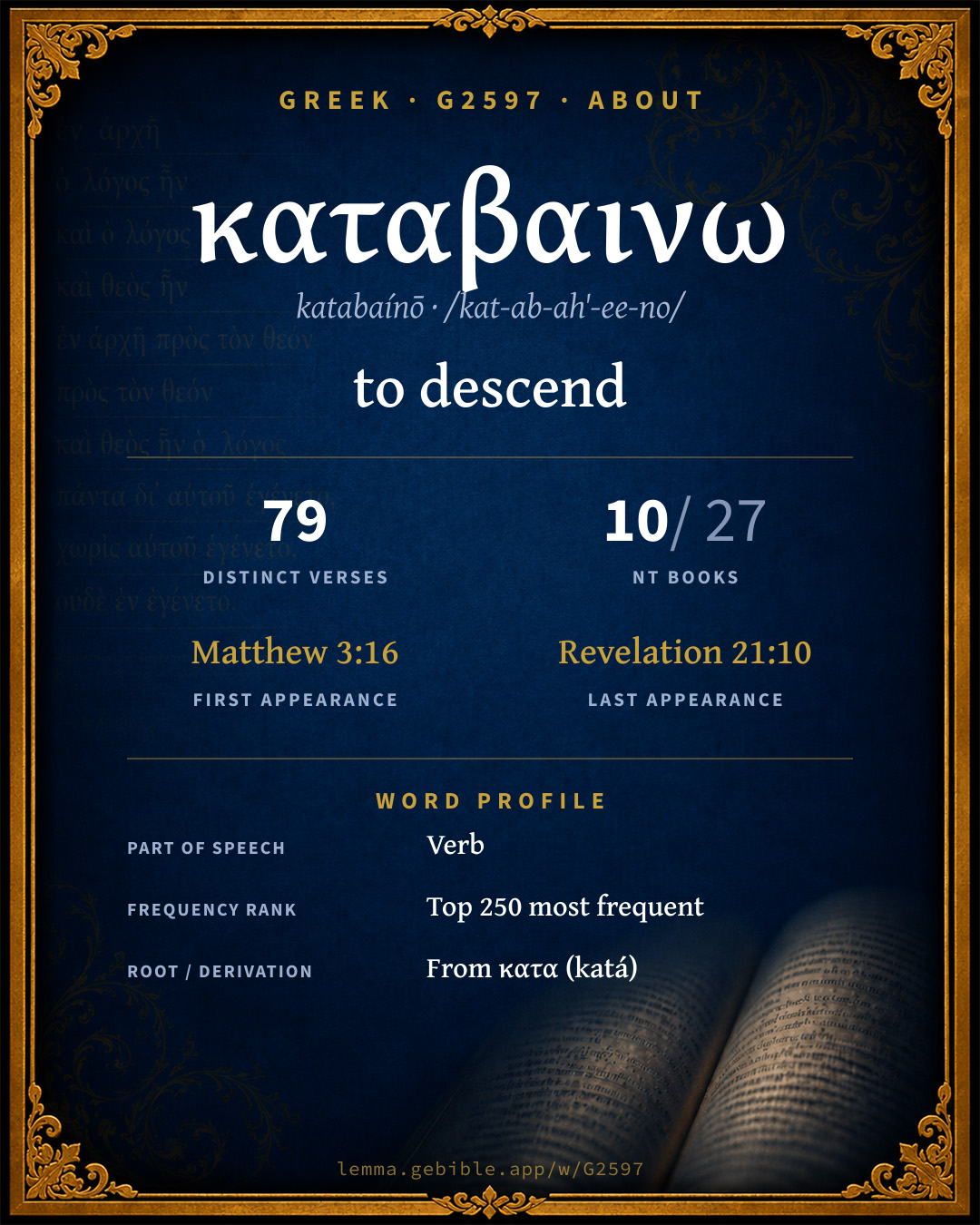
καταβαίνω
to descend
‘to descend’ is one of 4 main senses fuller range ↓
Full lexicon entry — Thayer's Greek Lexicon
From Thayer's Greek Lexicon
Where this word appears
See every Aorist-tense verb in the Greek New Testament →
Grammar key — what these labels mean
Part of speech
- Verb
- An action or state-of-being word.
Tense
- Aorist
- Action viewed as a simple whole, without regard to duration — often past (perfective aspect).
- Present
- Ongoing or general action in present time (imperfective aspect).
- Future
- Action expected in future time.
- Imperfect
- Continuous or repeated action in past time (“was writing”).
- Perfect
- A completed past action with continuing present results.
Voice
- Active
- The subject performs the action.
- Middle deponent
- Middle in form but active in meaning.
Mood
- Indicative
- States a fact or asks a factual question (the mood of reality).
- Participle
- A verbal adjective (“writing,” “having written”).
- Imperative
- Expresses a command or request.
- Infinitive
- A verbal noun (“to write”), unmarked for person or number.
- Subjunctive
- Expresses probability, purpose, or possibility (the mood of contingency).
Case
- Nominative
- The case of the subject (and the predicate nominative).
- Accusative
- The case of the direct object and of extent.
- Genitive
- The case of source, possession, or “of” — answers “whose / from what.”
- Dative
- The case of the indirect object, means, or location — “to / for / with / in.”
Person
- 3rd person
- The one spoken about (“he / she / it / they”).
- 2nd person
- The one addressed (“you”).
- 1st person
- The speaker (“I / we”).
Gender
- Masculine
- Grammatically masculine.
- Neuter
- Grammatically neuter.
- Feminine
- Grammatically feminine.
Number
- Singular
- One.
- Plural
- More than one.
2 verses where G2597 appears in the Perfect tense in the Book of John. Filtered view — show all forms. Click any verse to open its interlinear word-by-word view. Verse text shown in the World English Bible for context — . Each verse’s Greek form is shown with its reference; the English is not keyword-highlighted, since the data carries no word-level English alignment. Use “Compare translations” on any verse to read it across multiple English versions. This concordance covers the Greek New Testament; Septuagint (Greek Old Testament) occurrences of this word are not indexed here.
John
- John 6:38 καταβέβηκα perf act ind 1sg For I have come down from heaven, not to do my own will, but the will of him who sent me.
- John 6:42 καταβέβηκα perf act ind 1sg They said, "Isn't this Jesus, the son of Joseph, whose father and mother we know? How then does he say, 'I have come down out of heaven?'"
About this entry
At a glance — auto-summarized from this page’s data, not written by a person. Every figure links to its source below. This summary describes the numbers; it doesn’t interpret them.
At its core, καταβαινω (katabaínō) means “to descend.” Older and newer Bibles part ways — “came down” in the King James Version, “coming down” (unfoldingWord Literal Text) in modern versions. See the renderings breakdown. It turns up in 79 verses across 10 books, a moderately common footprint. Scripture first uses it in Matthew 3:16. Catalogued under 4 senses, its meaning is not single-sense. Each statement above links to its evidence; the full detail follows below.
Gloss history
Strong's 1890 vs modern scholarship

About this word
Strong's G2597 catalogs a Greek word from the Greek New Testament.
These counts are not copied from any lexicon or concordance. They are computed here, from the morphology-tagged Greek New Testament. What Lemma adds →
- 79
- distinct verses
- The word appears in 79 distinct verses.
- 10 / 27
- NT books
- The word appears in 10 of 27 New Testament books.
- #214
- by frequency
- Top 250 most frequent Greek words (rank 214 of 5,347 Greek words by occurrence).
View all 79 occurrences in the concordance →
By section of the New Testament
By traditional corpus
Conventional, traditional groupings — biblical authorship is debated, so this is a traditional corpus grouping, not an authorship claim. Some books belong to more than one corpus (Luke is in both the Gospels and the Lukan corpus, and so on), so these shares overlap and need not total 100%. Each figure is a share of the word’s 79 distinct verses.
- Gospels 45 verses · 57%
- Lukan (Luke–Acts) 31 verses · 39%
- Johannine 27 verses · 34%
- Revelation 10 verses · 13%
- Pauline corpus 4 verses · 5%
- General (Catholic) Epistles 1 verse · 1%
How translations render this word
Counts come from each version’s own published word-to-Strong’s tagging or interlinear alignment — an approximate guide to how each version renders this word, not a word-level alignment the data otherwise carries. Because each total is that version’s own tagged count, the per-version totals vary from one another and need not match the appearance or distinct-verse counts above. These counts may also differ from a printed concordance because Lemma counts each distinctly tagged rendering and does not collapse phrase taggings into a single head-word total. This is a fixed set of word-tagged versions (KJV, ASV, BSB, ULT) and does not change with the reading translation you choose elsewhere. Each version’s license is shown beside its name below (and on Sources).
- King James Version: Came down 12×, Come down 12×, Descended 7×
- American Standard Version: Came down 7×, Come down 7×, Descended 7×
- Berean Standard Bible: Came down 8×, Come down 8×, Went down 7×
- unfoldingWord Literal Text: Coming down 11×, Having come down 7×, Came down 6×
King James Version Public Domain
Renders G2597 across 85 tagged occurrences — most commonly:
Plus other, less common renderings. Plus 16 renderings that appear only once — usually multi-word phrases or single function words the recovered tagging swept in, not distinct renderings. Not rendered by a distinct English word in 1 further occurrence.
American Standard Version Public Domain
Renders G2597 across 83 tagged occurrences — most commonly:
Plus other, less common renderings. Plus 18 renderings that appear only once — usually multi-word phrases or single function words the recovered tagging swept in, not distinct renderings.
Berean Standard Bible Public Domain
Renders G2597 across 79 tagged occurrences — most commonly:
Plus other, less common renderings. Plus 17 renderings that appear only once — usually multi-word phrases or single function words the recovered tagging swept in, not distinct renderings.
unfoldingWord Literal Text CC BY-SA 4.0
Renders G2597 across 89 tagged occurrences — most commonly:
Plus other, less common renderings. Plus 23 renderings that appear only once — usually multi-word phrases or single function words the recovered tagging swept in, not distinct renderings.
Senses in Thayer's
The 4 senses Thayer's distinguishes for this word, in lexicon order (not ranked by frequency or importance). The full entry — with sub-senses — is in the Lexicon Entry tab.
- to go down, come down, descend
- to come (i.e. be sent) down
- to come (i.e. fall) down
- metaph. to (go i.e.) be cast down to the lowest state of wretchedness and shame
Word origin
Derived from κατα (katá) (G2596) — down.
Forms in the corpus
The 26 distinct written forms G2597 takes in the Greek New Testament, most frequent first — each parse links to that tense’s occurrences in the concordance.
Same root — word family
Other Thayer's entries built from the same root as G2597, grouped by Strong’s listed origin. These share a root / origin per the lexicon — not necessarily a shared meaning. Each links to that word’s own entry.
Derives from
Shares the same root
- καθα kathá G2505 according as
- καθαιρεω kathairéō G2507 to tear down
- καθαπτω katháptō G2510 to fasten down
- καθεδρα kathédra G2515 seat
- καθεζομαι kathézomai G2516 to sit down
- καθεξης kathexēs G2517 in order
- καθευδω katheúdō G2518 to fall asleep
- καθηγητης kathēgētḗs G2519 guide
- καθηκω kathḗkō G2520 to come down
- καθημαι káthēmai G2521 to sit down
- καθημερινος kathēmerinós G2522 daily
- καθιημι kathíēmi G2524 to send down
- καθιστημι kathístēmi G2525 to place
- καθο kathó G2526 according to what
- καθολου kathólou G2527 wholly
- καθοπλιζω kathoplízō G2528 to arm
- καθοραω kathoráō G2529 to see clearly
- καθοτι kathóti G2530 according to what
- καθως kathṓs G2531 according as
- καμμυω kammýō G2576 to close eyes
- καταβαλλω katabállō G2598 to cast down
- καταβαρεω katabaréō G2599 to weigh down
- καταβιβαζω katabibázō G2601 to bring down
- καταβραβευω katabrabeúō G2603 to defraud
+103 more words share this root (not shown).
Derived from this word
Compare all same-root words → Showing 4 of 130 — not the complete family. They share a root, not necessarily a meaning.
Septuagint usage
The same Greek word καταβαινω appears 295 times in the Greek Old Testament (Septuagint), across 267 verses in 29 books.
- 295
- LXX occurrences
- Tagged occurrences of this Greek word in the Septuagint.
- 267
- verses
- Distinct Septuagint verses containing this word.
- 29 / 39
- OT books
- The word appears in 29 of the 39 Old Testament books.
Sample Septuagint occurrences
- Genesis 11:5 καταβαίνω
- Exodus 2:5 καταβαίνω
- Leviticus 9:22 καταβαίνω
- Numbers 11:9 καταβαίνω
- Deuteronomy 9:12 καταβαίνω
- Joshua 2:23 καταβαίνω
- Judges 1:9 καταβαίνω
- Ruth 3:6 καταβαίνω
- 1 Samuel 6:21 καταβαίνω
- 2 Samuel 1:21 καταβαίνω
- 1 Kings 1:25 καταβαίνω
- 2 Kings 1:4 καταβαίνω
Septuagint occurrences (same lexeme)
Every verse where the same Strong’s number (G2597) appears in the Greek Septuagint — showing the first 50 of 267. Verse text shown in the World English Bible for context; the Greek form is the matched word — the English is not keyword-highlighted.
- Genesis 11:5 καταβαίνω Yahweh came down to see the city and the tower, which the children of men built.
- Genesis 11:7 καταβαίνω Come, let's go down, and there confuse their language, that they may not understand one another's speech."
- Genesis 12:10 καταβαίνω There was a famine in the land. Abram went down into Egypt to live as a foreigner there, for the famine was sore in the land.
- Genesis 15:11 καταβαίνω The birds of prey came down on the carcasses, and Abram drove them away.
- Genesis 18:21 καταβαίνω I will go down now, and see whether they have done altogether according to the cry of it, which is come to me. If not, I will know."
- Genesis 24:16 καταβαίνω The young lady was very beautiful to look at, a virgin, neither had any man known her. She went down to the spring, filled her pitcher, and came up.
- Genesis 24:45 καταβαίνω Before I had done speaking in my heart, behold, Rebekah came forth with her pitcher on her shoulder. She went down to the spring, and drew. I said to her, 'Please let me drink.'
- Genesis 26:2 καταβαίνω Yahweh appeared to him, and said, "Don't go down into Egypt. Dwell in the land which I will tell you of.
- Genesis 28:12 καταβαίνω He dreamed. Behold, a stairway set up on the earth, and the top of it reached to heaven. Behold, the angels of God ascending and descending on it.
- Genesis 37:35 καταβαίνω All his sons and all his daughters rose up to comfort him; but he refused to be comforted. He said, "For I will go down to Sheol to my son mourning." His father wept for him.
- Genesis 38:1 καταβαίνω It happened at that time, that Judah went down from his brothers, and visited a certain Adullamite, whose name was Hirah.
- Genesis 42:2 καταβαίνω He said, "Behold, I have heard that there is grain in Egypt. Go down there, and buy for us from there, so that we may live, and not die."
- Genesis 42:3 καταβαίνω Joseph's ten brothers went down to buy grain from Egypt.
- Genesis 42:38 καταβαίνω He said, "My son shall not go down with you; for his brother is dead, and he only is left. If harm happens to him by the way in which you go, then you will bring down my gray hairs with sorrow to Sheol."
- Genesis 43:4 καταβαίνω If you will send our brother with us, we will go down and buy you food,
- Genesis 43:13 καταβαίνω Take also your brother, and arise, go again to the man.
- Genesis 43:15 καταβαίνω The men took that present, and they took double money in their hand, and Benjamin; and rose up, went down to Egypt, and stood before Joseph.
- Genesis 43:20 καταβαίνω and said, "Oh, my lord, we came indeed down at the first time to buy food:
- Genesis 44:26 καταβαίνω We said, 'We can't go down. If our youngest brother is with us, then will we go down: for we may not see the man's face, unless our youngest brother is with us.'
- Genesis 45:9 καταβαίνω Hurry, and go up to my father, and tell him, 'This is what your son Joseph says, "God has made me lord of all Egypt. Come down to me. Don't wait.
- Genesis 46:3 καταβαίνω He said, "I am God, the God of your father. Don't be afraid to go down into Egypt; for there I will make of you a great nation.
- Genesis 46:4 καταβαίνω I will go down with you into Egypt. I will also surely bring you up again. Joseph will close your eyes."
- Exodus 2:5 καταβαίνω Pharaoh's daughter came down to bathe at the river. Her maidens walked along by the riverside. She saw the basket among the reeds, and sent her handmaid to get it.
- Exodus 3:8 καταβαίνω I have come down to deliver them out of the hand of the Egyptians, and to bring them up out of that land to a good and large land, to a land flowing with milk and honey; to the place of the Canaanite, the Hittite, the Amorite, the Perizzite, the Hivite, and the Jebusite.
- Exodus 11:8 καταβαίνω All these your servants shall come down to me, and bow down themselves to me, saying, 'Get out, and all the people who follow you; and after that I will go out.'" He went out from Pharaoh in hot anger.
- Exodus 19:10 καταβαίνω Yahweh said to Moses, "Go to the people, and sanctify them today and tomorrow, and let them wash their garments,
- Exodus 19:11 καταβαίνω and be ready against the third day; for on the third day Yahweh will come down in the sight of all the people on Mount Sinai.
- Exodus 19:14 καταβαίνω Moses went down from the mountain to the people, and sanctified the people; and they washed their clothes.
- Exodus 19:18 καταβαίνω Mount Sinai, the whole of it, smoked, because Yahweh descended on it in fire; and its smoke ascended like the smoke of a furnace, and the whole mountain quaked greatly.
- Exodus 19:20 καταβαίνω Yahweh came down on Mount Sinai, to the top of the mountain. Yahweh called Moses to the top of the mountain, and Moses went up.
- Exodus 19:21 καταβαίνω Yahweh said to Moses, "Go down, charge the people, lest they break through to Yahweh to gaze, and many of them perish.
- Exodus 19:24 καταβαίνω Yahweh said to him, "Go down and you shall bring Aaron up with you, but don't let the priests and the people break through to come up to Yahweh, lest he break forth on them."
- Exodus 19:25 καταβαίνω So Moses went down to the people, and told them.
- Exodus 24:16 καταβαίνω The glory of Yahweh settled on Mount Sinai, and the cloud covered it six days. The seventh day he called to Moses out of the midst of the cloud.
- Exodus 32:1 καταβαίνω When the people saw that Moses delayed to come down from the mountain, the people gathered themselves together to Aaron, and said to him, "Come, make us gods, which shall go before us; for as for this Moses, the man who brought us up out of the land of Egypt, we don't know what has become of him."
- Exodus 32:7 καταβαίνω Yahweh spoke to Moses, "Go, get down; for your people, who you brought up out of the land of Egypt, have corrupted themselves!
- Exodus 32:15 καταβαίνω Moses turned, and went down from the mountain, with the two tablets of the testimony in his hand; tablets that were written on both their sides; on the one side and on the other they were written.
- Exodus 32:34 καταβαίνω Now go, lead the people to the place of which I have spoken to you. Behold, my angel shall go before you. Nevertheless in the day when I punish, I will punish them for their sin."
- Exodus 33:9 καταβαίνω It happened, when Moses entered into the Tent, that the pillar of cloud descended, stood at the door of the Tent, and spoke with Moses.
- Exodus 34:5 καταβαίνω Yahweh descended in the cloud, and stood with him there, and proclaimed the name of Yahweh.
- Exodus 34:29 καταβαίνω It happened, when Moses came down from Mount Sinai with the two tablets of the testimony in Moses' hand, when he came down from the mountain, that Moses didn't know that the skin of his face shone by reason of his speaking with him.
- Leviticus 9:22 καταβαίνω Aaron lifted up his hands toward the people, and blessed them; and he came down from offering the sin offering, and the burnt offering, and the peace offerings.
- Numbers 11:9 καταβαίνω When the dew fell on the camp in the night, the manna fell on it.
- Numbers 11:17 καταβαίνω I will come down and talk with you there: and I will take of the Spirit which is on you, and will put it on them; and they shall bear the burden of the people with you, that you not bear it yourself alone.
- Numbers 11:25 καταβαίνω Yahweh came down in the cloud, and spoke to him, and took of the Spirit that was on him, and put it on the seventy elders: and it happened that when the Spirit rested on them, they prophesied, but they did so no more.
- Numbers 12:5 καταβαίνω Yahweh came down in a pillar of cloud, and stood at the door of the Tent, and called Aaron and Miriam; and they both came forth.
- Numbers 14:45 καταβαίνω Then the Amalekite came down, and the Canaanite who lived in that mountain, and struck them and beat them down, even to Hormah.
- Numbers 16:30 καταβαίνω But if Yahweh make a new thing, and the ground open its mouth, and swallow them up, with all that appertain to them, and they go down alive into Sheol; then you shall understand that these men have despised Yahweh.
- Numbers 16:33 καταβαίνω So they, and all that appertained to them, went down alive into Sheol: and the earth closed on them, and they perished from among the assembly.
- Numbers 20:15 καταβαίνω how our fathers went down into Egypt, and we lived in Egypt a long time; and the Egyptians dealt ill with us, and our fathers:
These are occurrences of the same Greek lexeme (G2597) in the Septuagint — not a translation of any one Hebrew word. The store carries no word-level Hebrew↔Greek alignment, so no Hebrew original is asserted here. Counts come from the recovered LXX Strong's tagging — high-frequency vocabulary is well covered, while rare or late forms may be untagged — so they reflect tagged occurrences and may slightly undercount.