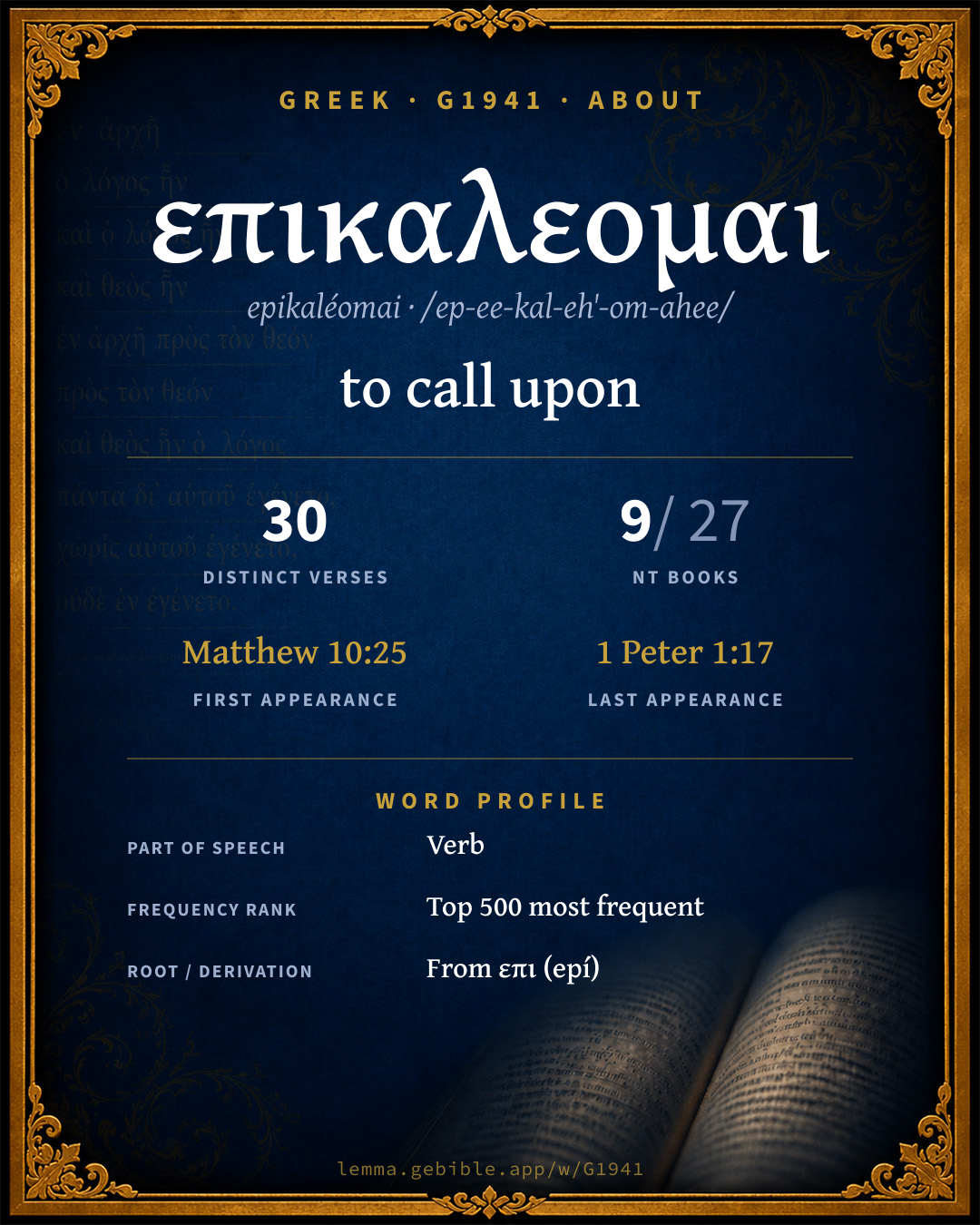
ἐπικαλέομαι
to call upon
‘to call upon’ is one of 8 main senses fuller range ↓
Full lexicon entry — Thayer's Greek Lexicon
From Thayer's Greek Lexicon
Where this word appears
See every Present-tense verb in the Greek New Testament →
Grammar key — what these labels mean
Part of speech
- Verb
- An action or state-of-being word.
Tense
- Present
- Ongoing or general action in present time (imperfective aspect).
- Aorist
- Action viewed as a simple whole, without regard to duration — often past (perfective aspect).
- Pluperfect
- A past action completed before another past point (“had written”).
- Perfect
- A completed past action with continuing present results.
Voice
- Middle
- The subject acts on or for itself, or with special interest in the action.
- Passive
- The subject receives the action.
- Active
- The subject performs the action.
- Middle deponent
- Middle in form but active in meaning.
Mood
- Participle
- A verbal adjective (“writing,” “having written”).
- Subjunctive
- Expresses probability, purpose, or possibility (the mood of contingency).
- Indicative
- States a fact or asks a factual question (the mood of reality).
- Infinitive
- A verbal noun (“to write”), unmarked for person or number.
Case
- Accusative
- The case of the direct object and of extent.
- Genitive
- The case of source, possession, or “of” — answers “whose / from what.”
- Nominative
- The case of the subject (and the predicate nominative).
- Dative
- The case of the indirect object, means, or location — “to / for / with / in.”
Person
- 3rd person
- The one spoken about (“he / she / it / they”).
- 1st person
- The speaker (“I / we”).
- 2nd person
- The one addressed (“you”).
Gender
- Masculine
- Grammatically masculine.
- Neuter
- Grammatically neuter.
Number
- Plural
- More than one.
- Singular
- One.
Every verse where G1941 appears in the Book of Acts — 20 distinct verses. Click any verse to open its interlinear word-by-word view. Verse text shown in the World English Bible for context — . Each verse’s Greek form is shown with its reference; the English is not keyword-highlighted, since the data carries no word-level English alignment. Use “Compare translations” on any verse to read it across multiple English versions. This concordance covers the Greek New Testament; Septuagint (Greek Old Testament) occurrences of this word are not indexed here.
Acts
- Acts 1:23 ἐπεκλήθη aor pass ind 3sg They put forward two, Joseph called Barsabbas, who was surnamed Justus, and Matthias.
- Acts 2:21 ἐπικαλέσηται aor mid subj 3sg It will be, that whoever will call on the name of the Lord will be saved.'
- Acts 4:36 ἐπικληθεὶς aor pass ptcp nom sg masc Joses, who by the apostles was surnamed Barnabas (which is, being interpreted, Son of Encouragement), a Levite, a man of Cyprus by race,
- Acts 7:59 ἐπικαλούμενον pres mid ptcp acc sg masc They stoned Stephen as he called out, saying, "Lord Jesus, receive my Spirit!"
- Acts 9:14 ἐπικαλουμένους pres mid ptcp acc pl masc Here he has authority from the chief priests to bind all who call on your name."
- Acts 9:21 ἐπικαλουμένους pres mid ptcp acc pl masc All who heard him were amazed, and said, "Isn't this he who in Jerusalem made havoc of those who called on this name? And he had come here intending to bring them bound before the chief priests!"
- Acts 10:5 ἐπικαλεῖται pres pass ind 3sg Now send men to Joppa, and get Simon, who is surnamed Peter.
- Acts 10:18 ἐπικαλούμενος pres pass ptcp nom sg masc and called and asked whether Simon, who was surnamed Peter, was lodging there.
- Acts 10:32 ἐπικαλεῖται pres pass ind 3sg Send therefore to Joppa, and summon Simon, who is surnamed Peter. He lodges in the house of Simon a tanner, by the seaside. When he comes, he will speak to you.'
- Acts 11:13 ἐπικαλούμενον pres pass ptcp acc sg masc He told us how he had seen the angel standing in his house, and saying to him, 'Send to Joppa, and get Simon, whose surname is Peter,
- Acts 12:12 ἐπικαλουμένου pres pass ptcp gen sg masc Thinking about that, he came to the house of Mary, the mother of John whose surname was Mark, where many were gathered together and were praying.
- Acts 12:25 ἐπικληθέντα aor pass ptcp acc sg masc Barnabas and Saul returned to Jerusalem, when they had fulfilled their service, also taking with them John whose surname was Mark.
- Acts 15:17 ἐπικέκληται perf pass ind 3sg That the rest of men may seek after the Lord; All the Gentiles who are called by my name, Says the Lord, who does all these things.
- Acts 22:16 ἐπικαλεσάμενος aor mid ptcp nom sg masc Now why do you wait? Arise, be baptized, and wash away your sins, calling on the name of the Lord.'
- Acts 25:11 ἐπικαλοῦμαι pres mid ind 1sg For if I have done wrong, and have committed anything worthy of death, I don't refuse to die; but if none of those things is true that they accuse me of, no one can give me up to them. I appeal to Caesar!"
- Acts 25:12 ἐπικέκλησαι perf mid ind 2sg Then Festus, when he had conferred with the council, answered, "You have appealed to Caesar. To Caesar you shall go."
- Acts 25:21 ἐπικαλεσαμένου aor mid ptcp gen sg masc But when Paul had appealed to be kept for the decision of the emperor, I commanded him to be kept until I could send him to Caesar."
- Acts 25:25 ἐπικαλεσαμένου aor mid ptcp gen sg masc But when I found that he had committed nothing worthy of death, and as he himself appealed to the emperor I determined to send him.
- Acts 26:32 ἐπεκέκλητο plup mid.dep ind 3sg Agrippa said to Festus, "This man might have been set free if he had not appealed to Caesar."
- Acts 28:19 ἐπικαλέσασθαι aor mid inf But when the Jews spoke against it, I was constrained to appeal to Caesar, not that I had anything about which to accuse my nation.
About this entry
At a glance — auto-summarized from this page’s data, not written by a person. Every figure links to its source below. This summary describes the numbers; it doesn’t interpret them.
“to call upon” is the headline sense of the Greek verb επικαλεομαι (epikaléomai). More than two-thirds of its appearances fall in Acts. It appears 30 verses across 9 books of the Greek New Testament, among its moderately common vocabulary. First canonically at Matthew 10:25, it enters the text early. Lexicons map it across 8 senses. The sections below give every sense, occurrence, and version rendering.
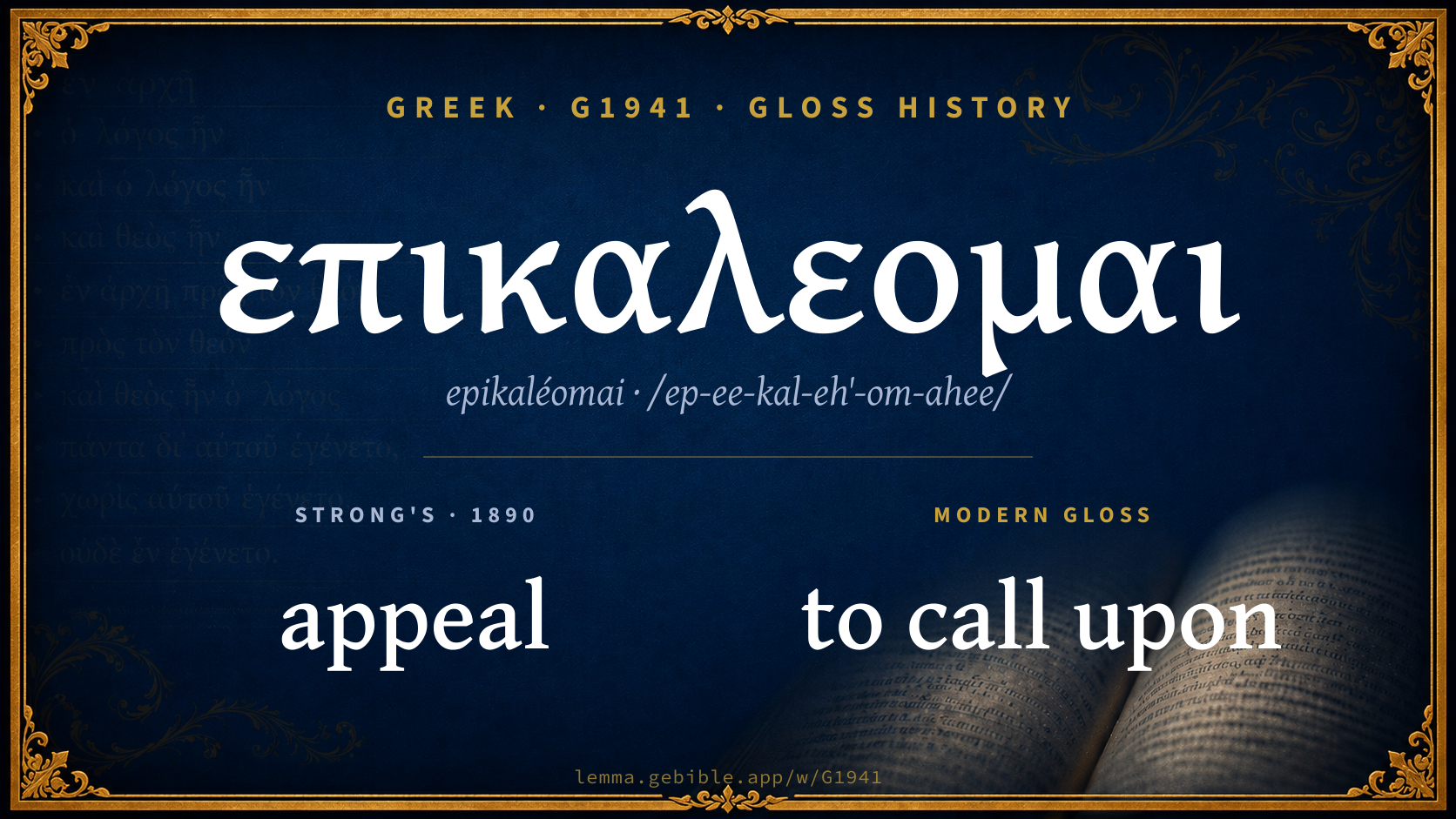
Gloss history
Strong's 1890 vs modern scholarship
About this word
Strong's G1941 catalogs a Greek word from the Greek New Testament.
These counts are not copied from any lexicon or concordance. They are computed here, from the morphology-tagged Greek New Testament. What Lemma adds →
- 30
- distinct verses
- The word appears in 30 distinct verses.
- 9 / 27
- NT books
- The word appears in 9 of 27 New Testament books.
- #463
- by frequency
- Top 500 most frequent Greek words (rank 463 of 5,347 Greek words by occurrence).
View all 30 occurrences in the concordance →
By section of the New Testament
By traditional corpus
Conventional, traditional groupings — biblical authorship is debated, so this is a traditional corpus grouping, not an authorship claim. Some books belong to more than one corpus (Luke is in both the Gospels and the Lukan corpus, and so on), so these shares overlap and need not total 100%. Each figure is a share of the word’s 30 distinct verses.
- Lukan (Luke–Acts) 20 verses · 67%
- Pauline corpus 6 verses · 20%
- General (Catholic) Epistles 2 verses · 7%
- Gospels 1 verse · 3%
- Hebrews 1 verse · 3%
How translations render this word
Counts come from each version’s own published word-to-Strong’s tagging or interlinear alignment — an approximate guide to how each version renders this word, not a word-level alignment the data otherwise carries. Because each total is that version’s own tagged count, the per-version totals vary from one another and need not match the appearance or distinct-verse counts above. These counts may also differ from a printed concordance because Lemma counts each distinctly tagged rendering and does not collapse phrase taggings into a single head-word total. This is a fixed set of word-tagged versions (KJV, ASV, BSB, ULT) and does not change with the reading translation you choose elsewhere. Each version’s license is shown beside its name below (and on Sources).
- King James Version: Surname is 3×, Surname was 3×, Was surnamed 3×
- American Standard Version: Call upon 3×, Was surnamed 3×, Appealed 2×
- Berean Standard Bible: Call on 4×, Called 4×, Is called 3×
- unfoldingWord Literal Text: Called 5×, Calling on 5×, Has been called 2×
King James Version Public Domain
Renders G1941 across 33 tagged occurrences — most commonly:
Plus 18 renderings that appear only once — usually multi-word phrases or single function words the recovered tagging swept in, not distinct renderings.
American Standard Version Public Domain
Renders G1941 across 29 tagged occurrences — most commonly:
Plus 15 renderings that appear only once — usually multi-word phrases or single function words the recovered tagging swept in, not distinct renderings.
Berean Standard Bible Public Domain
Renders G1941 across 30 tagged occurrences — most commonly:
Plus 15 renderings that appear only once — usually multi-word phrases or single function words the recovered tagging swept in, not distinct renderings.
unfoldingWord Literal Text CC BY-SA 4.0
Renders G1941 across 33 tagged occurrences — most commonly:
Plus 19 renderings that appear only once — usually multi-word phrases or single function words the recovered tagging swept in, not distinct renderings.
8 senses in Thayer's, in lexicon order
The 8 senses Thayer's distinguishes for this word, in lexicon order (not ranked by frequency or importance). The full entry — with sub-senses — is in the Lexicon Entry tab.
- to put a name upon, to surname
- to be named after someone
- to cry out upon or against one
- to charge something to one as a crime or reproach
- to summon one on any charge, prosecute one for a crime
- to blame one for, accuse one of
- to call upon for one's self, in one's behalf
- to call upon by pronouncing the name of Jehovah
Word origin
Derived from επι (epí) (G1909) — upon.
Forms in the corpus
The 23 distinct written forms G1941 takes in the Greek New Testament, most frequent first — each parse links to that tense’s occurrences in the concordance.
Same root — word family
Other Thayer's entries built from the same root as G1941, grouped by Strong’s listed origin. These share a root / origin per the lexicon — not necessarily a shared meaning. Each links to that word’s own entry.
Derives from
Shares the same root
- επαγγελλω epangéllō G1861 to announce
- επαγω epágō G1863 to bring upon
- επαγωνιζομαι epagōnízomai G1864 to contend
- επαθροιζω epathroízō G1865 to gather together
- επαινεω epainéō G1867 to approve
- επαινος épainos G1868 approval
- επαιρω epaírō G1869 to lift up
- επαισχυνομαι epaischýnomai G1870 to be ashamed
- επαιτεω epaitéō G1871 to ask repeatedly
- επακουω epakoúō G1873 to give ear to
- επακροαομαι epakroáomai G1874 to listen to
- επαν epán G1875 after
- επαναγκες epánankes G1876 necessarily
- επαναγω epanágō G1877 to lead back
- επαναμιμνησκω epanamimnḗskō G1878 to remind
- επαναπαυομαι epanapaúomai G1879 to rest upon
- επανερχομαι epanérchomai G1880 to return
- επανισταμαι epanístamai G1881 to raise up against
- επανορθωσις epanórthōsis G1882 correction
- επανω epánō G1883 above
- επαρκεω eparkéō G1884 to avail
- επαρχια eparchía G1885 office of governor
- επαυλις épaulis G1886 farm
- επαυριον epaúrion G1887 the next day
+110 more words share this root (not shown).
Proper names from this root
People and places named from this root — a name, not an additional meaning of the word.
Compare all same-root words → Showing 4 of 137 — not the complete family. 1 of the same-root words is a proper name (a person or place). They share a root, not necessarily a meaning.
Septuagint usage
The same Greek word επικαλεομαι appears 139 times in the Greek Old Testament (Septuagint), across 133 verses in 29 books.
- 139
- LXX occurrences
- Tagged occurrences of this Greek word in the Septuagint.
- 133
- verses
- Distinct Septuagint verses containing this word.
- 29 / 39
- OT books
- The word appears in 29 of the 39 Old Testament books.
Sample Septuagint occurrences
- Genesis 4:26 ἐπικαλέω
- Exodus 29:45 ἐπικαλέω
- Numbers 21:3 ἐπικαλέω
- Deuteronomy 4:7 ἐπικαλέω
- Joshua 21:9 ἐπικαλέω
- Judges 6:24 ἐπικαλέω
- 1 Samuel 12:17 ἐπικαλέω
- 2 Samuel 6:2 ἐπικαλέω
- 1 Kings 7:7 ἐπικαλέω
- 2 Kings 5:11 ἐπικαλέω
- 1 Chronicles 4:10 ἐπικαλέω
- 2 Chronicles 6:20 ἐπικαλέω
Septuagint occurrences (same lexeme)
Every verse where the same Strong’s number (G1941) appears in the Greek Septuagint — showing the first 50 of 133. Verse text shown in the World English Bible for context; the Greek form is the matched word — the English is not keyword-highlighted.
- Genesis 4:26 ἐπικαλέω There was also born a son to Seth, and he named him Enosh. Then men began to call on Yahweh's name.
- Genesis 12:8 ἐπικαλέω He left from there to the mountain on the east of Bethel, and pitched his tent, having Bethel on the west, and Ai on the east. There he built an altar to Yahweh, and called on the name of Yahweh.
- Genesis 13:4 ἐπικαλέω to the place of the altar, which he had made there at the first. There Abram called on the name of Yahweh.
- Genesis 21:33 ἐπικαλέω Abraham planted a tamarisk tree in Beersheba, and called there on the name of Yahweh, the Everlasting God.
- Genesis 26:25 ἐπικαλέω He built an altar there, and called on the name of Yahweh, and pitched his tent there. There Isaac's servants dug a well.
- Genesis 33:20 ἐπικαλέω He erected an altar there, and called it El Elohe Israel.
- Genesis 48:16 ἐπικαλέω the angel who has redeemed me from all evil, bless the lads, and let my name be named on them, and the name of my fathers Abraham and Isaac. Let them grow into a multitude in the midst of the earth."
- Exodus 29:45 ἐπικαλέω I will dwell among the children of Israel, and will be their God.
- Exodus 29:46 ἐπικαλέω They shall know that I am Yahweh their God, who brought them forth out of the land of Egypt, that I might dwell among them: I am Yahweh their God.
- Numbers 21:3 ἐπικαλέω Yahweh listened to the voice of Israel, and delivered up the Canaanites; and they utterly destroyed them and their cities: and the name of the place was called Hormah.
- Deuteronomy 4:7 ἐπικαλέω For what great nation is there, that has a god so near to them, as Yahweh our God is whenever we call on him?
- Deuteronomy 12:5 ἐπικαλέω But to the place which Yahweh your God shall choose out of all your tribes, to put his name there, even to his habitation shall you seek, and there you shall come;
- Deuteronomy 12:11 ἐπικαλέω then it shall happen that to the place which Yahweh your God shall choose, to cause his name to dwell there, there shall you bring all that I command you: your burnt offerings, and your sacrifices, your tithes, and the heave-offering of your hand, and all your choice vows which you vow to Yahweh.
- Deuteronomy 12:21 ἐπικαλέω If the place which Yahweh your God shall choose, to put his name there, be too far from you, then you shall kill of your herd and of your flock, which Yahweh has given you, as I have commanded you; and you may eat within your gates, after all the desire of your soul.
- Deuteronomy 12:26 ἐπικαλέω Only your holy things which you have, and your vows, you shall take, and go to the place which Yahweh shall choose:
- Deuteronomy 14:23 ἐπικαλέω You shall eat before Yahweh your God, in the place which he shall choose, to cause his name to dwell there, the tithe of your grain, of your new wine, and of your oil, and the firstborn of your herd and of your flock; that you may learn to fear Yahweh your God always.
- Deuteronomy 14:24 ἐπικαλέω If the way be too long for you, so that you are not able to carry it, because the place is too far from you, which Yahweh your God shall choose, to set his name there, when Yahweh your God shall bless you;
- Deuteronomy 15:2 ἐπικαλέω This is the manner of the release: every creditor shall release that which he has lent to his neighbor; he shall not exact it of his neighbor and his brother; because Yahweh's release has been proclaimed.
- Deuteronomy 16:2 ἐπικαλέω You shall sacrifice the Passover to Yahweh your God, of the flock and the herd, in the place which Yahweh shall choose, to cause his name to dwell there.
- Deuteronomy 16:6 ἐπικαλέω but at the place which Yahweh your God shall choose, to cause his name to dwell in, there you shall sacrifice the Passover at even, at the going down of the sun, at the season that you came forth out of Egypt.
- Deuteronomy 16:11 ἐπικαλέω and you shall rejoice before Yahweh your God, you, and your son, and your daughter, and your man-servant, and your maid-servant, and the Levite who is within your gates, and the foreigner, and the fatherless, and the widow, who are in the midst of you, in the place which Yahweh your God shall choose, to cause his name to dwell there.
- Deuteronomy 17:8 ἐπικαλέω If there arise a matter too hard for you in judgment, between blood and blood, between plea and plea, and between stroke and stroke, being matters of controversy within your gates; then shall you arise, and go up to the place which Yahweh your God shall choose;
- Deuteronomy 17:10 ἐπικαλέω You shall do according to the tenor of the sentence which they shall show you from that place which Yahweh shall choose; and you shall observe to do according to all that they shall teach you:
- Deuteronomy 26:2 ἐπικαλέω that you shall take of the first of all the fruit of the ground, which you shall bring in from your land that Yahweh your God gives you; and you shall put it in a basket, and shall go to the place which Yahweh your God shall choose, to cause his name to dwell there.
- Deuteronomy 28:10 ἐπικαλέω All the peoples of the earth shall see that you are called by the name of Yahweh; and they shall be afraid of you.
- Deuteronomy 33:19 ἐπικαλέω They shall call the peoples to the mountain; There shall they offer sacrifices of righteousness: For they shall suck the abundance of the seas, The hidden treasures of the sand.
- Joshua 21:9 ἐπικαλέω They gave out of the tribe of the children of Judah, and out of the tribe of the children of Simeon, these cities which are [here] mentioned by name:
- Judges 6:24 ἐπικαλέω Then Gideon built an altar there to Yahweh, and called it Yahweh-shalom: to this day it is yet in Ophrah of the Abiezrites.
- Judges 15:19 ἐπικαλέω But God split the hollow place that is in Lehi, and water came out of it. When he had drunk, his spirit came again, and he revived: therefore the name of it was called En Hakkore, which is in Lehi, to this day.
- 1 Samuel 12:17 ἐπικαλέω Isn't it wheat harvest today? I will call to Yahweh, that he may send thunder and rain; and you shall know and see that your wickedness is great, which you have done in the sight of Yahweh, in asking you a king.
- 1 Samuel 12:18 ἐπικαλέω So Samuel called to Yahweh; and Yahweh sent thunder and rain that day: and all the people greatly feared Yahweh and Samuel.
- 1 Samuel 23:28 ἐπικαλέω So Saul returned from pursuing after David, and went against the Philistines: therefore they called that place Sela Hammahlekoth.
- 2 Samuel 6:2 ἐπικαλέω David arose, and went with all the people who were with him, from Baale Judah, to bring up from there the ark of God, which is called by the Name, even the name of Yahweh of Hosts who sits [above] the cherubim.
- 2 Samuel 20:1 ἐπικαλέω There happened to be there a base fellow, whose name was Sheba, the son of Bichri, a Benjamite: and he blew the trumpet, and said, We have no portion in David, neither have we inheritance in the son of Jesse: every man to his tents, Israel.
- 2 Samuel 22:4 ἐπικαλέω I will call on Yahweh, who is worthy to be praised: So shall I be saved from my enemies.
- 2 Samuel 22:7 ἐπικαλέω In my distress I called on Yahweh; Yes, I called to my God: He heard my voice out of his temple, My cry [came] into his ears.
- 1 Kings 7:7 ἐπικαλέω He made the porch of the throne where he was to judge, even the porch of judgment: and it was covered with cedar from floor to floor.
- 1 Kings 8:43 ἐπικαλέω hear in heaven, your dwelling-place, and do according to all that the foreigner calls to you for; that all the peoples of the earth may know your name, to fear you, as does your people Israel, and that they may know that this house which I have built is called by my name.
- 1 Kings 8:52 ἐπικαλέω that your eyes may be open to the supplication of your servant, and to the supplication of your people Israel, to listen to them whenever they cry to you.
- 1 Kings 13:2 ἐπικαλέω He cried against the altar by the word of Yahweh, and said, altar, altar, thus says Yahweh: Behold, a son shall be born to the house of David, Josiah by name; and on you shall he sacrifice the priests of the high places who burn incense on you, and men's bones shall they burn on you.
- 1 Kings 13:4 ἐπικαλέω It happened, when the king heard the saying of the man of God, which he cried against the altar in Bethel, that Jeroboam put forth his hand from the altar, saying, Lay hold on him. His hand, which he put forth against him, dried up, so that he could not draw it back again to him.
- 1 Kings 16:24 ἐπικαλέω He bought the hill Samaria of Shemer for two talents of silver; and he built on the hill, and called the name of the city which he built, after the name of Shemer, the owner of the hill, Samaria.
- 1 Kings 17:21 ἐπικαλέω He stretched himself on the child three times, and cried to Yahweh, and said, Yahweh my God, please let this child's soul come into him again.
- 1 Kings 18:24 ἐπικαλέω You call on the name of your god, and I will call on the name of Yahweh; and the God who answers by fire, let him be God." All the people answered, "It is well said."
- 1 Kings 18:25 ἐπικαλέω Elijah said to the prophets of Baal, "Choose one bull for yourselves, and dress it first; for you are many; and call on the name of your god, but put no fire under it."
- 1 Kings 18:26 ἐπικαλέω They took the bull which was given them, and they dressed it, and called on the name of Baal from morning even until noon, saying, Baal, hear us. But there was no voice, nor any who answered. They leaped about the altar which was made.
- 1 Kings 18:27 ἐπικαλέω It happened at noon, that Elijah mocked them, and said, Cry aloud; for he is a god: either he is musing, or he is gone aside, or he is on a journey, or peradventure he sleeps and must be awakened.
- 1 Kings 18:28 ἐπικαλέω They cried aloud, and cut themselves after their manner with knives and lances, until the blood gushed out on them.
- 2 Kings 5:11 ἐπικαλέω But Naaman was angry, and went away, and said, Behold, I thought, He will surely come out to me, and stand, and call on the name of Yahweh his God, and wave his hand over the place, and recover the leper.
- 2 Kings 23:17 ἐπικαλέω Then he said, What monument is that which I see? The men of the city told him, It is the tomb of the man of God, who came from Judah, and proclaimed these things that you have done against the altar of Bethel.
These are occurrences of the same Greek lexeme (G1941) in the Septuagint — not a translation of any one Hebrew word. The store carries no word-level Hebrew↔Greek alignment, so no Hebrew original is asserted here. Counts come from the recovered LXX Strong's tagging — high-frequency vocabulary is well covered, while rare or late forms may be untagged — so they reflect tagged occurrences and may slightly undercount.