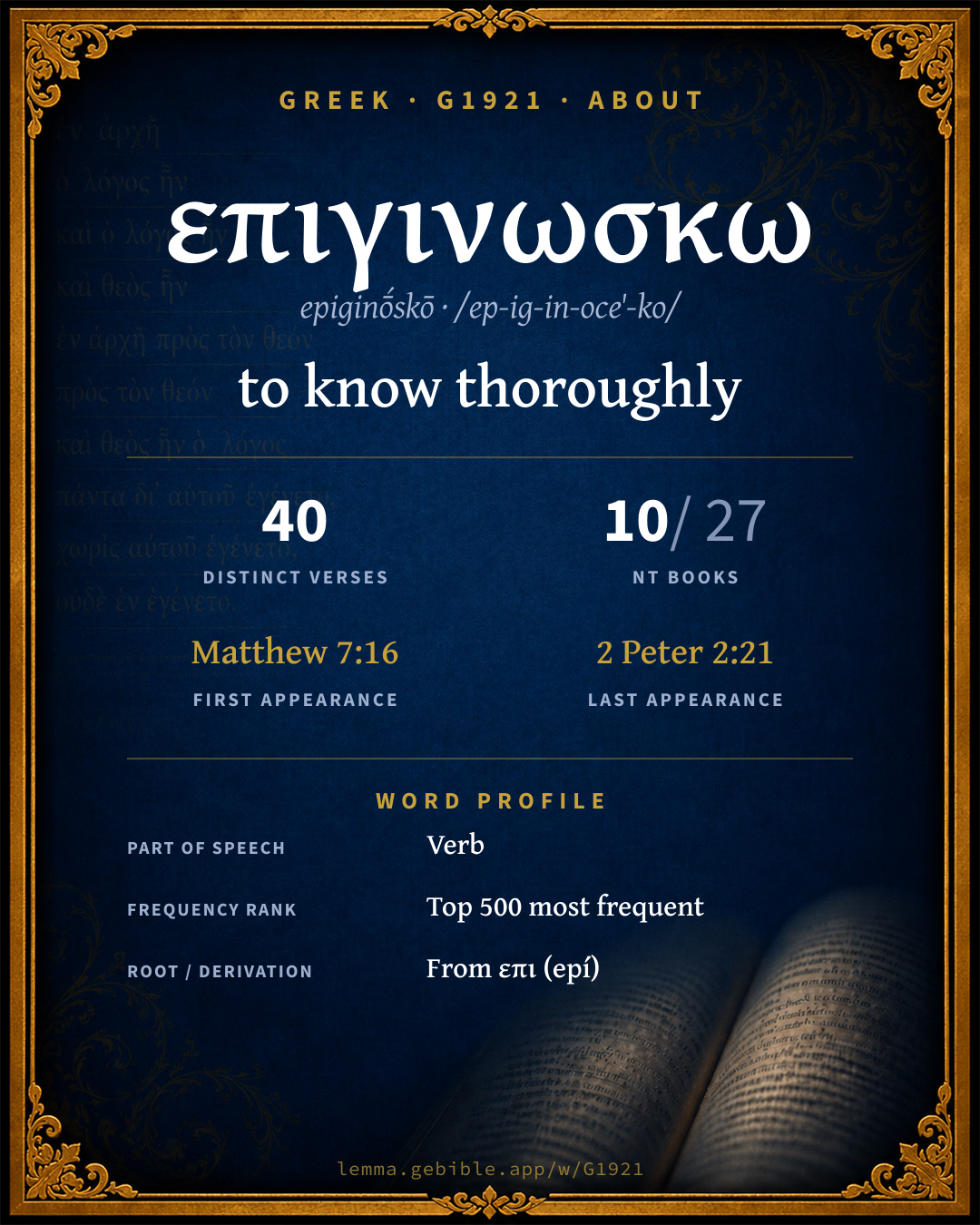
ἐπιγινώσκω
to know thoroughly
‘to know thoroughly’ is one of 5 main senses fuller range ↓
Full lexicon entry — Thayer's Greek Lexicon
From Thayer's Greek Lexicon
Where this word appears
See every Aorist-tense verb in the Greek New Testament →
Grammar key — what these labels mean
Part of speech
- Verb
- An action or state-of-being word.
Tense
- Aorist
- Action viewed as a simple whole, without regard to duration — often past (perfective aspect).
- Future
- Action expected in future time.
- Imperfect
- Continuous or repeated action in past time (“was writing”).
- Present
- Ongoing or general action in present time (imperfective aspect).
- Perfect
- A completed past action with continuing present results.
Voice
- Active
- The subject performs the action.
- Middle deponent
- Middle in form but active in meaning.
- Passive
- The subject receives the action.
Mood
- Participle
- A verbal adjective (“writing,” “having written”).
- Indicative
- States a fact or asks a factual question (the mood of reality).
- Infinitive
- A verbal noun (“to write”), unmarked for person or number.
- Subjunctive
- Expresses probability, purpose, or possibility (the mood of contingency).
- Imperative
- Expresses a command or request.
Case
- Nominative
- The case of the subject (and the predicate nominative).
- Dative
- The case of the indirect object, means, or location — “to / for / with / in.”
Person
- 3rd person
- The one spoken about (“he / she / it / they”).
- 2nd person
- The one addressed (“you”).
- 1st person
- The speaker (“I / we”).
Gender
- Masculine
- Grammatically masculine.
- Feminine
- Grammatically feminine.
Number
- Plural
- More than one.
- Singular
- One.
Grammatical forms 22 distinct
- Verb, Aorist, Active, Participle, Nominative, Plural, Masculine 5 times (11%)
- Verb, Aorist, Active, Participle, Nominative, Singular, Masculine 5 times (11%)
- Verb, Aorist, Active, Indicative, 3rd person, Plural 4 times (9%)
- Verb, Aorist, Active, Infinitive 4 times (9%)
- Verb, Future, Middle deponent, Indicative, 2nd person, Plural 3 times (7%)
- Verb, Imperfect, Active, Indicative, 3rd person, Plural 3 times (7%)
- Verb, Aorist, Active, Indicative, 2nd person, Plural 2 times (5%)
- Verb, Aorist, Active, Participle, Nominative, Singular, Feminine 2 times (5%)
+14 more forms (16 occurrences)
Parsed forms decoded from the imported morphology (Robinson–Tischendorf, public domain), counted across 44 parsed occurrences — not distinct verses.
Every verse where G1921 appears — 40 distinct verses across 10 books. Click any verse to open its interlinear word-by-word view. Verse text shown in the World English Bible for context — . Each verse’s Greek form is shown with its reference; the English is not keyword-highlighted, since the data carries no word-level English alignment. Use “Compare translations” on any verse to read it across multiple English versions. This concordance covers the Greek New Testament; Septuagint (Greek Old Testament) occurrences of this word are not indexed here.
Matthew 5 verses
- Matthew 7:16 ἐπιγνώσεσθε fut mid.dep ind 2pl By their fruits you will know them. Do you gather grapes from thorns, or figs from thistles?
- Matthew 7:20 ἐπιγνώσεσθε fut mid.dep ind 2pl Therefore, by their fruits you will know them.
- Matthew 11:27 ἐπιγινώσκει ἐπιγινώσκει pres act ind 3sg pres act ind 3sg All things have been delivered to me by my Father. No one knows the Son, except the Father; neither does anyone know the Father, except the Son, and he to whom the Son desires to reveal him.
- Matthew 14:35 ἐπιγνόντες aor act ptcp nom pl masc When the men of that place recognized him, they sent into all that surrounding region, and brought to him all who were sick,
- Matthew 17:12 ἐπέγνωσαν aor act ind 3pl but I tell you that Elijah has come already, and they didn't recognize him, but did to him whatever they wanted to. Even so the Son of Man will also suffer by them."
Mark 4 verses
- Mark 2:8 ἐπιγνοὺς aor act ptcp nom sg masc Immediately Jesus, perceiving in his spirit that they so reasoned within themselves, said to them, "Why do you reason these things in your hearts?
- Mark 5:30 ἐπιγνοὺς aor act ptcp nom sg masc Immediately Jesus, perceiving in himself that the power had gone out from him, turned around in the crowd, and asked, "Who touched my clothes?"
- Mark 6:33 ἐπέγνωσαν aor act ind 3pl They saw them going, and many recognized him and ran there on foot from all the cities. They arrived before them and came together to him.
- Mark 6:54 ἐπιγνόντες aor act ptcp nom pl masc When they had come out of the boat, immediately the people recognized him,
Luke 7 verses
- Luke 1:4 ἐπιγνῷς aor act subj 2sg that you might know the certainty concerning the things in which you were instructed.
- Luke 1:22 ἐπέγνωσαν aor act ind 3pl When he came out, he could not speak to them, and they perceived that he had seen a vision in the temple. He continued making signs to them, and remained mute.
- Luke 5:22 ἐπιγνοὺς aor act ptcp nom sg masc But Jesus, perceiving their thoughts, answered them, "Why are you reasoning so in your hearts?
- Luke 7:37 ἐπιγνοῦσα aor act ptcp nom sg fem Behold, a woman in the city who was a sinner, when she knew that he was reclining in the Pharisee's house, she brought an alabaster jar of ointment.
- Luke 23:7 ἐπιγνοὺς aor act ptcp nom sg masc When he found out that he was in Herod's jurisdiction, he sent him to Herod, who was also in Jerusalem during those days.
- Luke 24:16 ἐπιγνῶναι aor act inf But their eyes were kept from recognizing him.
- Luke 24:31 ἐπέγνωσαν aor act ind 3pl Their eyes were opened, and they recognized him, and he vanished out of their sight.
Acts 13 verses
- Acts 3:10 ἐπεγίνωσκον impf act ind 3pl They recognized him, that it was he who used to sit begging for gifts for the needy at the Beautiful Gate of the temple. They were filled with wonder and amazement at what had happened to him.
- Acts 4:13 ἐπεγίνωσκόν impf act ind 3pl Now when they saw the boldness of Peter and John, and had perceived that they were unlearned and ignorant men, they marveled. They recognized that they had been with Jesus.
- Acts 9:30 ἐπιγνόντες aor act ptcp nom pl masc When the brothers knew it, they brought him down to Caesarea, and sent him off to Tarsus.
- Acts 12:14 ἐπιγνοῦσα aor act ptcp nom sg fem When she recognized Peter's voice, she didn't open the gate for joy, but ran in, and reported that Peter was standing in front of the gate.
- Acts 19:34 ἐπιγνόντες aor act ptcp nom pl masc But when they perceived that he was a Jew, all with one voice for a time of about two hours cried out, "Great is Artemis of the Ephesians!"
- Acts 22:24 ἐπιγνῷ aor act subj 3sg the commanding officer commanded him to be brought into the barracks, ordering him to be examined by scourging, that he might know for what crime they shouted against him like that.
- Acts 22:29 ἐπιγνοὺς aor act ptcp nom sg masc Immediately those who were about to examine him departed from him, and the commanding officer also was afraid when he realized that he was a Roman, because he had bound him.
- Acts 23:28 ἐπιγνῶναι aor act inf Desiring to know the cause why they accused him, I brought him down to their council.
- Acts 24:8 ἐπιγνῶναι aor act inf By examining him yourself you may ascertain all these things of which we accuse him."
- Acts 24:11 ἐπιγνῶναι aor act inf seeing that you can recognize that it is not more than twelve days since I went up to worship at Jerusalem.
- Acts 25:10 ἐπιγινώσκεις pres act ind 2sg But Paul said, "I am standing before Caesar's judgment seat, where I ought to be tried. I have done no wrong to the Jews, as you also know very well.
- Acts 27:39 ἐπεγίνωσκον impf act ind 3pl When it was day, they didn't recognize the land, but they noticed a certain bay with a beach, and they decided to try to drive the ship onto it.
- Acts 28:1 ἐπέγνωμεν aor act ind 1pl When we had escaped, then they learned that the island was called Malta.
Romans 1 verse
1 Corinthians 3 verses
- 1 Corinthians 13:12 ἐπιγνώσομαι ἐπεγνώσθην fut mid.dep ind 1sg aor pass ind 1sg For now we see in a mirror, dimly, but then face to face. Now I know in part, but then I will know fully, even as I was also fully known.
- 1 Corinthians 14:37 ἐπιγινωσκέτω pres act impv 3sg If any man thinks himself to be a prophet, or spiritual, let him recognize the things which I write to you, that they are the commandment of the Lord.
- 1 Corinthians 16:18 ἐπιγινώσκετε pres act impv 2pl For they refreshed my spirit and yours. Therefore acknowledge those who are like that.
2 Corinthians 4 verses
- 2 Corinthians 1:13 ἐπιγινώσκετε ἐπιγνώσεσθε pres act ind 2pl fut mid.dep ind 2pl For we write no other things to you, than what you read or even acknowledge, and I hope you will acknowledge to the end;
- 2 Corinthians 1:14 ἐπέγνωτε aor act ind 2pl as also you acknowledged us in part, that we are your boasting, even as you also are ours, in the day of our Lord Jesus.
- 2 Corinthians 6:9 ἐπιγινωσκόμενοι pres pass ptcp nom pl masc as unknown, and yet well known; as dying, and behold, we live; as punished, and not killed;
- 2 Corinthians 13:5 ἐπιγινώσκετε pres act ind 2pl Test your own selves, whether you are in the faith. Test your own selves. Or don't you know as to your own selves, that Jesus Christ is in you?--unless indeed you are disqualified.
Colossians 1 verse
1 Timothy 1 verse
2 Peter 1 verse
About this entry
At a glance — auto-summarized from this page’s data, not written by a person. Every figure links to its source below. This summary describes the numbers; it doesn’t interpret them.
“to know thoroughly” is the headline sense of the Greek verb επιγινωσκω (epiginṓskō). Lexicons map it across 5 senses. With 40 verses in 10 books, it is a moderately common word in the Greek New Testament. It concentrates in Acts, which alone accounts for 33% of its uses. First canonically at Matthew 7:16, it enters the text early. The sections below give every sense, occurrence, and version rendering.
Gloss history
Strong's 1890 vs modern scholarship

About this word
Strong's G1921 catalogs a Greek word from the Greek New Testament.
These counts are not copied from any lexicon or concordance. They are computed here, from the morphology-tagged Greek New Testament. What Lemma adds →
- 40
- distinct verses
- The word appears in 40 distinct verses.
- 10 / 27
- NT books
- The word appears in 10 of 27 New Testament books.
- #343
- by frequency
- Top 500 most frequent Greek words (rank 343 of 5,347 Greek words by occurrence).
View all 40 occurrences in the concordance →
By section of the New Testament
By traditional corpus
Conventional, traditional groupings — biblical authorship is debated, so this is a traditional corpus grouping, not an authorship claim. Some books belong to more than one corpus (Luke is in both the Gospels and the Lukan corpus, and so on), so these shares overlap and need not total 100%. Each figure is a share of the word’s 40 distinct verses.
- Lukan (Luke–Acts) 20 verses · 50%
- Gospels 16 verses · 40%
- Pauline corpus 10 verses · 25%
- General (Catholic) Epistles 1 verse · 3%
How translations render this word
Counts come from each version’s own published word-to-Strong’s tagging or interlinear alignment — an approximate guide to how each version renders this word, not a word-level alignment the data otherwise carries. Because each total is that version’s own tagged count, the per-version totals vary from one another and need not match the appearance or distinct-verse counts above. These counts may also differ from a printed concordance because Lemma counts each distinctly tagged rendering and does not collapse phrase taggings into a single head-word total. This is a fixed set of word-tagged versions (KJV, ASV, BSB, ULT) and does not change with the reading translation you choose elsewhere. Each version’s license is shown beside its name below (and on Sources).
- King James Version: They knew 7×, Knew 3×, Know 2×
- American Standard Version: Knew 4×, Know 3×, Perceiving 3×
- Berean Standard Bible: Know 3×, Recognized 3×, Have known 2×
- unfoldingWord Literal Text: Having recognized 3×, Know 3×, Recognize 3×
King James Version Public Domain
Renders G1921 across 43 tagged occurrences — most commonly:
Plus 21 renderings that appear only once — usually multi-word phrases or single function words the recovered tagging swept in, not distinct renderings.
American Standard Version Public Domain
Renders G1921 across 43 tagged occurrences — most commonly:
Plus 18 renderings that appear only once — usually multi-word phrases or single function words the recovered tagging swept in, not distinct renderings.
Berean Standard Bible Public Domain
Renders G1921 across 44 tagged occurrences — most commonly:
Plus 24 renderings that appear only once — usually multi-word phrases or single function words the recovered tagging swept in, not distinct renderings.
unfoldingWord Literal Text CC BY-SA 4.0
Renders G1921 across 51 tagged occurrences — most commonly:
Plus 25 renderings that appear only once — usually multi-word phrases or single function words the recovered tagging swept in, not distinct renderings.
Senses in Thayer's
The 5 senses Thayer's distinguishes for this word, in lexicon order (not ranked by frequency or importance). The full entry — with sub-senses — is in the Lexicon Entry tab.
- to become thoroughly acquainted with, to know thoroughly
- to recognise
- to know i.e. to perceive
- to know i.e. to find out, ascertain
- to know i.e. to understand
Word origin
Derived from επι (epí) (G1909) — upon.
Forms in the corpus
The 22 distinct written forms G1921 takes in the Greek New Testament, most frequent first — each parse links to that tense’s occurrences in the concordance.
Same root — word family
Other Thayer's entries built from the same root as G1921, grouped by Strong’s listed origin. These share a root / origin per the lexicon — not necessarily a shared meaning. Each links to that word’s own entry.
Derives from
Shares the same root
- επαγγελλω epangéllō G1861 to announce
- επαγω epágō G1863 to bring upon
- επαγωνιζομαι epagōnízomai G1864 to contend
- επαθροιζω epathroízō G1865 to gather together
- επαινεω epainéō G1867 to approve
- επαινος épainos G1868 approval
- επαιρω epaírō G1869 to lift up
- επαισχυνομαι epaischýnomai G1870 to be ashamed
- επαιτεω epaitéō G1871 to ask repeatedly
- επακουω epakoúō G1873 to give ear to
- επακροαομαι epakroáomai G1874 to listen to
- επαν epán G1875 after
- επαναγκες epánankes G1876 necessarily
- επαναγω epanágō G1877 to lead back
- επαναμιμνησκω epanamimnḗskō G1878 to remind
- επαναπαυομαι epanapaúomai G1879 to rest upon
- επανερχομαι epanérchomai G1880 to return
- επανισταμαι epanístamai G1881 to raise up against
- επανορθωσις epanórthōsis G1882 correction
- επανω epánō G1883 above
- επαρκεω eparkéō G1884 to avail
- επαρχια eparchía G1885 office of governor
- επαυλις épaulis G1886 farm
- επαυριον epaúrion G1887 the next day
+110 more words share this root (not shown).
Derived from this word
Proper names from this root
People and places named from this root — a name, not an additional meaning of the word.
Compare all same-root words → Showing 4 of 138 — not the complete family. 1 of the same-root words is a proper name (a person or place). They share a root, not necessarily a meaning.
Septuagint usage
The same Greek word επιγινωσκω appears 96 times in the Greek Old Testament (Septuagint), across 94 verses in 24 books.
- 96
- LXX occurrences
- Tagged occurrences of this Greek word in the Septuagint.
- 94
- verses
- Distinct Septuagint verses containing this word.
- 24 / 39
- OT books
- The word appears in 24 of the 39 Old Testament books.
Sample Septuagint occurrences
- Genesis 27:23 ἐπιγιγνώσκω
- Deuteronomy 1:17 ἐπιγιγνώσκω
- Judges 18:3 ἐπιγιγνώσκω
- Ruth 2:10 ἐπιγιγνώσκω
- 1 Samuel 26:17 ἐπιγιγνώσκω
- 2 Samuel 19:8 ἐπιγινώσκω
- 1 Kings 21:41 ἐπιγιγνώσκω
- Ezra 3:13 ἐπιγιγνώσκω
- Esther 3:5 ἐπιγιγνώσκω
- Job 2:12 ἐπιγιγνώσκω
- Psalms 102:16 ἐπιγιγνώσκω
- Proverbs 14:8 ἐπιγιγνώσκω
Septuagint occurrences (same lexeme)
Every verse where the same Strong’s number (G1921) appears in the Greek Septuagint — showing the first 50 of 94. Verse text shown in the World English Bible for context; the Greek form is the matched word — the English is not keyword-highlighted.
- Genesis 27:23 ἐπιγιγνώσκω He didn't recognize him, because his hands were hairy, like his brother, Esau's hands. So he blessed him.
- Genesis 31:32 ἐπιγιγνώσκω With whoever you find your gods, he shall not live. Before our relatives, discern what is yours with me, and take it." For Jacob didn't know that Rachel had stolen them.
- Genesis 37:32 ἐπιγιγνώσκω They took the coat of many colors, and they brought it to their father, and said, "We have found this. Examine it, now, whether it is your son's coat or not."
- Genesis 37:33 ἐπιγιγνώσκω He recognized it, and said, "It is my son's coat. An evil animal has devoured him. Joseph is without doubt torn in pieces."
- Genesis 38:15 ἐπιγιγνώσκω When Judah saw her, he thought that she was a prostitute, for she had covered her face.
- Genesis 38:25 ἐπιγιγνώσκω When she was brought forth, she sent to her father-in-law, saying, "By the man, whose these are, I am with child." She also said, "Please discern whose are these-- the signet, and the cords, and the staff."
- Genesis 38:26 ἐπιγιγνώσκω Judah acknowledged them, and said, "She is more righteous than I, because I didn't give her to Shelah, my son." He knew her again no more.
- Genesis 41:31 ἐπιγιγνώσκω and the plenty will not be known in the land by reason of that famine which follows; for it will be very grievous.
- Genesis 42:7 ἐπιγιγνώσκω Joseph saw his brothers, and he recognized them, but acted like a stranger to them, and spoke roughly with them. He said to them, "Where did you come from?" They said, "From the land of Canaan to buy food."
- Genesis 42:8 ἐπιγιγνώσκω Joseph recognized his brothers, but they didn't recognize him.
- Deuteronomy 1:17 ἐπιγιγνώσκω You shall not show partiality in judgment; you shall hear the small and the great alike; you shall not be afraid of the face of man; for the judgment is God's: and the cause that is too hard for you, you shall bring to me, and I will hear it.
- Deuteronomy 16:19 ἐπιγιγνώσκω You shall not wrest justice: you shall not respect persons; neither shall you take a bribe; for a bribe does blind the eyes of the wise, and pervert the words of the righteous.
- Deuteronomy 21:17 ἐπιγιγνώσκω but he shall acknowledge the firstborn, the son of the hated, by giving him a double portion of all that he has; for he is the beginning of his strength; the right of the firstborn is his.
- Deuteronomy 33:9 ἐπιγιγνώσκω Who said of his father, and of his mother, I have not seen him; Neither did he acknowledge his brothers, Nor knew he his own children: For they have observed your word, Keep your covenant.
- Judges 18:3 ἐπιγιγνώσκω When they were by the house of Micah, they knew the voice of the young man the Levite; and they turned aside there, and said to him, Who brought you here? and what do you in this place? and what have you here?
- Ruth 2:10 ἐπιγιγνώσκω Then she fell on her face, and bowed herself to the ground, and said to him, Why have I found favor in your sight, that you should take knowledge of me, seeing I am a foreigner?
- Ruth 2:19 ἐπιγιγνώσκω Her mother-in-law said to her, Where have you gleaned today? and where have you worked? blessed be he who did take knowledge of you. She shown her mother-in-law with whom she had worked, and said, The man's name with whom I worked today is Boaz.
- Ruth 3:14 ἐπιγιγνώσκω She lay at his feet until the morning. She rose up before one could discern another. For he said, Let it not be known that the woman came to the threshing floor.
- Ruth 3:18 ἐπιγιγνώσκω Then said she, "Sit still, my daughter, until you know how the matter will fall; for the man will not rest, until he has finished the thing this day."
- 1 Samuel 26:17 ἐπιγιγνώσκω Saul knew David's voice, and said, Is this your voice, my son David? David said, It is my voice, my lord, O king.
- 2 Samuel 19:8 ἐπιγινώσκω Then the king arose, and sat in the gate. They told to all the people, saying, Behold, the king is sitting in the gate: and all the people came before the king. Now Israel had fled every man to his tent.
- 1 Kings 21:41 ἐπιγιγνώσκω
- Ezra 3:13 ἐπιγιγνώσκω so that the people could not discern the noise of the shout of joy from the noise of the weeping of the people; for the people shouted with a loud shout, and the noise was heard afar off.
- Ezra 16:12 ἐπιγιγνώσκω
- Ezra 23:24 ἐπιγιγνώσκω
- Esther 3:5 ἐπιγιγνώσκω When Haman saw that Mordecai didn't bow down, nor did him reverence, then was Haman full of wrath.
- Esther 4:1 ἐπιγιγνώσκω Now when Mordecai knew all that was done, Mordecai tore his clothes, and put on sackcloth with ashes, and went out into the midst of the city, and cried with a loud and a bitter cry;
- Job 2:12 ἐπιγιγνώσκω When they lifted up their eyes from a distance, and didn't recognize him, they raised their voices, and wept; and they each tore his robe, and sprinkled dust on their heads toward the sky.
- Job 4:16 ἐπιγιγνώσκω It stood still, but I couldn't discern the appearance of it; A form was before my eyes. Silence, then I heard a voice, saying,
- Job 6:17 ἐπιγιγνώσκω In the dry season, they vanish. When it is hot, they are consumed out of their place.
- Job 7:10 ἐπιγιγνώσκω He shall return no more to his house, Neither shall his place know him any more.
- Job 24:13 ἐπιγιγνώσκω "These are of those who rebel against the light; They don't know the ways of it, Nor abide in the paths of it.
- Job 24:16 ἐπιγιγνώσκω In the dark they dig through houses. They shut themselves up in the daytime. They don't know the light.
- Job 24:17 ἐπιγιγνώσκω For the morning is to all of them like thick darkness, For they know the terrors of the thick darkness.
- Job 34:27 ἐπιγιγνώσκω Because they turned aside from following him, And wouldn't have regard in any of his ways:
- Psalms 102:16 ἐπιγιγνώσκω For Yahweh has built up Zion. He has appeared in his glory.
- Psalms 141:5 ἐπιγιγνώσκω Let the righteous strike me, it is kindness; Let him reprove me, it is like oil on the head; Don't let my head refuse it; Yet my prayer is always against evil deeds.
- Proverbs 14:8 ἐπιγιγνώσκω The wisdom of the prudent is to think about his way, But the folly of fools is deceit.
- Proverbs 24:23 ἐπιγιγνώσκω These also are sayings of the wise. To show partiality in judgment is not good.
- Proverbs 27:23 ἐπιγιγνώσκω Know well the state of your flocks, And pay attention to your herds:
- Proverbs 30:18 ἐπιγιγνώσκω "There are three things which are too amazing for me, Four which I don't understand:
- Isaiah 61:9 ἐπιγιγνώσκω Their seed shall be known among the nations, and their offspring among the peoples; all who see them shall acknowledge them, that they are the seed which Yahweh has blessed.
- Isaiah 63:16 ἐπιγιγνώσκω For you are our Father, though Abraham doesn't know us, and Israel does not acknowledge us: you, Yahweh, are our Father; our Redeemer from everlasting is your name.
- Jeremiah 4:22 ἐπιγιγνώσκω For my people are foolish, they don't know me; they are foolish children, and they have no understanding; they are wise to do evil, but to do good they have no knowledge.
- Jeremiah 5:5 ἐπιγιγνώσκω I will get me to the great men, and will speak to them; for they know the way of Yahweh, and the law of their God. But these with one accord have broken the yoke, and burst the bonds.
- Jeremiah 24:5 ἐπιγιγνώσκω Thus says Yahweh, the God of Israel: Like these good figs, so will I regard the captives of Judah, whom I have sent out of this place into the land of the Chaldeans, for good.
- Lamentations 4:8 ἐπιγιγνώσκω Their visage is blacker than a coal; they are not known in the streets: Their skin cleaves to their bones; it is withered, it is become like a stick.
- Ezekiel 5:13 ἐπιγιγνώσκω Thus shall my anger be accomplished, and I will cause my wrath toward them to rest, and I shall be comforted; and they shall know that I, Yahweh, have spoken in my zeal, when I have accomplished my wrath on them.
- Ezekiel 6:7 ἐπιγιγνώσκω The slain shall fall in the midst of you, and you shall know that I am Yahweh.
- Ezekiel 6:10 ἐπιγιγνώσκω They shall know that I am Yahweh: I have not said in vain that I would do this evil to them.
These are occurrences of the same Greek lexeme (G1921) in the Septuagint — not a translation of any one Hebrew word. The store carries no word-level Hebrew↔Greek alignment, so no Hebrew original is asserted here. Counts come from the recovered LXX Strong's tagging — high-frequency vocabulary is well covered, while rare or late forms may be untagged — so they reflect tagged occurrences and may slightly undercount.