

2 Corinthians 13:5
Greek (Tischendorf 8th ed.) 2 Corinthians 13:5 appears in the Greek New Testament. The text above is from the Tischendorf 8th edition. Each word links to its Strong’s number and a concise gloss. Click any word for its full Thayer’s Greek Lexicon entry.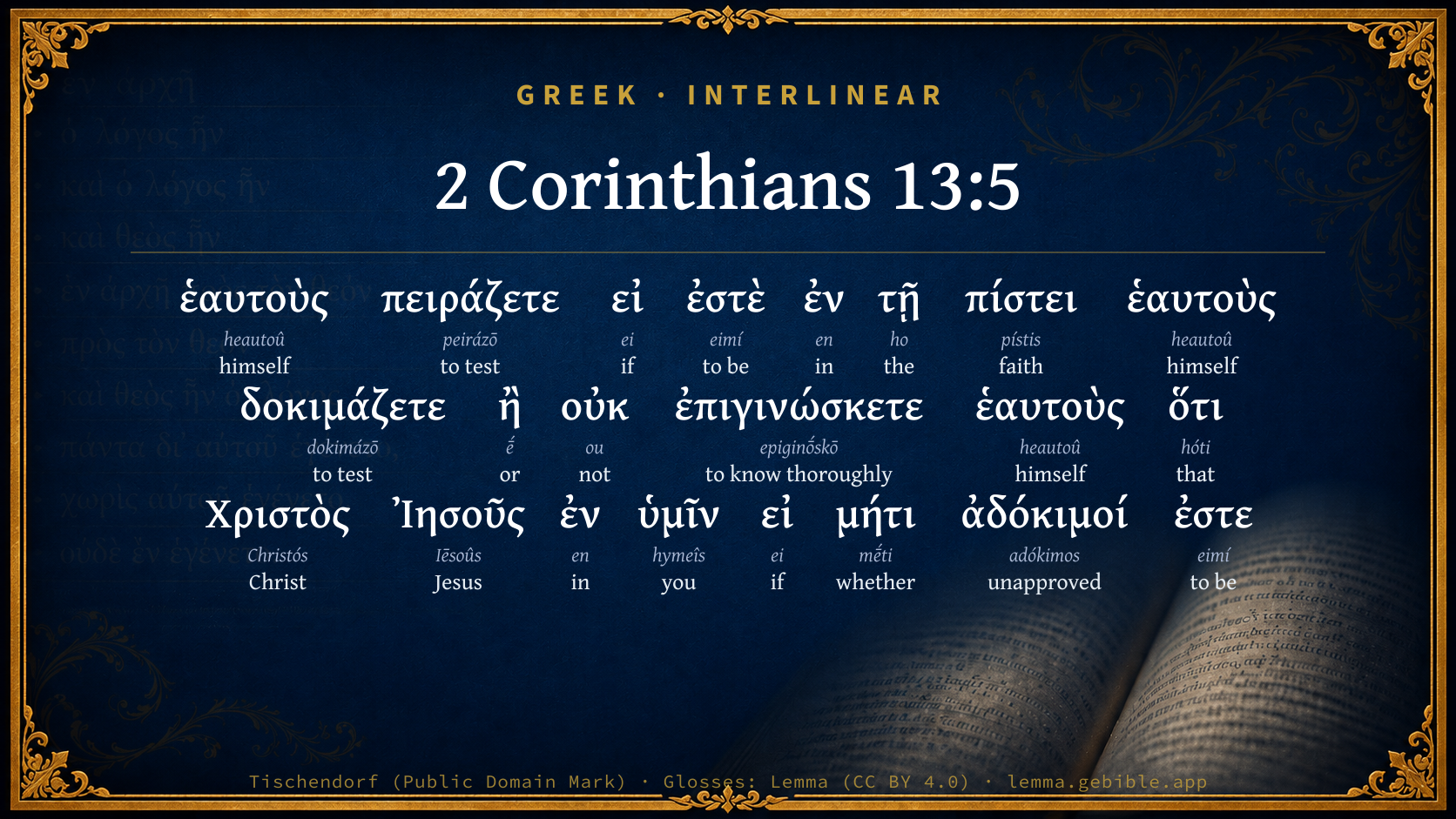
Test your own selves, whether you are in the faith. Test your own selves. Or don't you know as to your own selves, that Jesus Christ is in you?--unless indeed you are disqualified.
Download a study sheet
One document with this verse’s original text, its word-by-word gloss line, the meaning frame, cross-references with their text, attributed commentary, and full source and license credits — printable, and it pastes into notes with its structure intact.
This verse Autodidact and up
A passage Seminary Student
Up to 50 verses in one chapter. A passage sheet keeps up to 6 commentary sources and 12 cross-references per verse, in the order this page ranks them, and says so on the sheet whenever that leaves anything out. Ask for a single verse and you get the Autodidact verse sheet above.
Everything on this page stays free to read, with no account — the sheet is a download of what is already on screen, not access to it.
Compare translations 3
The same verse in 3 English versions, stacked beneath the original-language interlinear above. Click any original word for its lexicon entry.
Each is an independent rendering of the whole verse — the interlinear is not word-aligned to these translations.
Highlighted words mark where these versions differ — a whole-verse word diff, not a word-by-word alignment.
-
World English Bible Public Domain
Test your own selves, whether you are in the faith. Test your own selves. Or don't you know as to your own selves, that Jesus Christ is in you?--unless indeed you are disqualified.
-
King James Version Public Domain
Examine yourselves, whether ye be in the faith; prove your own selves. Know ye not your own selves, how that Jesus Christ is in you, except ye be reprobates?
-
unfoldingWord Literal Text CC BY-SA 4.0
Test yourselves, whether you are in the faith. Examine yourselves. Or do you not fully realize this about yourselves, that Jesus Christ in you—unless you are unapproved?
unfoldingWord Literal Text — © unfoldingWord, licensed CC BY-SA 4.0. Word-aligned USFM3 via Door43 (git.door43.org/unfoldingWord/en_ult).
Show all 19 translations
Every available English version of this verse, each an independent rendering of the whole verse.
-
World English Bible Public Domain
Test your own selves, whether you are in the faith. Test your own selves. Or don't you know as to your own selves, that Jesus Christ is in you?--unless indeed you are disqualified.
-
Berean Standard Bible Public Domain
Examine yourselves to see whether you are in the faith; test yourselves. Can’t you see for yourselves that Jesus Christ is in you—unless you actually fail the test?
-
Majority Standard Bible Public Domain
Examine yourselves to see whether you are in the faith; test yourselves. Do you not realize that Jesus Christ is in you—unless you actually fail the test?
-
King James Version Public Domain
Examine yourselves, whether ye be in the faith; prove your own selves. Know ye not your own selves, how that Jesus Christ is in you, except ye be reprobates?
-
American Standard Version (1901) Public Domain
Try your own selves, whether ye are in the faith; prove your own selves. Or know ye not as to your own selves, that Jesus Christ is in you? unless indeed ye be reprobate.
-
Revised Version (1885) Public Domain
Try your own selves, whether ye be in the faith; prove your own selves. Or know ye not as to your own selves, that Jesus Christ is in you? unless indeed ye be reprobate.
-
Geneva Bible (1599) Public Domain
Proue your selues whether ye are in the faith: examine your selues: knowe yee not your owne selues, howe that Iesus Christ is in you, except ye be reprobates?
-
Douay-Rheims (1899) Public Domain
Try your own selves if you be in the faith; prove ye yourselves. Know you not your own selves, that Christ Jesus is in you, unless perhaps you be reprobates?
-
Young's Literal Translation Public Domain
Your ownselves try ye, if ye are in the faith; your ownselves prove ye; do ye not know your ownselves, that Jesus Christ is in you, if ye be not in some respect disapproved of?
-
Literal Standard Version CC BY-SA 4.0
Try yourselves, if you are in the faith; prove yourselves; do you not know yourselves, that Jesus Christ is in you, if you are not disapproved of in some respect?
-
Unlocked Literal Bible CC BY-SA 4.0
Examine yourselves to see if you are in the faith. Test yourselves. Do you not realize this about yourselves that Jesus Christ is in you?—unless you have failed the test.
-
unfoldingWord Literal Text CC BY-SA 4.0
Test yourselves, whether you are in the faith. Examine yourselves. Or do you not fully realize this about yourselves, that Jesus Christ in you—unless you are unapproved?
-
Darby Bible Public Domain
examine your own selves if ye be in the faith; prove your own selves: do ye not recognise yourselves, that Jesus Christ is in you, unless indeed ye be reprobates?
-
World Messianic Bible Public Domain
Examine your own selves, whether you are in the faith. Test your own selves. Or don’t you know about your own selves, that Yeshua the Messiah is in you?—unless indeed you are disqualified.
-
Webster's Bible Public Domain
Examine yourselves, whether ye are in the faith; prove your own selves. Know ye not your own selves, that Jesus Christ is in you, except ye are reprobates?
-
Free Bible Version CC BY-SA 4.0
Examine yourselves to see if you are trusting God. Put yourselves to the test. Don't you yourselves realize that Jesus Christ is in you? Unless you have failed the test…
-
Bible in Basic English Public Domain
Make a test of yourselves, if you are in the faith; make certain of yourselves. Or are you not conscious in yourselves that Jesus Christ is in you, if you are truly Christ's?
-
Text-Critical English NT CC BY 4.0
Examine yourselves to see if you are in the faith; test yourselves. Or do you not realize that Jesus Christ is in you?—unless, of course, you fail to meet the test.
-
Tyndale New Testament (1534) Public Domain
Prove youre selves whether ye are in the fayth or not. Examen youre owne selves: knowe ye not youre awne selves how that Iesus Christ is in you excepte ye be castawayes?
Literal Standard Version (2020), Covenant Press — licensed CC BY-SA 4.0. Text via the HelloAO Bible API (eBible.org). Unlocked Literal Bible (unfoldingWord) — licensed CC BY-SA 4.0. Text via the HelloAO Bible API (eBible.org). unfoldingWord Literal Text — © unfoldingWord, licensed CC BY-SA 4.0. Word-aligned USFM3 via Door43 (git.door43.org/unfoldingWord/en_ult). Free Bible Version, Dr. Jonathan Gallagher — licensed CC BY-SA 4.0. Text via the HelloAO Bible API (eBible.org).
Word by word
More ways to search: Search by grammar → Find every occurrence → Compare this word →
Practice this passage: Drill this verse → Learn its vocabulary →
- Appears 8× in the Greek New Testament
- First appears at Romans 1:28
- Part of Speech
- Adjective
- Case
- Nominative
- Number
- Plural
- Gender
- Masculine
Full Thayer's Definition
- ἑαυτοὺς heautoû G1438 “himself” Reflexive pronoun, 2nd person, Accusative, Plural, Masculine
- πειράζετε peirázō G3985 “to test” Verb, Present, Active, Imperative, 2nd person, Plural
- εἰ ei G1487 “if” Conditional
- ἐστὲ eimí G1510 “to be” Verb, Present, Active, Indicative, 2nd person, Plural
- ἐν en G1722 “in” Preposition
- τῇ ho G3588 “the” Article, Dative, Singular, Feminine
- πίστει pístis G4102 “faith” Noun, Dative, Singular, Feminine
- ἑαυτοὺς heautoû G1438 “himself” Reflexive pronoun, 2nd person, Accusative, Plural, Masculine
- δοκιμάζετε dokimázō G1381 “to test” Verb, Present, Active, Imperative, 2nd person, Plural
- ἢ ḗ G2228 “or” Particle
- οὐκ ou G3756 “not” Particle, Negative
- ἐπιγινώσκετε epiginṓskō G1921 “to know thoroughly” Verb, Present, Active, Indicative, 2nd person, Plural
- ἑαυτοὺς heautoû G1438 “himself” Reflexive pronoun, 2nd person, Accusative, Plural, Masculine
- ὅτι hóti G3754 “that” Conjunction
- Χριστὸς Christós G5547 “Christ” Noun, Nominative, Singular, Masculine
- Ἰησοῦς Iēsoûs G2424 “Jesus” Noun, Nominative, Singular, Masculine
- ἐν en G1722 “in” Preposition
- ὑμῖν hymeîs G5210 “you” Personal pronoun, 2nd person, Dative, Plural
- εἰ ei G1487 “if” Conditional
- μήτι mḗti G3385 “whether” Particle, Interrogative
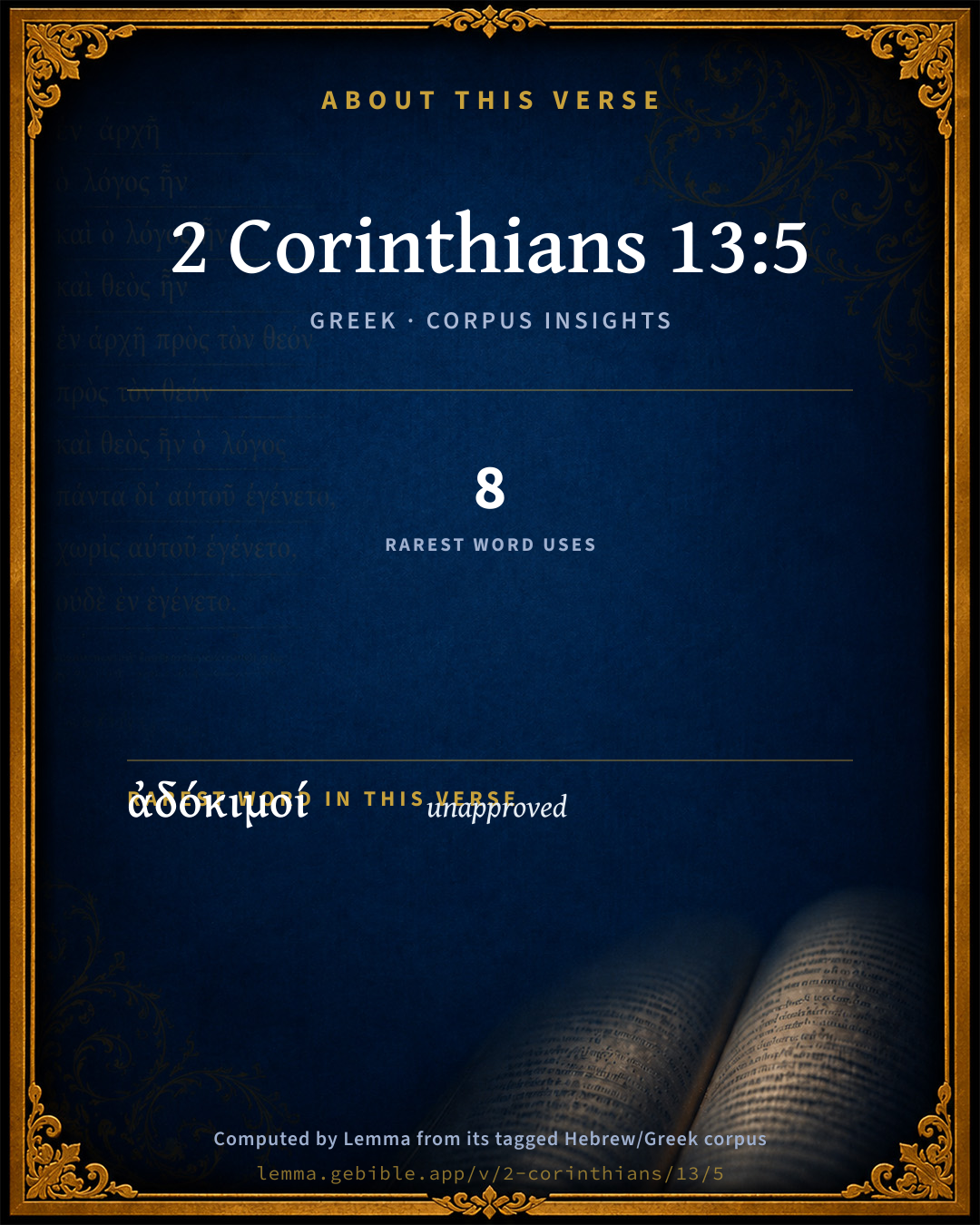
- ἀδόκιμοί adókimos G96 “unapproved” Adjective, Nominative, Plural, Masculine
- ἐστε eimí G1510 “to be” Verb, Present, Active, Indicative, 2nd person, Plural
About this verse
These counts appear in no published source. They are computed here, from the morphology-tagged text and Lemma’s own curated glosses. What Lemma adds →
- 22
- words
- 17
- distinct lemmas
- Pauline Epistles
- section
Cross-references
50Topical passages linked to 2 Corinthians 13:5 in the Treasury of Scripture Knowledge — connected by theme and wording, ordered by reader-vote popularity; previews shown in the World English Bible.
- Lamentations 3:40 Let us search and try our ways, and turn again to Yahweh.
- 1 Corinthians 11:28 But let a man examine himself, and so let him eat of the bread, and drink of the cup.
- Psalms 139:23–24 Search me, God, and know my heart. Try me, and know my thoughts.
- 1 Corinthians 9:27 but I beat my body and bring it into submission, lest by any means, after I have preached to others, I myself should be rejected.
- Revelation 2:5 Remember therefore from where you have fallen, and repent and do the first works; or else I am coming to you swiftly, and will move your lampstand out of its place, unless you repent.
- Galatians 6:4 But let each man test his own work, and then he will take pride in himself and not in his neighbor.
- 1 Corinthians 11:31 For if we discerned ourselves, we wouldn't be judged.
- Hebrews 12:15 looking carefully lest there be any man who falls short of the grace of God; lest any root of bitterness springing up trouble you, and thereby the many be defiled;
- John 14:23 Jesus answered him, "If a man loves me, he will keep my word. My Father will love him, and we will come to him, and make our home with him.
- Psalms 26:2 Examine me, Yahweh, and prove me. Try my heart and my mind.
- Galatians 2:20 I have been crucified with Christ, and it is no longer I that live, but Christ living in me. That life which I now live in the flesh, I live by faith in the Son of God, who loved me, and gave himself up for me.
- Titus 1:16 They profess that they know God, but by their works they deny him, being abominable, disobedient, and unfit for any good work.
- Romans 8:10 If Christ is in you, the body is dead because of sin, but the spirit is alive because of righteousness.
- Psalms 119:59 I considered my ways, And turned my steps to your statutes.
- Revelation 3:2–3 Wake up, and keep the things that remain, which you were about to throw away, for I have found no works of yours perfected before my God.
- Haggai 1:7 This is what Yahweh of Hosts says: "Consider your ways.
- Hebrews 4:1 Let us fear therefore, lest perhaps a promise being left of entering into his rest, anyone of you should seem to have come short of it.
- 1 Corinthians 9:24 Don't you know that those who run in a race all run, but one receives the prize? Run like that, that you may win.
- Haggai 1:5 Now therefore this is what Yahweh of Hosts says: Consider your ways.
- 1 Corinthians 3:16 Don't you know that you are a temple of God, and that God's Spirit lives in you?
- Psalms 17:3 You have proved my heart; you have visited me in the night; You have tried me, and found nothing; I have resolved that my mouth shall not disobey.
- John 15:4 Remain in me, and I in you. As the branch can't bear fruit by itself, unless it remains in the vine, so neither can you, unless you remain in me.
- Ephesians 2:20–22 being built on the foundation of the apostles and prophets, Christ Jesus himself being the chief cornerstone;
- John 17:23 I in them, and you in me, that they may be perfected into one; that the world may know that you sent me, and loved them, even as you loved me.
- Titus 2:2 that older men should be temperate, sensible, sober-minded, sound in faith, in love, and in patience:
- John 17:26 I made known to them your name, and will make it known; that the love with which you loved me may be in them, and I in them."
- 1 Corinthians 6:19 Or don't you know that your body is a temple of the Holy Spirit which is in you, which you have from God? You are not your own,
- Ephesians 3:17 that Christ may dwell in your hearts through faith; to the end that you, being rooted and grounded in love,
- James 4:4 You adulterers and adulteresses, don't you know that friendship with the world is enmity with God? Whoever therefore wants to be a friend of the world makes himself an enemy of God.
- John 6:6 This he said to test him, for he himself knew what he would do.
- John 6:56 He who eats my flesh and drinks my blood lives in me, and I in him.
- 1 Corinthians 6:2 Don't you know that the saints will judge the world? And if the world is judged by you, are you unworthy to judge the smallest matters?
- 2 Corinthians 6:16 What agreement has a temple of God with idols? For you are a temple of the living God. Even as God said, "I will dwell in them, and walk in them; and I will be their God, and they will be my people."
- Galatians 4:19 My little children, of whom I am again in travail until Christ is formed in you--
- Colossians 1:23 if it is so that you continue in the faith, grounded and steadfast, and not moved away from the hope of the Gospel which you heard, which is being proclaimed in all creation under heaven; of which I, Paul, was made a servant.
- Colossians 1:27 to whom God was pleased to make known what are the riches of the glory of this mystery among the Gentiles, which is Christ in you, the hope of glory;
- Colossians 2:7 rooted and built up in him, and established in the faith, even as you were taught, abounding in it in thanksgiving.
- 1 John 3:20–21 because if our heart condemns us, God is greater than our heart, and knows all things.
- Ezekiel 18:28 Because he considers, and turns away from all his transgressions that he has committed, he shall surely live, he shall not die.
- 2 Corinthians 13:6–7 But I hope that you will know that we aren't disqualified.
- Hebrews 6:8 but if it bears thorns and thistles, it is rejected and near being cursed, whose end is to be burned.
- 1 Peter 2:4–5 coming to him, a living stone, rejected indeed by men, but chosen by God, precious.
- 1 Peter 5:9 Withstand him steadfast in your faith, knowing that your brothers who are in the world are undergoing the same sufferings.
- Romans 1:28 Even as they refused to have God in their knowledge, God gave them up to a reprobate mind, to do those things which are not fitting;
- 1 Corinthians 6:15 Don't you know that your bodies are members of Christ? Shall I then take the members of Christ, and make them members of a prostitute? May it never be!
- Jeremiah 6:30 Refuse silver shall men them, because Yahweh has rejected them.
- Colossians 2:19 and not holding firmly to the Head, from whom all the body, being supplied and knit together through the joints and ligaments, grows with God's growth.
- 1 Timothy 2:15 but she will be saved through her child-bearing, if they continue in faith, love, and sanctification with sobriety.
- 2 Timothy 3:8 Even as Jannes and Jambres opposed Moses, so do these also oppose the truth; men corrupted in mind, reprobate concerning the faith.
- Titus 1:13 This testimony is true. For this cause, reprove them sharply, that they may be sound in the faith,
Cross-references courtesy of OpenBible.info (CC BY 4.0).
Lesson kit
Teaching starters — assembled from the data on this page, not authored interpretation. Every prompt links to the verse data it draws on. Edit before teaching.
2 Corinthians, in the Pauline Epistles, opens this verse with 22 words (17 distinct Greek lemmas). Its most distinctive word is adókimos (“unapproved”). A historical commentator’s framing appears above. Read the whole chapter for the surrounding context.
Discussion questions
- The word adókimos carries the sense “unapproved.” How does it shape the verse?
- How does Romans 1:28, which shares the word «unapproved», read alongside this verse?
- What does the repetition of “himself” (3× in this one verse) do in this verse?
- These translations render this verse differently. What is at stake in choosing one wording over another?
- Compare how The Biblical Illustrator and Joseph Benson's Commentary read this verse. Where do they agree or differ?
Things to notice
- These translations choose different wording for 20 words in this verse.
- “himself” occurs 3× in this single verse.
- 17 distinct Greek lemmas span 22 words in this verse.
Commentary
Notes on 2 Corinthians 13:5 from classic Christian and Jewish commentators (each source and its license shown beneath its notes). The classic Christian expositions comment on the surrounding passage and are grouped to its opening verse, so a note may address several verses; the Jewish commentaries on the Tanakh (Rashi and others) are per-verse, so they appear only where the commentator wrote on this verse.
Lemma curates 59 commentaries, every one of them public domain or Creative Commons licensed, each selected and text-cleaned for this edition rather than reprinted as found. About our sources →
The Biblical Illustrator
Joseph S. Exell
The Biblical Illustrator, edited by Joseph S. Exell (c. 1880s–1900s) — public domain. Text from a community e-Sword module.
Joseph Benson's Commentary
Joseph Benson's Commentary on the Old and New Testaments (1811–1818) — public domain. Text from a community e-Sword module.
The Pulpit Commentary
The Pulpit Commentary (1880–1919), ed. H.D.M. Spence-Jones & Joseph S. Exell — public domain. Text from a community e-Sword module.
Tyndale Open Study Notes
Tyndale Open Resources
Tyndale Open Study Notes — © Tyndale Open Resources, licensed CC BY-SA 4.0. Text via the HelloAO Bible API.
Bengel's Gnomon
Johann Albrecht Bengel
Bengel's Gnomon of the New Testament — English translation (T&T Clark, Edinburgh, 1860) — public domain. Text from a community e-Sword module.
Meyer's Critical & Exegetical Commentary
Heinrich August Wilhelm Meyer
Meyer — Critical and Exegetical Commentary on the New Testament — English translation by Peter Christie, edited by Frederick Crombie (T&T Clark, 1880) — public domain. Text from a community e-Sword module.
Expositor's Greek Testament
ed. W. Robertson Nicoll
The Expositor's Greek Testament, edited by W. Robertson Nicoll (1897–1910) — public domain. Text from a community e-Sword module.
Geneva Bible (1599)
Geneva Bible translators
Geneva Bible (1599) marginal notes — public domain. Text via Bolls.life.
Jamieson, Fausset & Brown
Robert Jamieson, A. R. Fausset & David Brown
Jamieson, Fausset & Brown — Commentary Critical and Explanatory on the Whole Bible (1871) — public domain (CC PDM 1.0). Text via the HelloAO Bible API.
Adam Clarke's Commentary
Adam Clarke's Commentary on the Bible (1810–1826) — public domain. Text from a community e-Sword/MySword module.
John Calvin's Commentaries
John Calvin's Commentaries (1540-1563) — public domain. Text from the Calvin Translation Society English edition (1840s-50s) via the Christian Classics Ethereal Library (ccel.org). Calvin's coverage is partial (roughly two-thirds of the Bible); uncommented books and verses are honest gaps, never fabricated. The 19th-century editor's footnotes and remarks are omitted so the notes are faithfully Calvin's own voice.
Ellicott's Commentary for English Readers
A Bible Commentary for English Readers, edited by Charles John Ellicott (1878–1897) — public domain. Text from a community e-Sword module.
The Cambridge Bible for Schools and Colleges
gen. ed. J. J. S. Perowne
The Cambridge Bible for Schools and Colleges (gen. ed. J. J. S. Perowne; Cambridge University Press, 1878–1918) — public domain. Text from a community e-Sword module.
John Gill's Exposition
John Gill's Exposition of the Whole Bible (1746–1763) — public domain (CC PDM 1.0). Text via the HelloAO Bible API.
Trapp's Complete Commentary
John Trapp
John Trapp, A Commentary or Exposition upon All the Books of the Old and New Testament (1647–1656) — public domain. Text from a community e-Sword module.
Albert Barnes' Notes on the Bible
Albert Barnes' Notes on the Bible (1834–1885) — public domain. Text from a community e-Sword/MySword module.
Haydock's Catholic Bible Commentary
George Leo Haydock (1774–1849), Haydock's Catholic Family Bible and Commentary, 1859 edition — public domain. Excludes Psalms (Douay-Rheims chapter numbering differs from Protestant) and Deuterocanonical books (Catholic canon only).
Matthew Poole's English Annotations
Matthew Poole's English Annotations on the Holy Bible (1683–1685) — public domain. Text from a community e-Sword/MySword module.
Whedon's Commentary on the Bible
Daniel D. Whedon
Daniel D. Whedon (gen. ed.), Commentary on the Old and New Testaments (1874–1909) — public domain. Text from a community e-Sword module.
John Wesley's Explanatory Notes
John Wesley, Explanatory Notes Upon the Whole Bible (1754–1765) — public domain. Text via the GEBible commentary corpus.
Kretzmann's Popular Commentary
Paul E. Kretzmann
Paul E. Kretzmann, Popular Commentary of the Bible (1921–1924) — public domain. Text from a community e-Sword module.
Burkitt's Expository Notes on the New Testament
William Burkitt
William Burkitt's Expository Notes on the New Testament (1700–1703) — public domain. Text from a community e-Sword module.
McGarvey & Pendleton's Commentaries
J. W. McGarvey
J. W. McGarvey (with Philip Y. Pendleton), Commentaries on the New Testament (The Fourfold Gospel, 1914; Acts; and the epistles) — public domain. Text from a community e-Sword/MySword module.
The People's New Testament
B. W. Johnson
B. W. Johnson's The People's New Testament with Notes (1889–1891) — public domain. Electronic text from the Christian Classics Ethereal Library (CCEL) ThML edition.
unfoldingWord translationNotes
Door43 World Missions Community
unfoldingWord translationNotes — © Distant Shores Media and the Door43 World Missions Community, licensed CC BY-SA 4.0. Source: git.door43.org/Door43/en_tn.
Cambridge Greek Testament for Schools and Colleges
Cambridge Greek Testament for Schools and Colleges (Cambridge University Press, 1896; 21 vols, various authors incl. Carr, Maclear, Plummer, Farrar, Lumby, Moule, M. R. James, Simcox) — public domain. Text from a community e-Sword module.
Alford’s Greek Testament
Henry Alford
Henry Alford, The Greek Testament (1849–1861) — public domain. Text from a community e-Sword module.
International Critical Commentary
International Critical Commentary — older volumes (1896–1929), various authors — public domain. Text from a community e-Sword module.
Vincent's Word Studies in the New Testament
Marvin R. Vincent
Marvin R. Vincent, Word Studies in the New Testament (1887–1900) — public domain. Text from a community e-Sword/MySword module.