
Isaiah 63:16

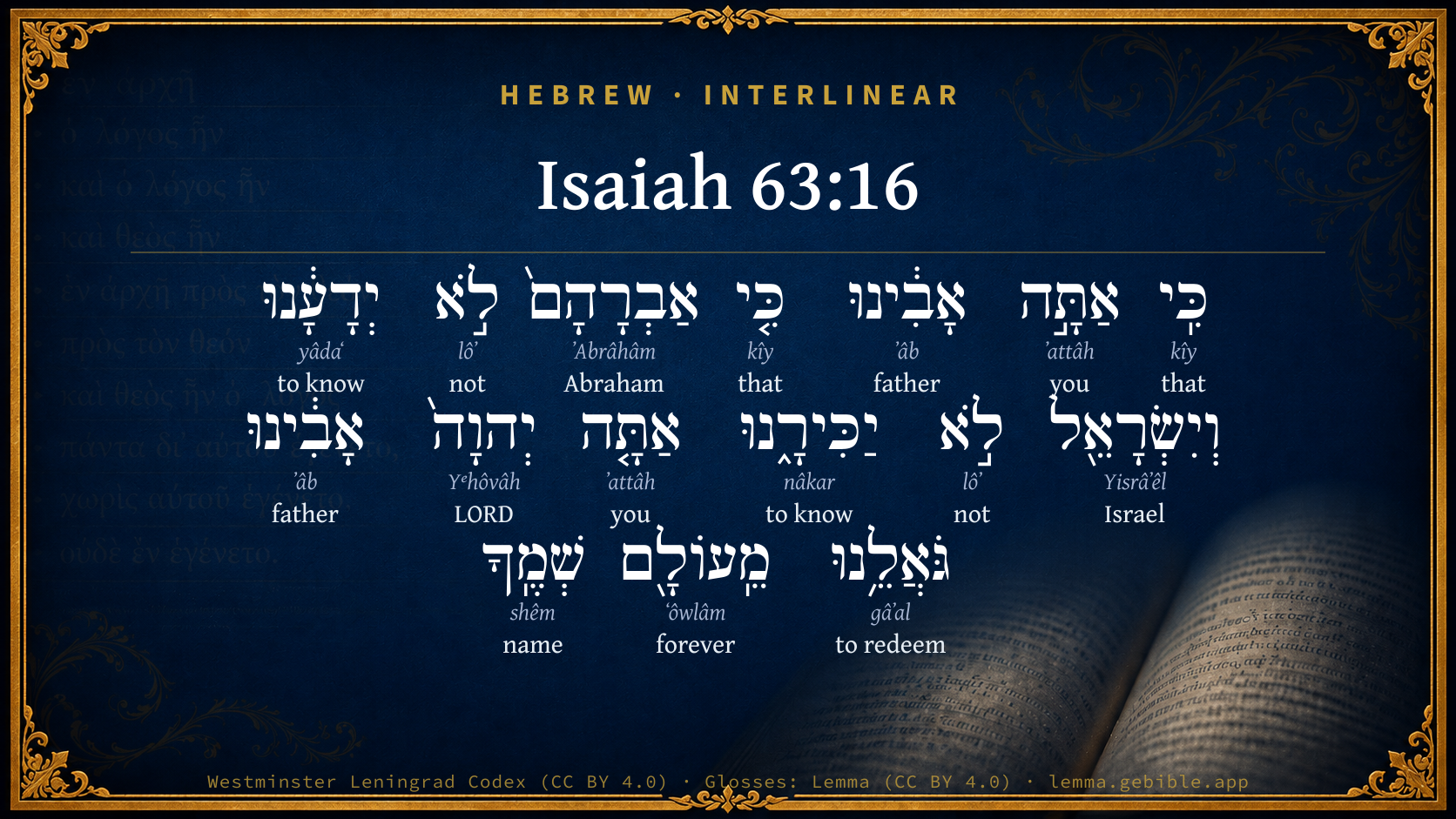
Hebrew (Westminster Leningrad Codex) Isaiah 63:16 appears in the Hebrew Old Testament. The text above is from the Westminster Leningrad Codex. Each word links to its Strong’s number, a concise gloss, and parsing drawn from the Open Scriptures Hebrew Bible morphology. Click any word for its full Brown-Driver-Briggs (BDB) entry.
Download image
Cite this verse

Isaiah 63:16 (World English Bible). Public Domain. Lemma interlinear Bible study tool, https://lemma.gebible.app/v/isaiah/63/16.

Show BibTeX & RIS
BibTeX
RIS
English Translation
For you are our Father, though Abraham doesn't know us, and Israel does not acknowledge us: you, Yahweh, are our Father; our Redeemer from everlasting is your name.
World English Bible · Public Domain
Download a study sheet

One document with this verse’s original text, its word-by-word gloss line, the meaning frame, cross-references with their text, attributed commentary, and full source and license credits — printable, and it pastes into notes with its structure intact.

This verse Autodidact and up

Study sheet (.html) Plain text (.txt)

A passage Seminary Student

Up to 50 verses in one chapter. A passage sheet keeps up to 6 commentary sources and 12 cross-references per verse, in the order this page ranks them, and says so on the sheet whenever that leaves anything out. Ask for a single verse and you get the Autodidact verse sheet above.

Everything on this page stays free to read, with no account — the sheet is a download of what is already on screen, not access to it.

Want to remove ads? Support Godless Engineer
Compare translations 3

The same verse in 3 English versions, stacked beneath the original-language interlinear above. Click any original word for its lexicon entry.

Each is an independent rendering of the whole verse — the interlinear is not word-aligned to these translations.

Highlighted words mark where these versions differ — a whole-verse word diff, not a word-by-word alignment.

  • World English Bible Public Domain
    For you are our Father, though Abraham doesn't know us, and Israel does not acknowledge us: you, Yahweh, are our Father; our Redeemer from everlasting is your name.
  • King James Version Public Domain
    Doubtless thou art our father, though Abraham be ignorant of us, and Israel acknowledge us not: thou, O LORD, art our father, our redeemer; thy name is from everlasting.
  • unfoldingWord Literal Text CC BY-SA 4.0
    For you our father, for Abraham does not know us, and Israel does not recognize us. You, Yahweh, our father; our redeemer from eternity your name.

unfoldingWord Literal Text — © unfoldingWord, licensed CC BY-SA 4.0. Word-aligned USFM3 via Door43 (git.door43.org/unfoldingWord/en_ult).

Versions to compare (up to 4)

3 of 4 selected

Show all 18 translations

Every available English version of this verse, each an independent rendering of the whole verse.

  • World English Bible Public Domain
    For you are our Father, though Abraham doesn't know us, and Israel does not acknowledge us: you, Yahweh, are our Father; our Redeemer from everlasting is your name.
  • Berean Standard Bible Public Domain
    Yet You are our Father, though Abraham does not know us and Israel does not acknowledge us. You, O LORD, are our Father; our Redeemer from Everlasting is Your name.
  • Majority Standard Bible Public Domain
    Yet You are our Father, though Abraham does not know us and Israel does not acknowledge us. You, O LORD, are our Father; our Redeemer from Everlasting is Your name.
  • King James Version Public Domain
    Doubtless thou art our father, though Abraham be ignorant of us, and Israel acknowledge us not: thou, O LORD, art our father, our redeemer; thy name is from everlasting.
  • American Standard Version (1901) Public Domain
    For thou art our Father, though Abraham knoweth us not, and Israel doth not acknowledge us: thou, O Jehovah, art our Father; our Redeemer from everlasting is thy name.
  • Revised Version (1885) Public Domain
    For thou art our father, though Abraham knoweth us not, and Israel doth not acknowledge us: thou, O LORD, art our father; our redeemer from everlasting is thy name.
  • Geneva Bible (1599) Public Domain
    Doutles thou art our Father: though Abraham be ignorant of vs, and Israel knowe vs not, yet thou, O Lord, art our Father, and our redeemer: thy Name is for euer.
  • Douay-Rheims (1899) Public Domain
    For thou art our father, and Abraham hath not known us, and Israel hath been ignorant of us: thou, O Lord, art our father, our redeemer, from everlasting is thy name.
  • Young's Literal Translation Public Domain
    For Thou `art' our Father, For Abraham hath not known us, And Israel doth not acknowledge us, Thou, O Jehovah, `art' our Father, Our redeemer from the age, `is' Thy name.
  • Literal Standard Version CC BY-SA 4.0
    For You [are] our Father, || For Abraham has not known us, || And Israel does not acknowledge us, || You, O YHWH, [are] our Father, || Our Redeemer from the Age, [is] Your Name.
  • Unlocked Literal Bible CC BY-SA 4.0
    For you are our father, though Abraham does not know us, and Israel does not recognize us, you, Yahweh, are our father. 'Our Redeemer' has been your name from ancient times.
  • unfoldingWord Literal Text CC BY-SA 4.0
    For you our father, for Abraham does not know us, and Israel does not recognize us. You, Yahweh, our father; our redeemer from eternity your name.
  • Darby Bible Public Domain
    For thou art our Father, though Abraham be ignorant of us, and Israel acknowledge us not: thou, Jehovah, art our Father; our Redeemer, from everlasting, is thy name.
  • World Messianic Bible Public Domain
    For you are our Father, though Abraham doesn’t know us, and Israel does not acknowledge us. You, LORD, are our Father. Our Redeemer from everlasting is your name.
  • Webster's Bible Public Domain
    Doubtless thou art our father, though Abraham be ignorant of us, and Israel acknowledge us not: thou, O LORD, art our father, our Redeemer; thy name is from everlasting.
  • Free Bible Version CC BY-SA 4.0
    But you are still our Father, even though Abraham wouldn't know us and Israel wouldn't acknowledge us. You, Lord, are our Father; you have always been called our Redeemer from long ago.
  • Bible in Basic English Public Domain
    For you are our father, though Abraham has no knowledge of us, and Israel gives no thought to us: you, O Lord, are our father; from the earliest days you have taken up our cause.
  • JPS Tanakh (1917) Public Domain
    For Thou art our Father; for Abraham knoweth us not, and Israel doth not acknowledge us; Thou, O LORD, art our Father, our Redeemer from everlasting is Thy name.

Literal Standard Version (2020), Covenant Press — licensed CC BY-SA 4.0. Text via the HelloAO Bible API (eBible.org). Unlocked Literal Bible (unfoldingWord) — licensed CC BY-SA 4.0. Text via the HelloAO Bible API (eBible.org). unfoldingWord Literal Text — © unfoldingWord, licensed CC BY-SA 4.0. Word-aligned USFM3 via Door43 (git.door43.org/unfoldingWord/en_ult). Free Bible Version, Dr. Jonathan Gallagher — licensed CC BY-SA 4.0. Text via the HelloAO Bible API (eBible.org).

Word by word

More ways to search: Search by grammar → Find every occurrence → Compare this word →

Practice this passage: Drill this verse → Learn its vocabulary →

יַכִּירָ֑נוּ
nâkar
H5234
“to know · us”
Verb, Hiphil, Imperfect, 3rd Person, Masculine, Singular + Suffix, Personal, 1st Person, Common, Plural
Part of Speech
Verb
Stem
Hiphil
Form
Imperfect
Person
3rd Person
Gender
Masculine
Number
Singular
Full BDB Definition

Origin: a primitive root

TWOT: 1368

to recognise, acknowledge, know, respect, discern, regard - (Niphal) to be recognised - (Piel) to regard - (Hiphil) - to regard, observe, pay attention to, pay regard to, notice - to recognise (as formerly known), perceive - to be willing to recognise or acknowledge, acknowledge with honour - to be acquainted with - to distinguish, understand - (Hithpael) to make oneself known - to act or treat as foreign or strange, disguise, misconstrue - (Niphal) to disguise oneself - (Piel) - to treat as foreign (profane) - to misconstrue - (Hithpael) - to act as alien - to disguise oneself
  1. כִּֽי kîy H3588 “that” Conjunction
  2. אַתָּ֣ה ʼattâh H859 “you” Pronoun, Personal, 2nd Person, Masculine, Singular
  3. אָבִ֔ינוּ ʼâb H1 “father · our” Noun, Common, Masculine, Singular, Construct + Suffix, Personal, 1st Person, Common, Plural
  4. כִּ֤י kîy H3588 “that” Conjunction
  5. אַבְרָהָם֙ ʼAbrâhâm H85 “Abraham” Noun, Proper
  6. לֹ֣א lôʼ H3808 “not” Particle, Negative
  7. יְדָעָ֔נוּ yâdaʻ H3045 “to know · us” Verb, Qal, Perfect, 3rd Person, Masculine, Singular + Suffix, Personal, 1st Person, Common, Plural
  8. וְיִשְׂרָאֵ֖ל Yisrâʼêl H3478 “and · Israel” Conjunction + Noun, Proper
  9. לֹ֣א lôʼ H3808 “not” Particle, Negative
  10. אַתָּ֤ה ʼattâh H859 “you” Pronoun, Personal, 2nd Person, Masculine, Singular
  11. יְהוָה֙ Yᵉhôvâh H3068 “LORD” Noun, Proper
  12. אָבִ֔ינוּ ʼâb H1 “father · our” Noun, Common, Masculine, Singular, Construct + Suffix, Personal, 1st Person, Common, Plural
  13. גֹּאֲלֵ֥נוּ gâʼal H1350 “redeeming · us” Verb, Qal, Participle Active, Masculine, Singular, Construct + Suffix, Personal, 1st Person, Common, Plural
  14. מֵֽעוֹלָ֖ם ʻôwlâm H5769 “from · forever” Preposition + Noun, Common, Masculine, Singular, Absolute
  15. שְׁמֶֽךָ shêm H8034 “name · your” Noun, Common, Masculine, Singular, Construct + Suffix, Personal, 2nd Person, Masculine, Singular

About this verse

These counts appear in no published source. They are computed here, from the morphology-tagged text and Lemma’s own curated glosses. What Lemma adds →

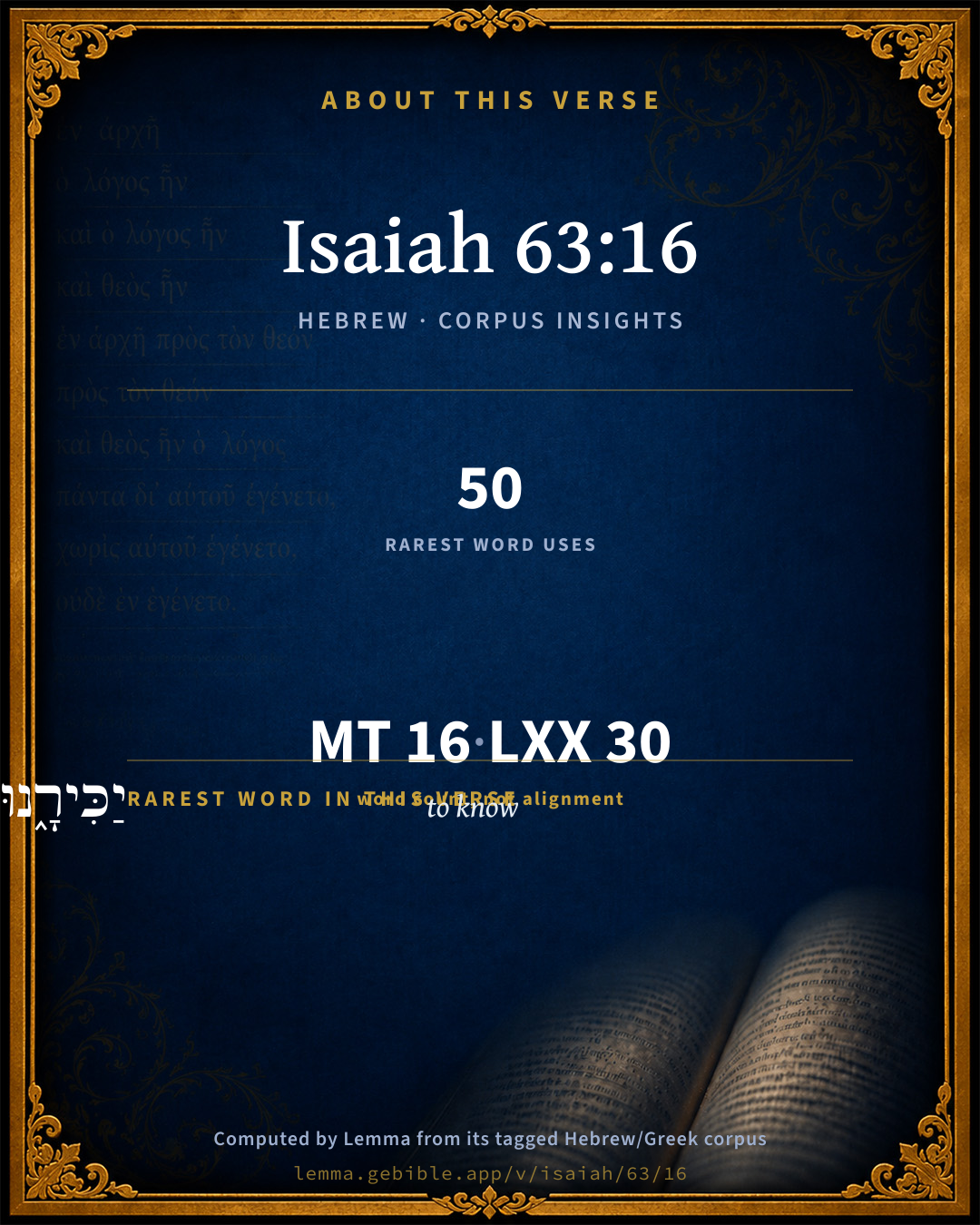
16
words
12
distinct lemmas
Prophets
section

Shared distinctive vocabulary

יַכִּירָ֑נוּ to know H5234 occurs in 47 verses of the Hebrew Bible. Also found in:

Grammatical profile

  • 3 verbs
  • 7 nouns
  • 2 pronouns
  • 2 conjunctions
  • 2 particles

Verb forms

  • יְדָעָ֔נוּ Qal · Perfect
  • יַכִּירָ֑נוּ Hiphil · Imperfect
  • גֹּאֲלֵ֥נוּ Qal · Participle Active

Repetition

Words recur within this verse — often emphatic in Hebrew:

  • אָבִ֔ינוּ father H1 ×2
  • כִּֽי that H3588 ×2
  • אַתָּ֣ה you H859 ×2
  • לֹ֣א not H3808 ×2

Hebrew & Septuagint length

In English translation the verse runs 28 words from the Hebrew and 35 from the Septuagint (LXX English) — closely comparable.

A rough comparison of the two English renderings, which tokenize alike — not a word-level alignment.

Word counts can differ between the Hebrew and the Greek without any difference in meaning — e.g. the Hebrew direct-object marker אֵת has no separate Greek word, and Greek often adds the article ὁ.

In the original languages it is 16 Hebrew tokens and 30 Greek tokens — but the two are counted differently (Hebrew bundles its prefixes and suffixes into one token; the Greek is in lemma form), so that isn’t a like-for-like length.

Cross-references

17

Topical passages linked to Isaiah 63:16 in the Treasury of Scripture Knowledge — connected by theme and wording, ordered by reader-vote popularity; previews shown in the World English Bible.

  • Isaiah 64:8 But now, Yahweh, you are our Father; we are the clay, and you our potter; and we all are the work of your hand.
  • Malachi 2:10 Don't we all have one father? Hasn't one God created us? Why do we deal treacherously every man against his brother, profaning the covenant of our fathers?
  • Deuteronomy 32:6 Do you thus requite Yahweh, Foolish people and unwise? Isn't he your father who has bought you? He has made you, and established you.
  • Jeremiah 3:19 But I said, How I will put you among the children, and give you a pleasant land, a goodly heritage of the hosts of the nations! and I said, You shall call me My Father, and shall not turn away from following me.
  • Isaiah 41:14 Don't be afraid, you worm Jacob, and you men of Israel; I will help you, says Yahweh, and your Redeemer is the Holy One of Israel.
  • Isaiah 44:6 Thus says Yahweh, the King of Israel, and his Redeemer, Yahweh of Hosts: I am the first, and I am the last; and besides me there is no God.
  • Malachi 1:6 "A son honors his father, and a servant his master. If I am a father, then where is my honor? And if I am a master, where is the respect due me? Says Yahweh of Hosts to you, priests, who despise my name. You say, 'How have we despised your name?'
  • 1 Chronicles 29:10 Therefore David blessed Yahweh before all the assembly; and David said, You are blessed, Yahweh, the God of Israel our father, forever and ever.
  • Job 14:21 His sons come to honor, and he doesn't know it; They are brought low, but he doesn't perceive it of them.
  • Isaiah 43:14 Thus says Yahweh, your Redeemer, the Holy One of Israel: For your sake I have sent to Babylon, and I will bring down all of them as fugitives, even the Chaldeans, in the ships of their rejoicing.
  • Jeremiah 31:9 They shall come with weeping; and with petitions will I lead them: I will cause them to walk by rivers of waters, in a straight way in which they shall not stumble; for I am a father to Israel, and Ephraim is my firstborn.
  • Exodus 4:22 You shall tell Pharaoh, 'Thus says Yahweh, Israel is my son, my firstborn,
  • Ecclesiastes 9:5 For the living know that they will die, but the dead don't know anything, neither do they have any more a reward; for the memory of them is forgotten.
  • Isaiah 54:5 For your Maker is your husband; Yahweh of Hosts is his name: and the Holy One of Israel is your Redeemer; the God of the whole earth shall he be called.
  • Isaiah 63:12 who caused his glorious arm to go at the right hand of Moses? who divided the waters before them, to make himself an everlasting name?
  • Matthew 6:9 Pray like this: 'Our Father in heaven, may your name be kept holy.
  • 1 Peter 1:18–21 knowing that you were redeemed, not with corruptible things, with silver or gold, from the useless way of life handed down from your fathers,

Cross-references courtesy of OpenBible.info (CC BY 4.0).

Hebrew and Greek witnesses Masoretic Hebrew ↔ Greek Septuagint

The same verse in the two great witnesses to the Old Testament, shown verse-for-verse.

These are two independent witnesses, not word-aligned to each other, and the Septuagint is shown in lemma (dictionary) form.

Hebrew Isaiah 63:16 Masoretic · Westminster Leningrad Codex

כִּֽי אַתָּ֣ה אָבִ֔ינוּ כִּ֤י אַבְרָהָם֙ לֹ֣א יְדָעָ֔נוּ וְיִשְׂרָאֵ֖ל לֹ֣א יַכִּירָ֑נוּ אַתָּ֤ה יְהוָה֙ אָבִ֔ינוּ גֹּאֲלֵ֥נוּ מֵֽעוֹלָ֖ם שְׁמֶֽךָ

For you are our Father, though Abraham doesn't know us, and Israel does not acknowledge us: you, Yahweh, are our Father; our Redeemer from everlasting is your name.

World English Bible · Public Domain

Greek LXX Isaiah 63:16 Septuagint · lemma form

σύ γάρ ἐγώ εἰμί πατήρ ὅτι ἀβραάμ οὐ γιγνώσκω ἐγώ καί ἰσραήλ οὐ ἐπιγιγνώσκω ἐγώ ἀλλά σύ κύριος πατήρ ἐγώ ῥύομαι ἐγώ ἀπό ἀρχή ὁ ὄνομα σύ ἐπί ἐγώ εἰμί

For you are our Father; for though Abraham knew us not, and Israel did not acknowledge us, yet do you, O Lord, our Father, deliver us: your name has been upon us from the beginning.

LXX2012 (modern English Septuagint) · Public Domain

On this verse, Adam Clarke's Commentary discusses the Septuagint’s reading. Read the note in Commentary ↓

Hebrew: Westminster Leningrad Codex (CC BY 4.0). Greek: Septuagint (public domain); English from LXX2012 (modern English Septuagint) (Public Domain). How the Septuagint differs from the Hebrew →

Targum (Aramaic paraphrase)

1

The Targum is the ancient Jewish Aramaic paraphrase of the Hebrew Scriptures — an interpretive translation, not the Hebrew text itself. Onkelos (literal) and Pseudo-Jonathan (expansive) render the Torah, and Jonathan the Prophets. Coverage is partial: where no permissively-licensed English translation exists for a verse, only the Aramaic is shown. This is verse-level text, not a word-by-word alignment to the Hebrew.

  1. Targum Jonathan Prophets (Joshua–Malachi)
    אֲרֵי אַתְּ הוּא דְרַחֲמָךְ עֲלָנָא סַגִיאִין כְּאָב עַל בְּנִין אֲרֵי אַבְרָהָם לָא אַסְקָנָא מִמִצְרַיִם וְיִשְׂרָאֵל לָא עָבַד לָנָא פְּרִישָׁן בְּמַדְבְּרָא אַתְּ הוּא יְיָ וְרַחְמָךְ עֲלָנָא סַגִיאִין כְּאָב עַל בְּנִין פִּרְקְנָא מַעֲלַם שְׁמָךְ:

    For Thou art He, whose mercies towards us are as many as a father's towards his children: for Abraham hath not brought us up out of Egypt, and Israel hath not wrought for us wonderful works in the wilderness; Thou art the Lord; Thy mercies towards us are many, like a father's towards his children, O, our Redeemer; Thy name is from everlasting.

    Targum Jonathan — Aramaic: “Mikraot Gedolot” (public domain). English: “Sefaria Community Translation” (CC0 1.0 (public-domain dedication)); “London "Chaldee Paraphrase," 1871” (public domain). Text via Sefaria.

Commentary

Notes on Isaiah 63:16 from classic Christian and Jewish commentators (each source and its license shown beneath its notes). The classic Christian expositions comment on the surrounding passage and are grouped to its opening verse, so a note may address several verses; the Jewish commentaries on the Tanakh (Rashi and others) are per-verse, so they appear only where the commentator wrote on this verse.

Lemma curates 59 commentaries, every one of them public domain or Creative Commons licensed, each selected and text-cleaned for this edition rather than reprinted as found. About our sources →

Trapp's Complete Commentary

John Trapp

Isa 63:16 Doubtless thou [art] our father, though Abraham be ignorant of us, and Israel acknowledge us not: thou, O LORD, [art] our father, our redeemer; thy name [is] from everlasting.

Ver. 16. Doubtless thou art our Father.] Though thou frownest and withdrawest. The people of God saw that he was angry, that their hearts also were hard; yet they thought they should know him amidst all his austerities, and they make to him for help. And, doubtless, help the Jews might yet have, could they seriously say, as here, "Certainly thou art our Father," and would no longer rest upon carnal things, boasting of Abraham their father, circumcision, and other external privileges.

Though Abraham be ignorant of us.] Ipsi nunc sua quiete fruuntur; they are at rest, and know nothing of our affairs. The monks tell us that the saints departed see things done here in the face of God as in a glass. But this is a mere fiction of theirs. See Psa 27:10 2Ki 22:20. Augustine {a} saith of his mother Monica, deceased, that she did now no longer yield him comfort, because she knew not what befell him. The greatest Popish clerks themselves confess that the invocation of saints departed had neither precept, promise, nor precedent in the book of God. Moreover, they cannot determine how the saints know our hearts and prayers, whether by hearing, or seeing, or presence everywhere, or by God’s relating or revealing men’s prayers and needs unto them. All which ways some of them hold as possible or probable, {b} and others deny and confute them as untrue. {c} The Syriac and Arabic render the text thus: Thou art our Father, we are ignorant of Abraham, and we acknowledge not Israel. Thou, O Lord, art our Father, &c. Agreeable whereunto is that of the heathen, Contemno minutos istos Deos, modo Iovem mihi propitium habeam, I care not for those petty gods, so that Jupiter will stand my friend. And that better saying of a devout Christian,

“ Una est in trepida mihi re medicina, Iehovae

Cor patrium, os verax, omnipotensque manus. ”

- Nathan. Chytraeus.

It hath been well observed that the defeat given to the Spanish fleet, A.D. 1588, happened to be on St James’s day, whom the Spaniards pray to as their patron or saint tutelar.

Thy name is from eternity,] i.e., This name of thine, "Our Redeemer." Some read the text thus: Our Redeemer is from of old thy name. Our redemption was not of yesterday, but verily foreordained before the foundation of the world. {1Pe 1:20}

{a} Lib. de cura pro mortuis agenda, cap. 13.

{b} Eccius, in locis.

{c} Morton’s Appeal, lib. ii. cap. 12, sect. 5.

John Trapp, A Commentary or Exposition upon All the Books of the Old and New Testament (1647–1656) — public domain. Text from a community e-Sword module.

The Biblical Illustrator

Joseph S. Exell

Isa_63:16

Doubtless Thou art our Father

The Jewish Church a spiritual body

The true sense of the verse, as it appears to me, is that the Church or chosen people, although once, for temporary reasons, co-extensive and coincident with a single race, is not essentially a national organization, but a spiritual body.

The father is not Abraham or Israel, but Jehovah, who is and always has been its Redeemer, who has borne that name from everlasting. (J. A. Alexander.)

Gods fatherly regard for His people

For Thou art our Father; for Abraham is ignorant of us, and Israel knows us not. Thou, Jehovah, art our Father; from of old our Redeemer is Thy name. Jehovah is Israels Father Isa_64:7), i.e begetter (Deu_32:6); His creative power and loving, merciful purpose called it into existence. The second for justifies this confession, that Jehovah is Israels Father, and that it can therefore look for fatherly care and help from Him alone; even the dearest and most honourable men, the nations progenitors, cannot help it. Abraham and Jacob--Israel--have been taken away from this world, and are unable of themselves to intervene in the history of their people. (F. Delitzsch, D. D.)

The Jewish sense of orphanhood

These words came from the heart of the Jewish people when they felt themselves aliens from the commonwealth of Israel, and strangers to the covenants of promise. They had wandered from the God of their fathers, and they feel as if their fathers had east them off. If Abraham were to appear on earth, he would not know them; if Jacob were to return, he would not acknowledge them; and what then can they do? They cannot endure life, cannot bear the burden of its sorrows and struggles without a father and a friend. What can they do but pass up beyond men, and seek a father in God? Their heart is an orphan everywhere, else, and is forced to this door of refuge; Doubtless Thou--Thou art our Father. (J. Ker, D. D.)

The cry of the orphaned heart

It has never died out, and is present still in many a spirit.

I. THE WORDS EXPRESS A DEEP LONGING OF THE HUMAN HEART. With all its folly and frivolity and sin, the heart of man has been made to feel after these words: Our Father--our Father which art in heaven. The lower creatures have not this cry, because they have not our wants, our aspirations, or the possibility of our hopes. There are wonderful instincts among them--most wonderful often in the most minute. But what curious microscope ever discovered among them a spire pointing heavenward, or tokens of prayer and praise? The magnet which is passed over the earth to draw things upward finds nothing in this world which trembles and turns to it save the human heart. It is very true that many hearts make little viable response, and seem to bear the want of a heavenly Father very lightly. But even in them there may be discerned the heart-hunger that shows itself in unnatural cravings which the lower creatures do not feel. The void may be discovered in the restless attempts men make to fill it. When we look at the length and breadth of mans history, it ,tells us that this cry constantly returns, O that I knew where I might find Him! There have been men in all ages to whom the answer of this cry has been the one necessity of life, and if you could convince them that is impossible to find a heavenly Father, they would smile no more.

II. YET IT IS OFTEN DIFFICULT TO SPEAK THESE WORDS WITH FULL ASSURANCE. The struggle to reach them is evident in the men who use them here, and is felt in the very word doubtless, with which they begin their claim.

1. There is one difficulty, which belongs specially to our time, in the mind of man as it deals with the universe and its laws. There is a form of science which says, I have ranged the world, and there is nothing in it but material law. There may be a heart in man, but there is no heart beyond to answer it; or, if there be, the heart of man can never reach it.

2. Besides the mind, the heart finds difficulties in itself. There are so many things in life which make it hard to believe in the love of God.

3. And still beyond the mind and heart there is the conscience. When we think of a Father in heaven, we must think of a righteous Father, of One who is of purer eyes than to behold iniquity. The weak, indulgent fatherhood, which is passed so lightly from hand to hand, will not fit into the parts of the worlds history which show the terrible penalties of sin; it will not satisfy the soul when it is brought face to face with the majesty of Gods law and the holiness of HIS character.

III. WITH ALL THESE DIFFICULTIES, IT IS A FEELING WHICH CAN BE AND HAS BEEN REACHED. There have been men who could look up and say, Doubtless Thou art our Father. They have said it not only in sunshine, but in storm and in the shadow of death; have given up their lives that they might testify to it clearly and fearlessly; and have shut the door and said it to their Father who seeth in secret. But we are to, think of One, the greatest of all. Even those who take the lowest view of Jesus Christ will admit that He, beyond all others, taught men to think of God as a Father, and gave the example of it in His own life and death. How strong it made Him, and how patient, how active in doing good, how comforted in solitude, that His Father had sent Him, and was present with Him, putting the cup of suffering into His hand, and ready to receive Him when He said, Father, into Thy hands commend My spirit! But His example, His influence, wonderful as they are, would not enable us to follow Him to God as a Father, unless there was something in His death which laid hold of us with stronger power. It is this which enables us to go to God the Judge of all with confidence, because we go through the blood of sprinkling. And when the conscience can say, My Father; the heart beans to say it also. When the heart has found a Father in God, all the worlds laws cannot lay hand on it to imprison it; it moves through the midst of them, and so passes by.

IV. THIS FULL SENSE OF GODS FATHERHOOD IS NOT GENERALLY GAINED AT ONCE. We do not say that the position is not gained at once. As soon as any one comes to God through Christ, he is no more a stranger and an enemy, but a child, and all the, dealings of God with him are paternal. But he may fail to recognize a Fathers voice and hand. Think of the ways by which it may be gained. Come, first of all, by a more simple and loving faith to the death of Christ in the fulness of its meaning. Then seek more fully to give Christ entrance into your heart and life. As the-heart is purified we see God. To have God for our Father is not merely to be forgiven, it is not even to be sanctified; it is to be one with Him in thought and feeling, to listen to Him and speak with Him, as one speaks with a friend. It is peculiarly the work of the Holy Spirit to lead us into this inmost sanctuary of sonship. As many as are led by the Spirit of God, they are the sons of God. But to be led by Him, we must not grieve Him by sin or neglect, but welcome His whispered admonitions; and then, as we listen and obey, we shall reach the innermost room where the Spirit beareth witness with our spirit, that we are the children of God.

V. TO USE THESE WORDS TRULY IS A MATTER OF INFINITE MOMENT TO US ALL. Here is a Friend we need in every stage of life, and in every event of it. (J. Ker, D. D.)

The assurance of Gods Fatherhood

There are three chambers by which we advance to the assurance of Fatherhood in God. The first is the upper chamber of Jerusalem, which comes to us ever and again in the Lords table, with its offer of pardon and peace. The second is the chamber of the heart, to which we give Him admission in love and obedience. And the third is the home, where the Holy Spirit teaches us to cry, Abba, Father. (J. Ker, D. D.)

The creed of the optimist

I. This noble utterance represents THE CONSOLATION AND FINAL APPEAL OF TEE SPIRIT OF MAN, baffled and dissatisfied with what the poet calls the riddle of this painful earth, or despised and rejected by his fellow-men; and that appeal is to the responsibility, omnipotence, unalterable love, and unerring justice of a Divine Father.

II. The cry of Isaiah is THE INSPIRED TEXT OF THE OPTIMIST, of the man who, in spite of the riddles and difficulties and waste and failure in a world teeming with injustice, persists in enthroning God alone behind all worlds, and saying to Him, Doubtless Thou art our Father, though scientific materialism be ignorant of us, and the facts of experience seem to be against us. (Basil Wilberforce, D. D.)

Our Redeemer,--

God the Redeemer

God signifies both a redeemer and an avenger, but the latter only as he is the former. Hence one reason for the close linking together of the two books of Isaiah. In the first Jehovah is the Avenger of the nation against the oppressor, of the poor against the godless rich, of the widow and fatherless against the unjust, of the outraged Theocracy against the no-gods which claim to be Jehovahs rivals and equals. In the second He is the Redeemer, who ransoms and delivers through the Nan of His choice. It is used in both senses throughout the Books of the Law, and in the Psalms. But in the writings of the prophets it is nearly confined to Isaiah. (F. Sessions.)

Our Redeemer

The Lord is our Redeemer for the soul. It is a great comfort to know that it is our heavenly Father who is our Redeemer. It is God in Christ.

1. Our Redeemer has suffered for us.

2. He is our Redeemer from the grave of sin.

3. He is our Redeemer, bringing us to God.

4. He is our Redeemer from our wicked self, and from the power of sin. (W. Birch.)

The Redeemer of Israel

Our Redeemer from everlasting is Thy name. (A. B.Davidson, D. D.)

The Biblical Illustrator, edited by Joseph S. Exell (c. 1880s–1900s) — public domain. Text from a community e-Sword module.

The Preacher's Complete Homiletical Commentary

Joseph S. Exell (gen. ed.)

GOD’S RELATION TO HIS PEOPLE

Isa_63:16. Doubtless Thou art our father, though Abraham, &c.

From thanksgiving and confession, the people betake themselves to earnest prayer for deliverance from sin and suffering (Isa_63:15). Consider God’s relation to His people in two aspects—

I. As a fact most encouraging at all times, but especially in times of trouble. God’s ancient people were in sore trouble (Isa_63:15 and others). Yet, amid all, they derived encouragement from the intimate relationships which existed between God and them.

1. As their Father (Isa_64:8; Deu_32:6; 1Ch_29:10; Jer_3:4). Though this relationship was revealed under the old covenant, it was practically realised only upon the rarest occasions. Amid their trials, this is now the ground of their appeal. As their Father He must love them, and be ready to listen to them, &c. Though their earthly fathers afforded them no assistance, and seem to have ceased to feel any interest in them, they have confidence in the constancy of their heavenly Father’s compassion (Jer_31:20). This is the ever deepening conviction of God’s people everywhere. Gourds may grow and wither, but our heavenly Father’s love neither grows nor withers—it is un-changing; it holds on and holds out, needing no sustenance from without, except that supplied by our need of it; it endures through all our unfaithfulness, &c.

As our Father—

(1) He is the author of our spiritual life. By His Spirit He quickens, &c., and imparts His own nature and image (2Pe_1:4; Col_3:10; Eph_4:23-24).

(2) He secures our instruction. By His works, Word, Spirit, &c.

(3) He supplies all our need. His supplies are suited, abundant, satisfying, inexhaustible.

(4) He protects us. Exposed to innumerable perils and evils, He is our shield, &c.

(5) He gives us a glorious and everlasting portion. A kingdom, a crown, &c., and bliss ineffable and eternal.

Such a relation cannot fail to be a source of unspeakable comfort to the people of God amid all their trials. Such a Father, ever living and loving, &c. Are you His child by the adoption of grace, &c.? He wants you to be His restored, obedient child, &c. “We are all the children of God,” in the highest sense, “by faith in Christ Jesus.”

2. As their Redeemer (kinsman). Their history was a series of remarkable deliverances. As their Redeemer He delivers His people—

(1) From the bondage of sin and Satan, &c. (pp. 295, 416, 417, 438, 551). No arm but His could break the chain, &c.

(2) From all their troubles (Psa_34:19). α. Either in this life, in answer to prayer (Psa_34:6; Psa_46:1, and others). At the fittest time, by the fittest instrument, through the fittest medium, and in the fittest manner. β. Or wholly, in the life to come. Here, then, is “strong consolation” for God’s people amid all their tribulations. Troubled one, “be of good cheer!”

3. As their unchanging Friend. “Name”—expresses the Divine perfections. We delight to tell our cares, &c., to a faithful friend. Whoever dies, Jesus lives.

II. As a fact independent of the recognition of the greatest men.—Abraham and Jacob were two of the greatest men in Jewish history—the venerated ancestors of the Hebrew race, &c. Whether these great men knew it or not, they felt their relationship to God was a fact most encouraging. The believer’s relation to God is a fact independent of man’s acknowledgment, however great.

The world knows us not, because it knows not our Father (1Jn_3:1-2). They often regard us as fanatics, &c. Nothing do they less understand than the elements which constitute the Christian’s character and joys. As they mistake our Father’s character, it is no wonder they should mistake ours (Joh_17:25; Act_3:17; 1Co_2:8). But whatever the great ones of the earth may think of you, if you have genuine faith in Christ, you are a child of God—the fact is as unalterable as it is glorious (Joh_1:12; 1Jn_3:1-2; Gal_4:4-7). Whoever refuses to acknowledge you, steadfastly believe in God as your Father, Redeemer, &c. This is infinitely more precious than the most honoured earthly ancestry, &c. Unspeakably blessed are those who have the LORD for their Father and Redeemer. They rise superior to all life’s trials, and exult in the hope of glory (Rom_5:2). Is this blessedness yours?—Alfred Tucker

I. The characters under which God is here addressed. (See former outline.) II. The affections and emotions of which God is the proper object.

1. Of admiring gratitude and awe.

2. Of filial confidence and trust.

3. Of earnest pleading and expostulation (Isa_63:15-19 and ch. 64).

4. Of high and animated hope. These are not the pleadings of despair, &c.—S. Thodey.

Isa_63:17-19. I. The sorrows of God’s people. Phases. Causes. Moral influence. II. Their chastisement. Just. Administered by means of their enemies. Merciful. Corrective. III. Their cure. Penitential prayer. Faith, founded on God’s peculiar right in His people.

Isa_63:19. God’s people as distinguished from their enemies are—I. His special property. II. His privileged subjects. II. His acknowledged children.—J. Lyth, D.D.

The Preacher's Complete Homiletical Commentary (gen. ed. Joseph S. Exell; Funk & Wagnalls, c. 1892) — public domain (pre-1929). A full-Bible homiletical/sermon-outline anthology covering 65 of 66 books (2 John is absent from the source module). Text from a community e-Sword module.

Keil & Delitzsch

C. F. Keil & F. Delitzsch

The prayer for help, and the lamentation over its absence, are now justified in Isa 63:16 : "For Thou art our Father; for Abraham is ignorant of us, and Israel knoweth us not. Thou, O Jehovah, art our Father; our Redeemer is from olden time Thy name." Jehovah is Israel's Father (Deu 32:6). His creative might, and the gracious counsels of His love, have called it into being: אבינוּ has not yet the deep and unrestricted sense of the New Testament "Our Father." The second kı̄ introduces the reason for this confession that Jehovah was Israel's Father, and could therefore look for paternal care and help from Him alone. Even the dearest and most honourable men, the forefathers of the nation, could not help it. Abraham and Jacob-Israel had been taken away from this world, and were unable to interfere on their own account in the history of their people. ידע and הכּיר suggest the idea of participating notice and regard, as in Deu 33:9 and Rut 2:10, Rut 2:19. יכּירנוּ has the vowel â (pausal for a, Isa 56:3) in the place of ē, to rhyme with ידענוּ (see Ges. 60, Anm. 2). In the concluding clause, according to the accents, מעולם גּאלנוּ are connected together; but the more correct accentuation is גאלנו tiphchah, מעולם mercha, and we have rendered it so. From the very earliest time the acts of Jehovah towards Israel had been such that Israel could call Him גאלנו.

Keil & Delitzsch — Biblical Commentary on the Old Testament (1861–1891) — public domain (CC PDM 1.0). Text via the HelloAO Bible API. (Old Testament only.)

Tyndale Open Study Notes

Tyndale Open Resources

63:16 our Father: God’s fatherhood and his commitment to his children are much more important and secure than national ancestry (see 9:6; 64:8; Deut 32:6; Ps 68:5; Mal 2:10; Matt 6:9-15; Rom 8:15-17).

Tyndale Open Study Notes — © Tyndale Open Resources, licensed CC BY-SA 4.0. Text via the HelloAO Bible API.

Geneva Bible (1599)

Geneva Bible translators

Though Abraham would refuse us to be his children, yet thou wilt not refuse to be our father.

Geneva Bible (1599) marginal notes — public domain. Text via Bolls.life.

Jamieson, Fausset & Brown

Robert Jamieson, A. R. Fausset & David Brown

thou . . . father--of Israel, by right not merely of creation, but also of electing adoption (Isa 64:8; Deu 32:6; Ch1 29:10).

though Abraham . . . Israel--It had been the besetting temptation of the Jews to rest on the mere privilege of their descent from faithful Abraham and Jacob (Mat 3:9; Joh 8:39; Joh 4:12); now at last they renounce this, to trust in God alone as their Father, notwithstanding all appearances to the contrary. Even though Abraham, our earthly father, on whom we have prided ourselves, disown us, Thou wilt not (Isa 49:15; Psa 27:10). Isaac is not mentioned, because not all his posterity was admitted to the covenant, whereas all Jacob's was; Abraham is specified because he was the first father of the Jewish race.

everlasting--an argument why He should help them, namely, because of His everlasting immutability.

Jamieson, Fausset & Brown — Commentary Critical and Explanatory on the Whole Bible (1871) — public domain (CC PDM 1.0). Text via the HelloAO Bible API.

Adam Clarke's Commentary

Verse 16. Our Redeemer; thy name is from everlasting - "O deliver us for the sake of thy name."] The present text reads, as our translation has rendered it, "Our Redeemer, thy name is from everlasting." But instead of מעולם meolam, from everlasting, an ancient MS. has למען lemaan, for the sake of, which gives a much better sense. To show the impropriety of the present reading, it is sufficient to observe, that the Septuagint and Syriac translators thought it necessary to add עלינו aleynu, upon us, to make out the sense; That is, "Thy name is upon us, or we are called by thy name, from of old." And the Septuagint have rendered גאלנו goalenu, in the imperative mood, ῥυσαι ἡμας, deliver us. - L.

Adam Clarke's Commentary on the Bible (1810–1826) — public domain. Text from a community e-Sword/MySword module.

Ellicott's Commentary for English Readers

(16) Doubtless thou art our father, though Abraham . . .—Better, For Abraham is ignorant of us. The passage is striking as being an anticipation of the New Testament thought, that the Fatherhood of, God rests on something else than hereditary descent, and extends not to a single nation only, but to all mankind. Abraham might disclaim his degenerate descendants, but Jehovah would still recognise them. Implicitly, at least, the words contain the truth that “God is able of these stones to raise up children unto Abraham” (Mat_3:9). He is still their Redeemer. The words may possibly imply the thought that, as in the case of Jeremiah (2Ma_15:13-14), and Rachel (Jer_31:15), Abraham was thought of as watching over his posterity, and interceding for them. So, eventually, Abraham appears in the popular belief of Israel, as welcoming his children in the unseen world (Luk_16:22).

A Bible Commentary for English Readers, edited by Charles John Ellicott (1878–1897) — public domain. Text from a community e-Sword module.

The Cambridge Bible for Schools and Colleges

gen. ed. J. J. S. Perowne

16. The verse reads: For thou art our Father; for Abraham knoweth us not and Israel doth not recognise us; Thou Jehovah art our Father; our Redeemer from of old is Thy Name. Jehovah is the Father of Israel, i.e. the Creator and founder of the nation (Deu_32:6; Mal_2:10; cf. Exo_4:22; Hos_11:1; Isa_1:2; Jer_3:4; Jer_3:19; Mal_1:6). The idea of the divine Fatherhood is not yet extended in the O.T. to the individual believer, although a remarkable anticipation of the N.T. doctrine is found in Sir_23:1; Sir_23:4 : “O Lord, Father and Master of my life, … O Lord, Father and God of my life.” (Cheyne.)

The Cambridge Bible for Schools and Colleges (gen. ed. J. J. S. Perowne; Cambridge University Press, 1878–1918) — public domain. Text from a community e-Sword module.

John Gill's Exposition

Doubtless thou art our father,.... Therefore why shouldst thou restrain thy mercies and bowels of compassion from us? or therefore look down upon us, and behold us; the church pleads her relation to God, and in a strong manner; faith of interest continued with her, though he hid his face from her. This relation of father and children, which subsists between God and his people, is not upon the foot of creation, so he is a father to all men; nor on account of national adoption, so he was to the whole body of the Jewish people; but through special adopting grace, which is a sovereign act of his will, founded in divine predestination; is a blessing of the covenant of grace; comes to men through Christ, through relation to him, and redemption by him, and is made manifest in regeneration; and a loving tender hearted father he is to his children, who sympathizes with them, provides all things for them, food and raiment, and bestows them on them, and lays up for them, for time to come, even an inheritance rescued in heaven; and though there are sometimes doubts in the minds of the children of God about this relation, through the temptations of Satan, by reason of their sins and corruptions, and because of their afflictions; yet those doubts are wholly removed through the testimony of the spirit of adoption, witnessing to their spirits that they are the children of God, when they can in the strength of faith claim their interest, and call him their Father:

though Abraham be ignorant of us, and Israel acknowledge us not; those, who were their ancestors, were both dead; and the dead know not any thing of their posterity, and of their case and circumstances in this world, temporal or spiritual; nor are capable of giving them any help or aid in time of distress; and perhaps the prophet, in the name of the church, purposely expresses himself in this language, knowing what confidence the Jews were apt to place in Abraham and Israel, to draw off their minds from them, and to lead them to look to God as their only Father; who only could help them in their time of affliction, and was infinitely more to them than any earthly father could possibly be. Some think the sense is, that they confess they were become so degenerate, that if Abraham and Jacob were to return from the dead, they would not know them to be their seed and offspring; and yet, notwithstanding this, God was their Father. This may be the language of some persons, who have comfortable views of their relation to God, when earthly parents, and even professors of religion, disown and slight them:

thou, O Lord; art our father; which is repeated for the confirmation of it, and to express their full assurance of faith in it the more strongly:

our Redeemer; thy name is from everlasting; or, "our Redeemer from everlasting is thy name" (e); more agreeably to the accents: Christ was appointed from everlasting to be the Redeemer of his people; God was so early in him, drawing the scheme of redemption and salvation, and made so early a covenant with him concerning it; which may be properly enough called the covenant of redemption, though not as distinct from the covenant of grace; and Christ was the Redeemer of his people in all ages, and lived as such, as well as God the Father was, of old, in all ages, the protector of his people, and the avenger of their wrongs, to whom they might at all times apply for help.

(e) "redemptor noster a seculo nomen tuum", V. L. "vel est", Vitringa; "assertor noster a seculo est nomen tuum", Cocceius.

John Gill's Exposition of the Whole Bible (1746–1763) — public domain (CC PDM 1.0). Text via the HelloAO Bible API.

Albert Barnes' Notes on the Bible

Doubtless - Hebrew, כי kı̂y - ‘For;’ verily; surely. It implies the utmost confidence that he still retained the feelings of a tender father.

Thou art our father - Notwithstanding appearances to the contrary, and though we should be disowned by all others, we will still believe that thou dost sustain the relation of a father. Though they saw no human aid, yet their confidence was unwavering that he had still tender compassion toward them.

Though Abraham be ignorant of us - Abraham was the father of the nations - their pious and much venerated ancestor. His memory they cherished with the deepest affection, and him they venerated as the illustrious patriarch whose name all were accustomed to speak with reverence. The idea here is, that though even such a man - one so holy, and so much venerated and loved - should refuse to own them as his children, yet that God would not forget his paternal relation to them. A similar expression of his unwavering love occurs in Isa 49:15 : ‘Can a woman forget her sucking child?’ See the note at that place. The language here expresses the unwavering conviction of the pious, that God’s love for his people would never change; that it would live when even the most tender earthly ties are broken, and when calamities so thicken around us that we seem to be forsaken by God; and are forsaken by our sunshine friends, and even by our most tender earthly connections.

And Israel acknowledge us not - And though Jacob, another much honored and venerated patriarch, should refuse to recognize us as his children. The Jewish expositors say, that the reason why Abraham and Jacob are mentioned here and Isaac omitted, is, that Abraham was the first of the patriarchs, and that all the posterity of Jacob was admitted to the privileges of the covenant, which was not true of Isaac. The sentiment here is, that we should have unwavering confidence in God. We should confide in him though all earthly friends refuse to own us, and cast out our names as evil. Though father and mother and kindred refuse to acknowledge us, yet we should believe that God is our unchanging friend; and it is of more value to have such a friend than to have the most honored earthly ancestry and the affections of the nearest earthly relatives. How often have the people of God been called to experience this! How many times in the midst of persecution; when forsaken by father and mother; when given up to a cruel death on account of their attachment to the Redeemer, have they had occasion to recoil this beautiful sentiment, and how unfailingly have they found it to be true! Forsaken and despised; cast out and rejected; abandoned apparently by God and by people, they have yet found, in the arms of their heavenly Father, a consolation which this world could not destroy, and have experienced his tender compassions attending them even down to the grave.

Our Redeemer - Margin, ‘Our Redeemer, from everlasting is thy name.’ The Hebrew will bear either construction. Lowth renders it, very loosely, in accordance with the reading of one ancient manuscript, ‘O deliver us for the sake of thy name.’ Probably the idea is that which results from a deeply affecting and tender view of God as the Redeemer of his people. The heart, overflowing with emotion, meditates upon the eternal honors of his name, and is disposed to ascribe to him everlasting praise.

Albert Barnes' Notes on the Bible (1834–1885) — public domain. Text from a community e-Sword/MySword module.

Haydock's Catholic Bible Commentary

Abraham, &c. That is, Abraham will not now acknowledge us for his children, by reason of our degeneracy; but thou, O Lord, art our true father and our redeemer, and no other can be called our parent in comparison with thee. (Challoner) --- Abraham is not able to save us. (Calmet) --- The patriarchs may justly disregard us, as degenerate children; yet we hope in God’s mercies. Thus St. Jerome, &c., explain the passage, which does not favour the errors of Vigilantius and of Luther, who maintain that the saints departed do not know what passes in this world. St. Augustine (Cura xv.) shews the contrary, from the example of Lazarus, Luke xvi. They know each other, though they had not lived together, (St. Gregory, Dial. iv. 33.) and beheld in the light of God what regards their clients. (St. Augustine, City of God xxii. 29.) We cannot decide how the martyrs do help those whom it is certain they assist. (St. Augustine, cura xvi., and contra Faust. xx. 21.; St. Jerome, contra Vigil.; St. Gregory, 3 ep. 30., and 7 ep. 126., &c.) (Worthington)

George Leo Haydock (1774–1849), Haydock's Catholic Family Bible and Commentary, 1859 edition — public domain. Excludes Psalms (Douay-Rheims chapter numbering differs from Protestant) and Deuterocanonical books (Catholic canon only).

Matthew Poole's English Annotations

Doubtless thou art our Father: thus they urge God with that relation he stands in unto them, Mal 2:10; therefore we as thy children expect the bowels and compassions of a father.

Though Abraham, he who was our father after the flesh, though he be dead, and so ignorant of our condition.

And Israel; or, Jacob; who was also our father; and therefore a vain thing to call upon them; or if they were not dead, they could not help us out of our straits; or if they were alive, we are so much degenerate that they would not own us. Some say Abraham and Israel are here mentioned, and not Isaac,

1. Because the covenant was made more solemnly, and the promises more frequently renewed, with them, than with Isaac.

2. Because with Abraham the covenant was first made, and the whole seed of Israel was taken into it; but not so of Isaac. Or else,

3. Abraham and Israel being named Isaac is included.

Thou art our Father, our Redeemer: this is urged as another argument for pity, and the more because their Father was their Redeemer, Deu 32:6.

Thy name is from everlasting; or, Redeemer is thy name from everlasting; thou hast been our Redeemer of old.

Matthew Poole's English Annotations on the Holy Bible (1683–1685) — public domain. Text from a community e-Sword/MySword module.

Whedon's Commentary on the Bible

Daniel D. Whedon

16. Doubtless — Rather, surely.

Thou art our Father — And to thee, not to Abraham, will we look for help. Their national privileges, derived through “Abraham,” had proved, through their own faithlessness, unsatisfactory and largely unfruitful; and now they would fain look to Him who not only appointed them, but especially could alone uphold the people, and make their relation as a separate nation fruitful of good to them.

Daniel D. Whedon (gen. ed.), Commentary on the Old and New Testaments (1874–1909) — public domain. Text from a community e-Sword module.

The Pulpit Commentary

Doubtless thou art our Father; rather, for thou art our Father. This is the ground of their appeal to God. As their Father, he must love them, and must be ready to listen to them. Abraham and Isaac, their earthly fathers, were of no service, lent them no aid, seemed to have ceased to feel any interest in them. It cannot be justly argued from this that the Jews looked to Abraham and Isaac as actual "patron saints," or directed towards them their religious regards. Had this been so, there would have been abundant evidence of it. Thou, O Lord, art our Father. (comp. Isa_64:8; and see also Deu_32:6, and Jer_3:4) Though the relationship was revealed under the old covenant, it was practically realized only upon the rarest occasions. Our Redeemer; thy name, etc.; rather, our Redeemer has been thy name from of old. "Redeemer" first appears as a name of God in Job (Job_19:25) and in the Psalms. (Psa_19:14 Psa_78:35) It is an epitheton usitatum only in the later portion of Isaiah. There it occurs thirteen times.

Good news concerning God.

"Doubtless thou art our Father." The Jews were the children of God. But they had been for a long time so neglecting him that they had lost all the nearer and dearer thoughts of him; and imaged him to themselves through the bleared and blinded vision of their own indulgences, wickedness, and sin. He became to them only a God to be feared, in the sense of "frightened at." Then the prophet"s message of a merciful God, fatherly still, recovering and saving even the guilty, was indeed good news from heaven to such a people. But that which is true of many Jews in the times of the later monarchy, is, in measure, true also of us. We have let our practical neglect of God set him far from us, and darken our thoughts concerning him. We think of God as hard, severe, or indifferent, and let the bitterness of orphans enter into our souls. Then it is good news indeed concerning God which is brought to us when it can be said, "Doubtless he is our Father. " Two consequences of this assurance about God may be illustrated.

I HE WANTS US TO BE HIS RESTORED, OBEDIENT CHILDREN. True children, worthy children, of the heavenly Father. But this is a more difficult matter than we at first: suppose. For what sort of children are we now? And what changes must we go through before we can become the children we should be? But God"s interest follows the prodigals. He can have no rest until they come home. Shepherds never willingly lose their sheep. Mothers cannot bear to lose a child. Our Father"s seeking, saving mercy reaches even to the height of the sacrifice on the cross. It restores; it fills with the home-feeling; it prepares us for the eternal home-place. "Now are we the sons of God," etc.

II HE WANTS US TO LEARN OF HIM HOW TO BE GOOD FATHERS AND MOTHERS TO OUR CHILDREN. Good sons and daughters make the best fathers and mothers. We may learn of the great Father:

1. The power of a sustained example of purity.

2. The influence of the spirit of self-denial.

3. The value of strictness to that which is truthful and righteous.

4. The gracious triumph of long-suffering patience.

These are just the things we need for our human fatherhood and motherhood. R.T.

The Pulpit Commentary (1880–1919), ed. H.D.M. Spence-Jones & Joseph S. Exell — public domain. Text from a community e-Sword module.

John Wesley's Explanatory Notes

Abraham - He who was our father after the flesh, though he be dead, and so ignorant of our condition. Redeemer - This is urged as another argument for pity; because their Father was their Redeemer. From everlasting - Thou hast been our Redeemer of old.

John Wesley, Explanatory Notes Upon the Whole Bible (1754–1765) — public domain. Text via the GEBible commentary corpus.

J. A. Alexander on Isaiah

Joseph Addison Alexander

“For thou (art) our father; for Abraham hath not known us, and Israel will not recognize us; thou Jehovah (art) our father, our redeemer of old (or from everlasting) is thy name.” The common version needlessly obscures the sense and violates the usage of the language by rendering the first ci ‘doubtless’, and the second ‘though’. ‘Why do we ask thee to look down from heaven and to hear our prayer? Because thou art our father.’ This does not merely mean our natural creator, but our founder, our national progenitor, as in Deu 32:6. Here, however, it appears to be employed in an emphatic and exclusive sense, as if he had said, ‘thou and thou alone art our father;’ for he immediately adds, as if to explain and justify this strange assertion, ‘for Abraham has not known us, and Israel will not recognize or acknowledge us.’ The assimilation of these tenses, as if both past or future, is entirely arbitrary; and their explanation as both present is a gratuitous evasion. As in many other cases, past and future are here joined to make the proposition universal. Dropping the peculiar parallel construction, the sense is that neither Abraham nor Israel have known or will know any thing about us, have recognized or will hereafter recognize us as their children. The church or chosen people, although once, for temporary reasons, co-extensive and coincident with a single race, is not essentially a national organization, but a spiritual body. Its father is not Abraham or Israel, but Jehovah, who is and always has been its Redeemer, who has borne that name from everlasting. According to the explanation which has now been given, this verse explicitly asserts what is implied and indirectly taught throughout these prophecies, in reference to the true design and mission of the Church, and its relation to Jehovah, to the world, and to the single race with which of old it seemed to be identified. This confirmation of our previous conclusions is the more satisfactory, because no use has hitherto been made of it, by anticipation, in determining the sense of many more obscure expressions, to which it may now be considered as affording a decisive key. It only remains to add, as a preventive of misapprehension, that the strong terms of this verse are of course to be comparatively understood, not as implying that the church will ever have occasion to repudiate its historical relation to the patriarchs, or cease to include among its members many of their natural descendants, but simply as denying all continued or perpetual pre-eminence to Israel as a race, and exalting the common relation of believers to their great Head as paramount to all connection with particular progenitors, the very doctrine so repeatedly and emphatically taught in the New Testament.

Joseph Addison Alexander, The Prophecies of Isaiah (1846–1847; New York: Scribner, 1870–1878) — public domain. Text from a community e-Sword module.

Scofield Reference Notes

C. I. Scofield

our Father

Cf. Isa 1:2; Isa 64:8. Israel, collectively, the national Israel, recognizes God as the national Father (cf) Exo 4:22; Exo 4:23 Doubtless the believing Israelite was born anew (cf); Joh 3:3; Joh 3:5; Luk 13:28 but the O.T. Scriptures show no trace of the consciousness of personal sonship. The explanation is given in Gal 4:1-7.

The Israelite, though a child, "differed nothing from a servant." The Spirit, as the "Spirit of His Son," could not be given to impart the consciousness of sonship until redemption had been accomplished. Gal 4:4-6 See "Adoption"; Rom 8:15; Eph 1:5. (See Scofield "Eph 1:5").

redeemer Heb. "goel," Redemp. (Kinsman type). (See Scofield "Isa 59:20")

The Scofield Reference Bible (1917 edition), notes by C. I. Scofield — public domain. Text from a community e-Sword module.

Rashi

Rabbi Shlomo Yitzchaki (Rashi)

For You are our father and it is incumbent upon You to look and see our troubles.

for Abraham did not know us in the trouble of Egypt.

neither did Israel recognize us in the desert, for they had already passed away from the world.

but You, O Lord, are our father In all of them, You became our father. And our Rabbis expounded this as they expounded in Tractate Shabbath (89b).

Rashi on the Tanakh — English translations: “The Judaica Press complete Tanach with Rashi, translated by A. J. Rosenberg” (CC BY 4.0); “Pentateuch with Rashi's commentary by M. Rosenbaum and A.M. Silbermann, 1929-1934” (public domain); “The Metsudah Tanach series, Lakewood, N.J” (CC BY 4.0); and “The Book of Joshua, Metsudah Publications, 1997” (CC BY 4.0). Text via Sefaria.

Ibn Ezra

Rabbi Abraham ibn Ezra

Thou art our father, and we are Thy children; Thou art a father that is always existing.

Though Abraham be ignorant of us, etc. Abraham is mentioned, as having been the first with whom God made a covenant to be a God unto him and his children; Jacob is also mentioned as the last of the patriarchs, and the founder of our nation exclusively.

יכירָנו Acknowledge us. Comp. יבדילני instead of יבדילֵני hath separated me (56:3)

Ibn Ezra on the Tanakh — English translations: “Sefaria Community Translation” (CC0 1.0 (public-domain dedication)); “Yalkut, Sifsei Chachomim Chumash, Metsudah Publications, 2009” (CC BY 4.0); and “Commentary of Ibn Ezra on Isaiah - trans. by M. Friedlander, 1873” (public domain). Text via Sefaria.

Lesson kit

Teaching starters — assembled from the data on this page, not authored interpretation. Every prompt links to the verse data it draws on. Edit before teaching.

Isaiah, in the Prophets, opens this verse with 16 words (12 distinct Hebrew lemmas). Its most distinctive word is nâkar (“to know”). A historical commentator’s framing appears above. Read the whole chapter for the surrounding context.

Discussion questions

  1. How does “to know” (nâkar) shape what this verse is saying?
  2. How does Genesis 27:23, which shares the word «to know», read alongside this verse?
  3. What does the repetition of “father” (2× in this one verse) do in this verse?
  4. The translations on this page render this verse differently — a whole-verse word diff, not a word-by-word alignment. What might account for the different wordings?
  5. «יְדָעָ֔נוּ» is a Qal Perfect verb. How does that grammatical form shape the action described?
  6. Compare how Trapp's Complete Commentary and The Biblical Illustrator read this verse. Where do they agree or differ?

Things to notice

Reading settings

Reading text

Shown beneath each verse's original-language words.

Old Testament
Old Testament edition

Read the OT as the Masoretic Hebrew (MT) or the Greek Septuagint (LXX).

English shown for the Greek Septuagint (in the Hebrew ↔ Greek comparison).

Comparing translations? Open the Compare panel on any verse page to stack up to four side by side.