Job 4:16

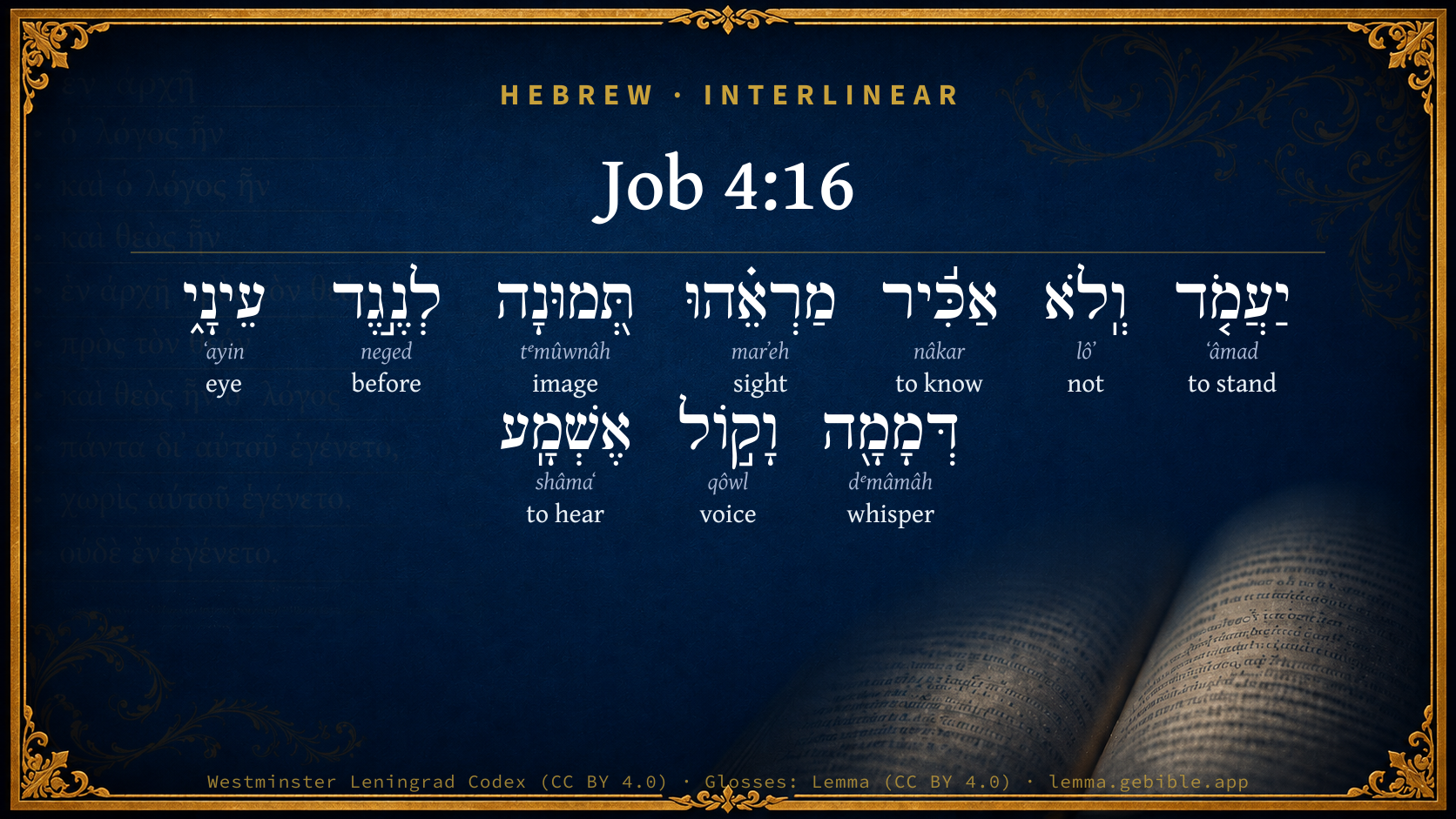
Hebrew (Westminster Leningrad Codex) Job 4:16 appears in the Hebrew Old Testament. The text above is from the Westminster Leningrad Codex. Each word links to its Strong’s number, a concise gloss, and parsing drawn from the Open Scriptures Hebrew Bible morphology. Click any word for its full Brown-Driver-Briggs (BDB) entry.
Download image
Cite this verse

Job 4:16 (World English Bible). Public Domain. Lemma interlinear Bible study tool, https://lemma.gebible.app/v/job/4/16.

Show BibTeX & RIS
BibTeX
RIS
English Translation
It stood still, but I couldn't discern the appearance of it; A form was before my eyes. Silence, then I heard a voice, saying,
World English Bible · Public Domain
Download a study sheet

One document with this verse’s original text, its word-by-word gloss line, the meaning frame, cross-references with their text, attributed commentary, and full source and license credits — printable, and it pastes into notes with its structure intact.

This verse Autodidact and up

Study sheet (.html) Plain text (.txt)

A passage Seminary Student

Up to 50 verses in one chapter. A passage sheet keeps up to 6 commentary sources and 12 cross-references per verse, in the order this page ranks them, and says so on the sheet whenever that leaves anything out. Ask for a single verse and you get the Autodidact verse sheet above.

Everything on this page stays free to read, with no account — the sheet is a download of what is already on screen, not access to it.

Want to remove ads? Support Godless Engineer
Compare translations 3

The same verse in 3 English versions, stacked beneath the original-language interlinear above. Click any original word for its lexicon entry.

Each is an independent rendering of the whole verse — the interlinear is not word-aligned to these translations.

Highlighted words mark where these versions differ — a whole-verse word diff, not a word-by-word alignment.

  • World English Bible Public Domain
    It stood still, but I couldn't discern the appearance of it; A form was before my eyes. Silence, then I heard a voice, saying,
  • King James Version Public Domain
    It stood still, but I could not discern the form thereof: an image was before mine eyes, there was silence, and I heard a voice, saying,
  • unfoldingWord Literal Text CC BY-SA 4.0
    It was standing still, but I was not recognizing its appearance. An image in front of my eyes. silence, then I heard a voice:

unfoldingWord Literal Text — © unfoldingWord, licensed CC BY-SA 4.0. Word-aligned USFM3 via Door43 (git.door43.org/unfoldingWord/en_ult).

Versions to compare (up to 4)

3 of 4 selected

Show all 18 translations

Every available English version of this verse, each an independent rendering of the whole verse.

  • World English Bible Public Domain
    It stood still, but I couldn't discern the appearance of it; A form was before my eyes. Silence, then I heard a voice, saying,
  • Berean Standard Bible Public Domain
    It stood still, but I could not discern its appearance; a form loomed before my eyes, and I heard a whispering voice:
  • Majority Standard Bible Public Domain
    It stood still, but I could not discern its appearance; a form loomed before my eyes, and I heard a whispering voice:
  • King James Version Public Domain
    It stood still, but I could not discern the form thereof: an image was before mine eyes, there was silence, and I heard a voice, saying,
  • American Standard Version (1901) Public Domain
    It stood still, but I could not discern the appearance thereof; A form was before mine eyes: `There was' silence, and I heard a voice, `saying',
  • Revised Version (1885) Public Domain
    It stood still, but I could not discern the appearance thereof; a form was before mine eyes: there was silence, and I heard a voice, saying,
  • Geneva Bible (1599) Public Domain
    Then stoode one, and I knewe not his face: an image was before mine eyes, and in silence heard I a voyce, saying,
  • Douay-Rheims (1899) Public Domain
    There stood one whose countenance I knew not, an image before my eyes, and I heard the voice as it were of a gentle wind:
  • Young's Literal Translation Public Domain
    It standeth, and I discern not its aspect, A similitude `is' over-against mine eyes, Silence! and a voice I hear:
  • Literal Standard Version CC BY-SA 4.0
    It stands, and I do not discern its aspect, || A likeness [is] before my eyes, || Silence! And I hear a voice:
  • Unlocked Literal Bible CC BY-SA 4.0
    The spirit stood still, but I could not discern its appearance. A form was before my eyes; there was silence, and I heard a voice that said,
  • unfoldingWord Literal Text CC BY-SA 4.0
    It was standing still, but I was not recognizing its appearance. An image in front of my eyes. silence, then I heard a voice:
  • Darby Bible Public Domain
    It stood still; I could not discern the appearance thereof: a form was before mine eyes; I heard a slight murmur and a voice:
  • World Messianic Bible Public Domain
    It stood still, but I couldn’t discern its appearance. A form was before my eyes. Silence, then I heard a voice, saying,
  • Webster's Bible Public Domain
    It stood still, but I could not discern its form: an image was before my eyes, there was silence, and I heard a voice, saying,
  • Free Bible Version CC BY-SA 4.0
    Something stopped, but I couldn't see its face. My eyes could only make out a shape. It was totally quiet, and then I heard a voice:
  • Bible in Basic English Public Domain
    Something was present before me, but I was not able to see it clearly; there was a form before my eyes: a quiet voice came to my ears, saying:
  • JPS Tanakh (1917) Public Domain
    It stood still, but I could not discern the appearance thereof; a form was before mine eyes; I heard a still voice:

Literal Standard Version (2020), Covenant Press — licensed CC BY-SA 4.0. Text via the HelloAO Bible API (eBible.org). Unlocked Literal Bible (unfoldingWord) — licensed CC BY-SA 4.0. Text via the HelloAO Bible API (eBible.org). unfoldingWord Literal Text — © unfoldingWord, licensed CC BY-SA 4.0. Word-aligned USFM3 via Door43 (git.door43.org/unfoldingWord/en_ult). Free Bible Version, Dr. Jonathan Gallagher — licensed CC BY-SA 4.0. Text via the HelloAO Bible API (eBible.org).

Word by word

More ways to search: Search by grammar → Find every occurrence → Compare this word →

Practice this passage: Drill this verse → Learn its vocabulary →

About this verse

These counts appear in no published source. They are computed here, from the morphology-tagged text and Lemma’s own curated glosses. What Lemma adds →

10
words
10
distinct lemmas
Wisdom
section

Notable vocabulary

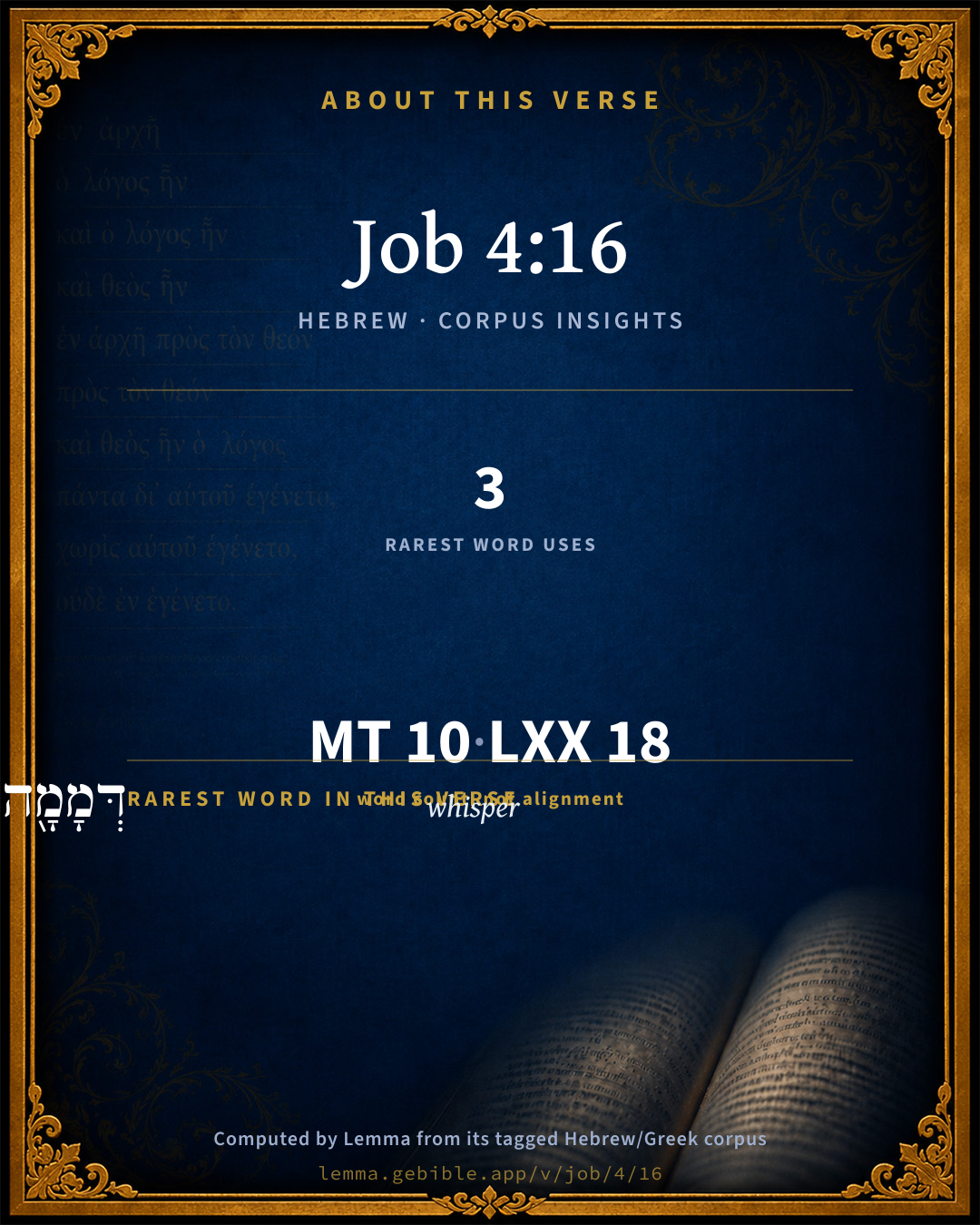
The rarest word here is דְּמָמָ֖ה whisper H1827 — appearing just 3 times in the whole Hebrew Bible.

Shared distinctive vocabulary

דְּמָמָ֖ה whisper H1827 occurs in 3 verses of the Hebrew Bible. Also found in:

Grammatical profile

  • 3 verbs
  • 5 nouns
  • 1 preposition
  • 1 particle

Verb forms

  • יַעֲמֹ֤ד Qal · Imperfect
  • אַכִּ֬יר Hiphil · Imperfect
  • אֶשְׁמָֽע Qal · Imperfect

Hebrew & Septuagint length

In English translation the verse runs 24 words from the Hebrew and 26 from the Septuagint (LXX English) — closely comparable.

A rough comparison of the two English renderings, which tokenize alike — not a word-level alignment.

Word counts can differ between the Hebrew and the Greek without any difference in meaning — e.g. the Hebrew direct-object marker אֵת has no separate Greek word, and Greek often adds the article ὁ.

In the original languages it is 10 Hebrew tokens and 18 Greek tokens — but the two are counted differently (Hebrew bundles its prefixes and suffixes into one token; the Greek is in lemma form), so that isn’t a like-for-like length.

Cross-references

1

Topical passages linked to Job 4:16 in the Treasury of Scripture Knowledge — connected by theme and wording, ordered by reader-vote popularity; previews shown in the World English Bible.

  • 1 Kings 19:12 and after the earthquake a fire; but Yahweh was not in the fire: and after the fire a still small voice.

Cross-references courtesy of OpenBible.info (CC BY 4.0).

Hebrew and Greek witnesses Masoretic Hebrew ↔ Greek Septuagint

The same verse in the two great witnesses to the Old Testament, shown verse-for-verse.

These are two independent witnesses, not word-aligned to each other, and the Septuagint is shown in lemma (dictionary) form.

Hebrew Job 4:16 Masoretic · Westminster Leningrad Codex

יַעֲמֹ֤ד וְֽלֹא אַכִּ֬יר מַרְאֵ֗הוּ תְּ֭מוּנָה לְנֶ֣גֶד עֵינָ֑י דְּמָמָ֖ה וָק֣וֹל אֶשְׁמָֽע

It stood still, but I couldn't discern the appearance of it; A form was before my eyes. Silence, then I heard a voice, saying,

World English Bible · Public Domain

Greek LXX Job 4:16 Septuagint · lemma form

ἀναἵστημι καί οὐ ἐπιγιγνώσκω ὁράω καί οὐ εἰμί μορφή πρό ὀφθαλμός ἐγώ ἀλλά ἤ αὔρα καί φωνή ἀκούω

I arose and perceived it not: I looked, and there, was no form before my eyes: but I only heard a breath and a voice, saying,

LXX2012 (modern English Septuagint) · Public Domain

On this verse, Albert Barnes' Notes on the Bible discusses the Septuagint’s reading. Read the note in Commentary ↓

Hebrew: Westminster Leningrad Codex (CC BY 4.0). Greek: Septuagint (public domain); English from LXX2012 (modern English Septuagint) (Public Domain). How the Septuagint differs from the Hebrew →

Commentary

Notes on Job 4:16 from classic Christian and Jewish commentators (each source and its license shown beneath its notes). The classic Christian expositions comment on the surrounding passage and are grouped to its opening verse, so a note may address several verses; the Jewish commentaries on the Tanakh (Rashi and others) are per-verse, so they appear only where the commentator wrote on this verse.

Lemma curates 59 commentaries, every one of them public domain or Creative Commons licensed, each selected and text-cleaned for this edition rather than reprinted as found. About our sources →

Trapp's Complete Commentary

John Trapp

Job 4:16 It stood still, but I could not discern the form thereof: an image [was] before mine eyes, [there was] silence, and I heard a voice, [saying],

Ver. 16. It stood still] As now ready to speak. An ambulatory voice is hardly heard: the heavens, indeed, are walking preachers, but then they utter but these three words (Lib. ii. de Arca, cap. 3), saith Hugo, in all languages, Accipe, Redde, Fuge, that is, Receive mercies, Return duties, Flee offences, and their just punishments.

But I could not discern the form thereof] Heb. the aspect or countenance. He was so frighted, that his eye could not do its office distinctly, to discern the thing that was just before it. It is natural to a man to fear at the sight of an angel: what then will wicked men do at the last day, when the Son of man shall bring all his angels, not leaving one behind him in heaven? Knowing therefore the terror of the Lord, we persuade men: and oh that we could persuade them!

An image was before mine eyes] But I could not tell what to make of it. It is not the will of God that man should represent him by an image, Deu 4:15-16. The Jews, after the captivity, were so far from idolatry, that they would not admit a carver or painter into their city. The Turks will not endure any image, no, not upon their coins, because of the second commandment. Varro saith, he that first brought in imagery (and that is thought to be Ninus, king of Babylon), superstitionem auxit, metum dempsit, increased superstition, and took away fear. The wiser heathens held that God was too subtle for sinew or sight to seize upon; and the Greek painters, when they would draw the image of their Jupiter in a table, they were still changing it, but never ending it, saying, that herein they showed him to be a god; for that they might begin to paint, but could not perfect him.

There was silence, and I heard a voice] It was fit there should be silence and sedateness of spirit when a Divine voice was to be heard. Let all the earth keep silence before God, Hab 2:20. When the seventh seal was opened there was half an hour’s silence in heaven, Rev 8:1. What a noise is there in many men’s hearts even while they are hearing what the Lord God speaketh unto them! what bargaining, lawing, projecting, running into another world (as men in dreams do), so that they can tell no more what the preacher said than the man in the moon can! Silence is a good preparative to audience. Speak, Lord, for thy servant heareth. Let the woman (and so the man too) learn in silence. Let by thoughts, swarming and humming in our hearts, like the flies of Egypt, be barred out; let the devil, interrupting us with his suggestions, as the Pythoness did Paul and his companions, be haltered up. Let even good thoughts, if unseasonable and heterogeneal to the work in hand, be turned out of doors; let us say to them, as Hushai did to Ahithophel, Thy counsel is good, but not now. How shall we else hear with attention and affection? how shall we listen as for life, and hearken diligently with much heed? Isa 21:7.

John Trapp, A Commentary or Exposition upon All the Books of the Old and New Testament (1647–1656) — public domain. Text from a community e-Sword module.

The Biblical Illustrator

Joseph S. Exell

Job_4:16

There was silence and I heard a voice.

Silence and a voice

1. Gods humbling dispensations toward His people will all come to a good issue, and the close of all His dealings will still be sweet. For after all his humbling and fear, preparing Eliphaz for the vision, and assuring him that God was present, the voice cometh.

2. The composing of our spirits, from the confusions and tumultuous disorders incident to them, is a necessary antecedent to Gods revealing of His mind. For when there was silence, I heard a voice.

3. As for this way of the Lords speaking by a still, or calm voice, albeit we need inquire after no reason why He makes use of it, who doth all things after the counsel of His own will, yet without wresting we may observe these in it.

(1) The Lord hereby did teach that these supernatural truths were mysteries, not blazed abroad throughout the world, but whispered among some few believers.

(2) The Lord hereby did press attention on those to whom He revealed His mind, while He spake not so loud as might reach them whether they attended or not, but in a still voice, which might excite them seriously to hearken.

(3) Hereby also the Lord declared that He will not be a terror to such as delight to converse with Him in His Word, for to such He would not appear as wind, earthquake, or fire, but in a still sweet voice.

(4) However men ought to speak the truths of God so audibly as they may be heard, and with that zeal and fervency that becometh; yet, it is not the clamorous voice that makes the word effectual, but the weight and importance of the matter seriously pressed home by the Spirit of God. For even by this still voice, God communicated His will, and made it to be obeyed in the world. (George Hutcheson.)

The Biblical Illustrator, edited by Joseph S. Exell (c. 1880s–1900s) — public domain. Text from a community e-Sword module.

Joseph Benson's Commentary

Job 4:16. It stood still — Though it passed by me, it did not immediately disappear and vanish, but made a stand, as having some business with me, and designing to address me. But I could not discern the form thereof — Namely, exactly and distinctly, so as to know what or who it was. An image was before my eyes — My eyes could not be deceived. I am thoroughly satisfied there was an image which showed itself to me visibly. There was silence — The spirit stood motionless; all other persons and things about me were entirely silent; and I also kept in my voice and breath as much as I could, that I might distinctly hear what I perceived the spirit was about to speak to me. In the Hebrew it is, Silence, and a voice I heard. Houbigant’s translation of the verse is, It stood still indeed, but I knew not its form; the appearance vanished from before my eyes, but I heard a voice.

Joseph Benson's Commentary on the Old and New Testaments (1811–1818) — public domain. Text from a community e-Sword module.

Geneva Bible (1599)

Geneva Bible translators

When all things were quiet, or when the fear was somewhat assuaged, as God appeared to Elijah, 1 Kings 19:12.

Geneva Bible (1599) marginal notes — public domain. Text via Bolls.life.

Jamieson, Fausset & Brown

Robert Jamieson, A. R. Fausset & David Brown

It stood still--At first the apparition glides before Eliphaz, then stands still, but with that shadowy indistinctness of form which creates such an impression of awe; a gentle murmur: not (English Version): there was silence; for in Kg1 19:12, the voice, as opposed to the previous storm, denotes a gentle, still murmur.

Jamieson, Fausset & Brown — Commentary Critical and Explanatory on the Whole Bible (1871) — public domain (CC PDM 1.0). Text via the HelloAO Bible API.

The Cambridge Bible for Schools and Colleges

gen. ed. J. J. S. Perowne

16. it stood still] It is the mysterious object in his presence.

there was silence, and I heard a voice] lit. stillness and a voice I heard, i. e. probably, I heard a still voice; cf. “whisper,” Job_4:12.

The Cambridge Bible for Schools and Colleges (gen. ed. J. J. S. Perowne; Cambridge University Press, 1878–1918) — public domain. Text from a community e-Sword module.

John Gill's Exposition

Shall mortal man be more just than God?.... Poor, weak, frail, dying man, and so sinful, as his mortality shows, which is the effect of sin; how should such a man be more righteous than God? who is so originally and essentially of himself, completely, perfectly, yea, infinitely righteous in his nature, and in his works, both of providence and grace; in chastising his people, punishing the wicked, and bestowing favours upon his friends, even in their election, redemption, justification, pardon, and eternal happiness: yea, not only profane wicked sinners can make no pretensions to anything of this kind, but even the best of men, none being without sin, no, not man in his best estate; for the righteousness he had then was of God, and therefore he could not be more just than he that made him upright. This comparative sense, which our version leads to, is more generally received; but it seems not to be the sense of the passage, since this is a truth clear from reason, and needed no vision or revelation to discover it; nor can it be thought that God would send an angelic spirit in such an awful and pompous manner, to declare that which every one knew, and no man would contradict; even the most self-righteous and self-sufficient man would never be so daring and insolent as to say he was more righteous than God; but the words should be rather rendered, "shall mortal man be justified by God, or be just from God?" or "with" him, or "before" him (t), in his sight, by any righteousness in him, or done by him? shall he enter into his presence, stand at his bar, and be examined there, and go away from thence, in the sight and account of God, as a righteous person of himself? no, he cannot; now this is a doctrine opposed to carnal reasoning and the common sentiments of men, a doctrine of divine revelation, a precious truth: this is the string of pearls Eliphaz received, see Job 4:12; that mortal man is of himself an unrighteous creature; that he cannot be justified by his own righteousness in the sight of God; and that he must look and seek out for a better righteousness than his own, to justify him before God; and this agrees with Eliphaz's interpretation of the vision, Job 15:14; with the sentiments of his friend Bildad, who seems to have some respect to it, Job 25:4; and also of Job himself, Job 9:2; and in like manner are we to understand the following clause:

shall a man be more pure than his Maker? even the greatest and best of men, since what purity was in Adam, in a state of innocence, was from God; and what good men have, in a state of grace, is from the grace of God and blood of Christ, without which no man is pure at all, and therefore cannot be purer than him from whom they have it: or rather "be pure from", or "with", or "before his Maker" (u), or be so accounted by him; every man is impure by his first birth, and in his nature state, and therefore cannot stand before a pure and holy God, who of purer eyes than to behold iniquity; or go away his presence, and be reckoned by him a pure and holy creature of himself; nor can any thing that he can do, in a moral or ceremonial manner, cleanse him from his impurity; and therefore it is necessary he should apply to the grace of God, and blood of Christ, for his purification.

(t) "an mortalis a Deo justificabitur?" Codurcus' Bolducius, Deodatus, Gussetius, Ebr. Comment. p. 709. "Num mortalis a numine justus erit?" Schultens; so Mr. Broughton, "can the sorrowful man be holden just before the Puissant?" (u) "an quisquam vir a factore suo mundus habebitur?" Codurcus; "an a conditore suo purus erit vir?" Schultens; so Mr. Broughton, "can the human being be clear before him that was his Maker?"

John Gill's Exposition of the Whole Bible (1746–1763) — public domain (CC PDM 1.0). Text via the HelloAO Bible API.

Albert Barnes' Notes on the Bible

It stood still - It took a fixed position and looked on me. It at first glided by, or toward him, then stood in an immovable position, as if to attract his attention, and to prepare him for the solemn announcement which it was about to make. This was the point in which most horror would be felt. We should be less alarmed at anything which a strange messenger should say, than to have him stand and fix his eyes steadily and silently upon us. Hence, Horatius, in “Hamlet,” tortured by the imperturbable silence of the Ghost, earnestly entreated it to give him relief by speaking.

Hor. - What art thou that usurp’st this time of night,

Together with that fair and warlike form

In which the majesty of buried Denmark

Did sometime march? By heaven, I charge thee, speak.

Mar. - It is offended.

Ber. - See: It stalks away.

Hor. - Stay; speak: speak, I charge thee speak.

Act i. Sc. i.

Re-enter Ghost.

Hor. - But, soft; behold! lo, where it comes again!

I’ll cross it, though it blast me. - Stay, illusion!

If thou hast any sound, or use of voice,

Speak to me:

If there be any good thing to be done,

That may to thee do ease, and grace to me,

Speak to me:

Which, happily, foreknowing may avoid,

If thou art privy to thy country’s fate.

O speak!

Or if thou hast uphoarded in thy life

Extorted treasure in the womb of earth,

For which, they say, you spirits oft walk in death,

Speak of it; stay, and speak.

Act i. Sc. i.

Enter Ghost

Hor. - Look, my lord; it comes!

Ham. - Angels and ministers of grace, defend us!

Be thou a spirit of health, or goblin damn’d,

Bring with thee airs from heaven, or blasts from hell,

Be thy intents wicked or charitable,

Thou com’st in such a questionable shape,

That I will speak to thee: I’ll call thee, Hamlet,

King, father, royal Dane: O, answer me;

Let me not burst in ignorance!

Act i: Sc. iv.

But I could not discern the form thereof - This might have arisen from fear, or from the darkness of the night, or because the spirit was not distinct enough in its outline to enable him to do it. There is here just the kind of obscurity which is essential to the sublime, and the statement of this circumstance is a master-stroke in the poet. A less perfect imagination would have attempted to describe the form of the spectre, and would have given an account of its shape, and eyes, and color. But none of these are here hinted at. The subject is left so that the imagination is most deeply impressed, and the whole scene has the aspect of the highest sublimity. Noyes very improperly renders this, “Its face I could not discern.” But the word used, מראה mar'eh, does not mean “face” here merely; it means the form, figure, aspect, of the spectre.

An image was before mine eyes - Some form; some appearance was before me, whose exact figure I could not mark or describe.

There was silence - Margin, “I heard a still voice.” So Rosenmuller says that the word here, דּממה demâmâh, does not mean silence, but a gentle breeze, or air - auram lenem - such as Elijah heard after the tempest had gone by, and when God spoke to him, 1Ki 19:12-13. Grotins supposes that it means here the בת־קול bath qôl, or “daughter of the voice,” of which the Jewish Robbins speak so often - the still and gentle voice in which God spoke to people. The word used דממה demâmâh usually means silence, stillness, as of the winds after a storm, a calm, Psa 107:29. The Septuagint renders it, “I heard a gentle breeze, αυραν auran, and a voice,” καί φωνὴν kai phōnēn. But it seems to me that the common reading is preferable. There was stillness - a solemn, awful silence, and then he heard a voice impressively speaking. The stillness was designed to fix the attention, and to prepare the mind for the sublime announcement which was to be made.

Albert Barnes' Notes on the Bible (1834–1885) — public domain. Text from a community e-Sword/MySword module.

Haydock's Catholic Bible Commentary

And I. Protestants, "there was silence, and I heard a voice." Marginal note, "a still voice." Septuagint, "But I heard a breeze and a voice." (Haydock)

George Leo Haydock (1774–1849), Haydock's Catholic Family Bible and Commentary, 1859 edition — public domain. Excludes Psalms (Douay-Rheims chapter numbering differs from Protestant) and Deuterocanonical books (Catholic canon only).

Matthew Poole's English Annotations

It stood still; having passed by him to and again he made a stand, as one that had some business with him, and addressed himself to speak to him.

I could not discern the form thereof; to wit, exactly and distinctly, so as to know what or who it was.

An image was before mine eyes; I saw some corporal or visible resemblance, though in a confused manner.

There was silence: the spirit, which possibly had made some noise with his motion, now standing still made no noise; all other persons and things about me were silent, and I also kept in my voice and breath as much as I could, that I might distinctly hear what I perceived the spirit was speaking to me. In the Hebrew the words run thus, silence and a voice (i.e. a silent, or still, or low voice, by a very common figure, called hendiadis) I heard.

Matthew Poole's English Annotations on the Holy Bible (1683–1685) — public domain. Text from a community e-Sword/MySword module.

Whedon's Commentary on the Bible

Daniel D. Whedon

16. An image — תמונה(rendered by the Septuagint μορφη, form, comp. Php_2:6) is used in Num_12:8 of some glorious, visible representation of God. (Sept. δοξα, also same in Psa_17:15.) The word happily blends the indefiniteness and the substantiality of spiritual existence — answering to Milton’s idea of that which: —

Substance might be called that shadow seemed.

The preceding word form Hitzig renders face, visage, that which has features.

Silence, and I heard a voice — Septuagint, I heard a soft murmur (αυραν) and a voice. Dillmann scouts the idea of rendering דממה, silence, “because we cannot hear silence,” and in common with Schlottmann and other German commentators, adopts the Septuagint. Renan and Conant hold to the radical meaning of the word, which is unquestionably silence. Mercerus renders it, I heard silence and a voice, “as if his wonderful words were compounded of silence and a voice.” In 1Ki_19:12, even prosaical description admits of the “voice of silence,” קול דממה. This would be no bolder a stroke for poetry than that of the author of “The Seasons,” who thus personifies silence, —

Come, then, expressive silence, muse his praise.

We can almost feel the silence that for a little while prevailed as the shadowy form stood before the trembling Eliphaz. There is nothing in the structure of the sentence to conflict with the version of the text, (there was) silence, etc. Tyndale’s rendering is more explicit, “There was stylnes, so that I heard this voice.”

Daniel D. Whedon (gen. ed.), Commentary on the Old and New Testaments (1874–1909) — public domain. Text from a community e-Sword module.

The Pulpit Commentary

It stood still, but I could not discern the form thereof. Canon Cook quotes, very appositely, Milton"s representation of Death as a fearful shape, "If shape it could be called that shape had none Distinguishable in member, joint, or limb, Or substance might be called that shadow seemed.

An image was before mine eyes; or, on appearance (LXX, morfh ). There was silence; or, a hush aeris nullo motu turbati, et tranquillissimus" (Schulteus). And I heard a voice, saying . After a while the silence was broken by a voice, which whispered in Eliphaz"s ear (setup. ver. 12).

The Pulpit Commentary (1880–1919), ed. H.D.M. Spence-Jones & Joseph S. Exell — public domain. Text from a community e-Sword module.

John Wesley's Explanatory Notes

Stood - Having passed by him to, and again, he made a stand, and addressed himself to speak. The form - Exactly and distinctly. An image - I saw some visible resemblance, though in a confused manner. Silence - The spirit, which possibly had made some noise with his motion, now standing still made no noise; all other persons and things about me were silent, and I also kept in my voice and breath, that I might distinctly hear. In the Hebrew, the words run thus, silence and a voice I heard.

John Wesley, Explanatory Notes Upon the Whole Bible (1754–1765) — public domain. Text via the GEBible commentary corpus.

unfoldingWord translationNotes

Door43 World Missions Community

General Information:

The writer uses parallelism in verse 17, conveying a single idea using two different statements to emphasize a question about the purity of man before God. (See: Parallelism)

A form was before my eyes

"Something was before my eyes," "I saw something"

and I heard

"then I heard"

Can a mortal man be more righteous than God?

Eliphaz poses this question so that Job will consider, "Do I regard myself as more righteous than God?" or "Am I justified before God?" AT: "A mortal man cannot be more righteous than God." or "A mortal man cannot be righteous before God." (See: Rhetorical Question)

Can a man be more pure than his Maker?

This question has the same purpose as the previous question. AT: "A man cannot be more pure than his Maker." or "A man cannot be pure before his Maker." (See: Rhetorical Question)

his Maker

"his Creator"

translationWords

spirit

discern

voice

righteous

God

pure

unfoldingWord translationNotes — © Distant Shores Media and the Door43 World Missions Community, licensed CC BY-SA 4.0. Source: git.door43.org/Door43/en_tn.

Rashi

Rabbi Shlomo Yitzchaki (Rashi)

It was standing It was standing before me, but I did not recognize its appearance.

a faint voice I heard the sound of faint words. Another explanation: I heard silence and a voice. I heard the voice of the silence, but the silence I did not hear. “Silence” denotes angels reciting praise silently, as [Jonathan] renders (I Kings 19:12): “a still small voice” as: a voice of those praising quietly. Moses heard the silence [i.e., the voice of the angels praising]—from here we deduce that the early prophets heard [lit. used] the voice, whereas the later ones heard an echo, like a man who hits with a hammer, and the echo resounds far away. From here... far away. Here it is written: silence and a voice, whereas concerning Elijah it is written: a still small voice; because Eliphaz heard only the silencing of the voice, like a person who shouts into a barrel, that the voice of the barrel shouts toward him. That is an echo, not the voice itself, but concerning Elijah if is written: a still, small voice, for he heard the voice itself] And this is what it said.

Rashi on the Tanakh — English translations: “The Judaica Press complete Tanach with Rashi, translated by A. J. Rosenberg” (CC BY 4.0); “Pentateuch with Rashi's commentary by M. Rosenbaum and A.M. Silbermann, 1929-1934” (public domain); “The Metsudah Tanach series, Lakewood, N.J” (CC BY 4.0); and “The Book of Joshua, Metsudah Publications, 1997” (CC BY 4.0). Text via Sefaria.

Lesson kit

Teaching starters — assembled from the data on this page, not authored interpretation. Every prompt links to the verse data it draws on. Edit before teaching.

Job, in the Wisdom, opens this verse with 10 words (10 distinct Hebrew lemmas). Its most distinctive word is dᵉmâmâh (“whisper”). A historical commentator’s framing appears above. Read the whole chapter for the surrounding context.

Discussion questions

  1. How does “whisper” (dᵉmâmâh) shape what this verse is saying?
  2. 1 Kings 19:12 shares the word «whisper» with this verse. How do the two illuminate each other?
  3. These translations render this verse differently. What is at stake in choosing one wording over another?
  4. The verb «יַעֲמֹ֤ד» is Qal Imperfect. How does its form color the action?
  5. Reading how Trapp's Complete Commentary and The Biblical Illustrator read this verse, where do the two commentators agree and where do they part?

Things to notice

Reading settings

Reading text

Shown beneath each verse's original-language words.

Old Testament
Old Testament edition

Read the OT as the Masoretic Hebrew (MT) or the Greek Septuagint (LXX).

English shown for the Greek Septuagint (in the Hebrew ↔ Greek comparison).

Comparing translations? Open the Compare panel on any verse page to stack up to four side by side.