
Jeremiah 24:5

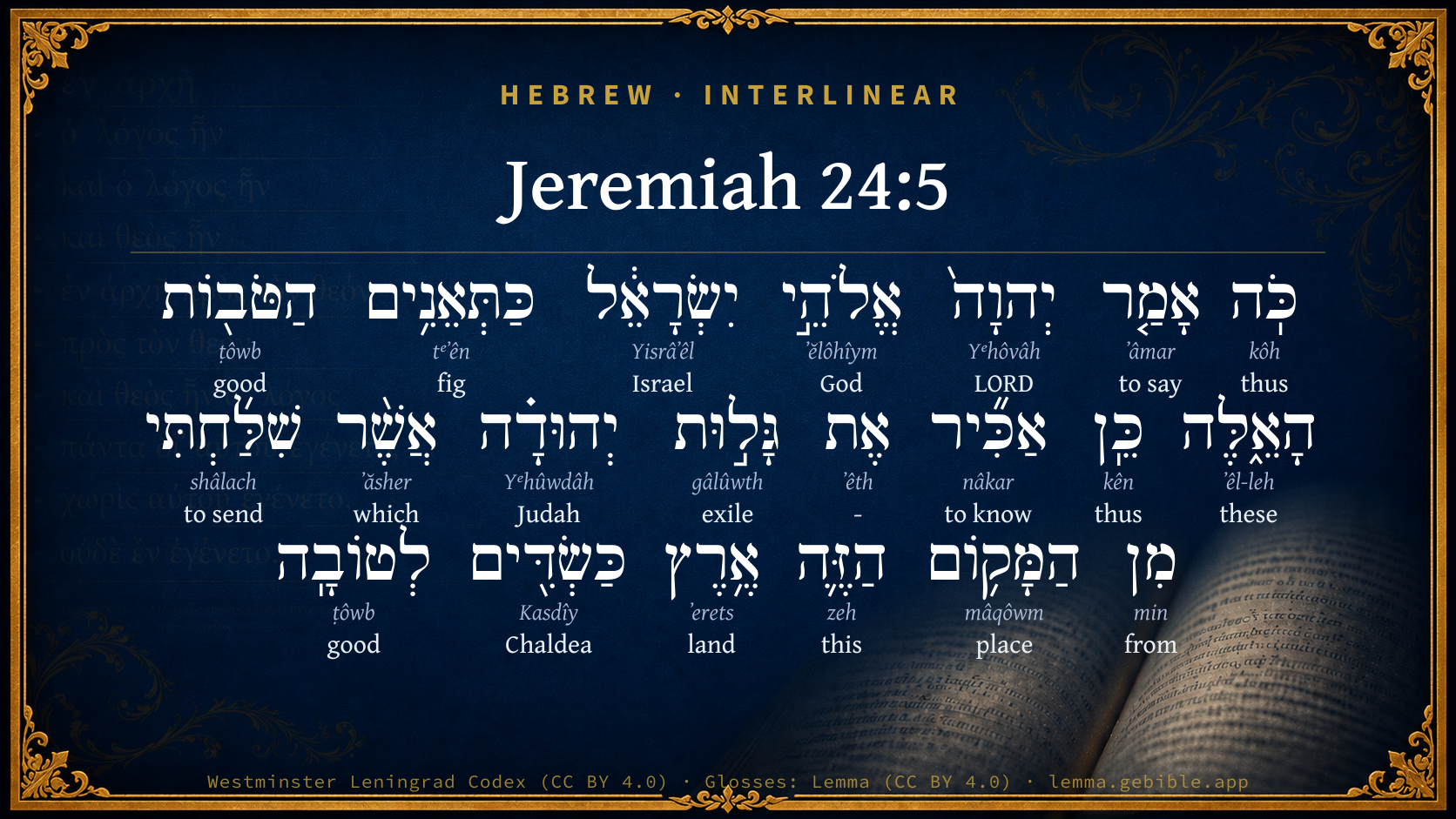
Hebrew (Westminster Leningrad Codex) Jeremiah 24:5 appears in the Hebrew Old Testament. The text above is from the Westminster Leningrad Codex. Each word links to its Strong’s number, a concise gloss, and parsing drawn from the Open Scriptures Hebrew Bible morphology. Click any word for its full Brown-Driver-Briggs (BDB) entry.
Download image
Cite this verse

Jeremiah 24:5 (World English Bible). Public Domain. Lemma interlinear Bible study tool, https://lemma.gebible.app/v/jeremiah/24/5.

Show BibTeX & RIS
BibTeX
RIS
English Translation
Thus says Yahweh, the God of Israel: Like these good figs, so will I regard the captives of Judah, whom I have sent out of this place into the land of the Chaldeans, for good.
World English Bible · Public Domain
Download a study sheet

One document with this verse’s original text, its word-by-word gloss line, the meaning frame, cross-references with their text, attributed commentary, and full source and license credits — printable, and it pastes into notes with its structure intact.

This verse Autodidact and up

Study sheet (.html) Plain text (.txt)

A passage Seminary Student

Up to 50 verses in one chapter. A passage sheet keeps up to 6 commentary sources and 12 cross-references per verse, in the order this page ranks them, and says so on the sheet whenever that leaves anything out. Ask for a single verse and you get the Autodidact verse sheet above.

Everything on this page stays free to read, with no account — the sheet is a download of what is already on screen, not access to it.

Want to remove ads? Support Godless Engineer
Compare translations 3

The same verse in 3 English versions, stacked beneath the original-language interlinear above. Click any original word for its lexicon entry.

Each is an independent rendering of the whole verse — the interlinear is not word-aligned to these translations.

Highlighted words mark where these versions differ — a whole-verse word diff, not a word-by-word alignment.

  • World English Bible Public Domain
    Thus says Yahweh, the God of Israel: Like these good figs, so will I regard the captives of Judah, whom I have sent out of this place into the land of the Chaldeans, for good.
  • King James Version Public Domain
    Thus saith the LORD, the God of Israel; Like these good figs, so will I acknowledge them that are carried away captive of Judah, whom I have sent out of this place into the land of the Chaldeans for their good.
  • unfoldingWord Literal Text CC BY-SA 4.0
    “Thus says Yahweh, the God of Israel: Like these good figs, so I will regard the exile of Judah whom I sent away from this place the land of the Chaldeans, for good.

unfoldingWord Literal Text — © unfoldingWord, licensed CC BY-SA 4.0. Word-aligned USFM3 via Door43 (git.door43.org/unfoldingWord/en_ult).

Versions to compare (up to 4)

3 of 4 selected

Show all 18 translations

Every available English version of this verse, each an independent rendering of the whole verse.

  • World English Bible Public Domain
    Thus says Yahweh, the God of Israel: Like these good figs, so will I regard the captives of Judah, whom I have sent out of this place into the land of the Chaldeans, for good.
  • Berean Standard Bible Public Domain
    “This is what the LORD, the God of Israel, says: ‘Like these good figs, so I regard as good the exiles from Judah, whom I have sent away from this place to the land of the Chaldeans.
  • Majority Standard Bible Public Domain
    “This is what the LORD, the God of Israel, says: ‘Like these good figs, so I regard as good the exiles from Judah, whom I have sent away from this place to the land of the Chaldeans.
  • King James Version Public Domain
    Thus saith the LORD, the God of Israel; Like these good figs, so will I acknowledge them that are carried away captive of Judah, whom I have sent out of this place into the land of the Chaldeans for their good.
  • American Standard Version (1901) Public Domain
    Thus saith Jehovah, the God of Israel: Like these good figs, so will I regard the captives of Judah, whom I have sent out of this place into the land of the Chaldeans, for good.
  • Revised Version (1885) Public Domain
    Thus saith the LORD, the God of Israel; Like these good figs, so will I regard the captives of Judah, whom I have sent out of this place into the land of the Chaldeans, for good.
  • Geneva Bible (1599) Public Domain
    Thus sayeth the Lord, the God of Israel, Like these good figges, so will I knowe them that are caryed away captiue of Iudah to bee good, whome I haue sent out of this place, into the land of the Caldeans.
  • Douay-Rheims (1899) Public Domain
    Thus saith the Lord the God of Israel: Like these good figs, so will I regard the captives of Juda, whom I have sent forth out of this place into the land oif the Chaldeans, for their own good.
  • Young's Literal Translation Public Domain
    Thus said Jehovah, God of Israel, Like these good figs so do I acknowledge The removed of Judah -- that I sent from this place, `To' the land of the Chaldeans -- for good.
  • Literal Standard Version CC BY-SA 4.0
    “Thus said YHWH, God of Israel: Like these good figs so I acknowledge || The expulsion of Judah that I sent from this place, || [To] the land of the Chaldeans—for good.
  • Unlocked Literal Bible CC BY-SA 4.0
    “Yahweh, God of Israel, says this: I will look on the exiles of Judah for their benefit, just like these good figs, the exiles whom I have sent out from this place to the land of Chaldea.
  • unfoldingWord Literal Text CC BY-SA 4.0
    “Thus says Yahweh, the God of Israel: Like these good figs, so I will regard the exile of Judah whom I sent away from this place the land of the Chaldeans, for good.
  • Darby Bible Public Domain
    Thus saith Jehovah, the God of Israel: Like these good figs, so will I regard for good them that are carried away captive of Judah, whom I have sent out of this place into the land of the Chaldeans;
  • World Messianic Bible Public Domain
    “The LORD, the God of Israel says: ‘Like these good figs, so I will regard the captives of Judah, whom I have sent out of this place into the land of the Kasdim, as good.
  • Webster's Bible Public Domain
    Thus saith the LORD, the God of Israel; Like these good figs, so will I acknowledge them that are carried away captive of Judah, whom I have sent out of this place into the land of the Chaldeans for their good.
  • Free Bible Version CC BY-SA 4.0
    This is what the Lord, the God of Israel, says: The good figs represent to me the exiles from Judah, those I have sent away from here to the country of Babylonia.
  • Bible in Basic English Public Domain
    This is what the Lord, the God of Israel, has said: Like these good figs, so in my eyes will be the prisoners of Judah, whom I have sent from this place into the land of the Chaldaeans for their good.
  • JPS Tanakh (1917) Public Domain
    'Thus saith the LORD, the God of Israel: Like these good figs, so will I regard the captives of Judah, whom I have sent out of this place into the land of the Chaldeans, for good.

Literal Standard Version (2020), Covenant Press — licensed CC BY-SA 4.0. Text via the HelloAO Bible API (eBible.org). Unlocked Literal Bible (unfoldingWord) — licensed CC BY-SA 4.0. Text via the HelloAO Bible API (eBible.org). unfoldingWord Literal Text — © unfoldingWord, licensed CC BY-SA 4.0. Word-aligned USFM3 via Door43 (git.door43.org/unfoldingWord/en_ult). Free Bible Version, Dr. Jonathan Gallagher — licensed CC BY-SA 4.0. Text via the HelloAO Bible API (eBible.org).

Word by word

More ways to search: Search by grammar → Find every occurrence → Compare this word →

Practice this passage: Drill this verse → Learn its vocabulary →

גָּל֣וּת
gâlûwth
H1546
“exile of”
Noun, Common, Feminine, Singular, Construct
Part of Speech
Noun
Type
Common
Gender
Feminine
Number
Singular
State
Construct
Full BDB Definition

Origin: from H1540

TWOT: 350b

exile, exiles - (TWOT) captivity
  1. כֹּֽה kôh H3541 “thus” Adverb
  2. אָמַ֤ר ʼâmar H559 “to say” Verb, Qal, Perfect, 3rd Person, Masculine, Singular
  3. יְהוָה֙ Yᵉhôvâh H3068 “LORD” Noun, Proper
  4. אֱלֹהֵ֣י ʼĕlôhîym H430 “God(s) of” Noun, Common, Masculine, Plural, Construct
  5. יִשְׂרָאֵ֔ל Yisrâʼêl H3478 “Israel” Noun, Proper
  6. כַּתְּאֵנִ֥ים tᵉʼên H8384 “like/as the · figs” Preposition, Determined + Noun, Common, Feminine, Plural, Absolute
  7. הַטֹּב֖וֹת ṭôwb H2896 “the · good” Particle, Definite Article + Adjective, Adjective, Feminine, Plural, Absolute
  8. הָאֵ֑לֶּה ʼêl-leh H428 “the · these” Particle, Definite Article + Pronoun, Demonstrative, Common, Plural
  9. כֵּֽן kên H3651 “thus” Particle, Demonstrative
  10. אַכִּ֞יר nâkar H5234 “to know” Verb, Hiphil, Imperfect, 1st Person, Common, Singular
  11. אֶת ʼêth H853 “-” Particle, Direct Object
  12. יְהוּדָ֗ה Yᵉhûwdâh H3063 “Judah” Noun, Proper
  13. אֲשֶׁ֨ר ʼăsher H834 “which” Particle, Relative
  14. שִׁלַּ֜חְתִּי shâlach H7971 “to send” Verb, Piel, Perfect, 1st Person, Common, Singular
  15. מִן min H4480 “from” Preposition
  16. הַמָּק֥וֹם mâqôwm H4725 “the · place” Particle, Definite Article + Noun, Common, Masculine, Singular, Absolute
  17. הַזֶּ֛ה zeh H2088 “the · this” Particle, Definite Article + Pronoun, Demonstrative, Masculine, Singular
  18. אֶ֥רֶץ ʼerets H776 “land of” Noun, Common, Both, Singular, Construct
  19. כַּשְׂדִּ֖ים Kasdîy H3778 “Chaldea” Noun, Proper
  20. לְטוֹבָֽה ṭôwb H2896 “to/for · good” Preposition + Adjective, Adjective, Feminine, Singular, Absolute

About this verse

These counts appear in no published source. They are computed here, from the morphology-tagged text and Lemma’s own curated glosses. What Lemma adds →

21
words
20
distinct lemmas
Prophets
section

Notable vocabulary

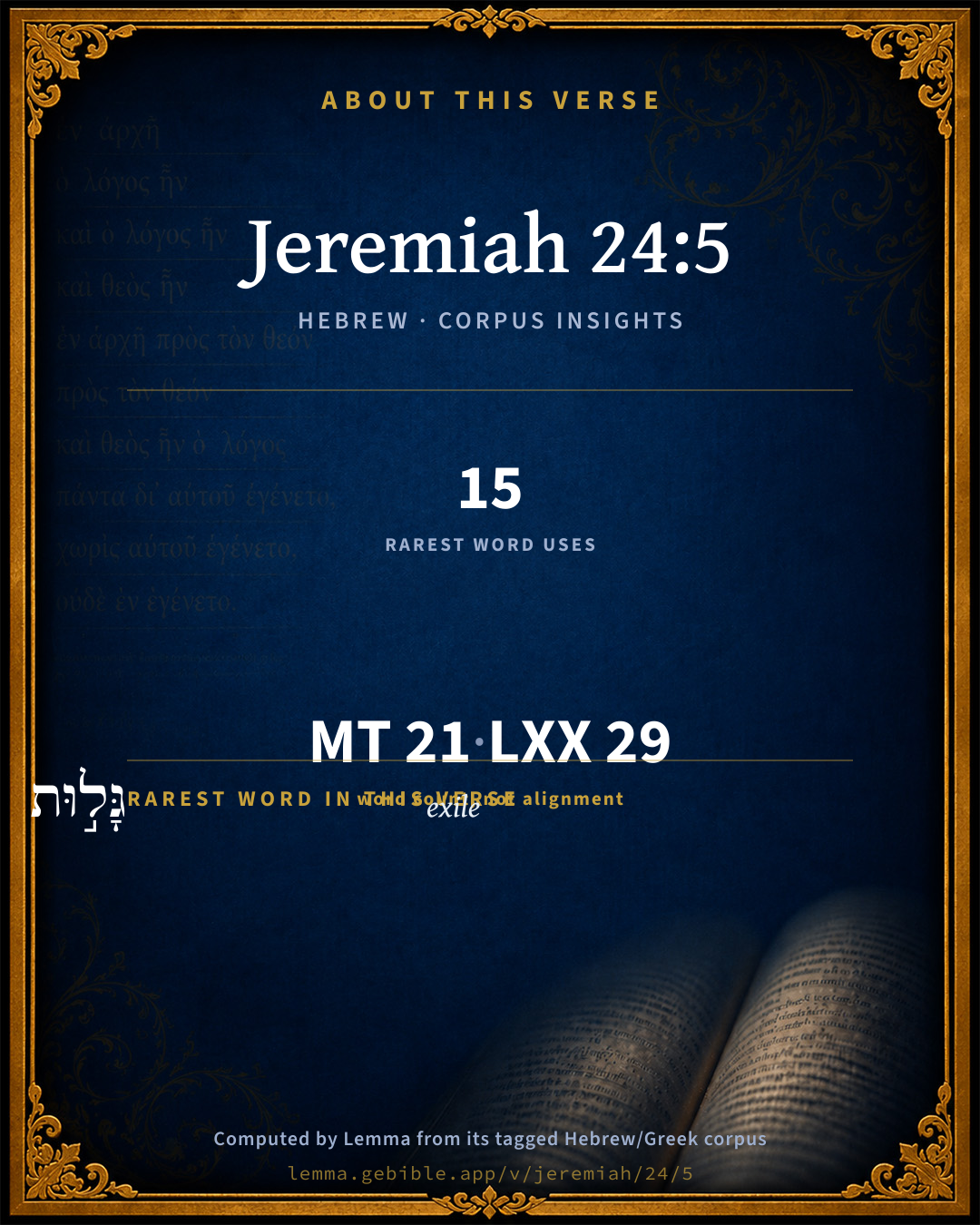
The rarest word here is גָּל֣וּת exile H1546 — appearing just 15 times in the whole Hebrew Bible.

Shared distinctive vocabulary

גָּל֣וּת exile H1546 occurs in 14 verses of the Hebrew Bible. Also found in:

Grammatical profile

  • 3 verbs
  • 9 nouns
  • 2 adjectives
  • 2 pronouns
  • 1 preposition
  • 1 adverb
  • 3 particles

Verb forms

  • אָמַ֤ר Qal · Perfect
  • אַכִּ֞יר Hiphil · Imperfect
  • שִׁלַּ֜חְתִּי Piel · Perfect

Repetition

A word recurs within this verse — often emphatic in Hebrew:

  • הַטֹּב֖וֹת good H2896 ×2

Hebrew & Septuagint length

In the original languages it is 21 Hebrew tokens and 29 Greek tokens — but the two are counted differently (Hebrew bundles its prefixes and suffixes into one token; the Greek is in lemma form), so that isn’t a like-for-like length.

Cross-references

14

Topical passages linked to Jeremiah 24:5 in the Treasury of Scripture Knowledge — connected by theme and wording, ordered by reader-vote popularity; previews shown in the World English Bible.

  • Zechariah 13:9 I will bring the third part into the fire, And will refine them as silver is refined, And will test them like gold is tested. They will call on my name, and I will hear them. I will say, 'It is my people;' And they will say, 'Yahweh is my God.'"
  • Nahum 1:7 Yahweh is good, a stronghold in the day of trouble; and he knows those who take refuge in him.
  • Deuteronomy 8:16 who fed you in the wilderness with manna, which your fathers didn't know; that he might humble you, and that he might prove you, to do you good at your latter end:
  • Psalms 94:12–14 Blessed is the man whom you discipline, Yah, And teach out of your law;
  • Psalms 119:67 Before I was afflicted, I went astray; But now I observe your word.
  • Psalms 119:71 It is good for me that I have been afflicted, That I may learn your statutes.
  • Matthew 25:12 But he answered, 'Most assuredly I tell you, I don't know you.'
  • John 10:27 My sheep hear my voice, and I know them, and they follow me.
  • Romans 8:28 We know that all things work together for good for those who love God, to those who are called according to his purpose.
  • 1 Corinthians 8:3 But if anyone loves God, the same is known by him.
  • Galatians 4:9 But now that you have come to know God, or rather to be known by God, why do you turn back again to the weak and miserable elements, to which you desire to be in bondage all over again?
  • 2 Timothy 2:19 However God's firm foundation stands, having this seal, "The Lord knows those who are his," and, "Let every one who names the name of the Lord depart from unrighteousness."
  • Hebrews 12:5–10 and you have forgotten the exhortation which reasons with you as with children, "My son, don't take lightly the chastening of the Lord, Nor faint when you are reproved by him;
  • Revelation 3:19 As many as I love, I reprove and chasten. Be zealous therefore, and repent.

Cross-references courtesy of OpenBible.info (CC BY 4.0).

Hebrew and Greek witnesses Masoretic Hebrew ↔ Greek Septuagint

The same verse in the two great witnesses to the Old Testament, shown verse-for-verse.

These are two independent witnesses, not word-aligned to each other, and the Septuagint is shown in lemma (dictionary) form.

Hebrew Jeremiah 24:5 Masoretic · Westminster Leningrad Codex

כֹּֽה אָמַ֤ר יְהוָה֙ אֱלֹהֵ֣י יִשְׂרָאֵ֔ל כַּתְּאֵנִ֥ים הַטֹּב֖וֹת הָאֵ֑לֶּה כֵּֽן אַכִּ֞יר אֶת גָּל֣וּת יְהוּדָ֗ה אֲשֶׁ֨ר שִׁלַּ֜חְתִּי מִן הַמָּק֥וֹם הַזֶּ֛ה אֶ֥רֶץ כַּשְׂדִּ֖ים לְטוֹבָֽה

Thus says Yahweh, the God of Israel: Like these good figs, so will I regard the captives of Judah, whom I have sent out of this place into the land of the Chaldeans, for good.

World English Bible · Public Domain

Greek LXX Structure differs

In the Septuagint, Jeremiah is about an eighth shorter than the Hebrew and arranges its material differently — the Oracles Against the Nations (Hebrew chapters 46–51) appear in the middle of the Greek book, after 25:13. Because the chapter and verse boundaries do not line up, a verse-for-verse comparison with the Hebrew is not shown.

A verse-for-verse comparison isn’t shown here because the chapters and verses don’t line up. Switch to the LXX edition with the MT / LXX toggle above to read the Greek directly.

Hebrew: Westminster Leningrad Codex (CC BY 4.0). Greek: Septuagint (public domain); English from a public-domain English Septuagint. How the Septuagint differs from the Hebrew →

Targum (Aramaic paraphrase)

1

The Targum is the ancient Jewish Aramaic paraphrase of the Hebrew Scriptures — an interpretive translation, not the Hebrew text itself. Onkelos (literal) and Pseudo-Jonathan (expansive) render the Torah, and Jonathan the Prophets. Coverage is partial: where no permissively-licensed English translation exists for a verse, only the Aramaic is shown. This is verse-level text, not a word-by-word alignment to the Hebrew.

  1. Targum Jonathan Prophets (Joshua–Malachi)
    כִּדְנַן אֲמַר יְיָ אֱלָהָא דְיִשְׂרָאֵל כְּתֵינַיָא טָבָתָא הָאִלֵין כֵּן אִשְׁתְּמוֹדַע יַת גַלְוַת יְהוּדָה דְאַגְלֵיתִי מִן אַתְרָא הָדֵין לַאֲרַע כַּסְדָאֵי לְטָבְתָא:

    (no public-domain English translation for this verse)

    Targum Jonathan — Aramaic: “Mikraot Gedolot” (public domain). English: “Sefaria Community Translation” (CC0 1.0 (public-domain dedication)); “London "Chaldee Paraphrase," 1871” (public domain). Text via Sefaria.

Commentary

Notes on Jeremiah 24:5 from classic Christian and Jewish commentators (each source and its license shown beneath its notes). The classic Christian expositions comment on the surrounding passage and are grouped to its opening verse, so a note may address several verses; the Jewish commentaries on the Tanakh (Rashi and others) are per-verse, so they appear only where the commentator wrote on this verse.

Lemma curates 59 commentaries, every one of them public domain or Creative Commons licensed, each selected and text-cleaned for this edition rather than reprinted as found. About our sources →

Trapp's Complete Commentary

John Trapp

Jer 24:5 Thus saith the LORD, the God of Israel; Like these good figs, so will I acknowledge them that are carried away captive of Judah, whom I have sent out of this place into the land of the Chaldeans for [their] good.

Ver. 5. Like these good figs.] Quas sic dat et arbor et aura, when once God hath made the tree good, the fruit will be good.

So will I acknowledge.] Heb., Know, that is, own, or take special notice of, and this made the difference.

Whom I have sent out of this place for their good.] It is for their good, temporal and eternal, that God chastiseth his children. Jehoiachin was preferred at length; and as the Jewish doctors say, converted, as Manasseh had been before him. Daniel and his associates were set over the kingdom. The Jews got good estates and respect in the land of their captivity, {Jer 29:4 Est 9:4; Est 9:29} and were at length sent back with many favours and privileges, &c.

John Trapp, A Commentary or Exposition upon All the Books of the Old and New Testament (1647–1656) — public domain. Text from a community e-Sword module.

The Biblical Illustrator

Joseph S. Exell

Jer_24:5

Whom I have sent out of this place into the land of the Chaldeans for their good.

The action of love

The Lord says He will send His people into captivity for their good. How marvellous is the action of love! The parent sends away the child he cannot live without for the childs good; men undertake long and perilous and costly journeys that they may accomplish a purpose that is good. Jesus Christ Himself said to His wondering disciples, It is expedient for you that I go away. Who can understand this action of love? It would seem to us to be otherwise: that it would be best for Jesus to remain until the very last wanderer is home. Are we not sent away? have we not lost fortune, station, standing? have we not been punished in a thousand different ways-chastised, humiliated, afflicted? have we not been suddenly surrounded with clouds in which there was no light--yea, and clouds in which there was no rain, simply darkness, sevenfold night? Yet it was for our good; it was that our vanity might be rebuked, that the centre of dependence might be found, that the throne of righteousness might be seen and approached. Let us look upon our afflictions, distresses, and losses in that light. (J. Parker, D. D.)

Outward circumstances no standard by which to judge of ones true state

The captives already in Babylon are compared to good fruit, such as is fit for use and sweet to the taste. The party in Jerusalem as yet free, is compared to bad fruit, unfit for use, and nauseous to the palate. And yet if one judged by the mere outward aspect of things, the state of the captives in the enemies city seemed a much more undesirable one than that of their brethren in the metropolis of their own land. Hence we see that the good or evil of ones circumstances is not to be judged by outward appearances. Often what seems a peculiarly hard and distressing position proves to have been the very best for us. God humbles us, and tries us sorely at the first, in order to do us good in our latter end. (A. R. Fausset, M. A.)

The Biblical Illustrator, edited by Joseph S. Exell (c. 1880s–1900s) — public domain. Text from a community e-Sword module.

Joseph Benson's Commentary

Jer 24:5-7. Thus saith the Lord God of Israel — Here the Lord explains the parable of the good figs, the figs first ripe. These represented the pious captives who were sent first into captivity, as if they had been first ripe for ruin; but who should prove first ripe for mercy, and their captivity should help to ripen them. Among these were Daniel and his companions, and also Ezekiel. The calamities inseparable from a state of captivity were calculated to humble them, and bring them to repentance, and it seems had that good effect: while those who escaped being carried away became more and more hardened in sin. Like these good figs so will I acknowledge them — Namely, for my people, and will favour them accordingly. “The Jews, who were left in their own country,” says Lowth, “thought themselves better beloved of God than their brethren who were carried away captive. To check this vain confidence, God promises to show the latter particular signs of his favour in a strange land, and to show distinguishing marks of his displeasure upon the former: see Jer 29:17. For I will set mine eyes upon them for good — To order every thing for the best, that all the circumstances of the affliction may concur to the answering of the great intention of it. Accordingly we find that many of these, Daniel and his companions, for instance, found great esteem and honour during their captivity. And I will bring them again to this land — Some of them probably returned before the end of the captivity, some at the end of the seventy years. “They were sent abroad,” says Henry, “for improvement awhile under a severe discipline; but they shall be fetched back, when they have gone through their trial there, to their Father’s house.” And I will build them, and not pull them down, &c. — The meaning of these metaphorical expressions is, I will prosper them, and provide for them. And it may be understood, both of the prosperous estate God would give them in the land of their captivity, where they should both build houses and increase their families, (see Jer 29:5-6,) and also of the blessings he would confer upon them and their posterity, after their return to their own land, ibid. Jer 24:10. And he engages to prepare them for the temporal blessings which he designed for them, by conferring spiritual blessings upon them. It is this that would make their captivity for their good: this would be both the improvement of their affliction and their qualification for deliverance. I will give them a heart to know me — I, who at first commanded light to shine out of darkness, will shine into their hearts, to give them the knowledge of my glory; even that true and saving knowledge of me which is eternal life; which is always productive of faith in, and love to, me, 1Jn 4:7-8; of obedience to my will, 1Jn 2:3-4; and a conformity to mine image, 2Co 3:18. They shall become acquainted with me in a higher degree, and to a better purpose, than formerly; and shall learn more of me by my providences and grace in Babylon than they had learned by my oracles and ordinances in Jerusalem. Mark well the expression, reader, I will give them a heart to know me; not only the mind, but the heart; not only the understanding and judgment, but the will and affections are concerned in the true knowledge of God, which does not consist in mere notions and speculations, but implies the exercise of all spiritual graces and the practice of all divine virtues. And this knowledge is the supernatural gift of God, communicated by the Spirit of wisdom and revelation, Eph 1:17. The mere natural and unenlightened man has it not: for God and divine things knoweth no man but by the Spirit of God, 1Co 2:11; 1Co 2:14 : see also 1Jn 5:20. And they shall be my people — I will own them for my people as formerly, as well in the discoveries of myself to them, as in my acceptances of their services, and my gracious appearance in their behalf. And I will be their God — They shall have liberty to own me for their God, both in their prayers and praises offered to me, and their expectations from me. For they shall return unto me with their whole heart — They shall be so thoroughly changed in heart and life that they shall make my will their rule, and my glory their end, in all their intentions, affections, and actions, and my service their chief and most delightful business from day to day. This follows upon the former: for they that have a heart to know God aright will not only turn to him, but turn with their whole heart: while those who are either lukewarm in their services, or formal and hypocritical in their religion, may be truly said to be unacquainted with him.

Joseph Benson's Commentary on the Old and New Testaments (1811–1818) — public domain. Text from a community e-Sword module.

Geneva Bible (1599)

Geneva Bible translators

Whereby he approveth the yielding of Jeconiah and his company, because they obeyed the Prophet, who exhorted them thereunto.

Geneva Bible (1599) marginal notes — public domain. Text via Bolls.life.

Jamieson, Fausset & Brown

Robert Jamieson, A. R. Fausset & David Brown

acknowledge--regard with favor, like as thou lookest on the good figs favorably.

for their good--Their removal to Babylon saved them from the calamities which befell the rest of the nation and led them to repentance there: so God bettered their condition (Kg2 25:27-30). Daniel and Ezekiel were among these captives.

Jamieson, Fausset & Brown — Commentary Critical and Explanatory on the Whole Bible (1871) — public domain (CC PDM 1.0). Text via the HelloAO Bible API.

Adam Clarke's Commentary

Verse 5. Like these good figs, so will I acknowledge] Those already carried away into captivity, I esteem as far more excellent than those who still remain in the land. They have not sinned so deeply, and they are now penitent; and, therefore, I will set mine eyes upon them for good, Jer 24:6. I will watch over them by an especial providence, and they shall be restored to their own land.

Adam Clarke's Commentary on the Bible (1810–1826) — public domain. Text from a community e-Sword/MySword module.

John Calvin's Commentaries

We have said that the badness of the figs is not to be explained of guilt, but of punishment: and this is what Jeremiah confirms, when he says, As these good figs, so will I acknowledge the captivity for good, or for beneficence, טובה, thube. It is well known that captivity means the persons led captive, it being a collective word. Then he says,

“I will acknowledge the captives of Judah, whom I have driven from this people, so as to do them good again.”

As this doctrine was then incredible, God calls the attention of the Jews to the final issue; as though he had said, that they were mistaken who took only a present view of things, and did not extend their thoughts to the hope of mercy. For they thus reasoned, “It is better to remain in the country where God is worshipped, where the Temple is and the altar, than to live among heathen nations; it is better to have some liberty than to be under the yoke of tyranny; it is better to retain even the name of being a separate people than to be scattered here and there, so as not to be a community at all.” Hence, according to their state at that time, they thought their condition better: but God corrected this wrong judgment; for they ought to have looked to the end, and what awaited the exiles and captives as well as those whom the king of Babylon had for a time spared. Though, indeed, it was the Prophet’s object to alleviate the grief of those who had been led away into Chaldea, yet he had a special regard to the people over whom he was appointed an instructor and teacher. He was then at Jerusalem; and we know how perverse were those whom he had to contend with, for none could have been more obstinate than that people. As God had delayed his punishment, they supposed that they had wholly escaped, especially as they had an uncle as a successor to their captive king.

Hence, then, was their contempt of threatenings; hence was their greater liberty in sinning: they thought that God had taken vengeance on the exiles, and that they were saved as being the more excellent portion of the community. The Prophet, therefore, in order to break down this presumption, which he could not bend, set before them this vision, which had been given him from above. We now, then, see that the doctrine especially set forth is, that God would remember the captives for the purpose of doing them good, as though he had said that a wrong judgment was formed of the calamity of a few years, and that the end was to be looked to. It follows —

John Calvin's Commentaries (1540-1563) — public domain. Text from the Calvin Translation Society English edition (1840s-50s) via the Christian Classics Ethereal Library (ccel.org). Calvin's coverage is partial (roughly two-thirds of the Bible); uncommented books and verses are honest gaps, never fabricated. The 19th-century editor's footnotes and remarks are omitted so the notes are faithfully Calvin's own voice.

Ellicott's Commentary for English Readers

(5) So will I acknowledge.—The expected revelation came. The two baskets represented the two sections of the people. The captives who had been carried to Babylon were, as the list shows, for the most part of higher rank than those who were left behind. The workmen were the skilled labourers of the artisan class. There are many indications that under the teaching of Daniel and his companions, and of Ezekiel, they were improving morally under their discipline of suffering. Their very contact with the monstrous idolatry of Babylon made them more conscious than they had ever been before of the greatness of their own faith. The process which, at the end of the seventy years of exile, made them once more and for ever a purely monotheistic people had already begun.

A Bible Commentary for English Readers, edited by Charles John Ellicott (1878–1897) — public domain. Text from a community e-Sword module.

The Cambridge Bible for Schools and Colleges

gen. ed. J. J. S. Perowne

5. so will I regard … for good] as one looks with pleasure on good fruit. Cp. Eze_11:17 ff; Eze_20:37 f. Ezekiel on the other hand condemns (as does Jeremiah) those who remained in Jerusalem (Eze_12:1-28; Eze_17:1-21; Eze_21:25-27; Eze_21:22).

The Cambridge Bible for Schools and Colleges (gen. ed. J. J. S. Perowne; Cambridge University Press, 1878–1918) — public domain. Text from a community e-Sword module.

John Gill's Exposition

For I will set mine eyes upon them for good,.... His eyes of omniscience, providence, and grace; to communicate good things to them; to take care of them in the furnace of affliction, that they were not lost, but made the better; to watch over them, protect and defend them; to deliver them out of their troubles, and to bring them into their own land; as follows:

and I will bring them again into this land: the land of Judea, and city of Jerusalem, where Jeremiah now was, and saw this vision: this was accomplished when the seventy years' captivity was ended:

and I will build them, and not pull them down; and I will plant them, and not pluck them up; alluding to the building of houses, and planting of vineyards; signifying that they and their families should be built up and continue; yea, that they should be a habitation for God, and the vineyard of the Lord of hosts, of his planting, and which should remain: this will be more fully accomplished in the latter day; though it had in part a fulfilment upon the Jews' return from captivity.

John Gill's Exposition of the Whole Bible (1746–1763) — public domain (CC PDM 1.0). Text via the HelloAO Bible API.

Haydock's Catholic Bible Commentary

Regard. Literally, "know," with love, Psalm i. 6. (Haydock) --- Jechonias was treated with honour, (4 Kings xxv. 27.) as well as Daniel (ii. 48.) and Zorobabel, of the same family, chap. xxix. 5. The captives, under Sedecias, (ver. 8.) were much more abused, chap. xxix. 17. (Calmet) --- This is the literal sense; the mystical shews that the good shall be rewarded. (Worthington)

George Leo Haydock (1774–1849), Haydock's Catholic Family Bible and Commentary, 1859 edition — public domain. Excludes Psalms (Douay-Rheims chapter numbering differs from Protestant) and Deuterocanonical books (Catholic canon only).

Matthew Poole's English Annotations

Thus saith the Lord, the God of Israel; who have power to do what I please, and who yet am in covenant with Israel, and have a kindness for the seed of my servant Jacob. Look, as thou approvest of one of these baskets of figs, so I do approve of those that were carried away captive with Jeconiah, repenting of their sinful courses, and accepting of that punishment of their iniquity.

Whom I have sent; though Nebuchadnezzar carried them away, it was by commission from met so that though he carried, yet I sent them.

For their good; which words may either refer to the last-mentioned words, intimating that God in sending them away aimed at either their spiritual good, to bring them to repentance, and an acknowledgment of their sins; or their temporal good, they being only quietly led away, without the miseries of famine, fire, and sword, besides carrying away; which those who remained, and were afterwards carried away with Zedekiah, experienced: or else they may be referred to the former words. I will acknowledge them for their good; that is, I will show them favour, being of the number of those who were not leaders to sin, but led away by the ill example of others, and who being carried away grew sensible of their sins by which they provoked me, and so accepted of the punishment of their iniquities.

Matthew Poole's English Annotations on the Holy Bible (1683–1685) — public domain. Text from a community e-Sword/MySword module.

The Pulpit Commentary

Acknowledge them; or, rather knowledge (notice) of them. (as Rth_2:10, Rth_2:19)

The Pulpit Commentary (1880–1919), ed. H.D.M. Spence-Jones & Joseph S. Exell — public domain. Text from a community e-Sword module.

John Wesley's Explanatory Notes

Acknowledge - I will acknowledge them for their good; I will shew them favour, being of the number of those who were not leaders to sin, but led away by the ill example of others, and who being carried away grew sensible of their sins, and so accepted of the punishment of their iniquities.

John Wesley, Explanatory Notes Upon the Whole Bible (1754–1765) — public domain. Text via the GEBible commentary corpus.

Rashi

Rabbi Shlomo Yitzchaki (Rashi)

so will I recognize the exile of, etc. This is an inverted verse: So will I recognize for good the exile of Judah which I have already exiled, viz., Jeconiah and his exile.

Rashi on the Tanakh — English translations: “The Judaica Press complete Tanach with Rashi, translated by A. J. Rosenberg” (CC BY 4.0); “Pentateuch with Rashi's commentary by M. Rosenbaum and A.M. Silbermann, 1929-1934” (public domain); “The Metsudah Tanach series, Lakewood, N.J” (CC BY 4.0); and “The Book of Joshua, Metsudah Publications, 1997” (CC BY 4.0). Text via Sefaria.

Lesson kit

Teaching starters — assembled from the data on this page, not authored interpretation. Every prompt links to the verse data it draws on. Edit before teaching.

Jeremiah, in the Prophets, opens this verse with 21 words (20 distinct Hebrew lemmas). Its most distinctive word is gâlûwth (“exile”). A historical commentator’s framing appears above. Read the whole chapter for the surrounding context.

Discussion questions

  1. What does “exile” (gâlûwth) contribute to the verse as a whole?
  2. 2 Kings 25:27 shares the word «exile» with this verse. How do the two illuminate each other?
  3. “good” occurs 2× in this one verse. What is the effect of the repetition?
  4. These translations render this verse differently. What is at stake in choosing one wording over another?
  5. The verb «אָמַ֤ר» is Qal Perfect. How does its form color the action?
  6. Reading how Trapp's Complete Commentary and The Biblical Illustrator read this verse, where do the two commentators agree and where do they part?

Things to notice

Reading settings

Reading text

Shown beneath each verse's original-language words.

Old Testament
Old Testament edition

Read the OT as the Masoretic Hebrew (MT) or the Greek Septuagint (LXX).

English shown for the Greek Septuagint (in the Hebrew ↔ Greek comparison).

Comparing translations? Open the Compare panel on any verse page to stack up to four side by side.