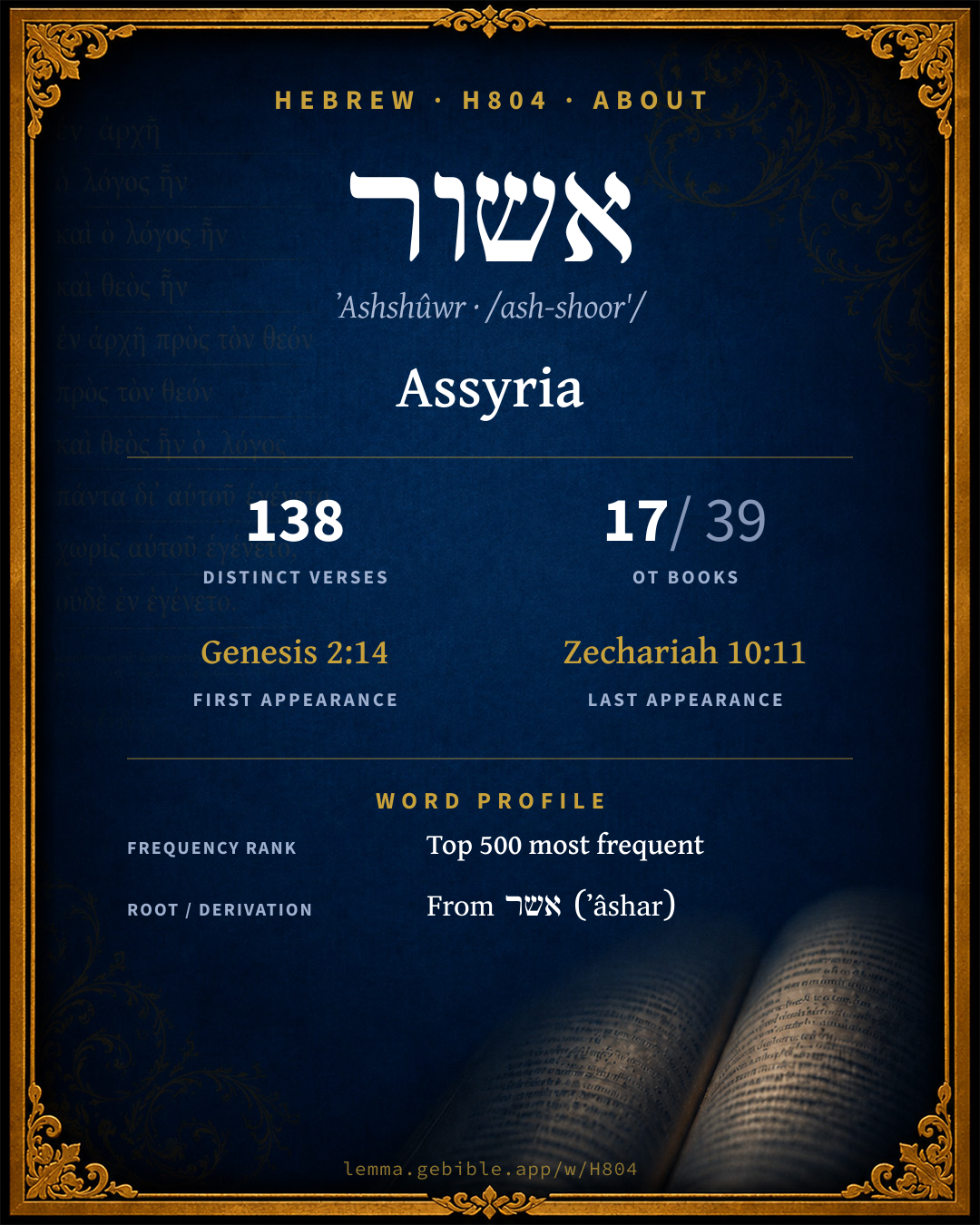
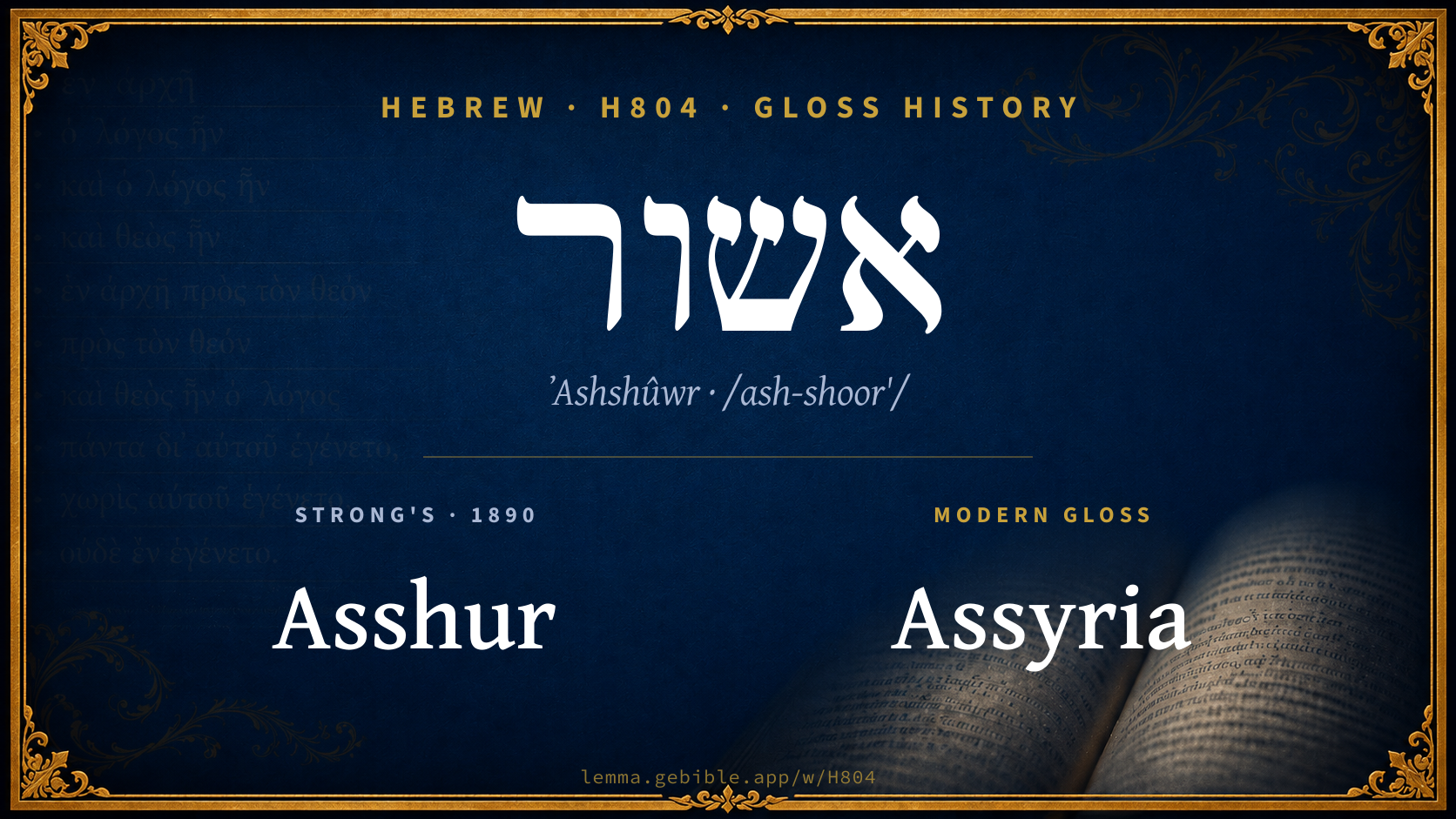
אַשּׁוּר
Assyria
BDB lists 5 entries for ‘Assyria’ fuller range ↓
Full lexicon entry — Brown-Driver-Briggs (BDB)
From Brown-Driver-Briggs (BDB)
Where this word appears
Grammar key — what these labels mean
Part of speech
- Noun
- A naming word — a person, place, thing, or idea.
Noun type
- Proper
- A name of a specific person, place, or people (e.g. Abraham, Zion, Israel).
- Gentilic
- A noun naming a member of a people, tribe, or region of origin (e.g. an Israelite, a Moabite).
State
- Absolute
- The independent form of a noun, not bound to a following word.
Gender
- Masculine
- Grammatically masculine.
Number
- Singular
- One.
Every verse where H804 appears in the Book of 2 Kings — 41 distinct verses. Click any verse to open its interlinear word-by-word view. Verse text shown in the World English Bible for context — . Each verse’s Hebrew form is shown with its reference; the English is not keyword-highlighted, since the data carries no word-level English alignment. Use “Compare translations” on any verse to read it across multiple English versions. This concordance covers the Hebrew Bible; Septuagint (Greek Old Testament) occurrences are not indexed here.
2 Kings
- 2 Kings 15:19 אַשּׁוּר֙ n Proper There came against the land Pul the king of Assyria; and Menahem gave Pul one thousand talents of silver, that his hand might be with him to confirm the kingdom in his hand.
- 2 Kings 15:20 אַשּׁ֔וּר אַשּׁ֔וּר n Proper n Proper Menahem exacted the money of Israel, even of all the mighty men of wealth, of each man fifty shekels of silver, to give to the king of Assyria. So the king of Assyria turned back, and didn't stay there in the land.
- 2 Kings 15:29 אַשּׁוּר֒ אַשּֽׁוּרָ/ה n Proper n Proper + sfx dem In the days of Pekah king of Israel came Tiglath Pileser king of Assyria, and took Ijon, and Abel Beth Maacah, and Janoah, and Kedesh, and Hazor, and Gilead, and Galilee, all the land of Naphtali; and he carried them captive to Assyria.
- 2 Kings 16:7 אַשּׁוּר֙ n Proper So Ahaz sent messengers to Tiglath Pileser king of Assyria, saying, I am your servant and your son: come up, and save me out of the hand of the king of Syria, and out of the hand of the king of Israel, who rise up against me.
- 2 Kings 16:8 אַשּׁ֖וּר n Proper Ahaz took the silver and gold that was found in the house of Yahweh, and in the treasures of the king's house, and sent it for a present to the king of Assyria.
- 2 Kings 16:9 אַשּׁ֔וּר אַשּׁ֤וּר n Proper n Proper The king of Assyria listened to him; and the king of Assyria went up against Damascus, and took it, and carried [the people of] it captive to Kir, and killed Rezin.
- 2 Kings 16:10 אַשּׁוּר֙ n Proper King Ahaz went to Damascus to meet Tiglath Pileser king of Assyria, and saw the altar that was at Damascus; and king Ahaz sent to Urijah the priest the fashion of the altar, and the pattern of it, according to all the workmanship of it.
- 2 Kings 16:18 אַשּֽׁוּר n Proper The covered way for the Sabbath that they had built in the house, and the king's entry outside, turned he to the house of Yahweh, because of the king of Assyria.
- 2 Kings 17:3 אַשּׁ֑וּר n Proper Against him came up Shalmaneser king of Assyria; and Hoshea became his servant, and brought him tribute.
- 2 Kings 17:4 אַשּׁ֨וּר אַשּׁ֖וּר אַשּׁ֔וּר n Proper n Proper n Proper The king of Assyria found conspiracy in Hoshea; for he had sent messengers to So king of Egypt, and offered no tribute to the king of Assyria, as he had done year by year: therefore the king of Assyria shut him up, and bound him in prison.
- 2 Kings 17:5 אַשּׁ֖וּר n Proper Then the king of Assyria came up throughout all the land, and went up to Samaria, and besieged it three years.
- 2 Kings 17:6 אַשּׁוּר֙ אַשּׁ֑וּרָ/ה n Proper n Proper + sfx dem In the ninth year of Hoshea the king of Assyria took Samaria, and carried Israel away to Assyria, and placed them in Halah, and on the Habor, the river of Gozan, and in the cities of the Medes.
- 2 Kings 17:23 אַשּׁ֔וּרָ/ה n Proper + sfx dem until Yahweh removed Israel out of his sight, as he spoke by all his servants the prophets. So Israel was carried away out of their own land to Assyria to this day.
- 2 Kings 17:24 אַשּׁ֡וּר n Proper The king of Assyria brought men from Babylon, and from Cuthah, and from Avva, and from Hamath and Sepharvaim, and placed them in the cities of Samaria instead of the children of Israel; and they possessed Samaria, and lived in the cities of it.
- 2 Kings 17:26 אַשּׁוּר֮ n Proper Therefore they spoke to the king of Assyria, saying, The nations which you have carried away, and placed in the cities of Samaria, don't know the law of the god of the land: therefore he has sent lions among them, and, behold, they kill them, because they don't know the law of the god of the land.
- 2 Kings 17:27 אַשּׁ֜וּר n Proper Then the king of Assyria commanded, saying, Carry there one of the priests whom you brought from there; and let them go and dwell there, and let him teach them the law of the god of the land.
- 2 Kings 18:7 אַשּׁ֖וּר n Proper Yahweh was with him; wherever he went forth he prospered: and he rebelled against the king of Assyria, and didn't serve him.
- 2 Kings 18:9 אַשּׁ֛וּר n Proper It happened in the fourth year of king Hezekiah, which was the seventh year of Hoshea son of Elah king of Israel, that Shalmaneser king of Assyria came up against Samaria, and besieged it.
- 2 Kings 18:11 אַשּׁ֛וּר אַשּׁ֑וּרָ/ה n Proper n Proper + sfx dem The king of Assyria carried Israel away to Assyria, and put them in Halah, and on the Habor, the river of Gozan, and in the cities of the Medes,
- 2 Kings 18:13 אַשּׁוּר֙ n Proper Now in the fourteenth year of king Hezekiah did Sennacherib king of Assyria come up against all the fortified cities of Judah, and took them.
- 2 Kings 18:14 אַשּׁוּר֩ אַשּׁ֜וּר n Proper n Proper Hezekiah king of Judah sent to the king of Assyria to Lachish, saying, I have offended; return from me: that which you put on me will I bear. The king of Assyria appointed to Hezekiah king of Judah three hundred talents of silver and thirty talents of gold.
- 2 Kings 18:16 אַשּֽׁוּר n Proper At that time did Hezekiah cut off [the gold from] the doors of the temple of Yahweh, and [from] the pillars which Hezekiah king of Judah had overlaid, and gave it to the king of Assyria.
- 2 Kings 18:17 אַשּׁ֡וּר n Proper The king of Assyria sent Tartan and Rabsaris and Rabshakeh from Lachish to king Hezekiah with a great army to Jerusalem. They went up and came to Jerusalem. When they were come up, they came and stood by the conduit of the upper pool, which is in the highway of the fuller's field.
- 2 Kings 18:19 אַשּׁ֔וּר n Proper Rabshakeh said to them, Say you now to Hezekiah, Thus says the great king, the king of Assyria, What confidence is this in which you trust?
- 2 Kings 18:23 אַשּׁ֑וּר n Gentilic ms Now therefore, Please give pledges to my master the king of Assyria, and I will give you two thousand horses, if you are able on your part to set riders on them.
- 2 Kings 18:28 אַשּֽׁוּר n Proper Then Rabshakeh stood, and cried with a loud voice in the Jews' language, and spoke, saying, Hear you the word of the great king, the king of Assyria.
- 2 Kings 18:30 אַשּֽׁוּר n Proper neither let Hezekiah make you trust in Yahweh, saying, Yahweh will surely deliver us, and this city shall not be given into the hand of the king of Assyria.
- 2 Kings 18:31 אַשּׁ֗וּר n Proper Don't listen to Hezekiah: for thus says the king of Assyria, Make your peace with me, and come out to me; and eat you everyone of his vine, and everyone of his fig tree, and everyone drink the waters of his own cistern;
- 2 Kings 18:33 אַשּֽׁוּר n Proper Has any of the gods of the nations ever delivered his land out of the hand of the king of Assyria?
- 2 Kings 19:4 אַשּׁ֤וּר n Proper It may be Yahweh your God will hear all the words of Rabshakeh, whom the king of Assyria his master has sent to defy the living God, and will rebuke the words which Yahweh your God has heard. Therefore lift up your prayer for the remnant that is left.
- 2 Kings 19:6 אַשּׁ֖וּר n Proper Isaiah said to them, Thus shall you tell your master, Thus says Yahweh, Don't be afraid of the words that you have heard, with which the servants of the king of Assyria have blasphemed me.
- 2 Kings 19:8 אַשּׁ֔וּר n Proper So Rabshakeh returned, and found the king of Assyria warring against Libnah; for he had heard that he was departed from Lachish.
- 2 Kings 19:10 אַשּֽׁוּר n Proper Thus shall you speak to Hezekiah king of Judah, saying, Don't let your God in whom you trust deceive you, saying, Jerusalem shall not be given into the hand of the king of Assyria.
- 2 Kings 19:11 אַשּׁ֛וּר n Proper Behold, you have heard what the kings of Assyria have done to all lands, by destroying them utterly: and shall you be delivered?
- 2 Kings 19:17 אַשּׁ֛וּר n Proper Of a truth, Yahweh, the kings of Assyria have laid waste the nations and their lands,
- 2 Kings 19:20 אַשּׁ֖וּר n Proper Then Isaiah the son of Amoz sent to Hezekiah, saying, Thus says Yahweh, the God of Israel, Whereas you have prayed to me against Sennacherib king of Assyria, I have heard [you].
- 2 Kings 19:32 אַשּׁ֔וּר n Proper Therefore thus says Yahweh concerning the king of Assyria, He shall not come to this city, nor shoot an arrow there, neither shall he come before it with shield, nor cast up a mound against it.
- 2 Kings 19:35 אַשּׁ֔וּר n Proper It happened that night, that the angel of Yahweh went forth, and struck in the camp of the Assyrians one hundred eighty-five thousand: and when men arose early in the morning, behold, these were all dead bodies.
- 2 Kings 19:36 אַשּׁ֑וּר n Proper So Sennacherib king of Assyria departed, and went and returned, and lived at Nineveh.
- 2 Kings 20:6 אַשּׁוּר֙ n Proper I will add to your days fifteen years; and I will deliver you and this city out of the hand of the king of Assyria; and I will defend this city for my own sake, and for my servant David's sake.
- 2 Kings 23:29 אַשּׁ֖וּר n Proper In his days Pharaoh Necoh king of Egypt went up against the king of Assyria to the river Euphrates: and king Josiah went against him; and [Pharaoh Necoh] killed him at Megiddo, when he had seen him.
About this entry
At a glance — auto-summarized from this page’s data, not written by a person. Every figure links to its source below. This summary describes the numbers; it doesn’t interpret them.
אשור (ʼAshshûwr) is a Hebrew name most often rendered “Assyria.” It first appears in Genesis 2:14. The Hebrew Bible uses it across 138 verses — common. 2 Kings dominates its distribution — 41 of 138 verses. For the data behind this summary, explore 138-verse concordance and the renderings breakdown below.
Gloss history
Strong's 1890 vs modern scholarship
About this word
Strong's H804 catalogs a Hebrew word from the Hebrew Old Testament.
These counts are not copied from any lexicon or concordance. They are computed here, from the morphology-tagged Hebrew Old Testament. What Lemma adds →
- 138
- distinct verses
- The word appears in 138 distinct verses.
- 17 / 39
- OT books
- The word appears in 17 of 39 Old Testament books.
- #297
- by frequency
- Top 500 most frequent Hebrew words (rank 297 of 8,640 Hebrew words by occurrence).
View all 138 occurrences in the concordance →
Most concentrated in
- 2 Kings 41 verses 30%
- Isaiah 41 verses 30%
- 2 Chronicles 13 verses 9%
By section of the Old Testament
By traditional corpus
Conventional, traditional groupings — biblical authorship is debated, so this is a traditional corpus grouping, not an authorship claim. Each share is this word’s portion of its verses in that division of the Hebrew canon. Each figure is a share of the word’s 138 distinct verses.
- Prophets (Nevi'im) 111 verses · 80%
- Writings (Ketuvim) 21 verses · 15%
- Torah (Pentateuch) 6 verses · 4%
How translations render this word
Counts come from each version’s own published word-to-Strong’s tagging or interlinear alignment — an approximate guide to how each version renders this word, not a word-level alignment the data otherwise carries. Because each total is that version’s own tagged count, the per-version totals vary from one another and need not match the appearance or distinct-verse counts above. These counts may also differ from a printed concordance because Lemma counts each distinctly tagged rendering and does not collapse phrase taggings into a single head-word total. This is a fixed set of word-tagged versions (KJV, ASV, BSB, ULT) and does not change with the reading translation you choose elsewhere. Each version’s license is shown beside its name below (and on Sources).
- King James Version: Assyria 115×, Assyrian 9×, Asshur 7×
- American Standard Version: Assyria 119×, Assyrian 6×, Asshur 5×
- Berean Standard Bible: Assyria 133×, Assyrians 7×, Asshur 5×
- unfoldingWord Literal Text: Assyria 133×, Asshur 5×, Assyrians 5×
King James Version Public Domain
Renders H804 across 147 tagged occurrences — most commonly:
Plus 6 renderings that appear only once — usually multi-word phrases or single function words the recovered tagging swept in, not distinct renderings. Not rendered by a distinct English word in 4 further occurrences.
American Standard Version Public Domain
Renders H804 across 147 tagged occurrences — most commonly:
Plus 12 renderings that appear only once — usually multi-word phrases or single function words the recovered tagging swept in, not distinct renderings.
Berean Standard Bible Public Domain
Renders H804 across 146 tagged occurrences — most commonly:
Plus 1 rendering that appears only once — usually multi-word phrases or single function words the recovered tagging swept in, not distinct renderings. Not rendered by a distinct English word in 5 further occurrences.
unfoldingWord Literal Text CC BY-SA 4.0
Renders H804 across 149 tagged occurrences — most commonly:
Plus 6 renderings that appear only once — usually multi-word phrases or single function words the recovered tagging swept in, not distinct renderings.
Senses in BDB
The 5 senses BDB distinguishes for this word, in lexicon order (not ranked by frequency or importance). The full entry — with sub-senses — is in the Lexicon Entry tab.
- Asshur or Assyria = "a step"
- the second son of Shem, eponymous ancestor of the Assyrians (noun proper masculine)
- the people of Assyria (noun proper masculine)
- the nation, Assyria (noun proper locative)
- the land, Assyria or Asshur (noun proper locative)
Word origin
אַשּׁוּר n.pr.gent. & terr. Asshur, Assyria
— Brown-Driver-Briggs (Oxford 1906, public domain), digitized via Sefaria, supplemented by the OpenScriptures HebrewLexicon (CC BY 4.0). See Sources.
Derived from אשר (ʼâshar) (H833) — to go straight.
Jastrow Dictionary
A second Hebrew/Aramaic lexicon for comparison, covering Aramaic and post-biblical (Talmudic, Targumic, Midrashic) usage that the biblical-Hebrew BDB does not. Matched by lemma rather than by Strong’s number, so a lemma may carry more than one Jastrow headword (shown separately below), and the entries cover usage well beyond the Bible.
אֲשׁוּר
- , interj., with (שור) הייא go on, make haste, quick! Gitt. 34ᵃ א׳ הבו לה הייא make haste, give her the letter of divorce; quick! Sabb. 119ᵃ א׳ הייא א׳ הייא. Ber. 57ᵇ א׳ צדיקי Ar. (ed. רהוטו) run, ye pious ones.
אַשּׁוּר
- (b. h.) Ashur, Assyria, Assyrian nation. Gen. R. s. 37; a. fr.—Yoma 10ᵃ; Keth. 10ᵇ א׳ זה סילק (סליקא) Ashur means (the later) Seleucia (ad Tigrim). Snh. 106ᵃ (referring to the Parthian kingdom). [Yalk. Ezek. 376, v. אֵשֶׁל 3).]
A Dictionary of the Targumim, the Talmud Babli and Yerushalmi, and the Midrashic Literature (Marcus Jastrow; London, Luzac, 1903) — Public Domain. Digitized via Sefaria. Digitized via Sefaria. Full attribution on Sources.
Forms in the corpus
The 34 distinct written forms H804 takes in the Hebrew Bible, most frequent first — each parse links to that state’s occurrences in the concordance. Hebrew forms include their vowel points and cantillation, so a single lemma takes many written forms.
| Form | Parsing | Example | Uses |
|---|---|---|---|
| אַשּׁ֔וּר | Noun, Proper | Ezekiel 16:28 | 31 |
| אַשּׁ֖וּר | Noun, Proper | Ezekiel 23:5 | 20 |
| אַשּֽׁוּר | Noun, Proper | 2 Chronicles 30:6 | 18 |
| אַשּׁ֑וּר | Noun, Proper | Genesis 2:14 | 16 |
| אַשּׁוּר֙ | Noun, Proper | Ezekiel 32:22 | 13 |
| אַשּׁ֛וּר | Noun, Proper | 2 Kings 18:9 | 6 |
| אַשּׁ֣וּר | Noun, Proper | Hosea 12:1 | 4 |
| אַשּׁ֤וּר | Noun, Proper | 2 Chronicles 32:9 | 4 |
| אַשּׁ֑וּרָ/ה | Noun, Proper | Genesis 25:18 | 3 |
| אַשּׁ֗וּר | Noun, Proper | 1 Chronicles 5:26 | 3 |
| אַשּׁ֜וּר | Noun, Proper | Ezekiel 31:3 | 3 |
| אַשּׁ֥וּר | Noun, Proper | Hosea 7:11 | 3 |
| אַשּׁ֔וּרָ/ה | Noun, Proper | 2 Kings 17:23 | 2 |
| אַשּׁ֡וּר | Noun, Proper | 2 Kings 17:24 | 2 |
| אַשּׁ֨וּר | Noun, Proper | Ezekiel 23:12 | 2 |
| וְ/אַשּׁ֖וּר | Noun, Proper | Hosea 11:5 | 2 |
| מֵֽ/אַשּׁ֑וּר | Noun, Proper | Isaiah 10:24 | 2 |
| אַ֠שּׁוּר | Noun, Proper | Isaiah 20:4 | 1 |
| אַ֭שּׁוּר | Noun, Proper | Psalms 83:8 | 1 |
| אַשֻּׁ֑ר | Noun, Proper | 1 Chronicles 5:6 | 1 |
| אַשּֽׁוּרָ/ה | Noun, Proper | 2 Kings 15:29 | 1 |
| אַשּׁוּר֒ | Noun, Proper | 2 Kings 15:29 | 1 |
| אַשּׁוּר֩ | Noun, Proper | 2 Kings 18:14 | 1 |
| אַשּׁוּר֮ | Noun, Proper | 2 Kings 17:26 | 1 |
| בְּ/אַשּׁ֑וּר | Noun, Proper | Isaiah 19:23 | 1 |
| וְ/אַשּׁ֑וּר | Noun, Proper | Genesis 10:22 | 1 |
| וְ/אַשּׁ֔וּר | Noun, Proper | 1 Chronicles 1:17 | 1 |
| וּ/בְ/אַשּׁ֖וּר | Noun, Proper | Hosea 9:3 | 1 |
| וּ/לְ/אַשּׁ֑וּר | Noun, Proper | Isaiah 19:24 | 1 |
| וּ/מֵֽ/אַשּׁ֖וּר | Noun, Proper | Zechariah 10:10 | 1 |
| לְ/אַשּׁ֣וּר | Noun, Proper | Hosea 10:6 | 1 |
| מֵ/אַשּׁ֨וּר | Noun, Proper | Isaiah 11:11 | 1 |
| מֵ/אַשּֽׁוּר | Noun, Proper | Jeremiah 2:36 | 1 |
| מֵֽ/אַשּׁ֔וּר | Noun, Proper | Micah 5:6 | 1 |
Same root — word family
Other BDB entries built from the same root as H804, grouped by Strong’s listed origin. These share a root / origin per the lexicon — not necessarily a shared meaning. Each links to that word’s own entry.
Derives from
Shares the same root
- אשר ʼesher H835 blessed
- אשר ʼôsher H837 happiness
- אשר ʼâshur H838 step
- אשרנא ʼushsharnâʼ H846 wall
- תאשור tᵉʼashshûwr H8391 box tree
Proper names from this root
People and places named from this root — a name, not an additional meaning of the word.
- אשר ʼÂshêr H836 Asher
- אשראל ʼĂsarʼêl H840 Asareel
- אשרה ʼăshêrâh H842 Asherah
- אשורי ʼĂshûwrîy H805 Asshuri
Compare all same-root words → Showing 4 of 11 — not the complete family. 4 of the same-root words are proper names (people or places). They share a root, not necessarily a meaning.
Bible dictionary
Public-domain dictionary articles matched to this entry by name (Assyria). A biblical name can be shared by more than one person or place, so an article may treat several.
Easton's Bible Dictionary · M. G. Easton, 1897
The name derived from the city Asshur on the Tigris, the original capital of the country, was originally a colony from Babylonia, and was ruled by viceroys from that kingdom. It was a mountainous region lying to the north of Babylonia, extending along the Tigris as far as to the high mountain range of Armenia, the Gordiaean or Carduchian mountains. It was founded in B.C. 1700 under Bel-kap-kapu, and became an independent and a conquering power, and shook off the yoke of its Babylonian masters. It subdued the whole of Northern Asia. The Assyrians were Semites (Gen. 10:22), but in process of time non-Semite tribes mingled with the inhabitants. They were a military people, the "Romans of the East."
Of the early history of the kingdom of Assyria little is positively known. In B.C. 1120 Tiglath-pileser I., the greatest of the Assyrian kings, "crossed the Euphrates, defeated the kings of the Hittites, captured the city of Carchemish, and advanced as far as the shores of the Mediterranean." He may be regarded as the founder of the first Assyrian empire. After this the Assyrians gradually extended their power, subjugating the states of Northern Syria. In the reign of Ahab, king of Israel, Shalmaneser II. marched an army against the Syrian states, whose allied army he encountered and vanquished at Karkar. This led to Ahab's casting off the yoke of Damascus and allying himself with Judah. Some years after this the Assyrian king marched an army against Hazael, king of Damascus. He besieged and took that city. He also brought under tribute Jehu, and the cities of Tyre and Sidon.
About a hundred years after this (B.C. 745) the crown was seized by a military adventurer called Pul, who assumed the name of Tiglath-pileser III. He directed his armies into Syria, which had by this time regained its independence, and took (B.C. 740) Arpad, near Aleppo, after a siege of three years, and reduced Hamath. Azariah (Uzziah) was an ally of the king of Hamath, and thus was compelled by Tiglath-pileser to do him homage and pay a yearly tribute.
In B.C. 738, in the reign of Menahem, king of Israel, Pul invaded Israel, and imposed on it a heavy tribute (2 Kings 15:19). Ahaz, the king of Judah, when engaged in a war against Israel and Syria, appealed for help to this Assyrian king by means of a present of gold and silver (2 Kings 16:8); who accordingly "marched against Damascus, defeated and put Rezin to death, and besieged the city itself." Leaving a portion of his army to continue the siege, "he advanced through the province east of Jordan, spreading fire and sword," and became master of Philistia, and took Samaria and Damascus. He died B.C. 727, and was succeeded by Shalmanezer IV., who ruled till B.C. 722. He also invaded Syria (2 Kings 17:5), but was deposed in favour of Sargon (q.v.) the Tartan, or commander-in-chief of the army, who took Samaria (q.v.) after a siege of three years, and so put an end to the kingdom of Israel, carrying the people away into captivity, B.C. 722 (2 Kings 17:1-6, 24; 18:7, 9). He also overran the land of Judah, and took the city of Jerusalem (Isa. 10:6, 12, 22, 24, 34). Mention is next made of Sennacherib (B.C. 705), the son and successor of Sargon (2 Kings 18:13; 19:37; Isa. 7:17, 18); and then of Esar-haddon, his son and successor, who took Manasseh, king of Judah, captive, and kept him for some time a prisoner at Babylon, which he alone of all the Assyrian kings made the seat of his government (2 Kings 19:37; Isa. 37:38).
Assur-bani-pal, the son of Esarhaddon, became king, and in Ezra 4:10 is referred to as Asnapper. From an early period Assyria had entered on a conquering career, and having absorbed Babylon, the kingdoms of Hamath, Damascus, and Samaria, it conquered Phoenicia, and made Judea feudatory, and subjected Philistia and Idumea. At length, however, its power declined. In B.C. 727 the Babylonians threw off the rule of the Assyrians, under the leadership of the powerful Chaldean prince Merodach-baladan (2 Kings 20:12), who, after twelve years, was subdued by Sargon, who now reunited the kingdom, and ruled over a vast empire. But on his death the smouldering flames of rebellion again burst forth, and the Babylonians and Medes successfully asserted their independence (B.C. 625), and Assyria fell according to the prophecies of Isaiah (10:5-19), Nahum (3:19), and Zephaniah (3:13), and the many separate kingdoms of which it was composed ceased to recognize the "great king" (2 Kings 18:19; Isa. 36:4). Ezekiel (31) attests (about B.C. 586) how completely Assyria was overthrown. It ceases to be a nation. (See NINEVEH; BABYLON.)
Hitchcock's Bible Names Dictionary · Roswell D. Hitchcock, 1869
country of Assur or Ashur
Classic public-domain reference works; full attribution on Sources.
Septuagint verse parallels
This word appears in 135 verses that also exist in the Greek Old Testament (Septuagint), out of the 138 Hebrew verses it occurs in. You can read those verses in Greek by switching the Old Testament edition to the Septuagint.
Read these verses in the Septuagint
- Genesis 2:14
- Numbers 24:22
- 2 Kings 15:19
- 1 Chronicles 1:17
- 2 Chronicles 28:16
- Ezra 4:2
- Psalms 83:8
- Isaiah 7:17
- Jeremiah 2:18
- Lamentations 5:6
- Ezekiel 16:28
- Hosea 5:13
This is a verse-level parallel only — the same verses exist in both the Hebrew and Greek Old Testaments. No word-level Hebrew↔Greek correspondence is claimed: the data carries no such alignment, so no Greek word is shown as this Hebrew word’s translation. Coverage is not total — the Septuagint omits the deuterocanon and renumbers the Psalms, so some Hebrew verses have no direct Greek parallel.