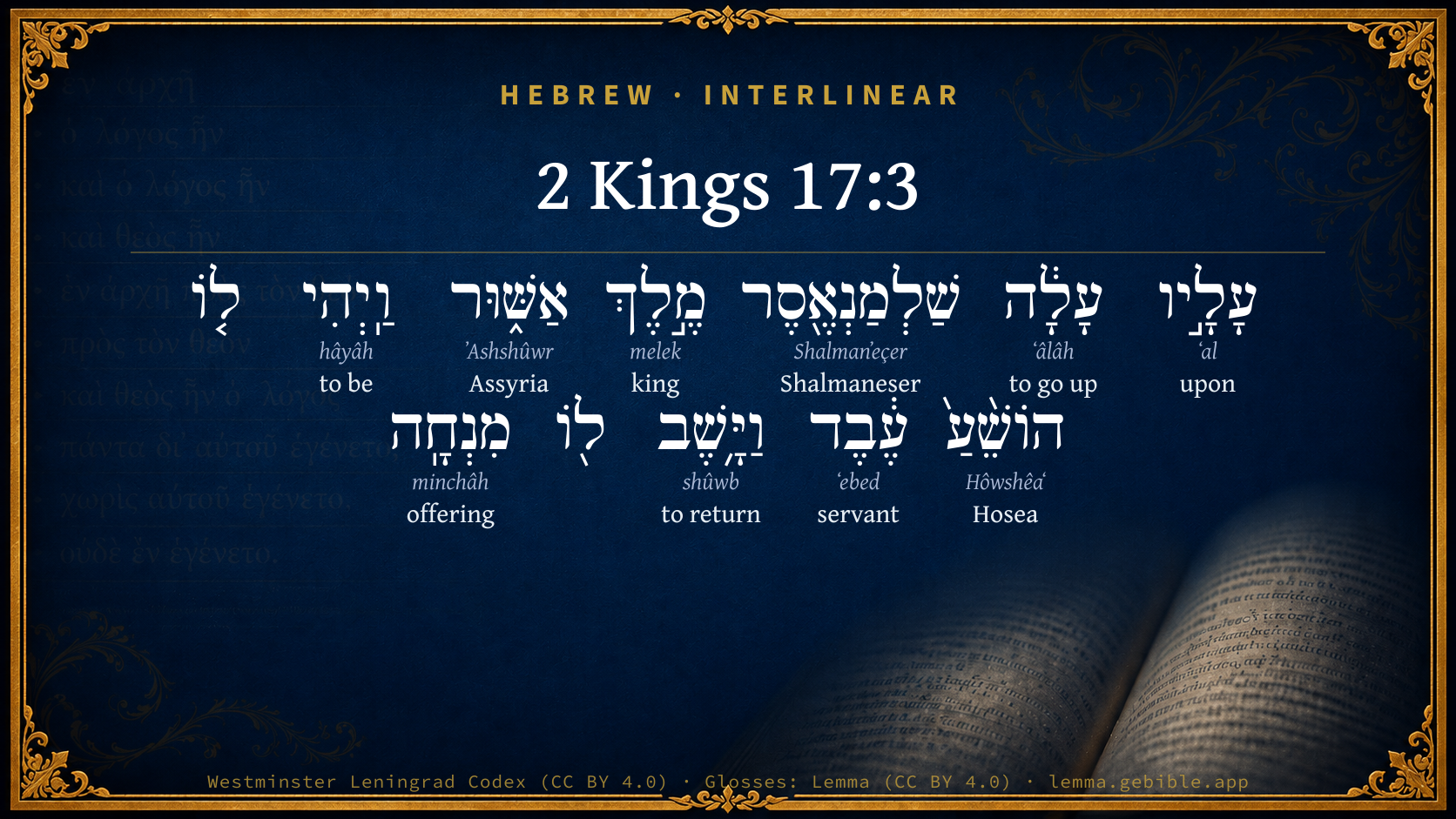
2 Kings 17:3

Hebrew (Westminster Leningrad Codex) 2 Kings 17:3 appears in the Hebrew Old Testament. The text above is from the Westminster Leningrad Codex. Each word links to its Strong’s number, a concise gloss, and parsing drawn from the Open Scriptures Hebrew Bible morphology. Click any word for its full Brown-Driver-Briggs (BDB) entry.
Download image
Cite this verse

2 Kings 17:3 (World English Bible). Public Domain. Lemma interlinear Bible study tool, https://lemma.gebible.app/v/2-kings/17/3.

Show BibTeX & RIS
BibTeX
RIS
English Translation
Against him came up Shalmaneser king of Assyria; and Hoshea became his servant, and brought him tribute.
World English Bible · Public Domain
Highlights
  • 1 first appearance in the Hebrew Bible
Full analysis ↓
Download a study sheet

One document with this verse’s original text, its word-by-word gloss line, the meaning frame, cross-references with their text, attributed commentary, and full source and license credits — printable, and it pastes into notes with its structure intact.

This verse Autodidact and up

Study sheet (.html) Plain text (.txt)

A passage Seminary Student

Up to 50 verses in one chapter. A passage sheet keeps up to 6 commentary sources and 12 cross-references per verse, in the order this page ranks them, and says so on the sheet whenever that leaves anything out. Ask for a single verse and you get the Autodidact verse sheet above.

Everything on this page stays free to read, with no account — the sheet is a download of what is already on screen, not access to it.

Want to remove ads? Support Godless Engineer
Compare translations 3

The same verse in 3 English versions, stacked beneath the original-language interlinear above. Click any original word for its lexicon entry.

Each is an independent rendering of the whole verse — the interlinear is not word-aligned to these translations.

Highlighted words mark where these versions differ — a whole-verse word diff, not a word-by-word alignment.

  • World English Bible Public Domain
    Against him came up Shalmaneser king of Assyria; and Hoshea became his servant, and brought him tribute.
  • King James Version Public Domain
    Against him came up Shalmaneser king of Assyria; and Hoshea became his servant, and gave him presents.
  • unfoldingWord Literal Text CC BY-SA 4.0
    Shalmaneser, the king of Assyria, came up against him, and Hoshea became a servant to him, and he paid tribute to him.

unfoldingWord Literal Text — © unfoldingWord, licensed CC BY-SA 4.0. Word-aligned USFM3 via Door43 (git.door43.org/unfoldingWord/en_ult).

Versions to compare (up to 4)

3 of 4 selected

Show all 18 translations

Every available English version of this verse, each an independent rendering of the whole verse.

  • World English Bible Public Domain
    Against him came up Shalmaneser king of Assyria; and Hoshea became his servant, and brought him tribute.
  • Berean Standard Bible Public Domain
    Shalmaneser king of Assyria attacked him, and Hoshea became his vassal and paid him tribute.
  • Majority Standard Bible Public Domain
    Shalmaneser king of Assyria attacked him, and Hoshea became his vassal and paid him tribute.
  • King James Version Public Domain
    Against him came up Shalmaneser king of Assyria; and Hoshea became his servant, and gave him presents.
  • American Standard Version (1901) Public Domain
    Against him came up Shalmaneser king of Assyria; and Hoshea became his servant, and brought him tribute.
  • Revised Version (1885) Public Domain
    Against him came up Shalmaneser king of Assyria; and Hoshea became his servant, and brought him presents.
  • Geneva Bible (1599) Public Domain
    And Shalmaneser king of Asshur came vp against him, and Hoshea became his seruant, and gaue him presents.
  • Douay-Rheims (1899) Public Domain
    Against him came up Salmanasar king of the Assyrians, and Osee became his servant, and paid him tribute.
  • Young's Literal Translation Public Domain
    against him came up Shalmaneser king of Asshur, and Hoshea is to him a servant, and doth render to him a present.
  • Literal Standard Version CC BY-SA 4.0
    Shalmaneser king of Asshur came up against him, and Hoshea is a servant to him, and renders a present to him.
  • Unlocked Literal Bible CC BY-SA 4.0
    Shalmaneser king of Assyria attacked him, and Hoshea became his servant and brought him tribute.
  • unfoldingWord Literal Text CC BY-SA 4.0
    Shalmaneser, the king of Assyria, came up against him, and Hoshea became a servant to him, and he paid tribute to him.
  • Darby Bible Public Domain
    Against him came up Shalmaneser king of Assyria, and Hoshea became his servant, and tendered him presents.
  • World Messianic Bible Public Domain
    Shalmaneser king of Assyria came up against him; and Hoshea became his servant, and brought him tribute.
  • Webster's Bible Public Domain
    Against him came up Shalmaneser king of Assyria; and Hoshea became his servant, and gave him presents.
  • Free Bible Version CC BY-SA 4.0
    Shalmaneser, king of Assyria, came and attacked him, and Hoshea submitted to him and paid him tribute.
  • Bible in Basic English Public Domain
    Against him came up Shalmaneser, king of Assyria, and Hoshea became his servant and sent him offerings.
  • JPS Tanakh (1917) Public Domain
    Against him came up Shalmaneser king of Assyria; and Hoshea became his servant, and brought him presents.

Literal Standard Version (2020), Covenant Press — licensed CC BY-SA 4.0. Text via the HelloAO Bible API (eBible.org). Unlocked Literal Bible (unfoldingWord) — licensed CC BY-SA 4.0. Text via the HelloAO Bible API (eBible.org). unfoldingWord Literal Text — © unfoldingWord, licensed CC BY-SA 4.0. Word-aligned USFM3 via Door43 (git.door43.org/unfoldingWord/en_ult). Free Bible Version, Dr. Jonathan Gallagher — licensed CC BY-SA 4.0. Text via the HelloAO Bible API (eBible.org).

Word by word

More ways to search: Search by grammar → Find every occurrence → Compare this word →

Practice this passage: Drill this verse → Learn its vocabulary →

שַׁלְמַנְאֶ֖סֶר
Shalmanʼeçer
H8022
“Shalmaneser”
Noun, Proper
Part of Speech
Noun
Type
Proper
Full BDB Definition

Origin: of foreign derivation

TWOT: None

Shalmaneser = "fire-worshipper" - Assyrian king who probably reigned between Tiglath-pileser and Sargon; invaded the northern kingdom of Israel when the last king Hoshea was on the throne; forced Hoshea to pay tribute but had to reinvade when Hoshea reneged; it is uncertain whether Shalmaneser or Sargon concluded the siege which finally ended the northern kingdom - maybe a common name for Assyrian kings in the 8th century BC
  1. עָלָ֣יו ʻal H5921 “upon · him” Preposition + Suffix, Personal, 3rd Person, Masculine, Singular
  2. עָלָ֔ה ʻâlâh H5927 “to go up” Verb, Qal, Perfect, 3rd Person, Masculine, Singular
  3. מֶ֣לֶךְ melek H4428 “king of” Noun, Common, Masculine, Singular, Construct
  4. אַשּׁ֑וּר ʼAshshûwr H804 “Assyria” Noun, Proper
  5. וַֽיְהִי hâyâh H1961 “and · to be” Conjunction + Verb, Qal, Sequential Imperfect, 3rd Person, Masculine, Singular
  6. הוֹשֵׁ֨עַ֙ Hôwshêaʻ H1954 “Hosea” Noun, Proper
  7. עֶ֔בֶד ʻebed H5650 “servant” Noun, Common, Masculine, Singular, Absolute
  8. וַיָּ֥שֶׁב shûwb H7725 “and · to return” Conjunction + Verb, Hiphil, Sequential Imperfect, 3rd Person, Masculine, Singular
  9. מִנְחָֽה minchâh H4503 “offering” Noun, Common, Feminine, Singular, Absolute

About this verse

These counts appear in no published source. They are computed here, from the morphology-tagged text and Lemma’s own curated glosses. What Lemma adds →

12
words
10
distinct lemmas
Historical
section

Notable vocabulary

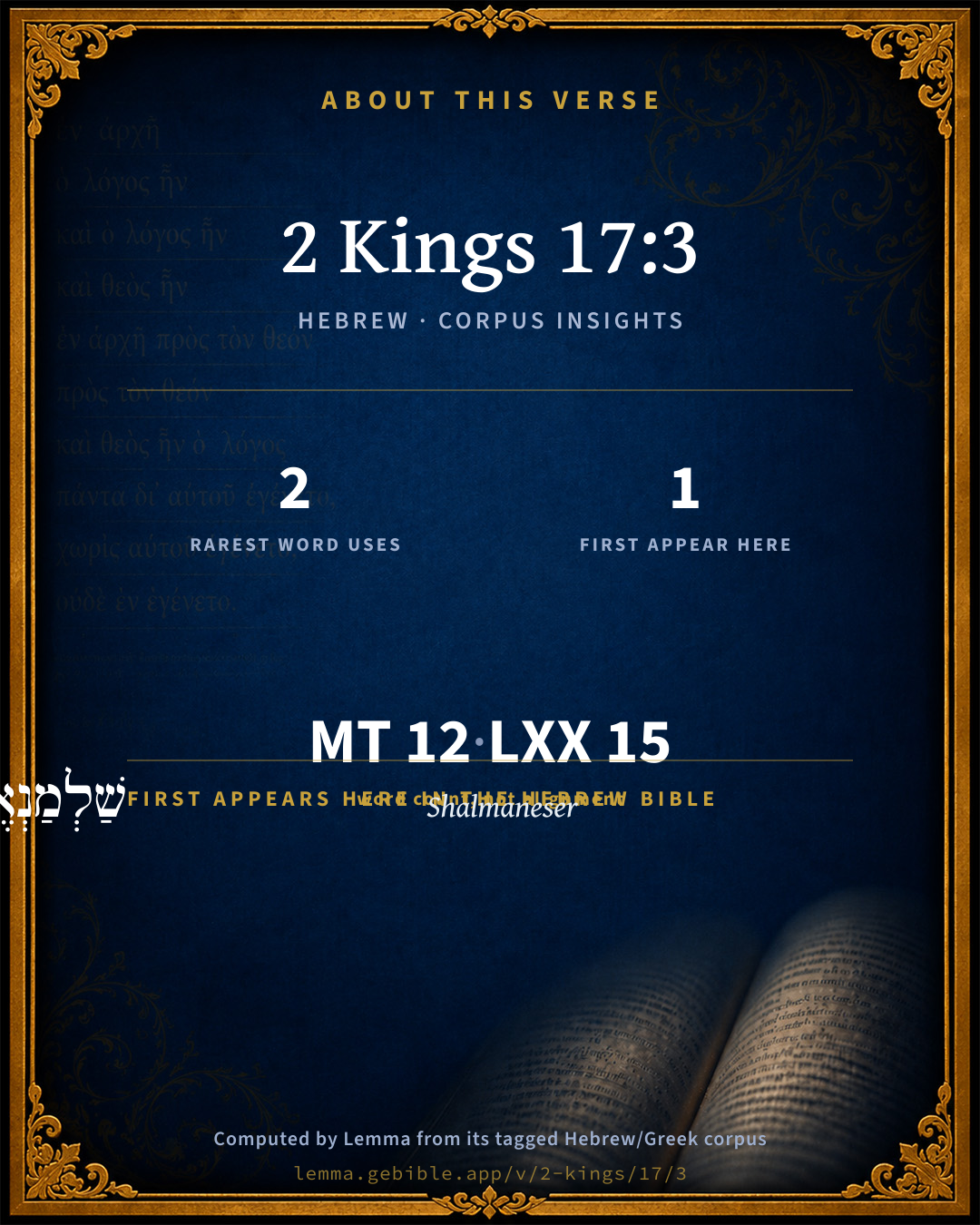
The rarest word here is שַׁלְמַנְאֶ֖סֶר Shalmaneser H8022 — appearing just 2 times in the whole Hebrew Bible.

First appearance in Scripture

This word makes its first canonical appearance in the Hebrew Bible here:

  • שַׁלְמַנְאֶ֖סֶר Shalmaneser H8022

Shared distinctive vocabulary

שַׁלְמַנְאֶ֖סֶר Shalmaneser H8022 occurs in 2 verses of the Hebrew Bible. Also found in:

Grammatical profile

  • 3 verbs
  • 6 nouns
  • 3 prepositions

Verb forms

  • עָלָ֔ה Qal · Perfect
  • וַֽיְהִי Qal · Sequential Imperfect
  • וַיָּ֥שֶׁב Hiphil · Sequential Imperfect

Hebrew & Septuagint length

In English translation the verse runs 17 words from the Hebrew and 18 from the Septuagint (LXX English) — closely comparable.

A rough comparison of the two English renderings, which tokenize alike — not a word-level alignment.

Word counts can differ between the Hebrew and the Greek without any difference in meaning — e.g. the Hebrew direct-object marker אֵת has no separate Greek word, and Greek often adds the article ὁ.

In the original languages it is 12 Hebrew tokens and 15 Greek tokens — but the two are counted differently (Hebrew bundles its prefixes and suffixes into one token; the Greek is in lemma form), so that isn’t a like-for-like length.

Cross-references

12

Topical passages linked to 2 Kings 17:3 in the Treasury of Scripture Knowledge — connected by theme and wording, ordered by reader-vote popularity; previews shown in the World English Bible.

  • Hosea 10:14 Therefore a battle roar will arise among your people, And all your fortresses will be destroyed, As Shalman destroyed Beth Arbel in the day of battle. The mother was dashed in pieces with her children.
  • 2 Samuel 8:2 He struck Moab, and measured them with the line, making them to lie down on the ground; and he measured two lines to put to death, and one full line to keep alive. The Moabites became servants to David, and brought tribute.
  • 2 Samuel 8:6 Then David put garrisons in Syria of Damascus; and the Syrians became servants to David, and brought tribute. Yahweh gave victory to David wherever he went.
  • 2 Kings 15:19 There came against the land Pul the king of Assyria; and Menahem gave Pul one thousand talents of silver, that his hand might be with him to confirm the kingdom in his hand.
  • 2 Kings 15:29 In the days of Pekah king of Israel came Tiglath Pileser king of Assyria, and took Ijon, and Abel Beth Maacah, and Janoah, and Kedesh, and Hazor, and Gilead, and Galilee, all the land of Naphtali; and he carried them captive to Assyria.
  • 2 Kings 16:7–8 So Ahaz sent messengers to Tiglath Pileser king of Assyria, saying, I am your servant and your son: come up, and save me out of the hand of the king of Syria, and out of the hand of the king of Israel, who rise up against me.
  • 2 Kings 18:9–16 It happened in the fourth year of king Hezekiah, which was the seventh year of Hoshea son of Elah king of Israel, that Shalmaneser king of Assyria came up against Samaria, and besieged it.
  • 2 Kings 18:31 Don't listen to Hezekiah: for thus says the king of Assyria, Make your peace with me, and come out to me; and eat you everyone of his vine, and everyone of his fig tree, and everyone drink the waters of his own cistern;
  • 2 Kings 19:36–37 So Sennacherib king of Assyria departed, and went and returned, and lived at Nineveh.
  • Isaiah 7:7–8 This is what the Lord Yahweh says: "It shall not stand, neither shall it happen."
  • Isaiah 10:5–6 Ho Assyrian, the rod of my anger, the staff in whose hand is my indignation!
  • Isaiah 10:11–12 shall I not, as I have done to Samaria and her idols, so do to Jerusalem and her idols?

Cross-references courtesy of OpenBible.info (CC BY 4.0).

Hebrew and Greek witnesses Masoretic Hebrew ↔ Greek Septuagint

The same verse in the two great witnesses to the Old Testament, shown verse-for-verse.

These are two independent witnesses, not word-aligned to each other, and the Septuagint is shown in lemma (dictionary) form.

Hebrew 2 Kings 17:3 Masoretic · Westminster Leningrad Codex

עָלָ֣יו עָלָ֔ה שַׁלְמַנְאֶ֖סֶר מֶ֣לֶךְ אַשּׁ֑וּר וַֽיְהִי ל֤וֹ הוֹשֵׁ֨עַ֙ עֶ֔בֶד וַיָּ֥שֶׁב ל֖וֹ מִנְחָֽה

Against him came up Shalmaneser king of Assyria; and Hoshea became his servant, and brought him tribute.

World English Bible · Public Domain

Greek LXX 2 Kings 17:3 Septuagint · lemma form

ἐπί αὐτός ἀναβαίνω σαλαμανασαρ βασιλεύς ἀσσύριος καί γίγνομαι αὐτός ωσηε δοῦλος καί ἐπιστρέφω αὐτός μαναα

Against him came up Salamanassar king of the Assyrians; and Osee became his servant, and rendered him tribute.

LXX2012 (modern English Septuagint) · Public Domain

On this verse, Keil & Delitzsch discusses the Septuagint’s reading. Read the note in Commentary ↓

Hebrew: Westminster Leningrad Codex (CC BY 4.0). Greek: Septuagint (public domain); English from LXX2012 (modern English Septuagint) (Public Domain). How the Septuagint differs from the Hebrew →

Targum (Aramaic paraphrase)

1

The Targum is the ancient Jewish Aramaic paraphrase of the Hebrew Scriptures — an interpretive translation, not the Hebrew text itself. Onkelos (literal) and Pseudo-Jonathan (expansive) render the Torah, and Jonathan the Prophets. Coverage is partial: where no permissively-licensed English translation exists for a verse, only the Aramaic is shown. This is verse-level text, not a word-by-word alignment to the Hebrew.

  1. Targum Jonathan Prophets (Joshua–Malachi)
    עֲלוֹהִי סְלִיק שַׁלְמַנְאֶסֶר מַלְכָּא דְאַתּוּר וַהֲוָה לֵיהּ הוֹשֵׁעַ עַבְדָא וַאֲתֵיב לֵיהּ תִּקְרוּבְתָּא:

    (no public-domain English translation for this verse)

    Targum Jonathan — Aramaic: “Mikraot Gedolot” (public domain). English: “Sefaria Community Translation” (CC0 1.0 (public-domain dedication)); “London "Chaldee Paraphrase," 1871” (public domain). Text via Sefaria.

Commentary

Notes on 2 Kings 17:3 from classic Christian and Jewish commentators (each source and its license shown beneath its notes). The classic Christian expositions comment on the surrounding passage and are grouped to its opening verse, so a note may address several verses; the Jewish commentaries on the Tanakh (Rashi and others) are per-verse, so they appear only where the commentator wrote on this verse.

Lemma curates 59 commentaries, every one of them public domain or Creative Commons licensed, each selected and text-cleaned for this edition rather than reprinted as found. About our sources →

Trapp's Complete Commentary

John Trapp

2Ki 17:3 Against him came up Shalmaneser king of Assyria; and Hoshea became his servant, and gave him presents.

Ver. 3. Against him came up Shalmaneser.] Son to Tiglathpileser, and father to Sennacherib; not the same with Sennacherib, as Eusebius maketh him. Under this Shalmaneser Tobias was carried captive, and he seemeth to be the same with that Shalman {Hos 10:14} who "spoiled Betharbel" - famous afterwards for the overthrow of Darius there - "in the day of battle; the mother was dashed in pieces upon her children."

John Trapp, A Commentary or Exposition upon All the Books of the Old and New Testament (1647–1656) — public domain. Text from a community e-Sword module.

Joseph Benson's Commentary

2Ki 17:3. Against him came up Shalmaneser — The son or successor of Tiglath-pileser. The ancient Hebrew writers made him the same with Sennacherib, who, eight years after this time, invaded the kingdom of Judah; it being very frequent, in the eastern parts, for one man to be called by several names. Josephus affirms, that he met with his name in the annals of the Tyrians, which were extant in his days. He came against him, either because he denied the tribute which he had promised to pay, or that he might make him tributary. And Hoshea became his servant, and gave him presents — Swore fealty to him, and engaged to pay him tribute. Thus the destruction came gradually, and they were, for some time, made tributaries, before they were made captives to the king of Assyria. And if the lesser judgment had prevailed to humble and reform them, the greater would have been prevented.

Joseph Benson's Commentary on the Old and New Testaments (1811–1818) — public domain. Text from a community e-Sword module.

Tyndale Open Study Notes

Tyndale Open Resources

17:3-4 King Shalmaneser V succeeded his father Tiglath-pileser III in 726 BC. Hoshea may have reasoned that this leadership change would allow Israel to become independent of Assyrian vassalage. But his withholding of the annual tribute simply invited Shalmaneser’s reprisal. • by asking King So of Egypt: Some scholars understand the name So as an abbreviation of Pharaoh Osorkon IV (730–715 BC). Others equate So with Pharaoh Piankhy (747–716 BC), viewing the biblical name So as a Hebraic rendering of one of the names in Piankhy’s titulary. Still others suggest that So refers to the city of Sais, the capital of Pharaoh Tefnakht (727–720 BC). Whatever the identity of this king, it is clear that Hoshea’s hope for help from Egypt was misplaced.

Tyndale Open Study Notes — © Tyndale Open Resources, licensed CC BY-SA 4.0. Text via the HelloAO Bible API.

Jamieson, Fausset & Brown

Robert Jamieson, A. R. Fausset & David Brown

Against him came up Shalmaneser--or Shalman (Hos 10:14), the same as the Sargon of Isaiah [Isa 20:1]. Very recently the name of this Assyrian king has been traced on the Ninevite monuments, as concerned in an expedition against a king of Samaria, whose name, though mutilated, COLONEL RAWLINSON reads as Hoshea.

Jamieson, Fausset & Brown — Commentary Critical and Explanatory on the Whole Bible (1871) — public domain (CC PDM 1.0). Text via the HelloAO Bible API.

Adam Clarke's Commentary

Verse 3. Shalmaneser] This was the son and successor of Tiglath-pileser. He is called Shalman by Hosea, Ho 10:14, and Enemessar, in the book of Tobit, 1:2.

Gave him presents.] Became tributary to him.

Adam Clarke's Commentary on the Bible (1810–1826) — public domain. Text from a community e-Sword/MySword module.

Ellicott's Commentary for English Readers

(3) Against him came up Shalmaneser king of Assyria.—Shalmaneser IV. (Shalmânu-ushshir, “Shalman be gracious!”), the successor of Tiglath Pileser II., and predecessor of Sargon, reigned 727-722 B.C. No annals of his reign have come down to us in the cuneiform inscriptions, but a fragment of the Eponyra-list notes foreign expeditions for the three successive years 725-723 B.C. This agrees with what Menander states (Josephus, Ant. ix. 14, 2), according to whom Shalmaneser made an expedition against Tyre (and no doubt Israel, as the ally of Tyre), which lasted five years—i.e., was continued beyond Shalmaneser’s reign into that of Sargon. Nothing is known of the death of Shalmaneser.

A Bible Commentary for English Readers, edited by Charles John Ellicott (1878–1897) — public domain. Text from a community e-Sword module.

The Cambridge Bible for Schools and Colleges

gen. ed. J. J. S. Perowne

3. Shalmaneser king of Assyria] This king according to the Assyrian monuments succeeded Tiglath-pileser, and was succeeded by Sargon. His reign lasted from b.c. 727–722.

and Hoshea became his servant] Probably it was in this way that Hoshea made himself strong enough to attack Pekah, and to mount the throne. The wars of Israel in the days of Pekah must have weakened the kingdom excessively, and made external help a necessity for any one who came to the throne.

and gave [R.V. brought] him presents] The word for ‘presents’ is that which came to be used for the ‘meal-offering’ of the Israelites. It is used euphemistically here for a gift which, though given with the appearance of free will, was no doubt compulsory, and of the nature of tribute.

The Cambridge Bible for Schools and Colleges (gen. ed. J. J. S. Perowne; Cambridge University Press, 1878–1918) — public domain. Text from a community e-Sword module.

John Gill's Exposition

Against him came up Shalmaneser king of Assyria,.... Which some take to be the same with Tiglathpileser, see Ch1 5:26 but he rather seems to be his son; his name was to be found, as Josephus (w) relates, in the archives of the Tyrians, against whom he had an expedition; his name is Salmanassar in Metasthenes (x), who says he reigned seventeen years:

and Hoshea became his servant, and gave him presents, to depart from him; he became tributary to him, and agreed to pay him a yearly tax.

(w) Antiqu. l. 9. c. 14. sect. 2. (x) De Judicio Temp. fol. 221. 2.

John Gill's Exposition of the Whole Bible (1746–1763) — public domain (CC PDM 1.0). Text via the HelloAO Bible API.

Albert Barnes' Notes on the Bible

Of Shalmaneser, the successor of Tiglath-pileser in the Assyrian Canon, we know little from Assyrian sources, since his records have been mutilated by his successors, the Sargonids, who were of a wholly different family. The archives of Tyre mention him as contemporary with, and warring against, a Tyrian king named Elulaeus. The expedition, referred to here, was probably in the first year of Shalmaneser (727 B.C.). Its main object was the reduction of Phoenicia, which had re-asserted its independence, but (except Tyre) was once more completely reduced. Shalmaneser probably passed on from Phoenicia into Galilee, where he attacked and took Beth-arbel (Arbela of Josephus, now Irbid), treating it with great severity Hos 10:14, in order to alarm Hoshea, who immediately submitted, and became tributary (see the marginal rendering and 1Ki 4:21 note). Shalmaneser then returned into Assyria.

Albert Barnes' Notes on the Bible (1834–1885) — public domain. Text from a community e-Sword/MySword module.

Haydock's Catholic Bible Commentary

Salmanasar, who is called Salman, or Salomo; (Osee x. 14.) and Enemassar, in the Greek of Toby[Tobias]. The Tyrians relate that he took many of their towns, but that Tyre sustained a siege of five years. (Josephus, [Antiquities?] ix. 14.)

George Leo Haydock (1774–1849), Haydock's Catholic Family Bible and Commentary, 1859 edition — public domain. Excludes Psalms (Douay-Rheims chapter numbering differs from Protestant) and Deuterocanonical books (Catholic canon only).

Matthew Poole's English Annotations

Shalmaneser; the son or successor of Tiglath-pileser. The ancient Hebrew writers make him the same with Sennacherib, who eight years after this time invaded the kingdom of Judah; see 2Ki 18:10,13; it being very frequent in the eastern parts for one man to be called by several names, especially by the people of several countries. Josephus affirms that he met with his name in the Annals of the Tyrians, which were extant in his days. He came against him, either because he denied the tribute which he had promised to pay, or that he might make him tributary.

Gave him presents; swore fealty to him, and engaged to pay him a tribute.

Matthew Poole's English Annotations on the Holy Bible (1683–1685) — public domain. Text from a community e-Sword/MySword module.

Whedon's Commentary on the Bible

Daniel D. Whedon

3. Shalmaneser — This Assyrian king and warrior seems to have been the regular and undisputed successor of Tiglath-pileser, and was therefore, probably, his son. The monuments bearing his records have been so mutilated by his successors that they shed very little light on his history. Josephus states, on the authority of Menander, that the name of this king was inscribed in the archives of Tyre, and that during the reign of one Eluleus he overran all Phenicia. But after his departure old Tyre rebelled, and the king of Assyria returned, and warred for five years against the city, but though he was assisted by many Phenicians, the Tyrians were more than a match for him, and his siege was unsuccessful. These wars with Phenicia were probably contemporaneous with those against Samaria.

Hoshea became his servant — Became a vassal king, rendering presents, or tribute, to Shalmaneser as the great king. Some think that Hoshea had refused or neglected to pay tribute to Assyria, and this was the reason of Shalmaneser’s invasion; others think that this coming up of the Assyrian king was merely an expedition of conquest, growing out of the ambition of the new sovereign, and not from any provocation of Hoshea.

Daniel D. Whedon (gen. ed.), Commentary on the Old and New Testaments (1874–1909) — public domain. Text from a community e-Sword module.

The Pulpit Commentary

Against him came up Shal-maneser King of Assyria. Shalmaneser"s succession to Tiglath-pileser on the throne of Assyria, once doubted, is now rendered certain by the Eponym Canon, which makes him ascend the throne in B.C. 727, and cease to reign in B.C. 722. It is uncertain whether he was Tiglath-pileser"s son or a usurper. The name, Shalmaneser (Sali-manu-uzur) was an old royal name in Assyria, and signified "Shalman protects" (compare the names Nabu-kudur-uzur, Nergal-asar-uzur, Nabu-pal-uzur, etc.). And Hoshea became his servant. Hoshea had been placed on the throne by Tiglath-pileser ("Eponym Canon," pp. 123, 124, lines 17, 18), and had paid him tribute (ibid., lines 18, 19). We must suppose that on Tiglath-pileser"s death, in B.C. 727, he had revolted, and resumed his independence. Shalmaneser. having become king, probably came up against Hoshea in the same year, and forced him to resume his position of Assyrian tributary. This may have been the time when Shalman spoiled Beth-Arbel in the day of battle" (Dos. 10:14), defeating Hoshea near that place (Arbela, now Irbid, in Galilee), and taking it. And gave him presents; or, rendered him tribute, as in the margin of the Authorized Version.

The Pulpit Commentary (1880–1919), ed. H.D.M. Spence-Jones & Joseph S. Exell — public domain. Text from a community e-Sword module.

John Wesley's Explanatory Notes

Shalmaneser - The son, or successor of Tiglath-pileser. The ancient Hebrew writers made him the same with Sennacherib, who eight years after this time, invaded the kingdom of Judah; it being very frequent in the Eastern parts, for one man to be called by several names. Josephus affirms, that he met with his name in the annals of the Tyrians, which were extant in his days. He came against him, either because he denied the tribute which he had promised to pay; or that he might make him tributary.

John Wesley, Explanatory Notes Upon the Whole Bible (1754–1765) — public domain. Text via the GEBible commentary corpus.

Keil & Delitzsch

C. F. Keil & F. Delitzsch

"Against him came up Salmanasar king of Assyria, and Hoshea became subject to him and rendered him tribute" (מנחה, as in Kg1 5:1). שׁלמנאסר, Δαλαμανασσάρ (lxx), Salmanasar, according to the more recent researches respecting Assyria, is not only the same person as the Shalman mentioned in Hos 10:14, but the same as the Sargon of Isa 20:1, whose name is spelt Sargina upon the monuments, and who is described in the inscriptions on his palace at Khorsabad as ruler over many subjugated lands, among which Samirina (Samaria?) also occurs (vid., Brandis b. d. Gewinn, pp. 48ff. and 53; M. v. Niebuhr, Gesch. Ass. pp. 129, 130; and M. Duncker, Gesch. des Alterth. i. pp. 687ff.). The occasion of this expedition of Salmanasar appears to have been simply the endeavour to continue the conquests of his predecessor Tiglath-pileser. There is no ground whatever for Maurer's assumption, that he had been asked to come to the help of a rival of Hoshea; and the opinion that he came because Hoshea had refused the tribute which had been paid to Assyria from the time of Menahem downwards, is at variance with the fact that in Kg2 15:29 Tiglath-pileser is simply said to have taken a portion of the territory of Israel; but there is no allusion to any payment of tribute or feudal obligation on the part of Pekah. Salmanasar was the first to make king Hoshea subject and tributary. This took place at the commencement of Hoshea's reign, as is evident from the fact that Hoshea paid the tribute for several years, and in the sixth year of his reign refused any further payment.

Keil & Delitzsch — Biblical Commentary on the Old Testament (1861–1891) — public domain (CC PDM 1.0). Text via the HelloAO Bible API. (Old Testament only.)

Lesson kit

Teaching starters — assembled from the data on this page, not authored interpretation. Every prompt links to the verse data it draws on. Edit before teaching.

2 Kings, in the Historical, opens this verse with 12 words (10 distinct Hebrew lemmas). Its most distinctive word is Shalmanʼeçer (“Shalmaneser”). A historical commentator’s framing appears above. Read the whole chapter for the surrounding context.

Discussion questions

  1. How does “Shalmaneser” (Shalmanʼeçer) shape what this verse is saying?
  2. This is the first place “Shalmaneser” appears in Scripture (first appears here). What does its debut here establish?
  3. How does 2 Kings 18:9, which shares the word «Shalmaneser», read alongside this verse?
  4. The translations on this page render this verse differently — a whole-verse word diff, not a word-by-word alignment. What might account for the different wordings?
  5. «עָלָ֔ה» is a Qal Perfect verb. How does that grammatical form shape the action described?
  6. Compare how Trapp's Complete Commentary and Joseph Benson's Commentary read this verse. Where do they agree or differ?

Things to notice

Reading settings

Reading text

Shown beneath each verse's original-language words.

Old Testament
Old Testament edition

Read the OT as the Masoretic Hebrew (MT) or the Greek Septuagint (LXX).

English shown for the Greek Septuagint (in the Hebrew ↔ Greek comparison).

Comparing translations? Open the Compare panel on any verse page to stack up to four side by side.