2 Kings 17:5

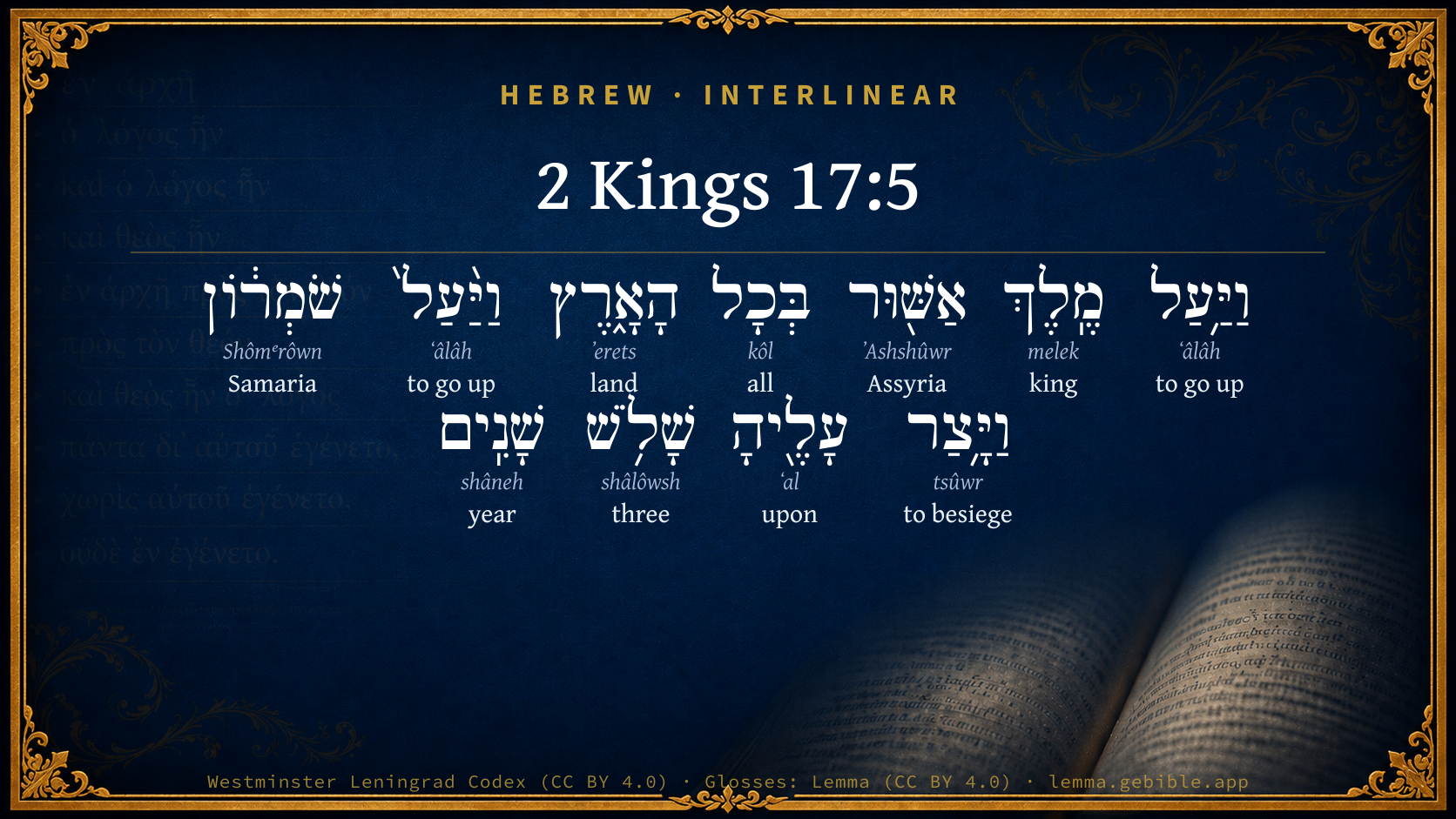
Hebrew (Westminster Leningrad Codex) 2 Kings 17:5 appears in the Hebrew Old Testament. The text above is from the Westminster Leningrad Codex. Each word links to its Strong’s number, a concise gloss, and parsing drawn from the Open Scriptures Hebrew Bible morphology. Click any word for its full Brown-Driver-Briggs (BDB) entry.
Download image
Cite this verse

2 Kings 17:5 (World English Bible). Public Domain. Lemma interlinear Bible study tool, https://lemma.gebible.app/v/2-kings/17/5.

Show BibTeX & RIS
BibTeX
RIS
English Translation
Then the king of Assyria came up throughout all the land, and went up to Samaria, and besieged it three years.
World English Bible · Public Domain
Download a study sheet

One document with this verse’s original text, its word-by-word gloss line, the meaning frame, cross-references with their text, attributed commentary, and full source and license credits — printable, and it pastes into notes with its structure intact.

This verse Autodidact and up

Study sheet (.html) Plain text (.txt)

A passage Seminary Student

Up to 50 verses in one chapter. A passage sheet keeps up to 6 commentary sources and 12 cross-references per verse, in the order this page ranks them, and says so on the sheet whenever that leaves anything out. Ask for a single verse and you get the Autodidact verse sheet above.

Everything on this page stays free to read, with no account — the sheet is a download of what is already on screen, not access to it.

Want to remove ads? Support Godless Engineer
Compare translations 3

The same verse in 3 English versions, stacked beneath the original-language interlinear above. Click any original word for its lexicon entry.

Each is an independent rendering of the whole verse — the interlinear is not word-aligned to these translations.

Highlighted words mark where these versions differ — a whole-verse word diff, not a word-by-word alignment.

  • World English Bible Public Domain
    Then the king of Assyria came up throughout all the land, and went up to Samaria, and besieged it three years.
  • King James Version Public Domain
    Then the king of Assyria came up throughout all the land, and went up to Samaria, and besieged it three years.
  • unfoldingWord Literal Text CC BY-SA 4.0
    Now the king of Assyria came up against all of the land, and he came up Samaria, and he besieged against it three years.

unfoldingWord Literal Text — © unfoldingWord, licensed CC BY-SA 4.0. Word-aligned USFM3 via Door43 (git.door43.org/unfoldingWord/en_ult).

Versions to compare (up to 4)

3 of 4 selected

Show all 18 translations

Every available English version of this verse, each an independent rendering of the whole verse.

  • World English Bible Public Domain
    Then the king of Assyria came up throughout all the land, and went up to Samaria, and besieged it three years.
  • Berean Standard Bible Public Domain
    Then the king of Assyria invaded the whole land, marched up to Samaria, and besieged it for three years.
  • Majority Standard Bible Public Domain
    Then the king of Assyria invaded the whole land, marched up to Samaria, and besieged it for three years.
  • King James Version Public Domain
    Then the king of Assyria came up throughout all the land, and went up to Samaria, and besieged it three years.
  • American Standard Version (1901) Public Domain
    Then the king of Assyria came up throughout all the land, and went up to Samaria, and besieged it three years.
  • Revised Version (1885) Public Domain
    Then the king of Assyria came up throughout all the land, and went up to Samaria, and besieged it three years.
  • Geneva Bible (1599) Public Domain
    Then the king of Asshur came vp throughout all the lande, and went against Samaria, and besieged it three yeere.
  • Douay-Rheims (1899) Public Domain
    And he went through all the land: and going up to Samaria, he besieged it three years.
  • Young's Literal Translation Public Domain
    And the king of Asshur goeth up into all the land, and he goeth up to Samaria, and layeth siege against it three years;
  • Literal Standard Version CC BY-SA 4.0
    And the king of Asshur goes up into all the land, and he goes up to Samaria, and lays siege against it [for] three years;
  • Unlocked Literal Bible CC BY-SA 4.0
    Then the king of Assyria attacked throughout all the land, and attacked Samaria and besieged it for three years.
  • unfoldingWord Literal Text CC BY-SA 4.0
    Now the king of Assyria came up against all of the land, and he came up Samaria, and he besieged against it three years.
  • Darby Bible Public Domain
    And the king of Assyria overran the whole land, and went up against Samaria, and besieged it three years.
  • World Messianic Bible Public Domain
    Then the king of Assyria came up throughout all the land, went up to Samaria, and besieged it three years.
  • Webster's Bible Public Domain
    Then the king of Assyria came up throughout all the land, and went up to Samaria, and besieged it three years.
  • Free Bible Version CC BY-SA 4.0
    Then the king of Assyria invaded the whole country, and attacked Samaria, besieging it for three years.
  • Bible in Basic English Public Domain
    Then the king of Assyria went through all the land and came up to Samaria, shutting it in with his forces for three years.
  • JPS Tanakh (1917) Public Domain
    Then the king of Assyria came up throughout all the land, and went up to Samaria, and besieged it three years.

Literal Standard Version (2020), Covenant Press — licensed CC BY-SA 4.0. Text via the HelloAO Bible API (eBible.org). Unlocked Literal Bible (unfoldingWord) — licensed CC BY-SA 4.0. Text via the HelloAO Bible API (eBible.org). unfoldingWord Literal Text — © unfoldingWord, licensed CC BY-SA 4.0. Word-aligned USFM3 via Door43 (git.door43.org/unfoldingWord/en_ult). Free Bible Version, Dr. Jonathan Gallagher — licensed CC BY-SA 4.0. Text via the HelloAO Bible API (eBible.org).

Word by word

More ways to search: Search by grammar → Find every occurrence → Compare this word →

Practice this passage: Drill this verse → Learn its vocabulary →

וַיָּ֥צַר
tsûwr
H6696
“and · to besiege”
Conjunction + Verb, Qal, Sequential Imperfect, 3rd Person, Masculine, Singular
Part of Speech
Conjunction + Verb
Stem
Qal
Form
Sequential Imperfect
Person
3rd Person
Gender
Masculine
Number
Singular
Full BDB Definition

Origin: a primitive root

TWOT: 1898 , 1899 , 1900

to bind, besiege, confine, cramp - (Qal) - to confine, secure - to shut in, beseige - to shut up, enclose - (Qal) to show hostility to, be an adversary, treat as foe - (Qal) to form, fashion, delineate
  1. וַיַּ֥עַל ʻâlâh H5927 “and · to go up” Conjunction + Verb, Qal, Sequential Imperfect, 3rd Person, Masculine, Singular
  2. מֶֽלֶךְ melek H4428 “king of” Noun, Common, Masculine, Singular, Construct
  3. אַשּׁ֖וּר ʼAshshûwr H804 “Assyria” Noun, Proper
  4. בְּכָל kôl H3605 “in/at · all of” Preposition + Noun, Common, Masculine, Singular, Construct
  5. הָאָ֑רֶץ ʼerets H776 “the · land” Particle, Definite Article + Noun, Common, Both, Singular, Absolute
  6. וַיַּ֨עַל֙ ʻâlâh H5927 “and · to go up” Conjunction + Verb, Qal, Sequential Imperfect, 3rd Person, Masculine, Singular
  7. שֹׁמְר֔וֹן Shômᵉrôwn H8111 “Samaria” Noun, Proper
  8. עָלֶ֖יהָ ʻal H5921 “upon · her” Preposition + Suffix, Personal, 3rd Person, Feminine, Singular
  9. שָׁלֹ֥שׁ shâlôwsh H7969 “three” Adjective, Cardinal number, Feminine, Singular, Absolute
  10. שָׁנִֽים shâneh H8141 “years” Noun, Common, Feminine, Plural, Absolute

About this verse

These counts appear in no published source. They are computed here, from the morphology-tagged text and Lemma’s own curated glosses. What Lemma adds →

11
words
10
distinct lemmas
Historical
section

Shared distinctive vocabulary

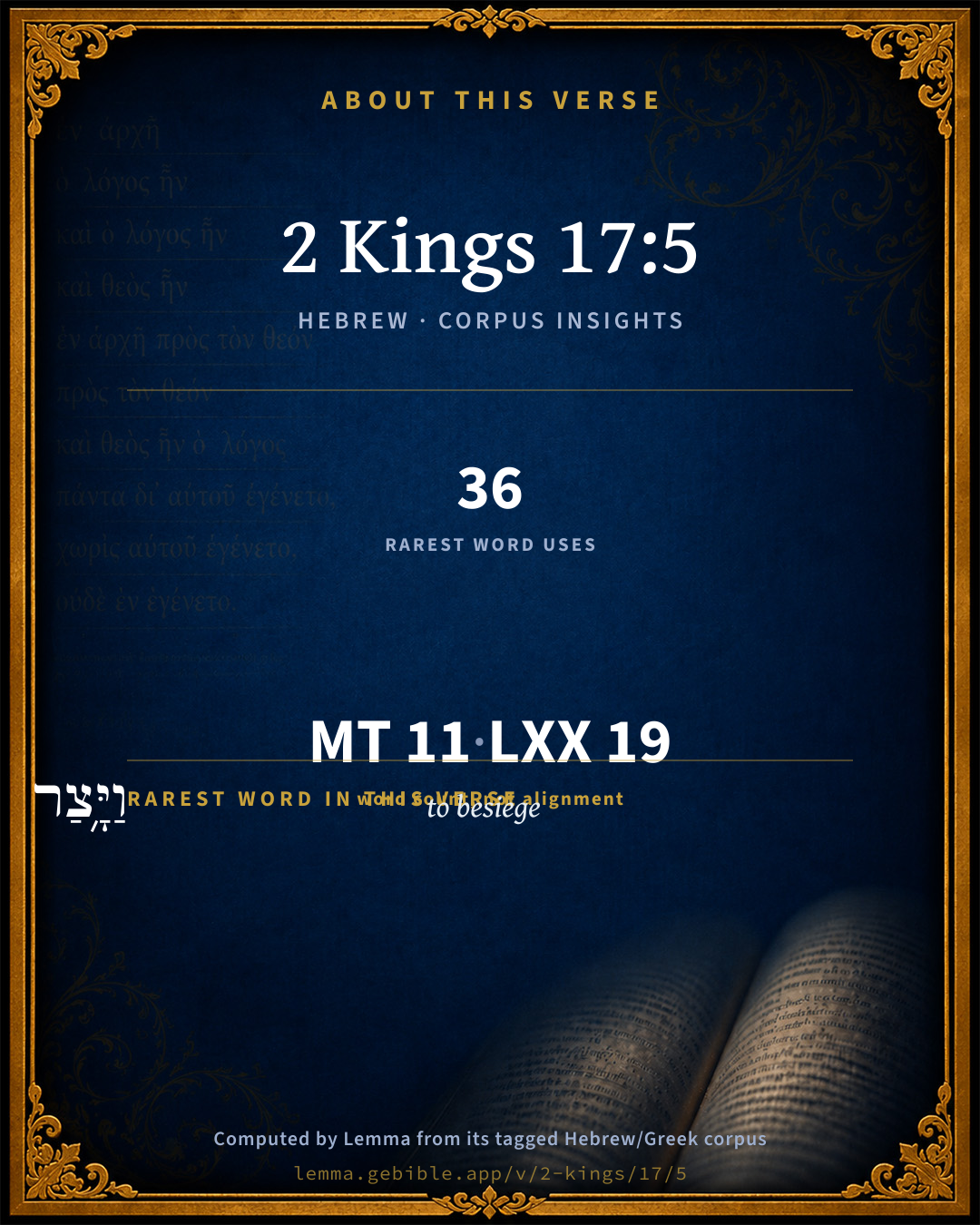
וַיָּ֥צַר to besiege H6696 occurs in 36 verses of the Hebrew Bible. Also found in:

Grammatical profile

  • 3 verbs
  • 6 nouns
  • 1 adjective
  • 1 preposition

Verb forms

  • וַיַּ֥עַל Qal · Sequential Imperfect
  • וַיַּ֨עַל֙ Qal · Sequential Imperfect
  • וַיָּ֥צַר Qal · Sequential Imperfect

Repetition

A word recurs within this verse — often emphatic in Hebrew:

  • וַיַּ֥עַל to go up H5927 ×2

Hebrew & Septuagint length

In English translation the verse runs 21 words from the Hebrew and 23 from the Septuagint (LXX English) — closely comparable.

A rough comparison of the two English renderings, which tokenize alike — not a word-level alignment.

Word counts can differ between the Hebrew and the Greek without any difference in meaning — e.g. the Hebrew direct-object marker אֵת has no separate Greek word, and Greek often adds the article ὁ.

In the original languages it is 11 Hebrew tokens and 19 Greek tokens — but the two are counted differently (Hebrew bundles its prefixes and suffixes into one token; the Greek is in lemma form), so that isn’t a like-for-like length.

Cross-references

4

Topical passages linked to 2 Kings 17:5 in the Treasury of Scripture Knowledge — connected by theme and wording, ordered by reader-vote popularity; previews shown in the World English Bible.

  • Hosea 13:16 Samaria will bear her guilt; For she has rebelled against her God. They will fall by the sword. Their infants will be dashed in pieces, And their pregnant women will be ripped open."
  • 2 Kings 18:9 It happened in the fourth year of king Hezekiah, which was the seventh year of Hoshea son of Elah king of Israel, that Shalmaneser king of Assyria came up against Samaria, and besieged it.
  • 2 Kings 25:1–3 It happened in the ninth year of his reign, in the tenth month, in the tenth day of the month, that Nebuchadnezzar king of Babylon came, he and all his army, against Jerusalem, and encamped against it; and they built forts against it round about.
  • Jeremiah 52:4–5 It happened in the ninth year of his reign, in the tenth month, in the tenth day of the month, that Nebuchadrezzar king of Babylon came, he and all his army, against Jerusalem, and encamped against it; and they built forts against it round about.

Cross-references courtesy of OpenBible.info (CC BY 4.0).

Hebrew and Greek witnesses Masoretic Hebrew ↔ Greek Septuagint

The same verse in the two great witnesses to the Old Testament, shown verse-for-verse.

These are two independent witnesses, not word-aligned to each other, and the Septuagint is shown in lemma (dictionary) form.

Hebrew 2 Kings 17:5 Masoretic · Westminster Leningrad Codex

וַיַּ֥עַל מֶֽלֶךְ אַשּׁ֖וּר בְּכָל הָאָ֑רֶץ וַיַּ֨עַל֙ שֹׁמְר֔וֹן וַיָּ֥צַר עָלֶ֖יהָ שָׁלֹ֥שׁ שָׁנִֽים

Then the king of Assyria came up throughout all the land, and went up to Samaria, and besieged it three years.

World English Bible · Public Domain

Greek LXX 2 Kings 17:5 Septuagint · lemma form

καί ἀναβαίνω ὁ βασιλεύς ἀσσύριος ἐν πᾶς ὁ γῆ καί ἀναβαίνω εἰς σαμαρεία καί πολιορκέω ἐπί αὐτός τρεῖς ἔτος

And the king of the Assyrians went up against all the land, and went up to Samaria, and besieged it for three years.

LXX2012 (modern English Septuagint) · Public Domain

Hebrew: Westminster Leningrad Codex (CC BY 4.0). Greek: Septuagint (public domain); English from LXX2012 (modern English Septuagint) (Public Domain). How the Septuagint differs from the Hebrew →

Targum (Aramaic paraphrase)

1

The Targum is the ancient Jewish Aramaic paraphrase of the Hebrew Scriptures — an interpretive translation, not the Hebrew text itself. Onkelos (literal) and Pseudo-Jonathan (expansive) render the Torah, and Jonathan the Prophets. Coverage is partial: where no permissively-licensed English translation exists for a verse, only the Aramaic is shown. This is verse-level text, not a word-by-word alignment to the Hebrew.

  1. Targum Jonathan Prophets (Joshua–Malachi)
    וּסְלִיק מַלְכָּא דְאַתּוּר בְּכָל אַרְעָא וּסְלִיק לְשֹׁמְרוֹן וְצַר עֲלָהּ תְּלַת שְׁנִין:

    (no public-domain English translation for this verse)

    Targum Jonathan — Aramaic: “Mikraot Gedolot” (public domain). English: “Sefaria Community Translation” (CC0 1.0 (public-domain dedication)); “London "Chaldee Paraphrase," 1871” (public domain). Text via Sefaria.

Commentary

Notes on 2 Kings 17:5 from classic Christian and Jewish commentators (each source and its license shown beneath its notes). The classic Christian expositions comment on the surrounding passage and are grouped to its opening verse, so a note may address several verses; the Jewish commentaries on the Tanakh (Rashi and others) are per-verse, so they appear only where the commentator wrote on this verse.

Lemma curates 59 commentaries, every one of them public domain or Creative Commons licensed, each selected and text-cleaned for this edition rather than reprinted as found. About our sources →

Trapp's Complete Commentary

John Trapp

2Ki 17:5 Then the king of Assyria came up throughout all the land, and went up to Samaria, and besieged it three years.

Ver. 5. Then the king of Assyria came up throughout all the land.] Like an overflowing flood; having first seized upon the country of the Moabites, that he might leave nothing behind him that might be to his prejudice, Ar and Kirharaseth being destroyed, as had been foretold three years before. See Isa 16:1-14 cum notis Tremellii.

John Trapp, A Commentary or Exposition upon All the Books of the Old and New Testament (1647–1656) — public domain. Text from a community e-Sword module.

Joseph Benson's Commentary

2Ki 17:5-6. Then the king of Assyria came up throughout all the land — And made himself master of it, treating the Israelites as traitors rather than as fair enemies, and punishing them with the sword of justice. And went up to Samaria, and besieged it three years — During which time it held out, but doubtless endured a great deal of misery, though this be not particularly recorded. At length the royal city was taken, and the king made a prisoner, shut up, and bound. This was in the ninth year of the reign of Hoshea, at which time Israel was carried away captive into Assyria — There, we have reason to think, after some time, they were so mingled with the nations, that they were lost, and the name of Israel was no more in remembrance. They that forgot God were themselves forgotten, and they that studied to be like the nations were buried among them; and they that would not serve God in their own land, were made to serve their enemies in a strange land. Thus ended Israel as a nation, and the prophecy of Hoshea was fulfilled: they became Lo-ammi, not a people, and Lo- ruhamah, unpitied. Now Canaan spewed them out. When we read of their entry into Canaan under Hoshea the son of Nun, who would have thought that such would be their exit under Hoshea the son of Elah? Thus Rome’s glory in Augustus sunk many ages after in Augustulus; yet we find St. James writing to the twelve tribes scattered abroad, (Jas 1:1,) and Paul speaks of the twelve tribes, instantly serving God day and night, Act 26:7 : so that, though we never read of the return of those that were carried captive, nor have any ground to believe that they still remain a distinct body in some remote corner of the world, yet a remnant of them did escape, and will remain, till all Israel be saved.

Joseph Benson's Commentary on the Old and New Testaments (1811–1818) — public domain. Text from a community e-Sword module.

Tyndale Open Study Notes

Tyndale Open Resources

17:5-6 the king of Assyria: Although sources identify Samaria’s conqueror as Shalmaneser V of Assyria (726–722 BC), Sargon II (who ruled Assyria 721–705 BC) claimed that he captured the city. Perhaps Sargon was the field commander when Samaria fell and then became king when Shalmaneser died during the year of the siege. • invaded the entire land: Assyrian military strategy was to devastate the territory surrounding an enemy’s primary city before launching a final attack. • The ninth year of King Hoshea’s reign was 722 BC. • the people . . . were exiled: The Assyrians practiced deportation in order to defuse future rebellions. Sargon also brought other people to Israel to form a mixed population (17:24-25). • Halah was situated northeast of Nineveh in Assyria. • The Habor River is a tributary of the Euphrates River in northwestern Assyria. • Gozan was located on the Habor River northeast of Haran (Gen 12:4). Assyrian documents from the area list personal names that are clearly Israelite, perhaps reflecting the deportation of the people of Samaria.

Tyndale Open Study Notes — © Tyndale Open Resources, licensed CC BY-SA 4.0. Text via the HelloAO Bible API.

Adam Clarke's Commentary

Verse 5. Besieged it three years.] It must have been well fortified, well provisioned, and well defended, to have held out so long.

Adam Clarke's Commentary on the Bible (1810–1826) — public domain. Text from a community e-Sword/MySword module.

Ellicott's Commentary for English Readers

(5) Then (and) the king of Assyria came up . . . and besieged it three years.—Sargon states that he took Samaria (Samerίna) in his first year. Shalmaneser therefore had besieged the city some two years before his death.

The brief narrative before us does not discriminate between the respective shares of the two Assyrian sovereigns in the overthrow of the kingdom of Israel, but it is noticeable that it does not say that Shalmaneser “besieged Samaria three years,” and “took Samaria.” (Comp. 2Ki_18:11.)

A Bible Commentary for English Readers, edited by Charles John Ellicott (1878–1897) — public domain. Text from a community e-Sword module.

The Cambridge Bible for Schools and Colleges

gen. ed. J. J. S. Perowne

5. throughout all the land] It seems to have been the usual plan of invaders to overrun the places more easily conquerable before they assailed the chief stronghold.

besieged it three years] Samaria from its position on a hill and from the pains bestowed on its building must have been a city of considerable strength for those days. It seems from the records that the city was not taken by the Assyrians during the reign of Shalmaneser, but in the beginning of the reign of Sargon his successor. See Smith, Assyrian Canon, p. 201. In view of this statement the language of the Bible is very remarkable. At the beginning of this chapter the movements are ascribed to Shalmaneser, but in verse 6 it is only said ‘the king of Assyria took Samaria’. And when the subject is mentioned again 2Ki_18:9-10, though stating that ‘Shalmaneser came up against Samaria and besieged it’, he continues ‘and at the end of three years they took it’, thus, though apparently quite undesignedly, giving support to the chronology which is established by the monuments. See note there.

The Cambridge Bible for Schools and Colleges (gen. ed. J. J. S. Perowne; Cambridge University Press, 1878–1918) — public domain. Text from a community e-Sword module.

John Gill's Exposition

Then the king of Assyria came up throughout all the land,.... Of Israel, there being none to oppose his march; Hoshea not daring to come out, and meet him and fight him:

and went up to Samaria, and besieged it three years; so long the city held out against him, see Kg2 18:9.

John Gill's Exposition of the Whole Bible (1746–1763) — public domain (CC PDM 1.0). Text via the HelloAO Bible API.

Albert Barnes' Notes on the Bible

All the land - The second invasion of Shalmaneser (723 B.C., his fifth year), is here contrasted with the first, as extending to the whole country, whereas the first had afflicted only a part.

Three years - From the fourth to the sixth of Hezekiah, and from the seventh to the ninth of Heshea; two years, therefore, according to our reckoning, but three, according to that of the Hebrews. This was a long time for so small a place to resist the Assyrians but Samaria was favorably situated on a steep hill; probably Sabaco made some attempts to relieve his vassal; the war with Tyre must have distracted Shalmaneser; and there is reason to believe that before the capture was effected a revolt had broken out at Nineveh which must have claimed Shalmaneser’s chief attention, though it did not induce him to abandon his enterprise.

Albert Barnes' Notes on the Bible (1834–1885) — public domain. Text from a community e-Sword/MySword module.

Whedon's Commentary on the Bible

Daniel D. Whedon

5. Came up throughout all the land — He overran all the country, subduing all the smaller towns, apparently as a measure preliminary to the final siege of the capital.

Besieged it three years — The length of this siege evidences the strength of Samaria, and the desperate resistance of its people. “It is remarkable,” says Ewald, “how strong a resemblance the fall of Samaria bears to the first and second destructions of Jerusalem, in the heroic resistance of its inhabitants.” The horrors of this siege may be inferred from Isa_28:1-4; Hos_10:14; Hos_13:16; Amo_6:9-14.

Daniel D. Whedon (gen. ed.), Commentary on the Old and New Testaments (1874–1909) — public domain. Text from a community e-Sword module.

The Pulpit Commentary

Then the King of Assyria rather, and the King of Assyriacame up throughout all the land i.e. , with an army that spread itself at once over the whole land, that came to conquer, not merely to strike a blow, and obtain submission, as on the former occasion (see ver. 3, and the comment)and went up to Samaria, and besieged it three years. From some time in Hoshea"s seventh year (2Ki_18:9) to some time in his ninth. (2Ki_18:10) According to the Hebrew mode of reckoning, parts of years are counted as years; and thus the siege need not have lasted much over a year, though it may have been extended to nearly three years. In either case, there was ample time for Shabak to have brought up his forces, had he been so minded; and his failure to do so, or in any way to succor his ally, showed how little reliance was to be placed on Egyptian promises. (comp. 2Ki_18:21)

The Pulpit Commentary (1880–1919), ed. H.D.M. Spence-Jones & Joseph S. Exell — public domain. Text from a community e-Sword module.

Lesson kit

Teaching starters — assembled from the data on this page, not authored interpretation. Every prompt links to the verse data it draws on. Edit before teaching.

2 Kings, in the Historical, opens this verse with 11 words (10 distinct Hebrew lemmas). Its most distinctive word is tsûwr (“to besiege”). A historical commentator’s framing appears above. Read the whole chapter for the surrounding context.

Discussion questions

  1. The word tsûwr carries the sense “to besiege.” How does it shape the verse?
  2. How does Exodus 23:22, which shares the word «to besiege», read alongside this verse?
  3. What does the repetition of “to go up” (2× in this one verse) do in this verse?
  4. These translations render this verse differently; the difference is in the English rendering, not the original. What questions does that raise?
  5. «וַיַּ֥עַל» is a Qal Sequential Imperfect verb. How does that grammatical form shape the action described?
  6. Compare how Trapp's Complete Commentary and Joseph Benson's Commentary read this verse. Where do they agree or differ?

Things to notice

Reading settings

Reading text

Shown beneath each verse's original-language words.

Old Testament
Old Testament edition

Read the OT as the Masoretic Hebrew (MT) or the Greek Septuagint (LXX).

English shown for the Greek Septuagint (in the Hebrew ↔ Greek comparison).

Comparing translations? Open the Compare panel on any verse page to stack up to four side by side.