Ezekiel 23:12

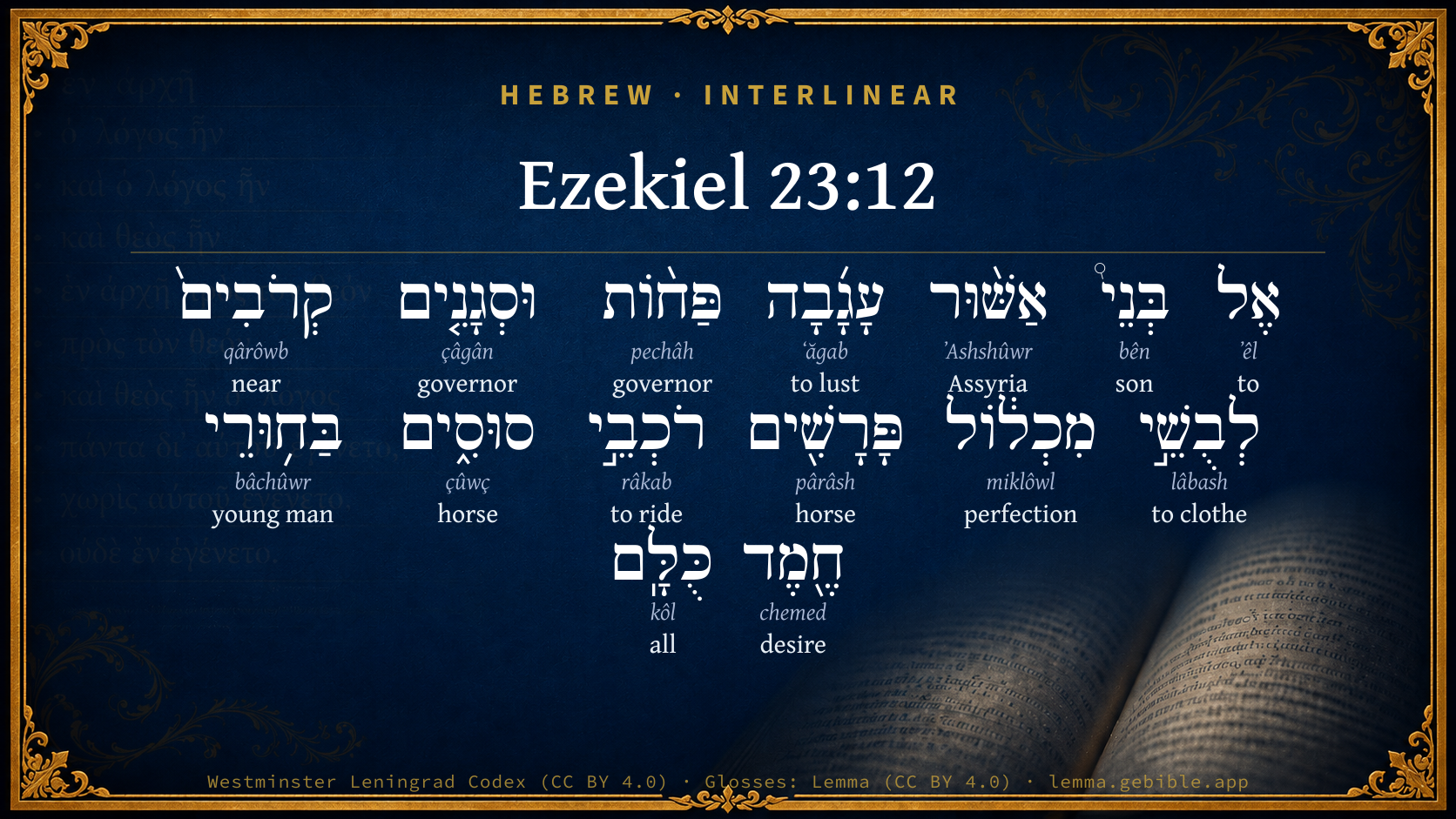
Hebrew (Westminster Leningrad Codex) Ezekiel 23:12 appears in the Hebrew Old Testament. The text above is from the Westminster Leningrad Codex. Each word links to its Strong’s number, a concise gloss, and parsing drawn from the Open Scriptures Hebrew Bible morphology. Click any word for its full Brown-Driver-Briggs (BDB) entry.
Download image
Cite this verse

Ezekiel 23:12 (World English Bible). Public Domain. Lemma interlinear Bible study tool, https://lemma.gebible.app/v/ezekiel/23/12.

Show BibTeX & RIS
BibTeX
RIS
English Translation
She doted on the Assyrians, governors and rulers, [her] neighbors, clothed most gorgeously, horsemen riding on horses, all of them desirable young men.
World English Bible · Public Domain
Highlights
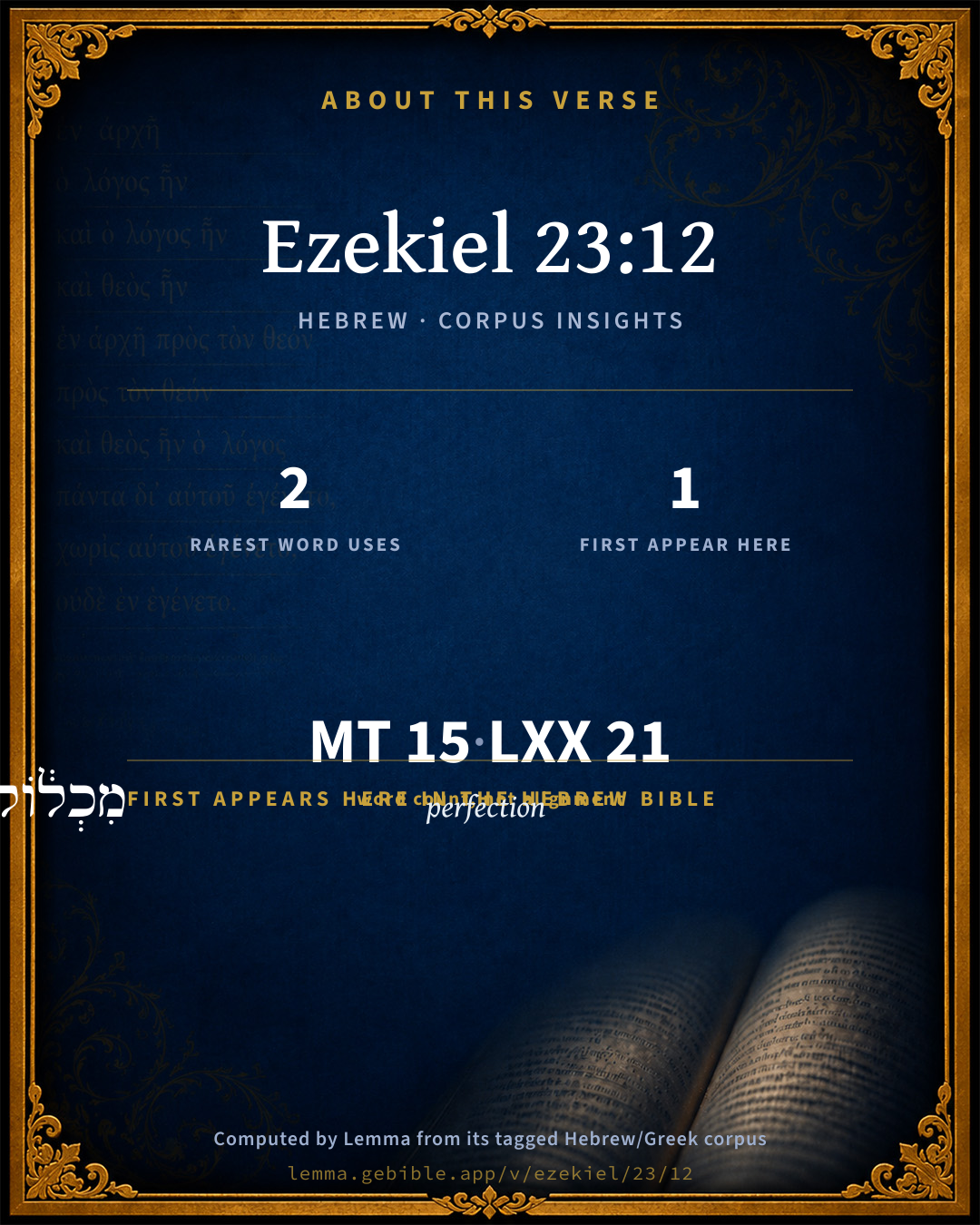
  • 1 first appearance in the Hebrew Bible
Full analysis ↓
Download a study sheet

One document with this verse’s original text, its word-by-word gloss line, the meaning frame, cross-references with their text, attributed commentary, and full source and license credits — printable, and it pastes into notes with its structure intact.

This verse Autodidact and up

Study sheet (.html) Plain text (.txt)

A passage Seminary Student

Up to 50 verses in one chapter. A passage sheet keeps up to 6 commentary sources and 12 cross-references per verse, in the order this page ranks them, and says so on the sheet whenever that leaves anything out. Ask for a single verse and you get the Autodidact verse sheet above.

Everything on this page stays free to read, with no account — the sheet is a download of what is already on screen, not access to it.

Want to remove ads? Support Godless Engineer
Compare translations 3

The same verse in 3 English versions, stacked beneath the original-language interlinear above. Click any original word for its lexicon entry.

Each is an independent rendering of the whole verse — the interlinear is not word-aligned to these translations.

Highlighted words mark where these versions differ — a whole-verse word diff, not a word-by-word alignment.

  • World English Bible Public Domain
    She doted on the Assyrians, governors and rulers, [her] neighbors, clothed most gorgeously, horsemen riding on horses, all of them desirable young men.
  • King James Version Public Domain
    She doted upon the Assyrians her neighbours, captains and rulers clothed most gorgeously, horsemen riding upon horses, all of them desirable young men.
  • unfoldingWord Literal Text CC BY-SA 4.0
    She lusted for the Assyrians, the governors and the dominating officials who dressed impressively, who were men riding horses. All of them were strong, handsome men.

unfoldingWord Literal Text — © unfoldingWord, licensed CC BY-SA 4.0. Word-aligned USFM3 via Door43 (git.door43.org/unfoldingWord/en_ult).

Versions to compare (up to 4)

3 of 4 selected

Show all 18 translations

Every available English version of this verse, each an independent rendering of the whole verse.

  • World English Bible Public Domain
    She doted on the Assyrians, governors and rulers, [her] neighbors, clothed most gorgeously, horsemen riding on horses, all of them desirable young men.
  • Berean Standard Bible Public Domain
    She too lusted after the Assyrians—governors and commanders, warriors dressed in splendor, horsemen riding on steeds, all desirable young men.
  • Majority Standard Bible Public Domain
    She too lusted after the Assyrians—governors and commanders, warriors dressed in splendor, horsemen riding on steeds, all desirable young men.
  • King James Version Public Domain
    She doted upon the Assyrians her neighbours, captains and rulers clothed most gorgeously, horsemen riding upon horses, all of them desirable young men.
  • American Standard Version (1901) Public Domain
    She doted upon the Assyrians, governors and rulers, `her' neighbors, clothed most gorgeously, horsemen riding upon horses, all of them desirable young men.
  • Revised Version (1885) Public Domain
    She doted upon the Assyrians, governors and rulers, her neighbours, clothed most gorgeously, horsemen riding upon horses, all of them desirable young men.
  • Geneva Bible (1599) Public Domain
    She doted vpon the Assyrians her neighbours, both captaines and princes clothed with diuers sutes, horsemen ryding vpon horses: they were all pleasant yong men.
  • Douay-Rheims (1899) Public Domain
    Impudently prostituting herself to the children of the Assyrians, the princes, and rulers that came to her, clothed with divers colours, to the horsemen that rode upon horses, and to young men all of great beauty.
  • Young's Literal Translation Public Domain
    On sons of Asshur she hath doted, Governors and prefects, Neighbouring ones -- clothed in perfection, Horsemen, riding on horses, Desirable young men all of them.
  • Literal Standard Version CC BY-SA 4.0
    She has lusted on sons of Asshur, || Governors and prefects, || Neighboring ones—clothed in perfection, || Horsemen, riding on horses, || All of them desirable young men.
  • Unlocked Literal Bible CC BY-SA 4.0
    She lusted for the Assyrians, the governors and the dominating officials who dressed impressively, who were men riding horses. All of them were strong, handsome men.
  • unfoldingWord Literal Text CC BY-SA 4.0
    She lusted for the Assyrians, the governors and the dominating officials who dressed impressively, who were men riding horses. All of them were strong, handsome men.
  • Darby Bible Public Domain
    She lusted after the children of Asshur [her] neighbours, governors and rulers, clothed most gorgeously, horsemen riding upon horses, all of them attractive young men.
  • World Messianic Bible Public Domain
    She lusted after the Assyrians, governors and rulers—her neighbors, clothed most gorgeously, horsemen riding on horses, all of them desirable young men.
  • Webster's Bible Public Domain
    She doted upon the Assyrians her neighbors, captains and rulers clothed most gorgeously, horsemen riding upon horses, all of them desirable young men.
  • Free Bible Version CC BY-SA 4.0
    She also wanted to have sex with the Assyrians: their leaders and commanders, their splendidly-dressed soldiers—all of them handsome young men in the cavalry.
  • Bible in Basic English Public Domain
    She was full of desire for the Assyrians, captains and rulers, her neighbours, clothed in blue, horsemen going on horses, all of them young men to be desired.
  • JPS Tanakh (1917) Public Domain
    She doted upon the Assyrians, governors and rulers, warriors, clothed most gorgeously, horsemen riding upon horses, all of them handsome young men.

Literal Standard Version (2020), Covenant Press — licensed CC BY-SA 4.0. Text via the HelloAO Bible API (eBible.org). Unlocked Literal Bible (unfoldingWord) — licensed CC BY-SA 4.0. Text via the HelloAO Bible API (eBible.org). unfoldingWord Literal Text — © unfoldingWord, licensed CC BY-SA 4.0. Word-aligned USFM3 via Door43 (git.door43.org/unfoldingWord/en_ult). Free Bible Version, Dr. Jonathan Gallagher — licensed CC BY-SA 4.0. Text via the HelloAO Bible API (eBible.org).

Word by word

More ways to search: Search by grammar → Find every occurrence → Compare this word →

Practice this passage: Drill this verse → Learn its vocabulary →

מִכְל֔וֹל
miklôwl
H4358
“perfection”
Noun, Common, Masculine, Singular, Absolute
Part of Speech
Noun
Type
Common
Gender
Masculine
Number
Singular
State
Absolute
Full BDB Definition

Origin: from H3634

TWOT: 985c

perfection, gorgeous attire (noun masculine) - perfectly, most gorgeously (adverb)
  1. אֶל ʼêl H413 “to” Preposition
  2. בְּנֵי֩ bên H1121 “sons of” Noun, Common, Masculine, Plural, Construct
  3. אַשּׁ֨וּר ʼAshshûwr H804 “Assyria” Noun, Proper
  4. עָגָ֜בָה ʻăgab H5689 “to lust” Verb, Qal, Perfect, 3rd Person, Feminine, Singular
  5. פַּח֨וֹת pechâh H6346 “governors” Noun, Common, Masculine, Plural, Absolute
  6. וּסְגָנִ֤ים çâgân H5461 “and · governors” Conjunction + Noun, Common, Masculine, Plural, Absolute
  7. קְרֹבִים֙ qârôwb H7138 “near” Adjective, Adjective, Masculine, Plural, Absolute
  8. לְבֻשֵׁ֣י lâbash H3847 “clothed of” Adjective, Adjective, Masculine, Plural, Construct
  9. פָּרָשִׁ֖ים pârâsh H6571 “horses” Noun, Common, Masculine, Plural, Absolute
  10. רֹכְבֵ֣י râkab H7392 “riding” Verb, Qal, Participle Active, Masculine, Plural, Construct
  11. סוּסִ֑ים çûwç H5483 “horses” Noun, Common, Masculine, Plural, Absolute
  12. בַּח֥וּרֵי bâchûwr H970 “young men of” Noun, Common, Masculine, Plural, Construct
  13. חֶ֖מֶד chemed H2531 “desire” Noun, Common, Masculine, Singular, Absolute
  14. כֻּלָּֽם kôl H3605 “all · their” Noun, Common, Masculine, Singular, Construct + Suffix, Personal, 3rd Person, Masculine, Plural

About this verse

These counts appear in no published source. They are computed here, from the morphology-tagged text and Lemma’s own curated glosses. What Lemma adds →

15
words
15
distinct lemmas
Prophets
section

Notable vocabulary

The rarest word here is מִכְל֔וֹל perfection H4358 — appearing just 2 times in the whole Hebrew Bible.

First appearance in Scripture

This word makes its first canonical appearance in the Hebrew Bible here:

  • מִכְל֔וֹל perfection H4358

Shared distinctive vocabulary

מִכְל֔וֹל perfection H4358 occurs in 2 verses of the Hebrew Bible. Also found in:

Grammatical profile

  • 2 verbs
  • 10 nouns
  • 2 adjectives
  • 1 preposition

Verb forms

  • עָגָ֜בָה Qal · Perfect
  • רֹכְבֵ֣י Qal · Participle Active

Hebrew & Septuagint length

In English translation the verse runs 23 words from the Hebrew and 27 from the Septuagint (LXX English) — closely comparable.

A rough comparison of the two English renderings, which tokenize alike — not a word-level alignment.

Word counts can differ between the Hebrew and the Greek without any difference in meaning — e.g. the Hebrew direct-object marker אֵת has no separate Greek word, and Greek often adds the article ὁ.

In the original languages it is 15 Hebrew tokens and 21 Greek tokens — but the two are counted differently (Hebrew bundles its prefixes and suffixes into one token; the Greek is in lemma form), so that isn’t a like-for-like length.

Cross-references

5

Topical passages linked to Ezekiel 23:12 in the Treasury of Scripture Knowledge — connected by theme and wording, ordered by reader-vote popularity; previews shown in the World English Bible.

  • 2 Kings 16:7–15 So Ahaz sent messengers to Tiglath Pileser king of Assyria, saying, I am your servant and your son: come up, and save me out of the hand of the king of Syria, and out of the hand of the king of Israel, who rise up against me.
  • 2 Chronicles 28:16–23 At that time did king Ahaz send to the kings of Assyria to help him.
  • Ezekiel 16:28 You have played the prostitute also with the Assyrians, because you were insatiable; yes, you have played the prostitute with them, and yet you weren't satisfied.
  • Ezekiel 23:5–6 Oholah played the prostitute when she was mine; and she doted on her lovers, on the Assyrians [her] neighbors,
  • Ezekiel 23:23 the Babylonians and all the Chaldeans, Pekod and Shoa and Koa, [and] all the Assyrians with them; desirable young men, governors and rulers all of them, princes and men of renown, all of them riding on horses.

Cross-references courtesy of OpenBible.info (CC BY 4.0).

Hebrew and Greek witnesses Masoretic Hebrew ↔ Greek Septuagint

The same verse in the two great witnesses to the Old Testament, shown verse-for-verse.

These are two independent witnesses, not word-aligned to each other, and the Septuagint is shown in lemma (dictionary) form.

Hebrew Ezekiel 23:12 Masoretic · Westminster Leningrad Codex

אֶל בְּנֵי֩ אַשּׁ֨וּר עָגָ֜בָה פַּח֨וֹת וּסְגָנִ֤ים קְרֹבִים֙ לְבֻשֵׁ֣י מִכְל֔וֹל פָּרָשִׁ֖ים רֹכְבֵ֣י סוּסִ֑ים בַּח֥וּרֵי חֶ֖מֶד כֻּלָּֽם

She doted on the Assyrians, governors and rulers, [her] neighbors, clothed most gorgeously, horsemen riding on horses, all of them desirable young men.

World English Bible · Public Domain

Greek LXX Ezekiel 23:12 Septuagint · lemma form

ἐπί ὁ υἱός ὁ ἀσσύριος ἐπιτίθημι ἡγέομαι καί στρατηγός ὁ ἐγγύς αὐτός ἐνδύω εὐπάρυφος ἱππεύς ἱππάζομαι ἐπί ἵππος νεανίσκος ἐπίλεκτος πᾶς

She doted upon the sons of the Assyrian, princes and captains, her neighbors, clothed with fine linen, horsemen riding on horses; they were all choice young men.

LXX2012 (modern English Septuagint) · Public Domain

Hebrew: Westminster Leningrad Codex (CC BY 4.0). Greek: Septuagint (public domain); English from LXX2012 (modern English Septuagint) (Public Domain). How the Septuagint differs from the Hebrew →

Targum (Aramaic paraphrase)

1

The Targum is the ancient Jewish Aramaic paraphrase of the Hebrew Scriptures — an interpretive translation, not the Hebrew text itself. Onkelos (literal) and Pseudo-Jonathan (expansive) render the Torah, and Jonathan the Prophets. Coverage is partial: where no permissively-licensed English translation exists for a verse, only the Aramaic is shown. This is verse-level text, not a word-by-word alignment to the Hebrew.

  1. Targum Jonathan Prophets (Joshua–Malachi)
    בָּתַר בְּנֵי אַתּוּר אִתְרְעִיאַת לְמִטְעֵי שִׁלְטוֹנִין וְטוּרְנִין קָרִיבִין לְבוּשֵׁי גְמַר וּפָרָשִׁין רָכְבֵי סוּסְוָן עוּלֵימֵי חֶמְדָתָא כּוּלְהוֹן:

    (no public-domain English translation for this verse)

    Targum Jonathan — Aramaic: “Mikraot Gedolot” (public domain). English: “Sefaria Community Translation” (CC0 1.0 (public-domain dedication)); “London "Chaldee Paraphrase," 1871” (public domain). Text via Sefaria.

Commentary

Notes on Ezekiel 23:12 from classic Christian and Jewish commentators (each source and its license shown beneath its notes). The classic Christian expositions comment on the surrounding passage and are grouped to its opening verse, so a note may address several verses; the Jewish commentaries on the Tanakh (Rashi and others) are per-verse, so they appear only where the commentator wrote on this verse.

Lemma curates 59 commentaries, every one of them public domain or Creative Commons licensed, each selected and text-cleaned for this edition rather than reprinted as found. About our sources →

Trapp's Complete Commentary

John Trapp

Eze 23:12 She doted upon the Assyrians [her] neighbours, captains and rulers clothed most gorgeously, horsemen riding upon horses, all of them desirable young men.

Ver. 12. She doted.] Amantes amentes. Loving her lovers. See Eze 23:5.

John Trapp, A Commentary or Exposition upon All the Books of the Old and New Testament (1647–1656) — public domain. Text from a community e-Sword module.

Jamieson, Fausset & Brown

Robert Jamieson, A. R. Fausset & David Brown

(Eze 23:6, Eze 23:23).

most gorgeously--literally, "to perfection." GROTIUS translates, "wearing a crown," or "chaplet," such as lovers wore in visiting their mistresses.

Jamieson, Fausset & Brown — Commentary Critical and Explanatory on the Whole Bible (1871) — public domain (CC PDM 1.0). Text via the HelloAO Bible API.

Ellicott's Commentary for English Readers

(12) Her neighbours.—See Note on Eze_23:5. In both places the warriors of Assyria are described in the most attractive way to carry out the figure; they are also spoken of as very powerful, to explain the political attraction to them. Israel was both fascinated by their splendour and overawed by their power.

A Bible Commentary for English Readers, edited by Charles John Ellicott (1878–1897) — public domain. Text from a community e-Sword module.

The Cambridge Bible for Schools and Colleges

gen. ed. J. J. S. Perowne

12. her neighbours] The order is: the Assyrians, governors and satraps, warriors clothed … See on Eze_23:5. The intervention of Assyria in the affairs of Judah was caused by the appeal of Ahaz for help against Syria and Ephraim, 2Ki_16:7. On the disastrous consequences of Ahaz’s folly cf. Isa_7:17-25.

The Cambridge Bible for Schools and Colleges (gen. ed. J. J. S. Perowne; Cambridge University Press, 1878–1918) — public domain. Text from a community e-Sword module.

John Gill's Exposition

She doted upon the Assyrians her neighbours,.... As in the times of Ahaz, who sent to Tiglathpileser, king of Assyria, for help; and from whence he took the pattern of an altar, and had one built like it at Jerusalem, and offered upon it, Kg2 16:7,

captains and rulers clothed most gorgeously; or "perfectly" (q); with all kind of precious garments, and of all manner of colours; not with blue only, but purple, scarlet, crimson, &c.

horsemen riding upon horses, all of them desirable young men; See Gill on Eze 23:6.

(q) "omni genera pulchrarum vestinto", Pagninus; "absoluto vestira", Montanus; "perfectione, sive universitate, sub. vestium", Vatablus; "perfectissime", Janius & Tremellius, Polanus; "perfecto ornatu", Piscator; "vestitos accurate", Cocceius.

John Gill's Exposition of the Whole Bible (1746–1763) — public domain (CC PDM 1.0). Text via the HelloAO Bible API.

Matthew Poole's English Annotations

This verse is the same with Eze 23:6, which see; only the clothing of blue there is here clothing of beauty; i.e. most beautiful.

Matthew Poole's English Annotations on the Holy Bible (1683–1685) — public domain. Text from a community e-Sword/MySword module.

The Pulpit Commentary

Doting on the Assyrians.

This foolish, fatal infatuation of Israel for the Assyrians may be taken as a striking instance of the fascination of worldliness. Israel had known the true God, and had been called to a peculiar destiny as a holy and. separate nation; yet she turned aside from her high vocation, lured by the fatal charms of military splendor and sensuous luxury in a great heathen empire.

I GOD"S PEOPLE ARE REQUIRED TO SEPARATE THEMSELVES FROM THE WORLD, who hear the call of God must follow him into the wilderness, or, if he gives them a land flowing with milk and honey, must still keep themselves apart from the evil world. This does not mean the physical separation of a hermit"s exile or a monk"s cloistered imprisonment. The true separation is spiritual, not local. We are called to forsake the spirit of the world, to renounce its evil practices, and to repudiate its low, material, sensuous tone of life.

II THE WORLD ENDEAVORS TO ENSNARE THE PEOPLE OF GOD. It is not content to let them stand aloof; it appears as a tempter trying to charm the bride of Christ into infidelity. We cannot afford to despise its fascinating influence, for this is most subtle and potent. It comes through various means.

1. Proximity. Assyria was a "neighbor" of Israel. The Church is in the world. Christian men are in daily intercourse with worldly men. "Evil communications corrupt good manners.

2. Earthly attractiveness. There was a material splendor in the great empire of Assyria which the marvelous sculptures and inscriptions that have been made familiar to us by Layard and others put beyond question. The "governors and rulers clothed most gorgeously," and the horsemen, "all of them desirable young men," awoke the admiration of the poor little semi-barbarous nation, Israel. The luxury of the world, its luscious literature and sensuous art, its enormous resources, and its elaborate culture of earthly refinement, are necessarily most fascinating.

3. Natural inclination. The world could not touch us for harm if it found nothing sympathetic in us. But it easily discovers remains of its old dominion. The old Adam is not quite dead. Passion within may be roused to answer to temptation from without.

III THE SNARES OF THE WORLD ARE FATAL TO THOSE WHO ARE ENTANGLED IN THEM. Israel"s doting upon the Assyrians was fatal to her religion, her morals, and her national existence. To succumb to the spirit of the world is to make shipwreck of life.

1. Religious ruin. "Ye cannot serve God and mammon." The spirit of worldliness is antagonistic to God. As surely as this spirit gains ground in our lives, the spirit of devotion will recede.

2. Moral ruin. True worldliness is morally evil. It is not a mere habit of external and earthly living. It carries with it the indulgence of the lower life. At least it tends to this, and all its fascinations drag the soul down.

3. Life-ruin. In the end the Christian man who gives himself up to the attractions of worldly living will reap the consequences of his tin in corruption and death.

The Pulpit Commentary (1880–1919), ed. H.D.M. Spence-Jones & Joseph S. Exell — public domain. Text from a community e-Sword module.

Rashi

Rabbi Shlomo Yitzchaki (Rashi)

For the sons of Assyria she lusted This is Ahaz, who sent to the king of Assyria for aid (II Kings 16:7).

Rashi on the Tanakh — English translations: “The Judaica Press complete Tanach with Rashi, translated by A. J. Rosenberg” (CC BY 4.0); “Pentateuch with Rashi's commentary by M. Rosenbaum and A.M. Silbermann, 1929-1934” (public domain); “The Metsudah Tanach series, Lakewood, N.J” (CC BY 4.0); and “The Book of Joshua, Metsudah Publications, 1997” (CC BY 4.0). Text via Sefaria.

Lesson kit

Teaching starters — assembled from the data on this page, not authored interpretation. Every prompt links to the verse data it draws on. Edit before teaching.

Ezekiel, in the Prophets, opens this verse with 15 words (15 distinct Hebrew lemmas). Its most distinctive word is miklôwl (“perfection”). A historical commentator’s framing appears above. Read the whole chapter for the surrounding context.

Discussion questions

  1. What does “perfection” (miklôwl) contribute to the verse as a whole?
  2. This is the first place “perfection” appears in Scripture (first appears here). What does its debut here establish?
  3. How does Ezekiel 38:4, which shares the word «perfection», read alongside this verse?
  4. These translations render this verse differently; the difference is in the English rendering, not the original. What questions does that raise?
  5. «עָגָ֜בָה» is a Qal Perfect verb. How does that grammatical form shape the action described?
  6. Compare how Trapp's Complete Commentary and Jamieson, Fausset & Brown read this verse. Where do they agree or differ?

Things to notice

Reading settings

Reading text

Shown beneath each verse's original-language words.

Old Testament
Old Testament edition

Read the OT as the Masoretic Hebrew (MT) or the Greek Septuagint (LXX).

English shown for the Greek Septuagint (in the Hebrew ↔ Greek comparison).

Comparing translations? Open the Compare panel on any verse page to stack up to four side by side.