2 Kings 18:7

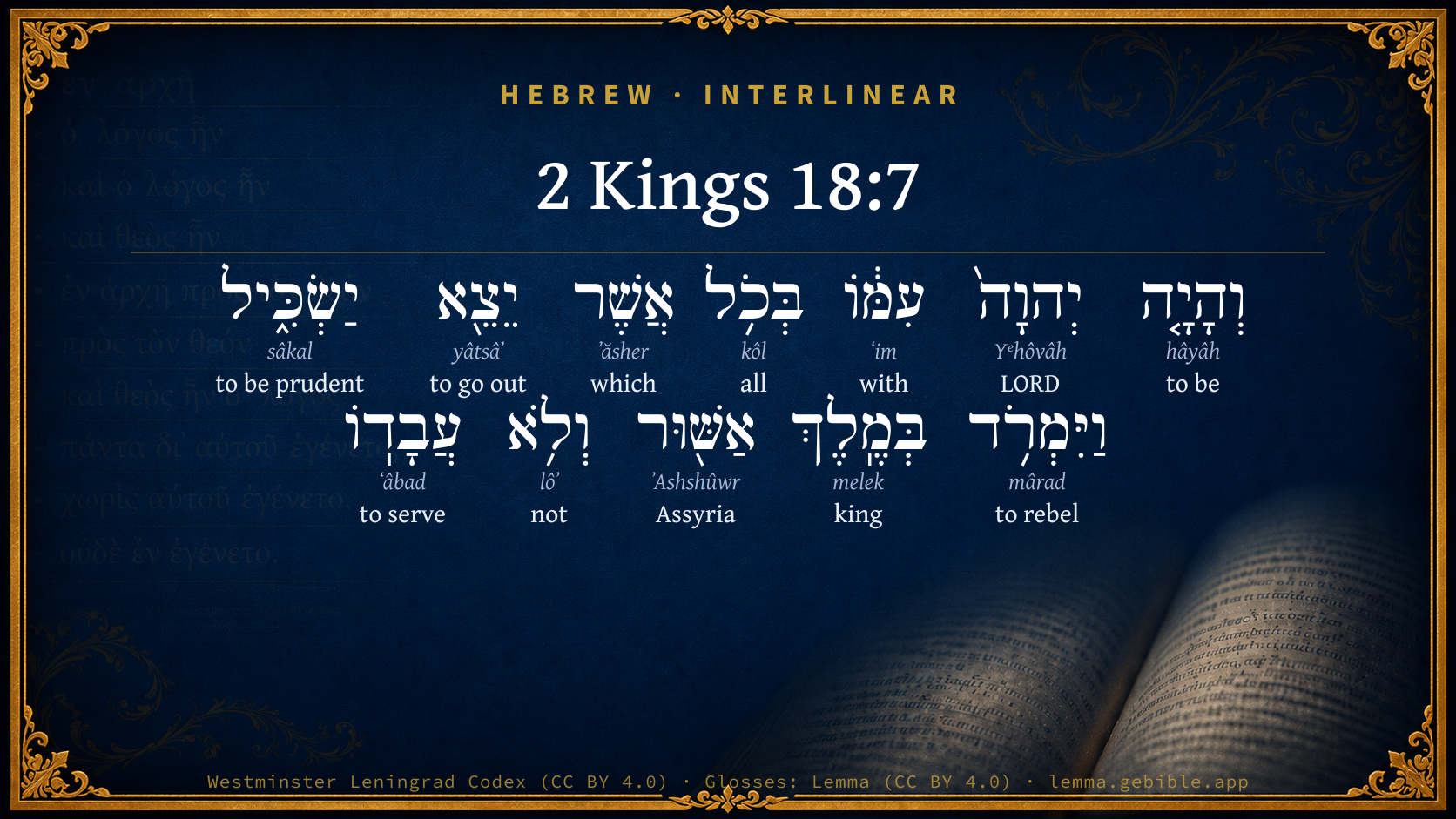
Hebrew (Westminster Leningrad Codex) 2 Kings 18:7 appears in the Hebrew Old Testament. The text above is from the Westminster Leningrad Codex. Each word links to its Strong’s number, a concise gloss, and parsing drawn from the Open Scriptures Hebrew Bible morphology. Click any word for its full Brown-Driver-Briggs (BDB) entry.
Download image
Cite this verse

2 Kings 18:7 (World English Bible). Public Domain. Lemma interlinear Bible study tool, https://lemma.gebible.app/v/2-kings/18/7.

Show BibTeX & RIS
BibTeX
RIS
English Translation
Yahweh was with him; wherever he went forth he prospered: and he rebelled against the king of Assyria, and didn't serve him.
World English Bible · Public Domain
Download a study sheet

One document with this verse’s original text, its word-by-word gloss line, the meaning frame, cross-references with their text, attributed commentary, and full source and license credits — printable, and it pastes into notes with its structure intact.

This verse Autodidact and up

Study sheet (.html) Plain text (.txt)

A passage Seminary Student

Up to 50 verses in one chapter. A passage sheet keeps up to 6 commentary sources and 12 cross-references per verse, in the order this page ranks them, and says so on the sheet whenever that leaves anything out. Ask for a single verse and you get the Autodidact verse sheet above.

Everything on this page stays free to read, with no account — the sheet is a download of what is already on screen, not access to it.

Want to remove ads? Support Godless Engineer
Compare translations 3

The same verse in 3 English versions, stacked beneath the original-language interlinear above. Click any original word for its lexicon entry.

Each is an independent rendering of the whole verse — the interlinear is not word-aligned to these translations.

Highlighted words mark where these versions differ — a whole-verse word diff, not a word-by-word alignment.

  • World English Bible Public Domain
    Yahweh was with him; wherever he went forth he prospered: and he rebelled against the king of Assyria, and didn't serve him.
  • King James Version Public Domain
    And the LORD was with him; and he prospered whithersoever he went forth: and he rebelled against the king of Assyria, and served him not.
  • unfoldingWord Literal Text CC BY-SA 4.0
    And Yahweh was with him. In every where he went out, he succeeded. And he rebelled against the king of Assyria, and he did not serve him.

unfoldingWord Literal Text — © unfoldingWord, licensed CC BY-SA 4.0. Word-aligned USFM3 via Door43 (git.door43.org/unfoldingWord/en_ult).

Versions to compare (up to 4)

3 of 4 selected

Show all 18 translations

Every available English version of this verse, each an independent rendering of the whole verse.

  • World English Bible Public Domain
    Yahweh was with him; wherever he went forth he prospered: and he rebelled against the king of Assyria, and didn't serve him.
  • Berean Standard Bible Public Domain
    And the LORD was with Hezekiah, and he prospered wherever he went. He rebelled against the king of Assyria and refused to serve him.
  • Majority Standard Bible Public Domain
    And the LORD was with Hezekiah, and he prospered wherever he went. He rebelled against the king of Assyria and refused to serve him.
  • King James Version Public Domain
    And the LORD was with him; and he prospered whithersoever he went forth: and he rebelled against the king of Assyria, and served him not.
  • American Standard Version (1901) Public Domain
    And Jehovah was with him; whithersoever he went forth he prospered: and he rebelled against the king of Assyria, and served him not.
  • Revised Version (1885) Public Domain
    And the LORD was with him; whithersoever he went forth he prospered: and he rebelled against the king of Assyria, and served him not.
  • Geneva Bible (1599) Public Domain
    So the Lord was with him, and he prospered in all thinges, which he tooke in hande: also he rebelled against the King of Asshur, and serued him not.
  • Douay-Rheims (1899) Public Domain
    Wherefore the Lord also was with him, and in all things, to which he went forth, he behaved himself wisely. And he rebelled against the king of the Assyrians, and served him not.
  • Young's Literal Translation Public Domain
    And Jehovah hath been with him, in every place where he goeth out he acteth wisely, and he rebelleth against the king of Asshur, and hath not served him;
  • Literal Standard Version CC BY-SA 4.0
    And YHWH has been with him; in every place where he goes out he acts wisely, and he rebels against the king of Asshur, and has not served him;
  • Unlocked Literal Bible CC BY-SA 4.0
    So Yahweh was with Hezekiah, and wherever he went he prospered. He rebelled against the king of Assyria and did not serve him.
  • unfoldingWord Literal Text CC BY-SA 4.0
    And Yahweh was with him. In every where he went out, he succeeded. And he rebelled against the king of Assyria, and he did not serve him.
  • Darby Bible Public Domain
    And Jehovah was with him; he prospered whithersoever he went forth. And he rebelled against the king of Assyria, and served him not.
  • World Messianic Bible Public Domain
    The LORD was with him. Wherever he went, he prospered. He rebelled against the king of Assyria, and didn’t serve him.
  • Webster's Bible Public Domain
    And the LORD was with him; and he prospered whithersoever he went forth: and he rebelled against the king of Assyria, and served him not.
  • Free Bible Version CC BY-SA 4.0
    The Lord was with him; he was successful in everything he did. He defied the king of Assyria and refused to submit to him.
  • Bible in Basic English Public Domain
    And the Lord was with him; he did well in all his undertakings: and he took up arms against the king of Assyria and was his servant no longer.
  • JPS Tanakh (1917) Public Domain
    And the LORD was with him: whithersoever he went forth he prospered; and he rebelled against the king of Assyria, and served him not.

Literal Standard Version (2020), Covenant Press — licensed CC BY-SA 4.0. Text via the HelloAO Bible API (eBible.org). Unlocked Literal Bible (unfoldingWord) — licensed CC BY-SA 4.0. Text via the HelloAO Bible API (eBible.org). unfoldingWord Literal Text — © unfoldingWord, licensed CC BY-SA 4.0. Word-aligned USFM3 via Door43 (git.door43.org/unfoldingWord/en_ult). Free Bible Version, Dr. Jonathan Gallagher — licensed CC BY-SA 4.0. Text via the HelloAO Bible API (eBible.org).

Word by word

More ways to search: Search by grammar → Find every occurrence → Compare this word →

Practice this passage: Drill this verse → Learn its vocabulary →

וַיִּמְרֹ֥ד
mârad
H4775
“and · to rebel”
Conjunction + Verb, Qal, Sequential Imperfect, 3rd Person, Masculine, Singular
Part of Speech
Conjunction + Verb
Stem
Qal
Form
Sequential Imperfect
Person
3rd Person
Gender
Masculine
Number
Singular
Full BDB Definition

Origin: a primitive root

TWOT: 1240

to rebel, revolt, be rebellious - (Qal) to rebel, revolt - against human king - against God - against light (poetic)
  1. וְהָיָ֤ה hâyâh H1961 “and · to be” Conjunction + Verb, Qal, Sequential Perfect, 3rd Person, Masculine, Singular
  2. יְהוָה֙ Yᵉhôvâh H3068 “LORD” Noun, Proper
  3. עִמּ֔וֹ ʻim H5973 “with · him” Preposition + Suffix, Personal, 3rd Person, Masculine, Singular
  4. בְּכֹ֥ל kôl H3605 “in/at · all” Preposition + Noun, Common, Masculine, Singular, Absolute
  5. אֲשֶׁר ʼăsher H834 “which” Particle, Relative
  6. יֵצֵ֖א yâtsâʼ H3318 “to go out” Verb, Qal, Imperfect, 3rd Person, Masculine, Singular
  7. יַשְׂכִּ֑יל sâkal H7919 “to be prudent” Verb, Hiphil, Imperfect, 3rd Person, Masculine, Singular
  8. בְּמֶֽלֶךְ melek H4428 “in/at · king of” Preposition + Noun, Common, Masculine, Singular, Construct
  9. אַשּׁ֖וּר ʼAshshûwr H804 “Assyria” Noun, Proper
  10. וְלֹ֥א lôʼ H3808 “and · not” Conjunction + Particle, Negative
  11. עֲבָדֽוֹ ʻâbad H5647 “to serve · him” Verb, Qal, Perfect, 3rd Person, Masculine, Singular + Suffix, Personal, 3rd Person, Masculine, Singular

About this verse

These counts appear in no published source. They are computed here, from the morphology-tagged text and Lemma’s own curated glosses. What Lemma adds →

12
words
12
distinct lemmas
Historical
section

Notable vocabulary

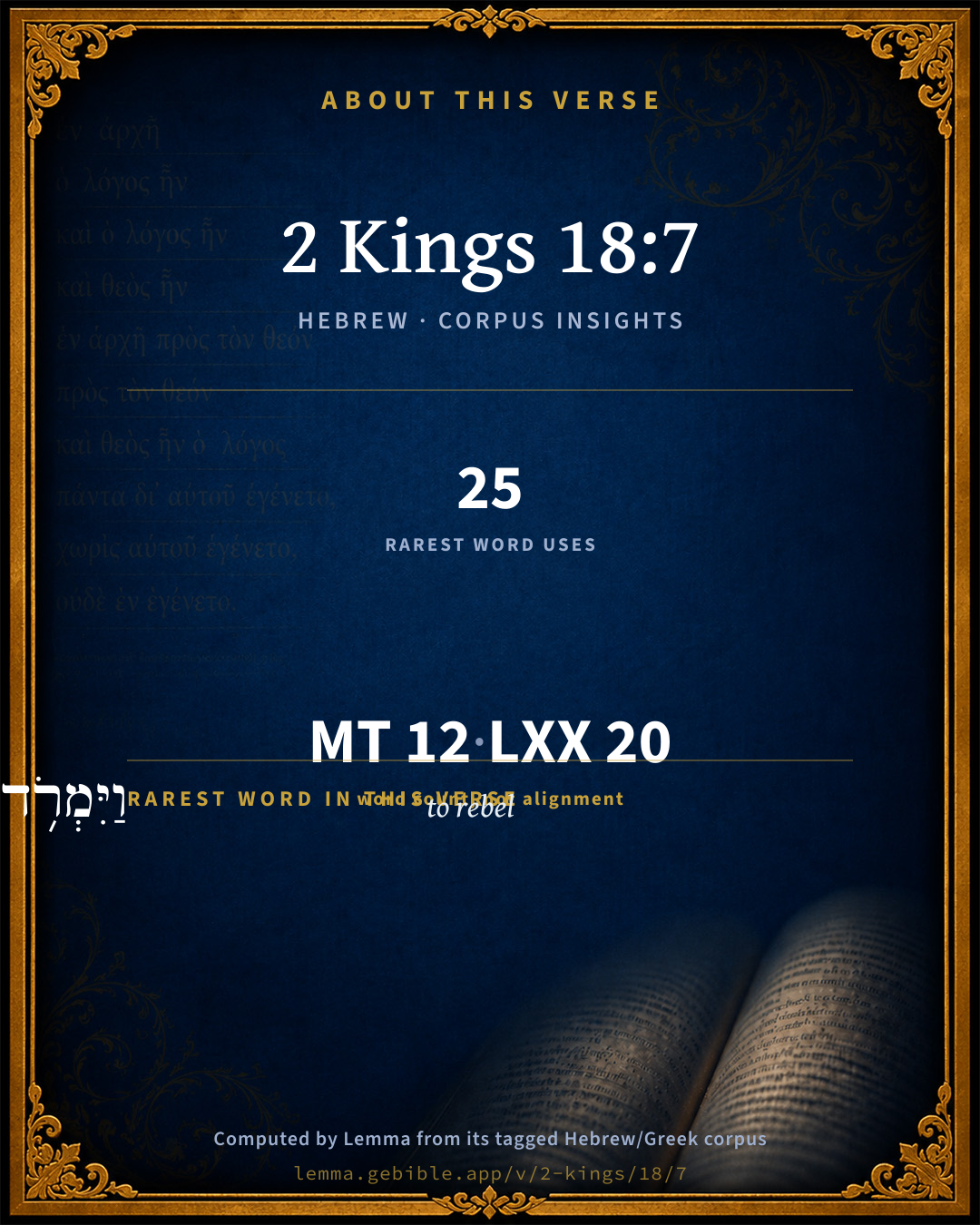
The rarest word here is וַיִּמְרֹ֥ד to rebel H4775 — appearing just 25 times in the whole Hebrew Bible.

Shared distinctive vocabulary

וַיִּמְרֹ֥ד to rebel H4775 occurs in 23 verses of the Hebrew Bible. Also found in:

Grammatical profile

  • 5 verbs
  • 4 nouns
  • 1 preposition
  • 2 particles

Verb forms

  • וְהָיָ֤ה Qal · Sequential Perfect
  • יֵצֵ֖א Qal · Imperfect
  • יַשְׂכִּ֑יל Hiphil · Imperfect
  • וַיִּמְרֹ֥ד Qal · Sequential Imperfect
  • עֲבָדֽוֹ Qal · Perfect

Hebrew & Septuagint length

In English translation the verse runs 22 words from the Hebrew and 28 from the Septuagint (LXX English) — closely comparable.

A rough comparison of the two English renderings, which tokenize alike — not a word-level alignment.

Word counts can differ between the Hebrew and the Greek without any difference in meaning — e.g. the Hebrew direct-object marker אֵת has no separate Greek word, and Greek often adds the article ὁ.

In the original languages it is 12 Hebrew tokens and 20 Greek tokens — but the two are counted differently (Hebrew bundles its prefixes and suffixes into one token; the Greek is in lemma form), so that isn’t a like-for-like length.

Cross-references

18

Topical passages linked to 2 Kings 18:7 in the Treasury of Scripture Knowledge — connected by theme and wording, ordered by reader-vote popularity; previews shown in the World English Bible.

  • Genesis 39:2–3 Yahweh was with Joseph, and he was a prosperous man. He was in the house of his master the Egyptian.
  • 2 Kings 16:7 So Ahaz sent messengers to Tiglath Pileser king of Assyria, saying, I am your servant and your son: come up, and save me out of the hand of the king of Syria, and out of the hand of the king of Israel, who rise up against me.
  • Psalms 60:12 Through God we shall do valiantly, For it is he who will tread down our adversaries.
  • Romans 8:31 What then shall we say about these things? If God is for us, who can be against us?
  • 1 Samuel 18:14 David behaved himself wisely in all his ways; and Yahweh was with him.
  • 2 Chronicles 31:21 In every work that he began in the service of the house of God, and in the law, and in the commandments, to seek his God, he did it with all his heart, and prospered.
  • 2 Chronicles 32:30 This same Hezekiah also stopped the upper spring of the waters of Gihon, and brought them straight down on the west side of the city of David. Hezekiah prospered in all his works.
  • Psalms 1:3 He will be like a tree planted by the streams of water, That brings forth its fruit in its season, Whose leaf also does not wither. Whatever he does shall prosper.
  • Matthew 28:20 teaching them to observe all things that I commanded you. Behold, I am with you always, even to the end of the age." Amen.
  • 2 Kings 18:20 You say (but they are but vain words), [There is] counsel and strength for the war. Now on whom do you trust, that you have rebelled against me?
  • 2 Chronicles 15:2 and he went out to meet Asa, and said to him, Hear you me, Asa, and all Judah and Benjamin: Yahweh is with you, while you are with him; and if you seek him, he will be found of you; but if you forsake him, he will forsake you.
  • Psalms 46:11 Yahweh of Hosts is with us. The God of Jacob is our refuge. Selah.
  • Matthew 1:23 "Behold, the virgin shall be with child, And shall bring forth a son. They shall call his name Immanuel;" Which is, being interpreted, "God with us."
  • 1 Samuel 18:5 David went out wherever Saul sent him, [and] behaved himself wisely: and Saul set him over the men of war, and it was good in the sight of all the people, and also in the sight of Saul's servants.
  • Genesis 21:22 It happened at that time, that Abimelech and Phicol the captain of his host spoke to Abraham, saying, "God is with you in all that you do.
  • 2 Samuel 8:6 Then David put garrisons in Syria of Damascus; and the Syrians became servants to David, and brought tribute. Yahweh gave victory to David wherever he went.
  • Acts 7:9–10 "The patriarchs, moved with jealousy against Joseph, sold him into Egypt. God was with him,
  • 2 Samuel 8:14 He put garrisons in Edom; throughout all Edom put he garrisons, and all the Edomites became servants to David. Yahweh gave victory to David wherever he went.

Cross-references courtesy of OpenBible.info (CC BY 4.0).

Hebrew and Greek witnesses Masoretic Hebrew ↔ Greek Septuagint

The same verse in the two great witnesses to the Old Testament, shown verse-for-verse.

These are two independent witnesses, not word-aligned to each other, and the Septuagint is shown in lemma (dictionary) form.

Hebrew 2 Kings 18:7 Masoretic · Westminster Leningrad Codex

וְהָיָ֤ה יְהוָה֙ עִמּ֔וֹ בְּכֹ֥ל אֲשֶׁר יֵצֵ֖א יַשְׂכִּ֑יל וַיִּמְרֹ֥ד בְּמֶֽלֶךְ אַשּׁ֖וּר וְלֹ֥א עֲבָדֽוֹ

Yahweh was with him; wherever he went forth he prospered: and he rebelled against the king of Assyria, and didn't serve him.

World English Bible · Public Domain

Greek LXX 2 Kings 18:7 Septuagint · lemma form

καί εἰμί κύριος μετά αὐτός ἐν πᾶς ὅς ποιέω συνἵημι καί ἀθετέω ἐν ὁ βασιλεύς ἀσσύριος καί οὐ δουλεύω αὐτός

And the Lord was with him; and he was wise in all that he undertook: and he revolted from the king of the Assyrians, and served him not.

LXX2012 (modern English Septuagint) · Public Domain

Hebrew: Westminster Leningrad Codex (CC BY 4.0). Greek: Septuagint (public domain); English from LXX2012 (modern English Septuagint) (Public Domain). How the Septuagint differs from the Hebrew →

Targum (Aramaic paraphrase)

1

The Targum is the ancient Jewish Aramaic paraphrase of the Hebrew Scriptures — an interpretive translation, not the Hebrew text itself. Onkelos (literal) and Pseudo-Jonathan (expansive) render the Torah, and Jonathan the Prophets. Coverage is partial: where no permissively-licensed English translation exists for a verse, only the Aramaic is shown. This is verse-level text, not a word-by-word alignment to the Hebrew.

  1. Targum Jonathan Prophets (Joshua–Malachi)
    וַהֲוָה מֵימְרָא דַייָ בְּסַעֲדֵיהּ בְּכֹל אֲתַר דִנְפַק מַצְלַח וּמְרִיד בְּמַלְכָּא דְאַתּוּר וְלָא פָלְחֵיהּ:

    (no public-domain English translation for this verse)

    Targum Jonathan — Aramaic: “Mikraot Gedolot” (public domain). English: “Sefaria Community Translation” (CC0 1.0 (public-domain dedication)); “London "Chaldee Paraphrase," 1871” (public domain). Text via Sefaria.

Commentary

Notes on 2 Kings 18:7 from classic Christian and Jewish commentators (each source and its license shown beneath its notes). The classic Christian expositions comment on the surrounding passage and are grouped to its opening verse, so a note may address several verses; the Jewish commentaries on the Tanakh (Rashi and others) are per-verse, so they appear only where the commentator wrote on this verse.

Lemma curates 59 commentaries, every one of them public domain or Creative Commons licensed, each selected and text-cleaned for this edition rather than reprinted as found. About our sources →

Trapp's Complete Commentary

John Trapp

2Ki 18:7 And the LORD was with him; [and] he prospered whithersoever he went forth: and he rebelled against the king of Assyria, and served him not.

Ver. 7. And the Lord was with him.] The Lord is with all those that are with him. {2Ch 15:3 Ezr 8:22}

And he prospered.] Or, He dealt prudently.

And he rebelled against the king of Assyria.] That is, He cast off his yoke, and refused to stand to his father’s wicked covenant. This the Assyrian counted and called rebellion.

John Trapp, A Commentary or Exposition upon All the Books of the Old and New Testament (1647–1656) — public domain. Text from a community e-Sword module.

The Biblical Illustrator

Joseph S. Exell

2Ki_18:7

The Lord was with him; and he prospered whithersoever he went.

The secret of well-being

That is a grand summing-up of a life. It is Hezekiahs experience which is thus gathered together in a couple of clauses. It may be ours if we like. Hezekiah fought his way to it, for his father was one of the worst kings that ever sat on the throne of Judah; and he himself began to reign at a time of national decadence and degradation. He struggled up from darkness that covered the people into the clear light of fellowship with God. So may we.

I. The Divine Companionship, The Lord was with him. Of course, He is not far from any of us; for in Him we live and move and have our being, as said Paul. But two people may be very near each other and yet be infinitely far from one another. And it is possible--and, alas! it is the experience of hosts of us--to be in fact all compassed about, like a frond of seaweed in the sea, with that ocean of the Divine presence, and yet to be at an infinite distance from God. His presence with us does not depend upon our consciousness of it, thank Him for that; but the blessing of His presence does depend on our being aware of it. But how many of us go through life, day in and day out, and never feel that tie stands by our side. Gods presence is not interrupted by any secularities of our vocation; but our consciousness of it is interrupted by the secularisation of our spirits. He may be with us in all daily duty.

II. What brings God. I have remarked that my text, by the and at the beginning of it, is hooked on, as being their consequence, to the previous words. These are very instructive if we note their sequence as analysing for us the steps in what the mystical teachers call the practice of the presence of God. They give three stages. First comes he trusted--faith brings God. Then follows he clave to Him-persistent adherence and desire bring God. Nature abhors a vacuum; God abhors it more. When a man opens his heart, God rushes in to fill it, as surely as when you dip an empty, pitcher into the sea you bring it up filled with water; Whereas, if you put a bit of bladder over it you might dip it in a million times, and bring it up as empty as when you let it down. Desire brings God. Last of all, and consequences of the faith and persistent adherence, comes he obeyed.

III. What the presence of the Divine companion brings. And the Lord was with him; and he prospered whithersoever he went. Christianity, real religion, which is nothing more than this continuous consciousness of the Divine Presence, has a direct tendency to promote even the lower kinds of prosperity which the world seeks after. It is better, on the lowest grounds, to be good than to be bad. It is better, on the lowest grounds, to carry the thought of God into life than to live ungodly amidst the whirl of external events and duties. And we all know that, though with many exceptions, as necessary for our discipline, still, on the whole, the dispositions which are cultivated in the man who is ever aware of God with him, are such as in the main, and on the general, and in the long run, do contribute to the material well-being of individuals and of nations. But, as we have to get rid of mere sensuous ideas when we talk about God being with us, so we have to get rid of mere sensuous ideas when we talk about the prosperity that comes from His Presence. Hezekiah had his own share of what people call disasters. He was not always prosperous. There was once the Assyrian camp outside the walls of Jerusalem, and he was reduced almost to desperation. He had that great sickness, where he behaved in a very cowardly and effeminate and selfish fashion. And yet, on the whole, God was with him, and he prospered! Yes; for the invasion drove him nearer to God, and he then felt more of the Divine Presence. If we have God on board, and let Him take the helm into His own hands, depend upon it, adverse winds will bear us to our haven. (A. Maclaren, D. D.)

The Biblical Illustrator, edited by Joseph S. Exell (c. 1880s–1900s) — public domain. Text from a community e-Sword module.

Joseph Benson's Commentary

2Ki 18:7. The Lord was with him, and he prospered, &c. — He adhered to God and his service, and therefore God was with him; and, having the special presence of God with him, he had wonderful success in all his enterprises, in his wars, his buildings, and especially his reformation; which good work was carried on with less difficulty than he could have expected. Thus we have in him an instructive and encouraging example, teaching us that they who do God’s work with an eye to his glory, and with confidence in his strength, may expect to prosper in it: for great is the truth, and will prevail. And he rebelled against the king of Assyria — That is, he threw off that yoke of subjection to him to which his father had basely submitted, and re-assumed that full and independent sovereignty which God had settled in the house of David. This, though here called rebelling against him, was really no more than asserting the just rights of his crown. For his case differed much from that of Zedekiah, who is blamed for rebellion against the king of Babylon. Zedekiah had engaged himself by a solemn oath and covenant, which we do not read that Ahaz had done, much less had Hezekiah. Zedekiah had broke the covenant which himself had made; and God had actually given the dominion of the land and people to the king of Babylon, and commanded both Zedekiah and his subjects to submit to him. But God had not given any such dominion to the king of Assyria, nor had he commanded either Hezekiah or his people to be subject to him. And as to the word rebel here used, it means no more than to depart from that subjection which had been performed to another, which sometimes may be justly done, and certainly might in this case. Indeed, that Hezekiah did not sin in revolting from the king of Assyria seems evident, because God owned and assisted him in it, and did not at all reprove him for it in that message which he sent to him by Isaiah, nor afterward, though he did particularly reprove him for his vain-glory and ostentation, 2Ch 32:25-26.

Joseph Benson's Commentary on the Old and New Testaments (1811–1818) — public domain. Text from a community e-Sword module.

Tyndale Open Study Notes

Tyndale Open Resources

18:7-8 Because of Hezekiah’s unparalleled spiritual commitment, God blessed him and he was successful in everything he did. Hezekiah began a series of reforms, including the cleansing, repair, and refurbishing of the Temple (2 Chr 29:3-36); observance of the Passover (2 Chr 30); and the reconstituting of vital worship in Judah (2 Chr 31:1-19). • He revolted against the king of Assyria: In the ancient Near East, rebellion and the withholding of tribute usually took place with the change of government; King Sennacherib of Assyria succeeded Sargon II in 704 BC. Assyria’s preoccupation with matters in southern Mesopotamia at this time might have emboldened Hezekiah. Assyria’s response was to invade Judah in 701 BC (18:13–19:36). • He also conquered the Philistines, who had been a menace during Ahaz’s reign (2 Chr 28:18).

Tyndale Open Study Notes — © Tyndale Open Resources, licensed CC BY-SA 4.0. Text via the HelloAO Bible API.

Jamieson, Fausset & Brown

Robert Jamieson, A. R. Fausset & David Brown

he rebelled against the king of Assyria--that is, the yearly tribute his father had stipulated to pay, he, with imprudent haste, withdrew. Pursuing the policy of a truly theocratic sovereign, he was, through the divine blessing which rested on his government, raised to a position of great public and national strength. Shalmaneser had withdrawn from Palestine, being engaged perhaps in a war with Tyre, or probably he was dead. Assuming, consequently, that full independent sovereignty which God had settled on the house of David, he both shook off the Assyrian yoke, and, by an energetic movement against the Philistines, recovered from that people the territory which they had taken from his father Ahaz (Ch2 28:18).

Jamieson, Fausset & Brown — Commentary Critical and Explanatory on the Whole Bible (1871) — public domain (CC PDM 1.0). Text via the HelloAO Bible API.

Ellicott's Commentary for English Readers

(7) And he prospered . . . went forth.—Whithersoever he would go forth he would prosper. (The italicised and is needless here, as in 2Ki_18:6.)

Prospered.—Comp. 1Ki_2:3; Pro_17:8. Going forth denotes any external undertaking or enterprise, especially going forth to war. (Comp. the phrase “going out and coming in.”)

He rebelled against the king of Assyria—i.e., refused the tribute which Ahaz his father had paid. In this matter also it is implied that Hezekiah succeeded. The mention of Hezekiah’s revolt here does not imply that it happened at the beginning of his reign, for 2Ki_18:1-12 are a preliminary sketch of his entire history. The subject here glanced at is continued at large in 2Ki_18:13 seq.

A Bible Commentary for English Readers, edited by Charles John Ellicott (1878–1897) — public domain. Text from a community e-Sword module.

The Cambridge Bible for Schools and Colleges

gen. ed. J. J. S. Perowne

7. and he prospered whithersoever he went forth] By placing the last four words at the beginning of the sentence, the R.V. again gets rid of the italic and.

he rebelled against the king of Assyria] Ahaz had purchased Assyrian help against Rezin and Pekah [2Ki_16:7-9] and had become the vassal of Tiglath-pileser. No doubt the terms between the two nations were meant to continue in the reigns of the successors of Ahaz and Tiglath-pileser. The revolt of Hezekiah seems to have been made regardless of these terms. For when Sennacherib comes to attack him, he feels he must admit (verse 14) that he has offended, ‘I have offended, return from me, that which thou puttest on me will I bear’.

The Cambridge Bible for Schools and Colleges (gen. ed. J. J. S. Perowne; Cambridge University Press, 1878–1918) — public domain. Text from a community e-Sword module.

John Gill's Exposition

He smote the Philistines even unto Gaza, and the borders thereof,.... Who in his father's time had invaded Judah, and taken many cities and towns in it, which Hezekiah now recovered, and drove them to their own territories, of which Gaza was one; see Ch2 28:18.

from the tower of the watchmen to the fenced city; that is, places both great and small, cities, towns, and villages; of this phrase, see Kg2 17:9.

John Gill's Exposition of the Whole Bible (1746–1763) — public domain (CC PDM 1.0). Text via the HelloAO Bible API.

Albert Barnes' Notes on the Bible

The Lord was with him - This had been said of no king since David (marginal reference). The phrase is very emphatic. The general prosperity of Hezekiah is set forth at some length by the author of Chronicles 2Ch 32:23, 2Ch 32:27-29. His great influence among the nations bordering on the northern kingdom, was the cause of the first expedition of Sennacherib against him, the Ekronites having expelled an Assyrian viceroy from their city, and delivered him to Hezekiah for safe keeping: an expedition which did not very long precede that of 2Ki 18:13, which fell toward the close of Hezekiah’s long reign.

Albert Barnes' Notes on the Bible (1834–1885) — public domain. Text from a community e-Sword/MySword module.

Haydock's Catholic Bible Commentary

Wisely. Hebrew, "with success." Syriac, &c., "he was victorious wherever he went." --- Rebelled. The Assyrian assumed an undue authority in consequence of the words of Achaz, (chap. xvi. 7.) and arrogated to himself the authority of doing what he pleased with the people, ver. 32. Ezechias having formed various alliances, judged it necessary to make some resistance. Yet the prophet Isaias (xxx. 1.) complains of his applying to the Egyptians. (Calmet)

George Leo Haydock (1774–1849), Haydock's Catholic Family Bible and Commentary, 1859 edition — public domain. Excludes Psalms (Douay-Rheims chapter numbering differs from Protestant) and Deuterocanonical books (Catholic canon only).

Matthew Poole's English Annotations

He shook off that yoke of subjection and tribute to which his father had wickedly submitted, 2Ki 16:7, and reassumed that full and independent sovereignty which God had settled in the house of David, which Ahaz could not alienate further than for his own time. And Hezekiah’s case differs much from that of Zedekiah, who is blamed for rebellion against the king of Babylon, both because he had engaged himself to him by a solemn oath and covenant, which we do not read of Ahaz; and because he broke the covenant which he himself had made; and because God had actually given the dominion of his own land and people to the king of Babylon, and commanded both Zedekiah and his people to submit to him. And whereas Hezekiah is here said to rebel, that word implies only a defection from that subjection which had been professed and performed to another: which sometimes may be justly done, and sometimes may not; and therefore that word doth not necessarily prove this action to be a sin. And these words,

he rebelled, & c., are explained by the next following words,

and he served him not. And that it was not a sin in him seems most probable because God did own and assist him therein; and did not at all reprove him for it in that message which he sent to him by Isaiah about this matter, 2Ki 19:20, &c., nor afterwards, though he did particularly reprove him for that which might seem a less fault, for his vain-glory and ostentation, 2Ch 32:25,26. For what he saith, I have offended, See Poole "2Ki 18:14".

Matthew Poole's English Annotations on the Holy Bible (1683–1685) — public domain. Text from a community e-Sword/MySword module.

Whedon's Commentary on the Bible

Daniel D. Whedon

7. Rebelled against the king of Assyria — By refusing to pay the customary tribute, and proclaiming himself independent of Assyria. This was the cause of Sennacherib’s invasion. 2Ki_18:13.

Daniel D. Whedon (gen. ed.), Commentary on the Old and New Testaments (1874–1909) — public domain. Text from a community e-Sword module.

The Pulpit Commentary

And the Lord was with him. Of no other King of Judah or Israel is this said, except only of David. (2Sa_5:10) It was the promise made to Moses, (Exo_3:12) repeated to Joshua, (Jos_1:5, Jos_1:7) and by implication given in them to all those who would rule his people faithfully. (comp. 2Ch_15:2) And he prospered whithersoever he went forth; rather, in all his goings in cunctis ad quae procedebat (Vulgate). Hezekiah"s prosperity is enlarged upon by the writer of Chronicles, who says, (2Ch_32:27-30) "And Hezekiah had exceeding much riches and honor: and he made himself treasuries for silver, and for gold, and for precious stones, and for spices, add for shields, and for all manner of pleasant jewels; storehouses also for the increase of corn, and wine, and oil; and stalls for all manner of beasts, and cotes for flocks. Moreover he provided him cities, and possessions of flocks and herds in abundance: for God had given him substance very much.... And Hezekiah prospered in all his works." Many brought presents to him to Jerusalem, and he was magnified in the sight of all the surrounding nations. (2Ch_32:23) And he rebelled against the King of Assyria, and served him not. Hezekiah"s "rebellion" probably took place at the very commencement of his reign, B.C. 727, in the year that Shalmaneser ascended the throne. Most likely it consisted simply in his withholding his tribute, and neither going in person nor sending representatives to Nineveh, to congratulate the new monarch on his accession. This would be understood as an assertion of independence. That it was not at once resented must be ascribed to Shalmaneser"s difficulties with Samaria and with Tyre, which were more pressing, as they lay nearer to Assyria. Before these were over, Sargon usurped the crown. There is reason to believe that he made at least one expedition against Hezekiah; but the date of it is uncertain. Rebellion met him on all sides, and had to be crushed near home before he could venture to deal with it on the remote outskirts of his empire. Meanwhile Hezekiah strengthened himself and built up a considerable power.

The Pulpit Commentary (1880–1919), ed. H.D.M. Spence-Jones & Joseph S. Exell — public domain. Text from a community e-Sword module.

John Wesley's Explanatory Notes

Rebelled - He shook off that yoke of subjection, to which his father had wickedly submitted, and reassumed that full and independent sovereignty which God had settled in the house of David. And Hezekiah's case differs much from that of Zedekiah, who is blamed for rebellion against the king of Babylon, both because he had engaged himself by a solemn oath and covenant, which we do not read of Ahaz; and because he broke the covenant which he himself had made; and because God had actually given the dominion of his own land and people to the king of Babylon, and commanded both Zedekiah and his people to submit to him. And whereas Hezekiah is here said to rebel; that word implies, only a defection from that subjection which had been performed to another; which sometimes may be justly done, and therefore that word doth not necessarily prove this to be a sin. And that it was not a sin in him, seems certain, because God owned and assisted him therein; and did not at all reprove him for it, in that message which he sent to him by Isaiah, nor afterwards, though he did particularly reprove him, for his vain-glory, and ostentation, 2 Chron. xxxii, 25, 26.

John Wesley, Explanatory Notes Upon the Whole Bible (1754–1765) — public domain. Text via the GEBible commentary corpus.

Rashi

Rabbi Shlomo Yitzchaki (Rashi)

He succeeded. He succeeded.

Rashi on the Tanakh — English translations: “The Judaica Press complete Tanach with Rashi, translated by A. J. Rosenberg” (CC BY 4.0); “Pentateuch with Rashi's commentary by M. Rosenbaum and A.M. Silbermann, 1929-1934” (public domain); “The Metsudah Tanach series, Lakewood, N.J” (CC BY 4.0); and “The Book of Joshua, Metsudah Publications, 1997” (CC BY 4.0). Text via Sefaria.

Lesson kit

Teaching starters — assembled from the data on this page, not authored interpretation. Every prompt links to the verse data it draws on. Edit before teaching.

2 Kings, in the Historical, opens this verse with 12 words (12 distinct Hebrew lemmas). Its most distinctive word is mârad (“to rebel”). A historical commentator’s framing appears above. Read the whole chapter for the surrounding context.

Discussion questions

  1. How does “to rebel” (mârad) shape what this verse is saying?
  2. Genesis 14:4 shares the word «to rebel» with this verse. How do the two illuminate each other?
  3. The translations on this page render this verse differently — a whole-verse word diff, not a word-by-word alignment. What might account for the different wordings?
  4. The verb «וְהָיָ֤ה» is Qal Sequential Perfect. How does its form color the action?
  5. Reading how Trapp's Complete Commentary and The Biblical Illustrator read this verse, where do the two commentators agree and where do they part?

Things to notice

Reading settings

Reading text

Shown beneath each verse's original-language words.

Old Testament
Old Testament edition

Read the OT as the Masoretic Hebrew (MT) or the Greek Septuagint (LXX).

English shown for the Greek Septuagint (in the Hebrew ↔ Greek comparison).

Comparing translations? Open the Compare panel on any verse page to stack up to four side by side.