
Psalms 83:8

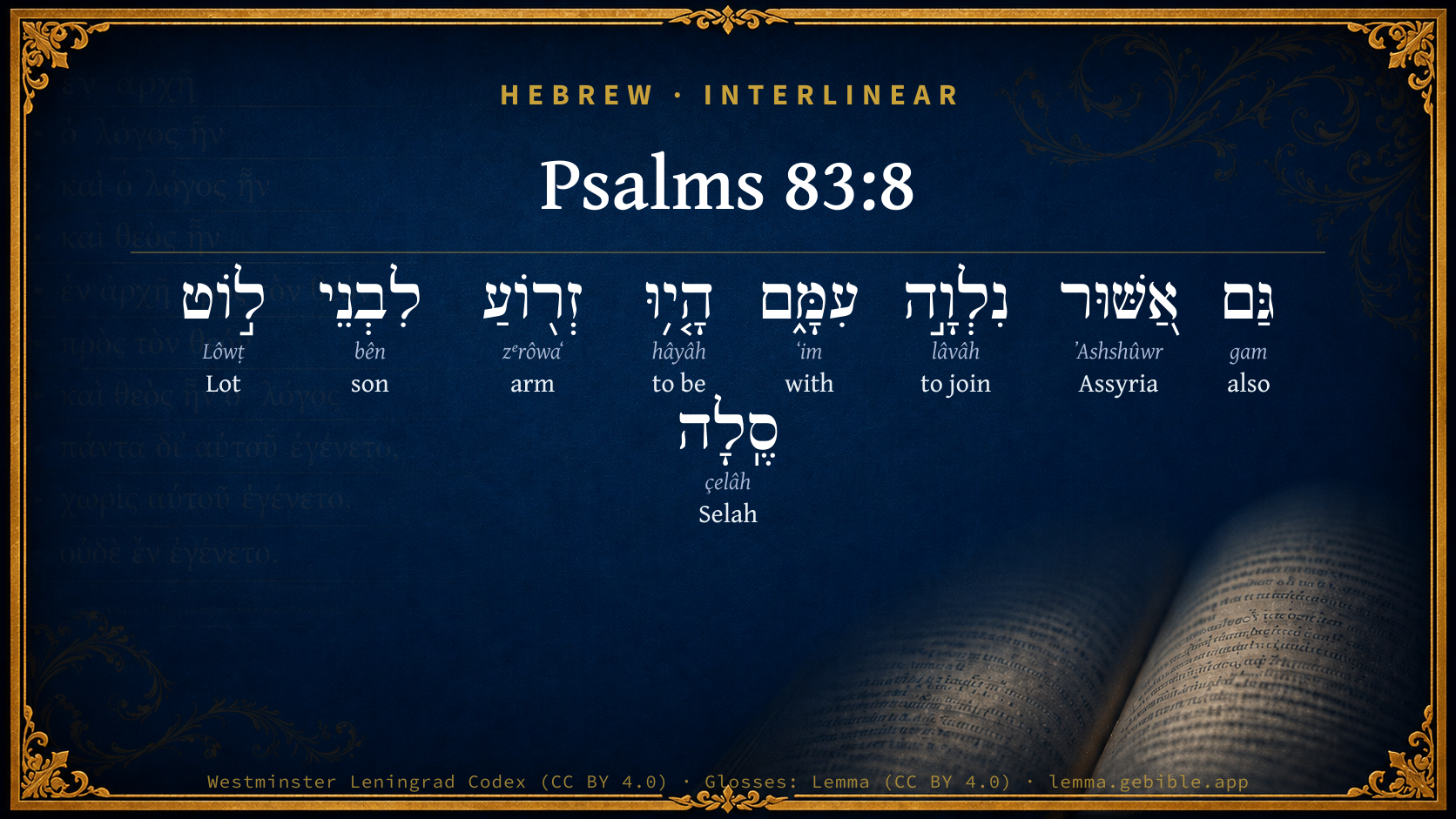
Hebrew (Westminster Leningrad Codex) Psalms 83:8 appears in the Hebrew Old Testament. The text above is from the Westminster Leningrad Codex. Each word links to its Strong’s number, a concise gloss, and parsing drawn from the Open Scriptures Hebrew Bible morphology. Click any word for its full Brown-Driver-Briggs (BDB) entry.
Download image
Cite this verse

Psalms 83:8 (World English Bible). Public Domain. Lemma interlinear Bible study tool, https://lemma.gebible.app/v/psalms/83/8.

Show BibTeX & RIS
BibTeX
RIS
English Translation
Assyria also is joined with them. They have helped the children of Lot. Selah.
World English Bible · Public Domain
Download a study sheet

One document with this verse’s original text, its word-by-word gloss line, the meaning frame, cross-references with their text, attributed commentary, and full source and license credits — printable, and it pastes into notes with its structure intact.

This verse Autodidact and up

Study sheet (.html) Plain text (.txt)

A passage Seminary Student

Up to 50 verses in one chapter. A passage sheet keeps up to 6 commentary sources and 12 cross-references per verse, in the order this page ranks them, and says so on the sheet whenever that leaves anything out. Ask for a single verse and you get the Autodidact verse sheet above.

Everything on this page stays free to read, with no account — the sheet is a download of what is already on screen, not access to it.

Want to remove ads? Support Godless Engineer
Compare translations 3

The same verse in 3 English versions, stacked beneath the original-language interlinear above. Click any original word for its lexicon entry.

Each is an independent rendering of the whole verse — the interlinear is not word-aligned to these translations.

Highlighted words mark where these versions differ — a whole-verse word diff, not a word-by-word alignment.

  • World English Bible Public Domain
    Assyria also is joined with them. They have helped the children of Lot. Selah.
  • King James Version Public Domain
    Assur also is joined with them: they have holpen the children of Lot. Selah.
  • unfoldingWord Literal Text CC BY-SA 4.0
    Also Assyria has joined with them; they an arm to the sons of Lot. Selah

unfoldingWord Literal Text — © unfoldingWord, licensed CC BY-SA 4.0. Word-aligned USFM3 via Door43 (git.door43.org/unfoldingWord/en_ult).

Versions to compare (up to 4)

3 of 4 selected

Show all 18 translations

Every available English version of this verse, each an independent rendering of the whole verse.

  • World English Bible Public Domain
    Assyria also is joined with them. They have helped the children of Lot. Selah.
  • Berean Standard Bible Public Domain
    Even Assyria has joined them, lending strength to the sons of Lot. Selah
  • Majority Standard Bible Public Domain
    Even Assyria has joined them, lending strength to the sons of Lot. Selah
  • King James Version Public Domain
    Assur also is joined with them: they have holpen the children of Lot. Selah.
  • American Standard Version (1901) Public Domain
    Assyria also is joined with them; They have helped the children of Lot. Selah
  • Revised Version (1885) Public Domain
    Assyria also is joined with them; they have holpen the children of Lot. Selah
  • Geneva Bible (1599) Public Domain
    Asshur also is ioyned with them: they haue bene an arme to the children of Lot. Selah.
  • Douay-Rheims (1899) Public Domain
    Gebal, and Ammon and Amalec: the Philistines, with the inhabitants of Tyre.
  • Young's Literal Translation Public Domain
    Asshur also is joined with them, They have been an arm to sons of Lot. Selah.
  • Literal Standard Version CC BY-SA 4.0
    Asshur is also joined with them, || They have been an arm to sons of Lot. Selah.
  • Unlocked Literal Bible CC BY-SA 4.0
    Assyria also is allied with them; they are helping the descendants of Lot. Selah
  • unfoldingWord Literal Text CC BY-SA 4.0
    Also Assyria has joined with them; they an arm to the sons of Lot. Selah
  • Darby Bible Public Domain
    Asshur also is joined with them: they are an arm to the sons of Lot. Selah.
  • World Messianic Bible Public Domain
    Assyria also is joined with them. They have helped the children of Lot. Selah.
  • Webster's Bible Public Domain
    \\83:7\\Gebal, and Ammon, and Amalek; the Philistines with the inhabitants of Tyre;
  • Free Bible Version CC BY-SA 4.0
    Assyria too has joined them, allied with the descendants of Lot. Selah.
  • Bible in Basic English Public Domain
    Assur is joined with them; they have become the support of the children of Lot. (Selah.)
  • JPS Tanakh (1917) Public Domain
    (83-9) Assyria also is joined with them; they have been an arm to the children of Lot. Selah

Literal Standard Version (2020), Covenant Press — licensed CC BY-SA 4.0. Text via the HelloAO Bible API (eBible.org). Unlocked Literal Bible (unfoldingWord) — licensed CC BY-SA 4.0. Text via the HelloAO Bible API (eBible.org). unfoldingWord Literal Text — © unfoldingWord, licensed CC BY-SA 4.0. Word-aligned USFM3 via Door43 (git.door43.org/unfoldingWord/en_ult). Free Bible Version, Dr. Jonathan Gallagher — licensed CC BY-SA 4.0. Text via the HelloAO Bible API (eBible.org).

Word by word

More ways to search: Search by grammar → Find every occurrence → Compare this word →

Practice this passage: Drill this verse → Learn its vocabulary →

About this verse

These counts appear in no published source. They are computed here, from the morphology-tagged text and Lemma’s own curated glosses. What Lemma adds →

9
words
9
distinct lemmas
Wisdom
section

Shared distinctive vocabulary

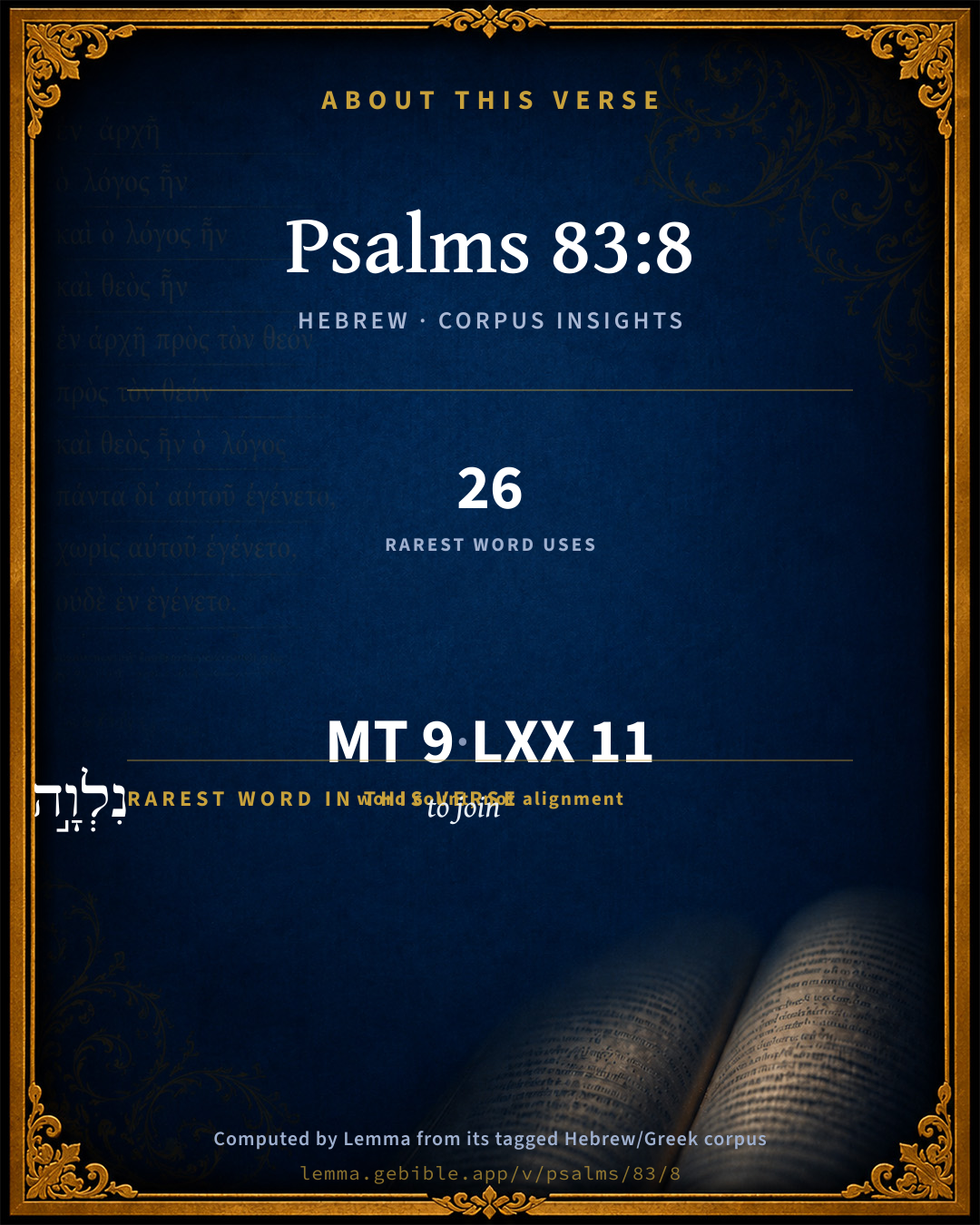
נִלְוָ֣ה to join H3867 occurs in 22 verses of the Hebrew Bible. Also found in:

Grammatical profile

  • 2 verbs
  • 4 nouns
  • 1 preposition
  • 2 particles

Verb forms

  • נִלְוָ֣ה Niphal · Perfect
  • הָ֤י֥וּ Qal · Perfect

Hebrew & Septuagint length

In English translation the verse runs 14 words from the Hebrew and 18 from the Septuagint (LXX English) — closely comparable.

A rough comparison of the two English renderings, which tokenize alike — not a word-level alignment.

Word counts can differ between the Hebrew and the Greek without any difference in meaning — e.g. the Hebrew direct-object marker אֵת has no separate Greek word, and Greek often adds the article ὁ.

In the original languages it is 9 Hebrew tokens and 11 Greek tokens — but the two are counted differently (Hebrew bundles its prefixes and suffixes into one token; the Greek is in lemma form), so that isn’t a like-for-like length.

Cross-references

6

Topical passages linked to Psalms 83:8 in the Treasury of Scripture Knowledge — connected by theme and wording, ordered by reader-vote popularity; previews shown in the World English Bible.

  • Deuteronomy 2:9 Yahweh said to me, Don't bother Moab, neither contend with them in battle; for I will not give you of his land for a possession; because I have given Ar to the children of Lot for a possession.
  • Genesis 10:11 Out of that land he went forth into Assyria, and built Nineveh, Rehoboth Ir, Calah,
  • Genesis 19:37–38 The firstborn bore a son, and named him Moab. The same is the father of the Moabites to this day.
  • Genesis 25:3 Jokshan became the father of Sheba, and Dedan. The sons of Dedan were Asshurim, Letushim, and Leummim.
  • 2 Kings 15:19 There came against the land Pul the king of Assyria; and Menahem gave Pul one thousand talents of silver, that his hand might be with him to confirm the kingdom in his hand.
  • Isaiah 33:2 Yahweh, be gracious to us; we have waited for you: be our arm every morning, our salvation also in the time of trouble.

Cross-references courtesy of OpenBible.info (CC BY 4.0).

Hebrew and Greek witnesses Masoretic Hebrew ↔ Greek Septuagint

The same verse in the two great witnesses to the Old Testament, shown verse-for-verse.

You’re reading Greek Psalm 82 (Hebrew Psalm 83). The Septuagint counts the superscription, so verse numbers can differ from the Hebrew — chapter-level alignment, not verse-by-verse. Numbering follows Rahlfs.

These are two independent witnesses, not word-aligned to each other, and the Septuagint is shown in lemma (dictionary) form.

Hebrew Psalms 83:8 Masoretic · Westminster Leningrad Codex

גַּם אַ֭שּׁוּר נִלְוָ֣ה עִמָּ֑ם הָ֤י֥וּ זְר֖וֹעַ לִבְנֵי ל֣וֹט סֶֽלָה

Assyria also is joined with them. They have helped the children of Lot. Selah.

World English Bible · Public Domain

Greek LXX Greek Psalm 82:8 Septuagint · lemma form

γεβαλ καί αμμων καί αμαληκ καί ἀλλόφυλος μετά ὁ καταοἰκέω τύρος

Yes, Assur too is come with them: they have become a help to the children of Lot. Pause.

LXX2012 (modern English Septuagint) · Public Domain

Hebrew: Westminster Leningrad Codex (CC BY 4.0). Greek: Septuagint (public domain); English from LXX2012 (modern English Septuagint) (Public Domain). How the Septuagint differs from the Hebrew →

Commentary

Notes on Psalms 83:8 from classic Christian and Jewish commentators (each source and its license shown beneath its notes). The classic Christian expositions comment on the surrounding passage and are grouped to its opening verse, so a note may address several verses; the Jewish commentaries on the Tanakh (Rashi and others) are per-verse, so they appear only where the commentator wrote on this verse.

Lemma curates 59 commentaries, every one of them public domain or Creative Commons licensed, each selected and text-cleaned for this edition rather than reprinted as found. About our sources →

Trapp's Complete Commentary

John Trapp

Psa 83:8 Assur also is joined with them: they have holpen the children of Lot. Selah.

Ver. 8. Assur also is joined with them] The Chaldee paraphraseth, Sennacherib, also the king of Asshur, &c. So doth the Turk, with the Church’s enemies; howbeit, Italy is the mark he shooteth at; and the Protestants have the happiness (as also America) to be farther out of his way, and no part of his present aim, for the greatest part of them.

John Trapp, A Commentary or Exposition upon All the Books of the Old and New Testament (1647–1656) — public domain. Text from a community e-Sword module.

J. A. Alexander on Psalms

Joseph Addison Alexander

9. (Psa 83:8). Also Assyria was joined with them. (These) were an arm to the Sons of Lot. Selah. Assyria is put last, as the remotest and least interested in this combination against Judah. It had evidently not yet supplanted Babylonia as the dominant power of Western Asia. The last clause refers, not merely to Assyria, as the plural verb shews, but to all the confederates except the Sons of Lot, i.e. Moab and Ammon (Gen 19:37-38), who are here referred to, as the authors and conductors of the expedition.

Joseph Addison Alexander, The Psalms Translated and Explained (1850) — public domain. Text from a community e-Sword module.

Tyndale Open Study Notes

Tyndale Open Resources

83:8 Assyria was northeast of Israel and north of the Persian Gulf. • The descendants of Lot were the Moabites and the Ammonites (83:6-7).

Tyndale Open Study Notes — © Tyndale Open Resources, licensed CC BY-SA 4.0. Text via the HelloAO Bible API.

Geneva Bible (1599)

Geneva Bible translators

The wickedness of the Ammonites and Moabites is described in that they provoked these other nations to fight against the Israelites their brethren.

Geneva Bible (1599) marginal notes — public domain. Text via Bolls.life.

Adam Clarke's Commentary

Verse 8. Assur also is joined] The Ammonites might have got those auxiliaries from beyond the Euphrates, against Jehosphaphat, as formerly they were brought against David. See 2Sa 10:16.

They have holpen the children of Lot.] The Ammonites, who appear to have been the chief instigators in this war.

Adam Clarke's Commentary on the Bible (1810–1826) — public domain. Text from a community e-Sword/MySword module.

Ellicott's Commentary for English Readers

(8) Assur.—For the more usual Ashur, Assyria. Some, however, think the Syria is here intended, that name being, in the view of the Greek writers, a corruption of Assyria. (“The Greeks call them Syrians, but the Barbarians Assyrians.”—Herod, vii., 63.) And even if etymologically incorrect, the error of the Greeks may have been consciously or unconsciously shared by the Jews, and the kingdom of the Seleucidæ be honoured by the name of the grander and more ancient power.

They have holpen.—See margin. And for the importance of the form of the statement see Introduction.

Children of Lot.—Ammon and Moab, who thus appear as the leaders of the confederacy.

A Bible Commentary for English Readers, edited by Charles John Ellicott (1878–1897) — public domain. Text from a community e-Sword module.

The Cambridge Bible for Schools and Colleges

gen. ed. J. J. S. Perowne

8. Assur] Assyria. The mention of Assyria as an auxiliary of Moab and Ammon seems to imply that it was not yet a leading power, which would fall in with an early date for the Psalm. Assyria is not known to have come in contact with Israel until the reign of Jehu, who paid tribute to Shalmaneser II in b.c. 842. Still in the time of Jehoshaphat the Assyrians appear to have made conquests in Phoenicia and Syria, and the Ammonites might have procured help from them as they did from Syria at an earlier date (2Sa_10:6).

If the Psalm belongs to the Persian or Maccabaean age, Assyria must stand for Persia or Syria. Theodoret suggests that the Samaritans, as Assyrian colonists, are meant. Lagarde, followed by Cheyne, cuts the knot by reading Geshur for Asshur (see 2Sa_3:3); but this petty Syrian kingdom would hardly be mentioned as an important ally.

they have holpen] Lit. they have been an arm, i.e. a help. Cp. Isa_33:2.

the children of Lot] The Moabites and Ammonites, who seem to be singled out as the leaders of the confederacy. Cp. 2Ch_20:1. The phrase occurs in Deu_2:9; Deu_2:19, the only other passages in O.T. outside of Genesis where Lot is mentioned. It points to the unbrotherly character of the hostility of these nations by recalling their common descent.

The Cambridge Bible for Schools and Colleges (gen. ed. J. J. S. Perowne; Cambridge University Press, 1878–1918) — public domain. Text from a community e-Sword module.

John Gill's Exposition

Assur also is joined with them,.... Before mentioned, or Assyria, though at so great a distance from Israel, and unprovoked by them: according to R. Joseph Kimchi, the sense is, that the Assyrians joined them, continuing in their wickedness, though their army had been destroyed by an angel in Hezekiah's time, of which they were unmindful; but this, as his son observes, makes this confederacy and war to be after the times of Hezekiah; whereas it was long before it: the Targum is,

"Sennacherib, king of Syria, is joined with them;''

and so some refer this to his invasion of Judea, and besieging Jerusalem, with an army consisting of many nations, in Hezekiah's time; but he was the principal there, and not an auxiliary, as here:

they have holpen the children of Lot; or were "an arm" (h) unto them, assisted and strengthened them: these were the Moabites and Ammonites, who were the principals in the war, and the rest auxiliaries, as it appears they were in the times of Jehoshaphat, Ch2 20:1, here were ten different nations, which joined in confederacy against the people of Israel; to which answer the ten horns of the beast, or ten antichristian kings, who agreed to give their kingdom to the beast, and to make war with the Lamb and his followers, Rev 17:12, and it may be observed, that these were on all sides of the land of Israel; the Edomites, Ishmaelites, and Amalekites, were on the south; the Moabites, Ammonites, and Hagarenes, were on the east; the Assyrians on the north; and the Philistines, Gebalites, and Tyrians, on the west: so that Israel was surrounded on all sides with enemies, as the Lord's people are troubled on every side, Co2 4:8, and so the Gog and Magog army, of which some understand this, will encompass the camp of the saints about, and the beloved city, Rev 20:9.

Selah. See Gill on Psa 3:2.

(h) "fuerunt brachium", Pagniuus, Montanus; "sunt brachium", Junius & Tremellius, Piscator, &c.

John Gill's Exposition of the Whole Bible (1746–1763) — public domain (CC PDM 1.0). Text via the HelloAO Bible API.

Albert Barnes' Notes on the Bible

Assur also is joined with them - Assyria. Assyria was on the northeast of Palestine. The conspirators had secured, it seems, the aid of this powerful kingdom, and they felt confident of success.

They have holpen the children of Lot - The sons, or the descendants of Lot. The margin is, as the Hebrew, “been an arm to.” That is, they were an aid, or help; in other words, the sons of Lot were permitted, as it were, to make use of the arm of these powerful nations in accomplishing their purposes. The sons of Lot were Moab and Ammon, the ancestors of the Moabites and the Ammonites, Gen 19:37-38. It would appear from this, that the purpose of destroying the Hebrew people had been originated by the Moabites and Ammonites, and that they had called in the aid of the surrounding nations to enable them to carry out their plan. The enumeration of those who had joined in the alliance shows that all the nations adjacent to Palestine, on every side, had entered into the agreement, so that the land was completely encompassed, or hemmed in, by enemies. In these circumstances, the conspirators felt secure; in these circumstances, the Hebrew people had no resource but to call upon God. Thus it often occurs that the people of God are so surrounded by enemies, or are so hemmed in by troubles and trials, that they have no other resource than this: they are shut up to the necessity of prayer. Often God so orders, or permits things to occur, as to cut off his people from every other dependence, and to make them feel that there is no help for them but in Him.

Albert Barnes' Notes on the Bible (1834–1885) — public domain. Text from a community e-Sword/MySword module.

Matthew Poole's English Annotations

Is joined with them in their counsels, and possibly with some of their forces, though not so openly and powerfully as afterwards.

The children of Lot; Moab and Ammon, who were the principal parties in that war, 2Ch 20, called here the children of Lot, to intimate their horrible degeneration from their pious progenitors.

Matthew Poole's English Annotations on the Holy Bible (1683–1685) — public domain. Text from a community e-Sword/MySword module.

The Treasury of David

Charles H. Spurgeon

Ver. 8. Assur is also joined with them. It was then a rising power, anxious for growth, and it thus early distinguished itself for evil. What a motley group they were; a league against Israel is always attractive, and gathers whole nations within its bonds. Herod and Pilate are friends, if Jesus is to be crucified. Romanism and Ritualism make common cause against the gospel.

They have holpen the children of Lot. All these have come to the aid of Moab and Ammon, which two nations were among the fiercest in the conspiracy. There were ten to one against Israel, and yet she overcame all her enemies. Her name is not blotted out; but many, nay, most of her adversaries are now a name only, their power and their excellence are alike gone.

Selah. There was good reason for a pause when the nation was in such jeopardy: and yet it needs faith to make a pause, for unbelief is always in a hurry.

Ver. 8. Assur also, etc. This determines the date of this Psalm to the latter times of the Jewish kingdom; for the other nations here mentioned had molested them before, but the Assyrians not till towards the end. William Wall, 1645 or 1646-1727-8.

None.

Psalms 83:9*

Charles H. Spurgeon's The Treasury of David (1869–1885) — public domain. Psalms only. Text from a community e-Sword/MySword module.

Whedon's Commentary on the Bible

Daniel D. Whedon

8. Assur—Assyria. The Assyrians might have sent troops, or only encouraged the enterprise by approbation, or promise of ultimate interference if needed.

Children of Lot—That is, Moab and Ammon, (Gen_19:30-38,) a clear proof that they were the instigators and chief actors in this stupendous tragedy. Moab had special cause for exterminating, or at least breaking, the power of the Hebrews, having recently thrown off the yoke of Israel, (2Ki_3:5,) with whom she now stood committed to a desperate war. 2Ki_3:5. Mesha, the brave and ambitious king of Moab, anticipated this, and had the address to raise the confederacy, and undoubtedly was the leading spirit of the expedition. It is wonderful that the inscription of the celebrated “Moabite stone,” discovered by Mr. Klein, missionary at Jerusalem, in 1868, near Deban, (Dibon,) in the Belkan district, (the northern part of ancient Moab,) was written in the name and by the dictation of this same Mesha, king of Moab, and fully states the oppression of Moab by “Omri, king of Israel, and his son,” (Ahab,) the hatred of Moab toward Israel, predatory wars on the Israelitish territory for the recovery of cities well known in the Bible, and, with many other things, clearly states a battle for the recovery of Horonaim, a city on the southern frontier, which, about a year after the date of this psalm was taken, with other cities, by Jehoram and Jehoshaphat. See Psa_83:4, and 2 Kings 3

Daniel D. Whedon (gen. ed.), Commentary on the Old and New Testaments (1874–1909) — public domain. Text from a community e-Sword module.

The Pulpit Commentary

Assur also is joined with them. This is the climax. Assyria the great empire the most important of all the kingdoms of the earth has joined the petty nations upon Israel"s border, and holds a place in the great confederacy. From the historical books it would appear that this occurred but once, viz. in David"s great war with the Ammonites and their allies (see the Introduction). They have holpen the children of Lot; i.e. the Moabites and Ammonites. (comp. Gen_19:37, 38 Deu_2:9, Deu_2:19) Moab and Ammon would seem to have been the principal powers engaged in the confederacy. The others were their helpers.

Vers. 8-11. Prayer based on experience and on history.

"Do unto them as unto the Midianites." Prayers which apparently express a desire for revenge are often misunderstood. Deliverance from national enemies of necessity involves the discomfiture and destruction of those enemies; and therefore a poet may ask for that discomfiture, not because he is thinking of the harm done to the enemy, but because he wants a figurative way of asking for the deliverance and safety of his people. Revengeful utterances are often no more than poetical forms, which are quite misused when unduly pressed. And again, when we recall historical events, we are free from revengeful feeling, though the calamities of beaten foes may be specially prominent in oar review. The prayer of the psalmist here is for a gracious Divine deliverance from these confederated foes that threaten Israel. He fortifies his prayer with persuasions drawn from the remembrance of God"s previous deliverances, and he magnifies his confidence in God"s ability to help now, by thinking how overwhelming was the destruction of God"s enemies on other occasions. Compare our anxiety to know how many were slain on the field of battle. The two victories specially recalled are those of Deborah and Barak over the host of Sisera, and of Gideon over the mingled hosts of Midianites. The subject suggested is the use we may make of Scripture knowledge; of the experiences of Christ"s Church; and of ourselves and our own lives. We stand in the very midst of Divine dealings, Divine interventions, Divine deliverances. They have been abundant in the past, and they have meant the effective mastery of all kinds of foes.

I WE MAY LEARN THAT NO STRANGE CIRCUMSTANCES SURROUND US. God"s people have, over and over again, been in precisely such conditions as we are in now. Our trouble is no surprise to our God.

II WE MAY FREELY CRY FOR DIVINE HELP, AS THOSE HAVE DONE WHO HAVE GONE BEFORE US. They cried; they were encouraged to cry. No limit was ever put on the praying of earnest souls.

III WE MAY USE THE EXPERIENCE OF OTHERS AS THE PLEA IN OUR PRAYERS. We can always say, "Thou hast helped;" and so we can make a personal plea, and say, "O Lord, the Helper, help me!" Constantly, in Bible prayers, what God has been to his people, and what he has done for them, is brought to his mind.

IV WE MAY HAVE THE FULLEST CONFIDENCE THAT WHAT GOD HAS BEEN HE STILL WILL BE. Resister of the wicked. Overwhelmer of the proud. Defender of his people. Deliverer of the imperilled saints. R.T.

The Pulpit Commentary (1880–1919), ed. H.D.M. Spence-Jones & Joseph S. Exell — public domain. Text from a community e-Sword module.

John Wesley's Explanatory Notes

Of Lot - Moab and Ammon.

John Wesley, Explanatory Notes Upon the Whole Bible (1754–1765) — public domain. Text via the GEBible commentary corpus.

unfoldingWord translationNotes

Door43 World Missions Community

Assyria

This represents the people of Assyria. AT: "the people of Assyria" (See: Metonymy)

the descendants of Lot

This refers to the people of the nations of Moab and Ammon. You can make clear the understood information. (See: Assumed Knowledge and Implicit Information)

Selah

This may be a musical term that tells people how to sing or play their instruments here. Some translations write the Hebrew word, and some translations do not include it. See how you translated this in Psalms 3:2. (See: Copy or Borrow Words)

translationWords

Assyria

descend

Lot

selah

unfoldingWord translationNotes — © Distant Shores Media and the Door43 World Missions Community, licensed CC BY-SA 4.0. Source: git.door43.org/Door43/en_tn.

Lesson kit

Teaching starters — assembled from the data on this page, not authored interpretation. Every prompt links to the verse data it draws on. Edit before teaching.

Psalms, in the Wisdom, opens this verse with 9 words (9 distinct Hebrew lemmas). Its most distinctive word is lâvâh (“to join”). A historical commentator’s framing appears above. Read the whole chapter for the surrounding context.

Discussion questions

  1. The word lâvâh carries the sense “to join.” How does it shape the verse?
  2. How does Genesis 29:34, which shares the word «to join», read alongside this verse?
  3. These translations render this verse differently. What is at stake in choosing one wording over another?
  4. «נִלְוָ֣ה» is a Niphal Perfect verb. How does that grammatical form shape the action described?
  5. Compare how Trapp's Complete Commentary and J. A. Alexander on Psalms read this verse. Where do they agree or differ?

Things to notice

Reading settings

Reading text

Shown beneath each verse's original-language words.

Old Testament
Old Testament edition

Read the OT as the Masoretic Hebrew (MT) or the Greek Septuagint (LXX).

English shown for the Greek Septuagint (in the Hebrew ↔ Greek comparison).

Comparing translations? Open the Compare panel on any verse page to stack up to four side by side.