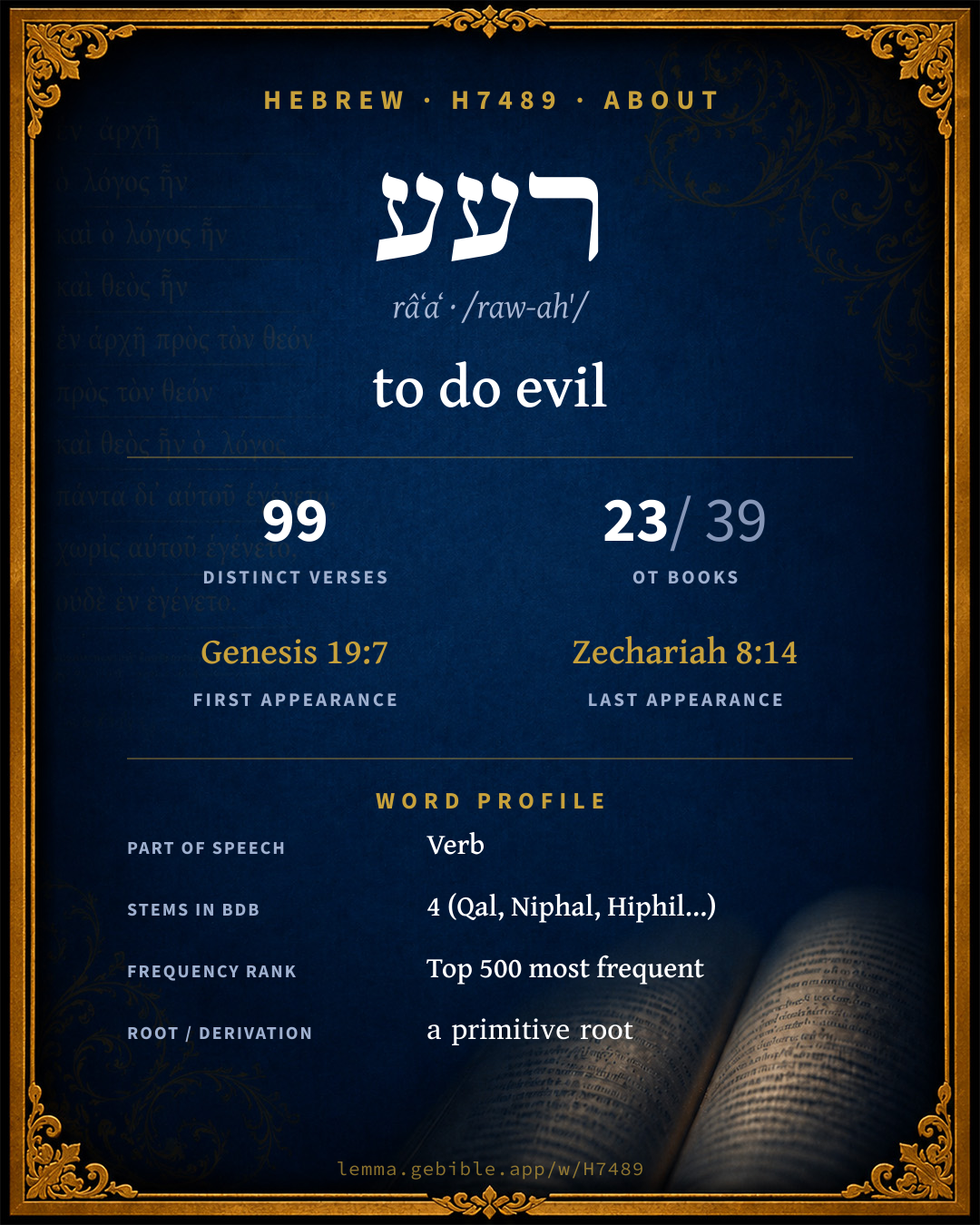
רָעַע
to do evil
‘to do evil’ is one of 2 main senses fuller range ↓
Full lexicon entry — Brown-Driver-Briggs (BDB)
From Brown-Driver-Briggs (BDB)
Where this word appears
See every Hiphil verb in the Hebrew Bible →
Grammar key — what these labels mean
Part of speech
- Verb
- An action or state-of-being word.
- Adjective
- A word that describes or qualifies a noun.
Stem
- Hiphil
- The causative active stem (“he caused / brought about”). Here: ‘do an injury’
- Qal
- The basic, simple active stem — the plain form of the verb (“he wrote”). Here: ‘be displeasing’
- Niphal
- Usually the simple passive or reflexive of the Qal (“he was written”). Here: ‘suffer hurt’
- Hithpolel
- The reflexive counterpart of the Polel.
Form
- Participle Active
- A verbal adjective expressing ongoing or characteristic action (“writing / one who writes”).
- Sequential Imperfect
- An imperfect with prefixed waw — the standard past-narrative form (waw-consecutive imperfect).
- Infinitive Construct
- A bound verbal noun, frequently with prepositions (“to write / in writing”).
- Imperfect
- An incomplete, ongoing, or future action (“he will / would write”).
- Perfect
- A completed action or state — Hebrew marks aspect (completeness) more than strict tense (“he wrote”).
- Jussive
- A third- or second-person volitional form expressing wish or command (“let him write”).
- Sequential Perfect
- A perfect with prefixed waw continuing a preceding imperfect or command (waw-consecutive perfect).
- Infinitive Absolute
- An unbound verbal noun, often intensifying or standing in for a finite verb.
- Imperative
- A direct command (“write!”).
State
- Absolute
- The independent form of a noun, not bound to a following word.
Person
- 3rd Person
- The one spoken about (“he / she / it / they”).
- 2nd Person
- The one addressed (“you”).
- 1st Person
- The speaker (“I / we”).
Gender
- Masculine
- Grammatically masculine.
- Common
- Either gender — not distinguished for this form.
- Feminine
- Grammatically feminine.
Number
- Plural
- More than one (in Hebrew, generally three or more).
- Singular
- One.
1 verse where H7489 appears in the Qal stem in the Book of Numbers. Filtered view — show all forms. Click any verse to open its interlinear word-by-word view. Verse text shown in the World English Bible for context — . Each verse’s Hebrew form is shown with its reference; the English is not keyword-highlighted, since the data carries no word-level English alignment. Use “Compare translations” on any verse to read it across multiple English versions. This concordance covers the Hebrew Bible; Septuagint (Greek Old Testament) occurrences are not indexed here.
Numbers
About this entry
At a glance — auto-summarized from this page’s data, not written by a person. Every figure links to its source below. This summary describes the numbers; it doesn’t interpret them.
רעע (râʻaʻ) is a Hebrew verb most often rendered “to do evil.” The King James Version usually renders it “do evil,” while modern versions prefer “wicked” (Berean Standard Bible) — see the renderings breakdown. With 99 verses in 23 books, it is a moderately common word in the Hebrew Bible. Debuting at Genesis 19:7, it then recurs through the corpus. Read the stem: it spans 4 stems, including Qal and Niphal. For the data behind this summary, explore the sense tree and the renderings breakdown below.
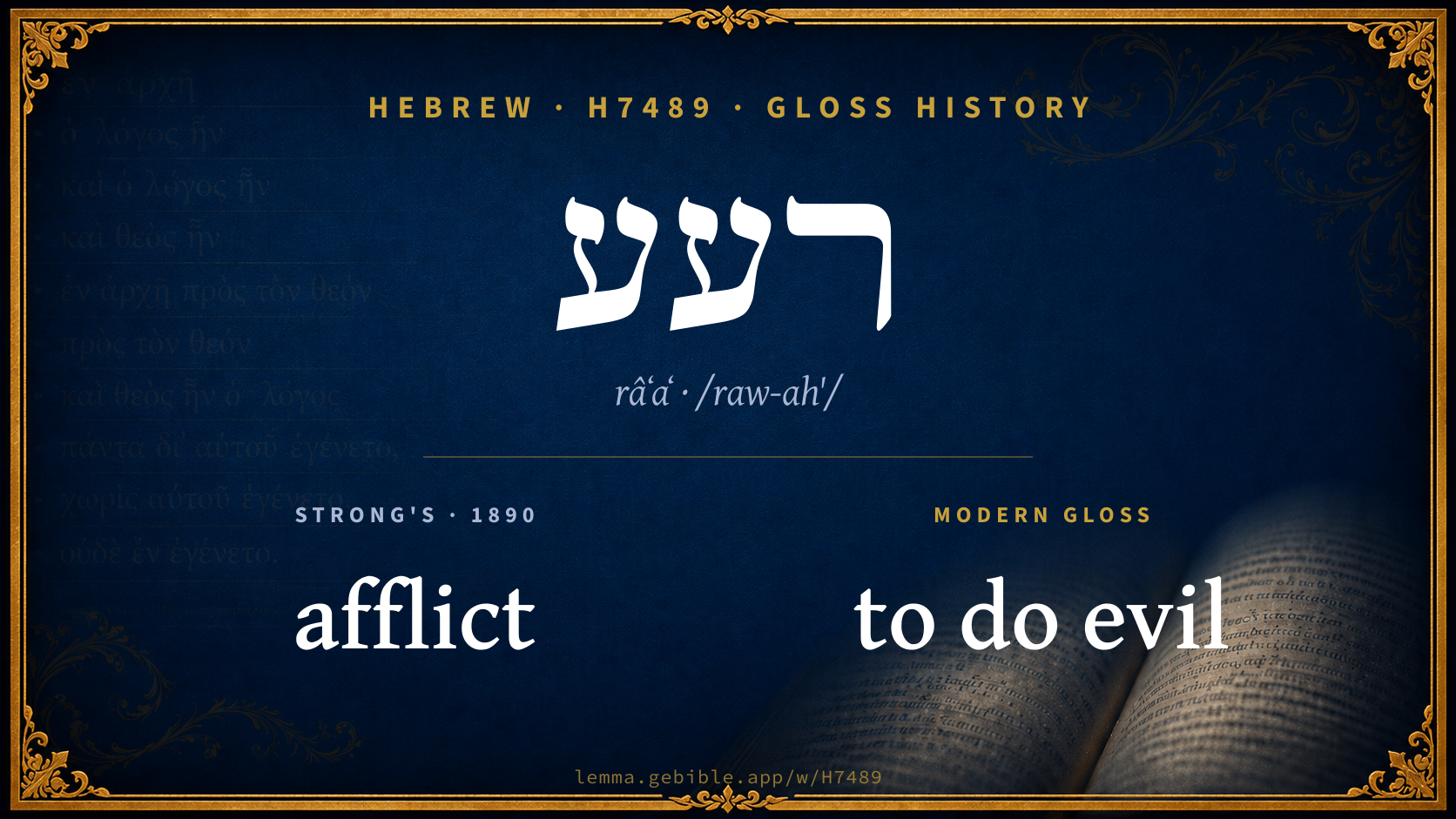
Gloss history
Strong's 1890 vs modern scholarship
About this word
Strong's H7489 catalogs a Hebrew word from the Hebrew Old Testament.
These counts are not copied from any lexicon or concordance. They are computed here, from the morphology-tagged Hebrew Old Testament. What Lemma adds →
- 99
- distinct verses
- The word appears in 99 distinct verses.
- 23 / 39
- OT books
- The word appears in 23 of 39 Old Testament books.
- #418
- by frequency
- Top 500 most frequent Hebrew words (rank 418 of 8,640 Hebrew words by occurrence).
View all 99 occurrences in the concordance →
By section of the Old Testament
By traditional corpus
Conventional, traditional groupings — biblical authorship is debated, so this is a traditional corpus grouping, not an authorship claim. Each share is this word’s portion of its verses in that division of the Hebrew canon. Each figure is a share of the word’s 99 distinct verses.
- Prophets (Nevi'im) 44 verses · 44%
- Writings (Ketuvim) 33 verses · 33%
- Torah (Pentateuch) 22 verses · 22%
How translations render this word
Counts come from each version’s own published word-to-Strong’s tagging or interlinear alignment — an approximate guide to how each version renders this word, not a word-level alignment the data otherwise carries. Because each total is that version’s own tagged count, the per-version totals vary from one another and need not match the appearance or distinct-verse counts above. These counts may also differ from a printed concordance because Lemma counts each distinctly tagged rendering and does not collapse phrase taggings into a single head-word total. This is a fixed set of word-tagged versions (KJV, ASV, BSB, ULT) and does not change with the reading translation you choose elsewhere. Each version’s license is shown beside its name below (and on Sources).
BDB lists this Strong’s number as 4 distinct words (homographs). Each count above pools all of them and is not split by sense — see the Senses section below. A low-frequency rendering may belong to a different one of those words, not the primary meaning.
- King James Version†: Do evil 6×, Evildoers 6×, Wicked 3×
- American Standard Version†: Evil-doers 8×, Do evil 6×, Do my prophets no harm 2×
- Berean Standard Bible†: Wicked 7×, Evildoers 6×, Harm 6×
- unfoldingWord Literal Text†: Evildoers 10×, And 8×, Do evil 7×
King James Version Public Domain
Renders H7489 across 83† tagged occurrences — most commonly:
Plus 60 renderings that appear only once — usually multi-word phrases or single function words the recovered tagging swept in, not distinct renderings.
American Standard Version Public Domain
Renders H7489 across 82† tagged occurrences — most commonly:
Plus 52 renderings that appear only once — usually multi-word phrases or single function words the recovered tagging swept in, not distinct renderings.
Berean Standard Bible Public Domain
Renders H7489 across 97† tagged occurrences — most commonly:
Plus 62 renderings that appear only once — usually multi-word phrases or single function words the recovered tagging swept in, not distinct renderings. Not rendered by a distinct English word in 5 further occurrences.
unfoldingWord Literal Text CC BY-SA 4.0
Renders H7489 across 130† tagged occurrences — most commonly:
Plus other, less common renderings. Plus 68 renderings that appear only once — usually multi-word phrases or single function words the recovered tagging swept in, not distinct renderings.
13 senses and sub-senses in the full BDB
Hebrew verbs can shift meaning by stem (binyan): Qal is the basic action, Niphal is often passive or reflexive, Piel often intensifies or makes it factitive, and Hiphil is typically causative. The senses below are grouped under the stem BDB assigns to each. This entry also uses one or more reduplicated stems (the Pōlēl/Pilpēl type), which for hollow or geminate roots behave much like Piel — often intensive or iterative.
What do BDB’s symbols mean?
BDB uses these scholarly abbreviations:
| Symbol | Meaning |
|---|---|
| 𝔊 | the Septuagint (the ancient Greek translation, LXX) |
| 𝔙 | the Vulgate (the Latin translation) |
| 𝔖 | the Syriac version (the Peshitta) |
| 𝔗 | the Targum (the Aramaic translation) |
| ψ | the Psalms |
| √ | root (the underlying root or stem) |
| ‖ | parallel passage (a synonymous or contrasted parallel) |
| † | the dagger: every passage where the word occurs is cited |
The 13 senses and sub-senses the full Brown-Driver-Briggs lexicon distinguishes for this word, in lexicon order (not ranked by frequency), with BDB’s own verbatim wording and sub-sense lettering. Shown in Hebrew script with BDB’s own scholarly abbreviations. The condensed entry is in the Lexicon Entry tab. See also the Forms in the corpus table below.
רעע I friend, companion (strange formation
רעע II denom. be evil, bad
Qal
- Pf. 3 ms. רַע Nu 22:34 + 3 times, רָ֑ע 11:10; 3 fs. רָעָה Dt 15:9 (Ex 21:8 v. i. רַע); Impf. 3 ms. יֵרַע (Ges§ 67 p) Gn 21:12 +; 3 fs. תֵּרַע Dt 28:54, 56; 3 mpl. יֵרְעוּ Ne 2:3;— e.g. Numbers 22:34
- 1. be displeasing: רַע בְּעֵינֵי Nu 11:10; 22:34 (J), Jos 24:15 (E), Je 40:4; Pr 24:18 (c. וְ consec.) impf. יֵרַע בְּעֵינֵי Gn 21:11, 12 (E), 48:17 (J), 1 S 8:6; 18:8; 2 S 11:25; later, וַיֵּרַע אֶל Jon 4:1 or וירע לְ Ne 2:10 (intensified by רָעָה גְדוֹלָה), וַיֵּרַע לִי מְאֹד 13:8. e.g. Numbers 11:10
- 2. be sad: ירע לבב Dt 15:10; 1 S 1:8; יֵֽרְעוּ פָנַי Ne 2:3. e.g. Deuteronomy 15:10
- 3. be injurious, evil: וַיֵּרַע לְ ψ 106:32 it went ill with Moses, pers. subj. 2 S 20:6; רַעָה עַיִן be grudging, c. ב pers., Dt 15:9; 28:54, 56. e.g. Psalms 106:32
- 4. be evil, wicked, ethically: וַיֵּרַע בְּעֵינֵי י׳ Gn 38:10 (J); 2 S 11:27; Is 59:15; בְּעֵינֵי אֱלֹהִים 1 Ch 21:7. e.g. Genesis 38:10
Niphal
- suffer hurt: Impf. 3 ms. יֵרוֹעַ (רַע) Pr 11:15; 13:20. e.g. Proverbs 11:15
Hiphil
- 70 Pf. 3 ms. הֵרַע Ex 5:23 +; 2 ms. הֲרֵעוֹתָ 1 K 17:20, etc.; Impf. 3 ms. יָרֵעַ Zp 1:12, וַיָּ֫רַע 1 K 16:25; 2 ms. תָּרַע ψ 44:3 +, etc. inf. abs. הָרֵעַ 1 S 12:25 1 Ch 21:17; cstr.הָרַע Gn 31:7 + 8 times, הָרֵ֑עַ Is 1:16 + 4 times; Pt. מֵרַע Is 9:16; Pr 17:4; pl. מְרֵעִים Is 1:4 +;— e.g. Exodus 5:23
- 1. do an injury, hurt: abs. Gn 44:5 (J), Is 11:9 = 65:25; Je 31:28; Pr 4:16; 24:8; opp. היטיב Is 41:23; Je 10:5; Zp 1:12 (all in prov. phr. = do anything at all, cf. רָע 2); הרע ל Gn 19:9; 43:6; Ex 5:22, 23; Nu 11:11 (J) 20:15; Jos 24:20 (E) + 5 times; c. acc. pers. Nu 16:15 (J) + 4 times; c. בְּ, 1 Ch 16:22 = ψ 105:15 (c. ל), Je 25:29 ψ 74:3; c. עִמָּדִי Gn 31:7 (E); c. על 1 K 17:20; c. ל + inf. Je 16:12; swear לְהָרַע, = to one’s hurt, ψ 15:4; Lv 5:4 (P); Pt. = subst. לְבָבָם לְמֵרָע Dn 11:27 (shall be) for mischief. e.g. Genesis 44:5
- 2. do evil, wickedly: abs. Gn 19:7 (J) 1 S 12:25(×2) + 6 times; opp. היטיב Je 4:22; 13:23; c. מִן comp., 1 K 14:9; 16:25; 2 K 21:11; Je 7:26; 16:12; c. acc. הֵרֵעוּ מַעַלְלֵיהֶם Mi 3:4, cf. 1 S 25:3; Pt. מֵרַע evil doer, Is 9:16; Pr 17:4; pl. Je 20:13; 23:14 ψ 27:2 + 7 times; זֶרַע מ׳ Is 1:4; 14:20; בית מ׳ 31:2; עֲדַת מ׳ ψ 22:17; קְהַל מ׳ 26:5; סוֹד מ׳ 64:3. e.g. Genesis 19:7
רעע III break (Aramaic loan-word = Heb. רָצַץ q.v.)
Qal
- Pf. 3 pl. רָעוּ Je 11:16; Impf. 3 ms. יָרֹעַ Je 15:12; Jb 34:24, 2 ms. sf. תְּרֹעֵם ψ 2:9 (but v. infr.); inf. abs. רֹ֫עָה Is 24:19 (del. ה as dittogr. and read רֹעַ, v. Hithpōʿ.); Pt. f. רֹעָה (? for רֹעֲעָה) Pr 25:19:— e.g. Jeremiah 11:16
- 1. trans. הֲיָרֹעַ כַּרְזֶל בַּרְזֶל וגו׳ Je 15:12 can one break iron, iron out of the north? cf. יָרֹעַ כַּבִּירִים Jb 34:24; תְּרֹעֵם בְּשֵׁבֶט בַּרְזֶל ψ 2:9 (but read תִּרְעֵם, v. I. רעה, 𝔊 𝔖 𝔙 Hup-Now al.). e.g. Jeremiah 15:12
- 2. intrans. break = be broken, of branches Je 11:16 (in fig.; Gf Or al.; > Hi Gie are in a sad state, √ I. רעע); שֵׁן רֹעָה Pr 25:19 a broken tooth (ר׳ = רֹעֲעָה?; Frankenb Niph. Pt. נְרָעָה, cf. Toy, but Niph. not elsewhere; Vrss רָעָה bad).—רֹ֫עוּ Is 8:9 read דְּעוּ (𝔊 Lo Che al., ‖ הַאֲזִינוּ). e.g. Jeremiah 11:16
Hithpōʿ
- Pf. 3 fs. + Qal inf. abs. (v. supr.) רֹעַ הִתְרֹעֲעָה הָארץ Is 24:19 the earth is broken asunder (‖ פּוֹר הִתְפּוֹרְרָה, מוֹט הִתְמוֹטְטָה); also inf. cstr. לְהִתְרוֹעֵעַ Pr 18:24 will be broken in pieces (Ges§ 114 i), ruined, De al., but לְהִתְרָעוֹת Vrss Toy al., v. II. רעה Hithp. (see, however, DrExpos. Times xi (1899–1900), 230 f.). e.g. Isaiah 24:19
Senses from the full Brown-Driver-Briggs lexicon (Brown, Driver, Briggs; Oxford 1906 — public domain), digitized via Sefaria, supplemented by the OpenScriptures HebrewLexicon (CC BY 4.0). Full attribution on Sources.
Word origin
II. n.m. friend, companion (strange formation; orig. dub.; Wetzst Syriac Dreschtafel, ZEthnol. 1873, 289 cp. مرياع miryâʿ, name of bell-wether among Syriac nomads (proposes [inseparable] companion), and der. from ריע, proposes closely joined; cf. Gerber 97, 162);—sf. מֵרֵעֵ֫הוּ Gn 26:26 +, מְרֵעֵ֫הוּ Pr 19:7, מֵרֵעֶ֑ךָ Ju 15:2; pl. מֵרֵעִים 14:11;—companion, confidential friend, Gn 26:26 (J; cf. רֵעֶה); of bridegroom’s escort Ju 14:11; ‘bestman’ (GFM) v 20; 15:2, 6; more gen. friends (‖ אחים) 2 S 3:8 Pr 19:7; 12:26 is dub., Död Hi De al. מִרְעֵהוּ; Toy conj. poss. מֵרָעָה (יָסֻר), v. further תור.
I. vb. denom. be evil, bad;—
II. vb. break (Aramaic loan-word = Heb. רָצַץ q.v.);—
— Brown-Driver-Briggs (Oxford 1906, public domain), digitized via Sefaria, supplemented by the OpenScriptures HebrewLexicon (CC BY 4.0). See Sources.
Origin: a primitive root
Jastrow Dictionary
A second Hebrew/Aramaic lexicon for comparison, covering Aramaic and post-biblical (Talmudic, Targumic, Midrashic) usage that the biblical-Hebrew BDB does not. Matched by lemma rather than by Strong’s number, so a lemma may carry more than one Jastrow headword (shown separately below), and the entries cover usage well beyond the Bible.
רָעַע
- (b. h.) [to bring in close contact, v. רֵיעַ,]
- 1. to strike against, shatter, impair. —Part. pass. רָעוּעַ; f. רְעוּעָה; pl. רְעוּעִים, רְעוּעִין; רְעוּעוֹת impaired, defective; in a ruinous state, threatening, opp. בריא sound. Kidd. 39ᵇ סולם ר׳ a broken ladder. Kel. III, 5 הר׳ a cracked vessel. Taan. 20ᵇ מפולת שאמרו בריאות ולא ר׳ the falling of houses which they mention (ib. III, 4) means the falling of sound buildings, but not of such as were out of repair; a. fr.
- 2. (neut. verb) רַע, imperf. יֵרַע to be injurious, evil; רע ל־ to grieve, displease. B. Mets. 84ᵇ בני אל ירע לך my son, let it not grieve thee; a. e.
- to shatter, break.—Part. pass. מְרוֹעָע; f. מְרוֹעַעַת; pl. מְרוֹעָעִים, מְרוֹעָעִין; מְרוֹעָעוֹת. Koh. R. to III, 2 השרוי בבית המר׳ he who dwells in a threatening house; Y. Sabb. II, 5ᵇ top מְרוֹעֲרַע (fr. רִעְרֵעַ). Gen. R. s. 32 קנקנים מר׳, v. קַנְקָן I. Y. Taan. III, 66ᵈ top מְרוֹעֲרָעִים threatening buildings; a. fr.
- , Hithpol. הִתְרוֹעֵעַ, Nithpol. נִתְרוֹעֵעַ to be shaken, cracked, become defective. Men. 53ᵇ (ref. to Jer. XI, 16) מקול מיליהן … נִיתְרָעֲעוּ דליותיהן וכ׳ from the sound of the words of the spies were the branches (young men) of Israel broken; Yalk. Jer. 289 נרתעו (read: נִתְרָעוּ). Sot. 48ᵃ (play on ערה, Zeph. II, 14) אפי׳ בית … מִתְרוֹעֵעַ even a house which lies in a thicket of cedars will be shaken; Yalk. Is. 292 מתנועע (corr. acc.). Y. Snh. X, 27ᵈ bot. לכיפה … כיון שנִתְרוֹעֲעָה אחת מהן נִתְרוֹעֲעוּ כולן like a heap of stones, when one of them is shaken (disturbed), all of them are shaken; Y. M. Kat. III, 83ᶜ שנִתְרַעְרְעָה … נִתְרַעְרְעוּ (fr. רערע); Gen. R. s. 100 וכולה מִתְרוֹעַעַת; a. e. e.g. Jeremiah 11:16
- 1. to shake, impair. Y. Shebi. X, 39ᵈ top מֵירַע כוחן it impairs their prerogatives; ib. מוֹרַע (fr. יָרַע). Y. Pes. VII, 34ᵈ top שהוֹרַעְתָּ כחו וכ׳ whose standing thou declarest impaired in the case of an ascertained uncleanness. Ex. R. s. 8 הֵרֵעוּ לנפשם they did harm to themselves; a. e.—V. הֲרָעָה.
- 2. to be evil; ה׳ ל־ to displease. Tanḥ. Sh’laḥ 5; Num. R. s. 167 וה׳ לאביו and it displeased his father; a. e.—[
- 3. to join, combine, v. רָעָהPi.]
- , or הוֹרַע (fr. יָרַע) to be shaken, impaired. Kidd. 20ᵇ, sq. ה׳ כחו his prerogative is impaired, v. יָפֶה. B. Kam. 44ᵃ; a. fr.
רְעַע
- , to shatter, break. Targ. Jud. IX, 53 ורָעַת (Levita ורְעִיעַת; some ed. ורעתת, corr. acc.). Targ. Y. II, Ex. XV, 6 רָעָא (some ed. רעע, corr. acc.). Targ. Job XX, 19 (ed. Wil. רָעַע Pa.); a. e.—Part. pass. רְעִיעַ, רְעִיעָא; f. רְעִיעָא, רְעִיעֲתָא. Targ. Is. XLII, 3. Targ. Koh. XII, 6; a. e.—Taan. 20ᵇ אשיתא ר׳ Ms. M. (ed. רעועה h.) a threatening wall. Ib. ביתא ר׳ a ruinous-looking house; a. fr.
- same. Targ. Job XX, 10. Ib. 19, v. supra; a. e.
- to do harm. Ib. XXIV, 21 מֵרַע (Ms. מְיָירַע; h. text רֹעֶה).
- 1. to be shaken, broken; be afraid. Targ. Y. Deut. XX, 3 (Var. תִּתְיָרְע׳).
- 2. to be shaken, impaired. Hor. 12ᵃ ומִיתְרַע מזליה and his luck may be shaken, v. רִיעַ II. B. Bath. 59ᵃ דתִיתְרַע וכ׳, v. אֲשִׁיתָא. Ḥull. 10ᵃ סכין אִיתְרְעָאִי וכ׳ the status of the knife has been impaired (the knife having been found notched after slaughtering), but the status of the slaughtered animal (the presumption of its ritual fitness) has not been shaken, v. רֵיעוּתָא.
A Dictionary of the Targumim, the Talmud Babli and Yerushalmi, and the Midrashic Literature (Marcus Jastrow; London, Luzac, 1903) — Public Domain. Digitized via Sefaria. Digitized via Sefaria. Full attribution on Sources.
Forms in the corpus
The 79 distinct written forms H7489 takes in the Hebrew Bible, most frequent first — each parse links to that stem’s occurrences in the concordance. Hebrew forms include their vowel points and cantillation, so a single lemma takes many written forms.
The 60 most common forms are shown; 19 rarer forms follow in the full concordance.
Same root — word family
Other BDB entries built from the same root as H7489, grouped by Strong’s listed origin. These share a root / origin per the lexicon — not necessarily a shared meaning. Each links to that word’s own entry.
Derived from this word
Compare all same-root words → Showing 4 of 5 — not the complete family. They share a root, not necessarily a meaning.
Septuagint verse parallels
This word appears in 89 verses that also exist in the Greek Old Testament (Septuagint), out of the 99 Hebrew verses it occurs in. You can read those verses in Greek by switching the Old Testament edition to the Septuagint.
Read these verses in the Septuagint
- Genesis 19:7
- Exodus 5:22
- Leviticus 5:4
- Numbers 11:10
- Deuteronomy 15:9
- Joshua 24:20
- Judges 19:23
- Ruth 1:21
- 1 Samuel 8:6
- 2 Samuel 11:25
- 1 Kings 14:9
- 2 Kings 21:11
This is a verse-level parallel only — the same verses exist in both the Hebrew and Greek Old Testaments. No word-level Hebrew↔Greek correspondence is claimed: the data carries no such alignment, so no Greek word is shown as this Hebrew word’s translation. Coverage is not total — the Septuagint omits the deuterocanon and renumbers the Psalms, so some Hebrew verses have no direct Greek parallel.