
Isaiah 24:19

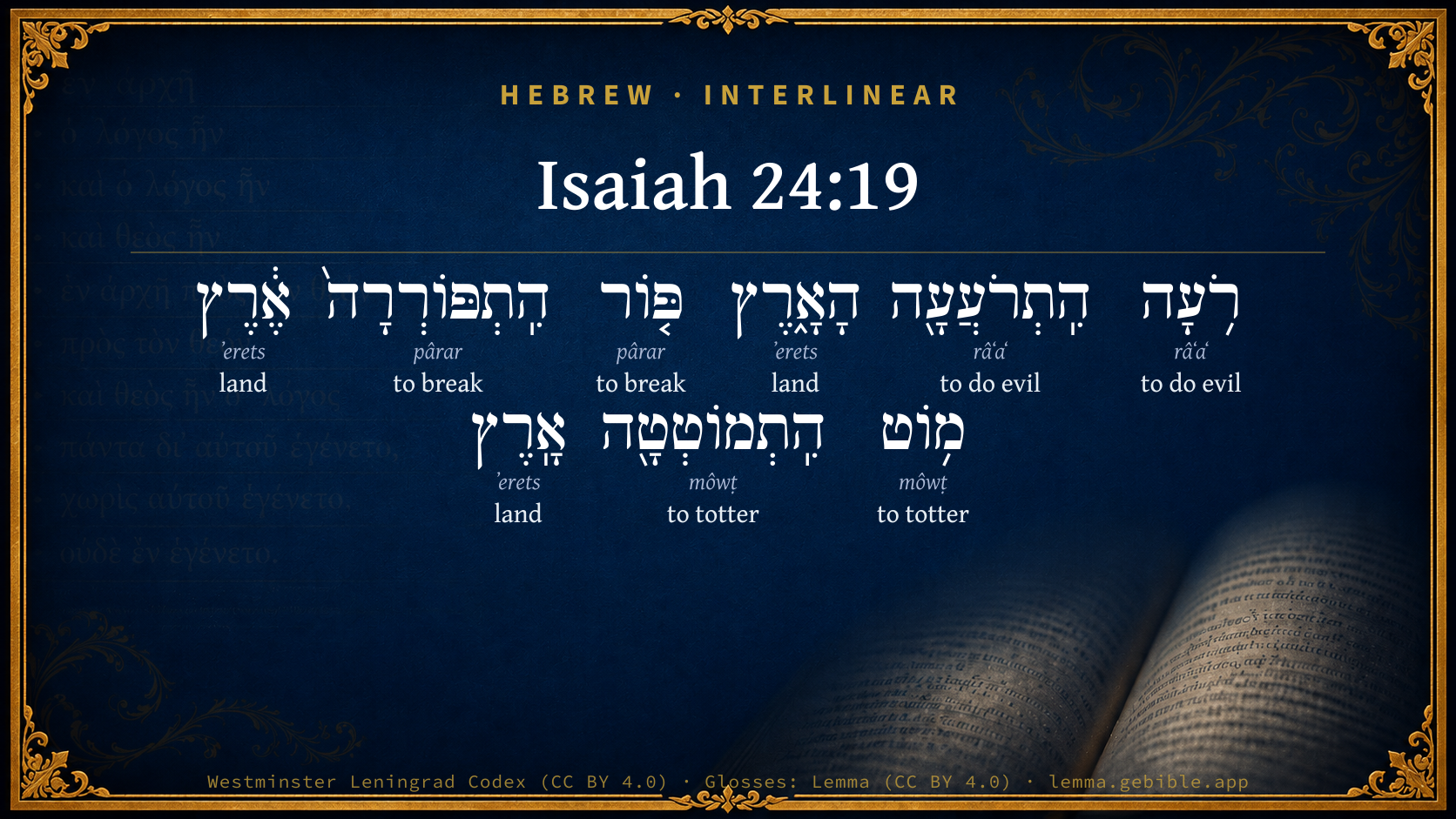
Hebrew (Westminster Leningrad Codex) Isaiah 24:19 appears in the Hebrew Old Testament. The text above is from the Westminster Leningrad Codex. Each word links to its Strong’s number, a concise gloss, and parsing drawn from the Open Scriptures Hebrew Bible morphology. Click any word for its full Brown-Driver-Briggs (BDB) entry.
Download image
Cite this verse

Isaiah 24:19 (World English Bible). Public Domain. Lemma interlinear Bible study tool, https://lemma.gebible.app/v/isaiah/24/19.

Show BibTeX & RIS
BibTeX
RIS
English Translation
The earth is utterly broken, the earth is torn apart, the earth is shaken violently.
World English Bible · Public Domain
Download a study sheet

One document with this verse’s original text, its word-by-word gloss line, the meaning frame, cross-references with their text, attributed commentary, and full source and license credits — printable, and it pastes into notes with its structure intact.

This verse Autodidact and up

Study sheet (.html) Plain text (.txt)

A passage Seminary Student

Up to 50 verses in one chapter. A passage sheet keeps up to 6 commentary sources and 12 cross-references per verse, in the order this page ranks them, and says so on the sheet whenever that leaves anything out. Ask for a single verse and you get the Autodidact verse sheet above.

Everything on this page stays free to read, with no account — the sheet is a download of what is already on screen, not access to it.

Want to remove ads? Support Godless Engineer
Compare translations 3

The same verse in 3 English versions, stacked beneath the original-language interlinear above. Click any original word for its lexicon entry.

Each is an independent rendering of the whole verse — the interlinear is not word-aligned to these translations.

Highlighted words mark where these versions differ — a whole-verse word diff, not a word-by-word alignment.

  • World English Bible Public Domain
    The earth is utterly broken, the earth is torn apart, the earth is shaken violently.
  • King James Version Public Domain
    The earth is utterly broken down, the earth is clean dissolved, the earth is moved exceedingly.
  • unfoldingWord Literal Text CC BY-SA 4.0
    Shattering, the earth is shattered; breaking, the earth is broken; shaking, the earth is shaken.

unfoldingWord Literal Text — © unfoldingWord, licensed CC BY-SA 4.0. Word-aligned USFM3 via Door43 (git.door43.org/unfoldingWord/en_ult).

Versions to compare (up to 4)

3 of 4 selected

Show all 18 translations

Every available English version of this verse, each an independent rendering of the whole verse.

  • World English Bible Public Domain
    The earth is utterly broken, the earth is torn apart, the earth is shaken violently.
  • Berean Standard Bible Public Domain
    The earth is utterly broken apart, the earth is split open, the earth is shaken violently.
  • Majority Standard Bible Public Domain
    The earth is utterly broken apart, the earth is split open, the earth is shaken violently.
  • King James Version Public Domain
    The earth is utterly broken down, the earth is clean dissolved, the earth is moved exceedingly.
  • American Standard Version (1901) Public Domain
    The earth is utterly broken, the earth is rent asunder, the earth is shaken violently.
  • Revised Version (1885) Public Domain
    The earth is utterly broken, the earth is clean dissolved, the earth is moved exceedingly.
  • Geneva Bible (1599) Public Domain
    The earth is vtterly broken downe: the earth is cleane dissolued: the earth is mooued exceedingly.
  • Douay-Rheims (1899) Public Domain
    With breaking shall the earth be broken, with crushing shall the earth be crushed, with trembling shall the earth be moved.
  • Young's Literal Translation Public Domain
    Utterly broken down hath been the land, Utterly broken hath been the land, Utterly moved hath been the land.
  • Literal Standard Version CC BY-SA 4.0
    The earth has been utterly broken down, || The earth has been utterly broken, || The earth has been utterly moved.
  • Unlocked Literal Bible CC BY-SA 4.0
    The earth will be completely broken, the earth ripped apart; the earth will be violently shaken.
  • unfoldingWord Literal Text CC BY-SA 4.0
    Shattering, the earth is shattered; breaking, the earth is broken; shaking, the earth is shaken.
  • Darby Bible Public Domain
    The earth is utterly broken down, the earth is completely dissolved, the earth is violently moved.
  • World Messianic Bible Public Domain
    The earth is utterly broken. The earth is torn apart. The earth is shaken violently.
  • Webster's Bible Public Domain
    The earth is utterly broken down, the earth is entirely dissolved, the earth is exceedingly moved.
  • Free Bible Version CC BY-SA 4.0
    The earth is completely broken up; the earth is ripped apart, the earth is violently shaken.
  • Bible in Basic English Public Domain
    The earth is completely broken, it is parted in two, it is violently moved.
  • JPS Tanakh (1917) Public Domain
    The earth is broken, broken down, the earth is crumbled in pieces, the earth trembleth and tottereth;

Literal Standard Version (2020), Covenant Press — licensed CC BY-SA 4.0. Text via the HelloAO Bible API (eBible.org). Unlocked Literal Bible (unfoldingWord) — licensed CC BY-SA 4.0. Text via the HelloAO Bible API (eBible.org). unfoldingWord Literal Text — © unfoldingWord, licensed CC BY-SA 4.0. Word-aligned USFM3 via Door43 (git.door43.org/unfoldingWord/en_ult). Free Bible Version, Dr. Jonathan Gallagher — licensed CC BY-SA 4.0. Text via the HelloAO Bible API (eBible.org).

Word by word

More ways to search: Search by grammar → Find every occurrence → Compare this word →

Practice this passage: Drill this verse → Learn its vocabulary →

About this verse

These counts appear in no published source. They are computed here, from the morphology-tagged text and Lemma’s own curated glosses. What Lemma adds →

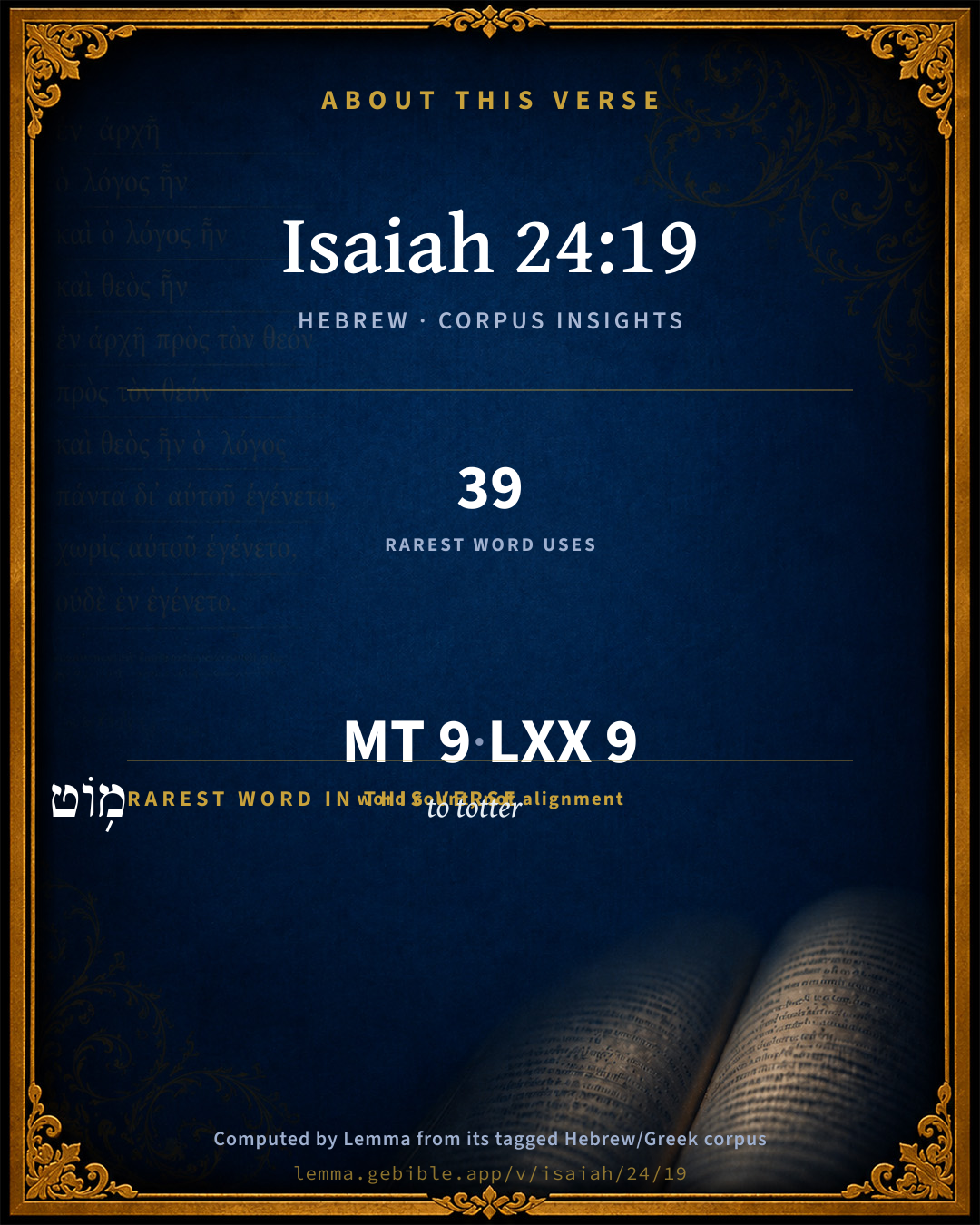
9
words
4
distinct lemmas
Prophets
section

Shared distinctive vocabulary

מ֥וֹט to totter H4131 occurs in 36 verses of the Hebrew Bible. Also found in:

Grammatical profile

  • 6 verbs
  • 3 nouns

Verb forms

  • רֹ֥עָה Qal · Infinitive Absolute
  • הִֽתְרֹעֲעָ֖ה Hithpolel · Perfect
  • פּ֤וֹר Qal · Infinitive Absolute
  • הִֽתְפּוֹרְרָה֙ Hithpolel · Perfect
  • מ֥וֹט Qal · Infinitive Absolute
  • הִֽתְמוֹטְטָ֖ה Hithpolel · Perfect

Repetition

Words recur within this verse — often emphatic in Hebrew:

  • הָאָ֑רֶץ land H776 ×3
  • רֹ֥עָה to do evil H7489 ×2
  • פּ֤וֹר to break H6565 ×2
  • מ֥וֹט to totter H4131 ×2

Hebrew & Septuagint length

In English translation the verse runs 15 words from the Hebrew and 13 from the Septuagint (LXX English) — closely comparable.

A rough comparison of the two English renderings, which tokenize alike — not a word-level alignment.

Word counts can differ between the Hebrew and the Greek without any difference in meaning — e.g. the Hebrew direct-object marker אֵת has no separate Greek word, and Greek often adds the article ὁ.

In the original languages it is 9 Hebrew tokens and 9 Greek tokens — but the two are counted differently (Hebrew bundles its prefixes and suffixes into one token; the Greek is in lemma form), so that isn’t a like-for-like length.

Cross-references

8

Topical passages linked to Isaiah 24:19 in the Treasury of Scripture Knowledge — connected by theme and wording, ordered by reader-vote popularity; previews shown in the World English Bible.

  • Isaiah 34:4–10 All the host of the sky shall be dissolved, and the heavens shall be rolled together as a scroll; and all their host shall fade away, as the leaf fades from off the vine, and as a fading [leaf] from the fig tree.
  • Deuteronomy 11:6 and what he did to Dathan and Abiram, the sons of Eliab, the son of Reuben; how the earth opened its mouth, and swallowed them up, and their households, and their tents, and every living thing that followed them, in the midst of all Israel:
  • Isaiah 24:1–5 Behold, Yahweh makes the earth empty, and makes it waste, and turns it upside down, and scatters abroad the inhabitants of it.
  • Jeremiah 4:23–28 I saw the earth, and, behold, it was waste and void; and the heavens, and they had no light.
  • Nahum 1:5 The mountains quake before him, and the hills melt away. The earth trembles at his presence, yes, the world, and all who dwell in it.
  • Revelation 20:11 I saw a great white throne, and him who sat on it, from whose face the earth and the heaven fled away. There was found no place for them.
  • Habakkuk 3:6 He stood, and shook the earth. He looked, and made the nations tremble. The ancient mountains were crumbled. The age-old hills collapsed. His ways are eternal.
  • Matthew 24:3 As he sat on the Mount of Olives, the disciples came to him privately, saying, "Tell us, when will these things be? What is the sign of your coming, and of the end of the age?"

Cross-references courtesy of OpenBible.info (CC BY 4.0).

Hebrew and Greek witnesses Masoretic Hebrew ↔ Greek Septuagint

The same verse in the two great witnesses to the Old Testament, shown verse-for-verse.

These are two independent witnesses, not word-aligned to each other, and the Septuagint is shown in lemma (dictionary) form.

Hebrew Isaiah 24:19 Masoretic · Westminster Leningrad Codex

רֹ֥עָה הִֽתְרֹעֲעָ֖ה הָאָ֑רֶץ פּ֤וֹר הִֽתְפּוֹרְרָה֙ אֶ֔רֶץ מ֥וֹט הִֽתְמוֹטְטָ֖ה אָֽרֶץ

The earth is utterly broken, the earth is torn apart, the earth is shaken violently.

World English Bible · Public Domain

Greek LXX Isaiah 24:19 Septuagint · lemma form

ταραχή ταράσσω ὁ γῆ καί ἀπορία ἀπορέω ὁ γῆ

the earth shall be utterly confounded, and the earth shall be completely perplexed.

LXX2012 (modern English Septuagint) · Public Domain

On this verse, John Gill's Exposition discusses the Septuagint’s reading. Read the note in Commentary ↓

Hebrew: Westminster Leningrad Codex (CC BY 4.0). Greek: Septuagint (public domain); English from LXX2012 (modern English Septuagint) (Public Domain). How the Septuagint differs from the Hebrew →

Targum (Aramaic paraphrase)

1

The Targum is the ancient Jewish Aramaic paraphrase of the Hebrew Scriptures — an interpretive translation, not the Hebrew text itself. Onkelos (literal) and Pseudo-Jonathan (expansive) render the Torah, and Jonathan the Prophets. Coverage is partial: where no permissively-licensed English translation exists for a verse, only the Aramaic is shown. This is verse-level text, not a word-by-word alignment to the Hebrew.

  1. Targum Jonathan Prophets (Joshua–Malachi)
    מַזָע תְּזוּעַ אַרְעָא מֵנָד תָּנוּד אַרְעָא פְּרוֹק תִּתְפְּרַק אַרְעָא:

    The land is terribly shaken, the land terribly reeleth to and fro, the land is utterly broken.

    Targum Jonathan — Aramaic: “Mikraot Gedolot” (public domain). English: “Sefaria Community Translation” (CC0 1.0 (public-domain dedication)); “London "Chaldee Paraphrase," 1871” (public domain). Text via Sefaria.

Commentary

Notes on Isaiah 24:19 from classic Christian and Jewish commentators (each source and its license shown beneath its notes). The classic Christian expositions comment on the surrounding passage and are grouped to its opening verse, so a note may address several verses; the Jewish commentaries on the Tanakh (Rashi and others) are per-verse, so they appear only where the commentator wrote on this verse.

Lemma curates 59 commentaries, every one of them public domain or Creative Commons licensed, each selected and text-cleaned for this edition rather than reprinted as found. About our sources →

Trapp's Complete Commentary

John Trapp

Isa 24:19 The earth is utterly broken down, the earth is clean dissolved, the earth is moved exceedingly.

Ver. 19. The earth is utterly broken down.] This he had said before. Oil, if not well rubbed in, pierceth not the skin. Menaces must be inculcated, or else they will be but little regarded. Let preachers press matters to the utmost, drive the nail home to the head; not forbearing through faint-heartedness, nor languishing through lukewarmness.

John Trapp, A Commentary or Exposition upon All the Books of the Old and New Testament (1647–1656) — public domain. Text from a community e-Sword module.

Joseph Benson's Commentary

Isa 24:19-20. The earth is utterly broken down — This is repeated again, to show the dreadfulness and certainty of these judgments, and to awaken the stupid Israelites. The earth shall reel to and fro — The people of the earth, the inhabitants of the land, shall be sorely perplexed and distressed, not knowing what to do, or whither to go. Or rather, the prophet here, in metaphorical expressions, borrowed from an earthquake, signifies how terribly Judea should be shaken by wars, desolations, and other divine judgments, to the entire overthrow of their church and commonwealth; and shall be removed — The people shall be removed, or their constitution, civil and religious, like a cottage — Or, like a lodge in a garden, of which this word is used, Isa 1:8, which is soon taken down and set up in another place: or, like a tent, which is easily and commonly carried from place to place. And the transgression thereof shall be heavy upon it — Upon their state and nation, especially the sin of crucifying the Lord of glory. And it shall fall — Their government shall be overturned, their state dissolved, and their nation ruined; and not rise again — Not till the latter days, when they shall believe in and receive Him whom they rejected and crucified.

Joseph Benson's Commentary on the Old and New Testaments (1811–1818) — public domain. Text from a community e-Sword module.

Jamieson, Fausset & Brown

Robert Jamieson, A. R. Fausset & David Brown

earth--the land: image from an earthquake.

Jamieson, Fausset & Brown — Commentary Critical and Explanatory on the Whole Bible (1871) — public domain (CC PDM 1.0). Text via the HelloAO Bible API.

Adam Clarke's Commentary

Verse 19. The earth - "The land"] הארץ haarets, forte delendum ה he, ut ex praecedente ortum. Vid. seqq. - Secker. "Probably the ה he, in הארץ haarets, should be blotted out, as having arisen from the preceding."

Adam Clarke's Commentary on the Bible (1810–1826) — public domain. Text from a community e-Sword/MySword module.

Ellicott's Commentary for English Readers

(19) The earth is utterly broken . . .—We note the characteristic form of Hebrew emphasis in the threefold iteration of “the earth.” (Comp. Isa_6:3; Jer_22:29.) There the form (more visibly in the Hebrew than in the English) is a climax representing the three stages of an earthquake: the first cleavage of the ground; the wide open gaping; the final shattering convulsion. The rhythm of the whole passage is almost an echo of the crashes.

A Bible Commentary for English Readers, edited by Charles John Ellicott (1878–1897) — public domain. Text from a community e-Sword module.

The Cambridge Bible for Schools and Colleges

gen. ed. J. J. S. Perowne

19. is clean dissolved] Better, is utterly shivered. For is moved render staggereth.

The Cambridge Bible for Schools and Colleges (gen. ed. J. J. S. Perowne; Cambridge University Press, 1878–1918) — public domain. Text from a community e-Sword module.

John Gill's Exposition

The earth shall reel to and fro like a drunkard,.... When it shall be moved and agitated to and fro, and dissolved; or this may be meant of the inhabitants, who shall be at their wits' end, and in the utmost confusion, not knowing what to do, nor where to go, having no more thought, nor sense, nor command of themselves, than a drunken man; and this is in just retaliation, that as they have been drunk with sin, having drank up iniquity like water, they shall now be drunk with punishment, which being heavy upon them, will make them stagger like a drunken man:

and shall be removed like a cottage; or, "a tent" (x); either of soldiers or shepherds, which are easily taken down and moved; or like "a lodge" (y), as the word is rendered Isa 1:8. The Septuagint render it a "fruit watch"; and, according to the Jewish writers, it signifies a booth or tent, in which the keepers of gardens or vineyards watched in the night; which Jarchi says was built on the top of a tree, and Kimchi on a hill; and, being made of light wood, was easily moved to and fro with the wind. The Targum is,

"and it goes and comes as a bed;''

that is, rocks as a cradle:

and the transgression thereof shall be heavy upon it; that is, the punishment of transgression, which, like a talent of lead, in Zac 5:8 shall crush it, and the inhabitants of it, to pieces:

and it shall fall, and not rise again; in the form it now is; for there will be new heavens and a new earth, in which the righteous, who will share the first resurrection, will dwell; for as for the first earth, or present one, it shall pass away, and no place be found for it, Rev 20:11.

(x) "quasi tabernaculum", V. L. (y) "Ut diversoriolum", Piscator.

John Gill's Exposition of the Whole Bible (1746–1763) — public domain (CC PDM 1.0). Text via the HelloAO Bible API.

Albert Barnes' Notes on the Bible

The earth is utterly broken down - The effect as it were of an earthquake where everything is thrown into commotion and ruin.

The earth is moved exceedingly - Everything in this verse is intense and emphatic. The verbs are in the strongest form of emphasis: ‘By breaking, the land is broken;’ ‘by scattering, the land is scattered;’ ‘by commotion, the land is moved.’ The repetition also of the expression in the same sense three times, is a strong form of emphasis; and the whole passage is designed to denote the utter desolation and ruin that had come upon the land.

Albert Barnes' Notes on the Bible (1834–1885) — public domain. Text from a community e-Sword/MySword module.

Matthew Poole's English Annotations

This is repeated again, partly to show the dreadfulness and certainty of these judgments, and partly to awaken and affect the stupid Israelites, who greatly needed it.

Matthew Poole's English Annotations on the Holy Bible (1683–1685) — public domain. Text from a community e-Sword/MySword module.

The Pulpit Commentary

The earth is utterly broken down. The material globe itself breaks up and perishes. It is "the crack of doom." Mr. Cheyne remarks that "the language imitates the cracking and bursting with which the present world shall pass away." The Authorized Version is very feeble compared to the original.

The Pulpit Commentary (1880–1919), ed. H.D.M. Spence-Jones & Joseph S. Exell — public domain. Text from a community e-Sword module.

John Wesley's Explanatory Notes

The earth - This is repeated again, to shew the dreadfulness and, certainty of these judgments, and to awaken the stupid Israelites.

John Wesley, Explanatory Notes Upon the Whole Bible (1754–1765) — public domain. Text via the GEBible commentary corpus.

J. A. Alexander on Isaiah

Joseph Addison Alexander

“Broken, broken is the earth; shattered, shattered is the earth; shaken, shaken is the earth.”

Joseph Addison Alexander, The Prophecies of Isaiah (1846–1847; New York: Scribner, 1870–1878) — public domain. Text from a community e-Sword module.

unfoldingWord translationNotes

Door43 World Missions Community

The earth will be completely broken, the earth ripped apart; the earth will be violently shaken

These passive clauses can be stated in active form. AT: "The earth will break and split apart; the earth will shake violently" (See: Active or Passive)

The earth will stagger like a drunken man and it will sway back and forth like a hut

These similes emphasize how the earth will shake back and forth. (See: Simile)

Its sin will be heavy on it and it will fall and never rise again

This speaks of the earth as if it were a person and transgressions were a heavy object. The person tries to carry the heavy weight but the weight causes the person to fall and not be able to stand back up. Here the earth represents the people of the earth who cause Yahweh to destroy the earth because of their sins. AT: "The sins of the people are many and so Yahweh will destroy the earth, and the earth will be like a person who falls and cannot get back up" (See: Metaphor and Metonymy)

translationWords

transgress

unfoldingWord translationNotes — © Distant Shores Media and the Door43 World Missions Community, licensed CC BY-SA 4.0. Source: git.door43.org/Door43/en_tn.

Rashi

Rabbi Shlomo Yitzchaki (Rashi)

The earth has broken (רֹעָה הִתְרֹעֲעָה) an expression of breaking. Comp. (Ps. 2:9): “You shall break them (תְּרֹעֵם) with an iron rod.”

has crumbled (פּוֹר הִתְפּוֹרְרָה), an expression of crumbs.

Rashi on the Tanakh — English translations: “The Judaica Press complete Tanach with Rashi, translated by A. J. Rosenberg” (CC BY 4.0); “Pentateuch with Rashi's commentary by M. Rosenbaum and A.M. Silbermann, 1929-1934” (public domain); “The Metsudah Tanach series, Lakewood, N.J” (CC BY 4.0); and “The Book of Joshua, Metsudah Publications, 1997” (CC BY 4.0). Text via Sefaria.

Ibn Ezra

Rabbi Abraham ibn Ezra

רעה Is broken. Comp. תרועם thou wilt break them (Ps. 2:9); a word found frequently in the Targum.

פור התפוררה Is broken asunder. Comp. ויפרפרני and he hath broken me asunder (Job 16:12); פוררת thou hast divided (Ps. 74:13)

Ibn Ezra on the Tanakh — English translations: “Sefaria Community Translation” (CC0 1.0 (public-domain dedication)); “Yalkut, Sifsei Chachomim Chumash, Metsudah Publications, 2009” (CC BY 4.0); and “Commentary of Ibn Ezra on Isaiah - trans. by M. Friedlander, 1873” (public domain). Text via Sefaria.

Lesson kit

Teaching starters — assembled from the data on this page, not authored interpretation. Every prompt links to the verse data it draws on. Edit before teaching.

Isaiah, in the Prophets, opens this verse with 9 words (4 distinct Hebrew lemmas). Its most distinctive word is môwṭ (“to totter”). A historical commentator’s framing appears above. Read the whole chapter for the surrounding context.

Discussion questions

  1. The word môwṭ carries the sense “to totter.” How does it shape the verse?
  2. How does Leviticus 25:35, which shares the word «to totter», read alongside this verse?
  3. What does the repetition of “land” (3× in this one verse) do in this verse?
  4. These translations render this verse differently. What is at stake in choosing one wording over another?
  5. «רֹ֥עָה» is a Qal Infinitive Absolute verb. How does that grammatical form shape the action described?
  6. Compare how Trapp's Complete Commentary and Joseph Benson's Commentary read this verse. Where do they agree or differ?

Things to notice

Reading settings

Reading text

Shown beneath each verse's original-language words.

Old Testament
Old Testament edition

Read the OT as the Masoretic Hebrew (MT) or the Greek Septuagint (LXX).

English shown for the Greek Septuagint (in the Hebrew ↔ Greek comparison).

Comparing translations? Open the Compare panel on any verse page to stack up to four side by side.