Isaiah 11:9

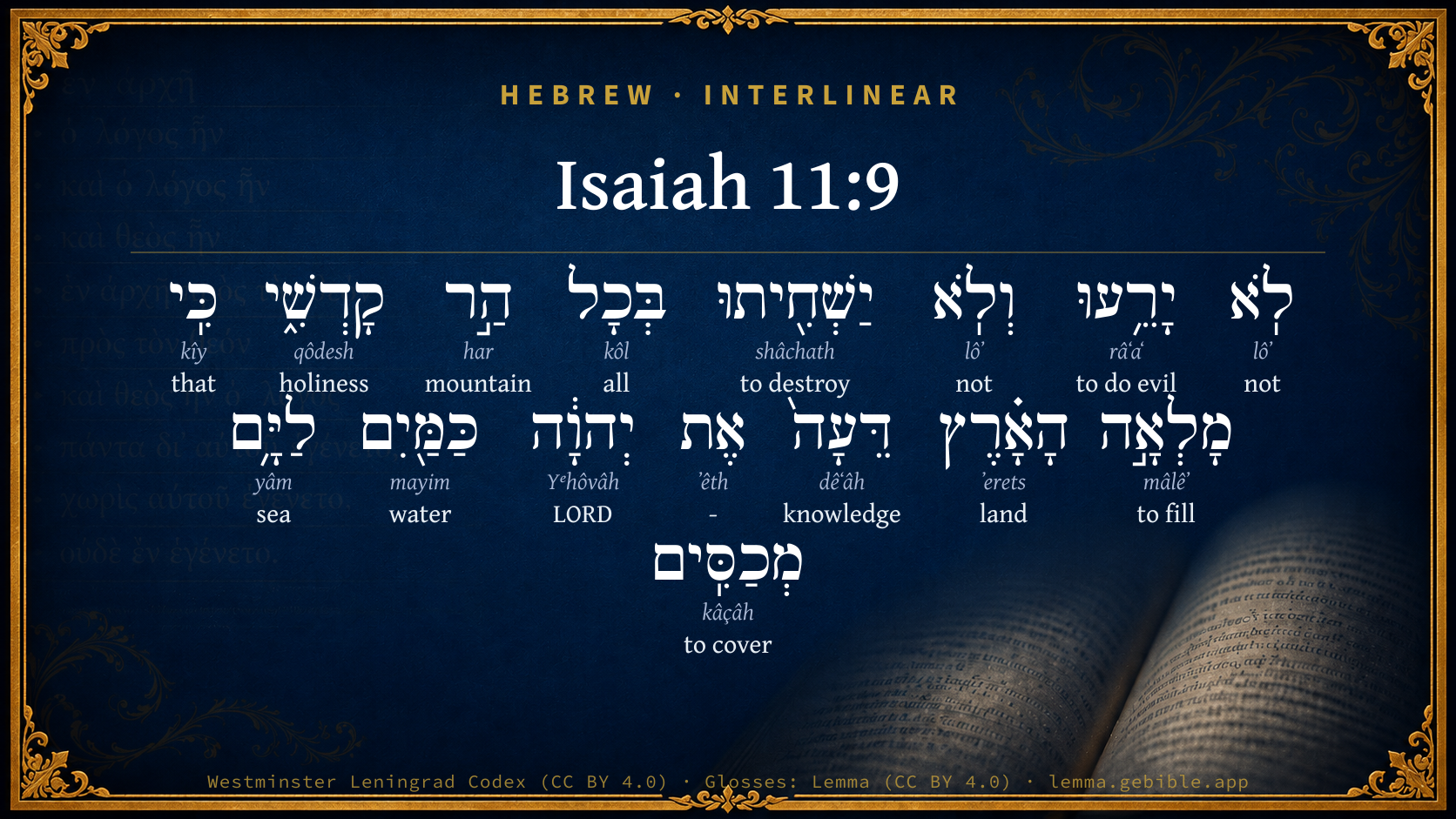
Hebrew (Westminster Leningrad Codex) Isaiah 11:9 appears in the Hebrew Old Testament. The text above is from the Westminster Leningrad Codex. Each word links to its Strong’s number, a concise gloss, and parsing drawn from the Open Scriptures Hebrew Bible morphology. Click any word for its full Brown-Driver-Briggs (BDB) entry.
Download image
Cite this verse

Isaiah 11:9 (World English Bible). Public Domain. Lemma interlinear Bible study tool, https://lemma.gebible.app/v/isaiah/11/9.

Show BibTeX & RIS
BibTeX
RIS
English Translation
They shall not hurt nor destroy in all my holy mountain; for the earth shall be full of the knowledge of Yahweh, as the waters cover the sea.
World English Bible · Public Domain
Download a study sheet

One document with this verse’s original text, its word-by-word gloss line, the meaning frame, cross-references with their text, attributed commentary, and full source and license credits — printable, and it pastes into notes with its structure intact.

This verse Autodidact and up

Study sheet (.html) Plain text (.txt)

A passage Seminary Student

Up to 50 verses in one chapter. A passage sheet keeps up to 6 commentary sources and 12 cross-references per verse, in the order this page ranks them, and says so on the sheet whenever that leaves anything out. Ask for a single verse and you get the Autodidact verse sheet above.

Everything on this page stays free to read, with no account — the sheet is a download of what is already on screen, not access to it.

Want to remove ads? Support Godless Engineer
Compare translations 3

The same verse in 3 English versions, stacked beneath the original-language interlinear above. Click any original word for its lexicon entry.

Each is an independent rendering of the whole verse — the interlinear is not word-aligned to these translations.

Highlighted words mark where these versions differ — a whole-verse word diff, not a word-by-word alignment.

  • World English Bible Public Domain
    They shall not hurt nor destroy in all my holy mountain; for the earth shall be full of the knowledge of Yahweh, as the waters cover the sea.
  • King James Version Public Domain
    They shall not hurt nor destroy in all my holy mountain: for the earth shall be full of the knowledge of the LORD, as the waters cover the sea.
  • unfoldingWord Literal Text CC BY-SA 4.0
    They will not cause harm and they will not destroy on all of the mountain of my holiness, for the earth will be full the knowledge of Yahweh, as the waters are covering the sea.

unfoldingWord Literal Text — © unfoldingWord, licensed CC BY-SA 4.0. Word-aligned USFM3 via Door43 (git.door43.org/unfoldingWord/en_ult).

Versions to compare (up to 4)

3 of 4 selected

Show all 18 translations

Every available English version of this verse, each an independent rendering of the whole verse.

  • World English Bible Public Domain
    They shall not hurt nor destroy in all my holy mountain; for the earth shall be full of the knowledge of Yahweh, as the waters cover the sea.
  • Berean Standard Bible Public Domain
    They will neither harm nor destroy on all My holy mountain, for the earth will be full of the knowledge of the LORD as the sea is full of water.
  • Majority Standard Bible Public Domain
    They will neither harm nor destroy on all My holy mountain, for the earth will be full of the knowledge of the LORD as the sea is full of water.
  • King James Version Public Domain
    They shall not hurt nor destroy in all my holy mountain: for the earth shall be full of the knowledge of the LORD, as the waters cover the sea.
  • American Standard Version (1901) Public Domain
    They shall not hurt nor destroy in all my holy mountain; for the earth shall be full of the knowledge of Jehovah, as the waters cover the sea.
  • Revised Version (1885) Public Domain
    They shall not hurt nor destroy in all my holy mountain: for the earth shall be full of the knowledge of the LORD, as the waters cover the sea.
  • Geneva Bible (1599) Public Domain
    Then shall none hurt nor destroy in all the mountaine of mine holines: for the earth shalbe full of the knowledge of the Lord, as the waters that couer the sea.
  • Douay-Rheims (1899) Public Domain
    They shall not hurt, nor shall they kill in all my holy mountain, for the earth is filled with the knowledge of the Lord, as the covering waters of the sea.
  • Young's Literal Translation Public Domain
    Evil they do not, nor destroy in all My holy mountain, For full hath been the earth with the knowledge of Jehovah, As the waters are covering the sea.
  • Literal Standard Version CC BY-SA 4.0
    They do no evil, nor destroy in all My holy mountain, || For the earth has been full with the knowledge of YHWH, || As the waters are covering the sea.”
  • Unlocked Literal Bible CC BY-SA 4.0
    They will not hurt nor destroy on all my holy mountain; for the earth will be full of knowledge of Yahweh, as the waters cover the sea.
  • unfoldingWord Literal Text CC BY-SA 4.0
    They will not cause harm and they will not destroy on all of the mountain of my holiness, for the earth will be full the knowledge of Yahweh, as the waters are covering the sea.
  • Darby Bible Public Domain
    They shall not hurt nor destroy in all my holy mountain; for the earth shall be full of the knowledge of Jehovah, as the waters cover the sea.
  • World Messianic Bible Public Domain
    They will not hurt nor destroy in all my holy mountain; for the earth will be full of the knowledge of the LORD, as the waters cover the sea.
  • Webster's Bible Public Domain
    They shall not hurt nor destroy in all my holy mountain: for the earth shall be full of the knowledge of the LORD, as the waters cover the sea.
  • Free Bible Version CC BY-SA 4.0
    Nothing will cause any harm or damage anywhere on my holy mountain, for the earth will be full of the knowledge of the Lord in the same way that water fills the sea.
  • Bible in Basic English Public Domain
    There will be no cause of pain or destruction in all my holy mountain: for the earth will be full of the knowledge of the Lord as the sea is covered by the waters.
  • JPS Tanakh (1917) Public Domain
    They shall not hurt nor destroy in all My holy mountain; for the earth shall be full of the knowledge of the LORD, as the waters cover the sea.

Literal Standard Version (2020), Covenant Press — licensed CC BY-SA 4.0. Text via the HelloAO Bible API (eBible.org). Unlocked Literal Bible (unfoldingWord) — licensed CC BY-SA 4.0. Text via the HelloAO Bible API (eBible.org). unfoldingWord Literal Text — © unfoldingWord, licensed CC BY-SA 4.0. Word-aligned USFM3 via Door43 (git.door43.org/unfoldingWord/en_ult). Free Bible Version, Dr. Jonathan Gallagher — licensed CC BY-SA 4.0. Text via the HelloAO Bible API (eBible.org).

Word by word

More ways to search: Search by grammar → Find every occurrence → Compare this word →

Practice this passage: Drill this verse → Learn its vocabulary →

דֵּעָה֙
dêʻâh
H1844
“knowledge”
Noun, Common, Feminine, Singular, Absolute
Part of Speech
Noun
Type
Common
Gender
Feminine
Number
Singular
State
Absolute
Full BDB Definition

Origin: from H1843

TWOT: 848b

knowledge (of God)
  1. לֹֽא lôʼ H3808 “not” Particle, Negative
  2. יָרֵ֥עוּ râʻaʻ H7489 “to do evil” Verb, Hiphil, Imperfect, 3rd Person, Masculine, Plural
  3. וְלֹֽא lôʼ H3808 “and · not” Conjunction + Particle, Negative
  4. יַשְׁחִ֖יתוּ shâchath H7843 “to destroy” Verb, Hiphil, Imperfect, 3rd Person, Masculine, Plural
  5. בְּכָל kôl H3605 “in/at · all of” Preposition + Noun, Common, Masculine, Singular, Construct
  6. הַ֣ר har H2022 “mountain of” Noun, Common, Masculine, Singular, Construct
  7. קָדְשִׁ֑י qôdesh H6944 “holiness · my” Noun, Common, Masculine, Singular, Construct + Suffix, Personal, 1st Person, Common, Singular
  8. כִּֽי kîy H3588 “that” Conjunction
  9. מָלְאָ֣ה mâlêʼ H4390 “to fill” Verb, Qal, Perfect, 3rd Person, Feminine, Singular
  10. הָאָ֗רֶץ ʼerets H776 “the · land” Particle, Definite Article + Noun, Common, Both, Singular, Absolute
  11. אֶת ʼêth H853 “-” Particle, Direct Object
  12. יְהוָ֔ה Yᵉhôvâh H3068 “LORD” Noun, Proper
  13. כַּמַּ֖יִם mayim H4325 “like/as the · water(s)” Preposition, Determined + Noun, Common, Masculine, Plural, Absolute
  14. לַיָּ֥ם yâm H3220 “to/for the · sea” Preposition, Determined + Noun, Common, Masculine, Singular, Absolute
  15. מְכַסִּֽים kâçâh H3680 “covering” Verb, Piel, Participle Active, Masculine, Plural, Absolute

About this verse

These counts appear in no published source. They are computed here, from the morphology-tagged text and Lemma’s own curated glosses. What Lemma adds →

16
words
15
distinct lemmas
Prophets
section

Notable vocabulary

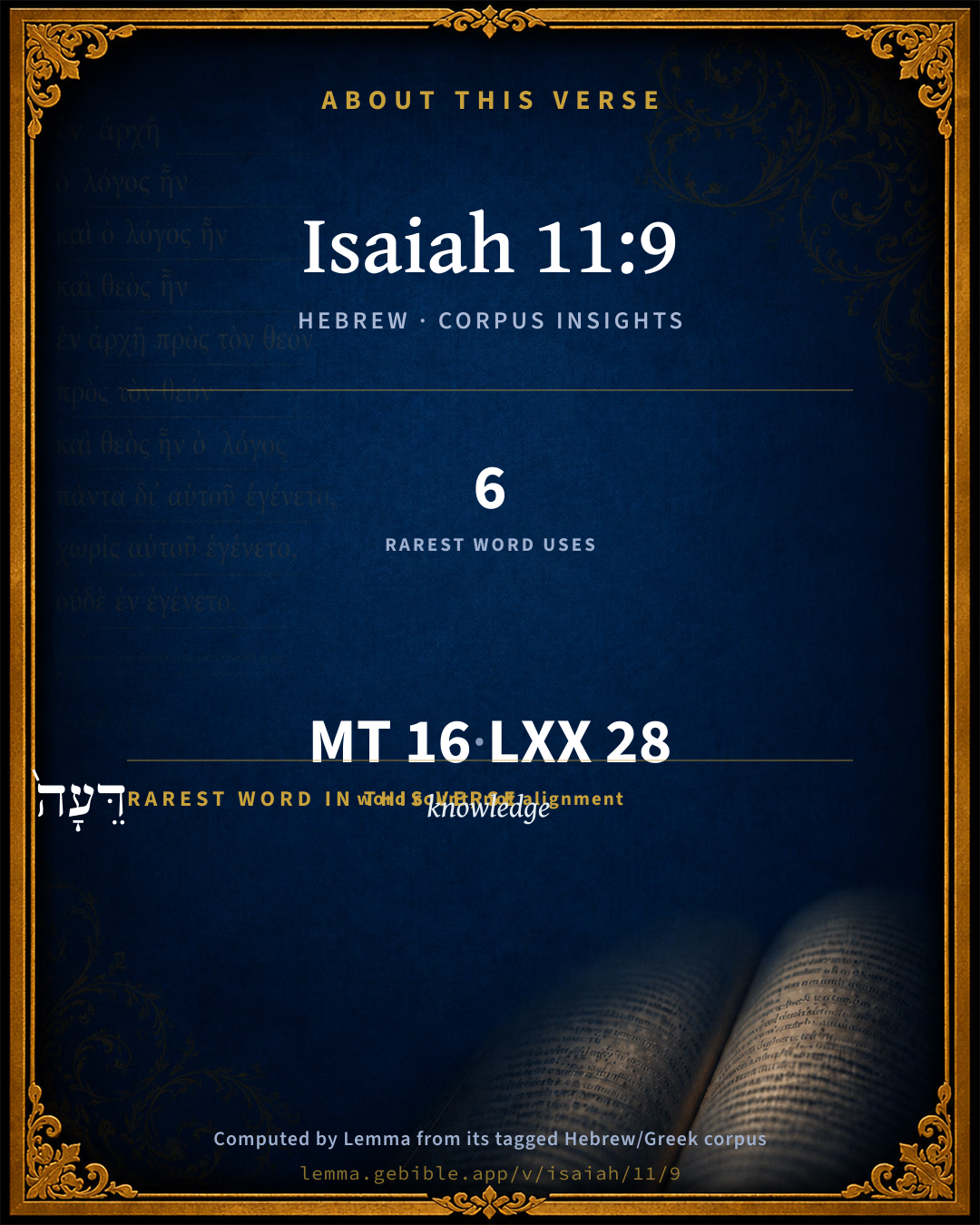
The rarest word here is דֵּעָה֙ knowledge H1844 — appearing just 6 times in the whole Hebrew Bible.

Shared distinctive vocabulary

דֵּעָה֙ knowledge H1844 occurs in 6 verses of the Hebrew Bible. Also found in:

Grammatical profile

  • 4 verbs
  • 8 nouns
  • 1 conjunction
  • 3 particles

Verb forms

  • יָרֵ֥עוּ Hiphil · Imperfect
  • יַשְׁחִ֖יתוּ Hiphil · Imperfect
  • מָלְאָ֣ה Qal · Perfect
  • מְכַסִּֽים Piel · Participle Active

Repetition

A word recurs within this verse — often emphatic in Hebrew:

Hebrew & Septuagint length

In English translation the verse runs 28 words from the Hebrew and 38 from the Septuagint (LXX English) — closely comparable.

A rough comparison of the two English renderings, which tokenize alike — not a word-level alignment.

Word counts can differ between the Hebrew and the Greek without any difference in meaning — e.g. the Hebrew direct-object marker אֵת has no separate Greek word, and Greek often adds the article ὁ.

In the original languages it is 16 Hebrew tokens and 28 Greek tokens — but the two are counted differently (Hebrew bundles its prefixes and suffixes into one token; the Greek is in lemma form), so that isn’t a like-for-like length.

Cross-references

25

Topical passages linked to Isaiah 11:9 in the Treasury of Scripture Knowledge — connected by theme and wording, ordered by reader-vote popularity; previews shown in the World English Bible.

  • Habakkuk 2:14 For the earth will be filled with the knowledge of the glory of Yahweh, as the waters cover the sea.
  • Isaiah 52:10 Yahweh has made bare his holy arm in the eyes of all the nations; and all the ends of the earth have seen the salvation of our God.
  • Psalms 98:2–3 Yahweh has made known his salvation. He has openly shown his righteousness in the sight of the nations.
  • Micah 4:2–4 Many nations will go and say, "Come, and let us go up to the mountain of Yahweh, And to the house of the God of Jacob; And he will teach us of his ways, And we will walk in his paths." For out of Zion will go forth the law, And the word of Yahweh from Jerusalem;
  • Job 5:23 For you shall be in league with the stones of the field. The animals of the field shall be at peace with you.
  • Isaiah 60:1–22 Arise, shine; for your light is come, and the glory of Yahweh is risen on you.
  • Psalms 72:19 Blessed be his glorious name forever! Let the whole earth be filled with his glory! Amen and amen.
  • Isaiah 59:19 So shall they fear the name of Yahweh from the west, and his glory from the rising of the sun; for he will come as a rushing stream, which the breath of Yahweh drives.
  • Psalms 22:27–31 All the ends of the earth shall remember and turn to Yahweh. All the relatives of the nations shall worship before you.
  • Isaiah 45:6 that they may know from the rising of the sun, and from the west, that there is none besides me: I am Yahweh, and there is no one else.
  • Isaiah 49:6 yes, he says, It is too light a thing that you should be my servant to raise up the tribes of Jacob, and to restore the preserved of Israel: I will also give you for a light to the Gentiles, that you may be my salvation to the end of the earth.
  • Zechariah 14:9 Yahweh will be King over all the earth. In that day Yahweh will be one, and his name one.
  • Revelation 21:27 There will in no way enter into it anything profane, or one who causes an abomination or a lie, but only those who are written in the Lamb's book of life.
  • Isaiah 2:4 He will judge between the nations, And will decide concerning many peoples; And they shall beat their swords into plowshares, And their spears into pruning-hooks. Nation shall not lift up sword against nation, Neither shall they learn war any more.
  • Isaiah 11:13 The envy also of Ephraim shall depart, and those who vex Judah shall be cut off: Ephraim shall not envy Judah, and Judah shall not vex Ephraim.
  • Isaiah 30:26 Moreover the light of the moon shall be as the light of the sun, and the light of the sun shall be sevenfold, as the light of seven days, in the day that Yahweh binds up the hurt of his people, and heals the stroke of their wound.
  • Isaiah 35:9 No lion shall be there, nor shall any ravenous animal go up thereon; they shall not be found there; but the redeemed shall walk [there]:
  • Matthew 5:44–45 But I tell you, love your enemies, bless those who curse you, do good to those who hate you, and pray for those who mistreat you and persecute you,
  • Acts 2:41–47 Then those who gladly received his word were baptized. There were added that day about three thousand souls.
  • Acts 4:29–35 Now, Lord, look at their threats, and grant to your servants to speak your word with all boldness,
  • Romans 11:25–26 For I don't desire, brothers, to have you ignorant of this mystery, so that you won't be wise in your own conceits, that a partial hardening has happened to Israel, until the fullness of the Gentiles has come in,
  • Romans 12:17–21 Repay no one evil for evil. Respect what is honorable in the sight of all men.
  • Galatians 5:22–24 But the fruit of the Spirit is love, joy, peace, patience, kindness, goodness, faithfulness,
  • Philippians 2:14–15 Do all things without murmurings and disputes,
  • Revelation 20:2–6 He seized the dragon, the old serpent, which is the devil and Satan, who deceives the whole inhabited earth, and bound him for a thousand years,

Cross-references courtesy of OpenBible.info (CC BY 4.0).

Hebrew and Greek witnesses Masoretic Hebrew ↔ Greek Septuagint

The same verse in the two great witnesses to the Old Testament, shown verse-for-verse.

These are two independent witnesses, not word-aligned to each other, and the Septuagint is shown in lemma (dictionary) form.

Hebrew Isaiah 11:9 Masoretic · Westminster Leningrad Codex

לֹֽא יָרֵ֥עוּ וְלֹֽא יַשְׁחִ֖יתוּ בְּכָל הַ֣ר קָדְשִׁ֑י כִּֽי מָלְאָ֣ה הָאָ֗רֶץ דֵּעָה֙ אֶת יְהוָ֔ה כַּמַּ֖יִם לַיָּ֥ם מְכַסִּֽים

They shall not hurt nor destroy in all my holy mountain; for the earth shall be full of the knowledge of Yahweh, as the waters cover the sea.

World English Bible · Public Domain

Greek LXX Isaiah 11:9 Septuagint · lemma form

καί οὐ μή κακοποιέω οὐδέ μή δύναμαι ἀποὀλλύω οὐδείς ἐπί ὁ ὄρος ὁ ἅγιος ἐγώ ὅτι ἐνπίμπλημι ὁ σύμπας ὁ γιγνώσκω ὁ κύριος ὡς ὕδωρ πολύς κατακαλύπτω θάλασσα

And they shall not hurt, nor shall they at all be able to destroy any one on my holy mountain: for the whole world is filled with the knowledge of the Lord, as much water covers the seas.

LXX2012 (modern English Septuagint) · Public Domain

Hebrew: Westminster Leningrad Codex (CC BY 4.0). Greek: Septuagint (public domain); English from LXX2012 (modern English Septuagint) (Public Domain). How the Septuagint differs from the Hebrew →

Targum (Aramaic paraphrase)

1

The Targum is the ancient Jewish Aramaic paraphrase of the Hebrew Scriptures — an interpretive translation, not the Hebrew text itself. Onkelos (literal) and Pseudo-Jonathan (expansive) render the Torah, and Jonathan the Prophets. Coverage is partial: where no permissively-licensed English translation exists for a verse, only the Aramaic is shown. This is verse-level text, not a word-by-word alignment to the Hebrew.

  1. Targum Jonathan Prophets (Joshua–Malachi)
    לָא יִבְאֲשׁוּן וְלָא יְחַבְּלוּן בְּכָל טוּרָא דְקוּדְשִׁי אֲרֵי תִתְמְלֵי אַרְעָא לְמִידַע יַת דְחַלְתָּא דַייָ כְּמַיָא דִלְיַמָא חָפָן:

    They shall not hurt nor destroy in all my holy mountain, for the earth shall be full of the knowledge of the fear of the Lord, as the waters cover the sea.

    Targum Jonathan — Aramaic: “Mikraot Gedolot” (public domain). English: “Sefaria Community Translation” (CC0 1.0 (public-domain dedication)); “London "Chaldee Paraphrase," 1871” (public domain). Text via Sefaria.

Commentary

Notes on Isaiah 11:9 from classic Christian and Jewish commentators (each source and its license shown beneath its notes). The classic Christian expositions comment on the surrounding passage and are grouped to its opening verse, so a note may address several verses; the Jewish commentaries on the Tanakh (Rashi and others) are per-verse, so they appear only where the commentator wrote on this verse.

Lemma curates 59 commentaries, every one of them public domain or Creative Commons licensed, each selected and text-cleaned for this edition rather than reprinted as found. About our sources →

Trapp's Complete Commentary

John Trapp

Isa 11:9 They shall not hurt nor destroy in all my holy mountain: for the earth shall be full of the knowledge of the LORD, as the waters cover the sea.

Ver. 9. None shall hurt.] Here the foregoing allegory is fully explained. In God’s Holy Mountain-that is, in the Church - there shall be a holy, harmless, and a sweet harmony of hearts. The word among them shall be this, "Beloved, if God so loved us, we ought also to love one another." {1Jn 4:11} Some differences and jars there may occur among the best, as did between Paul and Barnabas, Jerome and Augustine, Luther and Zuinglius; but these last not long - at utmost but till they come to heaven; and the ground of such a distemper is, that we know but in part, and therefore love but in part. {1Co 13:9} Oh pray for that blessed sight, {Eph 1:17-18} and for a fuller comprehension of those several dimensions, {Eph 3:18} that the "earth may be full of the knowledge of the Lord."

As the waters cover the sea,] i.e., The bosom and bottom of it, that God’s word may dwell richly in us in all wisdom, and that the knowledge we have of it may be a transforming knowledge. {2Co 3:18} Two or three words of God’s mouth hid in the heart, and there mingled with faith, work such an evident and entire change in a man, saith Lactantius, {a} that you can hardly know him to be the same. Da mihi virum qui sit iracundus, maledicus, effraenatus, paucissimis Dei verbis tam placidum quam ovem reddam. Da cupidum, avarum, tenacem, &c. Give me a man that is angry., ill-spoken, unruly; with a few words of Almighty God, I will make him as meek as a lamb. Give me one that is covetous, an oppressive hold fast, a very Nabal, I will make him a Nadib; of a covetous churl a liberal person, of a viper a child, of a lecher a chaste man, &c. Lo, this is the fruit of the sound and saving knowledge of God and of his word, of ourselves and of our duties.

{a} Lactant. Instit., lib. iii. cap. 86.

John Trapp, A Commentary or Exposition upon All the Books of the Old and New Testament (1647–1656) — public domain. Text from a community e-Sword module.

The Biblical Illustrator

Joseph S. Exell

Isa_11:9

They shall not hurt nor destroy in all My holy mountain

The golden age

Poets have sung of a golden age, saints have prayed for one, the Bible distinctly teaches that one will come.

This passage gives us the characteristics of this good time coming.

I. THE WHOLE EARTH SHALL BE THE SPIRITUAL REALISATION OF WHAT MOUNT ZION WAS BUT THE SYMBOL. What were the great ideas that Mount Zion of old symbolised They were especially two--

1. Mans meeting place with God.

2. Entire consecration to worship. It was for worship and worship only. These ideas will be fully realised in the last days. The whole earth will be mans meeting place with God, the Shechinah will gleam everywhere, light up every social circle, radiate from every institution, etc. Every spot, too, will be sacred to worship. Man will worship in everything, handicraft, commerce, politics, literature.

II. THE WHOLE EARTH SHALL BE FREED FROM INJUSTICE AND VIOLENCE. They shall not hurt nor destroy.

1. They shall not hurt. They shall not hurt by any unkind word, or any ungenerous deed, by any species of mean conduct. Exquisite delicacy of conduct shall distinguish all. Every man shall deal with his fellow with the loving tenderness of a brother.

2. They shall not destroy. They shall not destroy the property, the reputation, or the life. There shall be no wars.

III. THE WHOLE EARTH SHALL BE FLOODED WITH CHRISTIANITY. As the waters cover the sea. Full as the waters roll through the channels of the Mediterranean, will Christianity roll through every district of human life. But whilst this universal diffusion of Christianity is a characteristic of the golden age, the text suggests that it is the instrumental cause. We infer--

1. That Christianity is essentially pacific.

2. That every philanthropist should use Christianity as his grand instrument. There is no other panacea for the worlds woes. (Homilist.)

Messiahs peaceful reign

I. THE PACIFIC SPIRIT THAT SHALL BE IN THE WORLD IN MESSIAHS REIGN.

II. THE CAUSE OF ITS UNIVERSAL PREVALENCE. The knowledge with which the world will be filled. (J. Summerfield, M. A.)

For the earth shall be full of the knowledge of the Lord

The great Gospel and millennial kingdoms of Christ our Lord

1. The declaration of the word before us has never yet been fulfilled.

2. God is now about speedily to fulfil it.

I. We shall open the whole chapter which contains our text, in order to explain WHAT THE KINGDOM OF CHRIST IS of which it speaks, and we shall bring before you the great events with which the introduction of that kingdom of our Redeemer shall be attended.

1. The chapter commences with a glorious description of the Person and the office of the blessed Redeemer of men.

2. Proceed we now to open unto you the Gospel kingdom of Christ, which is contained in the following portion of the chapter. The design of the figure (Isa_11:6-9) is to show that in the great day when Christ shall execute His office in a more full and wide extent over the earth there shall be a marvellous concord and union and love among all the children of men by their being brought to worship the one Redeemer, through the one Gospel of His grace and through the sameness of His blessed Spirit.

3. With reference to the expression in our text--For the earth shall be full of the knowledge of the Lord, as the waters cover the sea--we have here set before us both the extent of the knowledge of the Lord, which shall characterise this kingdom of our Lord, and the depth of that knowledge also; for both are represented by this similitude of the ocean. We are to believe, therefore, that the knowledge of God which shall then prevail, shall as far surpass, in extent and in depth, the knowledge of every preceding Church state, as the waters of the ocean exceed, in width and profundity, the common lakes in the midst of kingdoms.

4. One great event that shall immediately precede this glorious issue of things shall be the conversion of Gods ancient people, the Jews; their gathering from out of all the nations of the earth into the land of their fathers; and, as I believe, their becoming the preachers of the Gospel of Christ to all those nations of the earth, which shall now be converted unto Him. This glorious event is immediately appended, in this chapter, to the description of the Gospel kingdom of the Redeemer (Isa_11:11, etc.).

5. Another mighty reality which shall accompany the introduction of the coming kingdom of our Lord and Saviour is the destruction of the anti-Christian church (the papacy).

6. The destruction of antichrist.

II. We shall present to your view THE MEANS WHICH YOU MAY THE MOST SAFELY ADOPT FOR INSTRUMENTALLY PROMOTING THE KINGDOM OF OUR ADORABLE REDEEMER amidst the kingdoms of the world. (H. Cole.)

The millennium

I. THE NATURE OF THE MILLENNIUM. It is generally believed, by judicious divines--

1. That the millennial blessedness shall consist of an extraordinary degree of spiritual knowledge.

2. That holiness shall prevail to an unexampled extent.

3. That the millennial period will be distinguished by happiness and peace altogether unexampled in any previous period of the history of the Church of Christ.

II. SOME PASSAGES WHICH SEEM PLAINLY TO INDICATE THAT SUCH A PERIOD SHALL ARRIVE (Psa_72:1-20; Isa_55:1-13; Rom_11:12; Rom_11:15; Rev_14:6).

III. EXHIBIT THE TRIUMPHS OF THE GOSPEL OF CHRIST DURING THE DAYS OF MILLENNIAL BLESSEDNESS. (A. Fletcher, D. D.)

The moral certainty of the earth being filled with the knowledge of the Lord

This prophecy was partially fulfilled when the Christian dispensation was instituted, and the Gospel of the kingdom produced the most wonderful effects on the hearts and lives of multitudes who had been the most determined enemies of the Cross. But the expression looks forward to a far more illustrious day, when the prediction will have its complete accomplishment, and the whole family of man will be blessed with the knowledge of the Lord.

I. THE IMPORT OF THE PHRASE, THE KNOWLEDGE OF THE LORD.

1. It implies an acquaintance with the character of the true God.

2. An acquaintance with the plan of salvation through the Lord Jesus Christ.

3. An acquaintance with Gods will.

II. THE MORAL CERTAINTY THAT THE EARTH SHALL BE FILLED WITH THE KNOWLEDGE OF THE LORD. Reason renders it probable, but revelation declares its certainty.

1. I argue this from a consideration of the nature of the Christian religion. Christianity is a religion of benevolence. It has nothing exclusive in its character. It is designed for man, considered as such, and is adapted to every latitude under heaven. It presents us with a worship which is simple, a faith which is easily understood, ordinances few in number, sacrifices that are unbloody, doctrines and precepts which lead to God, promises which are joy and peace, and hopes which centre in the throne of God! It is reasonable to conclude that God, who is good to all, will not limit blessings of such magnitude and so universally necessary for human happiness, to anyone particular nation or age, but that He will, in His own way and at His own time, extend the benefits of Christianity to the whole family of man.

2. The covenant relation between God and His beloved Son furnishes another guarantee that the prediction will be fulfilled.

3. We ground our hopes on the character of the Saviour as Mediator.

4. Think also of the prophetic record.

III. OUR DUTY AT THE PRESENT TIME IN CONNECTION WITH THE EXTENDING OF THIS KNOWLEDGE. The work is very great. How is it to be accomplished? By the agency of miracles? No. May we expect the Saviour to visit our earth and organise a system for the conversion of the heathen? He has done so already. He has made it our duty to use the means He has appointed. (John Hill, M. A.)

As the waters cover the sea

The expression is remarkable for its force. In looking over the face of the ocean, there are no differences to be perceived: one part is not fuller than another; one part is not covered, and another left dry; but all is one unbroken stream, filling and covering the whole. So shall it be with the Word of God among men. It shall not be known to some, and hidden from others. It shall not be fully declared in one place, and only partially set forth in another. This is not the whole purpose of the Almighty. But rather, whatever knowledge it pleases Him to give at all, shall be given equally, and without distinction. (H. A.Sullivan, M. A.)

A picture of the moral condition of the world without the knowledge of God

If the waters of the ocean were suddenly drained, and the channels of the great deep laid bare, rugged, unseemly spectacle would meet the eye. The elements of sublimity and beauty might then be seen, but strangely disfigured, and blended in rude chaotic masses: profound valleys and dark ravines, the pathways of the monsters of the deep; gloomy caverns, never visited by the light of day; towering mountains, abrupt headlands, and precipitous rocks, the cause of many disasters to the adventurous seaman, would form an uncouth, repulsive scene. All these are hidden now by a veil which the Almighty has thrown over them; He has covered them with a fluid, bright, transparent, elastic, filling all the depths, smoothing all the asperities, reducing mountains and valleys to one level, and spreading from the equator to the poles, ever in motion, ever obedient to His will, whether He bids its mountain billows utter His praise in awful tones, or its unruffled surface reflect His glories to the tranquil heavens bending over it. Like the dark, rude bed of ocean, emptied of its waters, has been the moral aspect of our world in all ages and countries since the fall. If we look abroad over the nations today, what disorder, misery, and ruin meet the eye and pain the heart! But the text speaks of a blessed change to be realised ere long: of a coming day, when the earth shall be full of the knowledge of the Lord, as the waters cover the sea. (W. J. Armstrong, D. D.)

The far-spreading grace of the Holy Spirit

1. Most exactly have the figures which the Holy Spirit condescended to apply to Himself been fulfilled in the course of the dispensation; nay, even to this day. His operation has been calm, equable, gradual, far-spreading, overtaking, intimate, irresistible. What is so awfully silent, so mighty, so inevitable, so encompassing as a flood of water? Such was the power of the Spirit in the beginning, when He vouchsafed to descend as an invisible wind, as an outpoured flood. Thus He changed the whole face of the world. The ark of God moved upon the face of the waters.

2. And what the power of the Spirit has been in the world at large, that it is also in every human heart to which it comes.

(1) Any spirit which professes to come to us alone, and not to others, which makes no claim of having moved the body of the Church at all times and places, is not of God, but a private spirit of error.

(2) Vehemence, tumult, confusion, are no attributes of that benignant flood with which God has replenished the earth. That flood of grace is sedate, majestic, gentle in its operation.

(3) The Divine baptism, wherewith God visits us, penetrates through our whole soul and body. It leaves no part of us uncleansed, unsanctified. It claims the whole man for God. Any spirit which is content with what is short of this, which does not lead us to utter self-surrender and devotion, is not from God.

3. The heart of every Christian ought to represent in miniature the Catholic Church, since one Spirit makes both the whole Church and every member of it to be His temple. As He makes the Church one, which, left to itself, would separate into many parts, so He makes the soul one, in spite of its various affections and faculties, and its contradictory aims. (J. H.Newman, D. D.)

The knowledge of the Lord

As the waters cover the sea. How do they cover it?

1. Completely. There are no gaps or interspaces. The sailor is glad to get out into the open sea. Near the land he is watchful, but when his pathless track lies far from the shore he is more at ease.

2. They cover it, too, abundantly. There is nothing scanty about the sea The average depth, geographers tells us, is about thirteen times the average height of land above sea level.

3. They also cover it helpfully. The waters seem to sever country from country, but, really, they are the best means of bringing far separate lands into communication with each other. What a grand picture, then, is here suggested with regard to the knowledge of God! It will cover the earth completely. All shall know Him from the least to the greatest. It will be an abundant knowledge. As it is, the earth is full of the glory of the Lord.

Everywhere, God. The cataract utters forth God. Every common bush afire with God, but too often we only sit round it and pick blackberries. It is one thing for God to be everywhere, it is another thing for God to be recognised everywhere. It will also be a helpful knowledge. It will not lead us to make less of this worlds duties, but more. As the waters that seem to separate, yet connect all the more closely, remote lands, so the more truly men know God, the better will they know each other, and the grander will seem the duties of the common day. One great blessing resulting from that knowledge is specially mentioned in the chapter--They shall not hurt nor destroy. It is something one can hardly imagine, that beautiful time when nature shall no more be red in tooth and claw. It may be but a poetical description of the peace and harmony of the Messiahs kingdom. But there is one part, at least, will be literally true. However it be with regard to the attitude of beasts to men, or to each other, mans attitude to the beasts will be one of thoughtfulness, gentleness, and mercy. It is said that a mans dog should be the better for his Christianity, and so it will. A righteous man regardeth the life of his beast. And, of course, still more will it be true that mans attitude to his fellow man will be what it ought to be. One of the saddest thoughts in connection with this earth of ours, as it is, is the frightful callousness and unconcern with regard to human life where God, as revealed in Jesus Christ, is not known. Think of a country like Dahomey, where the most prized ornaments are human heads stuck on poles along the highways. The Church of Christ may be far from perfect in our own day, but, at least, it stands for much that is beautiful and helpful among men, and it labours and prays for the fulfilment of its hope that righteousness and peace shall at last e universal. One comprehends that the Church--even the visible building of stone and lime--stands for some measure of realised blessing among men, by even such a simple story as that of the shipwrecked mariners, in doubt as to what sort of coast they had been cast upon,--whether the inhabitants were cannibals, or with some humanity in them,--and whose fears were quite relieved when one of their number, who had climbed a neighbouring hill, came rushing back, shouting, Its all right. We are safe. I saw a church spire in the distance. The most practical and visible result of the universal knowledge of the Lord will be that mens relationship to each other will be of the happiest and most helpful kind. (J. S. Maver, M. A.)

Things must be seen through the right medium

Seeing is believing. But no man sees. Nearly every man is befooled by his own eyes. We see nothing as it really is. We are the gulls and the dupes of appearances. Said a friend to me, whilst we lived in the Alps, Can you see any living things on the side of that mountain? Whereupon I answered, There is no living thing there. It was a reckless speech. I was then the victim of incomplete sight. I was deluded, as all men are deluded, by the naked eye. Said my, friend, Look through this telescope. And I looked, and, behold! the chamois and the shepherds--the beautiful little creatures feeding on abundance of grass on the slopes of the hill. I should have looked through the telescope before I gave my judgment. Things are not all given in revelation to the naked eye. We must look through the right medium if we would see things with any approach to reality. Is this world going to be converted to Christ? Never! Why say you, never? Because there are more drunkards than pure men; there are more brothels than altars; there are more dishonest gamblers on the Exchange than there are honest men. Now look through this telescope--the Divine promises, the Divine oaths, the repeated and emphatic assurances. Look! What seest thou now, O man? I see multitudes turning unto the Lord, Ethiopia stretching out her hands unto God to receive the vessel that shall carry the news of the eternal kingdom to all places on the face of the earth. That is how we view things. (Joseph Parker, D. D.)

A sure word of prophecy

On Sabbath, 15 th May 1836, we saw the sun seized, on the very apex of his glory, as if by a black hand, and so darkened that only a thin round ring of light remained visible, and the chill of twilight came prematurely on. That mass of darkness within seemed the world lying in wickedness, and that thin round ring of light, the present progress of the Gospel in it. But not more certain were we then, that that thin round ring of light was yet to become the broad and blazing sun, than are we now, that through a Divine interposal, but not otherwise, shall the knowledge of the glory of the Lord cover the earth as the waters the sea. (G. Gilfillan.)

The Biblical Illustrator, edited by Joseph S. Exell (c. 1880s–1900s) — public domain. Text from a community e-Sword module.

Joseph Benson's Commentary

Isa 11:9. They shall not hurt nor destroy in all my holy mountain — Here the prophet himself gives us a key wherewith to open his meaning in the three preceding verses. By the holy mountain he means, the Christian Church, frequently termed Zion, Jerusalem, and God’s holy mountain, in the writings of the prophets. Wherever the gospel comes and prevails; wherever the true and genuine religion of Christ takes place and is established, these effects are produced. And in due time the gospel shall prevail, and the true religion of Jesus be established everywhere. For the earth — The world, with its inhabitants, shall be full of the knowledge of the Lord — By this he intimates, that all that savageness and malignity which are in carnal and wicked men toward the people of God, and all those unholy, unkind, and unhappy dispositions which are in any of the human race, proceed from their ignorance of God, or their want of a true and saving acquaintance with him, which, wherever it takes place, produces a marvellous and thorough change in men’s hearts and lives. As the waters cover the sea — As the waters spread themselves over the bottom, and entirely fill all the channels of the sea. Although this prophecy begins to be fulfilled wherever the kingdom of grace is set up among men, and is more and more fulfilled in proportion as that kingdom is enlarged; yet the perfect accomplishment of it will not be witnessed till those latter days come, when, according to the Scriptures, the knowledge and practice of Christianity will be universally diffused, and all those divine virtues which it inculcates will be most eminently exerted and displayed.

Joseph Benson's Commentary on the Old and New Testaments (1811–1818) — public domain. Text from a community e-Sword module.

The Preacher's Complete Homiletical Commentary

Joseph S. Exell (gen. ed.)

THE DIFFUSION OF THE KNOWLEDGE OF GOD

(For Whit-Sunday.)

Isa_11:9. The earth shall be full of the knowledge of the Lord, as the waters cover the sea.

It was promised that “the waters should no more become a flood to destroy all flesh;” and yet a flood there was to be, all-compassing, all-absorbing, in God’s good time and in His merciful foreknowledge when He spake the former word; but not to destroy all flesh, but to save it; and in its season the rain of grace descended (Isa_45:8; Mat_7:25; Psa_98:8).

How different a fulfilment was this from that for which the apostles had been waiting! No doubt they imagined that such as Christ had been would be the Paraclete who was to come—One whose individuality and intelligence they could not doubt, and need not take on faith. When they were waiting for this Angelic Messenger, Prophet, and Lawgiver, One higher than all created strength and wisdom suddenly came down upon them; yet not as a Lord and Governor, but as an agency or power (Act_2:2-4).

Such was the coming of the Comforter, He who is infinitely personal, who is the One God, absolutely, fully, perfectly, simply; He it was who vouchsafed to descend upon the apostles, and that as if not a Person, but as an influence or quality, by His attribute of ubiquity diffusing Himself over their hearts, filling all the house, poured over the world, as wholly here as if He were not there, and hence vouchsafing to be compared to the inanimate and natural creation, to water and wind, which are of so subtle a nature, of so penetrating a virtue, and of so extended a range. And most exactly have these figures, which He condescended to apply to Himself, been fulfilled—

I. IN THE COURSE OF THE DISPENSATION OF THE SPIRIT. His operation has been calm, equable, gradual, far-spreading, overtaking, intimate, irresistible. What is so awfully silent, so mighty, so inevitable, so encompassing as a flood of water? Fire alarms from the first: we see it and we scent it; there is crashing and downfall, smoke and flame; it makes an inroad here and there; it is uncertain and wayward;—but a flood is the reverse of all this. It gives no tokens of its coming; it lets men sleep through the night, and they wake and find themselves hopelessly besieged; prompt, secret, successful, and equable, it preserves one level; it is everywhere; there is no refuge. And it makes its way to the foundations; towers and palaces rear themselves as usual; they have lost nothing of their perfection, and give no sign of danger, till at length suddenly they totter and fall. And here and there it is the same, as if by some secret understanding; for by one and the same agency the mighty movement goes on here and there and everywhere, and all things seem to act in concert with it, and to conspire together for their own ruin. And in the end they are utterly removed, and perish from off the face of the earth. Fire, which threatens more fiercely, leaves behind it relics and monuments of its agency; but water buries as well as destroys; it wipes off the memorial of its victims from the earth.

Such was the power of the Spirit in the beginning, when He vouchsafed to descend as an invisible wind, as an outpoured flood. Thus He changed the whole face of the world. For a while men went on as usual, and dreamed not what was coming: and when they were roused from their fast sleep, the work was done; it was too late for aught else but impotent anger and a hopeless struggle. The kingdom was taken away from them and given to another people. The ark of God moved upon the face of the waters. It was borne aloft by the power, greater than human, which had overspread the earth, and it triumphed, “Not by might, nor by power, but by My Spirit, saith the Lord of Hosts.”

II. IN EVERY HUMAN HEART TO WHICH HE COMES. By attending to the figure we shall understand (what concerns us most intimately) whether we are personally under His influence, or are deceiving ourselves.

(1.) Any spirit which professes to come to us alone and not to others, which makes no claim of having moved the body of the Church at all times and places, is not of God, but a private spirit of error (Psa_65:10-12).

(2.) Vehemence, tumult, confusion, are no attributes of that benignant flood with which God has replenished the earth. That flood of grace is sedate, majestic, gentle in its operations. If at any time it seems to be violent, that violence is occasioned by some accident or imperfection of the earthen vessels into which it vouchsafed to pour itself, and is no token of the coming of Divine Power. Ecstasies and transports often proceed from false spirits, who are but imitating heavenly influences as best they may, and seducing souls to their ruin.

(3.) The Divine baptism wherewith God visits us penetrates through the whole soul and body. It leaves no part of us uncleansed, unsanctified. It claims the whole man for God. It is everywhere, in every faculty, every affection, every design, every work (2Co_10:5). Thus—

III. THE HEART OF EVERY CHRISTIAN OUGHT TO REPRESENT IN MINIATURE THE WHOLE CHURCH. One Spirit makes the whole Church and every member of it to be His temple. As He gives peace to the multitude of nations, who are naturally in discord one with another, so does He give an orderly government to the soul, and set reason and conscience as sovereigns over the inferior parts of our nature. As He leavens each rank and pursuit of the community with the principles of the doctrine of Christ, so does that same Divine leaven spread through every thought of the mind, every member of the body, till the whole is sanctified. And let us be quite sure that these two operations of the Spirit depend upon each other. We cannot hope for peace at home while we are at war abroad. We cannot hope for unity of the faith if we at our own private will make a faith for ourselves. Break unity in one point, and the fault runs through the whole body. The flood of God’s grace keeps its level, and if it is low in one place it is low in another.

CONCLUSION.—As we would forward that blessed time when the knowledge of the Lord will in its fulness cover the earth, as the waters cover their bed, let us look at home, and wait on God for the cleansing and purifying of ourselves. Till we look at home, no good shall we be able to perform for the Church at large; we shall but do mischief when we intend to do good, and to us will apply that proverb, “Physician, heal thyself.” And let us not doubt that if we do thus proceed we shall advance the cause of Christ in the world. Let us but raise the level of religion in our hearts, and it will rise in the world. And, meantime, we shall have our true reward, which is personal, consisting in no mere external privileges, however great, but in the “water of life,” of which we are allowed to take freely (Psa_36:7-9; Psa_1:3; Isa_32:18; Psa_23:6).—John Henry Newman: Subjects of the Day, pp. 126–136.

The Preacher's Complete Homiletical Commentary (gen. ed. Joseph S. Exell; Funk & Wagnalls, c. 1892) — public domain (pre-1929). A full-Bible homiletical/sermon-outline anthology covering 65 of 66 books (2 John is absent from the source module). Text from a community e-Sword module.

Tyndale Open Study Notes

Tyndale Open Resources

11:9 Nothing will hurt or destroy: There will be no evildoers, corruption, or sin on God’s holy mountain (Zion).

Tyndale Open Study Notes — © Tyndale Open Resources, licensed CC BY-SA 4.0. Text via the HelloAO Bible API.

Geneva Bible (1599)

Geneva Bible translators

It shall be in as great abundance as the waters in the sea.

Geneva Bible (1599) marginal notes — public domain. Text via Bolls.life.

Jamieson, Fausset & Brown

Robert Jamieson, A. R. Fausset & David Brown

my holy mountain--Zion, that is, Jerusalem. The seat of government and of Messiah's throne is put for the whole earth (Jer 3:17).

sea--As the waters find their way into every cavern of its depths, so Christianity shall pervade every recess of the earth (Hab 2:14). As Isa 11:1-5 describe the personal qualities of Messiah, and Isa 11:6-9 the regenerating effects of His coming on creation, so Isa 11:10-16 the results of it in the restoration of His people, the Jews, and the conversion through them of the Gentiles.

Jamieson, Fausset & Brown — Commentary Critical and Explanatory on the Whole Bible (1871) — public domain (CC PDM 1.0). Text via the HelloAO Bible API.

Ellicott's Commentary for English Readers

(9) They shall not hurt nor destroy . . .—The pronoun may possibly refer to the evil beasts, the lion, the bear, the leopard, of the previous verses. The prophet, on this view, sees in his vision, as it were, a restored Eden, a paradise life, in which the fiercest brutes have lost their fierceness. The words admit, however, of being taken as a generalised statement: “None shall hurt nor destroy . . .” The “holy mountain “is none other than the “mountain of the Lord’s house” of Isa_2:2 in its future apocalyptic glory (Eze_40:2; Zec_14:10), but may, perhaps, include the whole of the hill-country of Israel, as in Isa_57:13; Psa_78:54; Exo_15:17.

The earth shall be full of the knowledge of the Lord.—If, as some have thought, the “earth” here should be the land (i.e., as in Isa_9:19; Isa_10:23, the land of Judah), that region is represented as the paradise centre of a restored world, to which, as in Isa_2:2, all nations turn for light and blessing. Probably, however, the words may be taken in their wider significance. This was for the prophet the crown and consummation of the work of redemption. More than all removal of physical evil, he thought of a victory over moral and spiritual darkness. As it is, in the existing order of the world, few fear God; still fewer know Him as He should be known. But in that new earth “the knowledge of Jehovah” shall flow far and wide. Even as the waters of the Mediterranean (the sea which must have suggested the prophet’s comparison) washed the shores of the far-off isles of the Gentiles, the coasts of Chittim (Num_24:24), as well as those of Israel, so should the knowledge of the truth of God expand beyond the limits of the people of Israel. Hence the transition was natural to the prophecies which speak at once of the restoration of Israel and the in-gathering of the heathen. It should be remembered that in Hos_3:5; Joe_2:28; Joe_3:17, prophecies like in kind had preceded Isaiah’s utterance. In Hab_2:14 it is all but verbally reproduced.

A Bible Commentary for English Readers, edited by Charles John Ellicott (1878–1897) — public domain. Text from a community e-Sword module.

The Cambridge Bible for Schools and Colleges

gen. ed. J. J. S. Perowne

9. It is questionable if the subject here is still the wild beasts (as in Isa_65:25). The second half of the verse is rather against this, and it is better to translate the first half: none shall do evil or act corruptly in all, &c.

my holy mountain] Most naturally “Zion,” but some commentators understand it of the whole hill-country of Palestine.

for the earth shall be full … sea] Cf. Hab_2:14. On the peculiar participial construction, see Driver, Tenses § 135. (7) Obs.

The Cambridge Bible for Schools and Colleges (gen. ed. J. J. S. Perowne; Cambridge University Press, 1878–1918) — public domain. Text from a community e-Sword module.

John Gill's Exposition

They shall not hurt nor destroy in all my holy mountain,.... In the Church, so called, in allusion to the holy hill of Zion; in the latter day, after the destruction of antichrist, there will be no more persecution of the saints; they will be no more injured nor harassed by wicked men, comparable to the above mentioned creatures, either for their cruelty or cunning; the reason follows:

for the earth shall be full of the knowledge of the Lord, as the waters cover the sea: full of the Gospel, the means of conveying the knowledge of Christ, and of God in Christ, of his person and office, of his grace and righteousness, of peace, pardon, life, and salvation by him. The phrase denotes the abundance and depth of the knowledge of divine things, and the large spread of the Gospel, and the multitude of persons that shall be blessed with it, and a profound knowledge of it; so that there will be none to molest, disturb, and distress the people of God, see Hab 2:14 this has had some appearance of accomplishment at several times; as at the first times of the Gospel, when the sound of it, by the apostles, went into all the earth, and diffused the savour of the knowledge of Christ in every place; and in the times of Constantine, when Paganism was abolished, and the whole empire became Christian, persecution ceased, and peace ensued, as before described; and at the Reformation, when whole nations embraced the Gospel of Christ; but the full accomplishment of it is yet to come, when the angel shall fly in the midst of heaven, having the everlasting Gospel to preach to all men, and the earth shall be lightened with his glory; when men shall run to and fro, and knowledge be increased, and all shall know the Lord, from the least to the greatest. This passage is applied to the times of the Messiah by the Jews, ancient and modern (d).

(d) Zohar in Exod. fol. 28. 3. Kimchi in Joel 2. 28. Maimon. Melachim. c. 12. sect. 1. Caphtor, fol. 57. 2. and 93. 1. and 108. 1.

John Gill's Exposition of the Whole Bible (1746–1763) — public domain (CC PDM 1.0). Text via the HelloAO Bible API.

Albert Barnes' Notes on the Bible

They shall not hurt - That is, those who are designated above under the emblems of the lion, the leopard, the bear, and the adder.

Nor destroy in all my holy mountain - Mount Zion; used here, as elsewhere, to denote the seat of his reign on the earth, or his church; the notes at Isa 1:8; Isa 2:4. The disposition of people, naturally ferocious and cruel, shall be changed so entirely, that the causes of strife and contention shall cease. They shall be disposed to do justice, and to promote each other’s welfare everywhere.

For the earth - That is, in the times of the Messiah, It does not say that it shall be immediate under his reign, but under his reign this shall occur on the earth.

The knowledge of the Lord - This is put for piety, as the “fear” of the Lord often is. The earth shall be full of a correct understanding of the existence, perfections, plans, and claims of God; and shall be disposed to yield to those claims - thus producing universal peace.

As the waters cover the sea - That is, the depths or the bottom of the sea; compare Hab 2:14. The vast waters of the ocean cover all its depths, find their way into all the caverns, flow into all the recesses on the shore - and thus shall the knowledge of Yahweh spread like deep, flowing waters, until the earth shall be pervaded and covered with it. It is evident that a time is here spoken of which has not yet fully come, and the mind is still directed onward, as was that of the prophet, to a future period when this shall be accomplished. The prophecy has been indeed in part fulfilled. Wherever the gospel has spread, its effect has been just that which is predicted here. It has calmed and subdued the angry passions of people; changed their feelings and their conduct; disposed them to peace; and tended to mitigate national ferocity, to produce kindness to captives, and to those who had been oppressed. It has mitigated laws that were cruel and bloody; and has abolished customs, games, sports, and pastimes that were ferocious and savage. It has often changed the bitter persecutor, as it did Saul of Tarsus, to the mildness and gentleness of a lamb; and it has spread an influence over nations tending to produce humanity and benevolence. It has produced mildness, gentleness, and love, in the domestic circle; changed a the cruel and lordly husband to a companion and friend; and the character of the stern and inexorable father to one of paternal kindness and peace. Wherever it has spread “in truth” and not “in form merely,” it has shed a mild, calming, and subduing influence over the passions, laws, and customs of people. But its effects have been but partially felt; and we are led, therefore, to look forward to future times, when the prophecy shall be entirely fulfilled, and the power of the gospel shall be felt in all nations.

Albert Barnes' Notes on the Bible (1834–1885) — public domain. Text from a community e-Sword/MySword module.

Haydock's Catholic Bible Commentary

Kill. The most inveterate pagans, being once converted, entirely alter their manners, Osee ii. 18.

George Leo Haydock (1774–1849), Haydock's Catholic Family Bible and Commentary, 1859 edition — public domain. Excludes Psalms (Douay-Rheims chapter numbering differs from Protestant) and Deuterocanonical books (Catholic canon only).

Matthew Poole's English Annotations

In my holy mountain; in Zion, in my church. Wherever the gospel comes and prevails, it will have this effect.

The earth; metonymically put for the inhabitants of the earth; and as before it was used for the greater part, Isa 11:4, so here it is used for the better part of the world.

Of the knowledge of the Lord; of saying and practical knowledge; whereby he intimates that all that savageness and malignity which is in wicked men towards true Christians proceeded from their deep ignorance, and particularly from ignorance of God; and withal, that a right knowledge of God will make a marvellous and thorough change in the dispositions and conversations of men.

The sea; the channel of the sea, the thing contained being put for the thing containing, by a metonymy common in Scripture and all authors.

Matthew Poole's English Annotations on the Holy Bible (1683–1685) — public domain. Text from a community e-Sword/MySword module.

Whedon's Commentary on the Bible

Daniel D. Whedon

9. The figures are changed almost to literal terms. Still the tropical peculiarity lingers.

They — Indefinitely, men in general.

Shall not hurt — Literally, shall do no evil; shall not deal corruptly.

In all my holy mountain — The holy land of the redeemed earth. There shall be no more a rapacious world-empire (lion, bear, leopard, Dan_7:4-7,) to annoy the Church struggling into life, and working up its energies through the infused spirit of the Messiah.

Knowledge — True religion shall fill the earth.

The sea — Literally, the depths of the sea; as waters fill the deep sea basins. For illustrating the effects and the prevalence of the effects of Messiah’s reign, more ample statement is not needed. The prophecy is in our day being fulfilled, though its complete fulfilment requires still most wonderful moral changes.

Daniel D. Whedon (gen. ed.), Commentary on the Old and New Testaments (1874–1909) — public domain. Text from a community e-Sword module.

The Pulpit Commentary

My holy mountain. As the Jewish Church is always bound up with the "holy hill of Zion," so the Messianic one receives the designation of "the mountain of the Lord", (Isa_2:3 Isa_30:29 Mic_4:2) or "the holy mountain". (Zec_8:3) What was physically true of the type is transferred to the antitype, which is "a city set upon a hill" in a certain sense. The earth shall be full of the knowledge of the Lord. (Hab_2:14 Joe_2:28 Mat_28:2-9) A fruitful knowledge, guiding and influencing conduct, seems to be intended. (see Isa_54:13, "All thy children shall be taught of the Lord, and great shall be the peace of thy children As the waters cover the sea; i.e. "as the ocean covers and fills the bed prepared for it.

The Christian "golden year.

Isaiah"s relief, from the burdens, sins, and sorrows of his times, is his anticipation of the coming days of Messiah, which were to ancient Jews their "golden year." Isaiah"s visions break in on his records of evil and prophetic denunciations, and lie like pools of blue in a cloudy sky, or stand like an oasis of palm-trees in a dreary desert. The general thought of this chapter is, that when righteousness can really and fully reign, then peace will be attained. As soon as the righteous King can reach the throne of universal dominion, the world shall be at peace from all its miseries, and not from war alone. When the perfect King is universally acknowledged, then there will be established the perfect kingdom.

I PROPHETIC SCRIPTURES SET FORTH A PERFECT BEING, AN IDEAL KING. Men have always been on the outlook for a glorious future good time coming." But poetic imagery has been vague, and generalization has meant weakness. Bible prophecy sets before us:

1. A Person a Son; and the actual incidents of his life, as a veritable human being, are foretold.

2. A perfect Person. Observe the statements of this chapter, and the idea that was formed of Messiah.

A Person with kingly authority. If he be a perfect man, he must be a king among men. This kingly idea was set forth

1. in the theocracy founded by Moses;

2. in David"s reign;

3. in Daniel"s vision.

In the times of Jewish captivity the promise of such a leader and deliverer was needed to keep men from utter despair. The conception of a perfect person is as utterly beyond us as the conception of a perfect age. Before Christ came neither had been realized. Now one has. The perfect Person has come, and we have a right to say that "with God all things are possible," seeing that the one so-called impossible has been overcome. The historical Christ is the realization of what men thought to be the impossible.

II PROPHETIC SCRIPTURES SET BEFORE US A PERFECT AGE, AN IDEAL KINGDOM. Observe the figures of the chapter; and such expressions as "He shall have dominion also from sea to sea," and Dan_7:13, Dan_7:14. Poetry has its golden age," for the most part, in the past. Scripture has it in the future. Towards it we are moving. For it we are working. In olden time men failed in faith that the perfect King would come, and now we fail in faith that the perfect kingdom will ever come, because we cannot quite explain the when, the how, and the why. It may be said Have we any seemingly good reasons for our failing faith? And it may be urged that

(1) the golden age has never yet been reached in part, anywhere;

(2) there are no signs of its nearing approach; and

(3) we cannot clearly mark even our own growing meetness for it.

The perfect age has scarcely even a faint beginning in us. But who can discern victory through the smoke of battle? And yet the victory may, in effect, be won. With cleared eyesight we might see many hopeful signs; such as these:

1. The King has come, and is conflicting for his rights.

2. The perfect kingdom is sometimes nearly reached by the saintly believers.

3. In limited measure it is realized in the Church of Christ.

4. In its wider form, as a kingdom of righteousness, it is extending over all the earth. And if God could give the world the perfect King, he can also give the perfect age. The practical question is What are we doing to hurry its on-coming? The world"s hope lies in the spreading of the knowledge of the Lord. Everywhere the heralds must go until the earth is full, as full as the sea-basin is with the waters. We must, for ourselves, know the Lord, and we must speak of him, and witness concerning him, to others; for every act of godly living and godly laboring is bringing near the "golden year. R.T.

The Pulpit Commentary (1880–1919), ed. H.D.M. Spence-Jones & Joseph S. Exell — public domain. Text from a community e-Sword module.

John Wesley's Explanatory Notes

My holy mountain - In Zion, in my church. The sea - The channel of the sea.

John Wesley, Explanatory Notes Upon the Whole Bible (1754–1765) — public domain. Text via the GEBible commentary corpus.

J. A. Alexander on Isaiah

Joseph Addison Alexander

The strong figures of the foregoing context are now resolved into literal expressions. “They (indefinitely, men in general) shall not hurt nor destroy in all my holy mountain, because the land is full of the knowledge of Jehovah (literally, of knowing him) like the waters covering the sea.” This is not so much a direct continuation of the previous description as a summary explanation of it. My holy mountain means Zion, or Moriah, or the city built upon them, not considered simply as a capital city, but as the seat of the true religion, and at that time the local habitation of the church. What was true of the church there is true of the church everywhere. The first clause clearly shows that the foregoing description is to be figuratively understood. That the wolf and the lamb should lie down together, means in other words, that none should hurt or destroy in the Messiah’s kingdom. The reason is given in the last clause. The point of comparison in the last clause is not the mere extent of surface, nor the depth but the fullness of the land to the extent of its capacity. This passage is descriptive of the reign of the Messiah, not at any one period, but as a whole. A historian, in giving a general description of the reign of David, would not use language applicable only to its beginning. The prophecy is therefore one of gradual fulfillment. So far as the cause operates, the effect follows, and when the cause shall operate without restraint, the effect will be complete and universal. The use of the future in the first clause and the preterit in the second may imply, that the prevalence of the knowledge of Jehovah must precede that of universal peace. It is not till the land has been filled with that knowledge, that men will cease to injure and destroy.

Joseph Addison Alexander, The Prophecies of Isaiah (1846–1847; New York: Scribner, 1870–1878) — public domain. Text from a community e-Sword module.

Scofield Reference Notes

C. I. Scofield

for the earth

(See Scofield "Hab 2:14")

The Scofield Reference Bible (1917 edition), notes by C. I. Scofield — public domain. Text from a community e-Sword module.

Rashi

Rabbi Shlomo Yitzchaki (Rashi)

knowledge of the Lord [lit.] to know the Lord.

Rashi on the Tanakh — English translations: “The Judaica Press complete Tanach with Rashi, translated by A. J. Rosenberg” (CC BY 4.0); “Pentateuch with Rashi's commentary by M. Rosenbaum and A.M. Silbermann, 1929-1934” (public domain); “The Metsudah Tanach series, Lakewood, N.J” (CC BY 4.0); and “The Book of Joshua, Metsudah Publications, 1997” (CC BY 4.0). Text via Sefaria.

Ibn Ezra

Rabbi Abraham ibn Ezra

They shall not hurt, etc. The asp and cockatrice will do no harm, as if all Palestine were full of the knowledge of the Lord; for it is an acknowledged fact, that he who knows the Lord will never destroy, but always build and improve.

כמים אשר לים מכסים ═ כמים לים מכסים Knowledge will increase, like the water which covers the sea. The water is never stopped, so knowledge will continually make progress.

Ibn Ezra on the Tanakh — English translations: “Sefaria Community Translation” (CC0 1.0 (public-domain dedication)); “Yalkut, Sifsei Chachomim Chumash, Metsudah Publications, 2009” (CC BY 4.0); and “Commentary of Ibn Ezra on Isaiah - trans. by M. Friedlander, 1873” (public domain). Text via Sefaria.

Lesson kit

Teaching starters — assembled from the data on this page, not authored interpretation. Every prompt links to the verse data it draws on. Edit before teaching.

Isaiah, in the Prophets, opens this verse with 16 words (15 distinct Hebrew lemmas). Its most distinctive word is dêʻâh (“knowledge”). A historical commentator’s framing appears above. Read the whole chapter for the surrounding context.

Discussion questions

  1. How does “knowledge” (dêʻâh) shape what this verse is saying?
  2. 1 Samuel 2:3 shares the word «knowledge» with this verse. How do the two illuminate each other?
  3. “not” occurs 2× in this one verse. What is the effect of the repetition?
  4. The translations on this page render this verse differently — a whole-verse word diff, not a word-by-word alignment. What might account for the different wordings?
  5. The verb «יָרֵ֥עוּ» is Hiphil Imperfect. How does its form color the action?
  6. Reading how Trapp's Complete Commentary and The Biblical Illustrator read this verse, where do the two commentators agree and where do they part?

Things to notice

Reading settings

Reading text

Shown beneath each verse's original-language words.

Old Testament
Old Testament edition

Read the OT as the Masoretic Hebrew (MT) or the Greek Septuagint (LXX).

English shown for the Greek Septuagint (in the Hebrew ↔ Greek comparison).

Comparing translations? Open the Compare panel on any verse page to stack up to four side by side.