
Proverbs 24:18

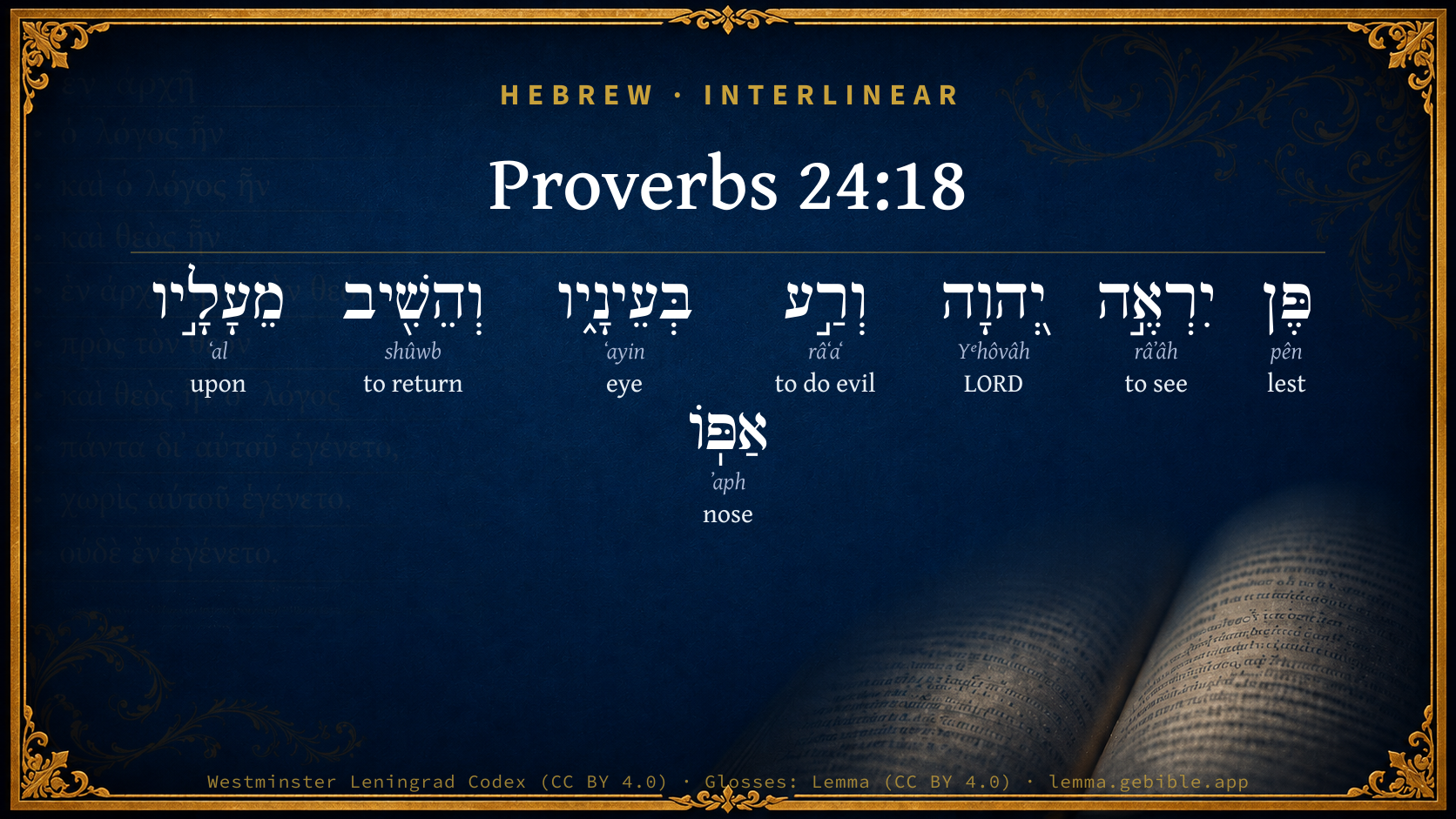
Hebrew (Westminster Leningrad Codex) Proverbs 24:18 appears in the Hebrew Old Testament. The text above is from the Westminster Leningrad Codex. Each word links to its Strong’s number, a concise gloss, and parsing drawn from the Open Scriptures Hebrew Bible morphology. Click any word for its full Brown-Driver-Briggs (BDB) entry.
Download image
Cite this verse

Proverbs 24:18 (World English Bible). Public Domain. Lemma interlinear Bible study tool, https://lemma.gebible.app/v/proverbs/24/18.

Show BibTeX & RIS
BibTeX
RIS
English Translation
Lest Yahweh see it, and it displease him, And he turn away his wrath from him.
World English Bible · Public Domain
Download a study sheet

One document with this verse’s original text, its word-by-word gloss line, the meaning frame, cross-references with their text, attributed commentary, and full source and license credits — printable, and it pastes into notes with its structure intact.

This verse Autodidact and up

Study sheet (.html) Plain text (.txt)

A passage Seminary Student

Up to 50 verses in one chapter. A passage sheet keeps up to 6 commentary sources and 12 cross-references per verse, in the order this page ranks them, and says so on the sheet whenever that leaves anything out. Ask for a single verse and you get the Autodidact verse sheet above.

Everything on this page stays free to read, with no account — the sheet is a download of what is already on screen, not access to it.

Want to remove ads? Support Godless Engineer
Compare translations 3

The same verse in 3 English versions, stacked beneath the original-language interlinear above. Click any original word for its lexicon entry.

Each is an independent rendering of the whole verse — the interlinear is not word-aligned to these translations.

Highlighted words mark where these versions differ — a whole-verse word diff, not a word-by-word alignment.

  • World English Bible Public Domain
    Lest Yahweh see it, and it displease him, And he turn away his wrath from him.
  • King James Version Public Domain
    Lest the LORD see it, and it displease him, and he turn away his wrath from him.
  • unfoldingWord Literal Text CC BY-SA 4.0
    lest Yahweh see, and evil in his eyes, and he turn away his nose from upon him.

unfoldingWord Literal Text — © unfoldingWord, licensed CC BY-SA 4.0. Word-aligned USFM3 via Door43 (git.door43.org/unfoldingWord/en_ult).

Versions to compare (up to 4)

3 of 4 selected

Show all 18 translations

Every available English version of this verse, each an independent rendering of the whole verse.

  • World English Bible Public Domain
    Lest Yahweh see it, and it displease him, And he turn away his wrath from him.
  • Berean Standard Bible Public Domain
    or the LORD will see and disapprove, and turn His wrath away from him.
  • Majority Standard Bible Public Domain
    or the LORD will see and disapprove, and turn His wrath away from him.
  • King James Version Public Domain
    Lest the LORD see it, and it displease him, and he turn away his wrath from him.
  • American Standard Version (1901) Public Domain
    Lest Jehovah see it, and it displease him, And he turn away his wrath from him.
  • Revised Version (1885) Public Domain
    Lest the LORD see it, and it displease him, and he turn away his wrath from him.
  • Geneva Bible (1599) Public Domain
    Least the Lord see it, and it displease him, and he turne his wrath from him.
  • Douay-Rheims (1899) Public Domain
    Lest the Lord see, and it displease him, and he turn away his wrath from him.
  • Young's Literal Translation Public Domain
    Lest Jehovah see, and `it be' evil in His eyes, And He hath turned from off him His anger.
  • Literal Standard Version CC BY-SA 4.0
    Lest YHWH see, and [it be] evil in His eyes, || And He has turned His anger from off him.
  • Unlocked Literal Bible CC BY-SA 4.0
    or Yahweh will see and disapprove and turn away his wrath from him.
  • unfoldingWord Literal Text CC BY-SA 4.0
    lest Yahweh see, and evil in his eyes, and he turn away his nose from upon him.
  • Darby Bible Public Domain
    lest Jehovah see it, and it be evil in his sight, and he turn away his anger from him.
  • World Messianic Bible Public Domain
    lest the LORD see it, and it displease him, and he turn away his wrath from him.
  • Webster's Bible Public Domain
    Lest the LORD see it, and it displease him, and he turn away his wrath from him.
  • Free Bible Version CC BY-SA 4.0
    otherwise when the Lord sees it, he'll be unhappy with you and won't punish your enemies as he planned.
  • Bible in Basic English Public Domain
    For fear that the Lord may see it, and it may be evil in his eyes, and his wrath may be turned away from him.
  • JPS Tanakh (1917) Public Domain
    Lest the LORD see it, and it displease Him, and He turn away His wrath from him.

Literal Standard Version (2020), Covenant Press — licensed CC BY-SA 4.0. Text via the HelloAO Bible API (eBible.org). Unlocked Literal Bible (unfoldingWord) — licensed CC BY-SA 4.0. Text via the HelloAO Bible API (eBible.org). unfoldingWord Literal Text — © unfoldingWord, licensed CC BY-SA 4.0. Word-aligned USFM3 via Door43 (git.door43.org/unfoldingWord/en_ult). Free Bible Version, Dr. Jonathan Gallagher — licensed CC BY-SA 4.0. Text via the HelloAO Bible API (eBible.org).

Word by word

More ways to search: Search by grammar → Find every occurrence → Compare this word →

Practice this passage: Drill this verse → Learn its vocabulary →

וְרַ֣ע
râʻaʻ
H7489
“and · to do evil”
Conjunction + Verb, Qal, Sequential Perfect, 3rd Person, Masculine, Singular
Part of Speech
Conjunction + Verb
Stem
Qal
Form
Sequential Perfect
Person
3rd Person
Gender
Masculine
Number
Singular
Full BDB Definition

Origin: a primitive root

TWOT: 2191 , 2192

to be bad, be evil - (Qal) - to be displeasing - to be sad - to be injurious, be evil - to be wicked, be evil (ethically) - (Hiphil) - to do an injury or hurt - to do evil or wickedly - mischief (participle) - to break, shatter - (Qal) - to break - broken (participle) - to be broken - (Hithpolel) to be broken, be broken in pieces, be broken asunder
  1. פֶּן pên H6435 “lest” Conjunction
  2. יִרְאֶ֣ה râʼâh H7200 “to see” Verb, Qal, Imperfect, 3rd Person, Masculine, Singular
  3. יְ֭הוָה Yᵉhôvâh H3068 “LORD” Noun, Proper
  4. בְּעֵינָ֑יו ʻayin H5869 “in/at · eyes · his” Preposition + Noun, Common, Both, Dual, Construct + Suffix, Personal, 3rd Person, Masculine, Singular
  5. וְהֵשִׁ֖יב shûwb H7725 “and · to return” Conjunction + Verb, Hiphil, Sequential Perfect, 3rd Person, Masculine, Singular
  6. מֵעָלָ֣יו ʻal H5921 “from · upon · him” Preposition + Preposition + Suffix, Personal, 3rd Person, Masculine, Singular
  7. אַפּֽוֹ ʼaph H639 “nose · his” Noun, Common, Masculine, Singular, Construct + Suffix, Personal, 3rd Person, Masculine, Singular

About this verse

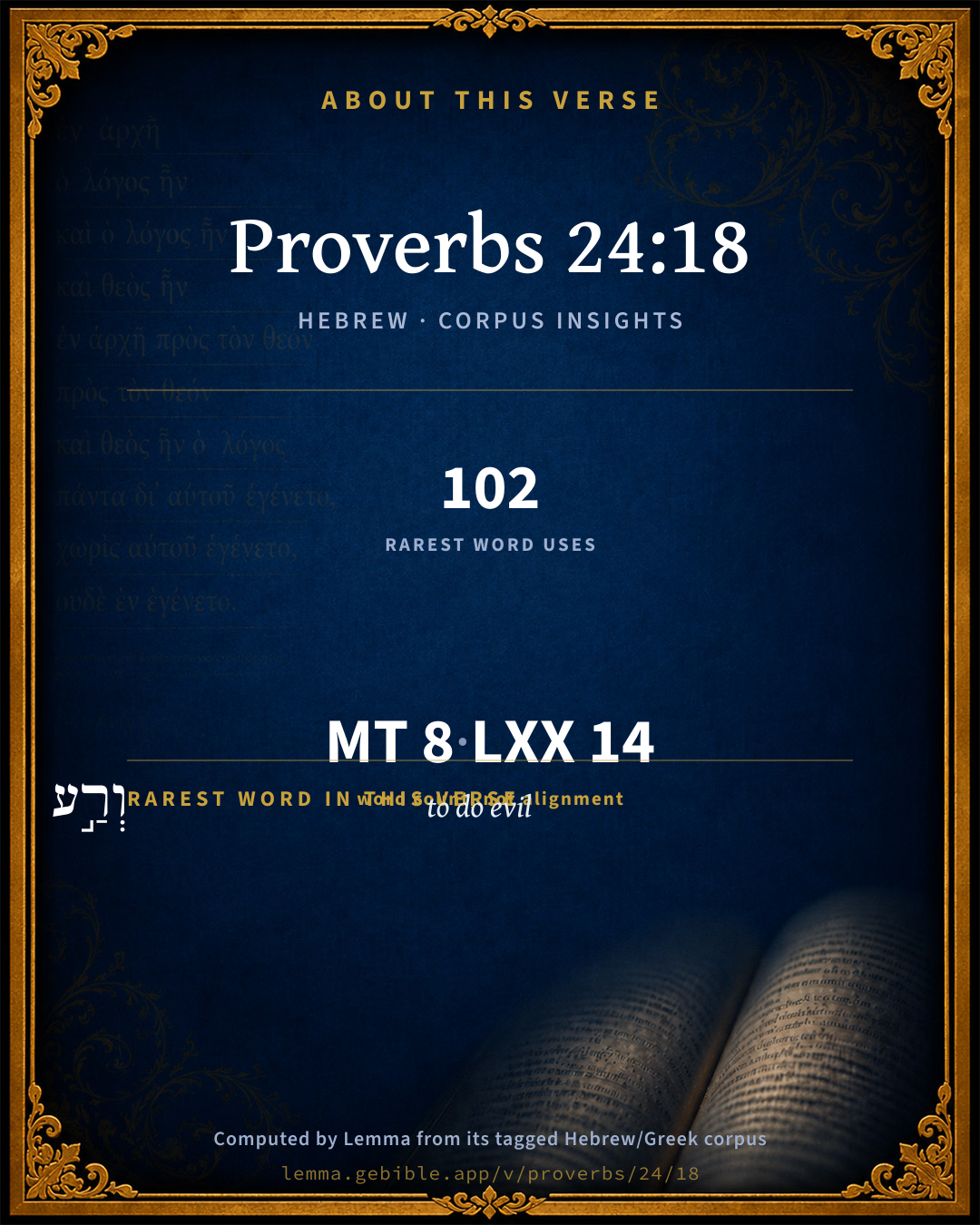
These counts appear in no published source. They are computed here, from the morphology-tagged text and Lemma’s own curated glosses. What Lemma adds →

8
words
8
distinct lemmas
Wisdom
section

Grammatical profile

  • 3 verbs
  • 3 nouns
  • 1 preposition
  • 1 conjunction

Verb forms

  • יִרְאֶ֣ה Qal · Imperfect
  • וְרַ֣ע Qal · Sequential Perfect
  • וְהֵשִׁ֖יב Hiphil · Sequential Perfect

Hebrew & Septuagint length

In English translation the verse runs 16 words from the Hebrew and 21 from the Septuagint (LXX English) — closely comparable.

A rough comparison of the two English renderings, which tokenize alike — not a word-level alignment.

Word counts can differ between the Hebrew and the Greek without any difference in meaning — e.g. the Hebrew direct-object marker אֵת has no separate Greek word, and Greek often adds the article ὁ.

In the original languages it is 8 Hebrew tokens and 14 Greek tokens — but the two are counted differently (Hebrew bundles its prefixes and suffixes into one token; the Greek is in lemma form), so that isn’t a like-for-like length.

Cross-references

2

Topical passages linked to Proverbs 24:18 in the Treasury of Scripture Knowledge — connected by theme and wording, ordered by reader-vote popularity; previews shown in the World English Bible.

  • Lamentations 4:21–22 Rejoice and be glad, daughter of Edom, that dwell in the land of Uz: The cup shall pass through to you also; you shall be drunken, and shall make yourself naked.
  • Zechariah 1:15–16 I am very angry with the nations that are at ease; for I was but a little displeased, but they added to the calamity."

Cross-references courtesy of OpenBible.info (CC BY 4.0).

Hebrew and Greek witnesses Masoretic Hebrew ↔ Greek Septuagint

The same verse in the two great witnesses to the Old Testament, shown verse-for-verse.

These are two independent witnesses, not word-aligned to each other, and the Septuagint is shown in lemma (dictionary) form.

Hebrew Proverbs 24:18 Masoretic · Westminster Leningrad Codex

פֶּן יִרְאֶ֣ה יְ֭הוָה וְרַ֣ע בְּעֵינָ֑יו וְהֵשִׁ֖יב מֵעָלָ֣יו אַפּֽוֹ

Lest Yahweh see it, and it displease him, And he turn away his wrath from him.

World English Bible · Public Domain

Greek LXX Proverbs 24:18 Septuagint · lemma form

ὅτι ὁράω κύριος καί οὐ ἀρέσω αὐτός καί ἀποστρέφω ὁ θυμός αὐτός ἀπό αὐτός

For the Lord will see it, and it will not please him, and he will turn away his wrath from him.

LXX2012 (modern English Septuagint) · Public Domain

Hebrew: Westminster Leningrad Codex (CC BY 4.0). Greek: Septuagint (public domain); English from LXX2012 (modern English Septuagint) (Public Domain). How the Septuagint differs from the Hebrew →

Commentary

Notes on Proverbs 24:18 from classic Christian and Jewish commentators (each source and its license shown beneath its notes). The classic Christian expositions comment on the surrounding passage and are grouped to its opening verse, so a note may address several verses; the Jewish commentaries on the Tanakh (Rashi and others) are per-verse, so they appear only where the commentator wrote on this verse.

Lemma curates 59 commentaries, every one of them public domain or Creative Commons licensed, each selected and text-cleaned for this edition rather than reprinted as found. About our sources →

Trapp's Complete Commentary

John Trapp

Pro 24:18 Lest the LORD see [it], and it displease him, and he turn away his wrath from him.

Ver. 18. Lest the Lord see it,] viz., Thy pride and cruelty, as he will, for he is ολοφθαλμος, all eye, and εχει Yεος εκδικον ομμα, if he see, he will kindle and turn the wheel upon thee, as he threatened to do upon Edom, for looking with liking upon Israel’s calamity. For prevention hereof, think thus with thyself, Either I am like mine enemy, or else I am better or worse than he. If like him, why may not I look for the like misery? If better, who made me to differ? If worse, what reason then have I to insult? See Oba 1:12.

John Trapp, A Commentary or Exposition upon All the Books of the Old and New Testament (1647–1656) — public domain. Text from a community e-Sword module.

Geneva Bible (1599)

Geneva Bible translators

To be avenged on thee.

Geneva Bible (1599) marginal notes — public domain. Text via Bolls.life.

Adam Clarke's Commentary

Verse 18. And he turn away his wrath from him.] Wrath is here taken for the effect of wrath, punishment; and the meaning must be as paraphrased above-lest he take the punishment from him, and inflict it upon thee. And in this way Coverdale understood it: "Lest the Lorde be angry, and turn his wrath from him unto thee." Or we may understand it thus: Lest the Lord inflict on thee a similar punishment; for if thou get into his spirit, rejoicing in the calamities of another, thou deservest punishment.

Adam Clarke's Commentary on the Bible (1810–1826) — public domain. Text from a community e-Sword/MySword module.

Ellicott's Commentary for English Readers

(18) And he turn away his wrath from him.—Upon thee as having sinned more deeply than thine enemy in thus rejoicing at his misfortunes. (Comp. Pro_17:5.)

A Bible Commentary for English Readers, edited by Charles John Ellicott (1878–1897) — public domain. Text from a community e-Sword module.

The Cambridge Bible for Schools and Colleges

gen. ed. J. J. S. Perowne

18. from him] Some commentators would add, “upon thee”; “et irascatur contra te,” Münster. It is better to leave the proverb as it stands, and to supplement its teaching by such proverbs as Pro_24:29, Pro_25:21-22.

The Cambridge Bible for Schools and Colleges (gen. ed. J. J. S. Perowne; Cambridge University Press, 1878–1918) — public domain. Text from a community e-Sword module.

John Gill's Exposition

Fret not thyself because of evil men,.... Because of their outward prosperity and worldly happiness, any more than rejoice at their adversity; neither do the one nor the other; where the one prevails, the other does also; by the frequent repetition of this advice, it looks as if this evil is what good men are prone to, and which was very common in Solomon's time, and in the time of his father David, from whom he seems to have borrowed these words, Psa 37:1; see Pro 23:17;

neither be thou envious at the wicked; though they may stand when thou fallest, or be in prosperity when thou art in adversity; the reasons follow.

John Gill's Exposition of the Whole Bible (1746–1763) — public domain (CC PDM 1.0). Text via the HelloAO Bible API.

Albert Barnes' Notes on the Bible

See the margin. The meaning is “Thy joy will be suicidal, the wrath of the righteous Judge will be turned upon thee, as the greater offender, and thou wilt have to bear a worse evil than that which thou exultest in.”

Albert Barnes' Notes on the Bible (1834–1885) — public domain. Text from a community e-Sword/MySword module.

Haydock's Catholic Bible Commentary

From. To punish thee. (Calmet) --- Thus will thy thirst of vengeance be disappointed. (Haydock) --- The Hebrews believed that there was no evil, which was not caused by sin; and this was true in some sense. But still God often afflicts his servants, (ver. 16,) as the whole book of Job tends to prove. (Calmet)

George Leo Haydock (1774–1849), Haydock's Catholic Family Bible and Commentary, 1859 edition — public domain. Excludes Psalms (Douay-Rheims chapter numbering differs from Protestant) and Deuterocanonical books (Catholic canon only).

Matthew Poole's English Annotations

Understand, upon thee, which is implied in the Hebrew phrase, such defects being usual in that concise language, Psa 84:11; Pro 19:1, and oft elsewhere. This consideration strikes at the root of that sinful and inhuman disposition, which is an expectation of safety or advantage to himself by his enemy’s downfall, which, saith he, by this very mean thou shalt lose, for thine enemy shall be raised, and thy danger greatly increased, by thy provoking both God and him against thee.

Matthew Poole's English Annotations on the Holy Bible (1683–1685) — public domain. Text from a community e-Sword/MySword module.

The Pulpit Commentary

Lest the Lord see it, and it displease him. This malignant pleasure at others" misfortunes (which Aristotle, "Eth. Nic.," 2:7. 15, calls epicairekakia ) is a sin in the eyes of God, and calls for punishment. And he turn away his wrath from him; and, as is implied, direct it upon thee. But it seems a mean motive to adduce, if the maxim is taken baldly to mean, "Do not rejoice at your enemy"s calamity, lest God relieve him from the evil:" for true charity would wish for such a result. Bode considers "his wrath" to be the enemy"s ill will against thee, which God by his grace changes to love, and thou art thus covered with confusion and shame for thy former vindictiveness. But the point is not so much the removal of God"s displeasure from the enemy as the punishment of tile malignant man, either mentally or materially. To a malignant mind no severer blow could be given than to see a foe recover God"s favor and rise from his fall. The moralist then warns the disciple against giving way to this epicairekakia lest he prepare for himself bitter mortification by having to witness the restoration of the hated one, or by being himself made to suffer that evil which he had rejoiced to see his neighbour experience. (comp. Pro_17:5, and note there)

The Pulpit Commentary (1880–1919), ed. H.D.M. Spence-Jones & Joseph S. Exell — public domain. Text from a community e-Sword module.

John Wesley's Explanatory Notes

From him - Understand, upon thee, which is implied in the Hebrew phrase.

John Wesley, Explanatory Notes Upon the Whole Bible (1754–1765) — public domain. Text via the GEBible commentary corpus.

Kretzmann's Popular Commentary

Paul E. Kretzmann

v. 18. lest the Lord see it and it displease Him, as all evidences of malice are hound to do, and He turn away His wrath from him, that is, from the enemy, His punishment striking the person of malignant spirit instead.

Paul E. Kretzmann, Popular Commentary of the Bible (1921–1924) — public domain. Text from a community e-Sword module.

Lesson kit

Teaching starters — assembled from the data on this page, not authored interpretation. Every prompt links to the verse data it draws on. Edit before teaching.

Proverbs, in the Wisdom, opens this verse with 8 words (8 distinct Hebrew lemmas). Its most distinctive word is râʻaʻ (“to do evil”). A historical commentator’s framing appears above. Read the whole chapter for the surrounding context.

Discussion questions

  1. How does “to do evil” (râʻaʻ) shape what this verse is saying?
  2. Lamentations 4:21–22 shares this passage’s theme. How do the two illuminate each other?
  3. These translations render this verse differently; the difference is in the English rendering, not the original. What questions does that raise?
  4. The verb «יִרְאֶ֣ה» is Qal Imperfect. How does its form color the action?
  5. Reading how Trapp's Complete Commentary and Geneva Bible (1599) read this verse, where do the two commentators agree and where do they part?

Things to notice

Reading settings

Reading text

Shown beneath each verse's original-language words.

Old Testament
Old Testament edition

Read the OT as the Masoretic Hebrew (MT) or the Greek Septuagint (LXX).

English shown for the Greek Septuagint (in the Hebrew ↔ Greek comparison).

Comparing translations? Open the Compare panel on any verse page to stack up to four side by side.