
Jeremiah 31:28

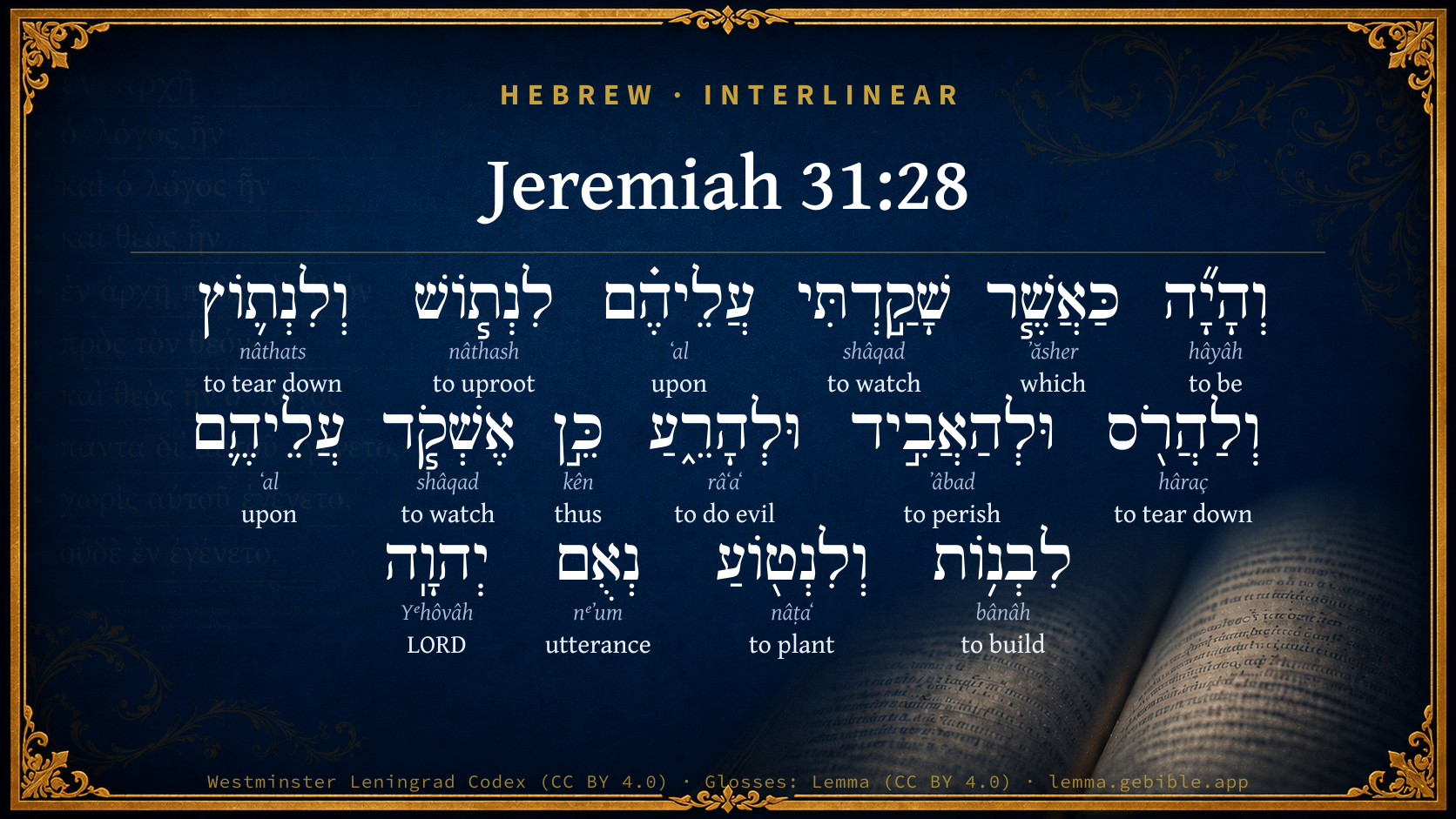
Hebrew (Westminster Leningrad Codex) Jeremiah 31:28 appears in the Hebrew Old Testament. The text above is from the Westminster Leningrad Codex. Each word links to its Strong’s number, a concise gloss, and parsing drawn from the Open Scriptures Hebrew Bible morphology. Click any word for its full Brown-Driver-Briggs (BDB) entry.
Download image
Cite this verse

Jeremiah 31:28 (World English Bible). Public Domain. Lemma interlinear Bible study tool, https://lemma.gebible.app/v/jeremiah/31/28.

Show BibTeX & RIS
BibTeX
RIS
English Translation
It shall happen that, like as I have watched over them to pluck up and to break down and to overthrow and to destroy and to afflict, so will I watch over them to build and to plant, says Yahweh.
World English Bible · Public Domain
Download a study sheet

One document with this verse’s original text, its word-by-word gloss line, the meaning frame, cross-references with their text, attributed commentary, and full source and license credits — printable, and it pastes into notes with its structure intact.

This verse Autodidact and up

Study sheet (.html) Plain text (.txt)

A passage Seminary Student

Up to 50 verses in one chapter. A passage sheet keeps up to 6 commentary sources and 12 cross-references per verse, in the order this page ranks them, and says so on the sheet whenever that leaves anything out. Ask for a single verse and you get the Autodidact verse sheet above.

Everything on this page stays free to read, with no account — the sheet is a download of what is already on screen, not access to it.

Want to remove ads? Support Godless Engineer
Compare translations 3

The same verse in 3 English versions, stacked beneath the original-language interlinear above. Click any original word for its lexicon entry.

Each is an independent rendering of the whole verse — the interlinear is not word-aligned to these translations.

Highlighted words mark where these versions differ — a whole-verse word diff, not a word-by-word alignment.

  • World English Bible Public Domain
    It shall happen that, like as I have watched over them to pluck up and to break down and to overthrow and to destroy and to afflict, so will I watch over them to build and to plant, says Yahweh.
  • King James Version Public Domain
    And it shall come to pass, that like as I have watched over them, to pluck up, and to break down, and to throw down, and to destroy, and to afflict; so will I watch over them, to build, and to plant, saith the LORD.
  • unfoldingWord Literal Text CC BY-SA 4.0
    In the past, I kept them under surveillance in order to uproot them and to tear them down, to overthrow, destroy, and bring them harm. But in the coming days, I will watch over them, in order to build them up and to plant them—this is Yahweh’s declaration.

unfoldingWord Literal Text — © unfoldingWord, licensed CC BY-SA 4.0. Word-aligned USFM3 via Door43 (git.door43.org/unfoldingWord/en_ult).

Versions to compare (up to 4)

3 of 4 selected

Show all 18 translations

Every available English version of this verse, each an independent rendering of the whole verse.

  • World English Bible Public Domain
    It shall happen that, like as I have watched over them to pluck up and to break down and to overthrow and to destroy and to afflict, so will I watch over them to build and to plant, says Yahweh.
  • Berean Standard Bible Public Domain
    Just as I watched over them to uproot and tear down, to demolish, destroy, and bring disaster, so I will watch over them to build and to plant,” declares the LORD.
  • Majority Standard Bible Public Domain
    Just as I watched over them to uproot and tear down, to demolish, destroy, and bring disaster, so I will watch over them to build and to plant,” declares the LORD.
  • King James Version Public Domain
    And it shall come to pass, that like as I have watched over them, to pluck up, and to break down, and to throw down, and to destroy, and to afflict; so will I watch over them, to build, and to plant, saith the LORD.
  • American Standard Version (1901) Public Domain
    And it shall come to pass that, like as I have watched over them to pluck up and to break down and to overthrow and to destroy and to afflict, so will I watch over them to build and to plant, saith Jehovah.
  • Revised Version (1885) Public Domain
    And it shall come to pass, that like as I have watched over them to pluck up and to break down, and to overthrow and to destroy, and to afflict; so will I watch over them to build and to plant, saith the LORD.
  • Geneva Bible (1599) Public Domain
    And like as I haue watched vpon them, to plucke vp and to roote out, and to throw downe, and to destroy, and to plague them, so wil I watch ouer them, to build and to plant them, saith ye Lord.
  • Douay-Rheims (1899) Public Domain
    And as I have watched over them, to pluck up, and to throw down, and to scatter, and destroy, and afflict: so will I watch over them, to build up, and to plant them, saith the Lord.
  • Young's Literal Translation Public Domain
    And it hath been, as I watched over them to pluck up, And to break down, and to throw down, And to destroy, and to afflict; So do I watch over them to build, and to plant, An affirmation of Jehovah.
  • Literal Standard Version CC BY-SA 4.0
    And it has been, as I watched over them to pluck up, || And to break down, and to throw down, || And to destroy, and to afflict; So I watch over them to build, and to plant,” || A declaration of YHWH.
  • Unlocked Literal Bible CC BY-SA 4.0
    In the past, I kept them under surveillance in order to uproot them and to tear them down, to overthrow, destroy, and bring them harm. But in the coming days, I will watch over them, in order to build them up and to plant them—this is Yahweh's declaration.
  • unfoldingWord Literal Text CC BY-SA 4.0
    In the past, I kept them under surveillance in order to uproot them and to tear them down, to overthrow, destroy, and bring them harm. But in the coming days, I will watch over them, in order to build them up and to plant them—this is Yahweh’s declaration.
  • Darby Bible Public Domain
    And it shall come to pass, as I have watched over them, to pluck up, and to break down, and to overthrow, and to destroy, and to afflict; so will I watch over them to build, and to plant, saith Jehovah.
  • World Messianic Bible Public Domain
    It will happen that, like as I have watched over them to pluck up and to break down and to overthrow and to destroy and to afflict, so I will watch over them to build and to plant,” says the LORD.
  • Webster's Bible Public Domain
    And it shall come to pass, that as I have watched over them, to pluck up, and to break down, and to throw down, and to destroy, and to afflict; so will I watch over them, to build and to plant, saith the LORD.
  • Free Bible Version CC BY-SA 4.0
    I took care of them by uprooting them and tearing them down, by wiping them out and destroying them and bringing them disaster. Now I will take care of them by building them up and helping them grow, declares the Lord.
  • Bible in Basic English Public Domain
    And it will come about that, as I have been watching over them for the purpose of uprooting and smashing down and overturning and sending destruction and causing trouble; so I will be watching over them for the purpose of building up and planting, says the Lord.
  • JPS Tanakh (1917) Public Domain
    And it shall come to pass, that like as I have watched over them to pluck up and to break down, and to overthrow and to destroy, and to afflict; so will I watch over them to build and to plant, saith the LORD.

Literal Standard Version (2020), Covenant Press — licensed CC BY-SA 4.0. Text via the HelloAO Bible API (eBible.org). Unlocked Literal Bible (unfoldingWord) — licensed CC BY-SA 4.0. Text via the HelloAO Bible API (eBible.org). unfoldingWord Literal Text — © unfoldingWord, licensed CC BY-SA 4.0. Word-aligned USFM3 via Door43 (git.door43.org/unfoldingWord/en_ult). Free Bible Version, Dr. Jonathan Gallagher — licensed CC BY-SA 4.0. Text via the HelloAO Bible API (eBible.org).

Word by word

More ways to search: Search by grammar → Find every occurrence → Compare this word →

Practice this passage: Drill this verse → Learn its vocabulary →

שָׁקַ֣דְתִּי
shâqad
H8245
“to watch”
Verb, Qal, Perfect, 1st Person, Common, Singular
Part of Speech
Verb
Stem
Qal
Form
Perfect
Person
1st Person
Gender
Common
Number
Singular
Full BDB Definition

Origin: a primitive root

TWOT: 2451

to wake, watch, awake, be alert - (Qal) - to keep watch of, be wakeful over - to be wakeful, wake (as mourner or sufferer)
  1. וְהָיָ֞ה hâyâh H1961 “and · to be” Conjunction + Verb, Qal, Sequential Perfect, 3rd Person, Masculine, Singular
  2. כַּאֲשֶׁ֧ר ʼăsher H834 “like/as · which” Preposition + Particle, Relative
  3. עֲלֵיהֶ֗ם ʻal H5921 “upon · them” Preposition + Suffix, Personal, 3rd Person, Masculine, Plural
  4. לִנְת֧וֹשׁ nâthash H5428 “to uproot” Preposition + Verb, Qal, Infinitive Construct
  5. וְלִנְת֛וֹץ nâthats H5422 “and · to tear down” Conjunction + Preposition + Verb, Qal, Infinitive Construct
  6. וְלַהֲרֹ֖ס hâraç H2040 “and · to tear down” Conjunction + Preposition + Verb, Qal, Infinitive Construct
  7. וּלְהַאֲבִ֣יד ʼâbad H6 “and · to perish” Conjunction + Preposition + Verb, Hiphil, Infinitive Construct
  8. וּלְהָרֵ֑עַ râʻaʻ H7489 “and · to do evil” Conjunction + Preposition + Verb, Hiphil, Infinitive Construct
  9. כֵּ֣ן kên H3651 “thus” Particle, Demonstrative
  10. אֶשְׁקֹ֧ד shâqad H8245 “to watch” Verb, Qal, Imperfect, 1st Person, Common, Singular
  11. עֲלֵיהֶ֛ם ʻal H5921 “upon · them” Preposition + Suffix, Personal, 3rd Person, Masculine, Plural
  12. לִבְנ֥וֹת bânâh H1129 “to build” Preposition + Verb, Qal, Infinitive Construct
  13. וְלִנְט֖וֹעַ nâṭaʻ H5193 “and · to plant” Conjunction + Preposition + Verb, Qal, Infinitive Construct
  14. נְאֻם nᵉʼum H5002 “utterance of” Noun, Common, Masculine, Singular, Construct
  15. יְהוָֽה Yᵉhôvâh H3068 “LORD” Noun, Proper

About this verse

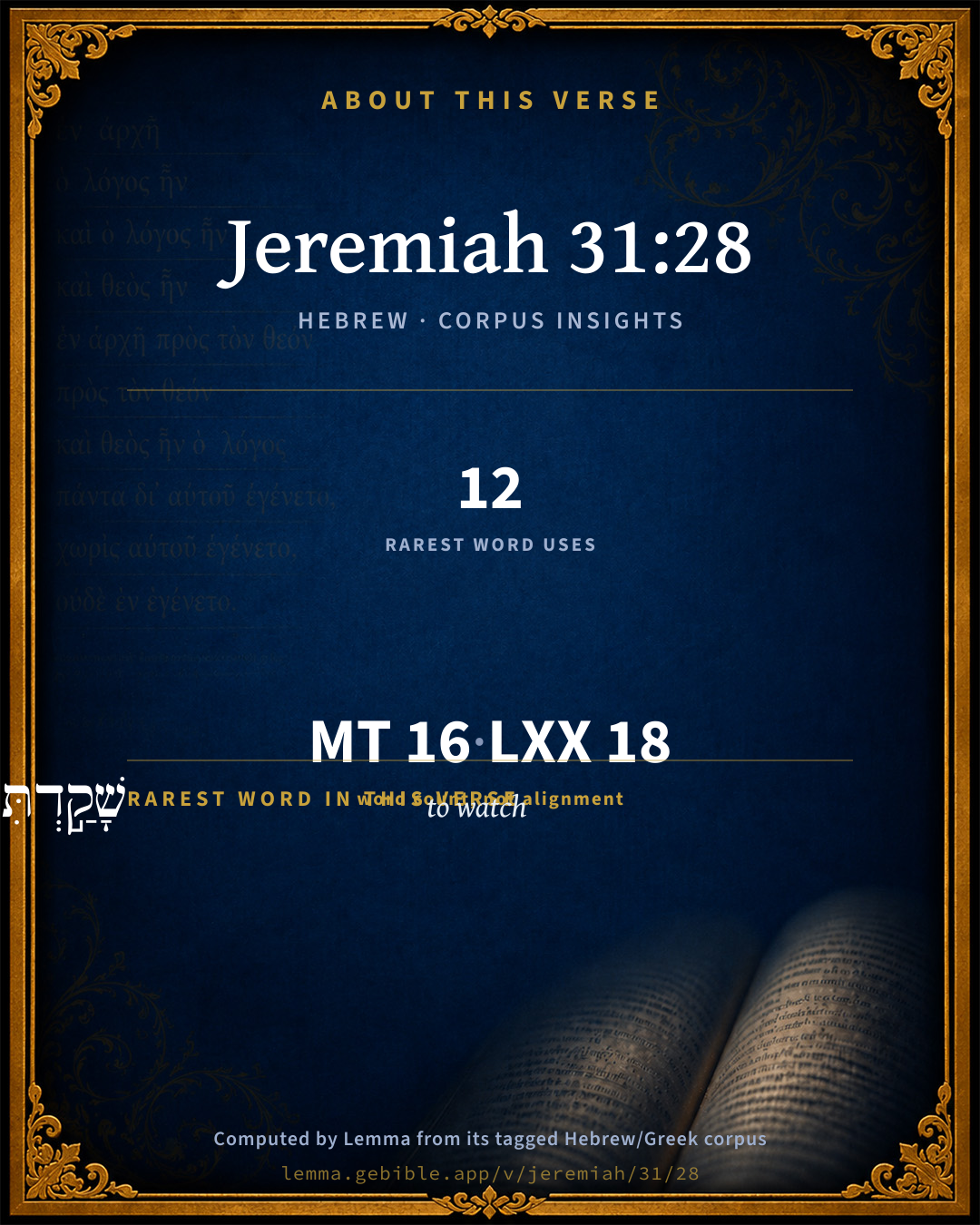
These counts appear in no published source. They are computed here, from the morphology-tagged text and Lemma’s own curated glosses. What Lemma adds →

16
words
14
distinct lemmas
Prophets
section

Notable vocabulary

The rarest word here is שָׁקַ֣דְתִּי to watch H8245 — appearing just 12 times in the whole Hebrew Bible.

Shared distinctive vocabulary

שָׁקַ֣דְתִּי to watch H8245 occurs in 11 verses of the Hebrew Bible. Also found in:

Grammatical profile

  • 10 verbs
  • 2 nouns
  • 2 prepositions
  • 2 particles

Verb forms

  • וְהָיָ֞ה Qal · Sequential Perfect
  • שָׁקַ֣דְתִּי Qal · Perfect
  • לִנְת֧וֹשׁ Qal · Infinitive Construct
  • וְלִנְת֛וֹץ Qal · Infinitive Construct
  • וְלַהֲרֹ֖ס Qal · Infinitive Construct
  • וּלְהַאֲבִ֣יד Hiphil · Infinitive Construct
  • וּלְהָרֵ֑עַ Hiphil · Infinitive Construct
  • אֶשְׁקֹ֧ד Qal · Imperfect
  • לִבְנ֥וֹת Qal · Infinitive Construct
  • וְלִנְט֖וֹעַ Qal · Infinitive Construct

Repetition

Words recur within this verse — often emphatic in Hebrew:

  • שָׁקַ֣דְתִּי to watch H8245 ×2
  • עֲלֵיהֶ֗ם upon H5921 ×2

Hebrew & Septuagint length

In the original languages it is 16 Hebrew tokens and 18 Greek tokens — but the two are counted differently (Hebrew bundles its prefixes and suffixes into one token; the Greek is in lemma form), so that isn’t a like-for-like length.

Cross-references

13

Topical passages linked to Jeremiah 31:28 in the Treasury of Scripture Knowledge — connected by theme and wording, ordered by reader-vote popularity; previews shown in the World English Bible.

  • Jeremiah 24:6 For I will set my eyes on them for good, and I will bring them again to this land: and I will build them, and not pull them down; and I will plant them, and not pluck them up.
  • Jeremiah 1:10 behold, I have this day set you over the nations and over the kingdoms, to pluck up and to break down and to destroy and to overthrow, to build and to plant.
  • Jeremiah 18:7–9 At what instant I shall speak concerning a nation, and concerning a kingdom, to pluck up and to break down and to destroy it;
  • Jeremiah 44:27 Behold, I watch over them for evil, and not for good; and all the men of Judah who are in the land of Egypt shall be consumed by the sword and by the famine, until there be an end of them.
  • Jeremiah 45:4 Thus shall you tell him, Thus says Yahweh: Behold, that which I have built will I break down, and that which I have planted I will pluck up; and this in the whole land.
  • Ecclesiastes 3:2–3 A time to be born, And a time to die; A time to plant, And a time to pluck up that which is planted;
  • Jeremiah 32:41 Yes, I will rejoice over them to do them good, and I will plant them in this land assuredly with my whole heart and with my whole soul.
  • Daniel 9:14 Therefore has Yahweh watched over the evil, and brought it on us; for Yahweh our God is righteous in all his works which he does, and we have not obeyed his voice.
  • Acts 15:16 'After these things I will return. I will again build the tent of David, which has fallen. I will again build its ruins. I will set it up,
  • Amos 9:11 In that day I will raise up the tent of David who is fallen, and close up its breaches, and I will raise up its ruins, and I will build it as in the days of old;
  • Psalms 69:35 For God will save Zion, and build the cities of Judah. They shall settle there, and own it.
  • Psalms 147:2 Yahweh builds up Jerusalem. He gathers together the outcasts of Israel.
  • Daniel 9:25 Know therefore and discern, that from the going forth of the commandment to restore and to build Jerusalem to the Anointed One, the prince, shall be seven weeks, and sixty-two weeks: it shall be built again, with street and moat, even in troubled times.

Cross-references courtesy of OpenBible.info (CC BY 4.0).

Hebrew and Greek witnesses Masoretic Hebrew ↔ Greek Septuagint

The same verse in the two great witnesses to the Old Testament, shown verse-for-verse.

These are two independent witnesses, not word-aligned to each other, and the Septuagint is shown in lemma (dictionary) form.

Hebrew Jeremiah 31:28 Masoretic · Westminster Leningrad Codex

וְהָיָ֞ה כַּאֲשֶׁ֧ר שָׁקַ֣דְתִּי עֲלֵיהֶ֗ם לִנְת֧וֹשׁ וְלִנְת֛וֹץ וְלַהֲרֹ֖ס וּלְהַאֲבִ֣יד וּלְהָרֵ֑עַ כֵּ֣ן אֶשְׁקֹ֧ד עֲלֵיהֶ֛ם לִבְנ֥וֹת וְלִנְט֖וֹעַ נְאֻם יְהוָֽה

It shall happen that, like as I have watched over them to pluck up and to break down and to overthrow and to destroy and to afflict, so will I watch over them to build and to plant, says Yahweh.

World English Bible · Public Domain

Greek LXX Structure differs

In the Septuagint, Jeremiah is about an eighth shorter than the Hebrew and arranges its material differently — the Oracles Against the Nations (Hebrew chapters 46–51) appear in the middle of the Greek book, after 25:13. Because the chapter and verse boundaries do not line up, a verse-for-verse comparison with the Hebrew is not shown.

A verse-for-verse comparison isn’t shown here because the chapters and verses don’t line up. Switch to the LXX edition with the MT / LXX toggle above to read the Greek directly.

Hebrew: Westminster Leningrad Codex (CC BY 4.0). Greek: Septuagint (public domain); English from a public-domain English Septuagint. How the Septuagint differs from the Hebrew →

Targum (Aramaic paraphrase)

1

The Targum is the ancient Jewish Aramaic paraphrase of the Hebrew Scriptures — an interpretive translation, not the Hebrew text itself. Onkelos (literal) and Pseudo-Jonathan (expansive) render the Torah, and Jonathan the Prophets. Coverage is partial: where no permissively-licensed English translation exists for a verse, only the Aramaic is shown. This is verse-level text, not a word-by-word alignment to the Hebrew.

  1. Targum Jonathan Prophets (Joshua–Malachi)
    וִיהִי כְמָה דְחַשְׁבֵית עֲלֵיהוֹן לְמֶעְקַר וּלְתַרְעָא וּלְפַגְרָא וּלְאַבָּדָא וּלְאַבְאָשָׁא כֵּן יֶחְדֵי מֵימְרֵי עֲלֵיהוֹן לְמֶבְנֵי וּלְקָיָמָא אֲמַר יְיָ:

    Just as I devised to uproot, smash, slay and destroy them, so I will devise plans to build and sustain them, says Hashem.

    Targum Jonathan — Aramaic: “Mikraot Gedolot” (public domain). English: “Sefaria Community Translation” (CC0 1.0 (public-domain dedication)); “London "Chaldee Paraphrase," 1871” (public domain). Text via Sefaria.

Commentary

Notes on Jeremiah 31:28 from classic Christian and Jewish commentators (each source and its license shown beneath its notes). The classic Christian expositions comment on the surrounding passage and are grouped to its opening verse, so a note may address several verses; the Jewish commentaries on the Tanakh (Rashi and others) are per-verse, so they appear only where the commentator wrote on this verse.

Lemma curates 59 commentaries, every one of them public domain or Creative Commons licensed, each selected and text-cleaned for this edition rather than reprinted as found. About our sources →

Trapp's Complete Commentary

John Trapp

Jer 31:28 And it shall come to pass, [that] like as I have watched over them, to pluck up, and to break down, and to throw down, and to destroy, and to afflict; so will I watch over them, to build, and to plant, saith the LORD.

Ver. 28. Like as I have watched over them.] I have been sedulous and assiduous.

To pluck up and break down, &c.] See Jer 1:10-11; Jer 10:12; Jer 18:7.

So I will watch.] I will make them a plentiful amends.

John Trapp, A Commentary or Exposition upon All the Books of the Old and New Testament (1647–1656) — public domain. Text from a community e-Sword module.

Tyndale Open Study Notes

Tyndale Open Resources

31:28 The future refers to the return of the exiled people to the Promised Land, whom the Lord had promised to plant and build (see 1:10).

Tyndale Open Study Notes — © Tyndale Open Resources, licensed CC BY-SA 4.0. Text via the HelloAO Bible API.

Jamieson, Fausset & Brown

Robert Jamieson, A. R. Fausset & David Brown

(Jer 44:27). The same God who, as it were (in human language), was on the watch for all means to destroy, shall be as much on the watch for the means of their restoration.

Jamieson, Fausset & Brown — Commentary Critical and Explanatory on the Whole Bible (1871) — public domain (CC PDM 1.0). Text via the HelloAO Bible API.

John Calvin's Commentaries

By these words the Prophet confirms what he had said; for the Israelites and the Jews might have ever made this objection, “Why should God promise to be the liberator of his people, whom he had suffered to be oppressed with so great evils, for it would have been easier to prevent them?” The Jews then might have raised this clamor, “Thou givest us here the hope of a return, but why does God suffer us to be driven into exile? why then does he not apply the remedy in time; for now too late he declares that he will be a help to us after our ruin.” As then the Jews thought that a restoration was promised to them unseasonably, the Prophet says that it was God who chastised them and punished them for their sins, and that he could also relieve them whenever it pleased him. For had the Chaldeans, according to their own pleasure, ruled over the Jews, and had obtained the victory over them, who could have ever hoped that the miserable men, thus reduced, could have been delivered by God’s hand? But now the Prophet shews that there was no reason for the Jews to despair, as though it were difficult for God to free them from the tyranny of their enemies; for nothing had happened to them by chance, or through the power of their enemies, but through the righteous judgment of God.

We now then perceive the design of the Holy Spirit in what the Prophet says, As I have watched over them to pluck up and to break down and to break in pieces and to destroy, and to afflict; so will I watch, etc. God then sets himself forth as the judge who had punished them for their sins, in order that he might convince them that he would also become their Physician, as though he had said, “I who have inflicted the wound can therefore heal it,” according to what is said elsewhere,

“God is he who kills and brings to life, who leads down to the grave and brings up.” (1 Samuel 2:6)

But he employs many words, for the great mass of so many evils might have plunged the Jews into the abyss of despair. Hence the Prophet anticipates them, and shews, that though they had been reduced to extremities, yet so many and so severe calamities could not prevent God from restoring them, when it seemed good to him. He yet reminds them, that it was not without cause that they suffered such grievous things; for God takes no delight in the miseries of his people. The people then ought to have learnt that they had been guilty of great sins from the fact, that they had been chastised with so much rigor and severity. He now adds, So will I watch over you to build and to plant

As for the verb destroy, if we read הרם erem, it ought to be rendered, and to take away The verb רם rem, as it is well known, means to elevate; but metaphorically, to take away. But the received reading, as I have said, is הרס eres. He says, that he would watch to build and to plant them, as he had watched to destroy them; as though he had said, that they had already been taught by experience, how great was the power of God’s hand to save as well as to destroy. They had disregarded threatenings as long as God had spared them, and they thought that they could sin with impunity; and we see how insolently they rejected all the Prophets. But God had at length shewed by severe proofs how his judgments oughf; to have been dreaded. He now then inspires them with hope, for his watching would no less avail for their preservation. It follows, —

John Calvin's Commentaries (1540-1563) — public domain. Text from the Calvin Translation Society English edition (1840s-50s) via the Christian Classics Ethereal Library (ccel.org). Calvin's coverage is partial (roughly two-thirds of the Bible); uncommented books and verses are honest gaps, never fabricated. The 19th-century editor's footnotes and remarks are omitted so the notes are faithfully Calvin's own voice.

Ellicott's Commentary for English Readers

(28) Like as I have watched over them . . .—Some twenty-three years had passed since the prophet’s call to his office, but the words that called him to it are living still. The very symbolism of the “almond,” with the play upon its meaning, as the “wakeful” or “watching” tree (see Notes on Jer_1:10-11), the very terms in which his two-fold work was painted, are present to his thoughts, yet are seen under a new and brighter aspect. Up to this time his task had been mainly that of a prophet of evil, “rooting out” and “pulling down.” Now he sees before him the happier work of “building up” and “planting.”

A Bible Commentary for English Readers, edited by Charles John Ellicott (1878–1897) — public domain. Text from a community e-Sword module.

The Cambridge Bible for Schools and Colleges

gen. ed. J. J. S. Perowne

28. I have watched over them] The Heb. verb is the same as that of ch. Jer_1:12, where see note.

to pluck up, etc.] Cp. ch. Jer_1:10, Jer_18:7; Jer_18:9. Thus the later and more cheering part of the message for which Jeremiah was ordained is now being delivered by him.

The Cambridge Bible for Schools and Colleges (gen. ed. J. J. S. Perowne; Cambridge University Press, 1878–1918) — public domain. Text from a community e-Sword module.

John Gill's Exposition

And it shall come to pass, that like as I have watched over them,.... In providence; looked upon them with an eye of vindictive justice; observed all their actions and motions; diligently attended to everything that passed, and took the first and most fitting opportunity:

to pluck up, and to break down, and to throw down, and to destroy, and to afflict; which words, as they have an elegance and an agreeableness in their sound, in the original; so they are expressive of the utter overthrow of the city, temple, and nation of the Jews, and of the several troubles and calamities they should be afflicted with:

so will I watch over them; be as careful and diligent, as intent, earnest, and early:

to build, and to plant, saith the Lord; to build their city and temple, and to plant them in their own land. So the church of God is his building, whose foundation he lays, the superstructure of which he rears up, and will complete it in his own time; and it is his plantation, into which he puts his pleasant plants, his plants of renown; which he waters with his Spirit and grace, by the ministry of the word, that they may grow, and become fruitful.

John Gill's Exposition of the Whole Bible (1746–1763) — public domain (CC PDM 1.0). Text via the HelloAO Bible API.

Matthew Poole's English Annotations

Nothing can produce in God a change of counsels, purposes, and decrees, for he is not as man that he should lie or repent, he is the God that changeth not, but men’s reformation may produce in him a change of providential dispensations. God is here set out as a man that is vindictive, and his vindictive nature prompts him to watch all opportunities of doing hurt to the person against whom he is set. There is no fury nor revenge in God, but what he doth is justice; but here an angry God is set out as taking all opportunities to punish sinners, as if he had watched for them, whereas he never slumbereth nor sleepeth: but the time of their reformation and his favour being come, God promiseth to be as diligent to do them good, which is here expressed by the metaphorical notions of planting and building them, as he was before to execute his justice upon them.

Matthew Poole's English Annotations on the Holy Bible (1683–1685) — public domain. Text from a community e-Sword/MySword module.

Whedon's Commentary on the Bible

Daniel D. Whedon

28. Watched — See Jer_1:12, and the note there.

Daniel D. Whedon (gen. ed.), Commentary on the Old and New Testaments (1874–1909) — public domain. Text from a community e-Sword module.

The Pulpit Commentary

As I have watched... so will I watch, etc. The allusion is to the twofold commission given to the prophet, (Jer_1:10) which was partly to pluck up and to destroy, partly to build and to plant. Jehovah has hitherto been "watchful" (another point of contact with Jer 1; see on Jer_1:12) over the fulfilment of the destructive prophecies; he will now be equally zealous for that of the promises of regeneration.

The Pulpit Commentary (1880–1919), ed. H.D.M. Spence-Jones & Joseph S. Exell — public domain. Text from a community e-Sword module.

Lesson kit

Teaching starters — assembled from the data on this page, not authored interpretation. Every prompt links to the verse data it draws on. Edit before teaching.

Jeremiah, in the Prophets, opens this verse with 16 words (14 distinct Hebrew lemmas). Its most distinctive word is shâqad (“to watch”). A historical commentator’s framing appears above. Read the whole chapter for the surrounding context.

Discussion questions

  1. The word shâqad carries the sense “to watch.” How does it shape the verse?
  2. How does Ezra 8:29, which shares the word «to watch», read alongside this verse?
  3. What does the repetition of “to watch” (2× in this one verse) do in this verse?
  4. These translations render this verse differently. What is at stake in choosing one wording over another?
  5. «וְהָיָ֞ה» is a Qal Sequential Perfect verb. How does that grammatical form shape the action described?
  6. Compare how Trapp's Complete Commentary and Tyndale Open Study Notes read this verse. Where do they agree or differ?

Things to notice

Reading settings

Reading text

Shown beneath each verse's original-language words.

Old Testament
Old Testament edition

Read the OT as the Masoretic Hebrew (MT) or the Greek Septuagint (LXX).

English shown for the Greek Septuagint (in the Hebrew ↔ Greek comparison).

Comparing translations? Open the Compare panel on any verse page to stack up to four side by side.