
Proverbs 4:16

Hebrew (Westminster Leningrad Codex) Proverbs 4:16 appears in the Hebrew Old Testament. The text above is from the Westminster Leningrad Codex. Each word links to its Strong’s number, a concise gloss, and parsing drawn from the Open Scriptures Hebrew Bible morphology. Click any word for its full Brown-Driver-Briggs (BDB) entry.
Download image
Cite this verse

Proverbs 4:16 (World English Bible). Public Domain. Lemma interlinear Bible study tool, https://lemma.gebible.app/v/proverbs/4/16.

Show BibTeX & RIS
BibTeX
RIS
English Translation
For they don't sleep, unless they do evil. Their sleep is taken away, unless they make someone fall.
World English Bible · Public Domain
Download a study sheet

One document with this verse’s original text, its word-by-word gloss line, the meaning frame, cross-references with their text, attributed commentary, and full source and license credits — printable, and it pastes into notes with its structure intact.

This verse Autodidact and up

Study sheet (.html) Plain text (.txt)

A passage Seminary Student

Up to 50 verses in one chapter. A passage sheet keeps up to 6 commentary sources and 12 cross-references per verse, in the order this page ranks them, and says so on the sheet whenever that leaves anything out. Ask for a single verse and you get the Autodidact verse sheet above.

Everything on this page stays free to read, with no account — the sheet is a download of what is already on screen, not access to it.

Want to remove ads? Support Godless Engineer
Compare translations 3

The same verse in 3 English versions, stacked beneath the original-language interlinear above. Click any original word for its lexicon entry.

Each is an independent rendering of the whole verse — the interlinear is not word-aligned to these translations.

Highlighted words mark where these versions differ — a whole-verse word diff, not a word-by-word alignment.

  • World English Bible Public Domain
    For they don't sleep, unless they do evil. Their sleep is taken away, unless they make someone fall.
  • King James Version Public Domain
    For they sleep not, except they have done mischief; and their sleep is taken away, unless they cause some to fall.
  • unfoldingWord Literal Text CC BY-SA 4.0
    For they do not sleep if they do not do evil and their sleep is robbed if they do not cause stumbling.

unfoldingWord Literal Text — © unfoldingWord, licensed CC BY-SA 4.0. Word-aligned USFM3 via Door43 (git.door43.org/unfoldingWord/en_ult).

Versions to compare (up to 4)

3 of 4 selected

Show all 18 translations

Every available English version of this verse, each an independent rendering of the whole verse.

  • World English Bible Public Domain
    For they don't sleep, unless they do evil. Their sleep is taken away, unless they make someone fall.
  • Berean Standard Bible Public Domain
    For they cannot sleep unless they do evil; they are deprived of slumber until they make someone fall.
  • Majority Standard Bible Public Domain
    For they cannot sleep unless they do evil; they are deprived of slumber until they make someone fall.
  • King James Version Public Domain
    For they sleep not, except they have done mischief; and their sleep is taken away, unless they cause some to fall.
  • American Standard Version (1901) Public Domain
    For they sleep not, except they do evil; And their sleep is taken away, unless they cause some to fall.
  • Revised Version (1885) Public Domain
    For they sleep not, except they have done mischief; and their sleep is taken away, unless they cause some to fall.
  • Geneva Bible (1599) Public Domain
    For they can not sleepe, except they haue done euill, and their sleepe departeth except they cause some to fall.
  • Douay-Rheims (1899) Public Domain
    For they sleep not except they have done evil: and their sleep is taken away unless they have made some to fall.
  • Young's Literal Translation Public Domain
    For they sleep not if they do not evil, And their sleep hath been taken violently away, If they cause not `some' to stumble.
  • Literal Standard Version CC BY-SA 4.0
    For they do not sleep if they do no evil, || And their sleep has been taken away violently, || If they do not cause [some] to stumble.
  • Unlocked Literal Bible CC BY-SA 4.0
    For they cannot sleep until they do evil and they are robbed of sleep until they cause someone to stumble.
  • unfoldingWord Literal Text CC BY-SA 4.0
    For they do not sleep if they do not do evil and their sleep is robbed if they do not cause stumbling.
  • Darby Bible Public Domain
    For they sleep not except they have done mischief, and their sleep is taken away unless they have caused [some] to fall.
  • World Messianic Bible Public Domain
    For they don’t sleep unless they do evil. Their sleep is taken away, unless they make someone fall.
  • Webster's Bible Public Domain
    For they sleep not, except they have done mischief; and their sleep is taken away, unless they cause some to fall.
  • Free Bible Version CC BY-SA 4.0
    Evil people won't rest until they've done something wrong; they can't sleep unless they've tripped someone up.
  • Bible in Basic English Public Domain
    For they take no rest till they have done evil; their sleep is taken away if they have not been the cause of someone's fall.
  • JPS Tanakh (1917) Public Domain
    For they sleep not, except they have done evil; and their sleep is taken away, unless they cause some to fall.

Literal Standard Version (2020), Covenant Press — licensed CC BY-SA 4.0. Text via the HelloAO Bible API (eBible.org). Unlocked Literal Bible (unfoldingWord) — licensed CC BY-SA 4.0. Text via the HelloAO Bible API (eBible.org). unfoldingWord Literal Text — © unfoldingWord, licensed CC BY-SA 4.0. Word-aligned USFM3 via Door43 (git.door43.org/unfoldingWord/en_ult). Free Bible Version, Dr. Jonathan Gallagher — licensed CC BY-SA 4.0. Text via the HelloAO Bible API (eBible.org).

Word by word

More ways to search: Search by grammar → Find every occurrence → Compare this word →

Practice this passage: Drill this verse → Learn its vocabulary →

יִֽ֭שְׁנוּ
yâshên
H3462
“to sleep”
Verb, Qal, Imperfect, 3rd Person, Masculine, Plural
Part of Speech
Verb
Stem
Qal
Form
Imperfect
Person
3rd Person
Gender
Masculine
Number
Plural
Full BDB Definition

Origin: a primitive root

TWOT: 928

to sleep, be asleep - (Qal) to sleep, go to sleep, be asleep - (Niphal) - to remain a long time, be stored up - to be festering (of leprosy) - (Piel) to cause to sleep, entice to sleep
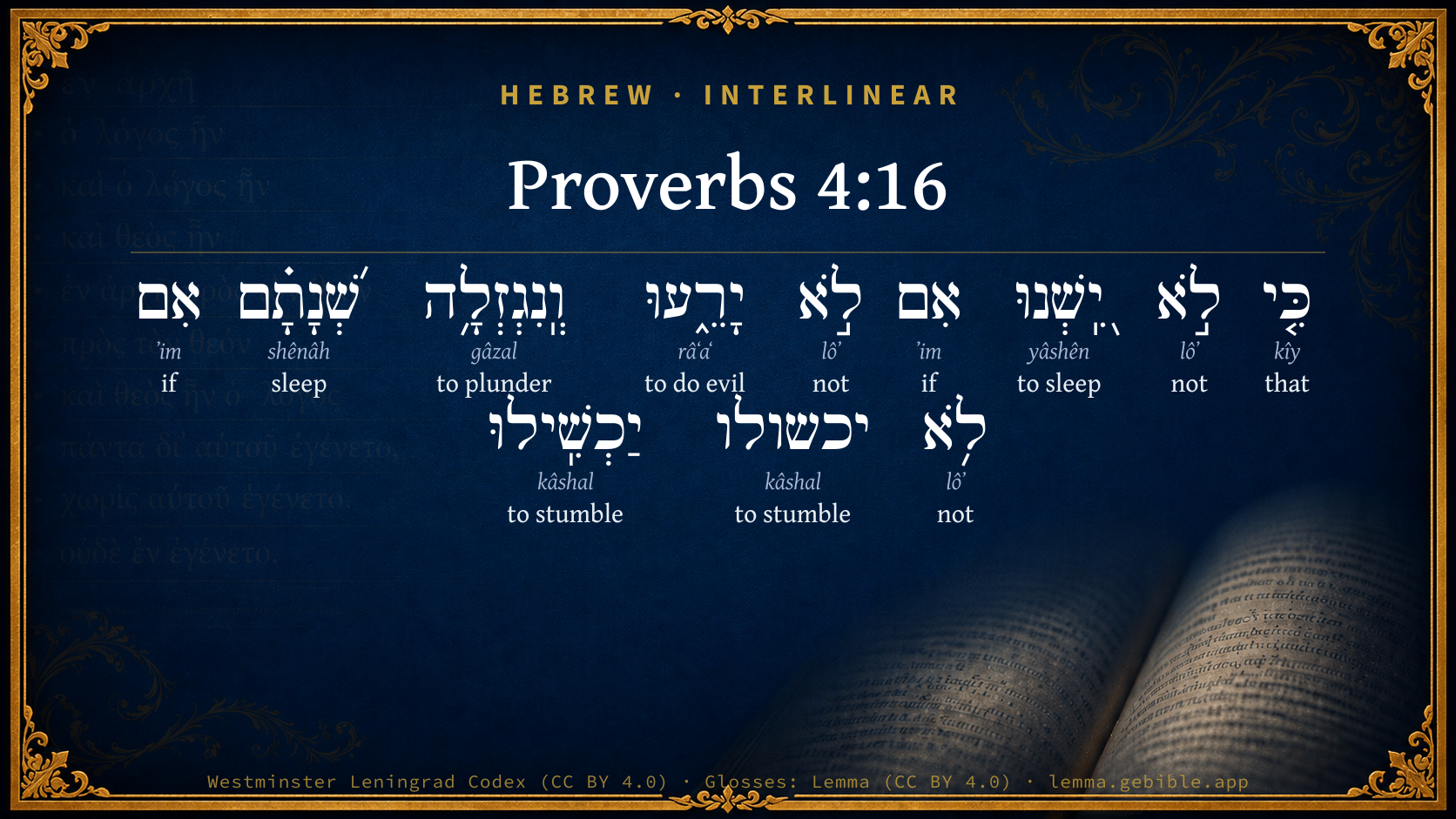
  1. כִּ֤י kîy H3588 “that” Conjunction
  2. לֹ֣א lôʼ H3808 “not” Particle, Negative
  3. אִם ʼim H518 “if” Conjunction
  4. לֹ֣א lôʼ H3808 “not” Particle, Negative
  5. יָרֵ֑עוּ râʻaʻ H7489 “to do evil” Verb, Hiphil, Imperfect, 3rd Person, Masculine, Plural
  6. וְֽנִגְזְלָ֥ה gâzal H1497 “and · to plunder” Conjunction + Verb, Niphal, Sequential Perfect, 3rd Person, Feminine, Singular
  7. שְׁ֝נָתָ֗ם shênâh H8142 “sleep · their” Noun, Common, Feminine, Singular, Construct + Suffix, Personal, 3rd Person, Masculine, Plural
  8. אִם ʼim H518 “if” Conjunction
  9. לֹ֥א lôʼ H3808 “not” Particle, Negative
  10. יכשולו kâshal H3782 “to stumble” Verb, Qal, Imperfect, 3rd Person, Masculine, Plural
  11. יַכְשִֽׁילוּ kâshal H3782 “to stumble” Verb, Hiphil, Imperfect, 3rd Person, Masculine, Plural

About this verse

These counts appear in no published source. They are computed here, from the morphology-tagged text and Lemma’s own curated glosses. What Lemma adds →

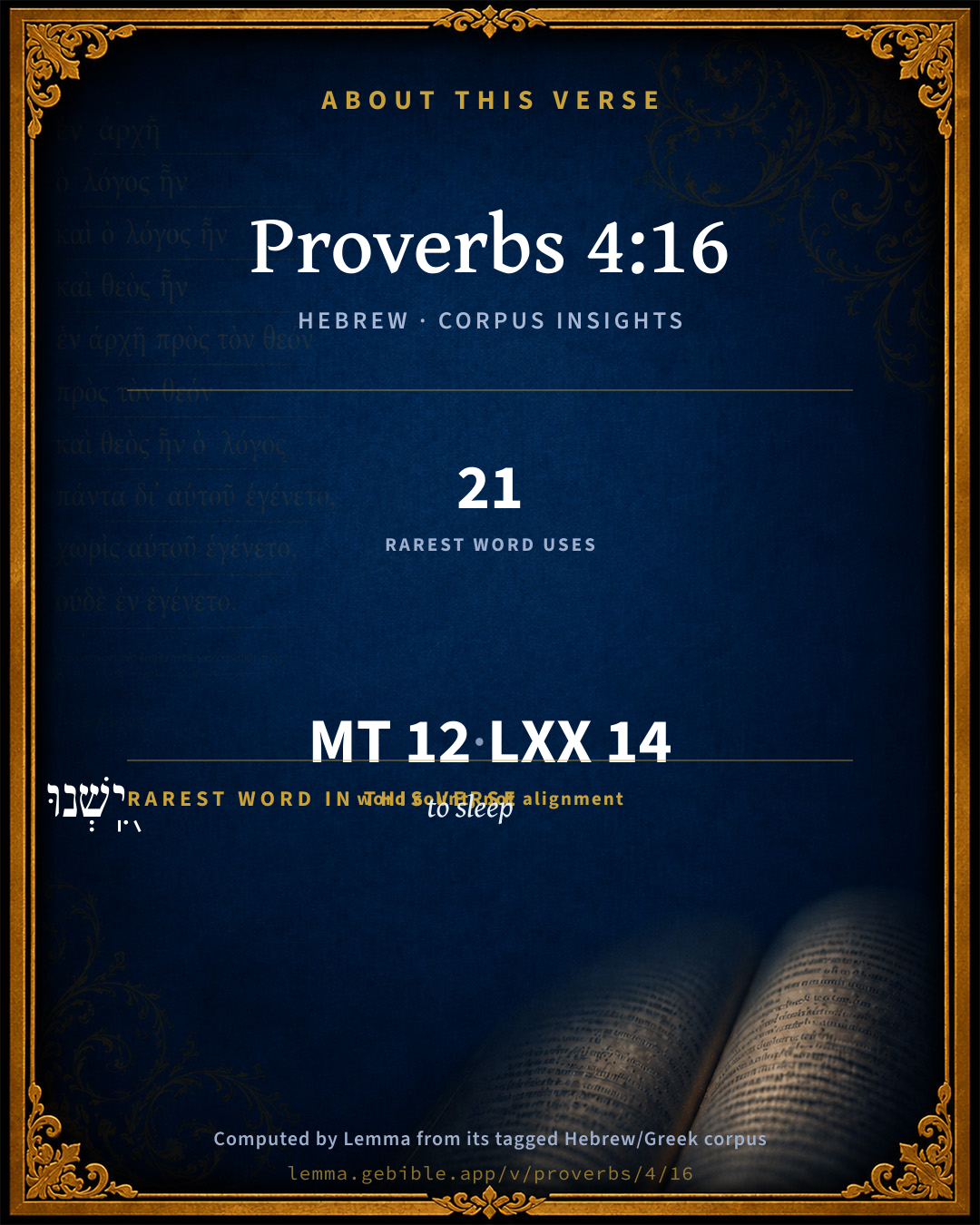
12
words
8
distinct lemmas
Wisdom
section

Notable vocabulary

The rarest word here is יִֽ֭שְׁנוּ to sleep H3462 — appearing just 21 times in the whole Hebrew Bible.

Shared distinctive vocabulary

יִֽ֭שְׁנוּ to sleep H3462 occurs in 21 verses of the Hebrew Bible. Also found in:

Grammatical profile

  • 5 verbs
  • 1 noun
  • 3 conjunctions
  • 3 particles

Verb forms

  • יִֽ֭שְׁנוּ Qal · Imperfect
  • יָרֵ֑עוּ Hiphil · Imperfect
  • וְֽנִגְזְלָ֥ה Niphal · Sequential Perfect
  • יכשולו Qal · Imperfect
  • יַכְשִֽׁילוּ Hiphil · Imperfect

Repetition

Words recur within this verse — often emphatic in Hebrew:

  • יכשולו to stumble H3782 ×2
  • לֹ֣א not H3808 ×3
  • אִם if H518 ×2

Hebrew & Septuagint length

In English translation the verse runs 18 words from the Hebrew and 18 from the Septuagint (LXX English) — the same length.

A rough comparison of the two English renderings, which tokenize alike — not a word-level alignment.

Word counts can differ between the Hebrew and the Greek without any difference in meaning — e.g. the Hebrew direct-object marker אֵת has no separate Greek word, and Greek often adds the article ὁ.

In the original languages it is 12 Hebrew tokens and 14 Greek tokens — but the two are counted differently (Hebrew bundles its prefixes and suffixes into one token; the Greek is in lemma form), so that isn’t a like-for-like length.

Cross-references

7

Topical passages linked to Proverbs 4:16 in the Treasury of Scripture Knowledge — connected by theme and wording, ordered by reader-vote popularity; previews shown in the World English Bible.

  • Psalms 36:4 He plots iniquity on his bed. He sets himself in a way that is not good; He doesn't abhor evil.
  • Micah 2:1 Woe to those who devise iniquity And work evil on their beds! When the morning is light, they practice it, Because it is in the power of their hand.
  • Isaiah 57:20 But the wicked are like the troubled sea; for it can't rest, and its waters cast up mire and dirt.
  • 2 Peter 2:14 having eyes full of adultery, and who can't cease from sin; enticing unsettled souls; having a heart trained in greed; children of cursing;
  • Proverbs 1:16 For their feet run to evil. They hurry to shed blood.
  • Luke 22:66 As soon as it was day, the assembly of the elders of the people was gathered together, both chief priests and scribes, and they led him away into their council, saying,
  • John 18:28 They led Jesus therefore from Caiaphas into the Praetorium. It was early, and they themselves didn't enter into the Praetorium, that they might not be defiled, but might eat the Passover.

Cross-references courtesy of OpenBible.info (CC BY 4.0).

Hebrew and Greek witnesses Masoretic Hebrew ↔ Greek Septuagint

The same verse in the two great witnesses to the Old Testament, shown verse-for-verse.

These are two independent witnesses, not word-aligned to each other, and the Septuagint is shown in lemma (dictionary) form.

Hebrew Proverbs 4:16 Masoretic · Westminster Leningrad Codex

כִּ֤י לֹ֣א יִֽ֭שְׁנוּ אִם לֹ֣א יָרֵ֑עוּ וְֽנִגְזְלָ֥ה שְׁ֝נָתָ֗ם אִם לֹ֥א יכשולו יַכְשִֽׁילוּ

For they don't sleep, unless they do evil. Their sleep is taken away, unless they make someone fall.

World English Bible · Public Domain

Greek LXX Proverbs 4:16 Septuagint · lemma form

οὐ γάρ μή ὑπνόω ἐάν μή κακοποιέω ἀποαἱρέω ὁ ὕπνος αὐτός καί οὐ κοιμάω

For they can’t sleep, unless they have done evil: their sleep is taken away, and they rest not.

LXX2012 (modern English Septuagint) · Public Domain

Hebrew: Westminster Leningrad Codex (CC BY 4.0). Greek: Septuagint (public domain); English from LXX2012 (modern English Septuagint) (Public Domain). How the Septuagint differs from the Hebrew →

Commentary

Notes on Proverbs 4:16 from classic Christian and Jewish commentators (each source and its license shown beneath its notes). The classic Christian expositions comment on the surrounding passage and are grouped to its opening verse, so a note may address several verses; the Jewish commentaries on the Tanakh (Rashi and others) are per-verse, so they appear only where the commentator wrote on this verse.

Lemma curates 59 commentaries, every one of them public domain or Creative Commons licensed, each selected and text-cleaned for this edition rather than reprinted as found. About our sources →

Trapp's Complete Commentary

John Trapp

Pro 4:16 For they sleep not, except they have done mischief; and their sleep is taken away, unless they cause [some] to fall.

Ver. 16. For they sleep not.] So much are they set upon it. Or as empty stomachs can hardly sleep, so neither can graceless persons rest till gorged and glutted with the sweetmeats of sin, with the murdering morsels of mischief. The devil, their taskmaster, will not allow them time to sleep; which is very hard bondage. "They have eyes full of adultery, and that cannot cease to sin." {2Pe 2:14}

Unless they cause some to fall.] Protagoras, as Plato relates, boasted of this, that whereas he had lived threescore years, forty of them he had spent in corrupting of young men that conversed with him.

John Trapp, A Commentary or Exposition upon All the Books of the Old and New Testament (1647–1656) — public domain. Text from a community e-Sword module.

The Biblical Illustrator

Joseph S. Exell

Pro_4:16

Their sleep is taken away, unless they cause some to fall.

The proselytism of error

It is of the wicked that Solomon here speaks. What a restlessness does this indicate! What a zeal in a bad cause! The subject suggested by the text is the restless activity of evil men in the propagation of evil. A man is accountable for his creed as well as for his practice--accountable inasmuch as it must be through his own fault that he believes what is false just as much as it is through his own fault that he does what is wrong. This takes all force from the objection that they who sleep not except they bring over others to what themselves hold to be true are performing a duty rather than committing a sin. It would seem as though error were far more energetic than truth. Why should falsehood be thus zealous in diffusing itself? Allowing that it sets an example, allowing that it addresses a rebuke to truth, how are we to account for its being so surprisingly energetic and devoted? The holder of falsehood may make religion a matter of party. Error is that which the warmest adherent may support from pride, or jealousy, or ambition, but truth is that which can enlist these passions in none but the hypocrite. Error can work on all the corruptions of our nature, whereas truth has to hold these corruptions in check. That falsehood should have a missionary spirit follows on the fact of its being falsehood, and therefore forced to lean upon others for support. (H. Melvill, B.D.)

The Biblical Illustrator, edited by Joseph S. Exell (c. 1880s–1900s) — public domain. Text from a community e-Sword module.

Tyndale Open Study Notes

Tyndale Open Resources

4:16 The wicked stay up at night to plan evil (Ps 36:4; Mic 2:1).

Tyndale Open Study Notes — © Tyndale Open Resources, licensed CC BY-SA 4.0. Text via the HelloAO Bible API.

Geneva Bible (1599)

Geneva Bible translators

Meaning, that to do evil is more proper and natural to the wicked than to sleep, eat or drink.

Geneva Bible (1599) marginal notes — public domain. Text via Bolls.life.

Jamieson, Fausset & Brown

Robert Jamieson, A. R. Fausset & David Brown

The reason is found in the character of sinners, whose zeal to do evil is forcibly depicted (Pro 6:4; Psa 36:5). They live by flagrant vices (Pro 1:13). Some prefer to render, "Their bread is wickedness, their drink violence" (compare Job 15:16; Job 34:7).

Jamieson, Fausset & Brown — Commentary Critical and Explanatory on the Whole Bible (1871) — public domain (CC PDM 1.0). Text via the HelloAO Bible API.

Adam Clarke's Commentary

Verse 16. Except they have done mischief] The night is their time for spoil and depredation. And they must gain some booty, before they go to rest. This I believe to be the meaning of the passage. I grant, also, that there may be some of so malevolent a disposition that they cannot be easy unless they can injure others, and are put to excessive pain when they perceive any man in prosperity, or receiving a kindness. The address in Virgil, to an ill-natured shepherd is well known: -

Et cum vidisti puero donata, dolebas:

Et si non aliqua nocuisses, mortuus esses.

ECLOG. iii. 14.

"When thou sawest the gifts given to the lad, thou wast distressed; and hadst thou not found some means of doing him a mischief, thou hadst died."

Adam Clarke's Commentary on the Bible (1810–1826) — public domain. Text from a community e-Sword/MySword module.

Ellicott's Commentary for English Readers

(16) For they sleep not . . .—The practice of evil has become as it were a second nature to them, they cannot live without it.

A Bible Commentary for English Readers, edited by Charles John Ellicott (1878–1897) — public domain. Text from a community e-Sword module.

The Cambridge Bible for Schools and Colleges

gen. ed. J. J. S. Perowne

16. their sleep is taken away] Comp.:

“Ergo non aliter poterit dormire; quibusdam

Somnum rixa facit.” Juv. Sat. III. 281, 2.

The Cambridge Bible for Schools and Colleges (gen. ed. J. J. S. Perowne; Cambridge University Press, 1878–1918) — public domain. Text from a community e-Sword module.

John Gill's Exposition

For they sleep not, except they have done mischief,.... Or they cannot sleep, as Jarchi and Gersom interpret it. Oftentimes they cannot sleep on their beds for devising mischief, their thoughts are so intensely set on contriving wicked schemes; and when they have so done, they cannot sleep until they have executed them; they are continually restless and uneasy day and night, like the troubled sea, constantly casting up mire and dirt. Who would keep such company as these?

and their sleep is taken away, unless they cause some to fall; into the snares and traps they lay for them, or into sin and calamity by it; the former of which they endeavour by all means to draw men into, and the latter is the unavoidable consequence of it. They imitate their father the devil, both delight in sin, and in the ruin of their fellow creatures; it is a sport to thereto do mischief, and they have no pleasure without it; see Pro 11:23. What company are such!

John Gill's Exposition of the Whole Bible (1746–1763) — public domain (CC PDM 1.0). Text via the HelloAO Bible API.

Matthew Poole's English Annotations

They sleep not; they cannot compose themselves to sleep with quietness and satisfaction to their own minds. To fall into their own snares, either into sin or into mischief.

Matthew Poole's English Annotations on the Holy Bible (1683–1685) — public domain. Text from a community e-Sword/MySword module.

Whedon's Commentary on the Bible

Daniel D. Whedon

16. They sleep not — A strong mode of saying they are restless to do evil. They love it more than they do their necessary sleep.

Mischief — Hardly strong enough; wickedness. Comp. Mal_2:8.

Daniel D. Whedon (gen. ed.), Commentary on the Old and New Testaments (1874–1909) — public domain. Text from a community e-Sword module.

The Pulpit Commentary

This verse exhibits the extreme depravity and debasement into which "the wicked" (r"shaim) and "the evil" (raim) of ver. 14 have fallen. Their sins are not sins of frailty, but arise from premeditation and from their insatiable desire to commit wickedness. Sin has become to them a kind of second nature, and, unless they indulge in it, sleep is banished from their eyes. They sleep not; lo-yish"nu, future of yashan, "to fall asleep;" the future here being used for the present, as is frequently the case in the Proverbs, and denoting a permanent condition or habit. Unless they cause some to fall; i.e. "unless they have betrayed others into sin," taking the verb in an ethical sense (Zockler), or, which is preferable, owing to ver. 16 a, unless they have done them some injury (Mercerus); Vulgate, nisi supplantaverint. For the Khetib yik"shulu, kal, which would mean "unless they have stumbled or fallen," the Keri substitutes the hiph. yak"shihi "unless they have caused some to fall." The hiph. is found without any object. (as here, in 2Ch_25:8) (On the verb khasal, from which it is derived, see Pro_4:12) With the statement of the verse we may compare David"s complaint of the persistent persecution of his enemies, (Psa_59:15) "If they be not satisfied, then will they stay all night" (margin). A similar construction to the one before us occurs in Virgil: "Et si non aliqua nocuisses, mortuus esses had you not, by some means or other done him an injury, you would have died" ("Eclog.," 3:15); cf. also Juvenal: "Ergo non aliter poterit dormire; quibusdam somnum rixa facit not otherwise, would he have slept; contention to some produces sleep." Hitzig rejects vers. 16 and 17 against all manuscript authority.

The Pulpit Commentary (1880–1919), ed. H.D.M. Spence-Jones & Joseph S. Exell — public domain. Text from a community e-Sword module.

John Wesley's Explanatory Notes

For - They cannot sleep with quietness.

John Wesley, Explanatory Notes Upon the Whole Bible (1754–1765) — public domain. Text via the GEBible commentary corpus.

unfoldingWord translationNotes

Door43 World Missions Community

they cannot sleep until they do evil

They probably could literally sleep, but the writer uses an exaggeration to express how intensely they desire to commit evil actions. (See: Hyperbole and Generalization)

they are robbed of sleep

The writer speaks of people being unable to sleep as if sleep were an object that someone stole from them. They probably could literally sleep, but the writer uses an exaggeration to express how intensely they desire to commit evil actions. AT: "they are unable to sleep" (See: Hyperbole and Generalization and Metaphor)

until they cause someone to stumble

The writer speaks of causing harm to another person as if it were causing that person to stumble. AT: "until they harm someone" (See: Metaphor)

they eat the bread of wickedness and drink the wine of violence

Possible meanings are 1) this is a metaphor in which the writer speaks of these people constantly committing wickedness and violence as if they ate and drank them like one would drink bread and wine. AT: "wickedness is like the bread that they eat and violence is like the wine that they drink" or 2) these people get their food and drink by committing wickedness and violence. AT: "they eat bread that they obtain by doing wicked things and drink wine that they obtain through violence" (See: Metaphor)

translationWords

evil

stumble

bread

wine

unfoldingWord translationNotes — © Distant Shores Media and the Door43 World Missions Community, licensed CC BY-SA 4.0. Source: git.door43.org/Door43/en_tn.

Rashi

Rabbi Shlomo Yitzchaki (Rashi)

For they will not sleep They are unable to sleep.

Rashi on the Tanakh — English translations: “The Judaica Press complete Tanach with Rashi, translated by A. J. Rosenberg” (CC BY 4.0); “Pentateuch with Rashi's commentary by M. Rosenbaum and A.M. Silbermann, 1929-1934” (public domain); “The Metsudah Tanach series, Lakewood, N.J” (CC BY 4.0); and “The Book of Joshua, Metsudah Publications, 1997” (CC BY 4.0). Text via Sefaria.

Lesson kit

Teaching starters — assembled from the data on this page, not authored interpretation. Every prompt links to the verse data it draws on. Edit before teaching.

Proverbs, in the Wisdom, opens this verse with 12 words (8 distinct Hebrew lemmas). Its most distinctive word is yâshên (“to sleep”). A historical commentator’s framing appears above. Read the whole chapter for the surrounding context.

Discussion questions

  1. The word yâshên carries the sense “to sleep.” How does it shape the verse?
  2. Genesis 2:21 shares the word «to sleep» with this verse. How do the two illuminate each other?
  3. “to stumble” occurs 2× in this one verse. What is the effect of the repetition?
  4. These translations render this verse differently; the difference is in the English rendering, not the original. What questions does that raise?
  5. The verb «יִֽ֭שְׁנוּ» is Qal Imperfect. How does its form color the action?
  6. Reading how Trapp's Complete Commentary and The Biblical Illustrator read this verse, where do the two commentators agree and where do they part?

Things to notice

Reading settings

Reading text

Shown beneath each verse's original-language words.

Old Testament
Old Testament edition

Read the OT as the Masoretic Hebrew (MT) or the Greek Septuagint (LXX).

English shown for the Greek Septuagint (in the Hebrew ↔ Greek comparison).

Comparing translations? Open the Compare panel on any verse page to stack up to four side by side.