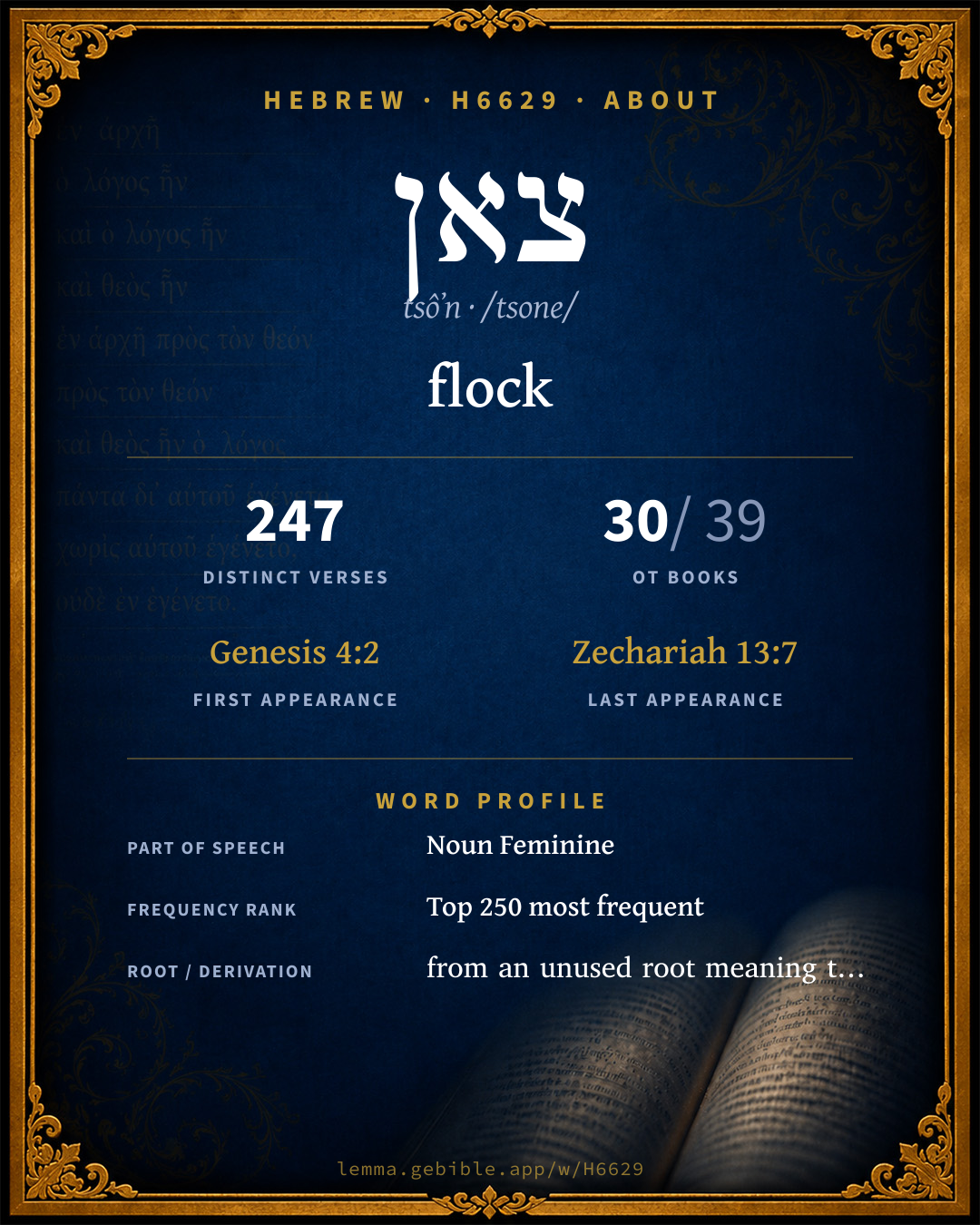
צֹאן
flock
also: small cattle, sheep, sheep and goats, flocks fuller range ↓
Full lexicon entry — Brown-Driver-Briggs (BDB)
From Brown-Driver-Briggs (BDB)
Where this word appears
See every Construct-state word in the Hebrew Bible →
Grammar key — what these labels mean
Part of speech
- Noun
- A naming word — a person, place, thing, or idea.
Noun type
- Common
- A common noun — a general class of person, place, or thing (“king,” “city,” “water”), not a specific name.
State
- Absolute
- The independent form of a noun, not bound to a following word.
- Construct
- A noun bound to a following noun in a possessive / “of” relationship (the construct chain).
Gender
- Both
- Attested as both masculine and feminine.
Number
- Singular
- One.
- Plural
- More than one (in Hebrew, generally three or more).
7 verses where H6629 appears in the Absolute state in the Book of Exodus. Filtered view — show all forms. Click any verse to open its interlinear word-by-word view. Verse text shown in the World English Bible for context — . Each verse’s Hebrew form is shown with its reference; the English is not keyword-highlighted, since the data carries no word-level English alignment. Use “Compare translations” on any verse to read it across multiple English versions. This concordance covers the Hebrew Bible; Septuagint (Greek Old Testament) occurrences are not indexed here.
Exodus
- Exodus 2:19 הַ/צֹּֽאן ptcl def.art + n c bs They said, "An Egyptian delivered us out of the hand of the shepherds, and moreover he drew water for us, and watered the flock."
- Exodus 3:1 צֹ֛אן הַ/צֹּאן֙ n c bs cs ptcl def.art + n c bs Now Moses was keeping the flock of Jethro, his father-in-law, the priest of Midian, and he led the flock to the back of the wilderness, and came to God's mountain, to Horeb.
- Exodus 9:3 וּ/בַ/צֹּ֑אן conj + prep det + n c bs behold, the hand of Yahweh is on your cattle which are in the field, on the horses, on the donkeys, on the camels, on the herds, and on the flocks with a very grievous pestilence.
- Exodus 12:21 צֹ֛אן n c bs Then Moses called for all the elders of Israel, and said to them, "Draw out, and take lambs according to your families, and kill the Passover.
- Exodus 12:38 וְ/צֹ֣אן conj + n c bs A mixed multitude went up also with them, with flocks, herds, and even very much cattle.
- Exodus 22:1 צֹ֖אן n c bs "If a man steals an ox or a sheep, and kills it, or sells it; he shall pay five oxen for an ox, and four sheep for a sheep.
- Exodus 34:3 הַ/צֹּ֤אן ptcl def.art + n c bs No one shall come up with you; neither let anyone be seen throughout all the mountain; neither let the flocks nor herds feed before that mountain."
About this entry
At a glance — auto-summarized from this page’s data, not written by a person. Every figure links to its source below. This summary describes the numbers; it doesn’t interpret them.
At its core, צאן (tsôʼn) means “flock.” Not a single-sense word: its full sense range also takes in “small cattle”, “sheep”, and “sheep and goats”. With 247 verses in 30 books, it is a common word in the Hebrew Bible. First canonically at Genesis 4:2, it enters the text early. From the same root come צנא and צאנן. Dig into 247-verse concordance and the renderings breakdown below.
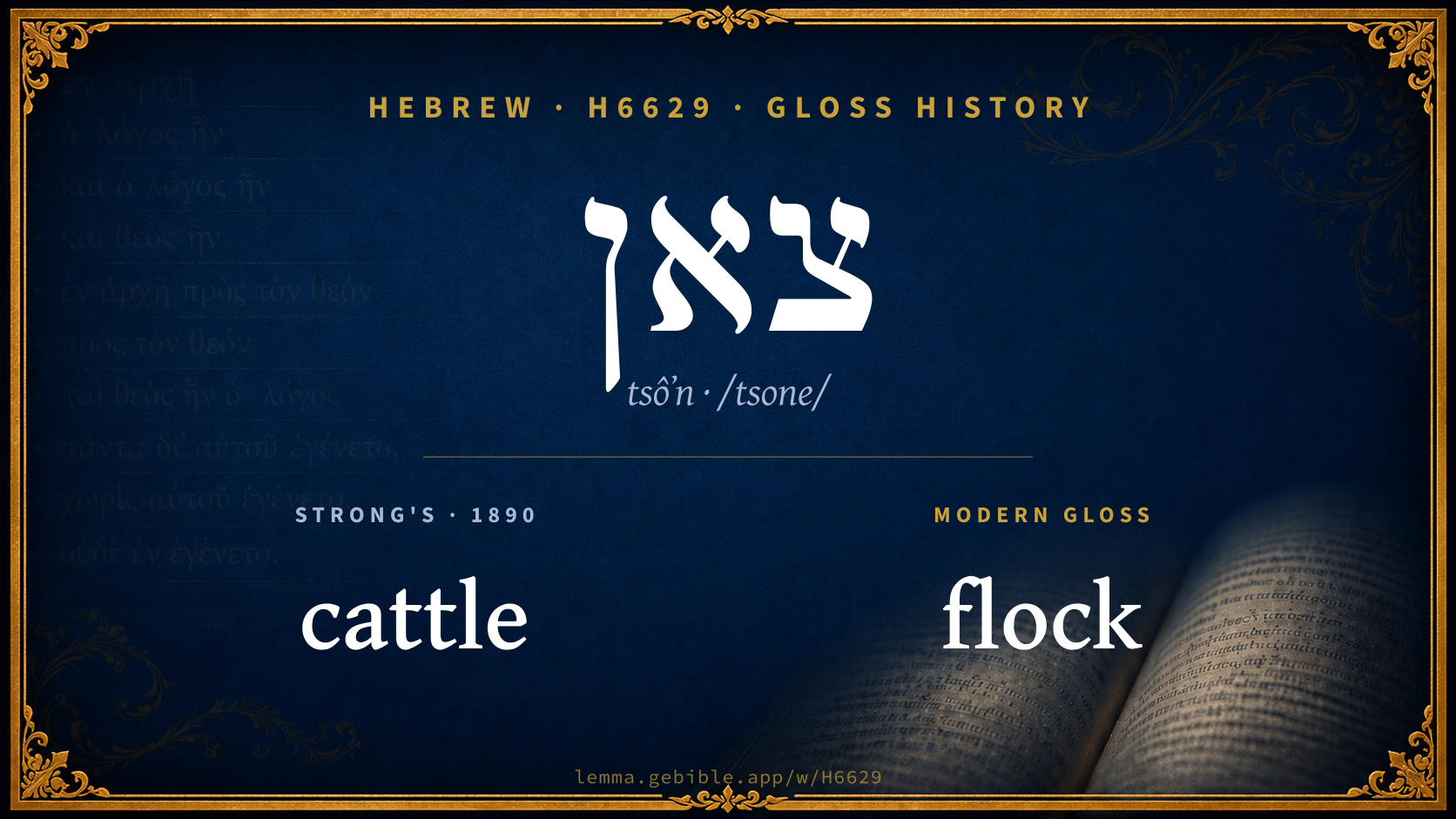
Gloss history
Strong's 1890 vs modern scholarship
About this word
Strong's H6629 catalogs a Hebrew word from the Hebrew Old Testament.
These counts are not copied from any lexicon or concordance. They are computed here, from the morphology-tagged Hebrew Old Testament. What Lemma adds →
- 247
- distinct verses
- The word appears in 247 distinct verses.
- 30 / 39
- OT books
- The word appears in 30 of 39 Old Testament books.
- #180
- by frequency
- Top 250 most frequent Hebrew words (rank 180 of 8,640 Hebrew words by occurrence).
View all 247 occurrences in the concordance →
By section of the Old Testament
By traditional corpus
Conventional, traditional groupings — biblical authorship is debated, so this is a traditional corpus grouping, not an authorship claim. Each share is this word’s portion of its verses in that division of the Hebrew canon. Each figure is a share of the word’s 247 distinct verses.
- Torah (Pentateuch) 103 verses · 42%
- Prophets (Nevi'im) 95 verses · 38%
- Writings (Ketuvim) 49 verses · 20%
How translations render this word
Counts come from each version’s own published word-to-Strong’s tagging or interlinear alignment — an approximate guide to how each version renders this word, not a word-level alignment the data otherwise carries. Because each total is that version’s own tagged count, the per-version totals vary from one another and need not match the appearance or distinct-verse counts above. These counts may also differ from a printed concordance because Lemma counts each distinctly tagged rendering and does not collapse phrase taggings into a single head-word total. This is a fixed set of word-tagged versions (KJV, ASV, BSB, ULT) and does not change with the reading translation you choose elsewhere. Each version’s license is shown beside its name below (and on Sources).
- King James Version: Sheep 97×, Flock 68×, Flocks 43×
- American Standard Version: Sheep 88×, Flock 63×, Flocks 40×
- Berean Standard Bible: Sheep 85×, Flock 70×, Flocks 62×
- unfoldingWord Literal Text: Flock 95×, Sheep 69×, Flock s 32×
King James Version Public Domain
Renders H6629 across 264 tagged occurrences — most commonly:
Plus 28 renderings that appear only once — usually multi-word phrases or single function words the recovered tagging swept in, not distinct renderings. Not rendered by a distinct English word in 10 further occurrences.
American Standard Version Public Domain
Renders H6629 across 265 tagged occurrences — most commonly:
Plus 50 renderings that appear only once — usually multi-word phrases or single function words the recovered tagging swept in, not distinct renderings.
Berean Standard Bible Public Domain
Renders H6629 across 259 tagged occurrences — most commonly:
Plus 22 renderings that appear only once — usually multi-word phrases or single function words the recovered tagging swept in, not distinct renderings. Not rendered by a distinct English word in 15 further occurrences.
unfoldingWord Literal Text CC BY-SA 4.0
Renders H6629 across 277 tagged occurrences — most commonly:
Plus other, less common renderings. Plus 19 renderings that appear only once — usually multi-word phrases or single function words the recovered tagging swept in, not distinct renderings.
Senses in the full BDB
What do BDB’s symbols mean?
BDB uses these scholarly abbreviations:
| Symbol | Meaning |
|---|---|
| 𝔊 | the Septuagint (the ancient Greek translation, LXX) |
| 𝔙 | the Vulgate (the Latin translation) |
| 𝔖 | the Syriac version (the Peshitta) |
| 𝔗 | the Targum (the Aramaic translation) |
| ψ | the Psalms |
| √ | root (the underlying root or stem) |
| ‖ | parallel passage (a synonymous or contrasted parallel) |
| † | the dagger: every passage where the word occurs is cited |
The 5 senses and sub-senses the full Brown-Driver-Briggs lexicon distinguishes for this word, in lexicon order (not ranked by frequency), with BDB’s own verbatim wording and sub-sense lettering. Shown in Hebrew script with BDB’s own scholarly abbreviations. The condensed entry is in the Lexicon Entry tab. See also the Forms in the corpus table below.
- 1. lit.
- a. small cattle, usually of sheep and goats in one flock (RobBR i. 477) Gn 30:31, 32 +; sheep specified also 21:28 (כִּבְשׂת הַצּ׳), 31:38 (אֵילֵי צ׳) +; sheep only 1 S 25:2 (+ עִזִּים); goats specified Gn 27:9; Je 50:8; צ׳ as yielding (1) animals for food Am 6:4 (כָּרִים), 1 S 14:32; 2 S 12:4; Ne 5:18 +; צ׳ מַאֲכָל ψ 44:12 (in sim.); (2) wool Gn 31:19 + (v. [גָּזַז], גֵּז); (3) milk, חֲלֵב צ׳ Dt 32:14 (? goats’ milk, cf. Pr 27:27); (4) sacrif. victims Gn 4:4 (J), Lv 1:2, 10; 3:6; Nu 15:3 (all P), 22:40 (E), Dt 12:6, 17, 21 + often; so צֹאן קָדָשִׁים Ez 36:38a, cf. בְּכוֹרֵי בְקָרֵינוּ וְצֹאנֵינוּ Ne 10:37; in gen. as property (often + בָּקָר, etc.) Gn 12:16; 13:5; 24:35 Jb 1:3; 42:12 + often (v. also ii. [עַשְׁתָּרוֹת]); gift Gn 20:14; 21:27; 38:17 (goat), Dt 15:14; 2 Ch 17:11; booty 1 S 15:9, 15 +. e.g. Genesis 30:31
- b. צ׳ sometimes of a definite number of animals (i.e. as pl. of שֶׂה, etc.): two Is 7:21, four Ex 21:37 (larger numbers v. 1 S 25:2, 5, 18; Nu 31:32, 36; Ne 5:18; Jb 1:3; 42:12 supr.).—Vid. also בֵּן 7 b; גְּדֵרָה, מִכְלָה, מַרְבֵּץ, נָוֶה, עֵדֶר; כֶּלֶב, רֹעֶה, שַׁעַר. e.g. Isaiah 7:21
- 2. sim. of multitude Ez 36:37, 38, cf. ψ 107:41; of children Jb 21:11; of dead, with death as shepherd ψ 49:15; of (shepherdless) Isr. Nu 27:17; 1 K 22:17 = 2 Ch 18:16; Zc 10:2; 13:7, wandering in sin Is 53:6; of Isr. led by י׳ ψ 77:21; 78:52; 80:2, cf. Zc 9:16 (on text v. We Now); Ez 34:12; of Isr. in distress, כְּצ׳ טִבְחָה ψ 44:23, cf. (of wicked) צ׳ לְטִבְחָה Je 12:3; of scattered Bab. Is 13:14. e.g. Ezekiel 36:37
- 3. metaph. of multitude, צ׳ אָדָם Ez 36:38; of Isr. 2 S 24:17 = 1 Ch 21:17; Je 23:1, 2, 3; Ez 24:5, and especially sustained fig. 34:2, 3 + 17 times 34, also Zc 11:7, 17; צ׳ אֹבְדוֹת Je 50:6, צ׳ תִּפְאַרְתֵּךְ 13:20; of Isr. under י׳’s care, (-וֹ, י—ִ) צ׳ מַרְעִיתֶ֑ךָ ψ 74:1; 79:13; 100:3; Ez 34:31, also צ׳ יָדוֹ ψ 95:7 (‖ עַם־מַרְעִיתוֹ; read perhaps צ׳ מַרְעִיתוֹ, עַם יָדוֹ, so Che al.); צ׳ נַחֲלָתֶ֑ךָ Mi 7:14; also in combinations: אַדִּירֵי הַצּ׳ Je 25:34, 35, 36, צ׳ חַהֲרֵגָה Zc 11:4, 7 (cf. ψ 44:23), עֲנִיֵּי הַצּ׳ v 7, 11 (all of Isr.); of Edom צְעִירֵי הַצּ׳ Je 49:20; 50:45. e.g. Ezekiel 36:38
Senses from the full Brown-Driver-Briggs lexicon (Brown, Driver, Briggs; Oxford 1906 — public domain), digitized via Sefaria, supplemented by the OpenScriptures HebrewLexicon (CC BY 4.0). Full attribution on Sources.
Word origin
n.coll.f. Gn 30:36 (poss. m. v 39a +, KöSynt. § 247 g, but dub., v 39b c. vb. fpl., as usually; in 1 S 15:14 join הַזֶּה with קוֹל; v. further Albr ZAW xv (1895), 316 ff.) small cattle, sheep and goats, flock, flocks;—צ׳ abs. Gn 4:2 +, cstr. 29:9 +; sf. צֹאנוֹ 4:4 +; צֹאנֵנוּ Ex 10:9, צֹאונֵנוּ ψ 144:13; as pl. צֹאנֵינוּ Ne 10:37 van d. H. Gi (not Baer); s. [צֹנֶא] צֹנֶה p. 856, etc.;—
— Brown-Driver-Briggs (Oxford 1906, public domain), digitized via Sefaria, supplemented by the OpenScriptures HebrewLexicon (CC BY 4.0). See Sources.
Origin: from an unused root meaning to migrate
Jastrow Dictionary
A second Hebrew/Aramaic lexicon for comparison, covering Aramaic and post-biblical (Talmudic, Targumic, Midrashic) usage that the biblical-Hebrew BDB does not. Matched by lemma rather than by Strong’s number, so a lemma may carry more than one Jastrow headword (shown separately below), and the entries cover usage well beyond the Bible.
צֹאן
- (b. h.) flock, small cattle. Gen. R. s. 73 צֹאנוֹ של לבן Laban’s flock. Gen. R. s. 42 אם אין תישים אין צ׳ אם אין צ׳ וכ׳ where there are no bucks, there is no flock, and where there is no flock, there is no shepherd; Lev. R. s. 11; Esth. R. introd.; a. fr.—צ׳ ברזל, v. בַּרְזֶל.
A Dictionary of the Targumim, the Talmud Babli and Yerushalmi, and the Midrashic Literature (Marcus Jastrow; London, Luzac, 1903) — Public Domain. Digitized via Sefaria. Digitized via Sefaria. Full attribution on Sources.
Forms in the corpus
The 117 distinct written forms H6629 takes in the Hebrew Bible, most frequent first — each parse links to that state’s occurrences in the concordance. Hebrew forms include their vowel points and cantillation, so a single lemma takes many written forms.
The 60 most common forms are shown; 57 rarer forms follow in the full concordance.
Same root — word family
Other BDB entries built from the same root as H6629, grouped by Strong’s listed origin. These share a root / origin per the lexicon — not necessarily a shared meaning. Each links to that word’s own entry.
Derived from this word
Proper names from this root
People and places named from this root — a name, not an additional meaning of the word.
Compare all same-root words → 1 of the same-root words is a proper name (a person or place). They share a root, not necessarily a meaning.
Septuagint verse parallels
This word appears in 231 verses that also exist in the Greek Old Testament (Septuagint), out of the 247 Hebrew verses it occurs in. You can read those verses in Greek by switching the Old Testament edition to the Septuagint.
Read these verses in the Septuagint
- Genesis 4:2
- Exodus 2:16
- Leviticus 1:2
- Numbers 11:22
- Deuteronomy 7:13
- Joshua 7:24
- 1 Samuel 8:17
- 2 Samuel 7:8
- 1 Kings 1:9
- 2 Kings 5:26
- 1 Chronicles 4:39
- 2 Chronicles 5:6
This is a verse-level parallel only — the same verses exist in both the Hebrew and Greek Old Testaments. No word-level Hebrew↔Greek correspondence is claimed: the data carries no such alignment, so no Greek word is shown as this Hebrew word’s translation. Coverage is not total — the Septuagint omits the deuterocanon and renumbers the Psalms, so some Hebrew verses have no direct Greek parallel.