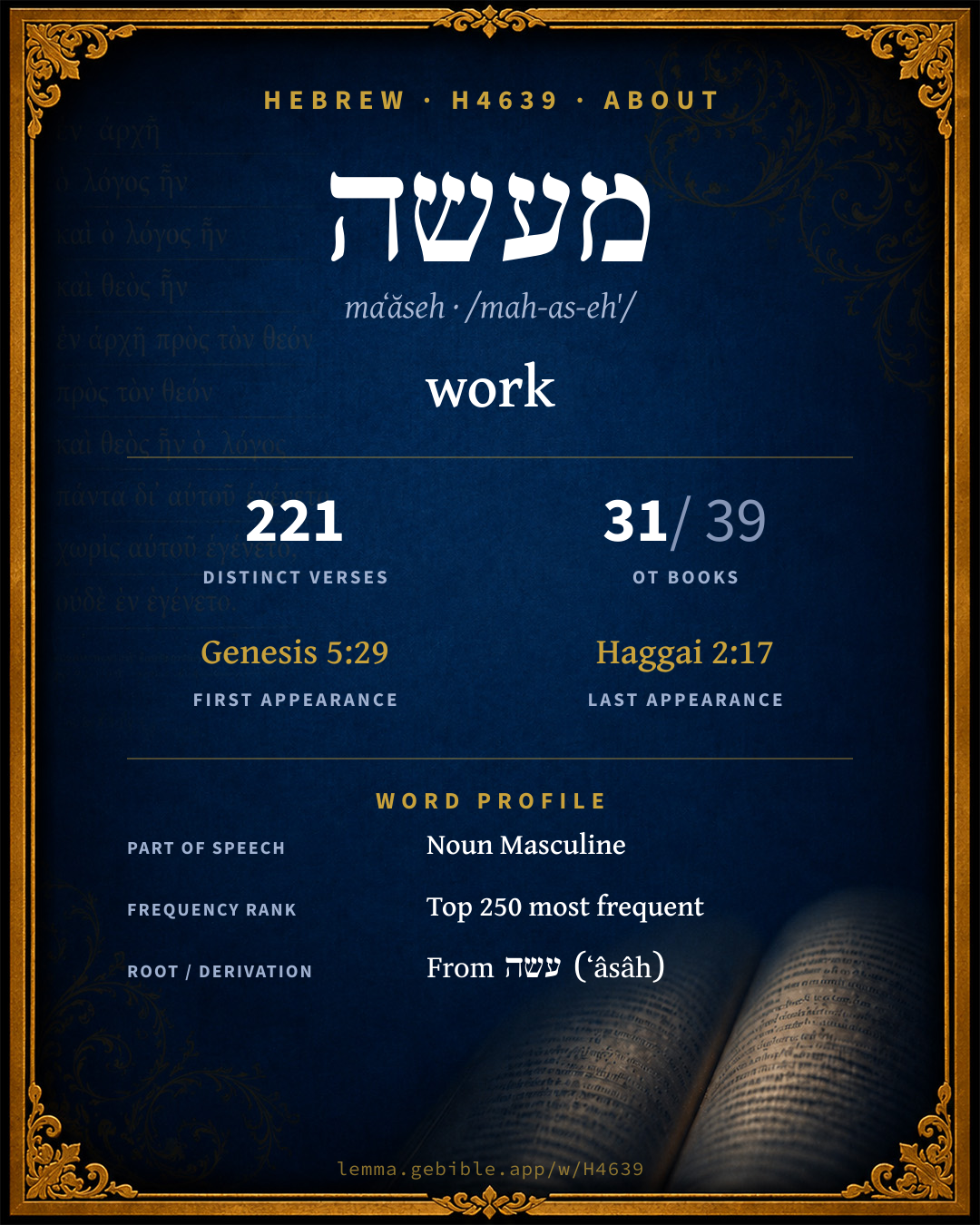
מַעֲשֶׂה
work
‘work’ is one of 10 main senses fuller range ↓
Full lexicon entry — Brown-Driver-Briggs (BDB)
From Brown-Driver-Briggs (BDB)
Where this word appears
See every Construct-state word in the Hebrew Bible →
Grammar key — what these labels mean
Part of speech
- Noun
- A naming word — a person, place, thing, or idea.
Noun type
- Common
- A common noun — a general class of person, place, or thing (“king,” “city,” “water”), not a specific name.
State
- Construct
- A noun bound to a following noun in a possessive / “of” relationship (the construct chain).
- Absolute
- The independent form of a noun, not bound to a following word.
Gender
- Masculine
- Grammatically masculine.
Number
- Singular
- One.
- Plural
- More than one (in Hebrew, generally three or more).
Every verse where H4639 appears in the Book of 2 Chronicles — 10 distinct verses. Click any verse to open its interlinear word-by-word view. Verse text shown in the World English Bible for context — . Each verse’s Hebrew form is shown with its reference; the English is not keyword-highlighted, since the data carries no word-level English alignment. Use “Compare translations” on any verse to read it across multiple English versions. This concordance covers the Hebrew Bible; Septuagint (Greek Old Testament) occurrences are not indexed here.
2 Chronicles
- 2 Chronicles 3:10 מַעֲשֵׂ֖ה n c ms cs In the most holy house he made two cherubim of image work; and they overlaid them with gold.
- 2 Chronicles 4:5 כְּ/מַעֲשֵׂ֣ה prep + n c ms cs It was a handbreadth thick; and the brim of it was worked like the brim of a cup, like the flower of a lily: it received and held three thousand baths.
- 2 Chronicles 4:6 מַעֲשֵׂ֥ה n c ms cs He made also ten basins, and put five on the right hand, and five on the left, to wash in them; such things as belonged to the burnt-offering they washed in them; but the sea was for the priests to wash in.
- 2 Chronicles 16:14 מַעֲשֶׂ֑ה n c ms They buried him in his own tombs, which he had hewn out for himself in the city of David, and laid him in the bed which was filled with sweet odors and various kinds [of spices] prepared by the perfumers' are: and they made a very great burning for him.
- 2 Chronicles 17:4 כְּ/מַעֲשֵׂ֥ה prep + n c ms cs but sought to the God of his father, and walked in his commandments, and not after the doings of Israel.
- 2 Chronicles 20:37 מַעֲשֶׂ֔י/ךָ n c mp cs + sfx pers 2ms Then Eliezer the son of Dodavahu of Mareshah prophesied against Jehoshaphat, saying, Because you have joined yourself with Ahaziah, Yahweh has destroyed your works. The ships were broken, so that they were not able to go to Tarshish.
- 2 Chronicles 31:21 מַעֲשֶׂ֞ה n c ms In every work that he began in the service of the house of God, and in the law, and in the commandments, to seek his God, he did it with all his heart, and prospered.
- 2 Chronicles 32:19 מַעֲשֵׂ֖ה n c ms cs They spoke of the God of Jerusalem, as of the gods of the peoples of the earth, which are the work of men's hands.
- 2 Chronicles 32:30 מַעֲשֵֽׂ/הוּ n c ms cs + sfx pers 3ms This same Hezekiah also stopped the upper spring of the waters of Gihon, and brought them straight down on the west side of the city of David. Hezekiah prospered in all his works.
- 2 Chronicles 34:25 מַעֲשֵׂ֣י n c mp cs Because they have forsaken me, and have burned incense to other gods, that they might provoke me to anger with all the works of their hands; therefore is my wrath poured out on this place, and it shall not be quenched.
About this entry
At a glance — auto-summarized from this page’s data, not written by a person. Every figure links to its source below. This summary describes the numbers; it doesn’t interpret them.
“work” is the headline sense of the Hebrew noun מעשה (maʻăseh). Translators differ — “work” in the King James Version, then “work of” (unfoldingWord Literal Text), as the renderings breakdown shows. With 221 verses in 31 books, it is a common word in the Hebrew Bible. First canonically at Genesis 5:29, it enters the text early. Its meaning spans more than one sense — see its full sense range. The sections below give every sense, occurrence, and version rendering.
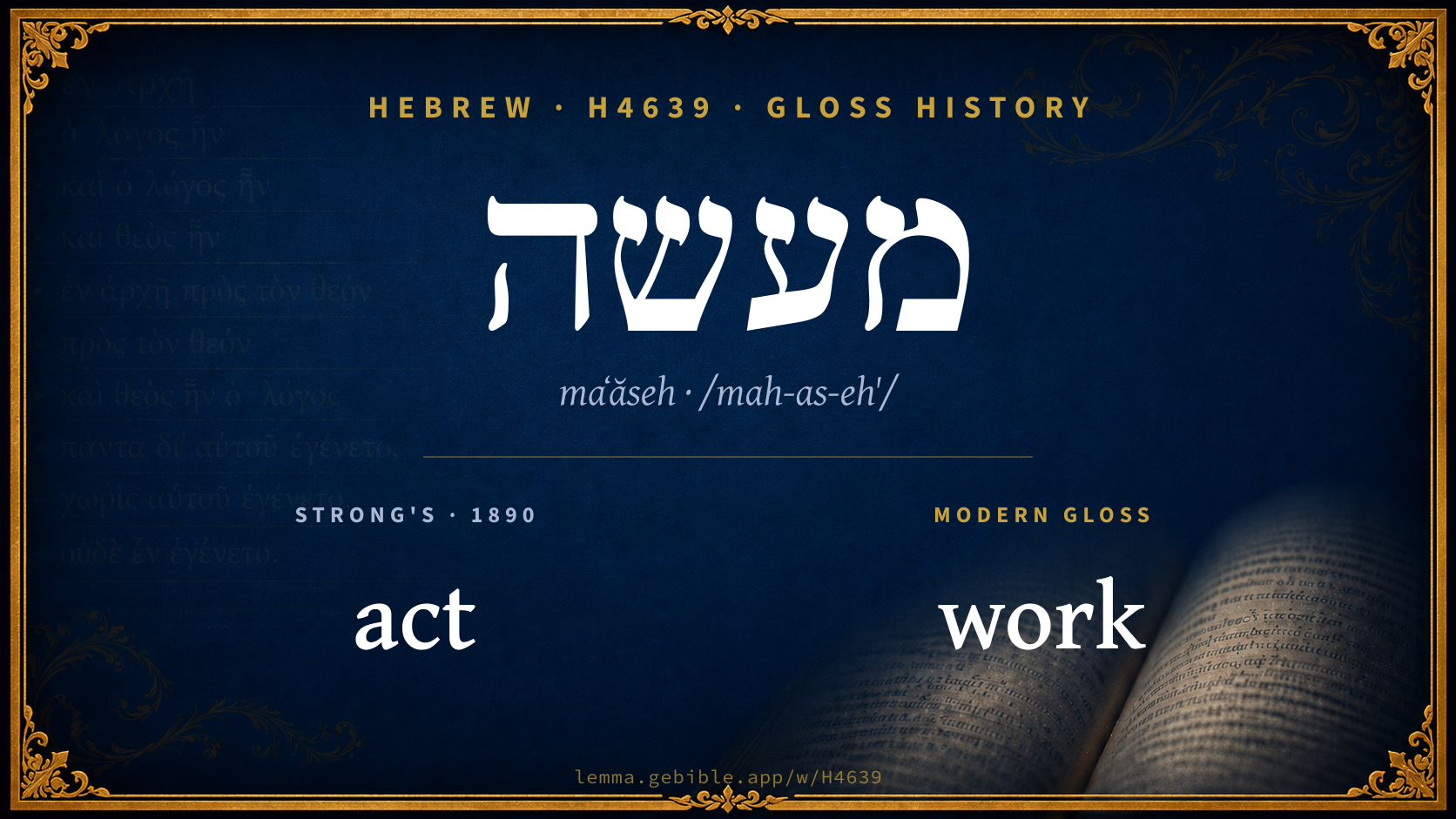
Gloss history
Strong's 1890 vs modern scholarship
About this word
Strong's H4639 catalogs a Hebrew word from the Hebrew Old Testament.
These counts are not copied from any lexicon or concordance. They are computed here, from the morphology-tagged Hebrew Old Testament. What Lemma adds →
- 221
- distinct verses
- The word appears in 221 distinct verses.
- 31 / 39
- OT books
- The word appears in 31 of 39 Old Testament books.
- #200
- by frequency
- Top 250 most frequent Hebrew words (rank 200 of 8,640 Hebrew words by occurrence).
View all 221 occurrences in the concordance →
By section of the Old Testament
By traditional corpus
Conventional, traditional groupings — biblical authorship is debated, so this is a traditional corpus grouping, not an authorship claim. Each share is this word’s portion of its verses in that division of the Hebrew canon. Each figure is a share of the word’s 221 distinct verses.
- Writings (Ketuvim) 84 verses · 38%
- Prophets (Nevi'im) 76 verses · 34%
- Torah (Pentateuch) 61 verses · 28%
How translations render this word
Counts come from each version’s own published word-to-Strong’s tagging or interlinear alignment — an approximate guide to how each version renders this word, not a word-level alignment the data otherwise carries. Because each total is that version’s own tagged count, the per-version totals vary from one another and need not match the appearance or distinct-verse counts above. These counts may also differ from a printed concordance because Lemma counts each distinctly tagged rendering and does not collapse phrase taggings into a single head-word total. This is a fixed set of word-tagged versions (KJV, ASV, BSB, ULT) and does not change with the reading translation you choose elsewhere. Each version’s license is shown beside its name below (and on Sources).
- King James Version: Work 72×, Works 33×, All the works 8×
- American Standard Version: Work 69×, Works 29×, All the work 7×
- Berean Standard Bible: Work 67×, Works 33×, Deeds 7×
- unfoldingWord Literal Text: Work of 77×, Work 23×, Works 23×
King James Version Public Domain
Renders H4639 across 229 tagged occurrences — most commonly:
Plus other, less common renderings. Plus 66 renderings that appear only once — usually multi-word phrases or single function words the recovered tagging swept in, not distinct renderings. Not rendered by a distinct English word in 6 further occurrences.
American Standard Version Public Domain
Renders H4639 across 226 tagged occurrences — most commonly:
Plus other, less common renderings. Plus 67 renderings that appear only once — usually multi-word phrases or single function words the recovered tagging swept in, not distinct renderings. Not rendered by a distinct English word in 4 further occurrences.
Berean Standard Bible Public Domain
Renders H4639 across 223 tagged occurrences — most commonly:
Plus other, less common renderings. Plus 61 renderings that appear only once — usually multi-word phrases or single function words the recovered tagging swept in, not distinct renderings. Not rendered by a distinct English word in 23 further occurrences.
unfoldingWord Literal Text CC BY-SA 4.0
Renders H4639 across 247 tagged occurrences — most commonly:
Plus other, less common renderings. Plus 34 renderings that appear only once — usually multi-word phrases or single function words the recovered tagging swept in, not distinct renderings.
6 senses and sub-senses in the full BDB
What do BDB’s symbols mean?
BDB uses these scholarly abbreviations:
| Symbol | Meaning |
|---|---|
| 𝔊 | the Septuagint (the ancient Greek translation, LXX) |
| 𝔙 | the Vulgate (the Latin translation) |
| 𝔖 | the Syriac version (the Peshitta) |
| 𝔗 | the Targum (the Aramaic translation) |
| ψ | the Psalms |
| √ | root (the underlying root or stem) |
| ‖ | parallel passage (a synonymous or contrasted parallel) |
| † | the dagger: every passage where the word occurs is cited |
The 6 senses and sub-senses the full Brown-Driver-Briggs lexicon distinguishes for this word, in lexicon order (not ranked by frequency), with BDB’s own verbatim wording and sub-sense lettering. Shown in Hebrew script with BDB’s own scholarly abbreviations. The condensed entry is in the Lexicon Entry tab. See also the Forms in the corpus table below.
- 1.
- a. (1) deed, thing done by man Nu 16:28 (JE), 1 K 13:11; Is 26:12;—1 S 20:19 is obscure; (2) implic. evil Gn 44:15 (J), Ex 23:24 (E), Ne 6:14 + 8 times, + sg. coll. doing(s) Mi 6:16; Lv 18:3(×2) (H), 2 Ch 17:4, מ׳ יְדֵיהֶם La 3:64; Hg 2:14; Jb 33:17 (reading מִמַּעֲשֵׂהוּ 𝔊 Di Siegf Bu), Ez 16:30 (behaviour); explic. מַעֲשֵׂינוּ הָרָעִים Ezr 9:13 cf. Ec 4:3; 8:11, 14, מַעֲשֵׂי־אָוֶן Is 59:6; specif. of idolatr. practices, מ׳ יְדֵיכֶם sg. Dt 31:29; Je 25:6, 7; 32:30, pl. 44:8, cf. sg. 1 K 16:7; 2 K 22:17 = 2 Ch 34:25; (3) implic. right, praiseworthy 1 S 19:4; 2 K 23:19; Jon 3:10; Pr 31:31; of duty in gen. הַמּ׳ אֲשֶׁר יַעֲשׂוּן Ex 18:20 (E) = what they are to do; explic. Ec 4:4; 8:14; (4) as basis of judgment (good or bad) Is 66:18 ψ 33:15; 62:13; Ec 12:14, מ׳ יְדֵיהֶם Je 25:14. e.g. Numbers 16:28
- b. (1) work, labour, husbandry Ex 23:16 (E), Gn 5:29 (J), Ju 19:16, מ׳ יְדֵיכֶם Hg 2:17; enforced labour of Isr. in Egypt Ex 5:5, 13 (J); in gen. 23:12 (E); also of product of labour 23:16, cf. Is 65:22; Ec 5:5; שֵׁשֶׁת יְמֵי הַמּ׳ Ez 46:1 the six working-days; of religious work, מ׳ עֲבֹדַת בֵּית הָא׳ 1 Ch 23:28, cf. מ׳ 2 Ch 31:21; (2) business, pursuit, Gn 46:33; 47:3 (J), Ju 13:12; 1 S 25:2; Is 54:16; in gen., occupation Is 29:15; Ec 2:4, 11; 3:17, 22; 8:9; 9:7, 10; (3) undertaking, enterprise Is 19:14, 15; Dt 15:10; מ׳ יָדֶ֑ךָ Dt 2:7 + 5 times Dt; 2 Ch 32:30; Jb 1:10 ψ 28:4, מ׳ יָדֵינוּ ψ 90:17(×2); (4) achievement Je 48:7; Est 10:2; (5) in weakened sense, מַעֲשֶׂיךָ Pr 16:3 thine affairs; nearly = occurrences Ec 1:14 (pl.), 2:17; 8:17 (sg.). e.g. Exodus 23:16
- c. deed(s), work(s) of י׳, especially in deliverance and in judgment, Ju 2:7, 10; Jos 24:31 (D), ψ 33:4 + 21 times, + מ׳ יָדָיו etc. Is 5:12 ψ 28:5; 92:5 + 4 times; מ׳ הָאֱלֹהִים in gen. Ec 7:13; 8:17; 11:5 cf. 3:11. e.g. Judges 2:7
- 2.
- a. (1) work, thing made, by man, מ׳ אֹפֶה Gn 40:17 (E) baker’s work; מ׳ יְדֵי יוֹצֵר La 4:2; often of furnishings of tabern., מ׳ חשֵׁב Ex 26:1 + 7 times, מ׳ רֹקֵם 26:36 + 5 times, מ׳ אֹרֵג 28:32 + 2 times, מ׳ חָרָשׁ 28:11, cf. מ׳ יְדֵי אָמָּן Ct 7:2; of holy oil, etc. מ׳ רֹקֵחַ Ex 30:25 + 2 times (ins. רֹקֵחַ perhaps also 2 Ch 16:14); hence מ׳ = work of art Is 3:24 (of coiffure), cf. כְּלִי מ׳ Nu 31:51; sq. n. of material, pattern, etc., מ׳ עִזִּים v 20 (i.e. goats’ hair), v. also Ex 27:4; 28:14 +; in temple, מ׳ שְׂבָכָה 1 K 7:17, מ׳ שׁוּשַׁן v 19, etc.; מ׳ צַעֲצֻעִים 2 Ch 3:10, cf. מ׳ הַחֲבִתִּים 1 Ch 9:31 the work of (consisting in) bread-wafers; = materials of (prepared for) הָעוֹלָה 2 Ch 4:6; in theoph. מ׳ לִבְנַת הַסַּפִּיר Ex 24:10 (J); מ׳ of ships 2 Ch 20:37; in gen. Is 29:16; Ez 27:16, 18 = thy manufactures, wares; מַעֲשַׂי ψ 45:2 = my verses (ποίημα, poem); (2) workmanship Ez 1:16(×2) (v 16a del. Co Toy) 1 K 7:8; Ex 28:8 + 11 times; (3) מ׳ יְדֵי אָדָם of idols (contemptuously) Dt 4:28; 2 K 19:18 = Is 37:19 = 2 Ch 32:19, ψ 115:4; 135:15, cf. Is 2:8 (מ׳ יָדָיו), Ho 14:4 Mi 5:12 Je 1:16; so (יְדֵי) מ׳ חָרָשׁ Dt 27:15 Je 10:3, 9, cf. Ho 13:2; מ׳ חֲכָמִים Je 10:9; מ׳ תַּעְתֻּעִים v 15 51:18; appar. also מַעֲשֵׂהֶם Is 41:29 cf. 57:12; Ez 6:6; מ׳ יָדָיו of altars Is 17:8. e.g. Genesis 40:17
- b. work (made by) God Ex 32:16 (E); especially (poet. and late), of created things, ψ 103:22; 104:24 + 4 times ψ; מ׳ אֶצְבְּעֹתֶיךָ 8:4, מ׳ יָדֶיךָ 102:26 (both of heavens), cf. 19:2 (heavenly bodies), 8:7 (animals); of man Jb 14:15; 34:19, cf. כָּל־אַנְשֵׁי מַעֲשֵׂהוּ every mortal whom He has made; also 37:7; of a nation Is 19:25; 60:21; 64:7; of weights Pr 16:11 (but read perhaps הַמֶּלָךְ for י׳ Gr Toy). e.g. Exodus 32:16
- c. product of olive-tree, מ׳ וַיִת Hb 3:17; fig. product of righteousness Is 32:17. e.g. Habakkuk 3:17
Senses from the full Brown-Driver-Briggs lexicon (Brown, Driver, Briggs; Oxford 1906 — public domain), digitized via Sefaria, supplemented by the OpenScriptures HebrewLexicon (CC BY 4.0). Full attribution on Sources.
Word origin
n.m. Gn 20:9 deed, work;—abs. מ׳ Gn 44:15 +, cstr. מַעֲשֵׂה Is 5:12 +; sf. מַעֲשֵׂהוּ Ju 13:12 +, etc.; pl. מַעֲשִׂים Gn 20:9 +; cstr. מַעֲשֵׂי Je 1:16 +; sf. מַעֲשָׂיו 1 S 19:4 (or sg., so Dr) +, etc.;—often acc. cogn. c. עשׂה;—
— Brown-Driver-Briggs (Oxford 1906, public domain), digitized via Sefaria, supplemented by the OpenScriptures HebrewLexicon (CC BY 4.0). See Sources.
Derived from עשה (ʻâsâh) (H6213) — to do.
Jastrow Dictionary
A second Hebrew/Aramaic lexicon for comparison, covering Aramaic and post-biblical (Talmudic, Targumic, Midrashic) usage that the biblical-Hebrew BDB does not. Matched by lemma rather than by Strong’s number, so a lemma may carry more than one Jastrow headword (shown separately below), and the entries cover usage well beyond the Bible.
מַעֲשֶׂה
- deed, act; practice; fact, event. Yeb. IV, 9 עד שיעשה … מ׳ until thy older brother takes action concerning her (v. חֲלִיצָה a. יִבּוּם). Ab. I, 17, v. מִדְרָשׁ. Kidd. 40ᵇ, v. לִימּוּד. B. Bath. 130ᵇ אין למדין הלכה … ולא מפי מ׳ … הלכה למ׳ you dare not derive a law either from a theoretical decision or from an act (of your teachers) unless they declare their decision a rule for practical guidance. Ib., a. fr. מ׳ רב a practical decision is a teacher (a guiding precedent). Yeb. XV, 2 וכמ׳ שהיה and only in the same way as it (the precedent) happened. Ib. 116ᵇ, a. fr. משום מ׳ שהיה on account of an occurrence. Ib. בירדן … דהוה מ׳ וכ׳ only for the Jordan and for a ship exactly as the event took place, they established the ordinance &c. Ber. I, 1 מ׳ ובאו וכ׳ it happened that &c. Bets. III, 2 מעשה בעכו"ם וכ׳ it happened that a gentile brought &c. Ib. 24ᵃ, a. fr. מ׳ לסתור you quote a fact which disproves your rule! Yeb. 70ᵇ מחוסר מ׳ ומ׳ בגופו he (the uncircumcised) lacks an act and this to be performed on his body; a. fr.—אנשי מ׳ (sub. נִסִּים) men in whose behalf miracles occur, saints. Sot. IX, 15; a. fr.—מַעֲשֵׂה מרכבה, מ׳ נסים &c., v. respective determinants.—Pl. מַעֲשִׂים, constr. מַעֲשֵׂי. B. Kam. 95ᵇ, a. fr. הא מ׳ בכל יום is it not a daily occurrence? Tosef. Nidd. IV, 3 שני מ׳ הוליך וכ׳ my father brought the report of two precedents from Tibin to Jabneh. Ber. 32ᵇ מ׳ טובים good deeds; a. v. fr.
A Dictionary of the Targumim, the Talmud Babli and Yerushalmi, and the Midrashic Literature (Marcus Jastrow; London, Luzac, 1903) — Public Domain. Digitized via Sefaria. Digitized via Sefaria. Full attribution on Sources.
Forms in the corpus
The 118 distinct written forms H4639 takes in the Hebrew Bible, most frequent first — each parse links to that state’s occurrences in the concordance. Hebrew forms include their vowel points and cantillation, so a single lemma takes many written forms.
The 60 most common forms are shown; 58 rarer forms follow in the full concordance.
Same root — word family
Other BDB entries built from the same root as H4639, grouped by Strong’s listed origin. These share a root / origin per the lexicon — not necessarily a shared meaning. Each links to that word’s own entry.
Derives from
Proper names from this root
People and places named from this root — a name, not an additional meaning of the word.
- בעשיה Baʻăsêyâh H1202 Baaseiah
- יעשו Yaʻăsûw H3299 Jaasau
- יעשיאל Yaʻăsîyʼêl H3300 Jasiel
- מעשי Maʻăsay H4640 Maasiai
- עשהאל ʻĂsâhʼêl H6214 Asahel
- עשו ʻÊsâv H6215 Esau
- עשיאל ʻĂsîyʼêl H6221 Asiel
- עשיה ʻĂsâyâh H6222 Asaiah
- מעשיה Maʻăsêyâh H4641 Maaseiah
Compare all same-root words → Showing 4 of 11 — not the complete family. 9 of the same-root words are proper names (people or places). They share a root, not necessarily a meaning.
Septuagint verse parallels
This word appears in 209 verses that also exist in the Greek Old Testament (Septuagint), out of the 221 Hebrew verses it occurs in. You can read those verses in Greek by switching the Old Testament edition to the Septuagint.
Read these verses in the Septuagint
- Genesis 5:29
- Exodus 5:4
- Leviticus 18:3
- Numbers 8:4
- Deuteronomy 2:7
- Joshua 24:31
- Judges 2:7
- 1 Samuel 8:8
- 1 Kings 7:8
- 2 Kings 16:10
- 1 Chronicles 9:31
- 2 Chronicles 3:10
This is a verse-level parallel only — the same verses exist in both the Hebrew and Greek Old Testaments. No word-level Hebrew↔Greek correspondence is claimed: the data carries no such alignment, so no Greek word is shown as this Hebrew word’s translation. Coverage is not total — the Septuagint omits the deuterocanon and renumbers the Psalms, so some Hebrew verses have no direct Greek parallel.