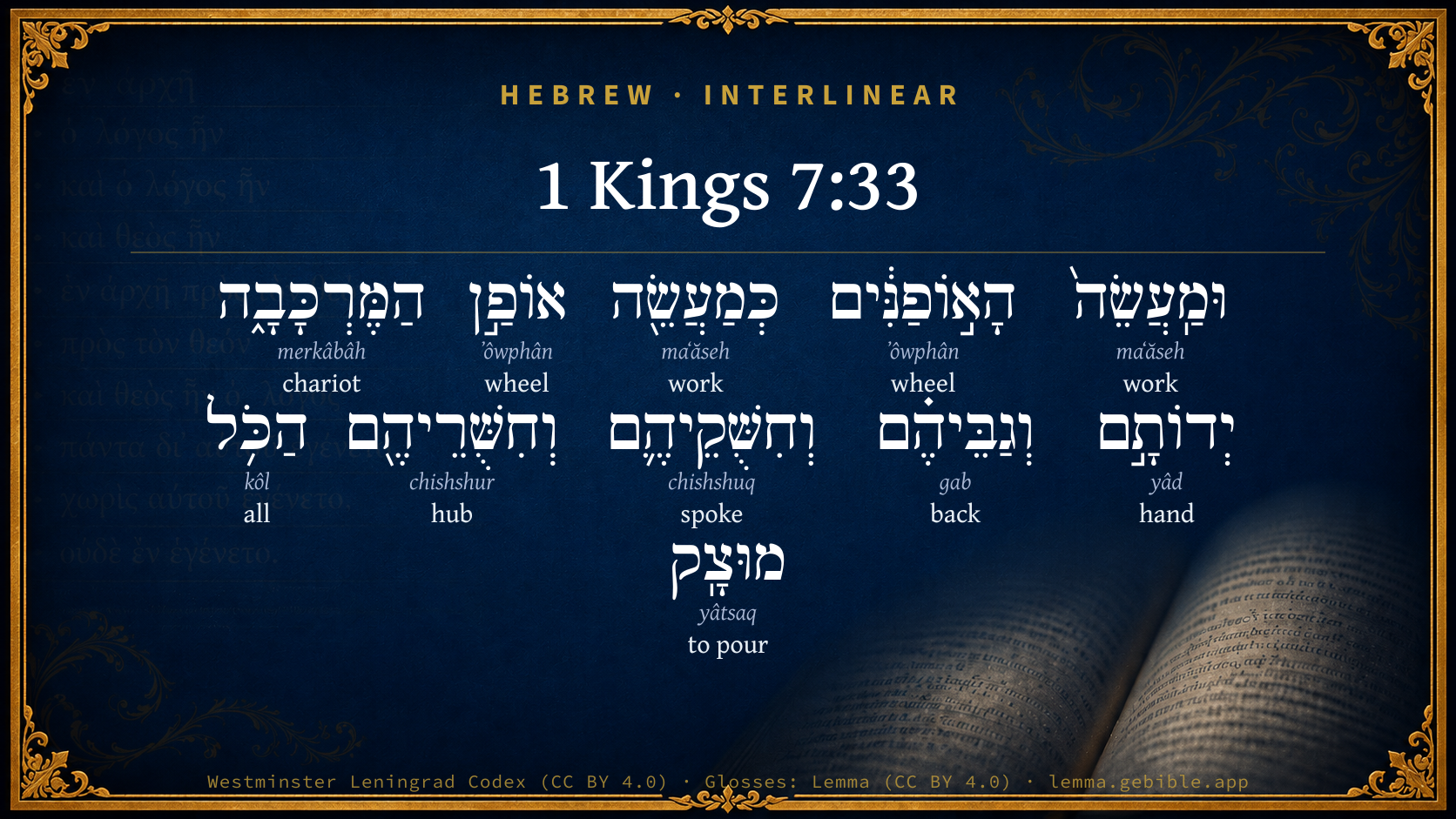
1 Kings 7:33

Hebrew (Westminster Leningrad Codex) 1 Kings 7:33 appears in the Hebrew Old Testament. The text above is from the Westminster Leningrad Codex. Each word links to its Strong’s number, a concise gloss, and parsing drawn from the Open Scriptures Hebrew Bible morphology. Click any word for its full Brown-Driver-Briggs (BDB) entry.
Download image
Cite this verse

1 Kings 7:33 (World English Bible). Public Domain. Lemma interlinear Bible study tool, https://lemma.gebible.app/v/1-kings/7/33.

Show BibTeX & RIS
BibTeX
RIS
English Translation
The work of the wheels was like the work of a chariot wheel: their axles, and their rims, and their spokes, and their naves, were all molten.
World English Bible · Public Domain
Highlights
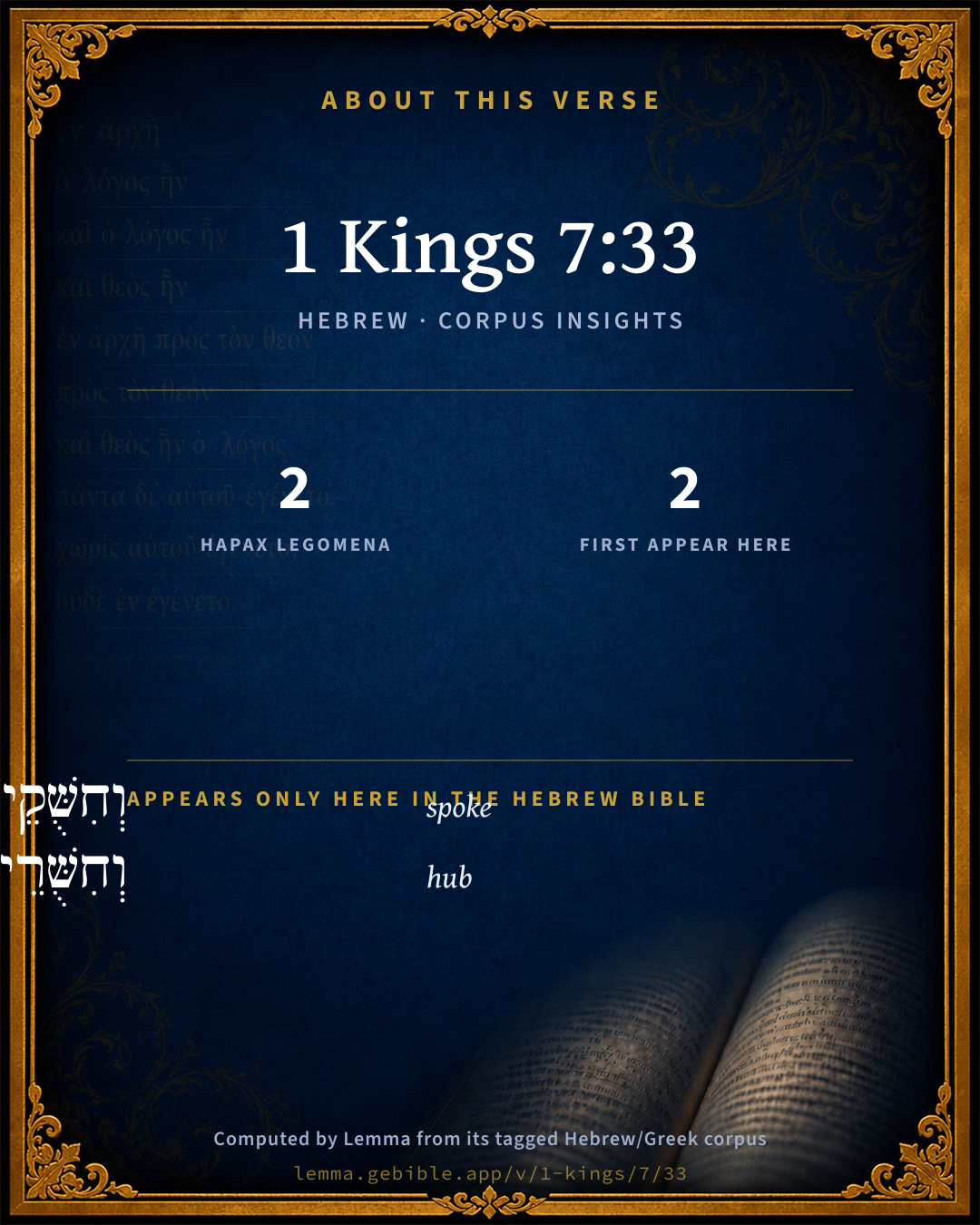
  • 2 hapax legomena — only here in the Hebrew Bible
  • 2 first appearances in the Hebrew Bible
Full analysis ↓
Download a study sheet

One document with this verse’s original text, its word-by-word gloss line, the meaning frame, cross-references with their text, attributed commentary, and full source and license credits — printable, and it pastes into notes with its structure intact.

This verse Autodidact and up

Study sheet (.html) Plain text (.txt)

A passage Seminary Student

Up to 50 verses in one chapter. A passage sheet keeps up to 6 commentary sources and 12 cross-references per verse, in the order this page ranks them, and says so on the sheet whenever that leaves anything out. Ask for a single verse and you get the Autodidact verse sheet above.

Everything on this page stays free to read, with no account — the sheet is a download of what is already on screen, not access to it.

Want to remove ads? Support Godless Engineer
Compare translations 3

The same verse in 3 English versions, stacked beneath the original-language interlinear above. Click any original word for its lexicon entry.

Each is an independent rendering of the whole verse — the interlinear is not word-aligned to these translations.

Highlighted words mark where these versions differ — a whole-verse word diff, not a word-by-word alignment.

  • World English Bible Public Domain
    The work of the wheels was like the work of a chariot wheel: their axles, and their rims, and their spokes, and their naves, were all molten.
  • King James Version Public Domain
    And the work of the wheels was like the work of a chariot wheel: their axletrees, and their naves, and their felloes, and their spokes, were all molten.
  • unfoldingWord Literal Text CC BY-SA 4.0
    And the work of the wheels like the work of the wheel of a chariot. Their hands and their rims and their spokes and their hubs, the whole was cast.

unfoldingWord Literal Text — © unfoldingWord, licensed CC BY-SA 4.0. Word-aligned USFM3 via Door43 (git.door43.org/unfoldingWord/en_ult).

Versions to compare (up to 4)

3 of 4 selected

Show all 18 translations

Every available English version of this verse, each an independent rendering of the whole verse.

  • World English Bible Public Domain
    The work of the wheels was like the work of a chariot wheel: their axles, and their rims, and their spokes, and their naves, were all molten.
  • Berean Standard Bible Public Domain
    The wheels were made like chariot wheels; their axles, rims, spokes, and hubs were all of cast metal.
  • Majority Standard Bible Public Domain
    The wheels were made like chariot wheels; their axles, rims, spokes, and hubs were all of cast metal.
  • King James Version Public Domain
    And the work of the wheels was like the work of a chariot wheel: their axletrees, and their naves, and their felloes, and their spokes, were all molten.
  • American Standard Version (1901) Public Domain
    And the work of the wheels was like the work of a chariot wheel: their axletrees, and their felloes, and their spokes, and their naves, were all molten.
  • Revised Version (1885) Public Domain
    And the work of the wheels was like the work of a chariot wheel: their axletrees, and their felloes, and their spokes, and their naves, were all molten.
  • Geneva Bible (1599) Public Domain
    And the facion of the wheeles was like the facion of a charet wheele, their axeltrees, and their naues and their felloes, and their spokes were all molten.
  • Douay-Rheims (1899) Public Domain
    And they were such wheels as are used to be made in a chariot: and their axletrees, and spokes, and strakes, and naves, were all east.
  • Young's Literal Translation Public Domain
    And the work of the wheels `is' as the work of the wheel of a chariot, their spokes, and their axles, and their felloes, and their naves; the whole `is' molten.
  • Literal Standard Version CC BY-SA 4.0
    And the work of the wheels [is] as the work of the wheel of a chariot, their spokes, and their axles, and their felloes, and their naves; the whole [is] molten.
  • Unlocked Literal Bible CC BY-SA 4.0
    The wheels were forged like chariot wheels. Their housings, rims, spokes, and hubs were all cast metal.
  • unfoldingWord Literal Text CC BY-SA 4.0
    And the work of the wheels like the work of the wheel of a chariot. Their hands and their rims and their spokes and their hubs, the whole was cast.
  • Darby Bible Public Domain
    And the work of the wheels was like the work of a chariot wheel: their supports, and their rims, and their spokes and their naves were all molten.
  • World Messianic Bible Public Domain
    The work of the wheels was like the work of a chariot wheel. Their axles, their rims, their spokes, and their hubs were all of cast metal.
  • Webster's Bible Public Domain
    And the work of the wheels was like the work of a chariot wheel: their axletrees, and their naves, and their fellies, and their spokes, were all molten.
  • Free Bible Version CC BY-SA 4.0
    The wheels were made in the same way as chariot wheels; their axles, rims, spokes, and hubs were all made by casting.
  • Bible in Basic English Public Domain
    The wheels were made like carriage-wheels, the rods on which they were fixed, the parts forming their edges, their rods and the middle points of them, were all formed out of liquid metal.
  • JPS Tanakh (1917) Public Domain
    And the work of the wheels was like the work of a chariot wheel; their axletrees, and their felloes, and their spokes, and their naves, were all molten.

Literal Standard Version (2020), Covenant Press — licensed CC BY-SA 4.0. Text via the HelloAO Bible API (eBible.org). Unlocked Literal Bible (unfoldingWord) — licensed CC BY-SA 4.0. Text via the HelloAO Bible API (eBible.org). unfoldingWord Literal Text — © unfoldingWord, licensed CC BY-SA 4.0. Word-aligned USFM3 via Door43 (git.door43.org/unfoldingWord/en_ult). Free Bible Version, Dr. Jonathan Gallagher — licensed CC BY-SA 4.0. Text via the HelloAO Bible API (eBible.org).

Word by word

More ways to search: Search by grammar → Find every occurrence → Compare this word →

Practice this passage: Drill this verse → Learn its vocabulary →

וְחִשֻּׁקֵיהֶ֛ם
chishshuq
H2839
“and · spokes · their”
Conjunction + Noun, Common, Masculine, Plural, Construct + Suffix, Personal, 3rd Person, Masculine, Plural
Part of Speech
Conjunction + Noun
Type
Common
Gender
Masculine
Number
Plural
State
Construct
Full BDB Definition

Origin: from H2836

TWOT: 773d

spoke, spoke of a wheel
  1. וּמַֽעֲשֵׂה֙ maʻăseh H4639 “and · work of” Conjunction + Noun, Common, Masculine, Singular, Construct
  2. הָא֣וֹפַנִּ֔ים ʼôwphân H212 “the · wheels” Particle, Definite Article + Noun, Common, Masculine, Plural, Absolute
  3. כְּמַעֲשֵׂ֖ה maʻăseh H4639 “like/as · work of” Preposition + Noun, Common, Masculine, Singular, Construct
  4. אוֹפַ֣ן ʼôwphân H212 “wheel of” Noun, Common, Masculine, Singular, Construct
  5. הַמֶּרְכָּבָ֑ה merkâbâh H4818 “the · chariot” Particle, Definite Article + Noun, Common, Feminine, Singular, Absolute
  6. יְדוֹתָ֣ם yâd H3027 “hands · their” Noun, Common, Both, Plural, Construct + Suffix, Personal, 3rd Person, Masculine, Plural
  7. וְגַבֵּיהֶ֗ם gab H1354 “and · backs · their” Conjunction + Noun, Common, Both, Plural, Construct + Suffix, Personal, 3rd Person, Masculine, Plural
  8. וְחִשֻּׁרֵיהֶ֖ם chishshur H2840 “and · hubs · their” Conjunction + Noun, Common, Masculine, Plural, Construct + Suffix, Personal, 3rd Person, Masculine, Plural
  9. הַכֹּ֥ל kôl H3605 “the · all” Particle, Definite Article + Noun, Common, Masculine, Singular, Absolute
  10. מוּצָֽק yâtsaq H3332 “poured” Verb, Hophal, Participle Passive, Masculine, Singular, Absolute

About this verse

These counts appear in no published source. They are computed here, from the morphology-tagged text and Lemma’s own curated glosses. What Lemma adds →

11
words
9
distinct lemmas
Historical
section

Notable vocabulary

2 hapax legomena — words that appear only here in the entire Hebrew Bible:

  • וְחִשֻּׁקֵיהֶ֛ם spoke H2839
  • וְחִשֻּׁרֵיהֶ֖ם hub H2840

First appearance in Scripture

These words make their first canonical appearance in the Hebrew Bible here:

  • וְחִשֻּׁקֵיהֶ֛ם spoke H2839
  • וְחִשֻּׁרֵיהֶ֖ם hub H2840

Shared distinctive vocabulary

וְגַבֵּיהֶ֗ם back H1354 occurs in 11 verses of the Hebrew Bible. Also found in:

Grammatical profile

  • 1 verb
  • 10 nouns

Verb forms

  • מוּצָֽק Hophal · Participle Passive

Repetition

Words recur within this verse — often emphatic in Hebrew:

  • וּמַֽעֲשֵׂה֙ work H4639 ×2
  • הָא֣וֹפַנִּ֔ים wheel H212 ×2

Hebrew & Septuagint length

In English translation the verse runs 27 words from the Hebrew and 27 from the Septuagint (LXX English) — the same length.

A rough comparison of the two English renderings, which tokenize alike — not a word-level alignment.

Word counts can differ between the Hebrew and the Greek without any difference in meaning — e.g. the Hebrew direct-object marker אֵת has no separate Greek word, and Greek often adds the article ὁ.

Cross-references

2

Topical passages linked to 1 Kings 7:33 in the Treasury of Scripture Knowledge — connected by theme and wording, ordered by reader-vote popularity; previews shown in the World English Bible.

  • Ezekiel 1:16 The appearance of the wheels and their work was like a beryl: and they four had one likeness; and their appearance and their work was as it were a wheel within a wheel.
  • Ezekiel 1:18 As for their rims, they were high and dreadful; and they four had their rims full of eyes round about.

Cross-references courtesy of OpenBible.info (CC BY 4.0).

Hebrew and Greek witnesses Masoretic Hebrew ↔ Greek Septuagint

The same verse in the two great witnesses to the Old Testament, shown verse-for-verse.

These are two independent witnesses, not word-aligned to each other, and the Septuagint is shown in lemma (dictionary) form.

Hebrew 1 Kings 7:33 Masoretic · Westminster Leningrad Codex

וּמַֽעֲשֵׂה֙ הָא֣וֹפַנִּ֔ים כְּמַעֲשֵׂ֖ה אוֹפַ֣ן הַמֶּרְכָּבָ֑ה יְדוֹתָ֣ם וְגַבֵּיהֶ֗ם וְחִשֻּׁקֵיהֶ֛ם וְחִשֻּׁרֵיהֶ֖ם הַכֹּ֥ל מוּצָֽק

The work of the wheels was like the work of a chariot wheel: their axles, and their rims, and their spokes, and their naves, were all molten.

World English Bible · Public Domain

Greek LXX 1 Kings 7:33 Septuagint · lemma form
And the work of the wheels was as the work of chariot wheels: their axles, and their felloes, and the rest of their work, were all molten.

LXX2012 (modern English Septuagint) · Public Domain

Hebrew: Westminster Leningrad Codex (CC BY 4.0). Greek: Septuagint (public domain); English from LXX2012 (modern English Septuagint) (Public Domain). How the Septuagint differs from the Hebrew →

Targum (Aramaic paraphrase)

1

The Targum is the ancient Jewish Aramaic paraphrase of the Hebrew Scriptures — an interpretive translation, not the Hebrew text itself. Onkelos (literal) and Pseudo-Jonathan (expansive) render the Torah, and Jonathan the Prophets. Coverage is partial: where no permissively-licensed English translation exists for a verse, only the Aramaic is shown. This is verse-level text, not a word-by-word alignment to the Hebrew.

  1. Targum Jonathan Prophets (Joshua–Malachi)
    וְעוֹבַד גִלְגְלַיָא כְּעוֹבַד גִלְגְלֵי מֶרְכְּבַת יְקָרָא אַשְׁדַתְהוֹן וְגַבֵּיהוֹן וְחוֹפֵיהוֹן וְכִבּוּשֵׁיהוֹן כּוֹלָא מַתָּךְ:

    (no public-domain English translation for this verse)

    Targum Jonathan — Aramaic: “Mikraot Gedolot” (public domain). English: “Sefaria Community Translation” (CC0 1.0 (public-domain dedication)); “London "Chaldee Paraphrase," 1871” (public domain). Text via Sefaria.

Commentary

Notes on 1 Kings 7:33 from classic Christian and Jewish commentators (each source and its license shown beneath its notes). The classic Christian expositions comment on the surrounding passage and are grouped to its opening verse, so a note may address several verses; the Jewish commentaries on the Tanakh (Rashi and others) are per-verse, so they appear only where the commentator wrote on this verse.

Lemma curates 59 commentaries, every one of them public domain or Creative Commons licensed, each selected and text-cleaned for this edition rather than reprinted as found. About our sources →

Trapp's Complete Commentary

John Trapp

1Ki 7:33 And the work of the wheels [was] like the work of a chariot wheel: their axletrees, and their naves, and their felloes, and their spokes, [were] all molten.

Ver. 33. Like the work of a chariot wheel,] i.e., Curiously wrought, and as having axle-tree, naves, felloes, spokes, all cast together in their moulds.

John Trapp, A Commentary or Exposition upon All the Books of the Old and New Testament (1647–1656) — public domain. Text from a community e-Sword module.

Joseph Benson's Commentary

1Ki 7:33-37. Were all molten — Cast together with the bases. The undersetters were of the very base — Not only of the same matter, but of the same piece, being cast with it. According to the proportion of every one — Hebrew, כמער, chemagnar, according to the nakedness, or, empty space of every one, that is, according to the extent of the spaces left empty for them, namely, that these figures were as large as the void plates would admit. All of them had one casting, &c. — They were cast in the same mould, and of the same size.

Joseph Benson's Commentary on the Old and New Testaments (1811–1818) — public domain. Text from a community e-Sword module.

Geneva Bible (1599)

Geneva Bible translators

Or, rings.

Geneva Bible (1599) marginal notes — public domain. Text via Bolls.life.

The Cambridge Bible for Schools and Colleges

gen. ed. J. J. S. Perowne

33. their axletrees] Literally, ‘hands’ as in the previous verse.

their naves] By etymology the original word must refer to some curved part of the wheel. It seems better therefore to render, with R.V., felloes here, and transfer the word ‘naves’ to translate the last of the four nouns, which by its derivation signifies ‘that to which all the parts converge.’ The third of the Hebrew words is akin to that which in Exo_27:10-11 is used for the ‘pillars’ or ‘poles’ which supported the hangings of the tabernacle. Hence here most likely ‘the spokes’ of the wheels.

The Cambridge Bible for Schools and Colleges (gen. ed. J. J. S. Perowne; Cambridge University Press, 1878–1918) — public domain. Text from a community e-Sword module.

John Gill's Exposition

And there were four undersetters to the four corners of one base,.... Or pillars, as in Kg1 7:30.

and the undersetters were of the base itself; they were cast together, and of the same piece of metal with it.

John Gill's Exposition of the Whole Bible (1746–1763) — public domain (CC PDM 1.0). Text via the HelloAO Bible API.

Matthew Poole's English Annotations

And cast together with the bases.

Matthew Poole's English Annotations on the Holy Bible (1683–1685) — public domain. Text from a community e-Sword/MySword module.

Whedon's Commentary on the Bible

Daniel D. Whedon

33. Axletrees… naves… felloes… spokes — The proper order and rendering of the words in the Hebrew text is as follows: Stays, felloes, spokes, naves. The nave is the same as the hub. (f f in figure.)

Daniel D. Whedon (gen. ed.), Commentary on the Old and New Testaments (1874–1909) — public domain. Text from a community e-Sword module.

The Pulpit Commentary

And the work of the wheels was like the work of a chariot wheel Heb. the chariot, i.e., the ordinary chariot: their axletrees Heb. hands, and their naves Gesenius understands rims. He derives bG, gibbus, from bbG; curvatus est, and their felloes or fellies, as the word is now written. These axe the parts which compose the circumference of the wheel; but Gesen. translates spokes, because they are the joinings (q conjunxit) of nave and rim and their spokes Gesen. would render naves, because the spokes collect at that part), were all molten.

The Pulpit Commentary (1880–1919), ed. H.D.M. Spence-Jones & Joseph S. Exell — public domain. Text from a community e-Sword module.

John Wesley's Explanatory Notes

Molten - And cast together with the bases.

John Wesley, Explanatory Notes Upon the Whole Bible (1754–1765) — public domain. Text via the GEBible commentary corpus.

Rashi

Rabbi Shlomo Yitzchaki (Rashi)

Like the work of a chariot wheel. [Targum] Yonoson rendered, “as the work of the wheels of a chariot,” a wheel within a wheel crosswise, as it is stated in Yechezkeil in [reference to] the “Heavenly Chariot.”

Their axles. Essieu [in O.F.]

Their hubs. Bojjols in O.F., they are the holes [for the axles].

Their rims. They are the enclosures around, which bind them together.

And their spokes. The arms of the wheels which are attached from the holes of the wheel to the rims, which is called rais, in O.F.

Rashi on the Tanakh — English translations: “The Judaica Press complete Tanach with Rashi, translated by A. J. Rosenberg” (CC BY 4.0); “Pentateuch with Rashi's commentary by M. Rosenbaum and A.M. Silbermann, 1929-1934” (public domain); “The Metsudah Tanach series, Lakewood, N.J” (CC BY 4.0); and “The Book of Joshua, Metsudah Publications, 1997” (CC BY 4.0). Text via Sefaria.

Lesson kit

Teaching starters — assembled from the data on this page, not authored interpretation. Every prompt links to the verse data it draws on. Edit before teaching.

1 Kings, in the Historical, opens this verse with 11 words (9 distinct Hebrew lemmas). Its most distinctive word is chishshuq (“spoke”). A historical commentator’s framing appears above. Read the whole chapter for the surrounding context.

Discussion questions

  1. What does “spoke” (chishshuq) contribute to the verse as a whole?
  2. This verse holds 2 words here found nowhere else in the Hebrew Bible. What might the rare words draw attention to?
  3. 2 words here appear for the first time in Scripture. What is being introduced at this debut?
  4. Leviticus 14:9 shares the word «back» with this verse. How do the two illuminate each other?
  5. “work” occurs 2× in this one verse. What is the effect of the repetition?
  6. These translations render this verse differently; the difference is in the English rendering, not the original. What questions does that raise?
  7. The verb «מוּצָֽק» is Hophal Participle Passive. How does its form color the action?
  8. Reading how Trapp's Complete Commentary and Joseph Benson's Commentary read this verse, where do the two commentators agree and where do they part?

Things to notice

  • 2 words in this verse appear nowhere else in the Hebrew Bible.
  • 2 words make their first canonical appearance in Scripture here.
  • These translations choose different wording for 11 words in this verse.
  • “work” occurs 2× in this single verse.
  • 9 distinct Hebrew lemmas span 11 words in this verse.

Reading settings

Reading text

Shown beneath each verse's original-language words.

Old Testament
Old Testament edition

Read the OT as the Masoretic Hebrew (MT) or the Greek Septuagint (LXX).

English shown for the Greek Septuagint (in the Hebrew ↔ Greek comparison).

Comparing translations? Open the Compare panel on any verse page to stack up to four side by side.