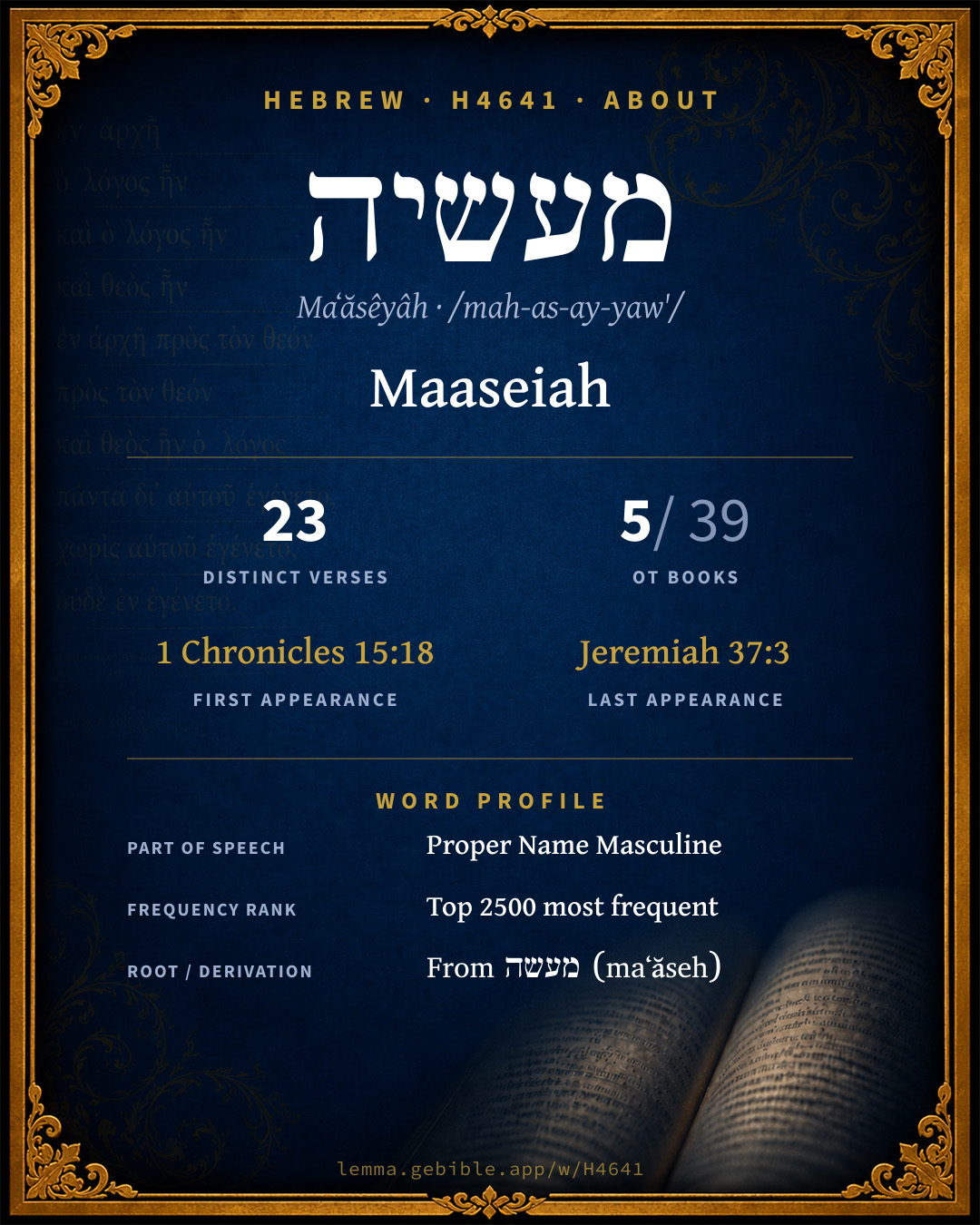
מַעֲשֵׂיָהוּ
Maaseiah
BDB lists 10 entries for ‘Maaseiah’ fuller range ↓
Full lexicon entry — Brown-Driver-Briggs (BDB)
From Brown-Driver-Briggs (BDB)
Where this word appears
Grammar key — what these labels mean
Part of speech
- Noun
- A naming word — a person, place, thing, or idea.
Noun type
- Proper
- A name of a specific person, place, or people (e.g. Abraham, Zion, Israel).
Every verse where H4641 appears — 23 distinct verses across 5 books. Click any verse to open its interlinear word-by-word view. Verse text shown in the World English Bible for context — . Each verse’s Hebrew form is shown with its reference; the English is not keyword-highlighted, since the data carries no word-level English alignment. Use “Compare translations” on any verse to read it across multiple English versions. This concordance covers the Hebrew Bible; Septuagint (Greek Old Testament) occurrences are not indexed here.
1 Chronicles 2 verses
- 1 Chronicles 15:18 וּ/מַֽעֲשֵׂיָ֡הוּ conj + n Proper and with them their brothers of the second degree, Zechariah, Ben, and Jaaziel, and Shemiramoth, and Jehiel, and Unni, Eliab, and Benaiah, and Maaseiah, and Mattithiah, and Eliphelehu, and Mikneiah, and Obed-edom, and Jeiel, the doorkeepers.
- 1 Chronicles 15:20 וּ/מַעֲשֵׂיָ֖הוּ conj + n Proper and Zechariah, and Aziel, and Shemiramoth, and Jehiel, and Unni, and Eliab, and Maaseiah, and Benaiah, with psalteries set to Alamoth;
2 Chronicles 4 verses
- 2 Chronicles 23:1 מַעֲשֵׂיָ֧הוּ n Proper In the seventh year Jehoiada strengthened himself, and took the captains of hundreds, Azariah the son of Jeroham, and Ishmael the son of Jehohanan, and Azariah the son of Obed, and Maaseiah the son of Adaiah, and Elishaphat the son of Zichri, into covenant with him.
- 2 Chronicles 26:11 וּ/מַעֲשֵׂיָ֖הוּ conj + n Proper Moreover Uzziah had an army of fighting men, who went out to war by bands, according to the number of their reckoning made by Jeiel the scribe and Maaseiah the officer, under the hand of Hananiah, one of the king's captains.
- 2 Chronicles 28:7 מַעֲשֵׂיָ֨הוּ֙ n Proper Zichri, a mighty man of Ephraim, killed Maaseiah the king's son, and Azrikam the ruler of the house, and Elkanah who was next to the king.
- 2 Chronicles 34:8 מַעֲשֵׂיָ֣הוּ n Proper Now in the eighteenth year of his reign, when he had purged the land and the house, he sent Shaphan the son of Azaliah, and Maaseiah the governor of the city, and Joah the son of Joahaz the recorder, to repair the house of Yahweh his God.
Ezra 4 verses
- Ezra 10:18 מַֽעֲשֵׂיָה֙ n Proper Among the sons of the priests there were found who had married foreign women: [namely], of the sons of Jeshua, the son of Jozadak, and his brothers, Maaseiah, and Eliezer, and Jarib, and Gedaliah.
- Ezra 10:21 מַעֲשֵׂיָ֤ה n Proper Of the sons of Harim: Maaseiah, and Elijah, and Shemaiah, and Jehiel, and Uzziah.
- Ezra 10:22 מַֽעֲשֵׂיָה֙ n Proper Of the sons of Pashhur: Elioenai, Maaseiah, Ishmael, Nethanel, Jozabad, and Elasah.
- Ezra 10:30 מַעֲשֵׂיָה֙ n Proper Of the sons of Pahath-moab: Adna, and Chelal, Benaiah, Maaseiah, Mattaniah, Bezalel, and Binnui, and Manasseh.
Nehemiah 8 verses
- Nehemiah 3:23 מַעֲשֵׂיָ֛ה n Proper After them repaired Benjamin and Hasshub over against their house. After them repaired Azariah the son of Maaseiah the son of Ananiah beside his own house.
- Nehemiah 8:4 וּ/מַעֲשֵׂיָ֖ה conj + n Proper Ezra the scribe stood on a pulpit of wood, which they had made for the purpose; and beside him stood Mattithiah, and Shema, and Anaiah, and Uriah, and Hilkiah, and Maaseiah, on his right hand; and on his left hand, Pedaiah, and Mishael, and Malchijah, and Hashum, and Hashbaddanah, Zechariah, [and] Meshullam.
- Nehemiah 8:7 מַעֲשֵׂיָ֡ה n Proper Also Jeshua, and Bani, and Sherebiah, Jamin, Akkub, Shabbethai, Hodiah, Maaseiah, Kelita, Azariah, Jozabad, Hanan, Pelaiah, and the Levites, caused the people to understand the law: and the people [stood] in their place.
- Nehemiah 10:25 מַעֲשֵׂיָֽה n Proper Rehum, Hashabnah, Maaseiah,
- Nehemiah 11:5 וּ/מַעֲשֵׂיָ֣ה conj + n Proper and Maaseiah the son of Baruch, the son of Colhozeh, the son of Hazaiah, the son of Adaiah, the son of Joiarib, the son of Zechariah, the son of the Shilonite.
- Nehemiah 11:7 מַעֲשֵׂיָ֛ה n Proper These are the sons of Benjamin: Sallu the son of Meshullam, the son of Joed, the son of Pedaiah, the son of Kolaiah, the son of Maaseiah, the son of Ithiel, the son of Jeshaiah.
- Nehemiah 12:41 מַעֲשֵׂיָ֡ה n Proper and the priests, Eliakim, Maaseiah, Miniamin, Micaiah, Elioenai, Zechariah, and Hananiah, with trumpets;
- Nehemiah 12:42 וּ/מַעֲשֵׂיָ֨ה conj + n Proper and Maaseiah, and Shemaiah, and Eleazar, and Uzzi, and Jehohanan, and Malchijah, and Elam, and Ezer. The singers sang loud, with Jezrahiah their overseer.
Jeremiah 5 verses
- Jeremiah 21:1 מַעֲשֵׂיָ֛ה n Proper The word which came to Jeremiah from Yahweh, when king Zedekiah sent to him Pashhur the son of Malchijah, and Zephaniah the son of Maaseiah, the priest, saying,
- Jeremiah 29:21 מַֽעֲשֵׂיָ֔ה n Proper Thus says Yahweh of Hosts, the God of Israel, concerning Ahab the son of Kolaiah, and concerning Zedekiah the son of Maaseiah, who prophesy a lie to you in my name: Behold, I will deliver them into the hand of Nebuchadrezzar king of Babylon; and he shall kill them before your eyes;
- Jeremiah 29:25 מַֽעֲשֵׂיָה֙ n Proper Thus speaks Yahweh of Hosts, the God of Israel, saying, Because you have sent letters in your own name to all the people who are at Jerusalem, and to Zephaniah the son of Maaseiah, the priest, and to all the priests, saying,
- Jeremiah 35:4 מַעֲשֵׂיָ֥הוּ n Proper and I brought them into the house of Yahweh, into the chamber of the sons of Hanan the son of Igdaliah, the man of God, which was by the chamber of the princes, which was above the chamber of Maaseiah the son of Shallum, the keeper of the threshold.
- Jeremiah 37:3 מַֽעֲשֵׂיָה֙ n Proper Zedekiah the king sent Jehucal the son of Shelemiah, and Zephaniah the son of Maaseiah, the priest, to the prophet Jeremiah, saying, Pray now to Yahweh our God for us.
About this entry
At a glance — auto-summarized from this page’s data, not written by a person. Every figure links to its source below. This summary describes the numbers; it doesn’t interpret them.
The Hebrew name מעשיה centers on the idea of “Maaseiah.” Its earliest occurrence is 1 Chronicles 15:18. It appears 23 verses across 5 books of the Hebrew Bible, among its uncommon vocabulary. The word gravitates to Nehemiah (35%), then Jeremiah and 2 Chronicles. Dig into 23-verse concordance and the renderings breakdown below.
Gloss history
Strong's 1890 vs modern scholarship
About this word
Strong's H4641 catalogs a Hebrew word from the Hebrew Old Testament.
These counts are not copied from any lexicon or concordance. They are computed here, from the morphology-tagged Hebrew Old Testament. What Lemma adds →
- 23
- distinct verses
- The word appears in 23 distinct verses.
- 5 / 39
- OT books
- The word appears in 5 of 39 Old Testament books.
- #1,368
- by frequency
- Top 2500 most frequent Hebrew words (rank 1,368 of 8,640 Hebrew words by occurrence).
View all 23 occurrences in the concordance →
Most concentrated in
- Nehemiah 8 verses 35%
- Jeremiah 5 verses 22%
- 2 Chronicles 4 verses 17%
By section of the Old Testament
By traditional corpus
Conventional, traditional groupings — biblical authorship is debated, so this is a traditional corpus grouping, not an authorship claim. Each share is this word’s portion of its verses in that division of the Hebrew canon. Each figure is a share of the word’s 23 distinct verses.
- Writings (Ketuvim) 18 verses · 78%
- Prophets (Nevi'im) 5 verses · 22%
How translations render this word
Counts come from each version’s own published word-to-Strong’s tagging or interlinear alignment — an approximate guide to how each version renders this word, not a word-level alignment the data otherwise carries. Because each total is that version’s own tagged count, the per-version totals vary from one another and need not match the appearance or distinct-verse counts above. These counts may also differ from a printed concordance because Lemma counts each distinctly tagged rendering and does not collapse phrase taggings into a single head-word total. This is a fixed set of word-tagged versions (KJV, ASV, BSB, ULT) and does not change with the reading translation you choose elsewhere. Each version’s license is shown beside its name below (and on Sources).
- King James Version: Maaseiah 23×
- American Standard Version: Maaseiah 23×
- Berean Standard Bible: Maaseiah 23×
- unfoldingWord Literal Text: Maaseiah 19×
King James Version Public Domain
Renders H4641 across 23 tagged occurrences — most commonly:
American Standard Version Public Domain
Renders H4641 across 23 tagged occurrences — most commonly:
Berean Standard Bible Public Domain
Renders H4641 across 23 tagged occurrences — most commonly:
unfoldingWord Literal Text CC BY-SA 4.0
Renders H4641 across 19 tagged occurrences — most commonly:
22 senses and sub-senses in the full BDB
What do BDB’s symbols mean?
BDB uses these scholarly abbreviations:
| Symbol | Meaning |
|---|---|
| 𝔊 | the Septuagint (the ancient Greek translation, LXX) |
| 𝔙 | the Vulgate (the Latin translation) |
| 𝔖 | the Syriac version (the Peshitta) |
| 𝔗 | the Targum (the Aramaic translation) |
| ψ | the Psalms |
| √ | root (the underlying root or stem) |
| ‖ | parallel passage (a synonymous or contrasted parallel) |
| † | the dagger: every passage where the word occurs is cited |
The 22 senses and sub-senses the full Brown-Driver-Briggs lexicon distinguishes for this word, in lexicon order (not ranked by frequency), with BDB’s own verbatim wording and sub-sense lettering. Shown in Hebrew script with BDB’s own scholarly abbreviations. The condensed entry is in the Lexicon Entry tab. See also the Forms in the corpus table below.
- 1. priest, Je.’s time, מַעֲשֵׂיָה Je 21:1; 29:25; 37:3; perhaps 35:4 (-יָהוּ). e.g. Jeremiah 21:1
- 2. 29:21. מַעֲשֵׂיָהוּ e.g. Jeremiah 29:21
- 3. Levites:
- a. 1 Ch 15:18, 20. e.g. 1 Chronicles 15:18
- b. 2 Ch 23:1. e.g. 2 Chronicles 23:1
- 4. officials:
- a. 26:11. e.g. 2 Chronicles 26:11
- b. 34:8. e.g. 2 Chronicles 34:8
- 5. son of Ahaz 28:7. e.g. 2 Chronicles 28:7
- 6. Levite 1 Ch 6:25 reading מַעֲשֵׂיָה for MT בַּעֲשֵׂיָה q.v., cf. Kit. מַעֲשֵׂיָה of various post-exil. men: e.g. 1 Chronicles 6:25
- 7. Ne 3:23 (Μαδασηλ, A Μαασιου). e.g. Nehemiah 3:23
- 8.
- a. 8:4, 7. e.g. Nehemiah 8:4
- b. 10:26. e.g. Nehemiah 10:26
- c. 11:5. e.g. Nehemiah 11:5
- d. v 7. e.g. Nehemiah 11:7
- e. 12:41. e.g. Nehemiah 12:41
- f. v 42. e.g. Nehemiah 12:42
- 9.
- a. Ezr 10:18. e.g. Ezra 10:18
- b. v 21 (Μασαηλ, Μασειας). e.g. Ezra 10:21
- c. v 22. e.g. Ezra 10:22
- d. v 30. e.g. Ezra 10:30
- 10. מַעֲשַׂי (van d. H. מַעְשַׂי) Μα(α)σαι(α), a priest 1 Ch 9:12. e.g. 1 Chronicles 9:12
Senses from the full Brown-Driver-Briggs lexicon (Brown, Driver, Briggs; Oxford 1906 — public domain), digitized via Sefaria, supplemented by the OpenScriptures HebrewLexicon (CC BY 4.0). Full attribution on Sources.
Word origin
† מַעֲשֵׂיָהוּ -יָה, מַעֲשַׂי n. pr.m. (work of י׳; cf. n.pr. מעשיהו on Isr. seal, Cl-Gann, v. Lzb315);—Μα(α)σσαια(ς), etc., 𝔊 B Ezr 10:21 Μασαηλ:—
— Brown-Driver-Briggs (Oxford 1906, public domain), digitized via Sefaria, supplemented by the OpenScriptures HebrewLexicon (CC BY 4.0). See Sources.
Derived from מעשה (maʻăseh) (H4639) — work.
Forms in the corpus
The 16 distinct written forms H4641 takes in the Hebrew Bible, most frequent first — each parse links to that state’s occurrences in the concordance. Hebrew forms include their vowel points and cantillation, so a single lemma takes many written forms.
| Form | Parsing | Example | Uses |
|---|---|---|---|
| מַֽעֲשֵׂיָה֙ | Noun, Proper | Ezra 10:18 | 4 |
| מַעֲשֵׂיָ֛ה | Noun, Proper | Jeremiah 21:1 | 3 |
| וּ/מַעֲשֵׂיָ֖הוּ | Noun, Proper | 1 Chronicles 15:20 | 2 |
| מַעֲשֵׂיָ֡ה | Noun, Proper | Nehemiah 8:7 | 2 |
| וּ/מַֽעֲשֵׂיָ֡הוּ | Noun, Proper | 1 Chronicles 15:18 | 1 |
| וּ/מַעֲשֵׂיָ֖ה | Noun, Proper | Nehemiah 8:4 | 1 |
| וּ/מַעֲשֵׂיָ֣ה | Noun, Proper | Nehemiah 11:5 | 1 |
| וּ/מַעֲשֵׂיָ֨ה | Noun, Proper | Nehemiah 12:42 | 1 |
| מַֽעֲשֵׂיָ֔ה | Noun, Proper | Jeremiah 29:21 | 1 |
| מַעֲשֵׂיָ֣הוּ | Noun, Proper | 2 Chronicles 34:8 | 1 |
| מַעֲשֵׂיָ֤ה | Noun, Proper | Ezra 10:21 | 1 |
| מַעֲשֵׂיָ֥הוּ | Noun, Proper | Jeremiah 35:4 | 1 |
| מַעֲשֵׂיָ֧הוּ | Noun, Proper | 2 Chronicles 23:1 | 1 |
| מַעֲשֵׂיָ֨הוּ֙ | Noun, Proper | 2 Chronicles 28:7 | 1 |
| מַעֲשֵׂיָֽה | Noun, Proper | Nehemiah 10:25 | 1 |
| מַעֲשֵׂיָה֙ | Noun, Proper | Ezra 10:30 | 1 |
Bible dictionary
Public-domain dictionary articles matched to this entry by name (Maaseiah). A biblical name can be shared by more than one person or place, so an article may treat several.
Easton's Bible Dictionary · M. G. Easton, 1897
The work of Jehovah. (1.) One of the Levites whom David appointed as porter for the ark (1 Chr. 15:18, 20).
(2.) One of the "captains of hundreds" associated with Jehoiada in restoring king Jehoash to the throne (2 Chr. 23:1).
(3.) The "king's son," probably one of the sons of king Ahaz, killed by Zichri in the invasion of Judah by Pekah, king of Israel (2 Chr. 28:7).
(4.) One who was sent by king Josiah to repair the temple (2 Chr. 34:8). He was governor (Heb. sar, rendered elsewhere in the Authorized Version "prince," "chief captain," chief ruler") of Jerusalem.
(5.) The father of the priest Zephaniah (Jer. 21:1; 37:3).
(6.) The father of the false prophet Zedekiah (Jer. 29:21).
Maase'iah, refuge is Jehovah, a priest, the father of Neriah (Jer. 32:12; 51:59).
Smith's Bible Dictionary · William Smith, 1863
(work of the Lord), the name of four persons who had married foreign wives. In the time of Ezra,
+ A descendant of Jeshua the priest. (Ezra 10:18) + A priest, of the sons of Harim. (Ezra 10:21) + A priest, of the sons of Pashur. (Ezra 10:22) + One of the laymen, a descendant of Pahath-moab. (Ezra 10:30) + The father of Azariah. (Nehemiah 3:23) + One of those who stood on the right hand of Ezra when he read the law to the people. (Nehemiah 8:4) + A Levite who assisted on the same occasion. (Nehemiah 8:7) + One of the heads of the people whose descendants signed the covenant with Nehemiah. (Nehemiah 10:25) + Son of Baruch the descendant of Pharez the son of Judah, (Nehemiah 11:5) + A Benjamite, ancestor of Sallu. (Nehemiah 11:7) + Two priests of this name are mentioned, (Nehemiah 12:41,42) as taking part in the musical service which accompanied the dedication of the wall of Jerusalem under Ezra. One of them is probably the same as No. 6. + Father of Zephaniah, who was a priest in the reign of Zedekiah. (Jeremiah 21:1; 29:25; 37:3) + Father of Zedekiah the false prophet. (Jeremiah 29:21) + One of the Levites of the second rank, appointed by David to sound "with psaltries on Alamoth." (1 Chronicles 15:18,20) + The son of Adaiah, and one of the captains of hundreds in the reign of Joash king of Judah. (2 Chronicles 23:1) + An officer of high rank in the reign of Uzziah. (2 Chronicles 26:11) He was probably a Levite, comp: (1 Chronicles 23:4) and engaged in a semi-military capacity. + The "king's son," killed by Zichri the Ephraimitish hero in the invasion of Judah by Pekah king of Israel, during the reign of Ahaz. (2 Chronicles 28:7) + The governor of Jerusalem in the reign of Josiah. (2 Chronicles 34:8) + The son of Shallum, a Levite of high rank in the reign of Jehoiakim. (Jeremiah 35:4) comp, 1Chr 9:19 + A priest; ancestor of Baruch and Seraiah, the sons of Neriah. (Jeremiah 32:12; 51:59)
Hitchcock's Bible Names Dictionary · Roswell D. Hitchcock, 1869
the work of the Lord
Classic public-domain reference works; full attribution on Sources.
Septuagint verse parallels
This word appears in 13 verses that also exist in the Greek Old Testament (Septuagint), out of the 23 Hebrew verses it occurs in. You can read those verses in Greek by switching the Old Testament edition to the Septuagint.
Read these verses in the Septuagint
This is a verse-level parallel only — the same verses exist in both the Hebrew and Greek Old Testaments. No word-level Hebrew↔Greek correspondence is claimed: the data carries no such alignment, so no Greek word is shown as this Hebrew word’s translation. Coverage is not total — the Septuagint omits the deuterocanon and renumbers the Psalms, so some Hebrew verses have no direct Greek parallel.