

Jeremiah 7:13

Hebrew (Westminster Leningrad Codex) Jeremiah 7:13 appears in the Hebrew Old Testament. The text above is from the Westminster Leningrad Codex. Each word links to its Strong’s number, a concise gloss, and parsing drawn from the Open Scriptures Hebrew Bible morphology. Click any word for its full Brown-Driver-Briggs (BDB) entry.
Download image
Cite this verse

Jeremiah 7:13 (World English Bible). Public Domain. Lemma interlinear Bible study tool, https://lemma.gebible.app/v/jeremiah/7/13.

Show BibTeX & RIS
BibTeX
RIS
English Translation
Now, because you have done all these works, says Yahweh, and I spoke to you, rising up early and speaking, but you didn't hear; and I called you, but you didn't answer:
World English Bible · Public Domain
Download a study sheet

One document with this verse’s original text, its word-by-word gloss line, the meaning frame, cross-references with their text, attributed commentary, and full source and license credits — printable, and it pastes into notes with its structure intact.

This verse Autodidact and up

Study sheet (.html) Plain text (.txt)

A passage Seminary Student

Up to 50 verses in one chapter. A passage sheet keeps up to 6 commentary sources and 12 cross-references per verse, in the order this page ranks them, and says so on the sheet whenever that leaves anything out. Ask for a single verse and you get the Autodidact verse sheet above.

Everything on this page stays free to read, with no account — the sheet is a download of what is already on screen, not access to it.

Want to remove ads? Support Godless Engineer
Compare translations 3

The same verse in 3 English versions, stacked beneath the original-language interlinear above. Click any original word for its lexicon entry.

Each is an independent rendering of the whole verse — the interlinear is not word-aligned to these translations.

Highlighted words mark where these versions differ — a whole-verse word diff, not a word-by-word alignment.

  • World English Bible Public Domain
    Now, because you have done all these works, says Yahweh, and I spoke to you, rising up early and speaking, but you didn't hear; and I called you, but you didn't answer:
  • King James Version Public Domain
    And now, because ye have done all these works, saith the LORD, and I spake unto you, rising up early and speaking, but ye heard not; and I called you, but ye answered not;
  • unfoldingWord Literal Text CC BY-SA 4.0
    So now, on account of your doing all of these deeds”—the declaration of Yahweh—“and I spoke to you rising early and speaking, but you did not listen, and I called you, but you did not answer,

unfoldingWord Literal Text — © unfoldingWord, licensed CC BY-SA 4.0. Word-aligned USFM3 via Door43 (git.door43.org/unfoldingWord/en_ult).

Versions to compare (up to 4)

3 of 4 selected

Show all 18 translations

Every available English version of this verse, each an independent rendering of the whole verse.

  • World English Bible Public Domain
    Now, because you have done all these works, says Yahweh, and I spoke to you, rising up early and speaking, but you didn't hear; and I called you, but you didn't answer:
  • Berean Standard Bible Public Domain
    And now, because you have done all these things, declares the LORD, and because I have spoken to you again and again but you would not listen, and I have called to you but you would not answer,
  • Majority Standard Bible Public Domain
    And now, because you have done all these things, declares the LORD, and because I have spoken to you again and again but you would not listen, and I have called to you but you would not answer,
  • King James Version Public Domain
    And now, because ye have done all these works, saith the LORD, and I spake unto you, rising up early and speaking, but ye heard not; and I called you, but ye answered not;
  • American Standard Version (1901) Public Domain
    And now, because ye have done all these works, saith Jehovah, and I spake unto you, rising up early and speaking, but ye heard not; and I called you, but ye answered not:
  • Revised Version (1885) Public Domain
    And now, because ye have done all these works, saith the LORD, and I spake unto you, rising up early and speaking, but ye heard not; and I called you, but ye answered not:
  • Geneva Bible (1599) Public Domain
    Therefore nowe because yee haue done all these woorkes, sayeth the Lord, (and I rose vp earely and spake vnto you: but when I spake, yee would not heare me, neither when I called, would yee answere).
  • Douay-Rheims (1899) Public Domain
    And now, because you have done all these works, saith the Lord: and I have spoken to you rising up early, and speaking, and you have not heard: and I have called you, and you have not answered:
  • Young's Literal Translation Public Domain
    And now, because of your doing all these works, An affirmation of Jehovah, And I speak unto you, rising early and speaking, And ye have not hearkened, And I call you, and ye have not answered,
  • Literal Standard Version CC BY-SA 4.0
    And now, because of your doing all these works,” || A declaration of YHWH, || “And I speak to you, rising early and speaking, || And you have not listened, || And I call you, and you have not answered,
  • Unlocked Literal Bible CC BY-SA 4.0
    So now, on account of your doing all of these practices—this is Yahweh's declaration—I spoke to you time and time again, but you did not listen. I summoned you, but you did not answer.
  • unfoldingWord Literal Text CC BY-SA 4.0
    So now, on account of your doing all of these deeds”—the declaration of Yahweh—“and I spoke to you rising early and speaking, but you did not listen, and I called you, but you did not answer,
  • Darby Bible Public Domain
    And now, because ye have done all these works, saith Jehovah, and I spoke unto you, rising up early and speaking, and ye heard not, and I called you, and ye answered not;
  • World Messianic Bible Public Domain
    Now, because you have done all these works,” says the LORD, “and I spoke to you, rising up early and speaking, but you didn’t hear; and I called you, but you didn’t answer;
  • Webster's Bible Public Domain
    And now, because ye have done all these works, saith the LORD, and I spoke to you, rising early and speaking, but ye heard not; and I called you, but ye answered not;
  • Free Bible Version CC BY-SA 4.0
    I've warned you time and again about all these things you've done but you've refused to listen, declares the Lord. I've called out to you but you didn't want to answer me.
  • Bible in Basic English Public Domain
    And now, because you have done all these works, says the Lord, and I sent my word to you, getting up early and sending, but you did not give ear; and my voice came to you, but you gave no answer:
  • JPS Tanakh (1917) Public Domain
    And now, because ye have done all these works, saith the LORD, and I spoke unto you, speaking betimes and often, but ye heard not, and I called you, but ye answered not;

Literal Standard Version (2020), Covenant Press — licensed CC BY-SA 4.0. Text via the HelloAO Bible API (eBible.org). Unlocked Literal Bible (unfoldingWord) — licensed CC BY-SA 4.0. Text via the HelloAO Bible API (eBible.org). unfoldingWord Literal Text — © unfoldingWord, licensed CC BY-SA 4.0. Word-aligned USFM3 via Door43 (git.door43.org/unfoldingWord/en_ult). Free Bible Version, Dr. Jonathan Gallagher — licensed CC BY-SA 4.0. Text via the HelloAO Bible API (eBible.org).

Word by word

More ways to search: Search by grammar → Find every occurrence → Compare this word →

Practice this passage: Drill this verse → Learn its vocabulary →

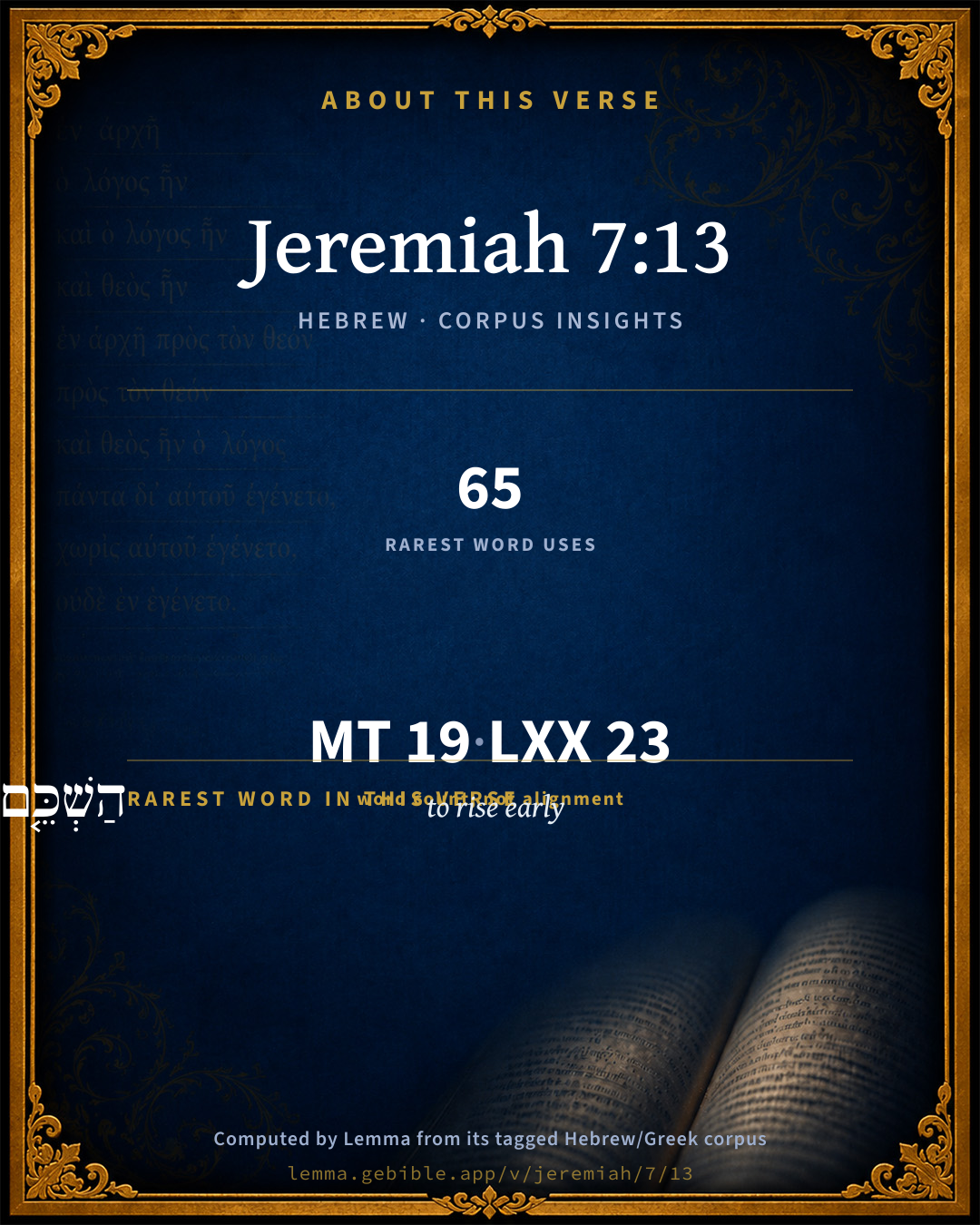
הַשְׁכֵּ֤ם
shâkam
H7925
“to rise early”
Verb, Hiphil, Infinitive Absolute
Part of Speech
Verb
Stem
Hiphil
Form
Infinitive Absolute
Full BDB Definition

Origin: a primitive root

TWOT: 2386

to rise or start early - (Hiphil) - to rise early, make an early start - early (as adverb)
  1. וְעַתָּ֗ה ʻattâh H6258 “and · now” Conjunction + Adverb
  2. יַ֧עַן yaʻan H3282 “because” Conjunction
  3. עֲשׂוֹתְכֶ֛ם ʻâsâh H6213 “to do · you” Verb, Qal, Infinitive Construct + Suffix, Personal, 2nd Person, Masculine, Plural
  4. אֶת ʼêth H853 “-” Particle, Direct Object
  5. כָּל kôl H3605 “all of” Noun, Common, Masculine, Singular, Construct
  6. הַמַּֽעֲשִׂ֥ים maʻăseh H4639 “the · works” Particle, Definite Article + Noun, Common, Masculine, Plural, Absolute
  7. הָאֵ֖לֶּה ʼêl-leh H428 “the · these” Particle, Definite Article + Pronoun, Demonstrative, Common, Plural
  8. נְאֻם nᵉʼum H5002 “utterance of” Noun, Common, Masculine, Singular, Construct
  9. יְהוָ֑ה Yᵉhôvâh H3068 “LORD” Noun, Proper
  10. וָאֲדַבֵּ֨ר dâbar H1696 “and · to speak” Conjunction + Verb, Piel, Sequential Imperfect, 1st Person, Common, Singular
  11. אֲלֵיכֶ֜ם ʼêl H413 “to · you” Preposition + Suffix, Personal, 2nd Person, Masculine, Plural
  12. וְדַבֵּר֙ dâbar H1696 “and · to speak” Conjunction + Verb, Piel, Infinitive Absolute
  13. וְלֹ֣א lôʼ H3808 “and · not” Conjunction + Particle, Negative
  14. שְׁמַעְתֶּ֔ם shâmaʻ H8085 “to hear” Verb, Qal, Perfect, 2nd Person, Masculine, Plural
  15. וָאֶקְרָ֥א qârâʼ H7121 “and · to call” Conjunction + Verb, Qal, Sequential Imperfect, 1st Person, Common, Singular
  16. אֶתְכֶ֖ם ʼêth H853 “- · you” Particle, Direct Object + Suffix, Personal, 2nd Person, Masculine, Plural
  17. וְלֹ֥א lôʼ H3808 “and · not” Conjunction + Particle, Negative
  18. עֲנִיתֶֽם ʻânâh H6030 “to answer” Verb, Qal, Perfect, 2nd Person, Masculine, Plural

About this verse

These counts appear in no published source. They are computed here, from the morphology-tagged text and Lemma’s own curated glosses. What Lemma adds →

19
words
16
distinct lemmas
Prophets
section

Grammatical profile

  • 7 verbs
  • 4 nouns
  • 1 pronoun
  • 1 preposition
  • 1 conjunction
  • 1 adverb
  • 4 particles

Verb forms

  • עֲשׂוֹתְכֶ֛ם Qal · Infinitive Construct
  • וָאֲדַבֵּ֨ר Piel · Sequential Imperfect
  • הַשְׁכֵּ֤ם Hiphil · Infinitive Absolute
  • וְדַבֵּר֙ Piel · Infinitive Absolute
  • שְׁמַעְתֶּ֔ם Qal · Perfect
  • וָאֶקְרָ֥א Qal · Sequential Imperfect
  • עֲנִיתֶֽם Qal · Perfect

Repetition

Words recur within this verse — often emphatic in Hebrew:

  • וָאֲדַבֵּ֨ר to speak H1696 ×2
  • וְלֹ֣א not H3808 ×2

Hebrew & Septuagint length

In the original languages it is 19 Hebrew tokens and 23 Greek tokens — but the two are counted differently (Hebrew bundles its prefixes and suffixes into one token; the Greek is in lemma form), so that isn’t a like-for-like length.

Cross-references

16

Topical passages linked to Jeremiah 7:13 in the Treasury of Scripture Knowledge — connected by theme and wording, ordered by reader-vote popularity; previews shown in the World English Bible.

  • Isaiah 65:12 I will destine you to the sword, and you shall all bow down to the slaughter; because when I called, you did not answer; when I spoke, you did not hear; but you did that which was evil in my eyes, and chose that in which I didn't delight.
  • 2 Chronicles 36:15–16 Yahweh, the God of their fathers, sent to them by his messengers, rising up early and sending, because he had compassion on his people, and on his dwelling-place:
  • Proverbs 1:24 Because I have called, and you have refused; I have stretched out my hand, and no one has paid attention;
  • Jeremiah 7:25 Since the day that your fathers came forth out of the land of Egypt to this day, I have sent to you all my servants the prophets, daily rising up early and sending them:
  • Hosea 11:2 They called to them, so they went from them. They sacrificed to the Baals, And burned incense to engraved images.
  • Zechariah 7:13 It has come to pass that, as he called, and they refused to listen, so they will call, and I will not listen," said Yahweh of Hosts;
  • Nehemiah 9:29–30 and testified against them, that you might bring them again to your law. Yet they dealt proudly, and didn't listen to your commandments, but sinned against your ordinances, (which if a man do, he shall live in them), and withdrew the shoulder, and hardened their neck, and would not hear.
  • Isaiah 50:2 Why, when I came, was there no man? when I called, was there none to answer? Is my hand shortened at all, that it can't redeem? or have I no power to deliver? Behold, at my rebuke I dry up the sea, I make the rivers a wilderness: their fish stink, because there is no water, and die for thirst.
  • Isaiah 66:4 I also will choose their delusions, and will bring their fears on them; because when I called, none did answer; when I spoke, they did not hear: but they did that which was evil in my eyes, and chose that in which I didn't delight.
  • Jeremiah 11:7 For I earnestly protested to your fathers in the day that I brought them up out of the land of Egypt, even to this day, rising early and protesting, saying, Obey my voice.
  • Jeremiah 25:3 From the thirteenth year of Josiah the son of Amon, king of Judah, even to this day, these twenty-three years, the word of Yahweh has come to me, and I have spoken to you, rising up early and speaking; but you have not listened.
  • Jeremiah 35:15 I have sent also to you all my servants the prophets, rising up early and sending them, saying, Return you now every man from his evil way, and amend your doings, and don't go after other gods to serve them, and you shall dwell in the land which I have given to you and to your fathers: but you have not inclined your ear, nor listened to me.
  • Jeremiah 35:17 therefore thus says Yahweh, the God of hosts, the God of Israel: Behold, I will bring on Judah and on all the inhabitants of Jerusalem all the evil that I have pronounced against them; because I have spoken to them, but they have not heard; and I have called to them, but they have not answered.
  • Jeremiah 44:4 However I sent to you all my servants the prophets, rising up early and sending them, saying, Oh, don't do this abominable thing that I hate.
  • Hosea 11:7 My people are determined to turn from me. Though they call to the Most High, He certainly won't exalt them.
  • Matthew 23:37 "Jerusalem, Jerusalem, who kills the prophets, and stones those who are sent to her! How often would I have gathered your children together, even as a hen gathers her chickens under her wings, and you would not!

Cross-references courtesy of OpenBible.info (CC BY 4.0).

Hebrew and Greek witnesses Masoretic Hebrew ↔ Greek Septuagint

The same verse in the two great witnesses to the Old Testament, shown verse-for-verse.

These are two independent witnesses, not word-aligned to each other, and the Septuagint is shown in lemma (dictionary) form.

Hebrew Jeremiah 7:13 Masoretic · Westminster Leningrad Codex

וְעַתָּ֗ה יַ֧עַן עֲשׂוֹתְכֶ֛ם אֶת כָּל הַמַּֽעֲשִׂ֥ים הָאֵ֖לֶּה נְאֻם יְהוָ֑ה וָאֲדַבֵּ֨ר אֲלֵיכֶ֜ם הַשְׁכֵּ֤ם וְדַבֵּר֙ וְלֹ֣א שְׁמַעְתֶּ֔ם וָאֶקְרָ֥א אֶתְכֶ֖ם וְלֹ֥א עֲנִיתֶֽם

Now, because you have done all these works, says Yahweh, and I spoke to you, rising up early and speaking, but you didn't hear; and I called you, but you didn't answer:

World English Bible · Public Domain

Greek LXX Structure differs

In the Septuagint, Jeremiah is about an eighth shorter than the Hebrew and arranges its material differently — the Oracles Against the Nations (Hebrew chapters 46–51) appear in the middle of the Greek book, after 25:13. Because the chapter and verse boundaries do not line up, a verse-for-verse comparison with the Hebrew is not shown.

A verse-for-verse comparison isn’t shown here because the chapters and verses don’t line up. Switch to the LXX edition with the MT / LXX toggle above to read the Greek directly.

Hebrew: Westminster Leningrad Codex (CC BY 4.0). Greek: Septuagint (public domain); English from a public-domain English Septuagint. How the Septuagint differs from the Hebrew →

Targum (Aramaic paraphrase)

1

The Targum is the ancient Jewish Aramaic paraphrase of the Hebrew Scriptures — an interpretive translation, not the Hebrew text itself. Onkelos (literal) and Pseudo-Jonathan (expansive) render the Torah, and Jonathan the Prophets. Coverage is partial: where no permissively-licensed English translation exists for a verse, only the Aramaic is shown. This is verse-level text, not a word-by-word alignment to the Hebrew.

  1. Targum Jonathan Prophets (Joshua–Malachi)
    וּכְעַן חֲלַף דַעֲבַדְתּוּן יַת כָּל עוֹבָדַיָא הָאִלֵין אֲמַר יְיָ וּשְׁלָחֵית לְוַתְכוֹן יַת כָּל עַבְדֵי נְבִיַיָא מַקְדִים וּמְמַלֵיל וְלָא קַבֵּילְתּוּן וְאִתְנַבִּיאוּ לְכוֹן וְלָא תַבְתּוּן:

    (no public-domain English translation for this verse)

    Targum Jonathan — Aramaic: “Mikraot Gedolot” (public domain). English: “Sefaria Community Translation” (CC0 1.0 (public-domain dedication)); “London "Chaldee Paraphrase," 1871” (public domain). Text via Sefaria.

Commentary

Notes on Jeremiah 7:13 from classic Christian and Jewish commentators (each source and its license shown beneath its notes). The classic Christian expositions comment on the surrounding passage and are grouped to its opening verse, so a note may address several verses; the Jewish commentaries on the Tanakh (Rashi and others) are per-verse, so they appear only where the commentator wrote on this verse.

Lemma curates 59 commentaries, every one of them public domain or Creative Commons licensed, each selected and text-cleaned for this edition rather than reprinted as found. About our sources →

Trapp's Complete Commentary

John Trapp

Jer 7:13 And now, because ye have done all these works, saith the LORD, and I spake unto you, rising up early and speaking, but ye heard not; and I called you, but ye answered not;

Ver. 13. And now, because ye have done.] Worthily are they made examples to others, that will not take example by others; that will not aliena frui insania, make benefit of other men’s miseries.

Rising early.] As good husbands use to do; and as Plutarch reporteth of the Persian kings, that they had an officer to call them up betimes, and to mind them of their business.

John Trapp, A Commentary or Exposition upon All the Books of the Old and New Testament (1647–1656) — public domain. Text from a community e-Sword module.

The Biblical Illustrator

Joseph S. Exell

Jer_7:13

I spake unto you, rising up early.

Gods call to sinners

I. A gracious call. We are utterly undeserving of it. Though we are transgressors, guilty, corrupt, depraved,--yet God calls upon us--to escape--to live--to be saved--to turn unto Him, and be forever blest and happy.

II. An affectionate call. The call of a merciful Creator who hath no pleasure in the death and destruction of His fallen creatures: and would rather they should repent and live; the call of a tender Father, who looks with compassion upon the prodigal wanderer, invites and urges him to abandon his wretchedness and want, and come back to his home of plenty, and his Fathers bosom again, and assures him of a joyous welcome if he will; the call of a Friend--that Friend that sticketh closer than a brother--even of Jesus our best friend, our elder brother.

III. A varied call. From every part of the outspread volume of creation, there issues a voice calling upon us, to know, fear, adore, worship, the great Creator. And as well as by His works, we are called upon by His ways--by His dealings with the children of men. The misfortunes and calamities that occur to others; and the bereavements, afflictions, and trials that happen to ourselves--the constant experience we have of the uncertainty of our present existence, and of the instability of all earthly good, by these and many similar things we are addressed and admonished to seek a more enduring substance, a more incorruptible and unfading inheritance. From every page, also, of the book of God there proceedeth a call, exhorting us to depart from iniquity, and follow after holiness,--to supplicate for pardoning mercy and for assisting grace.

IV. An oft-repeated--a reiterated call. We are not appealed to once or twice, and then abandoned to our folly. Forbearance is exercised towards us from year to year; line is given upon line, and precept upon precept,--here a little and there a little; so that we may have the last possible opportunity of being saved, and may not be left in despair until the last moment of the day of grace hath expired, and our souls be beyond the region of impression and awakening.

V. An earnest call. Men may be light and trifling. God is always serious--always in earnest. He is in earnest in what He does, and in what He speaks. All the appeals and persuasions by which the Almighty follows you, as children hastening madly on to destruction, are embodied in the very terms, and wear the very air of the utmost earnestness; yea, so serious and earnest are they, that, when it is considered from whom they come, and to what they relate, the wonder is, that men are not at once startled by them, and arrested in their downward course, and constrained to hasten to the only safe Refuge from the gathering and impending storm.

VI. An urgent call. Its reference is to the present: it demands immediate attention and instant compliance. (C. Cook.)

The Biblical Illustrator, edited by Joseph S. Exell (c. 1880s–1900s) — public domain. Text from a community e-Sword module.

Joseph Benson's Commentary

Jer 7:13-15. And now, because ye have done all these works — Either the same, or as bad, or worse than Israel did when the tabernacle was at Shiloh; and particularly those mentioned Jer 7:9. And I spake unto you, rising up early, &c. — A metaphor taken from persons who, being diligent in their business, are wont to rise up early; as if he had said, I not only spoke to you by my prophets, but they, in my name, made all possible haste, and used all possible diligence to reclaim you, continually and carefully preventing you with remonstrances; employing with all possible attention severity and softness, promises and threats; but all to no purpose. Therefore, &c. — Because you have added this, your obstinate rejecting of all admonitions and warnings, to the rest of your provocations, will I do unto this house, which is called by my name — This sumptuous temple, of which you boast, and in which you trust for protection and preservation; the place which I gave to you and to your fathers — Upon condition of your obedience, Psa 105:44-45, and therefore may justly, upon the breach of the condition, take from you again; as I have done to Shiloh — See Jer 7:12. And I will cast you out of my sight — You shall have my presence with you and watchful eye over you no more; but I will send you into captivity to Babylon, as I did your brethren into Assyria. See on 2Ki 17:6-18. He terms the Israelites their brethren here, to remind them that they both proceeded from the same stock, and therefore had no reason to expect but they should both fare alike, seeing their sins were alike: even the whole seed of Ephraim — The ten tribes, called often by this name, because the tribe of Ephraim was the most numerous and potent of them all, and Jeroboam, their first king, was of that tribe.

Joseph Benson's Commentary on the Old and New Testaments (1811–1818) — public domain. Text from a community e-Sword module.

Tyndale Open Study Notes

Tyndale Open Resources

7:13-15 The people of the northern kingdom had previously done what Judah was now doing. God had sent many prophets who spoke and called out to them (2 Kgs 17:22-23; 2 Chr 36:15-16), but they would not listen and refused to answer. The Lord had spared Jerusalem and the Temple when the northern tribes were taken into exile by the Assyrians in 722 BC; this time, the Temple would be destroyed.

Tyndale Open Study Notes — © Tyndale Open Resources, licensed CC BY-SA 4.0. Text via the HelloAO Bible API.

Geneva Bible (1599)

Geneva Bible translators

That is, I never ceased to warn you, as Isa. 65:2; Prov. 1:23.

He showeth what is the only remedy to redress our faults: to suffer God to lead us into the way, and to obey his calling, Isa. 66:4.

Geneva Bible (1599) marginal notes — public domain. Text via Bolls.life.

Jamieson, Fausset & Brown

Robert Jamieson, A. R. Fausset & David Brown

rising . . . early--implying unwearied earnestness in soliciting them (Jer 7:25; Jer 11:17; Ch2 36:15).

Jamieson, Fausset & Brown — Commentary Critical and Explanatory on the Whole Bible (1871) — public domain (CC PDM 1.0). Text via the HelloAO Bible API.

John Calvin's Commentaries

The Prophet confirms by an example what he said yesterday, — that the Jews deceived themselves in thinking that they were covered by the shadow of the Temple, while yet they disclosed themselves, and when the whole world were witness of their impious rebellion. He therefore mentions what had before happened. The Ark of the Covenant, as it is well known, had long rested in Shiloh. Now the Temple did not excel in dignity on its own account, but on account of the Ark of the Covenant and the altar. It was indeed splendidly adorned; but the holiness of the Temple was derived from the Ark of the Covenant, the altar, and the sacrifices. This Ark had been in Shiloh. Hence Jeremiah shews how foolish were the Jews in being proud, because they had among them the Ark of the Covenant and the altar, for the first place, where sacrifices had been offered to God, was not preserved in safety. This is the import of the whole.

But he did not in vain say, Even go to Shiloh The כי, ki, here, though commonly a causal particle, seems to be taken as explanatory. If yet it be viewed only as an affirmative, I do not object, “Well, go to Shiloh.” But the language in this case is ironical, “Ye glory in the Temple; forsooth! go to Shiloh.” And God calls it his place — my place, in order that the Jews might understand that it had nothing superior in itself. The Ark of the Covenant had indeed been removed into Mount Sion, and there God had chosen a perpetual habitation for himself; but the other place was superior as to antiquity. This is the reason why he calls it “my place, “and adds, Where I made my name to dwell, that is, where I designed the Ark to be: for the Ark of the Covenant and the altar, with all their furniture, were properly the name of God; nor was it by chance that all the tribes had placed the Ark in Shiloh; but it was God’s will to be there worshipped for a time. Hence he says, that the place was sacred before Jerusalem; and therefore he says at the first, בראשונה, berashune; that is, the Shilomites are not only equal with you, but antiquity brings them a greater honor: if then a comparison is made, they excel you as to what is ancient.

See, he says, what I did to that place for the iniquity of my people Israel. He calls here Israel his people, not for honor’s sake, but that he might again remind the Jews that they were only equal to the Israelites; and yet that it profited all the tribes nothing, that they were wont to assemble there to worship God. For when we reason from example, we must always see that there be no material difference. Jeremiah then shews that the Israelites were equal to the Jews, and that if the Jews claimed a superiority, the claim was neither just nor right, for Israel were also the people of God, inasmuch as it was God’s will to fix there the Ark of the Covenant, that sacrifices might be there offered to him; and then antiquity was in its favor, for it was a holy place before it was known that God had chosen Mount Sion as a situation for his Temple.

Hence he draws this conclusion, Now, then, as ye have done all these works, that is, as ye have become like the Israelites, therefore, etc. But he first amplifies their crime, — that they had not only imitated the wickedness of the twelve tribes, but had also perversely despised all warnings, I spake to you, he says, and rose up early By this metaphor he intimates, that he was as solicitous for preserving the kingdom of Judah, as parents are wont to be for the safety of their children: for as a father rises early to see what is necessary for his family, so also God says, that he rose early, inasmuch as he had been assiduous in exhorting them. He appropriates to his own person what properly belonged to his prophets: but as he had roused them by his Spirit and employed them in their work, he justly claims to himself whatever he had done by them as his instruments: and it was an exaggeration of their guilt, that they were slothful, nay, stupid, when God sedulously labored for their safety.

He adds, I spoke, and ye heard not; I cried to you, and ye did not answer, he inveighs more at large against their hardness; for had he only once warned them, some pretense might have been made; but as God, by rising early every day, labored to restore them to himself, and as he had not only employed instruction, but also crying, (for by crying he doubtless means exhortations and threatenings, which ought to have produced greater effect upon them,) there appeared in this contumacy the highest degree of mad audacity. The meaning is, — that God had tried all means to restore the Jews to a sound mind, but that they were wholly irreclaimable; for he had called them not only once, but often; and he had also endued his prophets with power to labor strenuously in the discharge of their office: he had not only shewed by them what was useful and necessary, but he had cried, that is, had employed greater vehemence, in order to correct their tardiness. Since then God, in using all these means, could effect nothing, what remained for them was miserably to perish, as they willfully sought their own destruction.

John Calvin's Commentaries (1540-1563) — public domain. Text from the Calvin Translation Society English edition (1840s-50s) via the Christian Classics Ethereal Library (ccel.org). Calvin's coverage is partial (roughly two-thirds of the Bible); uncommented books and verses are honest gaps, never fabricated. The 19th-century editor's footnotes and remarks are omitted so the notes are faithfully Calvin's own voice.

Ellicott's Commentary for English Readers

(13) Rising up early and speaking.—A characteristic phrase of Jeremiah’s, and used by him only (Jer_13:25, Jer_25:4; Jer_26:5; Jer_29:19). In its bold anthropomorphism it takes the highest form of human activity, waking from sleep and beginning at the dawn of day, to represent the like activity in God.

I called you, but ye answered not.—An echo of earlier complaints from prophets and wise men (Pro_1:24; Isa_65:12; Isa_66:4), destined itself to be used again by One greater than the prophets (Mat_23:37).

A Bible Commentary for English Readers, edited by Charles John Ellicott (1878–1897) — public domain. Text from a community e-Sword module.

John Gill's Exposition

And now, because ye have done all these works, saith the Lord,.... Meaning evil works, such as theft, murder, adultery, perjury, and idolatry, mentioned Jer 7:8 or the same which were done by the people of Israel, on account of which the tabernacle at Shiloh was left:

and I spake unto you, rising up early; that is, by his servants the prophets, whom he sent unto them, and by whom he spoke, as the Targum paraphrases it, and as it is in Jer 7:25, which shows the Lord's great concern for this people, his early care of them, in sending his servants betimes to warn, rebuke, and reclaim them:

and speaking, but ye heard not; would not listen to the words of the prophets, and of the Lord by them; but turned a deaf ear to them, which aggravates their stubbornness, obstinacy, and wickedness, that so much respect should be shown them, so much pains should be taken with them, and that so early, and yet to no purpose:

and I called you, but ye answered not; this call was by the external ministry of the prophets, and was with great vehemence in them, but not with divine energy; however, it was sufficient to leave the Jews without excuse; and their inattention to it exposes their hardness and wilful obstinacy; see Pro 1:24.

John Gill's Exposition of the Whole Bible (1746–1763) — public domain (CC PDM 1.0). Text via the HelloAO Bible API.

Albert Barnes' Notes on the Bible

Rising up early and speaking - A proverbial expression for “speaking zealously and earnestly.” It is used only by Jeremiah.

Albert Barnes' Notes on the Bible (1834–1885) — public domain. Text from a community e-Sword/MySword module.

Haydock's Catholic Bible Commentary

Early. Sparing no opportunity of reclaiming you. (Calmet)

George Leo Haydock (1774–1849), Haydock's Catholic Family Bible and Commentary, 1859 edition — public domain. Excludes Psalms (Douay-Rheims chapter numbering differs from Protestant) and Deuterocanonical books (Catholic canon only).

Matthew Poole's English Annotations

These works; either the same, or as bad, or worse than they did at Shiloh; or particularly those mentioned Jer 7:9.

Rising up early; a metaphor taken from persons that are diligent in their business, they use to rise up early: q.d. I did not only speak by my prophets, but they in my name used all diligence to reclaim you, Jer 11:7,8; 25:3,4, calling earnestly unto you; by which he means his exhortations and menaces, which ought to have had some efficacy upon them; but you slighted, and disregarded, and would not come at my call, Pro 1:24. See Poole "2Ch 36:15", See Poole "2Ch 36:16", and See Poole "Isa 1:2".

Matthew Poole's English Annotations on the Holy Bible (1683–1685) — public domain. Text from a community e-Sword/MySword module.

Whedon's Commentary on the Bible

Daniel D. Whedon

13. Rising up early — Showing deep and tender interest, in that he speaks from early morning onward.

Daniel D. Whedon (gen. ed.), Commentary on the Old and New Testaments (1874–1909) — public domain. Text from a community e-Sword module.

The Pulpit Commentary

Rising up early and speaking; i.e. speaking zealously and continually. (so ver. 25; Jer_25:4 Jer_26:5 Jer_29:19) It is an expression peculiar to Jeremiah.

The voice unheeded.

I GOD IS EVER SPEAKING TO HIS CHILDREN. There is a Divine voice speaking, not to favored prophets in rare moments of spiritual elevation, but to all men, that all who will may hear. This voice comes to us in many forms.

1. The voice of nature the proclamation of the power and wisdom of God in the awful, silent speech of the stars, (Psa_19:3) and the gentler language which tells of his tenderness and beneficence in the cheery songs of spring and the glad shout of the harvest.

2. The voice of history. God is in history, and speaks to us through the events of the past, warning by judgments (ver. 12), inviting by acts of deliverance and gifts of mercy (see Psalm 105).

3. The voice of providence in daily life. Has not God been speaking to us through our own experience using various prophetic agencies the advent of a new joy, the cloud of a great sorrow, a visitation of the angel of death to the home? Has he not repeatedly roused, invited, pleaded, and consoled us with voices from out eternity?

4. The voice of prophecy. God had often so spoken to the Jews before the days of Jeremiah, and reference is plainly made to this fact in the text. That voice still lives, because truth is eternal. Thus God speaks to us through the inspired thoughts of the Bible.

5. The voice of Christ. He is the "Word" of God made articulate in the dialect of men. (Joh_1:1-14) He who sees Christ hears the voice of God.

6. The voice of conscience. This is God speaking within the soul. Every time we feel compunction at doing wrong, or an inward urging to do the right, God is pleading in our heart by direct communion, spirit with spirit.

II THE VOICE OF GOD IS URGENT. God speaks with urgency up early and speaking.

1. The urgency of God"s voice is a proof of his great love to his children. He speaks with frequency, repeating the same unheeded lesson, and even when none attend to his voice. God speaks to his children before they pray to him. The first impulse, to spiritual communion comes from God, not

2. from us. (Psa_27:8) Christ stands at the door and knocks. (Rev_3:20) We may see in this an evidence of the long-suffering mercy of God a mercy which "endureth forever," and we may see an encouragement to listen and turn to him. Still he "waiteth to be gracious.

3. The urgency of God"s voice is a proof of the great importance of what he says. God is urgent. What tremendous destinies must turn on a question which even he must rouse and bestir himself about! We might expect that any voice from the awful majesty of God would be full of deep and vast meaning. What must be the significance of his words when even he speaks with earnest insistence, with pressing urgency? How can such an utterance be passed unheeded?

III GOD"S VOICE IS OFTEN NOT HEEDED. He speaks with the authority of the majesty of heaven, with the yearning love of a Father, with the urgency which betokens matters of profound interest, and with a direct reference to the most fearful woe and the most glorious blessedness of his children. Yet men turn aside with indifference. What are the causes of this appalling wonder?

1. Spiritual deafness. There are men who have no ears for the voice of God. Yet God can open our ears if we are willing to hear.

2. Hatred to the highest truth. Men stop their ears against the sound of honest words which are hateful to sinful hearts.

3. Consciousness of guilt. Fearing words of doom, men refuse to hear any words from God; but

a. the doom will not be the less because the warning is unheeded, and

b. God warns to save.

4. Unbelief. Doubt as to whether a voice is Divine is often natural, and if the doubt grows into widespread skepticism the cause may be intellectual rather than moral. Bat when once a voice is recognized as Divine, unbelief is distrust in God; is "making him a liar.

IV THE REFUSAL TO GIVE HEED TO GOD"S VOICE IS A FATAL EVIL.

1. It aggravates guilt by adding to it

a. fresh rebellion against our great King,

b. ingratitude to the pleading love of our merciful Father,

c. willful sin against light.

2. It leaves the purpose of God"s voice unaffected. He urges and pleads with his children, but he does not force them to return to him. If they will not heed his voice that voice is lost upon them, and the ruin from which it would call them unaverted.

Vers. 13, 25. "Rising up early.

A striking expression concerning Jehovah. In ver. 25 it is strengthened: "Daily rising up early." It speaks to us

I OF THE ANXIETY OF JEHOVAH FOR HIS PEOPLE. He who has important business on hand, or dear ones in trying circumstances, or great results dependent upon immediate and strenuous exertion, will show diligence in some such way. He will be unable to rest. So it is with God and his Church. Not that he can be said to fear or be uncertain as to the issues. But the interest he has in the fortunes and spiritual state of his people is of this description. It is no impassive God who is presented to us in Scripture. A profound concern for the interests of our race ever fills the mind of God. His deepest affections are engaged. He mourns the sin and rejoices in the salvation of men.

II OF HIS DILIGENCE IN PROVIDING FOR THE WANTS OF HIS PEOPLE. It is no aimless, helpless anxiety that fills his breast. The most practical measures of help and direction are devised and carried into execution. Prophets, the plenipotentiaries of Divine grace, are sent in immediate response to the needs and demands of men. No age of the world or the Church but has its thick succession. Heaven is in continual activity on behalf of sinners. The choicest spiritual gifts are ceaselessly rained upon the earth. The most devoted servants of God are raised up and sent. Truth in quick evolution anticipates the spiritual necessities of those who would seek God. There is no flagging, no cessation, from Adam"s fall to the uplifting of the second Adam. And onward from that Divine spectacle, in which was displayed the "fullness of the Godhead bodily," events hurry to the culminating glories of Pentecost and the marriage supper of the Lamb.

III IF THIS BE THE CASE, HOW OUGHT WE TO STUDY AND LAY HOLD OF THE MESSAGE OF SALVATION? Is there not a contrast between the affectionate concern and sacrifice of God and the languid indifference or stubborn refusals of men? How shall we escape if we neglect this infinite mercy? How shall we excuse the manner in which we listen to the Word of God? M.

Vers. 13-16. The Divine long-suffering worn out.

The above section brings before us, as do many other Scriptures, this very certain and very serious truth of God"s patience being not only exhaustible, but exhausted. We observe

I THE DIVINE LONG-SUFFERING IS A VERY PRECIOUS FACT. Nations, Churches, individuals have not we ourselves? have been examples of it. What have not all of us owed to the fact that the Lord is long-suffering, and" willeth not the death of a sinner, but rather that he should turn," etc.? But

II THIS TRUTH HAS VERY OFTEN BEEN MUCH ABUSED.

1. In men"s thoughts; for they hope, and to think that in have allowed themselves to pervert the truth of the "eternal " no way can the finite will of man exhaust the infinitude of mercy which there is in God.

2. And in their words also they have so set forth the long-suffering of God as to leave on men"s minds the impression that it was practically infinite, We love to sing such verses as those which tell how "None can measure out thy patience By the span of human thought, None can bound the tender mercies Which thy holy Son hath wrought.

And there is a sense in which these words are most blessedly true, but it is undeniable that such words are often pressed to a meaning which practically encourages the sinner to go on in sin.

3. And yet more is this truth abused in deed. Those to whom the prophet was writing had abused the long-suffering of God (cf. the closing verses of the Second Book of Chronicles). And how fearfully frequent is this abuse in the present day! How many reckon securely on making their peace with God, and having all the great affairs of their souls fully settled for eternity, although they go on, day by day and year by year, living in total disregard both of God and of his will. Therefore it is necessary to insist with all urgency

III THAT THE LONG-SUFFERING OF GOD CAN BE WORN OUT. The above section of this prophecy plainly declares this fact. And the fate of Jerusalem stands not alone in evidence of this (cf. the story of the Deluge, and how long then the long-suffering of God waited). Those who perished in the wilderness how often were they warned! And, indeed, it may be said that God never brings ruin upon nation, Church, or individual soul without warning, repeated, plain, and urgent. But the fact that he does send such ruin proves that men may tempt God too far.

IV AND THAT WHICH WILL EXHAUST THE LONG-SUFFERING OF GOD IS CLEARLY SHOWN US. It is not the fact of sin, great sin, repeated sin, but it is when, as in the case before us, sin has been persisted in, in spite of every kind and degree of plainest warning. "He that being often reproved hardeneth his neck," etc. (Pro_29:1) Now, such was the conduct of those told of here. God had not merely let them know of the peril of their conduct, but his loving solicitude for them had shown itself in the most marked ways. Note expressions in Ver. 13: God not only spoke to them, but like as "those who watch for the morning" rise up early, so God himself awoke early, i.e. he chose the most favorable hours, the most probable means for gaining attention to the truths which he, by his prophets, spoke to them. But it was all of no avail. "Ye heard not; ... ye answered not". (cf. Jer_6:16, Jer_6:17) Now, it is sin persisted in, in spite of all such Divine solicitude so repeatedly manifested" that God will not pardon (Vers. 14, 15). It is an unpardonable sin, and like such sin its forgiveness is not even to be prayed for. (Ver. 16, and cf. 1Jn_4:16)

V CONSIDER THE REASON OF THIS REFUSAL TO FORGIVE, It is not because there is not love sufficient in God to pardon, but because his love is so great, because he is love. For God"s love is not as that of too many earthly parents a partial and unjust thing, loving one child at the expense of the others but his love is for the children. His whole family are the subjects of his incessant and tenderest solicitude. Now, if a rebellious child come away from its rebellion, and have done with it, coming and confessing, "Father, I have sinned," with what joy the Father welcomes such returning one back! And so do the angels of God. No harm, but only good, results. But if there be no repentance, and the spirit of rebellion burns on in the heart of the child, how, consistently with true regard for the welfare of the other and obedient children, can the Father deal with that one as he does with these? It would turn heaven into hell, and make the Father"s house, now the home of blessedness and the blessed, a scene of eternal discord. It could not be. Now, it is because such despising of the long-suffering of God destroys the hope of repentance, renders impossible the sighing of the contrite heart, and renders certain the going on in rebellion, that therefore this sin wears out the long-suffering of God and hath never forgiveness. The very love of God necessitates that he who is separate and alien in heart from the children of his love should be separate and alien from them in every other respect as well. And therefore, because it would be praying against the well-being of God"s children, the prophet is forbidden to pray for the forgiveness of this sin. It is the unpardonable sin, the sin unto death, the sin against the Holy Ghost.

CONCLUSION. We learn what alone bars the mercy of God. Not this or that sin, however great. Still less the circumstance of death. But this "despising the forbearance of God." What need, then, for us all to pray, "Keep back thy servant also from presumptuous sins; let them not have dominion over me... I shall be innocent from the great transgression! C.

The Pulpit Commentary (1880–1919), ed. H.D.M. Spence-Jones & Joseph S. Exell — public domain. Text from a community e-Sword module.

Lesson kit

Teaching starters — assembled from the data on this page, not authored interpretation. Every prompt links to the verse data it draws on. Edit before teaching.

Jeremiah, in the Prophets, opens this verse with 19 words (16 distinct Hebrew lemmas). Its most distinctive word is shâkam (“to rise early”). A historical commentator’s framing appears above. Read the whole chapter for the surrounding context.

Discussion questions

  1. How does “to rise early” (shâkam) shape what this verse is saying?
  2. Isaiah 65:12 shares this passage’s theme. How do the two illuminate each other?
  3. “to speak” occurs 2× in this one verse. What is the effect of the repetition?
  4. These translations render this verse differently. What is at stake in choosing one wording over another?
  5. The verb «עֲשׂוֹתְכֶ֛ם» is Qal Infinitive Construct. How does its form color the action?
  6. Reading how Trapp's Complete Commentary and The Biblical Illustrator read this verse, where do the two commentators agree and where do they part?

Things to notice

Reading settings

Reading text

Shown beneath each verse's original-language words.

Old Testament
Old Testament edition

Read the OT as the Masoretic Hebrew (MT) or the Greek Septuagint (LXX).

English shown for the Greek Septuagint (in the Hebrew ↔ Greek comparison).

Comparing translations? Open the Compare panel on any verse page to stack up to four side by side.