
Proverbs 16:11

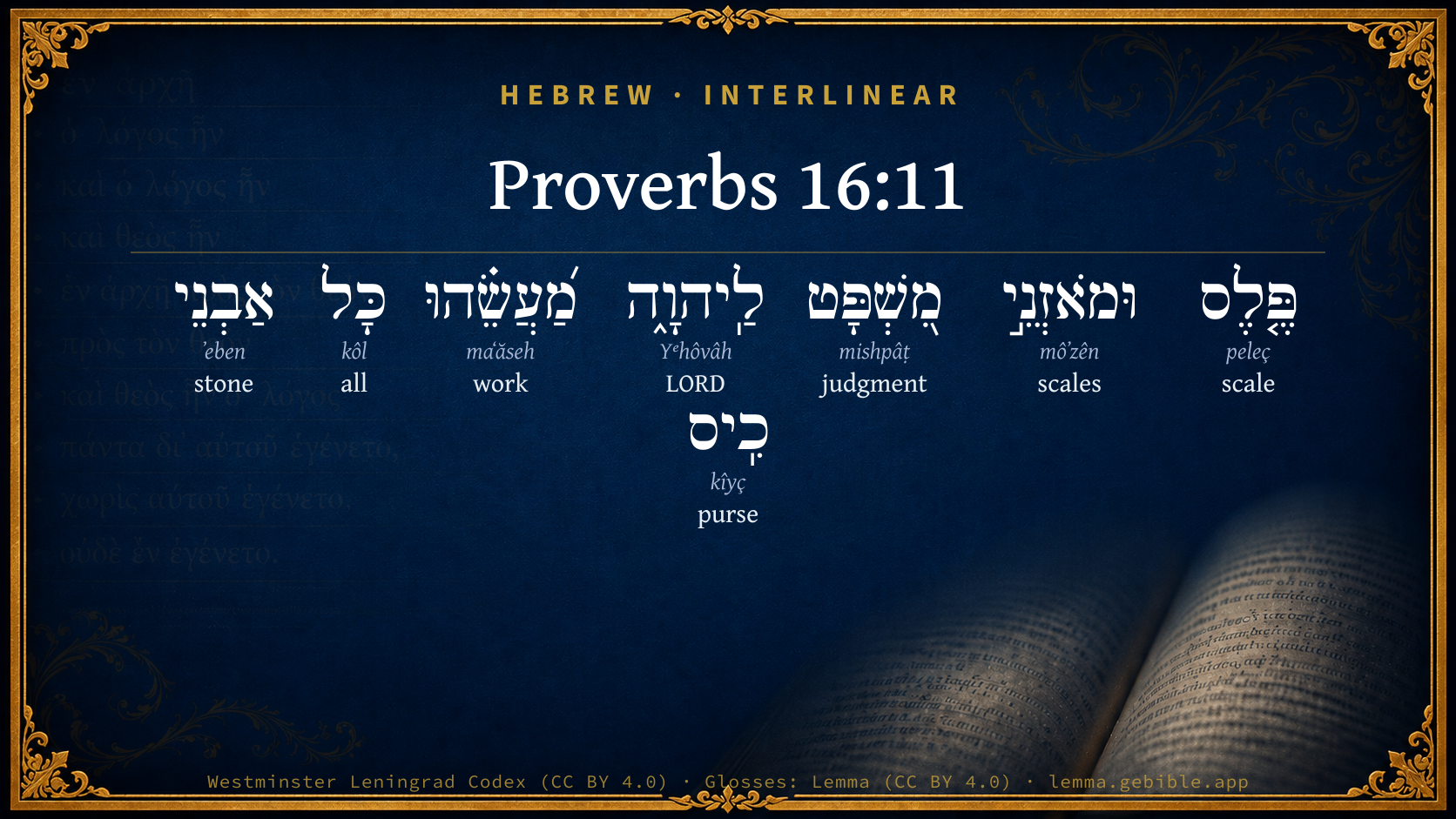
Hebrew (Westminster Leningrad Codex) Proverbs 16:11 appears in the Hebrew Old Testament. The text above is from the Westminster Leningrad Codex. Each word links to its Strong’s number, a concise gloss, and parsing drawn from the Open Scriptures Hebrew Bible morphology. Click any word for its full Brown-Driver-Briggs (BDB) entry.
Download image
Cite this verse

Proverbs 16:11 (World English Bible). Public Domain. Lemma interlinear Bible study tool, https://lemma.gebible.app/v/proverbs/16/11.

Show BibTeX & RIS
BibTeX
RIS
English Translation
Honest balances and scales are Yahweh's; All the weights in the bag are his work.
World English Bible · Public Domain
Highlights
  • 1 first appearance in the Hebrew Bible
Full analysis ↓
Download a study sheet

One document with this verse’s original text, its word-by-word gloss line, the meaning frame, cross-references with their text, attributed commentary, and full source and license credits — printable, and it pastes into notes with its structure intact.

This verse Autodidact and up

Study sheet (.html) Plain text (.txt)

A passage Seminary Student

Up to 50 verses in one chapter. A passage sheet keeps up to 6 commentary sources and 12 cross-references per verse, in the order this page ranks them, and says so on the sheet whenever that leaves anything out. Ask for a single verse and you get the Autodidact verse sheet above.

Everything on this page stays free to read, with no account — the sheet is a download of what is already on screen, not access to it.

Want to remove ads? Support Godless Engineer
Compare translations 3

The same verse in 3 English versions, stacked beneath the original-language interlinear above. Click any original word for its lexicon entry.

Each is an independent rendering of the whole verse — the interlinear is not word-aligned to these translations.

Highlighted words mark where these versions differ — a whole-verse word diff, not a word-by-word alignment.

  • World English Bible Public Domain
    Honest balances and scales are Yahweh's; All the weights in the bag are his work.
  • King James Version Public Domain
    A just weight and balance are the LORD's: all the weights of the bag are his work.
  • unfoldingWord Literal Text CC BY-SA 4.0
    A scale with the two balances of justice to Yahweh; all the stones of the bag his work.

unfoldingWord Literal Text — © unfoldingWord, licensed CC BY-SA 4.0. Word-aligned USFM3 via Door43 (git.door43.org/unfoldingWord/en_ult).

Versions to compare (up to 4)

3 of 4 selected

Show all 18 translations

Every available English version of this verse, each an independent rendering of the whole verse.

  • World English Bible Public Domain
    Honest balances and scales are Yahweh's; All the weights in the bag are his work.
  • Berean Standard Bible Public Domain
    Honest scales and balances are from the LORD; all the weights in the bag are His concern.
  • Majority Standard Bible Public Domain
    Honest scales and balances are from the LORD; all the weights in the bag are His concern.
  • King James Version Public Domain
    A just weight and balance are the LORD's: all the weights of the bag are his work.
  • American Standard Version (1901) Public Domain
    A just balance and scales are Jehovah's; All the weights of the bag are his work.
  • Revised Version (1885) Public Domain
    A just balance and scales are the LORD’S: all the weights of the bag are his work.
  • Geneva Bible (1599) Public Domain
    A true weight and balance are of the Lord: all the weightes of the bagge are his worke.
  • Douay-Rheims (1899) Public Domain
    Weight and balance are judgments of the Lord: and his work all the weights of the bag.
  • Young's Literal Translation Public Domain
    A just beam and balances `are' Jehovah's, His work `are' all the stones of the bag.
  • Literal Standard Version CC BY-SA 4.0
    A just beam and balances [are] YHWH’s, || All the stones of the bag [are] His work.
  • Unlocked Literal Bible CC BY-SA 4.0
    Honest scales come from Yahweh; all the weights in the bag are his work.
  • unfoldingWord Literal Text CC BY-SA 4.0
    A scale with the two balances of justice to Yahweh; all the stones of the bag his work.
  • Darby Bible Public Domain
    The just balance and scales are Jehovah's; all the weights of the bag are his work.
  • World Messianic Bible Public Domain
    Honest balances and scales are the LORD’s; all the weights in the bag are his work.
  • Webster's Bible Public Domain
    A just weight and balance are the LORD'S: all the weights of the bag are his work.
  • Free Bible Version CC BY-SA 4.0
    Accurate scales and balances are important to the Lord. He has determined all the weights in the bag.
  • Bible in Basic English Public Domain
    True measures and scales are the Lord's: all the weights of the bag are his work.
  • JPS Tanakh (1917) Public Domain
    A just balance and scales are the LORD'S; all the weights of the bag are His work.

Literal Standard Version (2020), Covenant Press — licensed CC BY-SA 4.0. Text via the HelloAO Bible API (eBible.org). Unlocked Literal Bible (unfoldingWord) — licensed CC BY-SA 4.0. Text via the HelloAO Bible API (eBible.org). unfoldingWord Literal Text — © unfoldingWord, licensed CC BY-SA 4.0. Word-aligned USFM3 via Door43 (git.door43.org/unfoldingWord/en_ult). Free Bible Version, Dr. Jonathan Gallagher — licensed CC BY-SA 4.0. Text via the HelloAO Bible API (eBible.org).

Word by word

More ways to search: Search by grammar → Find every occurrence → Compare this word →

Practice this passage: Drill this verse → Learn its vocabulary →

About this verse

These counts appear in no published source. They are computed here, from the morphology-tagged text and Lemma’s own curated glosses. What Lemma adds →

8
words
8
distinct lemmas
Wisdom
section

Notable vocabulary

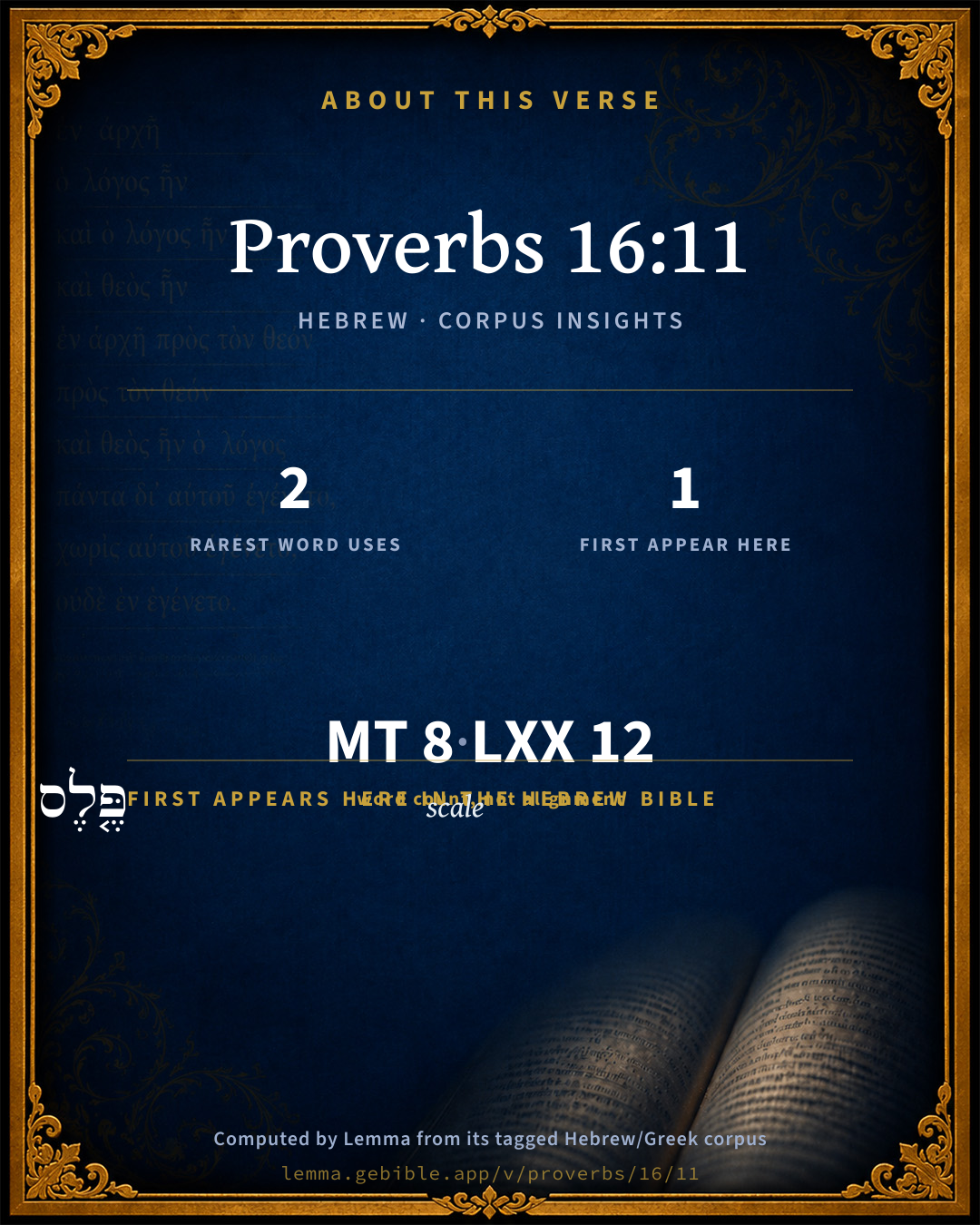
The rarest word here is פֶּ֤לֶס scale H6425 — appearing just 2 times in the whole Hebrew Bible.

First appearance in Scripture

This word makes its first canonical appearance in the Hebrew Bible here:

  • פֶּ֤לֶס scale H6425

Shared distinctive vocabulary

פֶּ֤לֶס scale H6425 occurs in 2 verses of the Hebrew Bible. Also found in:

Grammatical profile

  • 8 nouns

Hebrew & Septuagint length

In English translation the verse runs 15 words from the Hebrew and 16 from the Septuagint (LXX English) — closely comparable.

A rough comparison of the two English renderings, which tokenize alike — not a word-level alignment.

Word counts can differ between the Hebrew and the Greek without any difference in meaning — e.g. the Hebrew direct-object marker אֵת has no separate Greek word, and Greek often adds the article ὁ.

In the original languages it is 8 Hebrew tokens and 12 Greek tokens — but the two are counted differently (Hebrew bundles its prefixes and suffixes into one token; the Greek is in lemma form), so that isn’t a like-for-like length.

Cross-references

9

Topical passages linked to Proverbs 16:11 in the Treasury of Scripture Knowledge — connected by theme and wording, ordered by reader-vote popularity; previews shown in the World English Bible.

  • Proverbs 11:1 A false balance is an abomination to Yahweh, But accurate weights are his delight.
  • Proverbs 20:10 Differing weights and differing measures, Both of them alike are an abomination to Yahweh.
  • Proverbs 20:23 Yahweh detests differing weights, And dishonest scales are not pleasing.
  • Leviticus 19:35–36 "'You shall do no unrighteousness in judgment, in measures of length, of weight, or of quantity.
  • Deuteronomy 25:13–15 You shall not have in your bag diverse weights, a great and a small.
  • Ezekiel 45:10 You shall have just balances, and a just ephah, and a just bath.
  • Hosea 12:7 A merchant has dishonest scales in his hand. He loves to defraud.
  • Amos 8:5 Saying, 'When will the new moon be gone, that we may sell grain? And the Sabbath, that we may market wheat, Making the ephah small, and the shekel large, And dealing falsely with balances of deceit;
  • Micah 6:11 Shall I be pure with dishonest scales, And with a bag of deceitful weights?

Cross-references courtesy of OpenBible.info (CC BY 4.0).

Hebrew and Greek witnesses Masoretic Hebrew ↔ Greek Septuagint

The same verse in the two great witnesses to the Old Testament, shown verse-for-verse.

These are two independent witnesses, not word-aligned to each other, and the Septuagint is shown in lemma (dictionary) form.

Hebrew Proverbs 16:11 Masoretic · Westminster Leningrad Codex

פֶּ֤לֶס וּמֹאזְנֵ֣י מִ֭שְׁפָּט לַֽיהוָ֑ה מַ֝עֲשֵׂ֗הוּ כָּל אַבְנֵי כִֽיס

Honest balances and scales are Yahweh's; All the weights in the bag are his work.

World English Bible · Public Domain

Greek LXX Proverbs 16:11 Septuagint · lemma form

ἐν φῶς ζωή υἱός βασιλεύς ὁ δέ προσδεκτός αὐτός ὥσπερ νέφος ὄψιμος

The poise of the balance is righteousness with the Lord; and his works are righteous measures.

LXX2012 (modern English Septuagint) · Public Domain

On this verse, The Pulpit Commentary discusses the Septuagint’s reading. Read the note in Commentary ↓

Hebrew: Westminster Leningrad Codex (CC BY 4.0). Greek: Septuagint (public domain); English from LXX2012 (modern English Septuagint) (Public Domain). How the Septuagint differs from the Hebrew →

Commentary

Notes on Proverbs 16:11 from classic Christian and Jewish commentators (each source and its license shown beneath its notes). The classic Christian expositions comment on the surrounding passage and are grouped to its opening verse, so a note may address several verses; the Jewish commentaries on the Tanakh (Rashi and others) are per-verse, so they appear only where the commentator wrote on this verse.

Lemma curates 59 commentaries, every one of them public domain or Creative Commons licensed, each selected and text-cleaned for this edition rather than reprinted as found. About our sources →

Trapp's Complete Commentary

John Trapp

Pro 16:11 A just weight and balance [are] the LORD’S: all the weights of the bag [are] his work.

Ver. 11. A just weight and balance are the Lord’s,] i.e., Are commanded and commended by him. {Pro 2:1 Deu 25:14-16} {See Trapp on "Deu 25:14"} {See Trapp on "Deu 25:15"} {See Trapp on "Deu 25:16"}

All the weights of the bag are his work,] i.e., His ordinance, and therefore not to be violated. Yea, they are iudicia Domini, as the Vulgate here reads the former clause, God’s judgments. "Let no man therefore go beyond or defraud his brother" in buying and selling, "for God is the avenger of all such." {1Th 4:6} Surely his magistrates must not transgress in judgment, lest they prove but fures publici, as Cato {a} called them; latrones cum privilegio {b} as Columella, public thieves; "scabs," as the prophet Isaiah terms them, {Isa 5:7, marg.} and lest their regiment without righteousness appear to be but robbery with authority. So neither must private persons cheat and deceive their brethren by false weights and measures, &c., lest they be looked upon as the botches of the commonwealth, and enemies to civil society.

{a} Gal., lib. xi. c. 18.

{b} Colum., lib. i.

John Trapp, A Commentary or Exposition upon All the Books of the Old and New Testament (1647–1656) — public domain. Text from a community e-Sword module.

The Biblical Illustrator

Joseph S. Exell

Pro_16:11

A just weight and balance are the Lords.

A just balance

It is a part of the Lords watchful activity and direct connection with all the affairs of human life that He is interested in our business and trade. The Israelite was encouraged to think that all the work in which he was engaged was ordained by, and therefore under the observation of, his God. The commercial fraud of the primitive times took a comparatively simple form. The merchant used inadequate measures, and so nibbled a little from every article which he sold to a customer. It requires many generations for a civilised society to elaborate commercial fraud on the large scale.

1. We are all of us tempted to think that a considerable proportion of our life is too insignificant to attract the particular attention of God. We think He marks what business we enter, but when we are in it lets us alone. Or He marks a large business transaction in which there is room for a really gigantic fraud, but cannot pay any attention to a minute sale over the counter, the trivial adulteration of a common article, the ingenious subterfuge for disposing of a damaged or useless stock. But could anything be more illogical? Great and small are relative terms, and have no significance with God. If He knows us at all, He knows all about us. The whole life, with every detail from birth to death, is accurately photographed in the light of His omniscience.

2. In this exhaustive and detailed knowledge of the way in which you are conducting your business His warm approval follows everything that is honest and just; His vehement censure lights on all that is dishonest and unjust. We have no reason for thinking that the unjust balance has become any less abominable to the Lord because the eager and relentless competition of modern industrial life has multiplied, while it has refined the methods of fraud and has created a condition of things in which, as so many people urge, questionable practices have become actually necessary for one who would keep his head above water. Double-dealing, no matter what may be the plea, is abominable in the sight of the Lord.

3. All should order their business ways as in the sight of God, and concern themselves chiefly with the thought how they may be in conformity with His holy will. Do not be content with estimating your conduct by the judgment which other men would pass upon it. Do not be content even with estimating your conduct by the standard of your own unaided conscience. Unless you realise that God sees and knows, and unless you humbly submit everything to His judgment, you are sure to go wrong; your standard will insensibly fall, and you will insensibly fall away even from the fallen standard. You will not alter His judgment of your conduct by attempting to ignore it. But by seeking to understand it, and by laying your heart open to be influenced by it, you will find that your conduct is perceptibly altered, and apparent impossibilities are overcome, because by the fear of the Lord men depart from evil. (R. F. Horton, D.D.)

Weighed in the balances

A man once declared that he wished he had a window in his breast, that all men might see his heart and motives. How many of us would like to look into our own hearts and discover our motives? Because we fear to be face to face with ourselves self-examination is so greatly neglected. God looks into our hearts and weighs our motives in His just and unchanging balance. Our daily work is being weighed in Gods balances, and it is a weighing for eternity. People make a great mistake about their preparations for eternity. It is the duty of a Christian man to prepare for eternity every day he lives by trying to do his duty in the place where God puts him. Temptations and trials are weights and scales by which God tries our hearts. Perhaps you are vexed by a spiteful tongue that speaks cruelly and unjustly. That is a balance in which you are weighed to see whether your heart is right with God, whether you bear your trials meekly, giving back the soft answer, not rendering evil for evil. So every other trial or sorrow is a test, a weighing, to prove whether you are the true gold or base alloy. Prosperity and success are Gods balances. Every religious rite and service are means by which God weighs us. There are yet two more weighings to come. At our death we shall be weighed and placed in our proper waiting-place till the last judgment. Then will come the final weighing and the eternal sentence. (H. J. Wilmot-Buxton, M.A.)

The Biblical Illustrator, edited by Joseph S. Exell (c. 1880s–1900s) — public domain. Text from a community e-Sword module.

Joseph Benson's Commentary

Pro 16:11. A just weight, &c., are the Lord’s — Are God’s work, as it follows; made by his direction and appointment, so that no man can corrupt or alter them, without violating God’s rights and authority, and incurring his displeasure. In other words, the administration of public justice by the magistrate is an ordinance of God; in it the scales are held, or ought to be held, by a steady and impartial hand; and we ought to submit to it for the Lord’s sake, and to see his authority in that of the magistrate, Rom 13:1; 1Pe 2:13. The observation of justice in commerce between man and man is likewise a divine appointment. He taught men discretion to make scales and weights, for the adjusting of right exactly between buyer and seller, that neither might be wronged. And all other useful inventions, for the preserving of right, are from him. He has also appointed, by his law, that men be just; it is, therefore, a great affront to him, and to his government, to falsify, and so to do wrong under colour and pretence of doing right, which is wickedness in the place of judgment.

Joseph Benson's Commentary on the Old and New Testaments (1811–1818) — public domain. Text from a community e-Sword module.

The Expositor's Bible

CHAPTER 17

A JUST BALANCE

"A just balance and scales are the Lords: all the weights of the bag are His work."- Pro_16:11

"A false balance is an abomination to the Lord: but a just weight is His delight."- Pro_11:1

"Diverse weights, and divers measures, both of them alike are an abomination to the Lord."- Pro_20:10

"Diverse weights are an abomination to the Lord; and a false balance is not good."- Pro_20:23

THE sixteenth chapter opens-and we may annex to it the last verse of chapter 15.-with a series of sayings which are grouped together on the principle that the name of the Lord occurs in each. There is no obvious connection between the successive verses, and some of them have been already touched on in previous lectures, but it will be worthwhile to glance at the series as a whole.

The Lords presence must be recognized and reverenced before we can make any progress in wisdom, and in His presence we must humble ourselves before we can expect any honor. {Pro_15:33} We are entirely dependent upon Him; although our hearts may form plans, we cannot utter anything aright unless He controls our tongue. {Pro_16:1} However self-satisfied we may be with our own ways, however convinced we may be of our own innocence, He weighs our spirit, and will often find a guilt which our conceit ignores, an impurity which our vanity would hide. {Pro_16:2} We should do well, therefore, to commit all our works to Him, in order that He may revise and correct our purposes and establish those which are good. {Pro_16:3} We cannot think too much of His all-inclusive wisdom and knowledge; everything lies in His hands and is designed for His ends; even the wicked who rebel against Him - men like Pharaoh, Nebuchadnezzar, Judas, Elymas-must in their inevitable punishment glorify His righteousness and truth. {Pro_21:4} For punishment is absolutely sure; the proud are an abomination to Him, and although they combine to oppose His will and to escape the penalty, it will be quite in vain. {Pro_16:5} On the other hand, where He sees mercy and truth He will purge iniquity, and when men fear Him they will depart from evil. {Pro_16:6} When His smile is upon them and He approves their ways, He will make their path plain, pacifying their enemies, and making their hearts glad. {Pro_16:7} He will guide them, even directing their steps, in such a manner that their own imperfect counsels shall turn to a happy and successful issue. "Whoso trusteth in the Lord, happy is he." {Pro_26:20} Indeed we cannot exaggerate the minute observation of the Lord; no detail escapes His eye, no event is beyond His control; even what is generally called Chance is but another name for His unmarked and unknown direction; the very lot-that lot which settles contentions and separates the strong-cast into the lap is actually disposed by him {Pro_16:33} much more, therefore, are the deliberate transactions of commerce-those subtle bonds of the cash nexus which twine man to man and nation to nation-under His constant inspection and a subject of His most interested concern, "a just balance and scales are the Lords: all the Weights of the bag are His work."

It is, then, as part of the Lords watchful activity and direct, detailed connection with all the affairs of human life, that He is interested in our business and trade. We may notice at once that this is very characteristic of the Old Testament religion. In the Deuteronomic Law it was written: "Thou shalt not have in thy bag divers weights, a great and a small. Thou shalt not have in thine house divers measures, a great and a small. A perfect and a just weight shalt thou have; a perfect and a just measure shalt thou have: that thy days may be long upon the land which the Lord thy God giveth thee. For all that do such things, even all that do unrighteously, are an abomination unto the Lord thy God." {Deu_26:13-16} Again, in the Levitical Law we find: "Ye shall do no unrighteousness in judgment, in meter-yard, in weight, or in measure. Just balances, just weights, a just ephah, and a just hin, shall ye have: I am the Lord your God, which brought you out of the land of Egypt." {Lev_19:33; Lev_19:36}

The Israelite was encouraged to think that all the work in which he engaged was ordained by, and therefore under the observation of, his God. "Hate not laborious work, neither husbandry which the Most High hath ordained," says Ecclesiasticus. {Ecclesiasticus 7:15} And there is a striking passage in Isaiah where the operations of agriculture are described in detail, and all are attributed to God, who instructs the husbandman aright and teaches him. It all comes from the "Lord of hosts, which is wonderful in counsel, and excellent in wisdom." {Isa_28:23-29}

But at present we are concerned only with trade as a department of industrial life, and especially with the actual chaffering of exchange, the barter of goods for goods, the weights and measures which settle the quantities, and the rules which must govern all such transactions. We should gather that the commercial fraud of those primitive times took this comparatively simple form: the merchant would have, let us say, a half shekel which came a little short of the regulation weight; or he would have a cubit measure (1 ft. 9 in.) half an inch under a cubit; or he would have a vessel professing to hold a hin (i.e., a little more than a gallon), but actually holding a little less than a gallon; or he would have a dry measure, marked as an ephah (i.e., about three pecks), but incapable of holding the ostensible quantity. In an ordinary way he would use these inadequate measures, and thus nibble a little from every article which he sold to a customer. But in the event of a purchaser presenting himself who had a fuller knowledge or might conceivably act as an inspector and report the fraud to the judge, there would be a just half shekel weight in the bag, a full cubit rule hidden behind the counter, a hin or an ephah measure of legal dimensions within easy reach. You may smile at such primitive methods of deception, but it requires many generations for a civilized society to elaborate commercial fraud on the large scale.

Now passing at once to our own times and bringing the truth of our text to illuminate them, I should like to say a little to people engaged in business, whether employers or employed, whether the business is wholesale or retail. And let me assure you that I am not going to attempt a detailed examination and criticism of your business concerns. Such an attempt would be grossly impertinent, and might well expose me, not only to your indignation, but to your ridicule. No, I do not believe that it is the part of the preacher to meddle with matters which he does not understand; he only discredits his message by affecting an omniscience which he cannot possibly possess. I have no doubt that the youth who has been in a warehouse or behind the counter for six months already knows more of commercial habits, of trade practices, of the temptations and difficulties which practically press upon people in business, than I know, or am likely to know if I live to twice my present age. I shall not therefore insult you by attempting to point out evils and expose abuses, to denounce particular frauds, and to hold up any special people or classes of people to moral reprobation. My task is quite different; it is this: -I am to remind you, first, that God possesses that omniscience to which I can lay no claim, and therefore is intimately acquainted with all the transactions of your bank, your warehouse, your office, your counter, your workshop; and, secondly, that He regards with intense satisfaction all fair dealing, and with vindictive indignation every fraud, and trick, and lie. And on the strength of this I am to ask you very earnestly to review your lives and your practices in the light of His judgment, and to consider how you may bring all your doings in business into conformity with His will.

Perhaps you will let me, as a man speaking to his fellow-men, as a Christian, I hope, speaking to his fellow-Christians, expand these three points a little.

First. We are all of us tempted to think that a considerable proportion of our life is too insignificant to attract the particular attention of God. We can understand that He takes notice of our entrance into, and our exit from, the world, but we think that between the two limits He leaves us to "devise our own ways." Or possibly we can recognize His interest in the crisis of our life, but are inclined to question His minute care of the common and monotonous routine. He marks what business we enter, but, when we are in it, lets us alone. He is interested in our marriage, but, when we are married, leaves husband and wife to adjust their own relations. Or He marks a large business transaction in which there is room for a really gigantic fraud, but cannot pay any attention to a minute sale over the counter, the trivial adulteration of a common article, the ingenious subterfuge for disposing of a damaged or useless stock. Is not this our unspoken but implicit mode of reasoning? And could anything be more illogical? The Divine Power which would create this infinitely diversified universe must be able to mark every tiniest detail of the tiniest object in it. Great and small are relative terms, and have no significance to Him. Naturalists tell us that in the scale of living creatures, arranged according to size, the common beetle occupies the middle point, the smallest living creature being as much smaller as the largest is larger than it. And yet the microscope, so far from showing that God takes less care with the infinitesimal creations of His hand, rather inclines us to say that the smaller the creature is, the more delicate adjustment, the more exquisite proportions, the more brilliant hues, does it display. Our Lord brought home to us this minuteness of the Divine Mind, this infinite power of embracing the veriest trifles of the creation in His thought and care, by assuring us that not a sparrow falls without His notice and that the hairs of our heads are all numbered.

There is, then, no logical resting-place, when we are thinking of the Mind of God. If He knows us at all, He knows all about us. If He marks what we consider the important things m our life, He marks equally what we consider the unimportant things. The whole life, with every detail from birth to death, is accurately photographed in the light of His omniscience; and as the exposed plate of the camera receives many details which escape the observation of our eyes, so the smallest and least observed transaction in the daily business, every figure entered truly or falsely in the ledger, every coin dropped justly or dishonestly into the till, every bale, every packet, every thread, every pin, which changes hands in the market, passes at once into the observant and comprehending mind of God.

Second. But in this exhaustive and detailed knowledge of the way in which you are conducting your business, His warm approval follows everything that is honest and just, His vehement censure lights on all that is dishonest or unjust. It may come as a great comfort to you to know that a little business matter which cost you a considerable struggle the other day was duly noted and recorded by the Lord. I was not present at the time, nor did anyone who was near you in the least surmise what was passing. But you suddenly recognized the possibility of making a large profit by simply adopting a very slight subterfuge; what made the case peculiarly difficult was that neighboring and rival firms to your certain knowledge did the like every day; the innocent faces of wife and children at home seemed to urge you, for what a difference would this sum of money make to their comfort and welfare in the coming year? You weighed the little trick over and over again, and set it now in this light, now in that, until at last the black began to seem grey, and the grey almost white. After all, was it a subterfuge? was it not merely a quite legitimate reserve, an even laudable commercial prudence? And then, as you wavered, some clear light of truth fell upon your mind; you saw distinctly what was the right course, and very quietly you took it; the prospect of gain was surrendered, you saw the advantage pass over to your rival; he availed himself of it, and went to church next Sunday just the same. Sometimes you have wondered whether after all you were not too scrupulous.

Now all that God knows; it is His delight; He has recorded it already in His Book, and also in your own moral nature, which is the stronger and the better for it.

On the other hand, it must be a subject of some concern to many that the same all-observing, all-recording Mind regards with hatred all the sharp practices by which in business we deceive and defraud one another. I suppose there is a way of making up books which would pass any accountant in London, and yet would not pass the audit of God. I suppose there are gains which to the average commercial conscience of today appear fair enough, and yet to the One who weighs the spirits of men seem to be quite illicit. There must be men who made their money long ago in certain ways best known to themselves, and are now living in great comfort; but all the time in the books of God a terrible record stands against them, and as the eye of God falls upon those pages, the moan of the ruined, the cry of the fatherless and the widow, and the horrified entreaties of the helpless come up into His ear.

We have no reason for thinking that the unjust balance has become any less abominable to the Lord because the eager and relentless competition of modern industrial life has multiplied, while it has refined, the methods of fraud, and has created a condition of things in which, as so many people urge, questionable practices have become actually necessary for one who would keep his head above water. We have no reason to think that God regards it as at all essential that any of us should keep his head above water. The warm and honorable reception given to Lazarus in heaven, when his head had gone under the waters on earth, might lead us to think that what we call failures here may possibly be regarded as grand successes there. But we have every reason to think that double-dealing, no matter what may be the plea, is abominable in the sight of the Lord.

It is in vain to point to the great prosperity which has fallen to the lot of some whose dishonorable practices have been notorious. It is beyond a doubt that knavery may be successful in its way and a clever rogue may outdistance an honest dullard. The proverb "Honesty is the best policy" is not, as some people seem to think, in the Bible; honesty may or may not be the best policy, according to the object which you have in view. If your object is simply to amass wealth, the saying will read, "Honesty is the best policy; and where it is not, be dishonest." God does not judge in the least by worldly prosperity. From the parable just alluded to one would conclude that it is, in heaven, a certain presumption against a man; there may yet prove to be truth in the hard saying, "He that dies rich is damned." If God hates these questionable practices which are said to exist in modern trade, and if He enters them all in His black books, they who prosper by employing them are none the less failures: their ruin is sure; their remorse will be as inevitable as their recovery will be impossible.

Third. I come therefore now to urge upon all of you that you should order all your business ways as in the sight of God, and concern yourselves chiefly with the thought how they may be in conformity with His holy Will. Do not be content with estimating your conduct by the judgment which other men would pass upon it. While such an estimate might reveal many things which would not pass muster, it is doubtful whether their problematical censure will afford an adequate motive for reform, and it is sure to overlook many of the evils which they are bound to wink at, because their own hands are not clean. Do not be content even with estimating your conduct by the standard of your own unaided conscience. Your conscience may at any given time be in a degraded state; in order to keep it quiet you may have brought it down to the level of your conduct. A thiefs conscience seldom troubles him unless his theft is unsuccessful, in which case it reproaches him for not being more careful and more skillful. You may, like St. Paul, know nothing against yourself and yet not be thereby justified. For doubtless most of the evil practices of our time represent a conscience that has been stupefied with sophistry and deadened with selfishness, so that the worst culprits are the first to put on an air of injured innocence, and those who are least guilty suffer most just because the conscience is still sensitive and has not yet been seared with the usual hot iron.

No, the only safe and effectual method is to bring all your business habits, all the practices of the counter and the counting-house, under the searching eye of the All-seeing One. Unless you realize that He sees and knows, and unless you humbly submit everything to His judgment, you are sure to go wrong; your standard will insensibly fail, and you will insensibly fall away even from the fallen standard. It is said that peculiar difficulties beset you in the present day; it is said that it was never so hard to be straightforward and above-board in commercial dealings; it is said that the insane Moloch of competition imperatively demands the blood of our youth, and even makes assaults on the established virtues of maturity. It may be so, though we are generally inclined to exaggerate the peculiar temptations of our own time in comparison with those of a former age; but if it is so, then there is all the more urgent a necessity that you should bring your affairs to Gods judgment, seek diligently to understand His will, and then ask Him for a peculiar strength to enable you to overcome these peculiar temptations. You will not alter His judgment of your conduct by attempting to ignore it. But by seeking to understand it, and by laying your heart open to be influenced by it, you will find that your conduct is perceptibly altered and apparent impossibilities are overcome, because "by the fear of the Lord men depart from evil." {Pro_16:6}

William Robertson Nicoll, ed., The Expositor's Bible (London: Hodder & Stoughton, 1887–1910) — public domain. 65 of 66 books (1 Corinthians is not separately keyed, as that volume carries no machine-parseable verse references); section-level commentary keyed to the opening verse. Introductory and overview sections not keyed to a specific passage are excluded.

Tyndale Open Study Notes

Tyndale Open Resources

16:11 The message of this proverb is stated four times in the collection (cp. 11:1; 20:10, 23).

Tyndale Open Study Notes — © Tyndale Open Resources, licensed CC BY-SA 4.0. Text via the HelloAO Bible API.

Geneva Bible (1599)

Geneva Bible translators

If they be true and just, they are God’s work, and he delighteth therein, but otherwise if they be false, they are the work of the devil, and to their condemnation that use them.

Geneva Bible (1599) marginal notes — public domain. Text via Bolls.life.

Matthew Henry's Commentary

Note, 1. The administration of public justice by the magistrate is an ordinance of God; in it the scales are held, and ought to be held by a steady and impartial hand; and we ought to submit to it, for the Lord's sake, and to see his authority in that of the magistrate, Rom 13:1; Pe1 2:13. 2. The observance of justice in commerce between man and man is likewise a divine appointment. He taught men discretion to make scales and weights for the adjusting of right exactly between buyer and seller, that neither may be wronged; and all other useful inventions for the preserving of right are from him. He has also appointed by his law that they be just. It is therefore a great affront to him, and to his government, to falsify, and so to do wrong under colour and pretence of doing right, which is wickedness in the place of judgment.

Matthew Henry's Commentary on the Whole Bible (1708–1710) — public domain (CC PDM 1.0). Text via the HelloAO Bible API.

Jamieson, Fausset & Brown

Robert Jamieson, A. R. Fausset & David Brown

are the Lord's . . . his work--that is, what He has ordered, and hence should be observed by men.

Jamieson, Fausset & Brown — Commentary Critical and Explanatory on the Whole Bible (1871) — public domain (CC PDM 1.0). Text via the HelloAO Bible API.

Adam Clarke's Commentary

Verse 11. All the weights of the bag are his] Alluding, probably, to the standard weights laid up in a bag in the sanctuary, and to which all weights in common use in the land were to be referred, in order to ascertain whether they were just: but some think the allusion is to the weights carried about by merchants in their girdles, by which they weigh the money, silver and gold, that they take in exchange for their merchandise. As the Chinese take no coin but gold and silver by weight, they carry about with them a sort of small steelyard, by which they weigh those metals taken in exchange.

Adam Clarke's Commentary on the Bible (1810–1826) — public domain. Text from a community e-Sword/MySword module.

Ellicott's Commentary for English Readers

(11) A just weight and balance are the Lord’s.—See above on Pro_11:1.

A Bible Commentary for English Readers, edited by Charles John Ellicott (1878–1897) — public domain. Text from a community e-Sword module.

The Cambridge Bible for Schools and Colleges

gen. ed. J. J. S. Perowne

11. weight and balance] Rather, balance (or, steelyard) and scales. See Pro_11:1, note.

The Cambridge Bible for Schools and Colleges (gen. ed. J. J. S. Perowne; Cambridge University Press, 1878–1918) — public domain. Text from a community e-Sword module.

John Gill's Exposition

A just weight and balance are the Lord's,.... These are of his devising; what he has put into the heart, of men to contrive and make use of, for the benefit of mankind, for the keeping and maintaining truth and justice in commercial affairs; these are of his appointing, commanding, and approving, Lev 19:35;

all the weights of the bag are his work; or, "all the stones" (h); greater or smaller, which were formerly used in weighing, and were kept in a bag for that purpose; these are by the Lord's appointment and order. This may be applied to the Scriptures of truth, which are of God; are the balance of the sanctuary, in which every doctrine is to be weighed and tried; what agrees with them is to be received, and what is found wanting is to be rejected. The Targum is,

"his works, all of them, are weights of truth.''

(h) "lapides", Montanus, Vatablus, Piscator, Mercerus, Michaelis.

John Gill's Exposition of the Whole Bible (1746–1763) — public domain (CC PDM 1.0). Text via the HelloAO Bible API.

Albert Barnes' Notes on the Bible

See Pro 11:1 note. People are not to think that trade lies outside the divine law. God has commanded there also all that belongs to truth and right.

Albert Barnes' Notes on the Bible (1834–1885) — public domain. Text from a community e-Sword/MySword module.

Haydock's Catholic Bible Commentary

Bag. Many read sæculi, "of the world." So Ven. Bede, &c. All God’s appointments are perfectly just, chap. xi. 21. It was the custom for people to carry balances to weigh money, before it was coined. (Calmet)

George Leo Haydock (1774–1849), Haydock's Catholic Family Bible and Commentary, 1859 edition — public domain. Excludes Psalms (Douay-Rheims chapter numbering differs from Protestant) and Deuterocanonical books (Catholic canon only).

Matthew Poole's English Annotations

Are the Lord’s; are God’s work, as it follows; made by his direction and appointment, so as no man can corrupt or alter them without violating God’s rights and authority, and incurring his displeasure.

The weights, Heb. the stones, which they then used as weights. See Poole "Pro 11:1".

Matthew Poole's English Annotations on the Holy Bible (1683–1685) — public domain. Text from a community e-Sword/MySword module.

Whedon's Commentary on the Bible

Daniel D. Whedon

11. A just weight — Substantially the same as Pro_11:1, but varying in terms. Some are of the opinion that פלס, (peles,) weight, was something like a modern steelyard, and to be distinguished from מאזני, (mozene,) the balances. So Stuart: “The steelyard and the balances.” The word may, however, mean the yard or arms of the scales, which ought to be equal or just, as well as the scales or basins themselves. The expression מאזני משׁפשׂ, (mozene mishpat,) balances of justice, may imply such as are regulated by law, and may refer to the standard weights laid up in the sanctuary to which all others were to be conformed.

Weights of the bag — Literally, stones of the bag, referring to the standard weights kept in the bag in the sanctuary, or those carried about by travelling merchants in bags. The sentiment of the text is, that the institution of just weights and measures is an ordinance of God, as is civil government; and that he requires just and exact dealings between man and man. Compare Pro_11:1; Lev_19:35-36; Deu_25:13-15; Mic_6:11.

Daniel D. Whedon (gen. ed.), Commentary on the Old and New Testaments (1874–1909) — public domain. Text from a community e-Sword module.

The Pulpit Commentary

A just weight and balance are the Lord"s; (Pro_11:1) literally, the balance and scales of justice (are) the Lords. They come under his law, are subject to the Divine ordinances which regulate all man"s dealings. The great principles of truth end justice govern all the transactions of buying and selling; religion enters into the business of trading, and weights and measures are sacred things. Vulgate, "The weights and the balance are judgments of the Lord;" being true and fair, they are regarded as God"s judgment. Septuagint, "The turn of the balance is justice before God." All the weights of the bag are his work. Some have round a difficulty here, because the bag may contain false as well as true weights, (Deu_25:13) and it could not be said that the light weights were the Lord"s work. This surely is captious criticism. The maxim merely states that the trader"s weights take their origin and authority from God"s enactment, from certain eternal principles which he has established. What man"s chicanery and fraud make of them does not come into view. (For the law that regulates such matters, see Lev_19:35, etc.) That cheating in this respect was not uncommon we learn from the complaints of the prophets, as Mic_6:11. The religious character of the standard weights and measures is shown by the term "shekel of the sanctuary". (Exo_38:24, and elsewhere continually)

Ver. 11 and see Pro_11:1 Pro_20:10, Pro_20:23. Honesty in business.

The repetition of this maxim (see above) is an indication of the importance that should be attached to the subject. It is one that affects a very large proportion of mankind, and that affects men nearly every day of their life. The text reminds us

I THAT BUSINESS IS WITHIN THE PROVINCE OF RELIGION. The man who says, "Business is business, and religion is religion," is a man whose moral and spiritual perceptions are sadly confused. "God"s commandment is exceeding broad," and its breadth is such as will cover all the transactions of the market. Commerce and trade, as much as agriculture, are "the Lord"s;" it is an order of human activity which is in full accord with his design concerning us; and it is a sphere into which he expects us to introduce our highest principles and convictions, in which we may be always serving him.

II THAT DISHONESTY IS OFFENSIVE IN HIS SIGHT. "A false balance is his abomination". (Pro_11:1 Pro_20:10) Dishonesty is evil in his sight, inasmuch as:

1. It is a flagrant violation of one of his chief commandments. The second of all the commandments is this, "Thou shalt love thy neighbour as thyself". (see Mat_22:29) But to cheat our neighbour in the market is to do to him what we should strenuously protest against his doing to us.

2. It is a distinct breach of what is due to our brother. It is a most unbrotherly action; it is an act done in conscious disregard of all the claims our fellow men have on our consideration. Moreover, it is an injury to the society of which we are members; for it is one of those wrongs which are crimes as well as sins; it is an act which strikes at the root of all fellowship, all commerce between man and man.

3. It is an injury done by a man to himself. No man can rob his brother without wronging his own soul. He is something the worse for every act of dishonesty he perpetrates. And he who is systematically defrauding his neighbours is daily cutting into his own character, is continually staining his own spirit, is destroying himself.

III THAT HONESTY IS ACCEPTABLE TO GOD. "A just weight is his delight." Not that all honest dealing is equally acceptable to him. Much here, as everywhere, depends upon the motive. A man may be honest only because it is the best policy, because he fears the exposure and penalty of fraud: there is small virtue in that. On the other hand, he may be strictly fair and just in all his dealings, whether his work be known or unknown, because he has a conviction of what is due to his neighbour, or because he has an abiding sense of what God would have him be and do. In this case his honesty is as truly an act of piety, of holy service, as was a sacrifice at the temple of Jehovah, as is a prayer in the sanctuary of Christ. It is an act rendered "unto the Lord," and it is well pleasing in the sight of God his Saviour; he "serves the Lord Christ". (Col_3:23, Col_3:24) It is a great thing that we need not leave the shop or the ship, the office or the field, in order to render acceptable sacrifice unto the Lord our God. By simple conscientiousness, by sterling and immovable integrity, whatever the pest we occupy, maintained by us with a view to the observant eye of our ever-present Master, we may honour and please him as much as if we were bowing in prayer or lifting up our voice in praise in the worship of his house. C.

The Pulpit Commentary (1880–1919), ed. H.D.M. Spence-Jones & Joseph S. Exell — public domain. Text from a community e-Sword module.

John Wesley's Explanatory Notes

The Lord's - Are made by his direction and appointment, so that no man can alter them without violating God's rights and authority.

John Wesley, Explanatory Notes Upon the Whole Bible (1754–1765) — public domain. Text via the GEBible commentary corpus.

Keil & Delitzsch

C. F. Keil & F. Delitzsch

11 The scale and balances of a right kind are Jahve's;

His work are the weights of the bag.

Regarding פּלס, statera, a level or steelyard (from פּלס, to make even), vid., Pro 4:26; מאזנים (from אזן, to weigh), libra, is another form of the balance: the shop-balance furnished with two scales. אבני are here the stones that serve for weights, and כּים, which at Pro 1:14 properly means the money-bag, money-purse (cf. Pro 7:20), is here, as at Mic 6:11, the bag in which the merchant carries the weights. The genit. משׁפּט belongs also to פּלס, which, in our edition, is pointed with the disjunctive Mehuppach legarme, is rightly accented in Cod. 1294 (vid., Torath Emeth, p. 50) with the conjunctive Mehuppach. משׁפט, as 11b shows, is not like מרמה, the word with the principal tone; 11a says that the balance thus, or thus constructed, which weighs accurately and justly, is Jahve's, or His arrangement, and the object of His inspection, and 11b, that all the weight-stones of the bag, and generally the means of weighing and measuring, rest upon divine ordinance, that in the transaction and conduct of men honesty and certainty might rule. This is the declared will of God, the lawgiver; for among the few direct determinations of His law with reference to trade this stands prominent, that just weights and just measures shall be used, Lev 19:36; Deu 25:13-16. The expression of the poet here frames itself after this law; yet 'ה is not exclusively the God of positive revelation, but, as agriculture in Isa 28:29, cf. Sirach 7:15, so here the invention of normative and normal means of commercial intercourse is referred to the direction and institution of God.

Keil & Delitzsch — Biblical Commentary on the Old Testament (1861–1891) — public domain (CC PDM 1.0). Text via the HelloAO Bible API. (Old Testament only.)

Kretzmann's Popular Commentary

Paul E. Kretzmann

v. 11. A just weight and balance are the Lord’s, literally, "The scale and balances of justice belong to Jehovah," His sovereign will directs their proper use, He wants business to be carried on without cheating; all the weights of the bag are His work, the stones which were commonly used as weights and carried by the merchant in a sack were, by the direction of God, to be honest weight.

Paul E. Kretzmann, Popular Commentary of the Bible (1921–1924) — public domain. Text from a community e-Sword module.

unfoldingWord translationNotes

Door43 World Missions Community

Honest scales come from Yahweh

Yahweh requires justice and fairness when doing business. Dishonest people used heavier or lighter weights in their scales in order to gain more when buying or selling. (See: Assumed Knowledge and Implicit Information)

all the weights in the bag are his work

Merchants carried their weights in bags. Possible meanings are 1) Yahweh has determined how much every weight must weigh or 2) Yahweh is concerned with every weight that a merchant uses.

that is something to be despised

This can be stated in active form. AT: "that is something that people despise" or "that is something that Yahweh despises" (See: Active or Passive)

for a throne is established by doing what is right

Here the word "throne" represents the king's rule. This can be stated in active form. AT: "for the king establishes his reign by doing what is right" (See: Metonymy and Active or Passive)

translationWords

Yahweh

works

evil

throne

unfoldingWord translationNotes — © Distant Shores Media and the Door43 World Missions Community, licensed CC BY-SA 4.0. Source: git.door43.org/Door43/en_tn.

Rashi

Rabbi Shlomo Yitzchaki (Rashi)

The balance and scales of justice are the Lord’s etc. to requite a person according to his deed. משפט is (justice in French, in German Gerechtigkeit, and so in Isaiah 7,) the retribution for a person’s sins with a balance and scales.

all the weights in the bag Just as among the weights in the bag, there are large weights and small ones, so is everything according to a person’s deeds.

Rashi on the Tanakh — English translations: “The Judaica Press complete Tanach with Rashi, translated by A. J. Rosenberg” (CC BY 4.0); “Pentateuch with Rashi's commentary by M. Rosenbaum and A.M. Silbermann, 1929-1934” (public domain); “The Metsudah Tanach series, Lakewood, N.J” (CC BY 4.0); and “The Book of Joshua, Metsudah Publications, 1997” (CC BY 4.0). Text via Sefaria.

Lesson kit

Teaching starters — assembled from the data on this page, not authored interpretation. Every prompt links to the verse data it draws on. Edit before teaching.

Proverbs, in the Wisdom, opens this verse with 8 words (8 distinct Hebrew lemmas). Its most distinctive word is peleç (“scale”). A historical commentator’s framing appears above. Read the whole chapter for the surrounding context.

Discussion questions

  1. How does “scale” (peleç) shape what this verse is saying?
  2. The word “scale” first appears here in Scripture. What is being introduced at this debut?
  3. Isaiah 40:12 shares the word «scale» with this verse. How do the two illuminate each other?
  4. These translations render this verse differently. What is at stake in choosing one wording over another?
  5. Reading how Trapp's Complete Commentary and The Biblical Illustrator read this verse, where do the two commentators agree and where do they part?

Things to notice

Reading settings

Reading text

Shown beneath each verse's original-language words.

Old Testament
Old Testament edition

Read the OT as the Masoretic Hebrew (MT) or the Greek Septuagint (LXX).

English shown for the Greek Septuagint (in the Hebrew ↔ Greek comparison).

Comparing translations? Open the Compare panel on any verse page to stack up to four side by side.