2 Chronicles 3:10

Hebrew (Westminster Leningrad Codex) 2 Chronicles 3:10 appears in the Hebrew Old Testament. The text above is from the Westminster Leningrad Codex. Each word links to its Strong’s number, a concise gloss, and parsing drawn from the Open Scriptures Hebrew Bible morphology. Click any word for its full Brown-Driver-Briggs (BDB) entry.
Download image
Cite this verse

2 Chronicles 3:10 (World English Bible). Public Domain. Lemma interlinear Bible study tool, https://lemma.gebible.app/v/2-chronicles/3/10.

Show BibTeX & RIS
BibTeX
RIS
English Translation
In the most holy house he made two cherubim of image work; and they overlaid them with gold.
World English Bible · Public Domain
Highlights
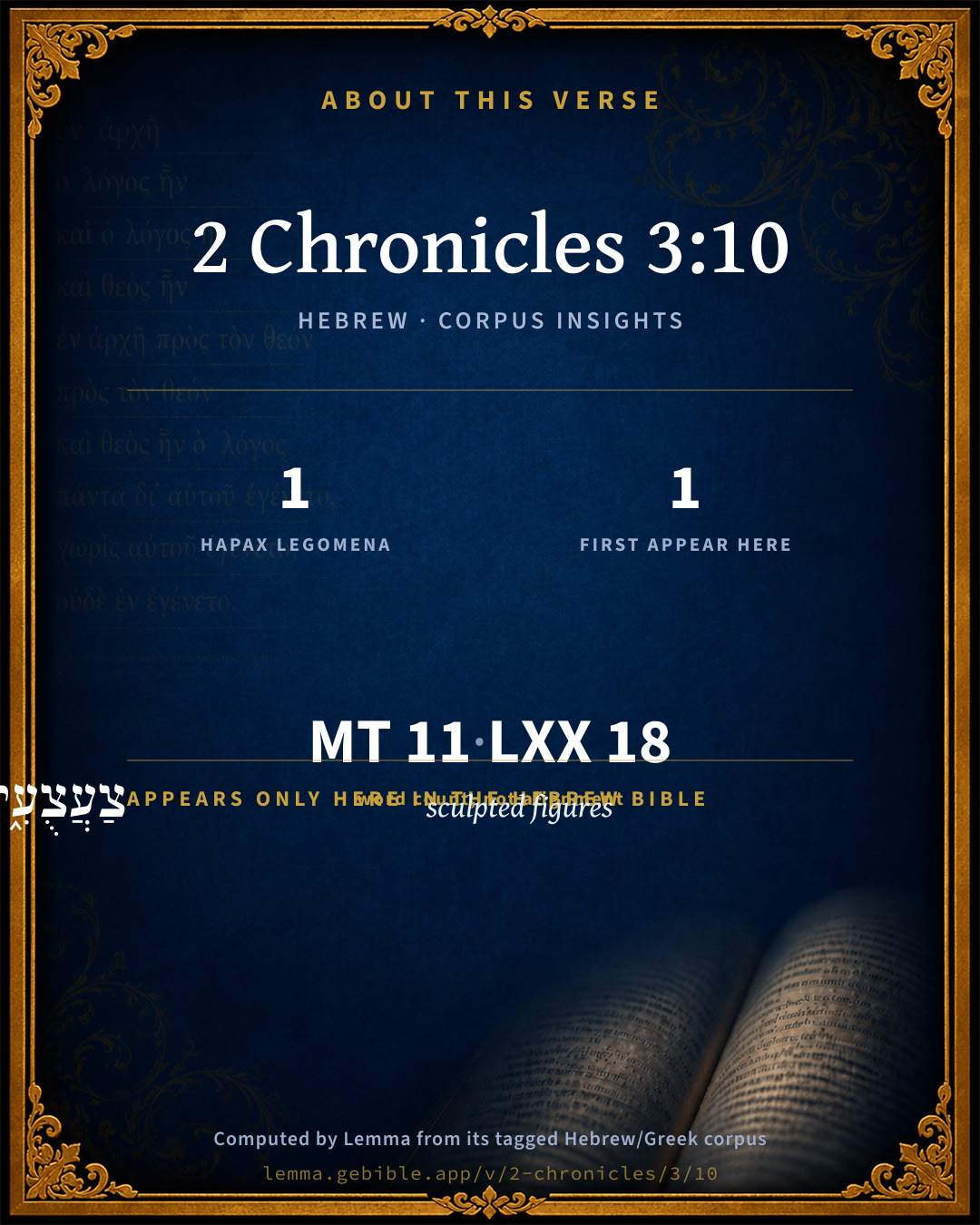
  • 1 hapax legomenon — only here in the Hebrew Bible
  • 1 first appearance in the Hebrew Bible
Full analysis ↓
Download a study sheet

One document with this verse’s original text, its word-by-word gloss line, the meaning frame, cross-references with their text, attributed commentary, and full source and license credits — printable, and it pastes into notes with its structure intact.

This verse Autodidact and up

Study sheet (.html) Plain text (.txt)

A passage Seminary Student

Up to 50 verses in one chapter. A passage sheet keeps up to 6 commentary sources and 12 cross-references per verse, in the order this page ranks them, and says so on the sheet whenever that leaves anything out. Ask for a single verse and you get the Autodidact verse sheet above.

Everything on this page stays free to read, with no account — the sheet is a download of what is already on screen, not access to it.

Want to remove ads? Support Godless Engineer
Compare translations 3

The same verse in 3 English versions, stacked beneath the original-language interlinear above. Click any original word for its lexicon entry.

Each is an independent rendering of the whole verse — the interlinear is not word-aligned to these translations.

Highlighted words mark where these versions differ — a whole-verse word diff, not a word-by-word alignment.

  • World English Bible Public Domain
    In the most holy house he made two cherubim of image work; and they overlaid them with gold.
  • King James Version Public Domain
    And in the most holy house he made two cherubim of image work, and overlaid them with gold.
  • unfoldingWord Literal Text CC BY-SA 4.0
    And he made in the house of the holy of holies two cherubim, a work of casting; and he overlaid them with gold.

unfoldingWord Literal Text — © unfoldingWord, licensed CC BY-SA 4.0. Word-aligned USFM3 via Door43 (git.door43.org/unfoldingWord/en_ult).

Versions to compare (up to 4)

3 of 4 selected

Show all 18 translations

Every available English version of this verse, each an independent rendering of the whole verse.

  • World English Bible Public Domain
    In the most holy house he made two cherubim of image work; and they overlaid them with gold.
  • Berean Standard Bible Public Domain
    In the Most Holy Place he made two cherubim of sculptured work, and he overlaid them with gold.
  • Majority Standard Bible Public Domain
    In the Most Holy Place he made two cherubim of sculptured work, and he overlaid them with gold.
  • King James Version Public Domain
    And in the most holy house he made two cherubim of image work, and overlaid them with gold.
  • American Standard Version (1901) Public Domain
    And in the most holy house he made two cherubim of image work; and they overlaid them with gold.
  • Revised Version (1885) Public Domain
    And in the most holy house he made two cherubim of image work; and they overlaid them with gold.
  • Geneva Bible (1599) Public Domain
    And in the house of the most holy place he made two Cherubims wrought like children, and ouerlayd them with golde.
  • Douay-Rheims (1899) Public Domain
    He made also in the house of the holy of holies two cherubims of image work: and he overlaid them with gold.
  • Young's Literal Translation Public Domain
    And he maketh in the most holy house two cherubs, image work, and he overlayeth them with gold;
  • Literal Standard Version CC BY-SA 4.0
    And he makes two cherubim in the most holy house, image work, and he overlays them with gold;
  • Unlocked Literal Bible CC BY-SA 4.0
    He made two images of cherubs for the most holy place; craftsmen overlaid them with gold.
  • unfoldingWord Literal Text CC BY-SA 4.0
    And he made in the house of the holy of holies two cherubim, a work of casting; and he overlaid them with gold.
  • Darby Bible Public Domain
    And in the house of the most holy place he made two cherubim of image work, and they overlaid them with gold.
  • World Messianic Bible Public Domain
    In the most holy place he made two cherubim by carving, and they overlaid them with gold.
  • Webster's Bible Public Domain
    And in the most holy house he made two cherubim of image work, and overlaid them with gold.
  • Free Bible Version CC BY-SA 4.0
    He made for the Most Holy Place two wooden cherubim covered with gold.
  • Bible in Basic English Public Domain
    And in the most holy place he made images of two winged beings, covering them with gold.
  • JPS Tanakh (1917) Public Domain
    And in the most holy place he made two cherubim of image work; and they overlaid them with gold.

Literal Standard Version (2020), Covenant Press — licensed CC BY-SA 4.0. Text via the HelloAO Bible API (eBible.org). Unlocked Literal Bible (unfoldingWord) — licensed CC BY-SA 4.0. Text via the HelloAO Bible API (eBible.org). unfoldingWord Literal Text — © unfoldingWord, licensed CC BY-SA 4.0. Word-aligned USFM3 via Door43 (git.door43.org/unfoldingWord/en_ult). Free Bible Version, Dr. Jonathan Gallagher — licensed CC BY-SA 4.0. Text via the HelloAO Bible API (eBible.org).

Word by word

More ways to search: Search by grammar → Find every occurrence → Compare this word →

Practice this passage: Drill this verse → Learn its vocabulary →

צַעֲצֻעִ֑ים
tsaʻtsuaʻ
H6816
“sculpted figures”
Noun, Common, Masculine, Plural, Absolute
Part of Speech
Noun
Type
Common
Gender
Masculine
Number
Plural
State
Absolute
Full BDB Definition

Origin: from an unused root meaning to bestrew with carvings

TWOT: 1891a

things formed, images, sculpted figures
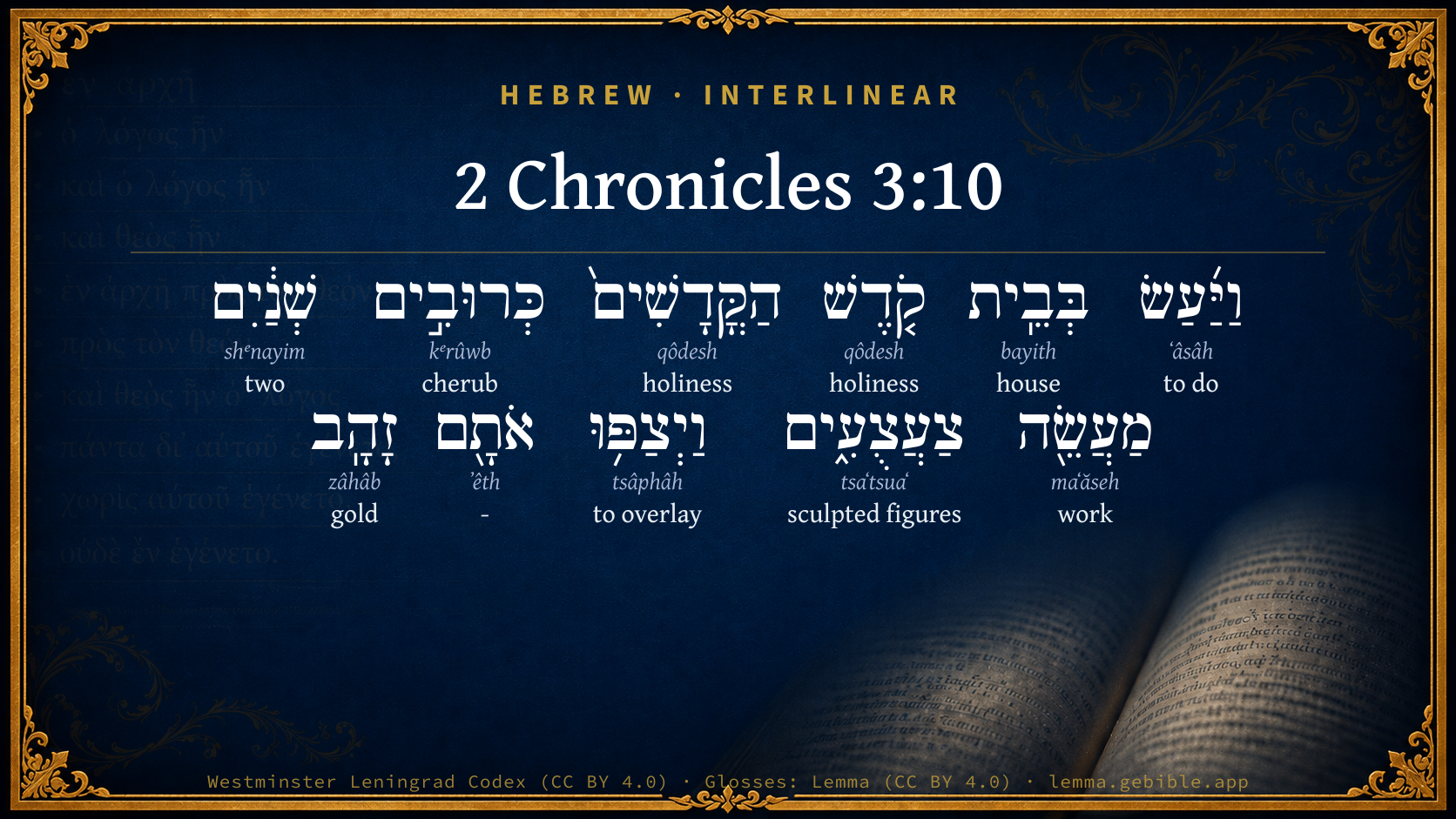
  1. וַיַּ֜עַשׂ ʻâsâh H6213 “and · to do” Conjunction + Verb, Qal, Sequential Imperfect, 3rd Person, Masculine, Singular
  2. בְּבֵֽית bayith H1004 “in/at · house of” Preposition + Noun, Common, Masculine, Singular, Construct
  3. קֹ֤דֶשׁ qôdesh H6944 “holiness of” Noun, Common, Masculine, Singular, Construct
  4. הַקֳּדָשִׁים֙ qôdesh H6944 “the · holy things” Particle, Definite Article + Noun, Common, Masculine, Plural, Absolute
  5. כְּרוּבִ֣ים kᵉrûwb H3742 “cherubim” Noun, Common, Masculine, Plural, Absolute
  6. שְׁנַ֔יִם shᵉnayim H8147 “two” Adjective, Cardinal number, Masculine, Dual, Absolute
  7. מַעֲשֵׂ֖ה maʻăseh H4639 “work of” Noun, Common, Masculine, Singular, Construct
  8. וַיְצַפּ֥וּ tsâphâh H6823 “and · to overlay” Conjunction + Verb, Piel, Sequential Imperfect, 3rd Person, Masculine, Plural
  9. אֹתָ֖ם ʼêth H853 “- · them” Particle, Direct Object + Suffix, Personal, 3rd Person, Masculine, Plural
  10. זָהָֽב zâhâb H2091 “gold” Noun, Common, Masculine, Singular, Absolute

About this verse

These counts appear in no published source. They are computed here, from the morphology-tagged text and Lemma’s own curated glosses. What Lemma adds →

11
words
10
distinct lemmas
Historical
section

Notable vocabulary

1 hapax legomenon — a word that appears only here in the entire Hebrew Bible:

  • צַעֲצֻעִ֑ים sculpted figures H6816

First appearance in Scripture

This word makes its first canonical appearance in the Hebrew Bible here:

  • צַעֲצֻעִ֑ים sculpted figures H6816

Shared distinctive vocabulary

וַיְצַפּ֥וּ to overlay H6823 occurs in 40 verses of the Hebrew Bible. Also found in:

Grammatical profile

  • 2 verbs
  • 7 nouns
  • 1 adjective
  • 1 particle

Verb forms

  • וַיַּ֜עַשׂ Qal · Sequential Imperfect
  • וַיְצַפּ֥וּ Piel · Sequential Imperfect

Repetition

A word recurs within this verse — often emphatic in Hebrew:

  • קֹ֤דֶשׁ holiness H6944 ×2

Hebrew & Septuagint length

In English translation the verse runs 18 words from the Hebrew and 17 from the Septuagint (LXX English) — closely comparable.

A rough comparison of the two English renderings, which tokenize alike — not a word-level alignment.

Word counts can differ between the Hebrew and the Greek without any difference in meaning — e.g. the Hebrew direct-object marker אֵת has no separate Greek word, and Greek often adds the article ὁ.

In the original languages it is 11 Hebrew tokens and 18 Greek tokens — but the two are counted differently (Hebrew bundles its prefixes and suffixes into one token; the Greek is in lemma form), so that isn’t a like-for-like length.

Cross-references

2

Topical passages linked to 2 Chronicles 3:10 in the Treasury of Scripture Knowledge — connected by theme and wording, ordered by reader-vote popularity; previews shown in the World English Bible.

  • 1 Kings 6:23–28 In the oracle he made two cherubim of olive-wood, each ten cubits high.
  • Exodus 25:18 You shall make two cherubim of hammered gold. You shall make them at the two ends of the mercy seat.

Cross-references courtesy of OpenBible.info (CC BY 4.0).

Hebrew and Greek witnesses Masoretic Hebrew ↔ Greek Septuagint

The same verse in the two great witnesses to the Old Testament, shown verse-for-verse.

These are two independent witnesses, not word-aligned to each other, and the Septuagint is shown in lemma (dictionary) form.

Hebrew 2 Chronicles 3:10 Masoretic · Westminster Leningrad Codex

וַיַּ֜עַשׂ בְּבֵֽית קֹ֤דֶשׁ הַקֳּדָשִׁים֙ כְּרוּבִ֣ים שְׁנַ֔יִם מַעֲשֵׂ֖ה צַעֲצֻעִ֑ים וַיְצַפּ֥וּ אֹתָ֖ם זָהָֽב

In the most holy house he made two cherubim of image work; and they overlaid them with gold.

World English Bible · Public Domain

Greek LXX 2 Chronicles 3:10 Septuagint · lemma form

καί ποιέω ἐν ὁ οἶκος ὁ ἅγιος ὁ ἅγιος χερουβιν δύο ἔργον ἐκ ξύλον καί χρυσόω αὐτός χρυσίον

And he made two cherubs in the most holy house, wood-work, and he gilded them with gold.

LXX2012 (modern English Septuagint) · Public Domain

On this verse, Ellicott's Commentary for English Readers discusses the Septuagint’s reading. Read the note in Commentary ↓

Hebrew: Westminster Leningrad Codex (CC BY 4.0). Greek: Septuagint (public domain); English from LXX2012 (modern English Septuagint) (Public Domain). How the Septuagint differs from the Hebrew →

Commentary

Notes on 2 Chronicles 3:10 from classic Christian and Jewish commentators (each source and its license shown beneath its notes). The classic Christian expositions comment on the surrounding passage and are grouped to its opening verse, so a note may address several verses; the Jewish commentaries on the Tanakh (Rashi and others) are per-verse, so they appear only where the commentator wrote on this verse.

Lemma curates 59 commentaries, every one of them public domain or Creative Commons licensed, each selected and text-cleaned for this edition rather than reprinted as found. About our sources →

Matthew Henry's Commentary

Here is an account of 1. The two cherubim, which were set up in the holy of holies. There were two already over the ark, which covered the mercy-seat with their wings; these were small ones. Now that the most holy place was enlarged, though these were continued (being appurtenances to the ark, which was not to be made new, as all the other utensils of the tabernacle were), yet those two large ones were added, doubtless by divine appointment, to fill up the holy place, which otherwise would have looked bare, like a room unfurnished. These cherubim are said to be of image-work (Ch2 3:10), designed, it is likely, to represent the angels who attend the divine Majesty. Each wing extended five cubits, so that the whole was twenty cubits (Ch2 3:12, Ch2 3:13), which was just the breadth of the most holy place, Ch2 3:8. They stood on their feet, as servants, their faces inward toward the ark (Ch2 3:13), that it might appear they were not set there to be adored (for then they would have been made sitting, as on a throne, and their faces towards their worshippers), but rather as themselves attendants on the invisible God. We must not worship angels, but we must worship with angels; for we have come into communion with them (Heb 12:22), and must do the will of God as the angels do it. The thought that we are worshipping him before whom the angels cover their faces will help to inspire us with reverence in all our approaches to God. Compare Co1 11:10 with Isa 6:2. 2. The veil that parted between the temple and the most holy place, Ch2 3:14. This denoted the darkness of that dispensation, and the distance which the worshippers were kept at; but, at the death of Christ, this veil was rent; for through him we are made nigh, and have boldness not only to look, but to enter, into the holiest. On this he was wrought cherubim. Heb. he caused them to ascend, that is, they were made in raised work, embossed. Or he made them on the wing in an ascending posture, as the other two that stood on their feet in an attending posture, to remind the worshippers to lift up their hearts, and to soar upwards in their devotions. 3. The two pillars which were set up before the temple. Both together were somewhat above thirty-five cubits in length (Ch2 3:15), about eighteen cubits high a-piece. See Kg1 7:15, etc., where we took a view of those pillars, Jachin and Boaz, establishment and strength in temple-work and by it.

Matthew Henry's Commentary on the Whole Bible (1708–1710) — public domain (CC PDM 1.0). Text via the HelloAO Bible API.

Trapp's Complete Commentary

John Trapp

2Ch 3:10 And in the most holy house he made two cherubims of image work, and overlaid them with gold.

Ver. 10. Two cherubims of image work.] Opere exemtili, so Tremellius; of work that might be taken asunder. Or of moving work, so others; that is to say, made as if they were in the act of flying or going. If it were image work - cherubims were made like boys, - yet this is no plea for Popish images; since they are flatly forbidden; and God made the law for us, not for himself.

John Trapp, A Commentary or Exposition upon All the Books of the Old and New Testament (1647–1656) — public domain. Text from a community e-Sword module.

Tyndale Open Study Notes

Tyndale Open Resources

3:10-13 The figures shaped like cherubim were made of costly wild olive wood and were covered with gold. Similar carvings have been found in Mesopotamia, Syria, and Canaan; such figures were a distinguishing feature of ancient thrones. Cherubim were composite creatures signifying the union of royalty (lion) with the highest powers of strength (bull), speed (eagle), and sagacity (human). Ancient temples found in Phoenicia show the throne of the deity supported by two animals. The sides of ancient Canaanite thrones were commonly shaped as cherubs. The cherubs of Solomon’s Temple were distinct because they were not designed to serve as a human throne. They were attached to the Ark, which was the footstool to God’s throne, with the wings touching in the middle and extending to the walls of the throne room. There was no actual seat to the throne, since none was necessary.

Tyndale Open Study Notes — © Tyndale Open Resources, licensed CC BY-SA 4.0. Text via the HelloAO Bible API.

Jamieson, Fausset & Brown

Robert Jamieson, A. R. Fausset & David Brown

two cherubims--These figures in the tabernacle were of pure gold (Exo. 25:1-40) and overshadowed the mercy seat. The two placed in the temple were made of olive wood, overlaid with gold. They were of colossal size, like the Assyrian sculptures; for each, with expanded wings, covered a space of ten cubits in height and length--two wings touched each other, while the other two reached the opposite walls; their faces were inward, that is, towards the most holy house, conformably to their use, which was to veil the ark.

The united height is here given; and though the exact dimensions would be thirty-six cubits, each column was only seventeen cubits and a half, a half cubit being taken up by the capital or the base. They were probably described as they were lying together in the mould before they were set up [POOLE]. They would be from eighteen to twenty-one feet in circumference, and stand forty feet in height. These pillars, or obelisks, as some call them, were highly ornamented, and formed an entrance in keeping with the splendid interior of the temple.

Next: 2 Chronicles Chapter 4

Jamieson, Fausset & Brown — Commentary Critical and Explanatory on the Whole Bible (1871) — public domain (CC PDM 1.0). Text via the HelloAO Bible API.

Ellicott's Commentary for English Readers

(10) Two cherubims.—1Ki_6:23-28. They were made of oleaster, plated with gold.

Of image work.—Literally, a work of statuary. The Hebrew word meaning “statuary” occurs here only, and looks suspicious. The Vulg. renders opere statuario; the LXX. “a work of logs”; the Syriac “a durable work.” With the last three renderings comp. 1Ki_6:23, “wood (or blocks) of oleaster,” a specially hard wood. The rendering of the LXX. suggests that the original reading may have been ma‘asçh ‘ççîm, “woodwork.”

And overlaid.—Heb., and they overlaid.

A Bible Commentary for English Readers, edited by Charles John Ellicott (1878–1897) — public domain. Text from a community e-Sword module.

The Cambridge Bible for Schools and Colleges

gen. ed. J. J. S. Perowne

10–13. The Cherubim

10. of image work] Both the meaning of the phrase and the reading are doubtful; LXX. ἔργον ἐκ ξύλων; 1Ki_6:23, of olive wood (R.V.).

and overlaid] R.V. and they overlaid; but the singular is probably right; LXX. ἐχρύσωσεν: 1Ki_6:28, and he overlaid.

The Cambridge Bible for Schools and Colleges (gen. ed. J. J. S. Perowne; Cambridge University Press, 1878–1918) — public domain. Text from a community e-Sword module.

Albert Barnes' Notes on the Bible

The word translated “image work,” or, in the margin, “moveable work,” occurs only in this passage, and has not even a Hebrew derivation. Modern Hebraists find an Arabic derivation, and explain the word to mean “carved work.”

Albert Barnes' Notes on the Bible (1834–1885) — public domain. Text from a community e-Sword/MySword module.

Haydock's Catholic Bible Commentary

Work. Hebrew, "of the work of young men," or resembling them. (Munster) --- Septuagint, "the work of wood." Vulgate literally, "of sculpture work," (Haydock) as Le Clerc renders the original. Some moderns translate, "of a work like men in motion." (Mariana, Buxtorf) --- The cherubims were in an erect posture.

George Leo Haydock (1774–1849), Haydock's Catholic Family Bible and Commentary, 1859 edition — public domain. Excludes Psalms (Douay-Rheims chapter numbering differs from Protestant) and Deuterocanonical books (Catholic canon only).

Matthew Poole's English Annotations

Of image work; made in the shape of young men or boys, as they commonly are. Or, of movable work; so called because they were not fixed to the mercy-seat, as the Mosaical cherubims were, but stood upon their feet, as it is said here 2Ch 3:13, in a moving posture.

Matthew Poole's English Annotations on the Holy Bible (1683–1685) — public domain. Text from a community e-Sword/MySword module.

The Pulpit Commentary

Image work. The word in the Hebrew text ( translated thus in our Authorized Version is a word unknown. Gesenius traces it to "an unused" Hebrew root wx, of Arabic derivation (meaning "to carry on the trade of a goldsmith"), and offers to translate it "statuary" work with the Vulgate (opus statuarium). The parallel (1Ki_6:23) gives simply "wood of oil" (not "olive,", Neh_8:15) i.e. the oleaster tree wood. It is obvious that some of the characters of these words would go some way to make the other unknown word. But it must be confessed that our text shows no external indications of a corrupt reading.

Vers. 10-13.

Life at its highest.

These cherubim were, of course, symbolic; but what did they symbolize?

1. Certainly not the Divine. Nothing is more improbable, indeed nothing is more incredible, than that in the holy place of the temple there should be anything artistic intended to portray or represent the Deity. That would have gone far to unteach the very truth which was so carefully taught by every Mosaic institution.

2. As certainly not the animal and irrational. Part of these creatures may have belonged to the unintelligent world; but if it were so, it would only be to represent some virtue or power of which that particular animal was suggestive.

3. Probably the highest form of creature-life, human or angelic; either man at his best, when endowed with nobler powers than he possesses here, or else the holy and pure intelligences which belong to that great realm that intervenes between the human and Divine. And the idea is that, as we reach the very noblest forms of life, we find these in the near presence of God and engaged in his study and service. To what shall we do well to aspire? Where shall we dwell when we touch our culminating point? In what activities shall we be then engaged? To these questions the cherubim provide the answer.

I IN THE NEAR PRESENCE OF GOD. The cherubim were, day and night, in the most holy place, close to the sacred ark, very near to the manifested presence of God. Life, at-its very highest, is life that is spent with God; in which the spirit is conscious of his nearness to itself. God was not more truly present at Bethel than elsewhere; but to Jacob that was the very "house of God," because there he felt himself to be in the very presence of the Holy One. And it is just as we realize that, step by step along all our earthly course, moment by moment through all our earthly life, God is truly with us and we are the objects of his thought and his love it is in that proportion that our life rises to its true stature, and we arenot only men, we are sons of God, we are "living ones" whose home is on the earth, but whose citizenship is in heaven.

II IN THE SUSTAINED STUDY OF GOD. The faces of these cherubim were "inward" (ver. 13). They turned toward the manifested presence; they gazed continually on God. God was the Object of their ceaseless thought, of their fixed and settled study. Just as we truly live, this will be so with us. We shall wish to know ourselves, and shall study our human nature in all its varied manifestations; we shall wish to know all we can learn of the visible universe, and shall delight to search its secret stores, its beauties, and its marvels. But we shall feel that the one object that is, far above all others, worthy of our most earnest and patient study, is the character, the life, the will, the working of our heavenly Father. The noblest and truest study of mankind is God, and our life is life indeed as we are engaged in the reverent and the intelligent study of his mind and spirit. To us who "have the mind of Christ," and know the Father by our knowledge of his Son, this grand privilege is open.

III IN THE ACTIVE SERVICE OF GOD. A full description is given of the wings of the cherubim. Why? Is it not to indicate that they stand ready, with their full powers outstretched, to do the bidding of Jehovah? The highest life is in the fullest service. As we serve we live. Even the "living ones" of the celestial kingdom find their nobility, not in commanding, but in fulfilling and in achieving. The attitude of the highest intelligences we can conceive and depict is that of perfect readiness to carry out the commandments, to do the work, to promote the kingdom of God. It wilt be thus that we too shall attain our highest. Not by receiving that which is most costly, not by enjoying that which is most pleasant; but by eagerly and faithfully doing that which is most worthy and most Divine. C.

The Pulpit Commentary (1880–1919), ed. H.D.M. Spence-Jones & Joseph S. Exell — public domain. Text from a community e-Sword module.

John Wesley's Explanatory Notes

Image work - Or, of moveable work, not fixed to the mercy- seat, as the Mosaical cherubim, but in a moving posture. It seems, they were designed to represent the angels, who attend the Divine Majesty.

John Wesley, Explanatory Notes Upon the Whole Bible (1754–1765) — public domain. Text via the GEBible commentary corpus.

Keil & Delitzsch

C. F. Keil & F. Delitzsch

The figures of the cherubim are called צעצעים מעשׂה, sculpture work. The ἁπ. λεγ.. צעצעים comes from צוּע, Arab. ṣâǵ, formavit, finxit, and signifies sculptures. The plur. יצפּוּ, "they overlaid them," is indefinite. The length of the wings was five cubits, and the four outspread wings extended across the whole width of the most holy place from one wall to the other. The repetition of the clauses האהר הכּרוּב...האהד כּנף (Ch2 3:11, Ch2 3:12) has a distributive force: the top of one wing of each cherub reached the wall of the house, that of the other wing reached the wing of the other cherub standing by. In the repetition the masc. מגּיע alternates with the fem. מגּעת, being construed in a freer way as the principal gender with the fem. כּנף, and also with דּבקה, adhaerebat, in the last clause. - In Ch2 3:12 Bertheau would strike out the word כּנפי because it does not suit פּרשׂים, which occurs in Ch1 28:17; Ch2 5:8; Kg1 8:7, in the transitive signification, "to stretch out the wings." But nothing is gained by that, for we must then supply the erased word after פּרשׂים again. And, moreover, the succeeding clause is introduced by והם, just because in the first clause the wings, and not the cherubim, were the subject. We hold the text to be correct, and translate: "the wings of these cherubim were, for they stretched them out, twenty cubits." והם refers to הכּרוּבים. They stood upon their feet, consequently upright, and were, according to Kg1 6:26, ten cubits high. "And their faces towards the house," i.e., turned towards the holy place, not having their faces turned towards each other, as was the case with the cherubim upon the Capporeth (Exo 25:20).

Keil & Delitzsch — Biblical Commentary on the Old Testament (1861–1891) — public domain (CC PDM 1.0). Text via the HelloAO Bible API. (Old Testament only.)

Kretzmann's Popular Commentary

Paul E. Kretzmann

The Cherubim, the Veil, and the Pillars

v. 10. And in the Most Holy House he made two cherubim of image work, literally, "a work of imagery," that is, sculptured, fashioned according to a conventional design, and overlaid them with gold, 1Ki 6:28.

v. 11. And the wings of the cherubim were twenty cubits long, that is, the four wings of the two cherubim together; one wing of the one cherub was five cubits, reaching to the wall of the house; and the other wing was likewise five cubits, reaching to the wing of the other cherub, their wings touched in the center and on either side just reached the wall.

v. 12. And one wing of the other cherub was five cubits, reaching to the wall of the house; and the other wing was five cubits also, joining to the wing of the other cherub, 1Ki 6:27.

v. 13. The wings of these cherubim spread themselves forth twenty cubits; and they stood on their feet, and their faces were inward, literally, "’toward the house," toward the Most Holy Place, for they were represented as guarding the ark.

v. 14. And he made the veil, the heavy curtain hanging before the Most Holy Place, of blue, and purple, and crimson, and fine linen, of the same four fine materials of which the veil in the Tabernacle had been made, Exo 26:31, and wrought cherubim thereon, weaving their figures into the cloth.

v. 15. Also he made before the house two pillars of thirty and five cubits high, rather, eighteen, as the original Hebrew text undoubtedly had it, or their combined height is given without their bases, and the chapiter, the capital, that was on the top of each of them was five cubits.

v. 16. And he made chains, garlands, as in the oracle, in the network of ornamental castings on or below the capitals, and put them on the heads of the pillars; and made an hundred pomegranates, and put them on the chains, so that there was an apple on every link of the chainlike ornament.

v. 17. And he reared up the pillars before the Temple, one on the right hand and the other on the left, as entrance obelisks of a grandeur in keeping with the rich interior of the Sanctuary; and called the name of that on the right hand Jachin and the name of that on the left Boaz. Cf 1Ki 7:21. As at the time of the wilderness journey, so the Lord now had a resting-place in the midst of His people, where they might worship Him.

Paul E. Kretzmann, Popular Commentary of the Bible (1921–1924) — public domain. Text from a community e-Sword module.

unfoldingWord translationNotes

Door43 World Missions Community

He made

The readers should understand that Solomon probably commanded other people to do the actual work. AT: "Solomon's workers made" (See: Metonymy)

twenty cubits ... five cubits

A cubit is 46 centimeters. AT: "9.2 meters ... 2.3 meters" (See: Biblical Distance)

translationWords

image

unfoldingWord translationNotes — © Distant Shores Media and the Door43 World Missions Community, licensed CC BY-SA 4.0. Source: git.door43.org/Door43/en_tn.

Rashi

Rabbi Shlomo Yitzchaki (Rashi)

with the appearance of children - Heb. צַעֲצֻעִים. A similar instance is (Isa. 22:24): הַצֶּאֱצָאִים וְהַצְּפִעוֹת, which is translated by the Targum as: the children, etc. He made the form of boys and girls for cherubim, [based on the Aramaic] כְּרַבְיָא, [meaning like children,] and they were of wood, which he afterwards overlaid with gold, and in I Kings (6:23): “And he made in the Debir two cherubim of olive wood,” but all that was within of wood he does not wish to mention in this Book because of its honor.

Rashi on the Tanakh — English translations: “The Judaica Press complete Tanach with Rashi, translated by A. J. Rosenberg” (CC BY 4.0); “Pentateuch with Rashi's commentary by M. Rosenbaum and A.M. Silbermann, 1929-1934” (public domain); “The Metsudah Tanach series, Lakewood, N.J” (CC BY 4.0); and “The Book of Joshua, Metsudah Publications, 1997” (CC BY 4.0). Text via Sefaria.

Lesson kit

Teaching starters — assembled from the data on this page, not authored interpretation. Every prompt links to the verse data it draws on. Edit before teaching.

2 Chronicles, in the Historical, opens this verse with 11 words (10 distinct Hebrew lemmas). Its most distinctive word is tsaʻtsuaʻ (“sculpted figures”). A historical commentator’s framing appears above. Read the whole chapter for the surrounding context.

Discussion questions

  1. What does “sculpted figures” (tsaʻtsuaʻ) contribute to the verse as a whole?
  2. This verse holds 1 word here found nowhere else in the Hebrew Bible. What might the rare word draw attention to?
  3. The word “sculpted figures” first appears here in Scripture. What is being introduced at this debut?
  4. Exodus 25:11 shares the word «to overlay» with this verse. How do the two illuminate each other?
  5. “holiness” occurs 2× in this one verse. What is the effect of the repetition?
  6. The translations on this page render this verse differently — a whole-verse word diff, not a word-by-word alignment. What might account for the different wordings?
  7. The verb «וַיַּ֜עַשׂ» is Qal Sequential Imperfect. How does its form color the action?
  8. Reading how Matthew Henry's Commentary and Trapp's Complete Commentary read this verse, where do the two commentators agree and where do they part?

Things to notice

  • 1 word in this verse appears nowhere else in the Hebrew Bible.
  • 1 word makes its first canonical appearance in Scripture here.
  • This verse counts 11 Hebrew ↔ 18 Greek words.
  • These translations choose different wording for 4 words in this verse.
  • “holiness” occurs 2× in this single verse.

Reading settings

Reading text

Shown beneath each verse's original-language words.

Old Testament
Old Testament edition

Read the OT as the Masoretic Hebrew (MT) or the Greek Septuagint (LXX).

English shown for the Greek Septuagint (in the Hebrew ↔ Greek comparison).

Comparing translations? Open the Compare panel on any verse page to stack up to four side by side.