
Ezekiel 1:16

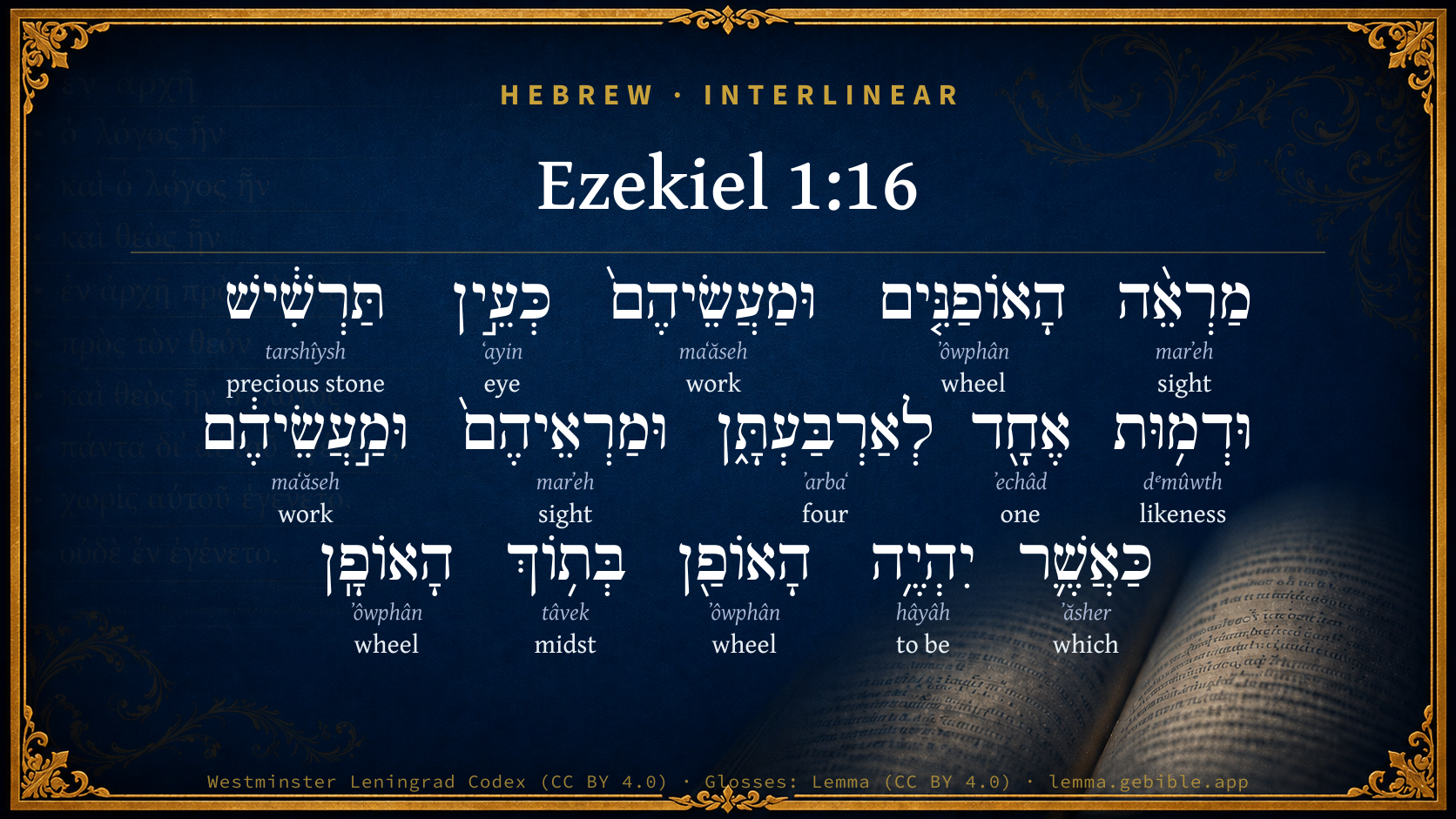
Hebrew (Westminster Leningrad Codex) Ezekiel 1:16 appears in the Hebrew Old Testament. The text above is from the Westminster Leningrad Codex. Each word links to its Strong’s number, a concise gloss, and parsing drawn from the Open Scriptures Hebrew Bible morphology. Click any word for its full Brown-Driver-Briggs (BDB) entry.
Download image
Cite this verse

Ezekiel 1:16 (World English Bible). Public Domain. Lemma interlinear Bible study tool, https://lemma.gebible.app/v/ezekiel/1/16.

Show BibTeX & RIS
BibTeX
RIS
English Translation
The appearance of the wheels and their work was like a beryl: and they four had one likeness; and their appearance and their work was as it were a wheel within a wheel.
World English Bible · Public Domain
Download a study sheet

One document with this verse’s original text, its word-by-word gloss line, the meaning frame, cross-references with their text, attributed commentary, and full source and license credits — printable, and it pastes into notes with its structure intact.

This verse Autodidact and up

Study sheet (.html) Plain text (.txt)

A passage Seminary Student

Up to 50 verses in one chapter. A passage sheet keeps up to 6 commentary sources and 12 cross-references per verse, in the order this page ranks them, and says so on the sheet whenever that leaves anything out. Ask for a single verse and you get the Autodidact verse sheet above.

Everything on this page stays free to read, with no account — the sheet is a download of what is already on screen, not access to it.

Want to remove ads? Support Godless Engineer
Compare translations 3

The same verse in 3 English versions, stacked beneath the original-language interlinear above. Click any original word for its lexicon entry.

Each is an independent rendering of the whole verse — the interlinear is not word-aligned to these translations.

Highlighted words mark where these versions differ — a whole-verse word diff, not a word-by-word alignment.

  • World English Bible Public Domain
    The appearance of the wheels and their work was like a beryl: and they four had one likeness; and their appearance and their work was as it were a wheel within a wheel.
  • King James Version Public Domain
    The appearance of the wheels and their work was like unto the colour of a beryl: and they four had one likeness: and their appearance and their work was as it were a wheel in the middle of a wheel.
  • unfoldingWord Literal Text CC BY-SA 4.0
    This was the appearance and structure of the wheels: Each wheel was like beryl, and the four had the same likeness; their appearance and structure was like a wheel intersecting another wheel.

unfoldingWord Literal Text — © unfoldingWord, licensed CC BY-SA 4.0. Word-aligned USFM3 via Door43 (git.door43.org/unfoldingWord/en_ult).

Versions to compare (up to 4)

3 of 4 selected

Show all 18 translations

Every available English version of this verse, each an independent rendering of the whole verse.

  • World English Bible Public Domain
    The appearance of the wheels and their work was like a beryl: and they four had one likeness; and their appearance and their work was as it were a wheel within a wheel.
  • Berean Standard Bible Public Domain
    The workmanship of the wheels looked like the gleam of beryl, and all four had the same likeness. Their workmanship looked like a wheel within a wheel.
  • Majority Standard Bible Public Domain
    The workmanship of the wheels looked like the gleam of beryl, and all four had the same likeness. Their workmanship looked like a wheel within a wheel.
  • King James Version Public Domain
    The appearance of the wheels and their work was like unto the colour of a beryl: and they four had one likeness: and their appearance and their work was as it were a wheel in the middle of a wheel.
  • American Standard Version (1901) Public Domain
    The appearance of the wheels and their work was like unto a beryl: and they four had one likeness; and their appearance and their work was as it were a wheel within a wheel.
  • Revised Version (1885) Public Domain
    The appearance of the wheels and their work was like unto the colour of a beryl: and they four had one likeness: and their appearance and their work was as it were a wheel within a wheel.
  • Geneva Bible (1599) Public Domain
    The facion of the wheeles and their worke was like vnto a chrysolite: and they foure had one forme, and their facion, and their worke was as one wheele in another wheele.
  • Douay-Rheims (1899) Public Domain
    And the appearance of the wheels, and the work of them was like the appearance of the sea: and the four had all one likeness: and their appearance and their work was as it were a wheel in the midst of a wheel.
  • Young's Literal Translation Public Domain
    The appearance of the wheels and their works `is' as the colour of beryl, and one likeness `is' to them four, and their appearances and their works `are' as it were the wheel in the midst of the wheel.
  • Literal Standard Version CC BY-SA 4.0
    The appearance of the wheels and their works [is] as the color of beryl, and the four of them had one likeness, and their appearances and their works [are] as it were the wheel in the midst of the wheel.
  • Unlocked Literal Bible CC BY-SA 4.0
    This was the appearance and structure of the wheels: Each wheel was like beryl, and the four had the same likeness; their appearance and structure was like a wheel intersecting another wheel.
  • unfoldingWord Literal Text CC BY-SA 4.0
    This was the appearance and structure of the wheels: Each wheel was like beryl, and the four had the same likeness; their appearance and structure was like a wheel intersecting another wheel.
  • Darby Bible Public Domain
    The appearance of the wheels and their work was as the look of a chrysolite; and they four had one likeness; and their appearance and their work was as it were a wheel in the middle of a wheel.
  • World Messianic Bible Public Domain
    The appearance of the wheels and their work was like a beryl. The four of them had one likeness. Their appearance and their work was as it were a wheel within a wheel.
  • Webster's Bible Public Domain
    The appearance of the wheels and their work was like the color of a beryl: and they four had one likeness: and their appearance and their work was as it were a wheel in the middle of a wheel.
  • Free Bible Version CC BY-SA 4.0
    The wheels looked like they were made of topaz, and all four wheels were the same. In the middle of each wheel was what looked like another wheel set crossways.
  • Bible in Basic English Public Domain
    The form of the wheels and their work was like a beryl; the four of them had the same form and design, and they were like a wheel inside a wheel.
  • JPS Tanakh (1917) Public Domain
    The appearance of the wheels and their work was like unto the colour of a beryl; and they four had one likeness; and their appearance and their work was as it were a wheel within a wheel.

Literal Standard Version (2020), Covenant Press — licensed CC BY-SA 4.0. Text via the HelloAO Bible API (eBible.org). Unlocked Literal Bible (unfoldingWord) — licensed CC BY-SA 4.0. Text via the HelloAO Bible API (eBible.org). unfoldingWord Literal Text — © unfoldingWord, licensed CC BY-SA 4.0. Word-aligned USFM3 via Door43 (git.door43.org/unfoldingWord/en_ult). Free Bible Version, Dr. Jonathan Gallagher — licensed CC BY-SA 4.0. Text via the HelloAO Bible API (eBible.org).

Word by word

More ways to search: Search by grammar → Find every occurrence → Compare this word →

Practice this passage: Drill this verse → Learn its vocabulary →

תַּרְשִׁ֔ישׁ
tarshîysh
H8658
“precious stone”
Noun, Common, Masculine, Singular, Absolute
Part of Speech
Noun
Type
Common
Gender
Masculine
Number
Singular
State
Absolute
Full BDB Definition

Origin: probably of foreign derivation [compare H8659 ]

TWOT: 2546

a precious stone or semi-precious gem - perhaps a chrysolite, yellow jasper, or other yellow coloured stone
  1. מַרְאֵ֨ה marʼeh H4758 “sight of” Noun, Common, Masculine, Singular, Construct
  2. הָאוֹפַנִּ֤ים ʼôwphân H212 “the · wheels” Particle, Definite Article + Noun, Common, Masculine, Plural, Absolute
  3. וּמַעֲשֵׂיהֶם֙ maʻăseh H4639 “and · works · their” Conjunction + Noun, Common, Masculine, Plural, Construct + Suffix, Personal, 3rd Person, Masculine, Plural
  4. כְּעֵ֣ין ʻayin H5869 “like/as · eye of” Preposition + Noun, Common, Both, Singular, Construct
  5. וּדְמ֥וּת dᵉmûwth H1823 “and · likeness” Conjunction + Noun, Common, Feminine, Singular, Absolute
  6. אֶחָ֖ד ʼechâd H259 “one” Adjective, Cardinal number, Masculine, Singular, Absolute
  7. לְאַרְבַּעְתָּ֑ן ʼarbaʻ H702 “to/for · four · their” Preposition + Adjective, Cardinal number, Masculine, Singular, Construct + Suffix, Personal, 3rd Person, Feminine, Plural
  8. וּמַרְאֵיהֶם֙ marʼeh H4758 “and · sights · their” Conjunction + Noun, Common, Masculine, Plural, Construct + Suffix, Personal, 3rd Person, Masculine, Plural
  9. וּמַ֣עֲשֵׂיהֶ֔ם maʻăseh H4639 “and · works · their” Conjunction + Noun, Common, Masculine, Plural, Construct + Suffix, Personal, 3rd Person, Masculine, Plural
  10. כַּאֲשֶׁ֛ר ʼăsher H834 “like/as · which” Preposition + Particle, Relative
  11. יִהְיֶ֥ה hâyâh H1961 “to be” Verb, Qal, Imperfect, 3rd Person, Masculine, Singular
  12. הָאוֹפַ֖ן ʼôwphân H212 “the · wheel” Particle, Definite Article + Noun, Common, Masculine, Singular, Absolute
  13. בְּת֥וֹךְ tâvek H8432 “in/at · midst of” Preposition + Noun, Common, Masculine, Singular, Construct
  14. הָאוֹפָֽן ʼôwphân H212 “the · wheel” Particle, Definite Article + Noun, Common, Masculine, Singular, Absolute

About this verse

These counts appear in no published source. They are computed here, from the morphology-tagged text and Lemma’s own curated glosses. What Lemma adds →

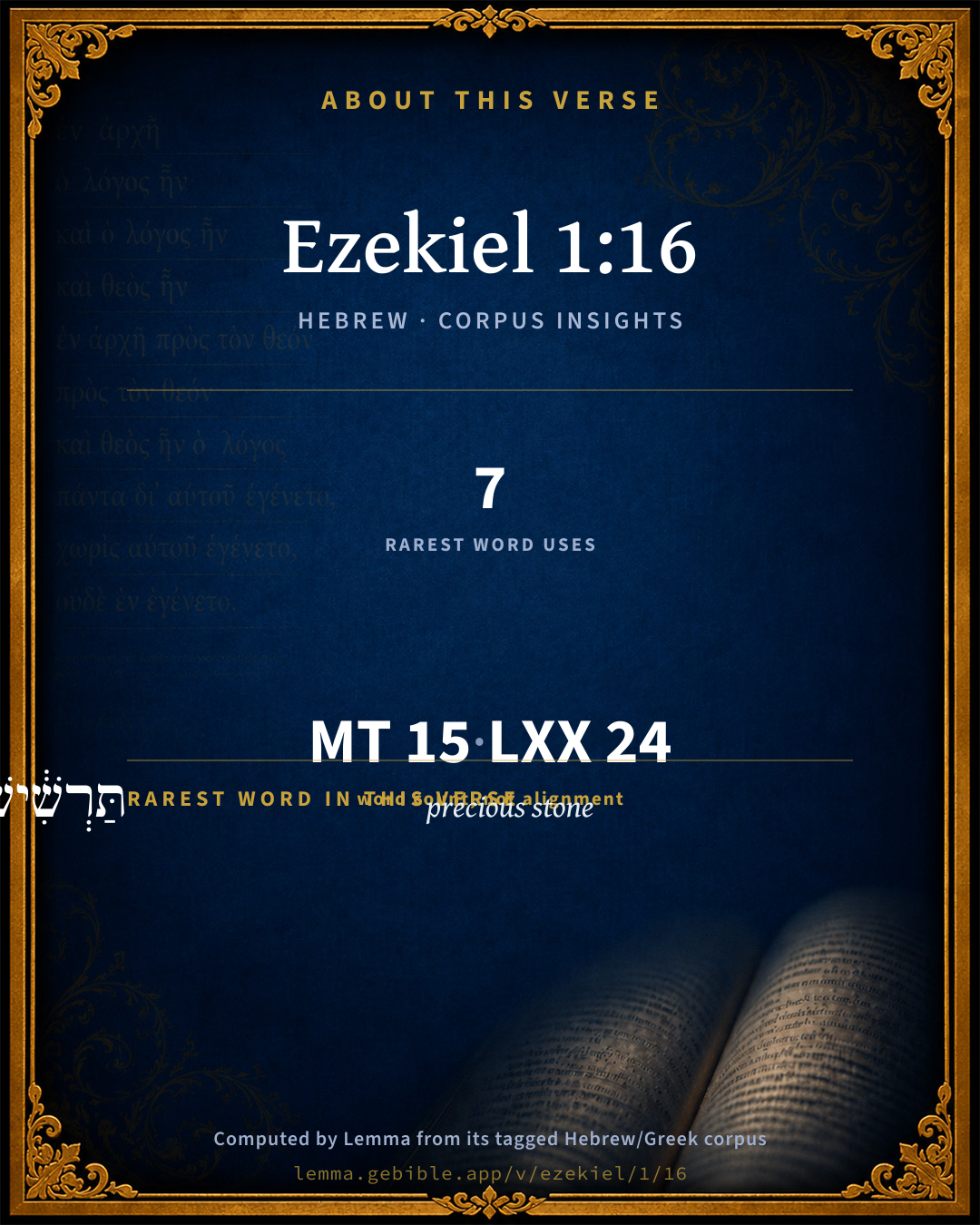
15
words
11
distinct lemmas
Prophets
section

Notable vocabulary

The rarest word here is תַּרְשִׁ֔ישׁ precious stone H8658 — appearing just 7 times in the whole Hebrew Bible.

Shared distinctive vocabulary

תַּרְשִׁ֔ישׁ precious stone H8658 occurs in 7 verses of the Hebrew Bible. Also found in:

Grammatical profile

  • 1 verb
  • 11 nouns
  • 2 adjectives
  • 1 particle

Verb forms

  • יִהְיֶ֥ה Qal · Imperfect

Repetition

Words recur within this verse — often emphatic in Hebrew:

  • הָאוֹפַנִּ֤ים wheel H212 ×3
  • מַרְאֵ֨ה sight H4758 ×2
  • וּמַעֲשֵׂיהֶם֙ work H4639 ×2

Hebrew & Septuagint length

In English translation the verse runs 33 words from the Hebrew and 30 from the Septuagint (LXX English) — closely comparable.

A rough comparison of the two English renderings, which tokenize alike — not a word-level alignment.

Word counts can differ between the Hebrew and the Greek without any difference in meaning — e.g. the Hebrew direct-object marker אֵת has no separate Greek word, and Greek often adds the article ὁ.

In the original languages it is 15 Hebrew tokens and 24 Greek tokens — but the two are counted differently (Hebrew bundles its prefixes and suffixes into one token; the Greek is in lemma form), so that isn’t a like-for-like length.

Cross-references

8

Topical passages linked to Ezekiel 1:16 in the Treasury of Scripture Knowledge — connected by theme and wording, ordered by reader-vote popularity; previews shown in the World English Bible.

  • Daniel 10:6 his body also was like the beryl, and his face as the appearance of lightning, and his eyes as flaming torches, and his arms and his feet like burnished brass, and the voice of his words like the voice of a multitude.
  • Ezekiel 10:9–11 I looked, and behold, four wheels beside the cherubim, one wheel beside one cherub, and another wheel beside another cherub; and the appearance of the wheels was like a beryl stone.
  • Exodus 39:13 and the fourth row, a chrysolite, an onyx, and a jasper. They were enclosed in gold settings.
  • Job 9:10 Who does great things past finding out, Yes, marvelous things without number.
  • Psalms 36:6 Your righteousness is like the mountains of God. Your judgments are like a great deep. Yahweh, you preserve man and animal.
  • Psalms 40:5 Many, Yahweh, my God, are the wonderful works which you have done, And your thoughts which are toward us. They can't be set in order to you; If I would declare and speak of them, they are more than can be numbered.
  • Romans 11:33 Oh the depth of the riches both of the wisdom and the knowledge of God! How unsearchable are his judgments, and his ways past tracing out!
  • Ephesians 3:10 to the intent that now through the assembly the manifold wisdom of God might be made known to the principalities and the powers in the heavenly places,

Cross-references courtesy of OpenBible.info (CC BY 4.0).

Hebrew and Greek witnesses Masoretic Hebrew ↔ Greek Septuagint

The same verse in the two great witnesses to the Old Testament, shown verse-for-verse.

These are two independent witnesses, not word-aligned to each other, and the Septuagint is shown in lemma (dictionary) form.

Hebrew Ezekiel 1:16 Masoretic · Westminster Leningrad Codex

מַרְאֵ֨ה הָאוֹפַנִּ֤ים וּמַעֲשֵׂיהֶם֙ כְּעֵ֣ין תַּרְשִׁ֔ישׁ וּדְמ֥וּת אֶחָ֖ד לְאַרְבַּעְתָּ֑ן וּמַרְאֵיהֶם֙ וּמַ֣עֲשֵׂיהֶ֔ם כַּאֲשֶׁ֛ר יִהְיֶ֥ה הָאוֹפַ֖ן בְּת֥וֹךְ הָאוֹפָֽן

The appearance of the wheels and their work was like a beryl: and they four had one likeness; and their appearance and their work was as it were a wheel within a wheel.

World English Bible · Public Domain

Greek LXX Ezekiel 1:16 Septuagint · lemma form

καί ὁ εἶδος ὁ τροχός ὡς εἶδος θαρσις καί ὁμοίωμα εἷς ὁ τέσσαρες καί ὁ ἔργον αὐτός εἰμί καθώς ἄν εἰμί τροχός ἐν τροχός

And the appearance of the wheels was as the appearance of beryl: and the four had one likeness: and their work was as it were a wheel in a wheel.

LXX2012 (modern English Septuagint) · Public Domain

On this verse, The Cambridge Bible for Schools and Colleges discusses the Septuagint’s reading. Read the note in Commentary ↓

Hebrew: Westminster Leningrad Codex (CC BY 4.0). Greek: Septuagint (public domain); English from LXX2012 (modern English Septuagint) (Public Domain). How the Septuagint differs from the Hebrew →

Targum (Aramaic paraphrase)

1

The Targum is the ancient Jewish Aramaic paraphrase of the Hebrew Scriptures — an interpretive translation, not the Hebrew text itself. Onkelos (literal) and Pseudo-Jonathan (expansive) render the Torah, and Jonathan the Prophets. Coverage is partial: where no permissively-licensed English translation exists for a verse, only the Aramaic is shown. This is verse-level text, not a word-by-word alignment to the Hebrew.

  1. Targum Jonathan Prophets (Joshua–Malachi)
    חֵיזוּ גִלְגְלַיָא וְעוֹבָדֵיהוֹן כְּעֵין אֲבַן טָבָא וּדְמוּת חַד לְאַרְבַּעְתְּהֵן וְחֶזְוֵהֶן וְעוֹבָדֵיהֶן כְּמָא דַהֲוֵי גַלְגַל בְּגוֹ גַלְגָל:

    (no public-domain English translation for this verse)

    Targum Jonathan — Aramaic: “Mikraot Gedolot” (public domain). English: “Sefaria Community Translation” (CC0 1.0 (public-domain dedication)); “London "Chaldee Paraphrase," 1871” (public domain). Text via Sefaria.

Commentary

Notes on Ezekiel 1:16 from classic Christian and Jewish commentators (each source and its license shown beneath its notes). The classic Christian expositions comment on the surrounding passage and are grouped to its opening verse, so a note may address several verses; the Jewish commentaries on the Tanakh (Rashi and others) are per-verse, so they appear only where the commentator wrote on this verse.

Lemma curates 59 commentaries, every one of them public domain or Creative Commons licensed, each selected and text-cleaned for this edition rather than reprinted as found. About our sources →

Trapp's Complete Commentary

John Trapp

Eze 1:16 The appearance of the wheels and their work [was] like unto the colour of a beryl: and they four had one likeness: and their appearance and their work [was] as it were a wheel in the middle of a wheel.

Ver. 16. The appearance of the wheels … was like unto the colour of a beryl.] Heb., As the eye or colour of Tarshish - i.e., the sea, or beryl, which is of a sea colour, even sea-green; whereby is represented the flux and fluctuating constitution of things here below.

And they four had one likeness.] There is the same instability of things in one place as in another, and the same overruling providence.

Their appearance and their work were as it were a wheel in the midst of a wheel.] God hath a wheel, providence, in all the wheeling businesses of the world. These are so one within another, as that all their motion dependeth on the angels, whom he also moderateth and ordereth at his own pleasure. Whensoever, therefore, we see such things come to pass that we can see no reason for - as the Churches overthrown, the wicked exalted, &c. - consider that one wheel is within another, and the wings of the angels are one within another. {a}

{a} Dr Preston.

John Trapp, A Commentary or Exposition upon All the Books of the Old and New Testament (1647–1656) — public domain. Text from a community e-Sword module.

The Biblical Illustrator

Joseph S. Exell

Eze_1:16

A wheel in the middle of a wheel.

God in human activity

By a wheel within a wheel God governs and makes all things work together for good to those who love Him: all pleasant and all painful things; all that is mean, contemptible, slanderous, all that vexes and annoys. So we may put on gladness, knowing that He overrules each event of life, and while we work, He worketh in us according to His pleasure.

1. The Scriptures affirm this truth. They are as full of evidences of it as the daily press is full of the records of mans workings in individual and national life. Eyes see clearer, washed with tears. Paul could glory in his infirmities, for he saw even in them that the power of Christ was made glorious. In all the pains and penalties, the joys and griefs, the thoughts and imaginations of life, God is busy, out of evil still educing good.

2. History proves this. Never did men meet behind closed doors without God seeing them. Every plot and conspiracy is known to Him. The Jews were persecuted and peeled, they were ever an easy prey to the spoiler, now they are the bankers and traders of the world; many hold seats of power among the nations. The thing you intend to accomplish carries with it a score of things you did not intend to do. Luther and Columbus accomplished more than they ever dreamed of doing, because God was in their movements.

3. The laws of nature illustrate this. The thunderstorm is His scavenger, driving off malaria and noxious vapour. The earthquake is a safety valve by which imprisoned gases are set free. Weeds, thistles, insects, are made to work out some good.

Conclusion--

1. We cannot get along without God. If we choose to rebel against His working, He will curb and overthrow us. If we lead selfish, prayerless, cruel lives, He will thwart and destroy.

2. Nothing happens which does not help him who loves God. Losses, crosses, abuse, and injury lead to the growth of patience, watchfulness, and the silent bearing of sorrow. Burn your own smoke and go on. Trials help to build up character.

3. The love of God is emphasised by the truth before us. He reigns--not sin. (H. M. Gallaher, D. D.)

The symbol of Providence

I. Your troubles, difficulties, losses, whatever they may be and whatever may be the instruments of them, are all from God. Your times are in His hands. Your ways are ordered by Him. Your breath depends upon His will. All your sorrows and all your joys are parts of His one great plan of education for you to make you meet to be His own forever.

II. Succeeding events explain the providence and purposes of God. We learn what He intended to do, by what He has done. If we study the Lords providence, remembering that all its events come from God, and that God alone can teach us what is their meaning and design; if we wait upon God with patient faith in His Divine teaching, to see what He means to do with us, all the flames will unfold themselves in due time. The whirlwind will pass by. The clouds will scatter, and light alone, the purest light, will remain to shine around us, clear as amber.

III. All the providences of God have a fixed purpose, and are wisely arranged in their operation. There is no blind chance in the government of God or in the affairs of men. When one asked Dr. Payson if he could discern any reason for his great personal sufferings, he answered, No; but I am as well satisfied as if I saw ten thousand reasons. The will of God is the perfection of all reason. The ways and thoughts of God are not like ours. He does not give to us a previous account of His plans and purposes. But He knows the thoughts which He thinks concerning us. And He makes us to see and acknowledge at last how wire and how perfect they all were. Thus every providence appears to us with the face of a man, open, intelligent, and clear, having a manifest design, and perfectly adapted to accomplish it. It has also the eye of an eagle, which seeth afar off. It is watchful over the least of the affairs which it includes. The very hairs of our head, the stones in our path, the moments of our unconscious sleep, are all the subjects of its provision and control. These providences are also perfectly steady and uniform in their operation. The Lord is of one mind, and changeth not; the same yesterday, today, and forever.

IV. The same providences are often designed to produce separate and sometimes apparently opposite results. These various results of Providence, and the instruments by which they are completed, are not generally wonderful or strange things. They are perfectly natural and common things, but brought about by ways which we had not anticipated. They are things which occur just as naturally as a wheel revolves, or as wings support in flight. But they come and go in their particular occurrence as God directs, and they bring to pass the designs which God has formed.

V. In this gracious and wonderful scheme all providences have a secret purpose of blessing for those who love God. This is a very precious lesson. The plans of Divine providence are always subservient to the plans of Divine grace. They are designed as blessings for the chosen people of God. Whom He loves, He protects and prospers. There can be no one to harm those who are followers after that which is good. However God may try His people on the way, and however dark, unintelligible, and hard to bear these trials may appear, the triumphant and happy result is always the same, perfectly sure, and entirely compensating. He refines His chosen ones like gold and silver, and they glorify Him in the fires.

VI. All the providences of God are under the control of the great Redeemer and Saviour of the people of God, the Lord Jesus Christ. The government of the world is on His shoulder, and He upholdeth all things by the word of His power. (S. H. Tyng, D. D.)

The whole universe is ruled by God

1. He rules in the world of physical nature. The whirlwind which the prophet saw was under the throne. All forces of nature, however strange and irresistible they may appear, are subject to God. What science reveals as laws, are no more than means and methods of Divine operation. God was seen in Jacobs dream above the ladder; so above all secondary causes is the great First Cause who originated them, and who still inspires them with energy and guides their courses.

2. He rules in the world of spirit. The cherubim which the prophet saw, with their mysterious forms and motions, were also under the throne. Freedom appears inseparable from spirit, but all creaturely freedom moves and acts within the will of God. He doth according to His will in the army of heaven (Dan_4:35). Holy beings ever obey lovingly. His will is not only their law, but the ground and means of their blessedness. Devils are compelled to obey. This is the cause of their constant rage and misery. Inspired by hatred to God and goodness, they are obliged to see that not only are their plots defeated, but they are eventually made to promote the very ends they sought to destroy. It is so also with men in this way: the renewed are workers together with God; the unrenewed, though unwilling and rebellious, must subserve Divine purposes (Rom_9:17).

3. He rules in the order of history. The wheels the prophet saw symbolised the government of the world in its entirety. There was an appearance as of a wheel within a wheel--the multiform agencies and complications employed by Providence. The wheels went straight on--the direct course of Providence, which never halts, and is never turned aside from its purposes. The rings were high and dreadful--the vastness of the Divine purposes, awful in their sweep and grandeur. The rings were full of eyes--the omniscience of God, so appalling to the wicked, so comforting to saints. The noise of the moving wheels and of the accompanying cherubim was as the voice of the Almighty--all nature, and life, and the course of history, a revelation of the living, omnipotent Deity. (Christian Age.)

The mysteries of Providence

I. God carries on all things by a secret and an invisible virtue, that though you see the hand without, yet you see not the spring within.

II. Mens spirits are many times raised unto an extraordinary pitch beyond the spirits of men. Drawn out to higher resolutions, they pitch upon higher thoughts and purposes than ever the times require: why now, mark, here is a mystery in this, that at one time a man should rise higher than at another time, and their resolutions and courages rise higher, and they should dare to encounter with those difficulties that even formerly they did tremble to think of. What is the reason of it? Oh, here is the mystery of Providence (Zec_12:8).

III. God puts impressions and apprehensions upon men many times, that they run to their own ruins.

1. Sometimes impressions of discouragement (Jdg_7:13-14).

2. Sometimes impressions of encouragements (2Ki_3:22-23).

IV. God many times raiseth up instruments, and He qualifies them for His work. Girding up their loins and strengthening their hands, that they shall go through that at one time that you would have thought ten thousand instruments could not have done it at another (Isa_45:1-2). God lays the same instrument aside again at another time. Many times the Lord will make a combination, and there shall be a conjunction of instruments, and afterwards the Lord will make use of these, even to destroy one another. Abimelech and the men of Shechem.

V. God many times destroys men by those means by which in all human judgment they think they shall be preserved. The people of Israel, when they were in any necessity, then by and by unto King Jareb, which some expound to be a helping king: sometimes in the way of Assyria, sometimes in the way of Egypt; yet, notwithstanding, they were destroyed by those that they brought in to their help. They bound Paul that he should not preach: My bonds tend to the furtherance of the Gospel. They banished the Church out of Jerusalem, on purpose that so they might have destroyed it: but that is the Churchs preservation, when Jerusalem is destroyed. These are the strange actings of Providence.

VI. When things are brought to the lowest ebb, the means weakest, and the confidence of the enemy and their expectations highest, then many times God is pleased to destroy the power of the mighty. When Gideon hath but three hundred men, he is fit to fight Gods battles; yea, Sisera must fall by the hand of a woman. Uses--

1. In all actings of Providence subscribe to His wisdom.

2. In all actings of Providence submit to His will. (W. Strong.)

The Biblical Illustrator, edited by Joseph S. Exell (c. 1880s–1900s) — public domain. Text from a community e-Sword module.

Tyndale Open Study Notes

Tyndale Open Resources

1:16-17 It would be impossible to build a physical chariot in which each wheel had a second wheel turning crosswise within it. This picture depicts a chariot that could travel equally well in any direction, symbolizing God’s freedom of movement in judgment.

Tyndale Open Study Notes — © Tyndale Open Resources, licensed CC BY-SA 4.0. Text via the HelloAO Bible API.

Geneva Bible (1599)

Geneva Bible translators

The Hebrew word is tarshish meaning that the color was like the Cilician Sea, or a precious stone so called.

Geneva Bible (1599) marginal notes — public domain. Text via Bolls.life.

Jamieson, Fausset & Brown

Robert Jamieson, A. R. Fausset & David Brown

appearance . . . work--their form and the material of their work.

beryl--rather, "the glancing appearance of the Tarshish stone"; the chrysolite or topaz, brought from Tarshish or Tartessus in Spain. It was one of the gems in the breastplate of the high priest (Exo 28:20; Sol 5:14; Dan 10:6).

four had one likeness--The similarity of the wheels to one another implies that there is no inequality in all God's works, that all have a beautiful analogy and proportion.

Jamieson, Fausset & Brown — Commentary Critical and Explanatory on the Whole Bible (1871) — public domain (CC PDM 1.0). Text via the HelloAO Bible API.

John Calvin's Commentaries

Now the Prophet uses the plural number, and says, there were four wheels. He says, the color was like a precious stone. Jerome translates it “sea,” because the sea which looks towards Cilicia with respect to Judea is called Tharsis. But I know not why the color of the sea or the sky took his fancy. But granting that, the word is not found simply for a bluish-green color, for tharsis is a precious stone, as we learn from Exodus, Exodus 28:20, and many other places. The Greeks translated it chrysolite, but I know not whether correctly, nor does it much matter. We need only hold it to be a precious stone, whose color was so exquisite that it attracted all eyes to itself. And so God wished, under the figure of wheels, to place before his Prophet something earthly; but, at the same time, to raise his mind by its color, because he would ascertain from this that they were not either common wheels, or wooden, or of any earthly material, but heavenly ones. The color, then, was intended to draw off the Prophet’s mind, so that he might ascertain that heavenly secrets were laid open to him.

Like the appearance of a precious stone, he says: afterwards, and they four had one likeness This may, indeed, be referred to the living creatures as some have conjectured, but I have no doubt that the Prophet here teaches, that the wheels were so equal that there was no difference between them. Therefore their proportion and equality shows that in all God’s work there is the greatest arrangement — not that this lies on the surface, (for we should rather think that all things are involved in hurried confusion,) but if we raise our senses above the world, it will doubtless be given us to acknowledge what the Prophet here describes, viz.: that in all God’s works the arrangement is so complete that no line could be better directed. God therefore, whilst he turns round the world, preserves an even course with respect to himself, so that what we call changes or revolutions have no inequality with respect to himself, but each is in harmony with all the others. At length he adds, their aspect and workmanship, or form, was as if each wheel were in the midst of a wheel, so that the bending of one wheel is across that of another. For he does not mean to say, that one wheel was greater and another less, but that two wheels were so united that they were at right angles to each other. Now, we may see why the wheels were double; I touched on it briefly yesterday — viz., because God does not seem to hold on a direct course, but to have various changes, and, as it were, in contrary directions, as if the motion by which each creature is inspired with vigor was drawn in different ways. Therefore it is said, one wheel was in the middle, of another Finally, here God represents to us to the life what experience teaches. For first, the world is carried, along just as the wheels run round, and that, too, not simply but with such great variety that God seems to send forth his impelling force, now to the right hand and now to the left. This, then, is as if two wheels were entangled together. But I cannot proceed further now, and must leave the rest till to-morrow.

John Calvin's Commentaries (1540-1563) — public domain. Text from the Calvin Translation Society English edition (1840s-50s) via the Christian Classics Ethereal Library (ccel.org). Calvin's coverage is partial (roughly two-thirds of the Bible); uncommented books and verses are honest gaps, never fabricated. The 19th-century editor's footnotes and remarks are omitted so the notes are faithfully Calvin's own voice.

Ellicott's Commentary for English Readers

(16) Their work was like unto the colour of a beryl.—“Work” is used in the sense of workmanship or construction; and “beryl” here, and in Eze_10:9, is not the precious stone of a green colour which we know by that name, but the “chrysolite” of the ancients, the modern topaz, having the lustre of gold, and in harmony with the frequent mention throughout the vision of fire and brilliant light.

A wheel in the middle of a wheel.—We are to conceive of the wheels as double, and one part at right angles to the other, like the equator and a meridian circle upon the globe, so that they could go, without being turned, equally well in any direction. Of course, such a wheel would be impossible of mechanical construction; it is only seen in vision and as a symbol; it was never intended to be actually made.

A Bible Commentary for English Readers, edited by Charles John Ellicott (1878–1897) — public domain. Text from a community e-Sword module.

The Cambridge Bible for Schools and Colleges

gen. ed. J. J. S. Perowne

16. the colour of a beryl] Heb. tarshish-stone, so named from Tartessus in Spain, in which country it was found. It is the chrysolite of the ancients, the topaz of the moderns, a stone of a golden colour. Colour is “glance.” The words “and their work” in first clause, and “and their appearance” in second clause are wanting in LXX.

wheel in the middle of a wheel] This was their work or construction; each of the four wheels (ch. Eze_10:10) had this appearance. What seems meant is that the wheels had such a construction that they could run not only, say, east and west, as an ordinary wheel, but also (without turning) north and south. This could be in no other way than by each wheel being double, consisting of two wheels cutting one another in planes at right angles. Thus in whatever direction the chariot moved four wheels appeared to be running in that direction.

The Cambridge Bible for Schools and Colleges (gen. ed. J. J. S. Perowne; Cambridge University Press, 1878–1918) — public domain. Text from a community e-Sword module.

John Gill's Exposition

The appearance of the wheels, and their work, was like unto the colour of a beryl,.... Which is a precious stone; see Exo 28:20; the Syriac version renders it a chrysolite; the Arabic, a jasper; and so may denote the preciousness, glory, and excellency of the churches, and the true members of them, which are as jewels and pearls of great price in the esteem of Christ; and the colour of this stone being a sea green, from whence it has here the name of "tarshish", a word sometimes used for the sea, may signify the fluctuating and uncertain state of the churches in this world, and in their present circumstances:

and they four had one likeness: this shows that there were four wheels, and that they were all alike, as the true churches of Christ are; they are alike gathered out of the world, and consist of the same sort of persons, true believers in Christ; they profess the same faith; they have the same officers and ordinances; keep up the same discipline, and are under the same form of government, and have all the same power and authority:

and their appearance and work was as it were a wheel in the middle of a wheel; not as if one wheel was comprehended and included in another; for then one must be lesser than another; whereas all the wheels were alike, as for form, so for size; but the work or make of them was in a transverse way, or cross way; just as two hoops may be put together cross ways, and so form four semicircles, and these a globe or sphere; hence this wheel is called "an orb" or "globe", in Eze 10:13; and it was on those four semicircles that the four faces of the ox, the man, the lion, and eagle, were engraved; the reason of their being wrought in this form was, for the motion of them; as follows:

John Gill's Exposition of the Whole Bible (1746–1763) — public domain (CC PDM 1.0). Text via the HelloAO Bible API.

Haydock's Catholic Bible Commentary

Sea; sky blue. Hebrew, "Tharsis," which Symmachus renders "the hyacinth;" a precious stone, Exodus xxviii. 20. (Calmet) --- Midst. The evangelists and New Testament agree perfectly with the Old. (St. Gregory, hom. vi.) (Worthington)

George Leo Haydock (1774–1849), Haydock's Catholic Family Bible and Commentary, 1859 edition — public domain. Excludes Psalms (Douay-Rheims chapter numbering differs from Protestant) and Deuterocanonical books (Catholic canon only).

Matthew Poole's English Annotations

The appearance; the form in which these wheels were seen.

Their work; all that was wrought, whether engraved or otherwise, was of one colour.

The colour of a beryl, Heb. tharshish, a sea-green; some say this colour here was of a carbuncle, or chrysolite, or hyacinth, but it is better rendered a sea-green colour, which if it note the instability and changeableness of sublunary affairs, and of the outward concerns of the church, it may note also the inherent rigour and beauty of the church, and the frame of earthly things, when they are in a calm course, not disturbed first with sin, and then with punishment of sin.

They four, by this it appears what was the number of the wheels,

had one likeness; were exactly of the same make for dimensions, colour, frame, and motion, so that who sees and knows one sees and knows all, hereby noting the harmony and likeness which is in God’s works, which are all framed, managed, and governed by the same wisdom, and consequently the same uncertainty in all things under the sun.

Their appearance and their work was as it were a wheel in the middle of a wheel: it is somewhat difficult to unfold this. It is probable the wheels were framed so as to be an exact sphere or globe, which is easily rolled to any side or quarter, since it toucheth the earth or basis on which it stands in a point, and is exactly orbicular. It is fitter we note,

1. The unsearchableness of Divine methods.

2. The curious frame of them.

3. The connexion of one part with other,

4. The seeming interfering and real harmony; what would seem to hinder shall further God’s work.

5. How easily God can change affairs, and move for or against a people.

Matthew Poole's English Annotations on the Holy Bible (1683–1685) — public domain. Text from a community e-Sword/MySword module.

Whedon's Commentary on the Bible

Daniel D. Whedon

16. One wheel was beside each living creature. Each wheel flashed like a precious stone.

A wheel in the middle of a wheel — Each wheel seemed to be composed of two wheels cutting each other at right angles. Thus each wheel was always facing every point of the compass, and in whatever direction the chariot moved four wheels were running. They, like the chariot, could, without turning, revolve in any direction the spirit indicated.

Wesley conceived these wheels as globes or spheres of light, having tires of exceptional brightness. Wheels fitly symbolize “the height, unsearchableness, wisdom, and vigilance of the divine power.”

Daniel D. Whedon (gen. ed.), Commentary on the Old and New Testaments (1874–1909) — public domain. Text from a community e-Sword module.

The Pulpit Commentary

Like unto the colour of a beryl. The Hebrew for "beryl" (tarshish) suggests that the stone was called, like the turquoise, from the region which produced it. Here and in Dan_10:6 the LXX leaves it untranslated. In liqov; (Exo_28:20) we find cruso in Eze_10:9 and Eze_28:13 anqrax, i.e. carbuncle. It is obvious, from this variety of renderings, that the stone was not easily identified. Probably it was of a red or golden color, suggesting the thought of fire rather than the pale green of the aquamarine or beryl (see especially. (Dan_10:6) They four had one likeness, etc. A closer gaze led the prophet to see that there was a plurality in the unity. For the one "wheel" we have four; perhaps, as some have thought, two wheels intersecting at right angles, perhaps, one, probably seen behind, perhaps also below, each of the living creatures. They are not said actually to rest upon it, and the word "chariot" is not used as it is in 1Ch_28:18. They would seem rather to have hovered over the wheels, moving simultaneously and in full accord with them. The "wheels" obviously represent the forces and laws that sustain the manifold forms of life represented by the "living creatures" and the "Spirit." In each case the number four is, as elsewhere, the symbol of completeness. A wheel in the midst of (within, Revised Version) a wheel; i.e. with an inner and outer circumference, the space between the two forming the "ring" or felloe of ver. 18.

The Pulpit Commentary (1880–1919), ed. H.D.M. Spence-Jones & Joseph S. Exell — public domain. Text from a community e-Sword module.

John Wesley's Explanatory Notes

Work - All that was wrought, whether engraved or otherwise was of one colour. Beryl - A sea green. One likeness - The same for dimensions, colour, frame, and motion. In the middle - It is probable, the wheels were framed so as to be an exact sphere, which is easily rolled to any side.

John Wesley, Explanatory Notes Upon the Whole Bible (1754–1765) — public domain. Text via the GEBible commentary corpus.

Rashi

Rabbi Shlomo Yitzchaki (Rashi)

like the appearance of crystal Heb. תַּרְשִּׂישּׂ, like a precious stone named tarshish, cristal in French.

as...would be A wheel set within a wheel, crosswise. Since they go to every side, with their faces to the four directions, the wheel must roll in its four directions.

Rashi on the Tanakh — English translations: “The Judaica Press complete Tanach with Rashi, translated by A. J. Rosenberg” (CC BY 4.0); “Pentateuch with Rashi's commentary by M. Rosenbaum and A.M. Silbermann, 1929-1934” (public domain); “The Metsudah Tanach series, Lakewood, N.J” (CC BY 4.0); and “The Book of Joshua, Metsudah Publications, 1997” (CC BY 4.0). Text via Sefaria.

Lesson kit

Teaching starters — assembled from the data on this page, not authored interpretation. Every prompt links to the verse data it draws on. Edit before teaching.

Ezekiel, in the Prophets, opens this verse with 15 words (11 distinct Hebrew lemmas). Its most distinctive word is tarshîysh (“precious stone”). A historical commentator’s framing appears above. Read the whole chapter for the surrounding context.

Discussion questions

  1. How does “precious stone” (tarshîysh) shape what this verse is saying?
  2. How does Exodus 28:20, which shares the word «precious stone», read alongside this verse?
  3. What does the repetition of “wheel” (3× in this one verse) do in this verse?
  4. These translations render this verse differently. What is at stake in choosing one wording over another?
  5. «יִהְיֶ֥ה» is a Qal Imperfect verb. How does that grammatical form shape the action described?
  6. Compare how Trapp's Complete Commentary and The Biblical Illustrator read this verse. Where do they agree or differ?

Things to notice

Reading settings

Reading text

Shown beneath each verse's original-language words.

Old Testament
Old Testament edition

Read the OT as the Masoretic Hebrew (MT) or the Greek Septuagint (LXX).

English shown for the Greek Septuagint (in the Hebrew ↔ Greek comparison).

Comparing translations? Open the Compare panel on any verse page to stack up to four side by side.