
Numbers 8:4

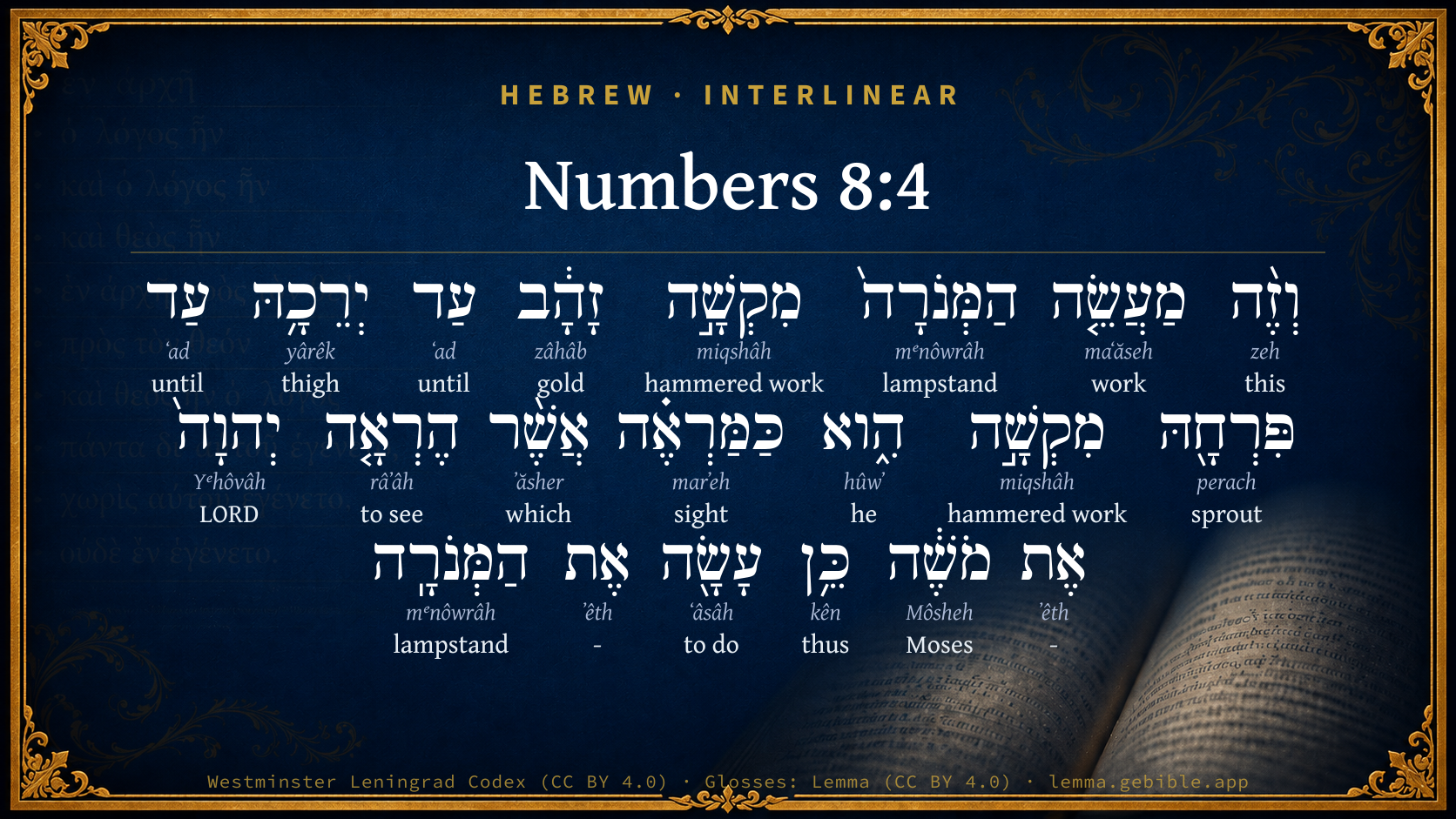
Hebrew (Westminster Leningrad Codex) Numbers 8:4 appears in the Hebrew Old Testament. The text above is from the Westminster Leningrad Codex. Each word links to its Strong’s number, a concise gloss, and parsing drawn from the Open Scriptures Hebrew Bible morphology. Click any word for its full Brown-Driver-Briggs (BDB) entry.
Download image
Cite this verse

Numbers 8:4 (World English Bible). Public Domain. Lemma interlinear Bible study tool, https://lemma.gebible.app/v/numbers/8/4.

Show BibTeX & RIS
BibTeX
RIS
English Translation
This was the workmanship of the lampstand, beaten work of gold. From its base to its flowers, it was beaten work: according to the pattern which Yahweh had shown Moses, so he made the lampstand.
World English Bible · Public Domain
Download a study sheet

One document with this verse’s original text, its word-by-word gloss line, the meaning frame, cross-references with their text, attributed commentary, and full source and license credits — printable, and it pastes into notes with its structure intact.

This verse Autodidact and up

Study sheet (.html) Plain text (.txt)

A passage Seminary Student

Up to 50 verses in one chapter. A passage sheet keeps up to 6 commentary sources and 12 cross-references per verse, in the order this page ranks them, and says so on the sheet whenever that leaves anything out. Ask for a single verse and you get the Autodidact verse sheet above.

Everything on this page stays free to read, with no account — the sheet is a download of what is already on screen, not access to it.

Want to remove ads? Support Godless Engineer
Compare translations 3

The same verse in 3 English versions, stacked beneath the original-language interlinear above. Click any original word for its lexicon entry.

Each is an independent rendering of the whole verse — the interlinear is not word-aligned to these translations.

Highlighted words mark where these versions differ — a whole-verse word diff, not a word-by-word alignment.

  • World English Bible Public Domain
    This was the workmanship of the lampstand, beaten work of gold. From its base to its flowers, it was beaten work: according to the pattern which Yahweh had shown Moses, so he made the lampstand.
  • King James Version Public Domain
    And this work of the candlestick was of beaten gold, unto the shaft thereof, unto the flowers thereof, was beaten work: according unto the pattern which the LORD had showed Moses, so he made the candlestick.
  • unfoldingWord Literal Text CC BY-SA 4.0
    And this the work of the lampstand: a hammered work of gold; it a hammered work up to its side, up to its blossom. According to the appearance that Yahweh showed Moses, so he made the lampstand.

unfoldingWord Literal Text — © unfoldingWord, licensed CC BY-SA 4.0. Word-aligned USFM3 via Door43 (git.door43.org/unfoldingWord/en_ult).

Versions to compare (up to 4)

3 of 4 selected

Show all 18 translations

Every available English version of this verse, each an independent rendering of the whole verse.

  • World English Bible Public Domain
    This was the workmanship of the lampstand, beaten work of gold. From its base to its flowers, it was beaten work: according to the pattern which Yahweh had shown Moses, so he made the lampstand.
  • Berean Standard Bible Public Domain
    This is how the lampstand was constructed: it was made of hammered gold from its base to its blossoms, fashioned according to the pattern the LORD had shown Moses.
  • Majority Standard Bible Public Domain
    This is how the lampstand was constructed: it was made of hammered gold from its base to its blossoms, fashioned according to the pattern the LORD had shown Moses.
  • King James Version Public Domain
    And this work of the candlestick was of beaten gold, unto the shaft thereof, unto the flowers thereof, was beaten work: according unto the pattern which the LORD had showed Moses, so he made the candlestick.
  • American Standard Version (1901) Public Domain
    And this was the work of the candlestick, beaten work of gold; unto the base thereof, `and' unto the flowers thereof, it was beaten work: according unto the pattern which Jehovah had showed Moses, so he made the candlestick.
  • Revised Version (1885) Public Domain
    And this was the work of the candlestick, beaten work of gold; unto the base thereof, and unto the flowers thereof, it was beaten work: according unto the pattern which the LORD had shewed Moses, so he made the candlestick.
  • Geneva Bible (1599) Public Domain
    And this was the worke of the Candlesticke, euen of golde beaten out with the hammer, both the shafte, and the flowres thereof was beaten out with the hammer: according to the paterne, which the Lord had shewed Moses, so made he the Candlesticke.
  • Douay-Rheims (1899) Public Domain
    Now this was the work of the candlestick, it was of beaten gold, both the shaft in the middle, and all that came out of both sides of the branches: according to the pattern which the Lord had shewn to Moses, so he made the candlestick.
  • Young's Literal Translation Public Domain
    And this `is' the work of the candlestick: beaten work of gold; unto its thigh, unto its flower it `is' beaten work; as the appearance which Jehovah shewed Moses, so he hath made the candlestick.
  • Literal Standard Version CC BY-SA 4.0
    And this [is] the work of the lampstand: beaten work of gold; from its thigh to its flower it [is] beaten work; as the appearance which YHWH showed Moses, so he has made the lampstand.
  • Unlocked Literal Bible CC BY-SA 4.0
    The lampstand was made in this way and Yahweh showed Moses the pattern for it. It was to be hammered gold from its base to its top, with hammered cups like blossoms.
  • unfoldingWord Literal Text CC BY-SA 4.0
    And this the work of the lampstand: a hammered work of gold; it a hammered work up to its side, up to its blossom. According to the appearance that Yahweh showed Moses, so he made the lampstand.
  • Darby Bible Public Domain
    And this was the work of the candlestick: [it was] of beaten gold; from its base to its flowers was it beaten work; according to the form which Jehovah had shewn Moses, so had he made the candlestick.
  • World Messianic Bible Public Domain
    This was the workmanship of the lamp stand, beaten work of gold. From its base to its flowers, it was beaten work. He made the lamp stand according to the pattern which the LORD had shown Moses.
  • Webster's Bible Public Domain
    And this work of the candlestick was of beaten gold, to its shaft, to the flowers of it, was beaten work: according to the pattern which the LORD had showed Moses, so he made the candlestick.
  • Free Bible Version CC BY-SA 4.0
    The lampstand was made of hammered gold from its base to the flower decorations on the top, in accordance with the design that the Lord had shown Moses.
  • Bible in Basic English Public Domain
    The support for the lights was of hammered gold work, from its base to its flowers it was of hammered work; from the design which the Lord had given to Moses, he made the support for the lights.
  • JPS Tanakh (1917) Public Domain
    And this was the work of the candlestick, beaten work of gold; unto the base thereof, and unto the flowers thereof, it was beaten work; according unto the pattern which the LORD had shown Moses, so he made the candlestick.

Literal Standard Version (2020), Covenant Press — licensed CC BY-SA 4.0. Text via the HelloAO Bible API (eBible.org). Unlocked Literal Bible (unfoldingWord) — licensed CC BY-SA 4.0. Text via the HelloAO Bible API (eBible.org). unfoldingWord Literal Text — © unfoldingWord, licensed CC BY-SA 4.0. Word-aligned USFM3 via Door43 (git.door43.org/unfoldingWord/en_ult). Free Bible Version, Dr. Jonathan Gallagher — licensed CC BY-SA 4.0. Text via the HelloAO Bible API (eBible.org).

Word by word

More ways to search: Search by grammar → Find every occurrence → Compare this word →

Practice this passage: Drill this verse → Learn its vocabulary →

מִקְשָׁ֣ה
miqshâh
H4749
“hammered work”
Noun, Common, Feminine, Singular, Absolute
Part of Speech
Noun
Type
Common
Gender
Feminine
Number
Singular
State
Absolute
Full BDB Definition

Origin: from H4748

TWOT: 2086b

hammered work, finely decorated cultic objects of gold or silver
  1. וְזֶ֨ה zeh H2088 “and · this” Conjunction + Pronoun, Demonstrative, Masculine, Singular
  2. מַעֲשֵׂ֤ה maʻăseh H4639 “work of” Noun, Common, Masculine, Singular, Construct
  3. הַמְּנֹרָה֙ mᵉnôwrâh H4501 “the · lampstand” Particle, Definite Article + Noun, Common, Feminine, Singular, Absolute
  4. זָהָ֔ב zâhâb H2091 “gold” Noun, Common, Masculine, Singular, Absolute
  5. עַד ʻad H5704 “until” Preposition
  6. יְרֵכָ֥הּ yârêk H3409 “thigh · her” Noun, Common, Feminine, Singular, Construct + Suffix, Personal, 3rd Person, Feminine, Singular
  7. עַד ʻad H5704 “until” Preposition
  8. פִּרְחָ֖הּ perach H6525 “sprout · her” Noun, Common, Masculine, Singular, Construct + Suffix, Personal, 3rd Person, Feminine, Singular
  9. מִקְשָׁ֣ה miqshâh H4749 “hammered work” Noun, Common, Feminine, Singular, Absolute
  10. הִ֑וא hûwʼ H1931 “he” Pronoun, Personal, 3rd Person, Feminine, Singular
  11. כַּמַּרְאֶ֗ה marʼeh H4758 “like/as the · sight” Preposition, Determined + Noun, Common, Masculine, Singular, Absolute
  12. אֲשֶׁ֨ר ʼăsher H834 “which” Particle, Relative
  13. הֶרְאָ֤ה râʼâh H7200 “to see” Verb, Hiphil, Perfect, 3rd Person, Masculine, Singular
  14. יְהוָה֙ Yᵉhôvâh H3068 “LORD” Noun, Proper
  15. אֶת ʼêth H853 “-” Particle, Direct Object
  16. מֹשֶׁ֔ה Môsheh H4872 “Moses” Noun, Proper
  17. כֵּ֥ן kên H3651 “thus” Particle, Demonstrative
  18. עָשָׂ֖ה ʻâsâh H6213 “to do” Verb, Qal, Perfect, 3rd Person, Masculine, Singular
  19. אֶת ʼêth H853 “-” Particle, Direct Object
  20. הַמְּנֹרָֽה mᵉnôwrâh H4501 “the · lampstand” Particle, Definite Article + Noun, Common, Feminine, Singular, Absolute

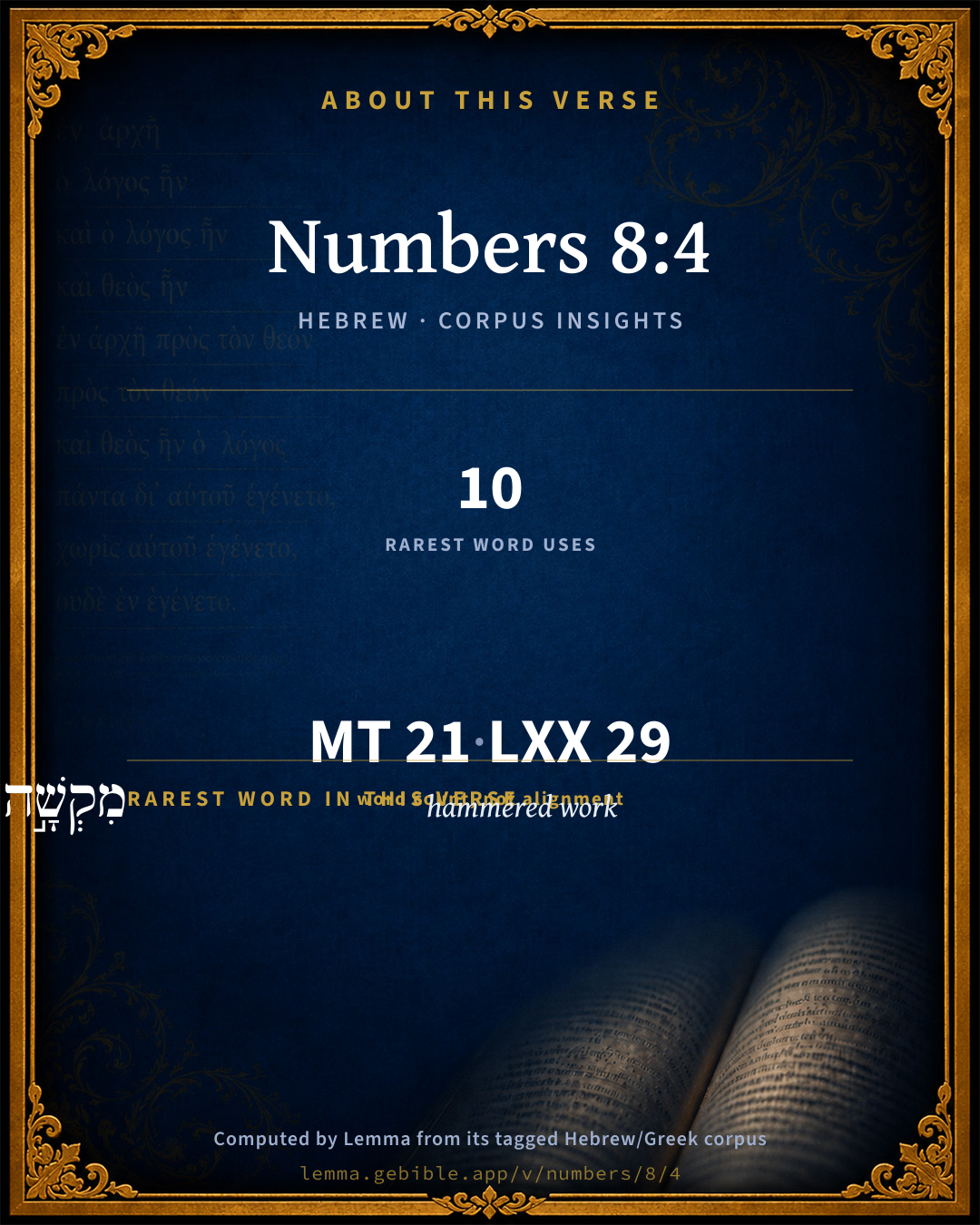
About this verse

These counts appear in no published source. They are computed here, from the morphology-tagged text and Lemma’s own curated glosses. What Lemma adds →

21
words
17
distinct lemmas
Pentateuch
section

Notable vocabulary

The rarest word here is מִקְשָׁ֣ה hammered work H4749 — appearing just 10 times in the whole Hebrew Bible.

Shared distinctive vocabulary

מִקְשָׁ֣ה hammered work H4749 occurs in 9 verses of the Hebrew Bible. Also found in:

Grammatical profile

  • 2 verbs
  • 11 nouns
  • 2 pronouns
  • 2 prepositions
  • 4 particles

Verb forms

  • הֶרְאָ֤ה Hiphil · Perfect
  • עָשָׂ֖ה Qal · Perfect

Repetition

Words recur within this verse — often emphatic in Hebrew:

  • הַמְּנֹרָה֙ lampstand H4501 ×2
  • מִקְשָׁ֣ה hammered work H4749 ×2
  • עַד until H5704 ×2

Hebrew & Septuagint length

In English translation the verse runs 35 words from the Hebrew and 31 from the Septuagint (LXX English) — closely comparable.

A rough comparison of the two English renderings, which tokenize alike — not a word-level alignment.

Word counts can differ between the Hebrew and the Greek without any difference in meaning — e.g. the Hebrew direct-object marker אֵת has no separate Greek word, and Greek often adds the article ὁ.

In the original languages it is 21 Hebrew tokens and 29 Greek tokens — but the two are counted differently (Hebrew bundles its prefixes and suffixes into one token; the Greek is in lemma form), so that isn’t a like-for-like length.

Cross-references

8

Topical passages linked to Numbers 8:4 in the Treasury of Scripture Knowledge — connected by theme and wording, ordered by reader-vote popularity; previews shown in the World English Bible.

  • Exodus 25:9 According to all that I show you, the pattern of the tent, and the pattern of all of its furniture, even so you shall make it.
  • Exodus 25:18 You shall make two cherubim of hammered gold. You shall make them at the two ends of the mercy seat.
  • Exodus 25:31–40 "You shall make a lampstand of pure gold. Of hammered work shall the lampstand be made, even its base, its shaft, its cups, its buds, and its flowers, shall be of one piece with it.
  • Exodus 37:17–24 He made the lampstand of pure gold. He made the lampstand of beaten work. Its base, its shaft, its cups, its buds, and its flowers were of one piece with it.
  • Exodus 37:7 He made two cherubim of gold. He made them of beaten work them, at the two ends of the mercy seat;
  • 1 Chronicles 28:11–19 Then David gave to Solomon his son the pattern of the porch [of the temple], and of the houses of it, and of the treasuries of it, and of the upper rooms of it, and of the inner chambers of it, and of the place of the mercy seat;
  • Hebrews 8:5 who serve a copy and shadow of the heavenly things, even as Moses was warned by God when he was about to make the tabernacle, for he said, "See, you shall make everything according to the pattern that was shown to you on the mountain."
  • Hebrews 9:23 It was necessary therefore that the copies of the things in the heavens should be cleansed with these; but the heavenly things themselves with better sacrifices than these.

Cross-references courtesy of OpenBible.info (CC BY 4.0).

Hebrew and Greek witnesses Masoretic Hebrew ↔ Greek Septuagint

The same verse in the two great witnesses to the Old Testament, shown verse-for-verse.

These are two independent witnesses, not word-aligned to each other, and the Septuagint is shown in lemma (dictionary) form.

Hebrew Numbers 8:4 Masoretic · Westminster Leningrad Codex

וְזֶ֨ה מַעֲשֵׂ֤ה הַמְּנֹרָה֙ מִקְשָׁ֣ה זָהָ֔ב עַד יְרֵכָ֥הּ עַד פִּרְחָ֖הּ מִקְשָׁ֣ה הִ֑וא כַּמַּרְאֶ֗ה אֲשֶׁ֨ר הֶרְאָ֤ה יְהוָה֙ אֶת מֹשֶׁ֔ה כֵּ֥ן עָשָׂ֖ה אֶת הַמְּנֹרָֽה

This was the workmanship of the lampstand, beaten work of gold. From its base to its flowers, it was beaten work: according to the pattern which Yahweh had shown Moses, so he made the lampstand.

World English Bible · Public Domain

Greek LXX Numbers 8:4 Septuagint · lemma form

καί οὗτος ὁ κατασκευή ὁ λυχνία στερεός χρυσοῦς ὁ καυλός αὐτός καί ὁ κρίνον αὐτός στερεός ὅλος κατά ὁ εἶδος ὅς δεικνύω κύριος ὁ μωυσῆς οὕτως ποιέω ὁ λυχνία

And this is the construction of the candlestick: it is solid, golden—its stem, and its lilies—all solid: according to the pattern which the Lord showed Moses, so he made the candlestick.

LXX2012 (modern English Septuagint) · Public Domain

Hebrew: Westminster Leningrad Codex (CC BY 4.0). Greek: Septuagint (public domain); English from LXX2012 (modern English Septuagint) (Public Domain). How the Septuagint differs from the Hebrew →

Targum (Aramaic paraphrase)

2

The Targum is the ancient Jewish Aramaic paraphrase of the Hebrew Scriptures — an interpretive translation, not the Hebrew text itself. Onkelos (literal) and Pseudo-Jonathan (expansive) render the Torah, and Jonathan the Prophets. Coverage is partial: where no permissively-licensed English translation exists for a verse, only the Aramaic is shown. This is verse-level text, not a word-by-word alignment to the Hebrew.

  1. Targum Onkelos Torah (Genesis–Deuteronomy)
    וְדֵין עוֹבַד מְנַרְתָּא נְגִידָא דְהַב עַד שִׁידַהּ עַד שׁוֹשַׁנַהּ נְגִידָא הִיא כְּחֶזְוָא דִי אַחֲזֵי יְיָ יָת משֶׁה כֵּן עֲבַד יָת מְנַרְתָּא

    (no public-domain English translation for this verse)

    Targum Onkelos — Aramaic: “Onkelos Genesis” (public domain); “Onkelos Exodus” (public domain); “Onkelos Leviticus” (public domain); “Onkelos Numbers” (public domain); “Onkelos Deuteronomy” (public domain). English: “Sefaria Community Translation” (CC0 1.0 (public-domain dedication)); “J.W. Etheridge. The Targums of Onkelos and Jonathan Ben Uzziel on the Pentateuch. London: Longmans, Green, 1862” (public domain). Text via Sefaria.

  2. Targum Pseudo-Jonathan Torah (Genesis–Deuteronomy)
    וְדֵין עוֹבַד מְנַרְתָּא מִינָא קַשְׁיָא דִדְהַב עַד בָּסִיס דִידָהּ וְעַד שׁוֹשַׁנְיָיהָא עוֹבַד אוּמַן בְּקוּרְנְסָא הִיא מִתְעַבְדָא הֵי כְחֵיזוּ דְאַחֲזֵי יְיָ יַת משֶׁה הֵיכְדֵין עָבַד בְּצַלְאֵל יַת מְנַרְתָּא

    And this was the work of the candelabrum, which was of beaten gold, from its foundations unto its lilies, the work of the artificer, with the hammer was it wrought: according to the vision which the Lord had showed Mosheh, so did Bezalel make the candelabrum.

    Targum Pseudo-Jonathan — Aramaic: “Targum Jonathan on Genesis” (public domain); “Targum Jonathan on Exodus” (public domain); “Targum Jonathan on Leviticus” (public domain); “Targum Jonathan on Numbers” (public domain); “Targum Jonathan on Deuteronomy” (public domain). English: “The Targum of Jonathan ben Uzziel, trans. J. W. Etheridge, London, 1862” (public domain). Text via Sefaria.

Commentary

Notes on Numbers 8:4 from classic Christian and Jewish commentators (each source and its license shown beneath its notes). The classic Christian expositions comment on the surrounding passage and are grouped to its opening verse, so a note may address several verses; the Jewish commentaries on the Tanakh (Rashi and others) are per-verse, so they appear only where the commentator wrote on this verse.

Lemma curates 59 commentaries, every one of them public domain or Creative Commons licensed, each selected and text-cleaned for this edition rather than reprinted as found. About our sources →

Trapp's Complete Commentary

John Trapp

Num 8:4 And this work of the candlestick [was of] beaten gold, unto the shaft thereof, unto the flowers thereof, [was] beaten work: according unto the pattern which the LORD had shewed Moses, so he made the candlestick.

Ver. 4. Beaten work.] To show that ministers must beat their brains to beat out the sense of the Scriptures, as the fowl beats the shell, to get out the fish, with great vehemency. {a}

{a} Kοπιαν, παρα το κοπτειν.

John Trapp, A Commentary or Exposition upon All the Books of the Old and New Testament (1647–1656) — public domain. Text from a community e-Sword module.

Joseph Benson's Commentary

Num 8:4. Of beaten gold — Not hollow, but solid gold, beaten out of one piece, not of several pieces joined or soldered together.

Joseph Benson's Commentary on the Old and New Testaments (1811–1818) — public domain. Text from a community e-Sword module.

Geneva Bible (1599)

Geneva Bible translators

And not set together of divers pieces.

Geneva Bible (1599) marginal notes — public domain. Text via Bolls.life.

Adam Clarke's Commentary

Verse 4. This work of the candlestick, c.] See many curious particulars relative to this candlestick, See Clarke on Ex 25:31 and "Ex 25:39". The candlestick itself was an emblem of the Church of Christ the oil, of the graces and gifts of the Spirit of God; and the light, of those gifts and graces in action among men. See Re 1:12-20. God builds his Church and sends forth his Spirit to dwell in it, to sanctify and cleanse it, that it may be shown unto the world as his own workmanship. The seven lights in the candlesticks point out the seven Spirits of God, the Holy Ghost being thus termed, Re 3:1, from the variety and abundance of his gifts and influences; seven being used among the Hebrews to denote any thing full, complete, and perfect. A candlestick or lamp without oil is of no use; oil not burning is of no use. So a Church or society of religious people without the influence of the Holy Ghost are dead while they have a name to live; and if they have a measure of this light, and do not let it shine by purity of living and holy zeal before men, their religion is neither useful to themselves nor to others. Reader, it is possible to be in the Church of God and not be of that Church; it is possible to have a measure of the Spirit and neither profit nor be profited. Feel this dreadful possibility, and pray to God that thou be not a proof of it.

Adam Clarke's Commentary on the Bible (1810–1826) — public domain. Text from a community e-Sword/MySword module.

Ellicott's Commentary for English Readers

(4) And this work of the candlestick . . . —Better, And this was the work of the candlestick, i.e., the material of which it was made.

Beaten gold.—Better, turned (or twisted) gold.

Unto the shaft thereof, unto the flowers thereof.—Literally, unto its base, unto its flower or blossom, i.e., the whole of the candlestick, from its base to its flowers. The several parts of the candlestick, beginning with the base and ending with the flowers, are enumerated in Exo_25:31.

A Bible Commentary for English Readers, edited by Charles John Ellicott (1878–1897) — public domain. Text from a community e-Sword module.

The Cambridge Bible for Schools and Colleges

gen. ed. J. J. S. Perowne

4. beaten work] Repoussé work, hammered out of a solid plate of gold (Exo_25:31; Exo_25:36; Exo_37:17-22). This work was employed also for the Cherubim (Exo_25:18; Exo_37:7) and the two silver clarions (Num_10:2).

unto the base … and unto the flowers] The Heb. idiom means both base and flowers. The flowers were the ornamentation on each of the six shafts and on the central stem. In every shaft there were three cups, and on the central stem four, each consisting of a calyx and petals of an almond blossom. The lampstand of Herod’s temple was made on this model, and is familiar from its representation on the arch of Titus.

The Cambridge Bible for Schools and Colleges (gen. ed. J. J. S. Perowne; Cambridge University Press, 1878–1918) — public domain. Text from a community e-Sword module.

John Gill's Exposition

And this work of the candlestick was of beaten gold,.... As it is also said to be; See Gill on Exo 25:31; and See Gill on Exo 25:36,

unto the shalt thereof, unto the flowers thereof, was beaten work; of which, see Exo 25:31,

according unto the pattern which the Lord had showed Moses; when on Mount Sinai with him:

so he made the candlestick; that is, ordered it to be made, and took care that it was made exactly to the pattern he had of it; otherwise Bezaleel was the artificer; and so the Targum of Jonathan here expresses him by name.

John Gill's Exposition of the Whole Bible (1746–1763) — public domain (CC PDM 1.0). Text via the HelloAO Bible API.

Matthew Poole's English Annotations

Beaten gold, not hollow, but solid and massive gold, beaten out of one piece, and not of several pieces joined or soldered together. See Exo 25:18,31; 37:17.

Matthew Poole's English Annotations on the Holy Bible (1683–1685) — public domain. Text from a community e-Sword/MySword module.

The Pulpit Commentary

And this work of the candlestick. For the meaning of the details here given see Exo_25:31, sq. According unto the pattern which the Lord had shewed Moses, viz., in the mount (see Exo_25:40) so he made the candlestick. This has been recorded in Exo_37:17. The repetition of the statement in this place seems to be conclusive that these verses are out of their historical position, and that their insertion here is due to some fact connected with the original records with which we are not acquainted. It may be simply this, that these verses originally followed verse 89 of the previous chapter, and followed it still when it was inserted, for reasons already suggested, after the narrative of the offerings of the princes. Why, or how, such an admission should discredit the sacred narrative or imperil the truth of its inspiration it would be hard to say. The only thing really likely to imperil the sacred narrative is to persistently deny the obvious literary conclusions which arise from an honest consideration of the text.

The Pulpit Commentary (1880–1919), ed. H.D.M. Spence-Jones & Joseph S. Exell — public domain. Text from a community e-Sword module.

John Wesley's Explanatory Notes

Of beaten gold - Not hollow, but solid gold, beaten out of one piece, not of several pieces joined or soldered together.

John Wesley, Explanatory Notes Upon the Whole Bible (1754–1765) — public domain. Text via the GEBible commentary corpus.

Rashi

Rabbi Shlomo Yitzchaki (Rashi)

וזה מעשה המנרה AND THIS IS THE WORK OF THE CANDLESTICK — “This” — we may gather that the Holy One, blessed be He, showed it to him (Moses) with His finger, because he was puzzled by it (how to construct it); and that is why it states, “this is [the construction of the candlestick]” (Sifrei Bamidbar 61; Menachot 29a).

מקשה means batediz in O. F., — [English = beaten], an expression of the same meaning as in (Daniel 5:6) “[and his feet] knocked (נקשן) one against another”. There was a block weighing a talent of gold and he (who made the candlestick) beat it with the hammer, and cut away with a chisel in order that its branches might be made to spread out as they should do, and it was not formed of separate pieces made into a whole by joining them together.

עד ירכה עד פרחה UNTO THE SHAFT THEREOF, UNTO THE FLOWERS THEREOF — Its ירך was the boxlike base which was above the feet (thus, the feet stood beneath this; cf. Rashi on Exodus 25:31), hollow, like the candlesticks of princely houses (lit., as the candlesticks standing before the princes).

עד ירכה עד פרחה — This phrase means as much as: the whole body of the candlestick and everything attached to it.

עד ירכה — FROM THE BASE which is a massive part.

עד פרחה — UP TO ITS FLOWER, which was the most slender piece of work in it — all was beaten out of the lump. The double form of עד … עד) עד) is used in this sense (to include everything), as e.g., (Judges 15:5) “[and he (Samson) burnt up everything] from the shocks to (עד) the standing corn and to (ועד) the vineyard and the olives".

כמראה אשר הראה וגו׳ ACCORDING UNTO THE PATTERN WHICH [THE LORD] HAD SHOWED [MOSES] — i. e. according to the shape which he had shewn him on the mountain, as it is said, (Exodus 25:40) and see, that thou make them after their pattern [which was shewn thee in the mountain]".

כן עשה את המנורה SO HE MADE THE CANDELABRUM — “he” means, the one who made it (not Moses, as might be assumed from the wording of the text; the subject is suppressed and it means no more than: so was the candlestick made). A Midrashic explanation is: By the instrumentality of the Holy One, blessed be He, it was made of itself (according to this the subject is “God” who is mentioned immediately before) (Midrash Tanchuma, Beha'alotcha 3; cf. Rashi on Exodus 25:31).

Rashi on the Tanakh — English translations: “The Judaica Press complete Tanach with Rashi, translated by A. J. Rosenberg” (CC BY 4.0); “Pentateuch with Rashi's commentary by M. Rosenbaum and A.M. Silbermann, 1929-1934” (public domain); “The Metsudah Tanach series, Lakewood, N.J” (CC BY 4.0); and “The Book of Joshua, Metsudah Publications, 1997” (CC BY 4.0). Text via Sefaria.

Ramban (Nachmanides)

Rabbi Moshe ben Nachman (Ramban / Nachmanides)

AND THIS WAS THE WORK OF THE CANDELABRUM, BEATEN WORK OF GOLD. The meaning thereof is to allude [to the law] that throughout all [future] generations the candelabrum must be beaten [and fashioned out of one solid piece of metal], and that this is essential [for the validity of the candelabrum and lighting the lamps therein]. This is why He expressly mentioned at the beginning [that it is to be] beaten work, but did not mention [here] that in the making thereof there should be branches [going out of the candelabrum], knops, and cups shaped like almond-blossoms. But He did mention [here that it be of] gold, for it is likewise a commandment for all generations that it be made of gold, in order to glorify the House of our G-d. Then He repeated [in the verse before us] it was beaten work, in order to say that it is only [failure to make it] of beaten work that invalidates the candelabrum, but [the requirement] of gold is not [indispensable, since it is valid if made of any metal], and certainly its other embellishments [such as the cups and knops do not invalidate it if they are missing]. And thus have our Rabbis said in the Sifre 61. and in Tractate Menachoth.

ACCORDING TO THE PATTERN WHICH THE ETERNAL HAD SHOWN MOSES, SO ‘HE’ MADE THE CANDELABRUM — that is, Moses mentioned above, for it was he who made efforts to learn about it and directed the making thereof by command. And so the Rabbis have said in the Sifre: 61. “[This is stated] in order to praise Moses, [by emphasizing] that he made it exactly as the Holy One, blessed be He, told him to make [the candelabrum].” And Rashi wrote: “So he made — [the word ‘he’ refers to] the one who made it [i.e., to whomever it was that made it, and does not refer to Moses]. But a Midrash Agadah 5. — “Midrash Agadah.” Rabbinic texts on the Five Books of Moses are divided into two classes: “Midrash Halachah” (texts dealing mainly with the legal parts of the Torah), which consist of the Mechilta on the Book of Exodus, Sifra [or Torath Kohanim] on the Book of Leviticus, and Sifre on the Books of Numbers and Deuteronomy. Another set of texts deal mainly with the narrative, ethical and homiletical aspects of the Scriptures. These comprise two major works — the Midrash Rabbah and Tanchuma. There is in addition a large group of smaller Midrashim that belong to this category. The generic term “Midrash Agadah” includes all this second group of texts. has it: [The subject ‘he’ refers to the Eternal, for] it was made of its own accord [without human intervention], by the Holy One, blessed be He.”

Ramban (Nachmanides) on the Tanakh — English translation: “Commentary on the Torah by Ramban (Nachmanides). Translated and annotated by Charles B. Chavel. New York, Shilo Pub. House, 1971-1976” (CC BY 4.0). Text via Sefaria.

Lesson kit

Teaching starters — assembled from the data on this page, not authored interpretation. Every prompt links to the verse data it draws on. Edit before teaching.

Numbers, in the Pentateuch, opens this verse with 21 words (17 distinct Hebrew lemmas). Its most distinctive word is miqshâh (“hammered work”). A historical commentator’s framing appears above. Read the whole chapter for the surrounding context.

Discussion questions

  1. The word miqshâh carries the sense “hammered work.” How does it shape the verse?
  2. Exodus 25:18 shares the word «hammered work» with this verse. How do the two illuminate each other?
  3. “lampstand” occurs 2× in this one verse. What is the effect of the repetition?
  4. The translations on this page render this verse differently — a whole-verse word diff, not a word-by-word alignment. What might account for the different wordings?
  5. The verb «הֶרְאָ֤ה» is Hiphil Perfect. How does its form color the action?
  6. Reading how Trapp's Complete Commentary and Joseph Benson's Commentary read this verse, where do the two commentators agree and where do they part?

Things to notice

Reading settings

Reading text

Shown beneath each verse's original-language words.

Old Testament
Old Testament edition

Read the OT as the Masoretic Hebrew (MT) or the Greek Septuagint (LXX).

English shown for the Greek Septuagint (in the Hebrew ↔ Greek comparison).

Comparing translations? Open the Compare panel on any verse page to stack up to four side by side.