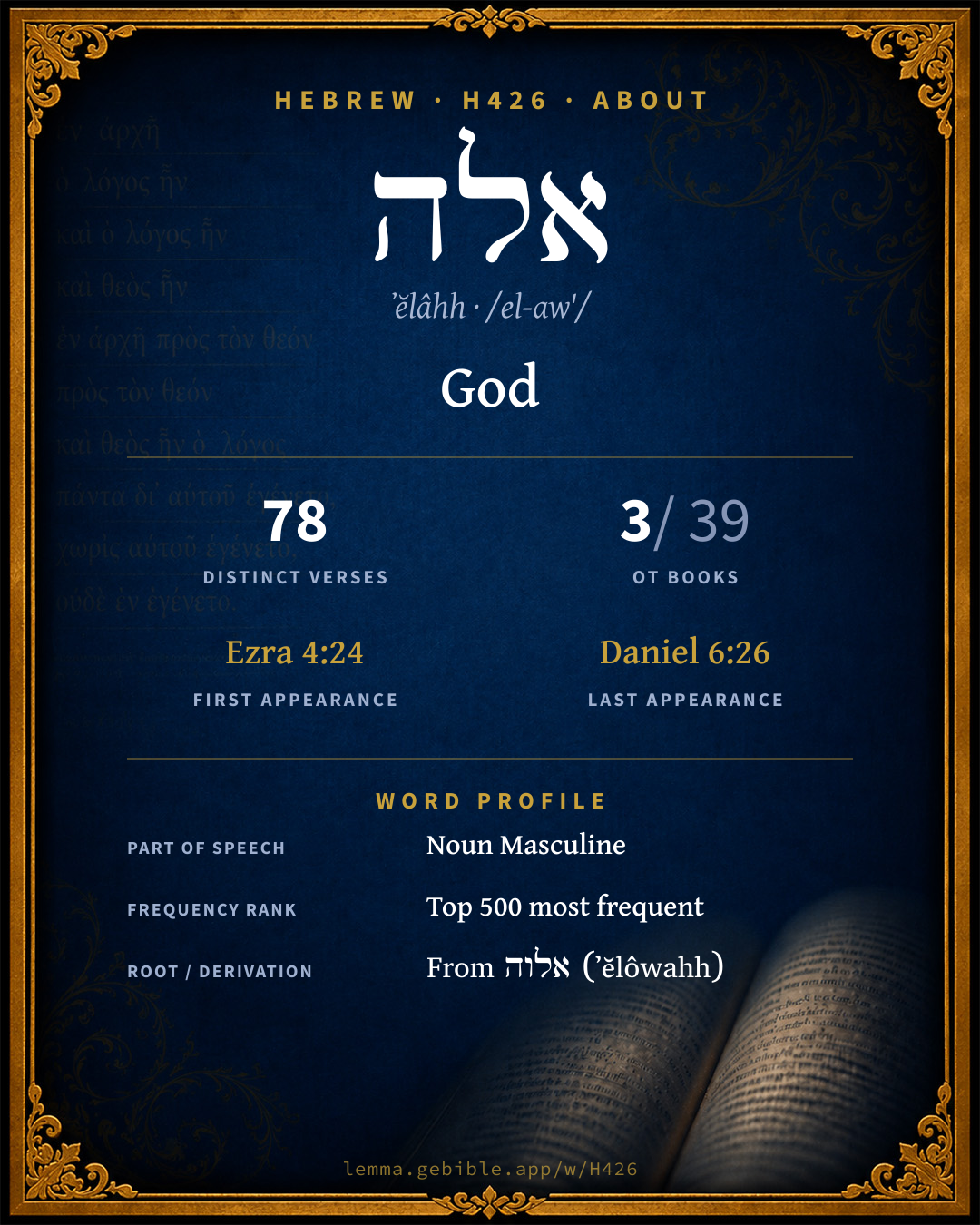
אֱלָהּ
God
‘God’ is one of 3 main senses fuller range ↓
Full lexicon entry — Brown-Driver-Briggs (BDB)
From Brown-Driver-Briggs (BDB)
Where this word appears
See every Construct-state word in the Hebrew Bible →
Grammar key — what these labels mean
Part of speech
- Noun
- A naming word — a person, place, thing, or idea.
Noun type
- Common
- A common noun — a general class of person, place, or thing (“king,” “city,” “water”), not a specific name.
State
- Construct
- A noun bound to a following noun in a possessive / “of” relationship (the construct chain).
- Absolute
- The independent form of a noun, not bound to a following word.
Gender
- Masculine
- Grammatically masculine.
Number
- Singular
- One.
- Plural
- More than one (in Hebrew, generally three or more).
Grammatical forms
- Noun, Common, Masculine, Singular, Construct 45 times (46%)
- Particle, Definite Article 32 times (33%)
- Noun, Common, Masculine, Plural, Absolute 9 times (9%)
- Noun, Common, Masculine, Singular, Absolute 7 times (7%)
- Noun, Common, Masculine, Plural, Construct 4 times (4%)
Parsed forms decoded from the imported morphology (morphhb / Westminster Leningrad Codex — WLC text public domain, morphhb tagging CC BY 4.0), counted across 97 parsed occurrences — not distinct verses.
Every verse where H426 appears — 78 distinct verses across 3 books. Click any verse to open its interlinear word-by-word view. Verse text shown in the World English Bible for context — . Each verse’s Hebrew form is shown with its reference; the English is not keyword-highlighted, since the data carries no word-level English alignment. Use “Compare translations” on any verse to read it across multiple English versions. This concordance covers the Hebrew Bible; Septuagint (Greek Old Testament) occurrences are not indexed here.
Ezra 36 verses
- Ezra 4:24 אֱלָהָ֔/א n c ms det + ptcl def.art Then ceased the work of the house of God which is at Jerusalem; and it ceased until the second year of the reign of Darius king of Persia.
- Ezra 5:1 אֱלָ֥הּ n c ms cs Now the prophets, Haggai the prophet, and Zechariah the son of Iddo, prophesied to the Jews who were in Judah and Jerusalem; in the name of the God of Israel [prophesied they] to them.
- Ezra 5:2 אֱלָהָ֖/א אֱלָהָ֖/א n c ms det + ptcl def.art n c ms det + ptcl def.art Then rose up Zerubbabel the son of Shealtiel, and Jeshua the son of Jozadak, and began to build the house of God which is at Jerusalem; and with them were the prophets of God, helping them.
- Ezra 5:5 אֱלָהֲ/הֹ֗ם n c ms cs + sfx pers 3mp But the eye of their God was on the elders of the Jews, and they did not make them cease, until the matter should come to Darius, and then answer should be returned by letter concerning it.
- Ezra 5:8 אֱלָהָ֣/א n c ms det + ptcl def.art Be it known to the king, that we went into the province of Judah, to the house of the great God, which is built with great stones, and timber is laid in the walls; and this work goes on with diligence and prospers in their hands.
- Ezra 5:11 אֱלָ֨הּ n c ms cs Thus they returned us answer, saying, We are the servants of the God of heaven and earth, and are building the house that was built these many years ago, which a great king of Israel built and finished.
- Ezra 5:12 לֶ/אֱלָ֣הּ ptcl do + n c ms cs But after that our fathers had provoked the God of heaven to wrath, he gave them into the hand of Nebuchadnezzar king of Babylon, the Chaldean, who destroyed this house, and carried the people away into Babylon.
- Ezra 5:13 אֱלָהָ֥/א n c ms det + ptcl def.art But in the first year of Cyrus king of Babylon, Cyrus the king made a decree to build this house of God.
- Ezra 5:14 אֱלָהָ/א֮ n c ms det + ptcl def.art The gold and silver vessels also of the house of God, which Nebuchadnezzar took out of the temple that was in Jerusalem, and brought into the temple of Babylon, those did Cyrus the king take out of the temple of Babylon, and they were delivered to one whose name was Sheshbazzar, whom he had made governor;
- Ezra 5:15 אֱלָהָ֖/א n c ms det + ptcl def.art and he said to him, Take these vessels, go, put them in the temple that is in Jerusalem, and let the house of God be built in its place.
- Ezra 5:16 אֱלָהָ֖/א n c ms det + ptcl def.art Then came the same Sheshbazzar, and laid the foundations of the house of God which is in Jerusalem: and since that time even until now has it been in building, and yet it is not completed.
- Ezra 5:17 אֱלָהָ֥/א n c ms det + ptcl def.art Now therefore, if it seem good to the king, let there be search made in the king's treasure-house, which is there at Babylon, whether it be so, that a decree was made of Cyrus the king to build this house of God at Jerusalem; and let the king send his pleasure to us concerning this matter.
- Ezra 6:3 אֱלָהָ֤/א n c ms det + ptcl def.art In the first year of Cyrus the king, Cyrus the king made a decree: Concerning the house of God at Jerusalem, let the house be built, the place where they offer sacrifices, and let the foundations of it be strongly laid; the height of it sixty cubits, and the breadth of it sixty cubits;
- Ezra 6:5 אֱלָהָ/א֮ אֱלָהָֽ/א n c ms det + ptcl def.art n c ms det + ptcl def.art Also let the gold and silver vessels of the house of God, which Nebuchadnezzar took forth out of the temple which is at Jerusalem, and brought to Babylon, be restored, and brought again to the temple which is at Jerusalem, everyone to its place; and you shall put them in the house of God.
- Ezra 6:7 אֱלָהָ֣/א אֱלָהָ֥/א n c ms det + ptcl def.art n c ms det + ptcl def.art let the work of this house of God alone; let the governor of the Jews and the elders of the Jews build this house of God in its place.
- Ezra 6:8 אֱלָהָ֣/א n c ms det + ptcl def.art Moreover I make a decree what you shall do to these elders of the Jews for the building of this house of God: that of the king's goods, even of the tribute beyond the River, expenses be given with all diligence to these men, that they be not hindered.
- Ezra 6:9 לֶ/אֱלָ֪הּ prep + n c ms cs That which they have need of, both young bulls, and rams, and lambs, for burnt offerings to the God of heaven; [also] wheat, salt, wine, and oil, according to the word of the priests who are at Jerusalem, let it be given them day by day without fail;
- Ezra 6:10 לֶ/אֱלָ֣הּ prep + n c ms cs that they may offer sacrifices of sweet savor to the God of heaven, and pray for the life of the king, and of his sons.
- Ezra 6:12 וֵֽ/אלָהָ֞/א אֱלָהָ֥/א conj + n c ms det + ptcl def.art n c ms det + ptcl def.art and the God who has caused his name to dwell there overthrow all kings and peoples who shall put forth their hand to alter [the same], to destroy this house of God which is at Jerusalem. I Darius have made a decree; let it be done with all diligence.
- Ezra 6:14 אֱלָ֣הּ n c ms cs The elders of the Jews built and prospered, through the prophesying of Haggai the prophet and Zechariah the son of Iddo. They built and finished it, according to the commandment of the God of Israel, and according to the decree of Cyrus, and Darius, and Artaxerxes king of Persia.
- Ezra 6:16 אֱלָהָ֥/א n c ms det + ptcl def.art The children of Israel, the priests, and the Levites, and the rest of the children of the captivity, kept the dedication of this house of God with joy.
- Ezra 6:17 אֱלָהָ֣/א n c ms det + ptcl def.art They offered at the dedication of this house of God one hundred bulls, two hundred rams, four hundred lambs; and for a sin-offering for all Israel, twelve male goats, according to the number of the tribes of Israel.
- Ezra 6:18 אֱלָהָ֖/א n c ms det + ptcl def.art They set the priests in their divisions, and the Levites in their courses, for the service of God, which is at Jerusalem; as it is written in the book of Moses.
- Ezra 7:12 אֱלָ֧הּ n c ms cs Artaxerxes, king of kings, to Ezra the priest, the scribe of the law of the God of heaven, perfect and so forth.
- Ezra 7:14 אֱלָהָ֖/ךְ n c ms cs + sfx pers 2ms Because you are sent of the king and his seven counselors, to inquire concerning Judah and Jerusalem, according to the law of your God which is in your hand,
- Ezra 7:15 לֶ/אֱלָ֣הּ prep + n c ms cs and to carry the silver and gold, which the king and his counselors have freely offered to the God of Israel, whose habitation is in Jerusalem,
- Ezra 7:16 אֱלָהֲ/הֹ֖ם n c ms cs + sfx pers 3mp and all the silver and gold that you shall find in all the province of Babylon, with the freewill-offering of the people, and of the priests, offering willingly for the house of their God which is in Jerusalem;
- Ezra 7:17 אֱלָהֲ/כֹ֖ם n c ms cs + sfx pers 2mp therefore you shall with all diligence buy with this money bulls, rams, lambs, with their meal-offerings and their drink-offerings, and shall offer them on the altar of the house of your God which is in Jerusalem.
- Ezra 7:18 אֱלָהֲ/כֹ֖ם n c ms cs + sfx pers 2mp Whatever shall seem good to you and to your brothers to do with the rest of the silver and the gold, that do you after the will of your God.
- Ezra 7:19 אֱלָהָ֑/ךְ אֱלָ֥הּ n c ms cs + sfx pers 2ms n c ms cs The vessels that are given you for the service of the house of your God, deliver you before the God of Jerusalem.
- Ezra 7:20 אֱלָהָ֔/ךְ n c ms cs + sfx pers 2ms Whatever more shall be needful for the house of your God, which you shall have occasion to bestow, bestow it out of the king's treasure-house.
- Ezra 7:21 אֱלָ֣הּ n c ms cs I, even I Artaxerxes the king, do make a decree to all the treasurers who are beyond the River, that whatever Ezra the priest, the scribe of the law of the God of heaven, shall require of you, it be done with all diligence,
- Ezra 7:23 אֱלָ֣הּ אֱלָ֣הּ n c ms cs n c ms cs Whatever is commanded by the God of heaven, let it be done exactly for the house of the God of heaven; for why should there be wrath against the realm of the king and his sons?
- Ezra 7:24 אֱלָהָ֣/א n c ms det + ptcl def.art Also we inform you, that touching any of the priests and Levites, the singers, porters, Nethinim, or servants of this house of God, it shall not be lawful to impose tribute, custom, or toll, on them.
- Ezra 7:25 אֱלָהָ֤/ךְ אֱלָהָ֑/ךְ n c ms cs + sfx pers 2ms n c ms cs + sfx pers 2ms You, Ezra, after the wisdom of your God who is in your hand, appoint magistrates and judges, who may judge all the people who are beyond the River, all such as know the laws of your God; and teach you him who doesn't know them.
- Ezra 7:26 אֱלָהָ֗/ךְ n c ms cs + sfx pers 2ms Whoever will not do the law of your God, and the law of the king, let judgment be executed on him with all diligence, whether it be to death, or to banishment, or to confiscation of goods, or to imprisonment.
Jeremiah 1 verse
Daniel 41 verses
- Daniel 2:11 אֱלָהִ֔ין n c mp It is a rare thing that the king requires, and there is no other who can show it before the king, except the gods, whose dwelling is not with flesh.
- Daniel 2:18 אֱלָ֣הּ n c ms cs that they would desire mercies of the God of heaven concerning this secret; that Daniel and his companions should nor perish with the rest of the wise men of Babylon.
- Daniel 2:19 לֶ/אֱלָ֥הּ ptcl do + n c ms cs Then was the secret revealed to Daniel in a vision of the night. Then Daniel blessed the God of heaven.
- Daniel 2:20 אֱלָהָ/א֙ n c ms det + ptcl def.art Daniel answered, Blessed be the name of God forever and ever; for wisdom and might are his.
- Daniel 2:23 אֱלָ֣הּ n c ms cs I thank you, and praise you, you God of my fathers, who have given me wisdom and might, and have now made known to me what we desired of you; for you have made known to us the king's matter.
- Daniel 2:28 אֱלָ֤הּ n c ms but there is a God in heaven who reveals secrets, and he has made known to the king Nebuchadnezzar what shall be in the latter days. Your dream, and the visions of your head on your bed, are these:
- Daniel 2:37 אֱלָ֣הּ n c ms cs You, O king, are king of kings, to whom the God of heaven has given the kingdom, the power, and the strength, and the glory;
- Daniel 2:44 אֱלָ֨הּ n c ms cs In the days of those kings shall the God of heaven set up a kingdom which shall never be destroyed, nor shall the sovereignty of it be left to another people; but it shall break in pieces and consume all these kingdoms, and it shall stand forever.
- Daniel 2:45 אֱלָ֥הּ n c ms Because you saw that a stone was cut out of the mountain without hands, and that it broke in pieces the iron, the brass, the clay, the silver, and the gold; the great God has made known to the king what shall happen hereafter: and the dream is certain, and the interpretation of it sure.
- Daniel 2:47 אֱלָהֲ/כ֗וֹן אֱלָ֧הּ אֱלָהִ֛ין n c ms cs + sfx pers 2mp n c ms cs n c mp The king answered to Daniel, and said, Of a truth your God is the God of gods, and the Lord of kings, and a revealer of secrets, seeing you have been able to reveal this secret.
- Daniel 3:12 ל/אלהי/ך לֵֽ/אלָהָ/ךְ֙ prep + n c mp cs + sfx pers 2ms prep + n c ms cs + sfx pers 2ms There are certain Jews whom you have appointed over the affairs of the province of Babylon: Shadrach, Meshach, and Abednego; these men, O king, have not regarded you: they don't serve your gods, nor worship the golden image which you have set up.
- Daniel 3:14 לֵֽ/אלָהַ֗/י prep + n c ms cs + sfx pers 1cs Nebuchadnezzar answered them, Is it on purpose, Shadrach, Meshach, and Abednego, that you don't serve my god, nor worship the golden image which I have set up?
- Daniel 3:15 אֱלָ֔הּ n c ms Now if you are ready whenever you hear the sound of the horn, flute, zither, lyre, harp, pipe, and all kinds of music to you fall down and worship the image which I have made, [well]: but if you don't worship, you shall be cast the same hour into the midst of a burning fiery furnace; and who is that god that shall deliver you out of my hands?
- Daniel 3:17 אֱלָהַ֨/נָא֙ n c ms cs + sfx pers 1cp If it be [so], our God whom we serve is able to deliver us from the burning fiery furnace; and he will deliver us out of your hand, O king.
- Daniel 3:18 ל/אלהי/ך לֵֽ/אלָהָ/ךְ֙ prep + n c mp cs + sfx pers 2ms prep + n c ms cs + sfx pers 2ms But if not, be it known to you, O king, that we will not serve your gods, nor worship the golden image which you have set up.
- Daniel 3:25 אֱלָהִֽין n c mp He answered, Look, I see four men loose, walking in the midst of the fire, and they have no hurt; and the aspect of the fourth is like a son of the gods.
- Daniel 3:26 אֱלָהָ֥/א n c ms det + ptcl def.art Then Nebuchadnezzar came near to the mouth of the burning fiery furnace: he spoke and said, Shadrach, Meshach, and Abednego, you servants of the Most High God, come forth, and come here. Then Shadrach, Meshach, and Abednego came forth out of the midst of the fire.
- Daniel 3:28 אֱלָהֲ/הוֹן֙ אֱלָ֔הּ לֵ/אלָֽהֲ/הֽוֹן n c ms cs + sfx pers 3mp n c ms ptcl do + n c ms cs + sfx pers 3mp Nebuchadnezzar spoke and said, Blessed be the God of Shadrach, Meshach, and Abednego, who has sent his angel, and delivered his servants who trusted in him, and have changed the king's word, and have yielded their bodies, that they might not serve nor worship any god, except their own God.
- Daniel 3:29 אֱלָהֲ/ה֗וֹן אֱלָ֣ה n c ms cs + sfx pers 3mp n c ms Therefore I make a decree, that every people, nation, and language, which speak anything evil against the God of Shadrach, Meshach, and Abednego, shall be cut in pieces, and their houses shall be made a dunghill; because there is no other god who is able to deliver after this sort.
- Daniel 4:2 אֱלָהָ֖/א n c ms det + ptcl def.art It has seemed good to me to show the signs and wonders that the Most High God has worked toward me.
- Daniel 4:8 אֱלָהִ֔/י אֱלָהִ֥ין n c ms cs + sfx pers 1cs n c mp But at the last Daniel came in before me, whose name was Belteshazzar, according to the name of my god, and in whom is the spirit of the holy gods: and I told the dream before him, [saying],
- Daniel 4:9 אֱלָהִ֤ין n c mp Belteshazzar, master of the magicians, because I know that the spirit of the holy gods is in you, and no secret troubles you, tell me the visions of my dream that I have seen, and the interpretation of it.
- Daniel 4:18 אֱלָהִ֥ין n c mp This dream I, king Nebuchadnezzar, have seen; and you, Belteshazzar, declare the interpretation, because all the wise men of my kingdom are not able to make known to me the interpretation; but you are able; for the spirit of the holy gods is in you.
- Daniel 5:3 אֱלָהָ֖/א n c ms det + ptcl def.art Then they brought the golden vessels that were taken out of the temple of the house of God which was at Jerusalem; and the king and his lords, his wives and his concubines, drank from them.
- Daniel 5:4 לֵֽ/אלָהֵ֞י ptcl do + n c mp cs They drank wine, and praised the gods of gold, and of silver, of brass, of iron, of wood, and of stone.
- Daniel 5:11 אֱלָהִ֣ין אֱלָהִ֖ין n c mp n c mp There is a man in your kingdom, in whom is the spirit of the holy gods; and in the days of your father light and understanding and wisdom, like the wisdom of the gods, were found in him; and the king Nebuchadnezzar your father, the king, [I say], your father, made him master of the magicians, enchanters, Chaldeans, and soothsayers;
- Daniel 5:14 אֱלָהִ֖ין n c mp I have heard of you, that the spirit of the gods is in you, and that light and understanding and excellent wisdom are found in you.
- Daniel 5:18 אֱלָהָ/א֙ n c ms det + ptcl def.art You king, the Most High God gave Nebuchadnezzar your father the kingdom, and greatness, and glory, and majesty:
- Daniel 5:21 אֱלָהָ֤/א n c ms det + ptcl def.art and he was driven from the sons of men, and his heart was made like the animals', and his dwelling was with the wild donkeys; he was fed with grass like oxen, and his body was wet with the dew of the sky; until he knew that the Most High God rules in the kingdom of men, and that he sets up over it whoever he will.
- Daniel 5:23 וְ/לֵֽ/אלָהֵ֣י וְ/לֵֽ/אלָהָ֞/א conj + prep + n c mp cs conj + prep + n c ms det + ptcl def.art but have lifted up yourself against the Lord of heaven; and they have brought the vessels of his house before you, and you and your lords, your wives and your concubines, have drunk wine from them; and you have praised the gods of silver and gold, of brass, iron, wood, and stone, which don't see, nor hear, nor know; and the God in whose hand your breath is, and whose are all your ways, you have not glorified.
- Daniel 5:26 אֱלָהָ֥/א n c ms det + ptcl def.art This is the interpretation of the thing: MENE; God has numbered your kingdom, and brought it to an end;
- Daniel 6:5 אֱלָהֵֽ/הּ n c ms cs + sfx pers 3ms Then said these men, We shall not find any occasion against this Daniel, except we find it against him concerning the law of his God.
- Daniel 6:7 אֱלָ֨הּ n c ms All the presidents of the kingdom, the deputies and the satraps, the counselors and the governors, have consulted together to establish a royal statute, and to make a strong interdict, that whoever shall ask a petition of any god or man for thirty days, save of you, O king, he shall be cast into the den of lions.
- Daniel 6:10 אֱלָהֵ֔/הּ n c ms cs + sfx pers 3ms When Daniel knew that the writing was signed, he went into his house (now his windows were open in his chamber toward Jerusalem) and he kneeled on his knees three times a day, and prayed, and gave thanks before his God, as he did before.
- Daniel 6:11 אֱלָהֵֽ/הּ n c ms cs + sfx pers 3ms Then these men assembled together, and found Daniel making petition and supplication before his God.
- Daniel 6:12 אֱלָ֨הּ n c ms Then they came near, and spoke before the king concerning the king's interdict: Haven't you signed an interdict, that every man who shall make petition to any god or man within thirty days, save to you, O king, shall be cast into the den of lions? The king answered, The thing is true, according to the law of the Medes and Persians, which doesn't alter.
- Daniel 6:16 אֱלָהָ֗/ךְ n c ms cs + sfx pers 2ms Then the king commanded, and they brought Daniel, and cast him into the den of lions. [Now] the king spoke and said to Daniel, Your God whom you serve continually, he will deliver you.
- Daniel 6:20 אֱלָהָ֣/א אֱלָהָ֗/ךְ n c ms det + ptcl def.art n c ms cs + sfx pers 2ms When he came near to the den to Daniel, he cried with a lamentable voice; the king spoke and said to Daniel, Daniel, servant of the living God, is your God, whom you serve continually, able to deliver you from the lions?
- Daniel 6:22 אֱלָהִ֞/י n c ms cs + sfx pers 1cs My God has sent his angel, and has shut the lions' mouths, and they have not hurt me; because as before him innocence was found in me; and also before you, O king, have I done no hurt.
- Daniel 6:23 בֵּ/אלָהֵֽ/הּ prep + n c ms cs + sfx pers 3ms Then was the king exceeding glad, and commanded that they should take Daniel up out of the den. So Daniel was taken up out of the den, and no manner of hurt was found on him, because he had trusted in his God.
- Daniel 6:26 אֱלָהֵ֣/הּ אֱלָהָ֣/א n c ms cs + sfx pers 3ms n c ms det + ptcl def.art I make a decree, that in all the dominion of my kingdom men tremble and fear before the God of Daniel; for he is the living God, and steadfast forever, His kingdom that which shall not be destroyed; and his dominion shall be even to the end.
About this entry
At a glance — auto-summarized from this page’s data, not written by a person. Every figure links to its source below. This summary describes the numbers; it doesn’t interpret them.
The Hebrew name אלה centers on the idea of “God.” The word gravitates to Daniel (53%), then Ezra and Jeremiah. It turns up in 78 verses across 3 books, a moderately common footprint. First canonically at Ezra 4:24, it enters the text early. Dig into 78-verse concordance and the renderings breakdown below.
Gloss history
Strong's 1890 vs modern scholarship
About this word
Strong's H426 catalogs a Hebrew word from the Hebrew Old Testament.
These counts are not copied from any lexicon or concordance. They are computed here, from the morphology-tagged Hebrew Old Testament. What Lemma adds →
- 78
- distinct verses
- The word appears in 78 distinct verses.
- 3 / 39
- OT books
- The word appears in 3 of 39 Old Testament books.
- #432
- by frequency
- Top 500 most frequent Hebrew words (rank 432 of 8,640 Hebrew words by occurrence).
View all 78 occurrences in the concordance →
By section of the Old Testament
By traditional corpus
Conventional, traditional groupings — biblical authorship is debated, so this is a traditional corpus grouping, not an authorship claim. Each share is this word’s portion of its verses in that division of the Hebrew canon. Each figure is a share of the word’s 78 distinct verses.
- Writings (Ketuvim) 77 verses · 99%
- Prophets (Nevi'im) 1 verse · 1%
How translations render this word
Counts come from each version’s own published word-to-Strong’s tagging or interlinear alignment — an approximate guide to how each version renders this word, not a word-level alignment the data otherwise carries. Because each total is that version’s own tagged count, the per-version totals vary from one another and need not match the appearance or distinct-verse counts above. These counts may also differ from a printed concordance because Lemma counts each distinctly tagged rendering and does not collapse phrase taggings into a single head-word total. This is a fixed set of word-tagged versions (KJV, ASV, BSB, ULT) and does not change with the reading translation you choose elsewhere. Each version’s license is shown beside its name below (and on Sources).
- King James Version: God 73×, Gods 14×
- American Standard Version: God 72×, Gods 10×
- Berean Standard Bible: God 73×, Gods 15×
- unfoldingWord Literal Text: God 62×, God of 17×, Gods 13×
King James Version Public Domain
Renders H426 across 95 tagged occurrences — most commonly:
Plus 8 renderings that appear only once — usually multi-word phrases or single function words the recovered tagging swept in, not distinct renderings.
American Standard Version Public Domain
Renders H426 across 95 tagged occurrences — most commonly:
Plus 13 renderings that appear only once — usually multi-word phrases or single function words the recovered tagging swept in, not distinct renderings.
Berean Standard Bible Public Domain
Renders H426 across 94 tagged occurrences — most commonly:
Plus 6 renderings that appear only once — usually multi-word phrases or single function words the recovered tagging swept in, not distinct renderings. Not rendered by a distinct English word in 1 further occurrence.
unfoldingWord Literal Text CC BY-SA 4.0
Renders H426 across 110 tagged occurrences — most commonly:
Plus 2 renderings that appear only once — usually multi-word phrases or single function words the recovered tagging swept in, not distinct renderings.
Senses in BDB
The 3 senses BDB distinguishes for this word, in lexicon order (not ranked by frequency or importance). The full entry — with sub-senses — is in the Lexicon Entry tab.
- god, God
- god, heathen deity
- God (of Israel)
Word origin
אֱלָהּ 94 n.m. god, God
— Brown-Driver-Briggs (Oxford 1906, public domain), digitized via Sefaria, supplemented by the OpenScriptures HebrewLexicon (CC BY 4.0). See Sources.
Derived from אלוה (ʼĕlôwahh) (H433) — God.
Jastrow Dictionary
A second Hebrew/Aramaic lexicon for comparison, covering Aramaic and post-biblical (Talmudic, Targumic, Midrashic) usage that the biblical-Hebrew BDB does not. Matched by lemma rather than by Strong’s number, so a lemma may carry more than one Jastrow headword (shown separately below), and the entries cover usage well beyond the Bible.
אָלָה
- to curse, v. אלי.
אָלָה ²
- imprecation, curse. Sot. II, 5 (17ᵃ); a. fr.—Pl. אָלוֹת. Ib. a. e.
אֵלֶּה
- c. pl. (b. h.; v. preced.) these, those (cmp. הרי). Ex. R. s. 30 v’elleh (and this) adds to the preceding (continues), elleh (these) restricts. V. אֵלּוּ.
אֵלָה
- v. preced. ws.) terebinth. Shebi. VII, 5.
אלה
- Sabb. 90ᵃ Ar., v. אֵילָא 3.
אַלָּה
- Josh. XXIV, 26; v. אַלָּתָא) [pointed, prominent] e.g. Joshua 24:26
- 1. lance, fork. Kel. XVI, 8 חפוי הא׳, v. חִפּוּי. Pes. 57ᵃ אוי לי מֵאַלָּתָן woe to me (I am afraid) of their fork (weapon). Sabb. VI, 3 (63ᵃ) ed. (Ms. אלא); Y. ibid. 8ᵇ (expl. דייקרן).
- 2. sign-pole, used in the barn as a mark. Ib.; Y. Maasr. I, 49ᵃ bot.; Tosef. Ter. III, 11 משתיעקר הא׳ (ed. Zuck. משיתעשר, corr. acc.) as soon as the sign-pole (fork) is removed (indicating that the grain is ready for use and priestly gifts).
אֱלָהּ
- (= h. אֱלוֹהַּ) God. Dan. III, 28; a. fr.—Targ. O. Deut. XXXIII, 26; a. fr.—Lev. R. s. 5, end את אלה רב Ar. (ed. אלוה). Y. B. Mets. II, 8ᶜ אלההון דיהודאי the God of the Jews. Y. Snh. X, 28ᵇ.—Pl. (also plur. majest.) אֱלָהִין. Dan. II, 11; a. e.—אֱלָהַיָּא. Jer. X, 11. Targ. Ps. CXXXVI, 2 אלהי אלהיא the God of gods. [Gen. R. s. 26 כומריא גנבו א׳ וכ׳ (read אלהון) when priests rob—who would swear by their god?] Ib. (ref. to Gen. VI, 2).—Lev. R. s. 33 תמן קריין … אֱלָהַיָּיא there (in Rome) they call their kings gods. e.g. Daniel 3:28
אלי I
- to curse. Sifré Num. 18 (ref. to Num. XVIII, 21) לאלה שיהו אָלִין בה וכ׳ ‘as a curse’ means that people shall curse by her (pointing to her), ‘may happen unto thee what happened to …’. e.g. Numbers 18:21
A Dictionary of the Targumim, the Talmud Babli and Yerushalmi, and the Midrashic Literature (Marcus Jastrow; London, Luzac, 1903) — Public Domain. Digitized via Sefaria. Digitized via Sefaria. Full attribution on Sources.
Forms in the corpus
The 52 distinct written forms H426 takes in the Hebrew Bible, most frequent first — each parse links to that state’s occurrences in the concordance. Hebrew forms include their vowel points and cantillation, so a single lemma takes many written forms.
Same root — word family
Other BDB entries built from the same root as H426, grouped by Strong’s listed origin. These share a root / origin per the lexicon — not necessarily a shared meaning. Each links to that word’s own entry.
Derives from
Proper names from this root
People and places named from this root — a name, not an additional meaning of the word.
Compare all same-root words → 2 of the same-root words are proper names (people or places). They share a root, not necessarily a meaning.
Bible dictionary
Public-domain dictionary articles matched to this entry by name (God). A biblical name can be shared by more than one person or place, so an article may treat several.
Easton's Bible Dictionary · M. G. Easton, 1897
(A.S. and Dutch God; Dan. Gud; Ger. Gott), the name of the Divine Being. It is the rendering (1) of the Hebrew 'El, from a word meaning to be strong; (2) of 'Eloah_, plural _'Elohim. The singular form, Eloah, is used only in poetry. The plural form is more commonly used in all parts of the Bible, The Hebrew word Jehovah (q.v.), the only other word generally employed to denote the Supreme Being, is uniformly rendered in the Authorized Version by "LORD," printed in small capitals. The existence of God is taken for granted in the Bible. There is nowhere any argument to prove it. He who disbelieves this truth is spoken of as one devoid of understanding (Ps. 14:1).
The arguments generally adduced by theologians in proof of the being of God are:
(1.) The a priori argument, which is the testimony afforded by reason.
(2.) The a posteriori argument, by which we proceed logically from the facts of experience to causes. These arguments are,
(a) The cosmological, by which it is proved that there must be a First Cause of all things, for every effect must have a cause.
(b) The teleological, or the argument from design. We see everywhere the operations of an intelligent Cause in nature.
(c) The moral argument, called also the anthropological argument, based on the moral consciousness and the history of mankind, which exhibits a moral order and purpose which can only be explained on the supposition of the existence of God. Conscience and human history testify that "verily there is a God that judgeth in the earth."
The attributes of God are set forth in order by Moses in Ex. 34:6, 7. (see also Deut. 6:4; 10:17; Num. 16:22; Ex. 15:11; 33:19; Isa. 44:6; Hab. 3:6; Ps. 102:26; Job 34:12.) They are also systematically classified in Rev. 5:12 and 7:12.
God's attributes are spoken of by some as absolute, i.e., such as belong to his essence as Jehovah, Jah, etc.; and relative, i.e., such as are ascribed to him with relation to his creatures. Others distinguish them into communicable, i.e., those which can be imparted in degree to his creatures: goodness, holiness, wisdom, etc.; and incommunicable, which cannot be so imparted: independence, immutability, immensity, and eternity. They are by some also divided into natural attributes, eternity, immensity, etc.; and moral, holiness, goodness, etc.
Smith's Bible Dictionary · William Smith, 1863
(good). Throughout the Hebrew Scriptures two chief names are used for the one true divine Being--ELOHIM, commonly translated God in our version, and Jehovah, translated Lord . Elohim is the plural of Eloah (in Arabic Allah); it is often used in the short form EL (a word signifying strength, as in EL-SHADDAI, God Almighty, the name by which God was specially known to the patriarchs. (Genesis 17:1; 28:3; Exodus 6:3) The etymology is uncertain, but it is generally agreed that the primary idea is that of strength, power of effect, and that it properly describes God in that character in which he is exhibited to all men in his works, as the creator, sustainer and supreme governor of the world. The plural form of Elohim has given rise to much discussion. The fanciful idea that it referred to the trinity of persons in the Godhead hardly finds now a supporter among scholars. It is either what grammarians call the plural of majesty, or it denotes the fullness of divine strength, the sum of the powers displayed by God. Jehovah denotes specifically the one true God, whose people the Jews were, and who made them the guardians of his truth. The name is never applied to a false god, nor to any other being except one, the ANGEL-JEHOVAH who is thereby marked as one with God, and who appears again in the New Covenant as "God manifested in the flesh." Thus much is clear; but all else is beset with difficulties. At a time too early to be traced, the Jews abstained from pronouncing the name, for fear of its irreverent use. The custom is said to have been founded on a strained interpretation of (Leviticus 24:16) and the phrase there used, "THE NAME" (Shema), is substituted by the rabbis for the unutterable word. In reading the Scriptures they substituted for it the word ADONAI (Lord), from the translation of which by Kurios in the LXX., followed by the Vulgate, which uses Dominus, we have the Lord of our version. The substitution of the word Lord is most unhappy, for it in no way represents the meaning of the sacred name. The key to the meaning of the name is unquestionably given in God's revelation of himself to Moses by the phrase "I AM THAT I AM," (Exodus 3:14; 6:3) We must connect the name Jehovah with the Hebrew substantive verb to be, with the inference that it expresses the essential, eternal, unchangeable being of Jehovah. But more, it is not the expression only, or chiefly, of an absolute truth: it is a practical revelation of God, in his essential, unchangeable relation to this chosen people, the basis of his covenant.
Classic public-domain reference works; full attribution on Sources.
Septuagint verse parallels
This word appears in 75 verses that also exist in the Greek Old Testament (Septuagint), out of the 78 Hebrew verses it occurs in. You can read those verses in Greek by switching the Old Testament edition to the Septuagint.
Read these verses in the Septuagint
This is a verse-level parallel only — the same verses exist in both the Hebrew and Greek Old Testaments. No word-level Hebrew↔Greek correspondence is claimed: the data carries no such alignment, so no Greek word is shown as this Hebrew word’s translation. Coverage is not total — the Septuagint omits the deuterocanon and renumbers the Psalms, so some Hebrew verses have no direct Greek parallel.