Ezra 5:15

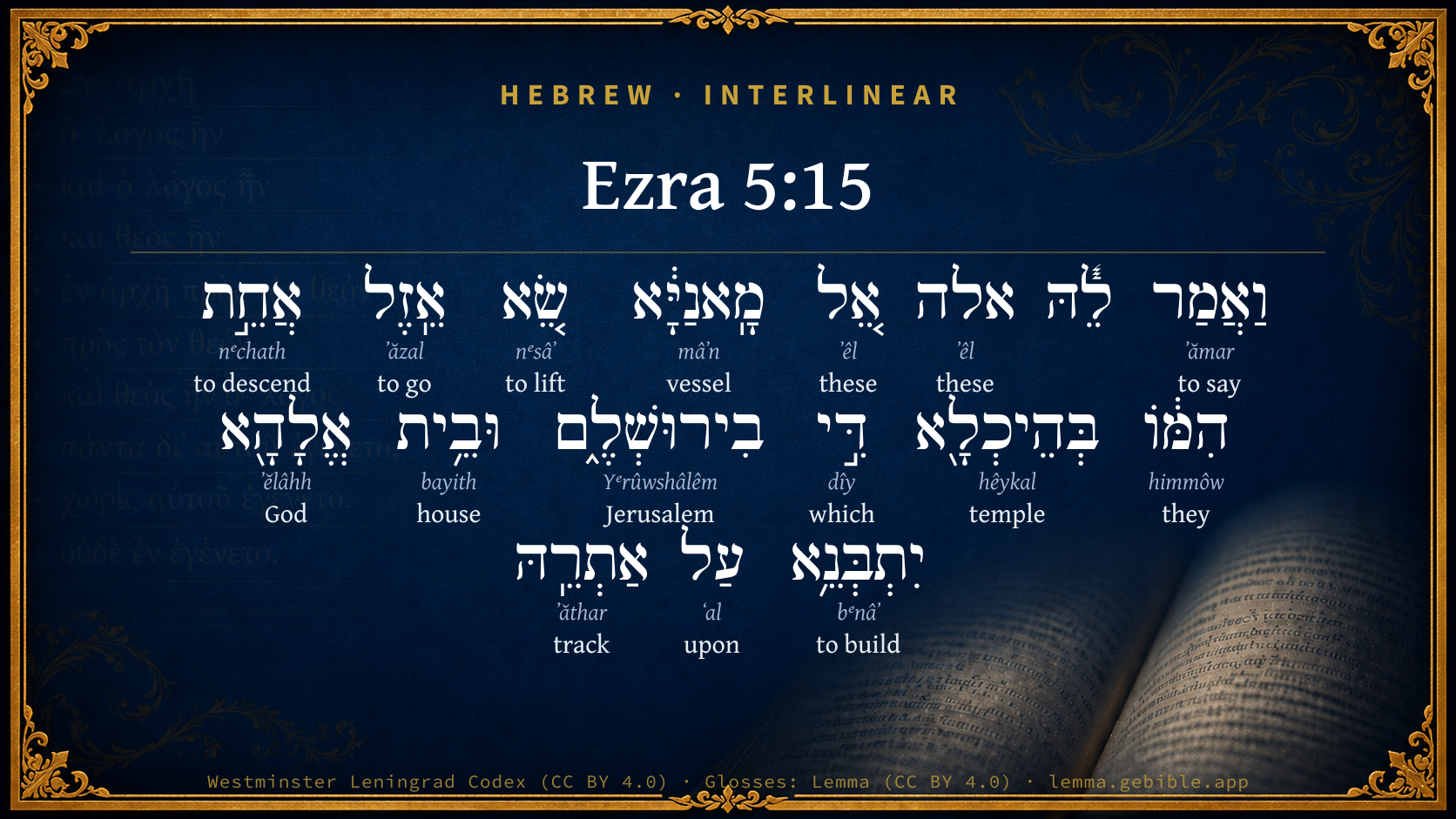
Hebrew (Westminster Leningrad Codex) Ezra 5:15 appears in the Hebrew Old Testament. The text above is from the Westminster Leningrad Codex. Each word links to its Strong’s number, a concise gloss, and parsing drawn from the Open Scriptures Hebrew Bible morphology. Click any word for its full Brown-Driver-Briggs (BDB) entry.
Download image
Cite this verse

Ezra 5:15 (World English Bible). Public Domain. Lemma interlinear Bible study tool, https://lemma.gebible.app/v/ezra/5/15.

Show BibTeX & RIS
BibTeX
RIS
English Translation
and he said to him, Take these vessels, go, put them in the temple that is in Jerusalem, and let the house of God be built in its place.
World English Bible · Public Domain
Highlights
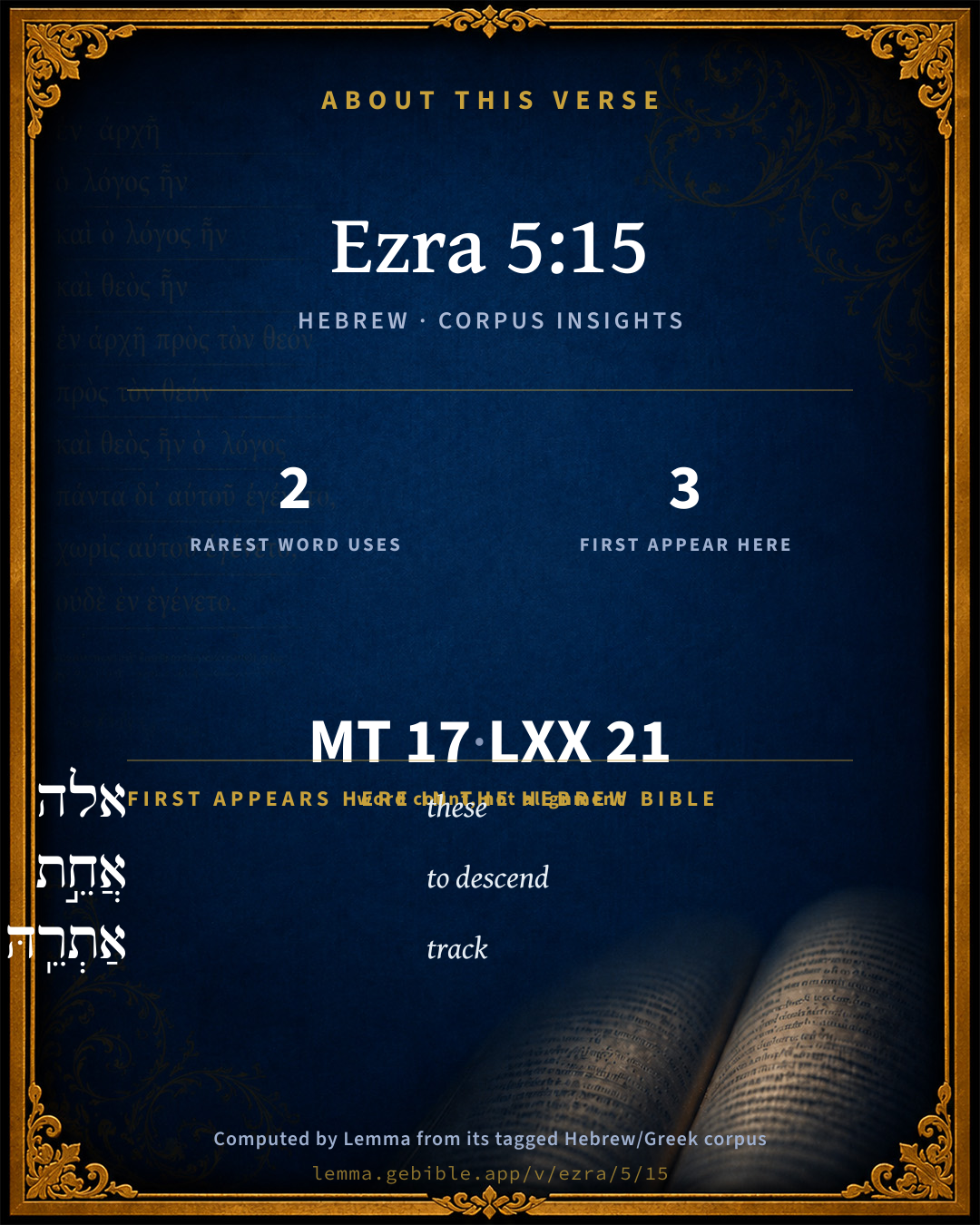
  • 3 first appearances in the Hebrew Bible
Full analysis ↓
Download a study sheet

One document with this verse’s original text, its word-by-word gloss line, the meaning frame, cross-references with their text, attributed commentary, and full source and license credits — printable, and it pastes into notes with its structure intact.

This verse Autodidact and up

Study sheet (.html) Plain text (.txt)

A passage Seminary Student

Up to 50 verses in one chapter. A passage sheet keeps up to 6 commentary sources and 12 cross-references per verse, in the order this page ranks them, and says so on the sheet whenever that leaves anything out. Ask for a single verse and you get the Autodidact verse sheet above.

Everything on this page stays free to read, with no account — the sheet is a download of what is already on screen, not access to it.

Want to remove ads? Support Godless Engineer
Compare translations 3

The same verse in 3 English versions, stacked beneath the original-language interlinear above. Click any original word for its lexicon entry.

Each is an independent rendering of the whole verse — the interlinear is not word-aligned to these translations.

Highlighted words mark where these versions differ — a whole-verse word diff, not a word-by-word alignment.

  • World English Bible Public Domain
    and he said to him, Take these vessels, go, put them in the temple that is in Jerusalem, and let the house of God be built in its place.
  • King James Version Public Domain
    And said unto him, Take these vessels, go, carry them into the temple that is in Jerusalem, and let the house of God be builded in his place.
  • unfoldingWord Literal Text CC BY-SA 4.0
    Then he said to him, “Take away these vessels. Go deposit them in the temple that is in Jerusalem, and let the house of God be built on its place.”

unfoldingWord Literal Text — © unfoldingWord, licensed CC BY-SA 4.0. Word-aligned USFM3 via Door43 (git.door43.org/unfoldingWord/en_ult).

Versions to compare (up to 4)

3 of 4 selected

Show all 18 translations

Every available English version of this verse, each an independent rendering of the whole verse.

  • World English Bible Public Domain
    and he said to him, Take these vessels, go, put them in the temple that is in Jerusalem, and let the house of God be built in its place.
  • Berean Standard Bible Public Domain
    and instructed, ‘Take these articles, put them in the temple in Jerusalem, and let the house of God be rebuilt on its original site.’
  • Majority Standard Bible Public Domain
    and instructed, ‘Take these articles, put them in the temple in Jerusalem, and let the house of God be rebuilt on its original site.’
  • King James Version Public Domain
    And said unto him, Take these vessels, go, carry them into the temple that is in Jerusalem, and let the house of God be builded in his place.
  • American Standard Version (1901) Public Domain
    and he said unto him, Take these vessels, go, put them in the temple that is in Jerusalem, and let the house of God be builded in its place.
  • Revised Version (1885) Public Domain
    and he said unto him, Take these vessels, go, put them in the temple that is in Jerusalem, and let the house of God be builded in its place.
  • Geneva Bible (1599) Public Domain
    And he sayde vnto him, Take these vessels and goe thy way, and put them in the Temple that is in Ierusalem, and let the house of God be buylt in his place.
  • Douay-Rheims (1899) Public Domain
    And said to him: Take these vessels, and go, and put them in the temple that is in Jerusalem, and let the house of God be built in its place.
  • Young's Literal Translation Public Domain
    and said to him, These vessels lift up, go, put them down in the temple that `is' in Jerusalem, and the house of God is builded on its place.
  • Literal Standard Version CC BY-SA 4.0
    and said to him, Lift up these vessels, go, put them down in the temple that [is] in Jerusalem, and the house of God is built on its place.
  • Unlocked Literal Bible CC BY-SA 4.0
    He said to him, “Take these objects. Go and put them in the temple in Jerusalem. Let the house of God be rebuilt there.”
  • unfoldingWord Literal Text CC BY-SA 4.0
    Then he said to him, “Take away these vessels. Go deposit them in the temple that is in Jerusalem, and let the house of God be built on its place.”
  • Darby Bible Public Domain
    And he said to him, Take these vessels, go, carry them into the temple that is at Jerusalem, and let the house of God be built in its place.
  • World Messianic Bible Public Domain
    He said to him, ‘Take these vessels, go, put them in the temple that is in Jerusalem, and let God’s house be built in its place.’
  • Webster's Bible Public Domain
    And said to him, Take these vessels, go, carry them into the temple that is in Jerusalem, and let the house of God be built in its place.
  • Free Bible Version CC BY-SA 4.0
    telling him, Take these items and place them in the Temple in Jerusalem. Rebuild God's Temple on its original site.
  • Bible in Basic English Public Domain
    And he said to him, Go, take these vessels, and put them in the Temple in Jerusalem, and let the house of God be put up again in its place.
  • JPS Tanakh (1917) Public Domain
    and he said unto him: Take these vessels, go, put them in the temple that is in Jerusalem, and let the house of God be builded in its place.

Literal Standard Version (2020), Covenant Press — licensed CC BY-SA 4.0. Text via the HelloAO Bible API (eBible.org). Unlocked Literal Bible (unfoldingWord) — licensed CC BY-SA 4.0. Text via the HelloAO Bible API (eBible.org). unfoldingWord Literal Text — © unfoldingWord, licensed CC BY-SA 4.0. Word-aligned USFM3 via Door43 (git.door43.org/unfoldingWord/en_ult). Free Bible Version, Dr. Jonathan Gallagher — licensed CC BY-SA 4.0. Text via the HelloAO Bible API (eBible.org).

Word by word

More ways to search: Search by grammar → Find every occurrence → Compare this word →

Practice this passage: Drill this verse → Learn its vocabulary →

אלה
ʼêl
H412
“these”
Adjective, P, Construct
Part of Speech
Adjective
State
Construct
Full BDB Definition

Origin: corresponding to H411

TWOT: 02575

these
  1. וַאֲמַר ʼămar H560 “and · to say” Adjective, C + Verb, Qal, Perfect, 3rd Person, Masculine, Singular
  2. אֵ֚ל ʼêl H412 “these” Adjective, N, Common
  3. מָֽאנַיָּ֔א mâʼn H3984 “vessels · the” Adjective, N, Common + Particle, Definite Article
  4. שֵׂ֚א nᵉsâʼ H5376 “lift” Adjective, V
  5. אֵֽזֶל ʼăzal H236 “go” Adjective, V
  6. אֲחֵ֣ת nᵉchath H5182 “descend” Adjective, V
  7. הִמּ֔וֹ himmôw H1994 “they” Adjective, P
  8. בְּהֵיכְלָ֖א hêykal H1965 “in/at · temple · the” Adjective, R + Noun, Common, Masculine, Singular, Determined + Particle, Definite Article
  9. דִּ֣י dîy H1768 “which” Adjective, T
  10. בִירוּשְׁלֶ֑ם Yᵉrûwshâlêm H3390 “in/at · Jerusalem” Adjective, R + Noun, Proper
  11. וּבֵ֥ית bayith H1005 “and · house of” Adjective, C + Noun, Common, Masculine, Singular, Construct
  12. אֱלָהָ֖א ʼĕlâhh H426 “God · the” Adjective, N, Common + Particle, Definite Article
  13. יִתְבְּנֵ֥א bᵉnâʼ H1124 “to build” Adjective, V
  14. עַל ʻal H5922 “upon” Adjective, R
  15. אַתְרֵֽהּ ʼăthar H870 “track · his” Adjective, N, Common + Suffix, Personal, 3rd Person, Masculine, Singular

About this verse

These counts appear in no published source. They are computed here, from the morphology-tagged text and Lemma’s own curated glosses. What Lemma adds →

17
words
15
distinct lemmas
Historical
section

Notable vocabulary

The rarest word here is אלה these H412 — appearing just 2 times in the whole Hebrew Bible.

First appearance in Scripture

These words make their first canonical appearance in the Hebrew Bible here:

  • אלה these H412
  • אֲחֵ֣ת to descend H5182
  • אַתְרֵֽהּ track H870

Grammatical profile

  • 1 verb
  • 2 nouns
  • 11 adjectives
  • 3 particles

Verb forms

  • וַאֲמַר Qal · Perfect

Repetition

A word recurs within this verse — often emphatic in Hebrew:

  • אלה these H412 ×2

Hebrew & Septuagint length

In English translation the verse runs 29 words from the Hebrew and 22 from the Septuagint (LXX English) — closely comparable.

A rough comparison of the two English renderings, which tokenize alike — not a word-level alignment.

Word counts can differ between the Hebrew and the Greek without any difference in meaning — e.g. the Hebrew direct-object marker אֵת has no separate Greek word, and Greek often adds the article ὁ.

In the original languages it is 17 Hebrew tokens and 21 Greek tokens — but the two are counted differently (Hebrew bundles its prefixes and suffixes into one token; the Greek is in lemma form), so that isn’t a like-for-like length.

Cross-references

3

Topical passages linked to Ezra 5:15 in the Treasury of Scripture Knowledge — connected by theme and wording, ordered by reader-vote popularity; previews shown in the World English Bible.

  • Ezra 1:2 Thus says Cyrus king of Persia, All the kingdoms of the earth has Yahweh, the God of heaven, given me; and he has charged me to build him a house in Jerusalem, which is in Judah.
  • Ezra 3:3 They set the altar on its base; for fear was on them because of the peoples of the countries: and they offered burnt offerings thereon to Yahweh, even burnt offerings morning and evening.
  • Ezra 6:3 In the first year of Cyrus the king, Cyrus the king made a decree: Concerning the house of God at Jerusalem, let the house be built, the place where they offer sacrifices, and let the foundations of it be strongly laid; the height of it sixty cubits, and the breadth of it sixty cubits;

Cross-references courtesy of OpenBible.info (CC BY 4.0).

Hebrew and Greek witnesses Masoretic Hebrew ↔ Greek Septuagint

The same verse in the two great witnesses to the Old Testament, shown verse-for-verse.

These are two independent witnesses, not word-aligned to each other, and the Septuagint is shown in lemma (dictionary) form.

Hebrew Ezra 5:15 Masoretic · Westminster Leningrad Codex

וַאֲמַר לֵ֓הּ אלה אֵ֚ל מָֽאנַיָּ֔א שֵׂ֚א אֵֽזֶל אֲחֵ֣ת הִמּ֔וֹ בְּהֵיכְלָ֖א דִּ֣י בִירוּשְׁלֶ֑ם וּבֵ֥ית אֱלָהָ֖א יִתְבְּנֵ֥א עַל אַתְרֵֽהּ

and he said to him, Take these vessels, go, put them in the temple that is in Jerusalem, and let the house of God be built in its place.

World English Bible · Public Domain

Greek LXX Ezra 5:15 Septuagint · lemma form

καί εἶπον αὐτός πᾶς ὁ σκεῦος λαμβάνω καί πορεύομαι τίθημι αὐτός ἐν ὁ οἶκος ὁ ἐν ἰερουσαλήμ εἰς ὁ ἑαυτοῦ τόπος

and said to him, Take all the vessels, and go, put them in the house that is in Jerusalem in their place.

LXX2012 (modern English Septuagint) · Public Domain

In the Septuagint this is one book — Esdras B (2 Esdras): Ezra is chapters 1–10, Nehemiah 11–23.

Hebrew: Westminster Leningrad Codex (CC BY 4.0). Greek: Septuagint (public domain); English from LXX2012 (modern English Septuagint) (Public Domain). How the Septuagint differs from the Hebrew →

Commentary

Notes on Ezra 5:15 from classic Christian and Jewish commentators (each source and its license shown beneath its notes). The classic Christian expositions comment on the surrounding passage and are grouped to its opening verse, so a note may address several verses; the Jewish commentaries on the Tanakh (Rashi and others) are per-verse, so they appear only where the commentator wrote on this verse.

Lemma curates 59 commentaries, every one of them public domain or Creative Commons licensed, each selected and text-cleaned for this edition rather than reprinted as found. About our sources →

Trapp's Complete Commentary

John Trapp

Ezr 5:15 And said unto him, Take these vessels, go, carry them into the temple that [is] in Jerusalem, and let the house of God be builded in his place.

Ver. 15. Take these vessels, go, carry them] Go thyself in person, and see that all things be well carried there. This pleased Zerubbabel well; it confined him to live in that element where he would live; as if one should be confined to paradise.

John Trapp, A Commentary or Exposition upon All the Books of the Old and New Testament (1647–1656) — public domain. Text from a community e-Sword module.

Ellicott's Commentary for English Readers

(15) Take these vessels, go, carry them . . . and let the house of God . . .—The three imperatives in this verse, without a copula, followed by a fourth, vividly express the feeling of the suppliants in the remembrance of the decree: thus we have another note of historical truth.

A Bible Commentary for English Readers, edited by Charles John Ellicott (1878–1897) — public domain. Text from a community e-Sword module.

The Pulpit Commentary

Let the house of God be builded in his place. i.e. upon the old holy site the place where Abraham offered his son Isaac, in a figure, (Heb_11:17-19) where the angel stood and stayed the pestilence in David"s time, (2Sa_24:16-18) and where "the glory of the Lord descended and filled the house" under Solomon. (2Ch_7:1)

The Pulpit Commentary (1880–1919), ed. H.D.M. Spence-Jones & Joseph S. Exell — public domain. Text from a community e-Sword module.

Keil & Delitzsch

C. F. Keil & F. Delitzsch

Take these vessels, go forth, place them in the temple. For אלּה the Keri reads אל, according to Ch1 20:8. אחת is imperat. Aphel of נחת. The three imperatives succeed each other without any copula in this rapid form of expression. The last sentence, "and let the house of God be built in its place," i.e., be rebuilt in its former place, gives the reason for the command to deposit the vessels in the temple at Jerusalem, i.e., in the house of God, which is to be rebuilt in its former place.

Keil & Delitzsch — Biblical Commentary on the Old Testament (1861–1891) — public domain (CC PDM 1.0). Text via the HelloAO Bible API. (Old Testament only.)

Rashi

Rabbi Shlomo Yitzchaki (Rashi)

And he said to him And so did Cyrus say to Sheshbazzar, “Take these vessels and bring them down into the Temple that is in Jerusalem, and the House of the Holy One, blessed be He, shall be built on its place.”

Rashi on the Tanakh — English translations: “The Judaica Press complete Tanach with Rashi, translated by A. J. Rosenberg” (CC BY 4.0); “Pentateuch with Rashi's commentary by M. Rosenbaum and A.M. Silbermann, 1929-1934” (public domain); “The Metsudah Tanach series, Lakewood, N.J” (CC BY 4.0); and “The Book of Joshua, Metsudah Publications, 1997” (CC BY 4.0). Text via Sefaria.

Lesson kit

Teaching starters — assembled from the data on this page, not authored interpretation. Every prompt links to the verse data it draws on. Edit before teaching.

Ezra, in the Historical, opens this verse with 17 words (15 distinct Hebrew lemmas). Its most distinctive word is ʼêl (“these”). A historical commentator’s framing appears above. Read the whole chapter for the surrounding context.

Discussion questions

  1. The word ʼêl carries the sense “these.” How does it shape the verse?
  2. 3 words make their first appearance in Scripture here. What does this debut establish?
  3. How does Ezra 1:2, which shares this passage’s theme, read alongside this verse?
  4. What does the repetition of “these” (2× in this one verse) do in this verse?
  5. These translations render this verse differently; the difference is in the English rendering, not the original. What questions does that raise?
  6. «וַאֲמַר» is a Qal Perfect verb. How does that grammatical form shape the action described?
  7. Compare how Trapp's Complete Commentary and Ellicott's Commentary for English Readers read this verse. Where do they agree or differ?

Things to notice

Reading settings

Reading text

Shown beneath each verse's original-language words.

Old Testament
Old Testament edition

Read the OT as the Masoretic Hebrew (MT) or the Greek Septuagint (LXX).

English shown for the Greek Septuagint (in the Hebrew ↔ Greek comparison).

Comparing translations? Open the Compare panel on any verse page to stack up to four side by side.