Ezra 6:16

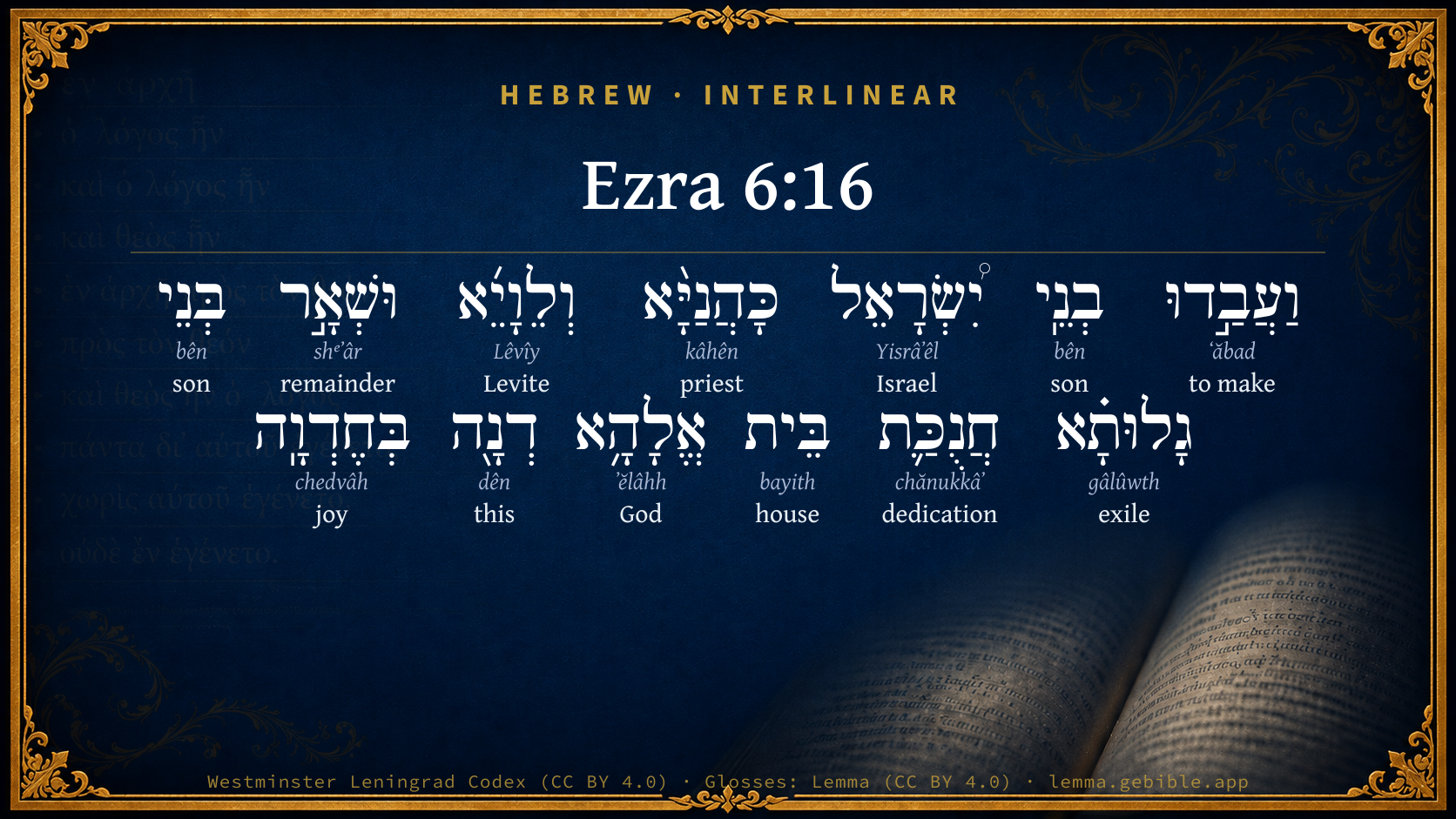
Hebrew (Westminster Leningrad Codex) Ezra 6:16 appears in the Hebrew Old Testament. The text above is from the Westminster Leningrad Codex. Each word links to its Strong’s number, a concise gloss, and parsing drawn from the Open Scriptures Hebrew Bible morphology. Click any word for its full Brown-Driver-Briggs (BDB) entry.
Download image
Cite this verse

Ezra 6:16 (World English Bible). Public Domain. Lemma interlinear Bible study tool, https://lemma.gebible.app/v/ezra/6/16.

Show BibTeX & RIS
BibTeX
RIS
English Translation
The children of Israel, the priests, and the Levites, and the rest of the children of the captivity, kept the dedication of this house of God with joy.
World English Bible · Public Domain
Highlights
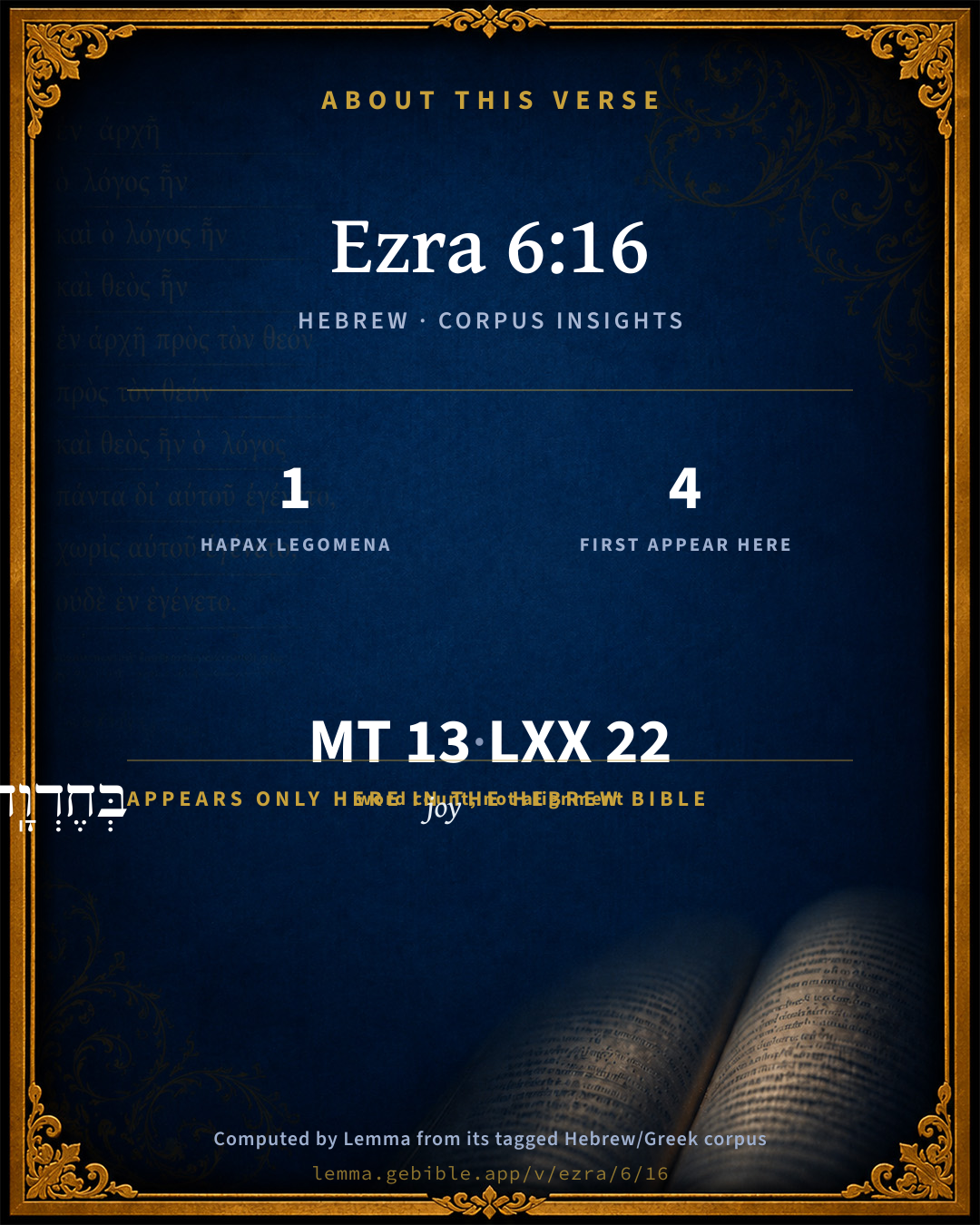
  • 1 hapax legomenon — only here in the Hebrew Bible
  • 4 first appearances in the Hebrew Bible
Full analysis ↓
Download a study sheet

One document with this verse’s original text, its word-by-word gloss line, the meaning frame, cross-references with their text, attributed commentary, and full source and license credits — printable, and it pastes into notes with its structure intact.

This verse Autodidact and up

Study sheet (.html) Plain text (.txt)

A passage Seminary Student

Up to 50 verses in one chapter. A passage sheet keeps up to 6 commentary sources and 12 cross-references per verse, in the order this page ranks them, and says so on the sheet whenever that leaves anything out. Ask for a single verse and you get the Autodidact verse sheet above.

Everything on this page stays free to read, with no account — the sheet is a download of what is already on screen, not access to it.

Want to remove ads? Support Godless Engineer
Compare translations 3

The same verse in 3 English versions, stacked beneath the original-language interlinear above. Click any original word for its lexicon entry.

Each is an independent rendering of the whole verse — the interlinear is not word-aligned to these translations.

Highlighted words mark where these versions differ — a whole-verse word diff, not a word-by-word alignment.

  • World English Bible Public Domain
    The children of Israel, the priests, and the Levites, and the rest of the children of the captivity, kept the dedication of this house of God with joy.
  • King James Version Public Domain
    And the children of Israel, the priests, and the Levites, and the rest of the children of the captivity, kept the dedication of this house of God with joy.
  • unfoldingWord Literal Text CC BY-SA 4.0
    And the sons of Israel, the priests, and the Levites, and the rest of the sons of the exile performed the dedication of this house of God with joy.

unfoldingWord Literal Text — © unfoldingWord, licensed CC BY-SA 4.0. Word-aligned USFM3 via Door43 (git.door43.org/unfoldingWord/en_ult).

Versions to compare (up to 4)

3 of 4 selected

Show all 18 translations

Every available English version of this verse, each an independent rendering of the whole verse.

  • World English Bible Public Domain
    The children of Israel, the priests, and the Levites, and the rest of the children of the captivity, kept the dedication of this house of God with joy.
  • Berean Standard Bible Public Domain
    Then the people of Israel—the priests, the Levites, and the rest of the exiles—celebrated the dedication of the house of God with joy.
  • Majority Standard Bible Public Domain
    Then the people of Israel—the priests, the Levites, and the rest of the exiles—celebrated the dedication of the house of God with joy.
  • King James Version Public Domain
    And the children of Israel, the priests, and the Levites, and the rest of the children of the captivity, kept the dedication of this house of God with joy.
  • American Standard Version (1901) Public Domain
    And the children of Israel, the priests, and the Levites, and the rest of the children of the captivity, kept the dedication of this house of God with joy.
  • Revised Version (1885) Public Domain
    And the children of Israel, the priests and the Levites, and the rest of the children of the captivity, kept the dedication of this house of God with joy.
  • Geneva Bible (1599) Public Domain
    And the children of Israel, the Priestes, and the Leuites, and the residue of the children of the captiuitie kept the dedication of this house of God with ioy,
  • Douay-Rheims (1899) Public Domain
    And the children of Israel, the priests and the Levites, and the rest of the children of the captivity kept the dedication of the house of God with joy.
  • Young's Literal Translation Public Domain
    And the sons of Israel have made, `and' the priests, and the Levites, and the rest of the sons of the captivity, a dedication of this house of God with joy,
  • Literal Standard Version CC BY-SA 4.0
    And the sons of Israel have made, [and] the priests, and the Levites, and the rest of the sons of the captivity, a dedication of this house of God with joy,
  • Unlocked Literal Bible CC BY-SA 4.0
    The Israelite people, priests, Levites, and the rest of the captives celebrated the dedication of this house of God with joy.
  • unfoldingWord Literal Text CC BY-SA 4.0
    And the sons of Israel, the priests, and the Levites, and the rest of the sons of the exile performed the dedication of this house of God with joy.
  • Darby Bible Public Domain
    And the children of Israel, the priests and the Levites, and the rest of the children of the captivity, kept the dedication of this house of God with joy;
  • World Messianic Bible Public Domain
    The children of Israel, the priests, the Levites, and the rest of the children of the captivity, kept the dedication of this house of God with joy.
  • Webster's Bible Public Domain
    And the children of Israel, the priests, and the Levites, and the rest of the children of the captivity, kept the dedication of this house of God with joy,
  • Free Bible Version CC BY-SA 4.0
    Then the people of Israel, the priests, the Levites, and the rest of those who had returned from exile, all joyfully celebrated the dedication of God's Temple.
  • Bible in Basic English Public Domain
    And the children of Israel, the priests and the Levites, and the rest of those who had come back, kept the feast of the opening of this house of God with joy.
  • JPS Tanakh (1917) Public Domain
    And the children of Israel, the priests and the Levites, and the rest of the children of the captivity, kept the dedication of this house of God with joy.

Literal Standard Version (2020), Covenant Press — licensed CC BY-SA 4.0. Text via the HelloAO Bible API (eBible.org). Unlocked Literal Bible (unfoldingWord) — licensed CC BY-SA 4.0. Text via the HelloAO Bible API (eBible.org). unfoldingWord Literal Text — © unfoldingWord, licensed CC BY-SA 4.0. Word-aligned USFM3 via Door43 (git.door43.org/unfoldingWord/en_ult). Free Bible Version, Dr. Jonathan Gallagher — licensed CC BY-SA 4.0. Text via the HelloAO Bible API (eBible.org).

Word by word

More ways to search: Search by grammar → Find every occurrence → Compare this word →

Practice this passage: Drill this verse → Learn its vocabulary →

בְּחֶדְוָֽה
chedvâh
H2305
“in/at · joy”
Adjective, R + Noun, Common, Feminine, Singular, Absolute
Part of Speech
Adjective + Noun
Type
Common
Gender
Feminine
Number
Singular
State
Absolute
Full BDB Definition

Origin: corresponding to H2304

TWOT: 2719

joy
  1. וַעֲבַ֣דוּ ʻăbad H5648 “and · to make” Adjective, C + Verb, Qal, Perfect, 3rd Person, Masculine, Plural
  2. בְנֵֽי bên H1123 “sons of” Adjective, N, Common
  3. יִ֠שְׂרָאֵל Yisrâʼêl H3479 “Israel” Adjective, N
  4. כָּהֲנַיָּ֨א kâhên H3549 “priests · the” Adjective, N, Common + Particle, Definite Article
  5. וְלֵוָיֵ֜א Lêvîy H3879 “and · Levites · the” Adjective, C + Noun, Gentilic, Masculine, Plural, Determined + Particle, Definite Article
  6. וּשְׁאָ֣ר shᵉʼâr H7606 “and · remainder of” Adjective, C + Noun, Common, Masculine, Singular, Construct
  7. בְּנֵי bên H1123 “sons of” Adjective, N, Common
  8. גָלוּתָ֗א gâlûwth H1547 “exile · the” Adjective, N, Common + Particle, Definite Article
  9. חֲנֻכַּ֛ת chănukkâʼ H2597 “dedication of” Adjective, N, Common
  10. בֵּית bayith H1005 “house of” Adjective, N, Common
  11. אֱלָהָ֥א ʼĕlâhh H426 “God · the” Adjective, N, Common + Particle, Definite Article
  12. דְנָ֖ה dên H1836 “this” Adjective, P

About this verse

These counts appear in no published source. They are computed here, from the morphology-tagged text and Lemma’s own curated glosses. What Lemma adds →

13
words
12
distinct lemmas
Historical
section

Notable vocabulary

1 hapax legomenon — a word that appears only here in the entire Hebrew Bible:

  • בְּחֶדְוָֽה joy H2305

First appearance in Scripture

These words make their first canonical appearance in the Hebrew Bible here:

  • וְלֵוָיֵ֜א Levite H3879
  • גָלוּתָ֗א exile H1547
  • חֲנֻכַּ֛ת dedication H2597
  • בְּחֶדְוָֽה joy H2305

Shared distinctive vocabulary

וְלֵוָיֵ֜א Levite H3879 occurs in 4 verses of the Hebrew Bible. Also found in:

Grammatical profile

  • 1 verb
  • 2 nouns
  • 6 adjectives
  • 4 particles

Verb forms

  • וַעֲבַ֣דוּ Qal · Perfect

Repetition

A word recurs within this verse — often emphatic in Hebrew:

  • בְנֵֽי son H1123 ×2

Hebrew & Septuagint length

In English translation the verse runs 28 words from the Hebrew and 29 from the Septuagint (LXX English) — closely comparable.

A rough comparison of the two English renderings, which tokenize alike — not a word-level alignment.

Word counts can differ between the Hebrew and the Greek without any difference in meaning — e.g. the Hebrew direct-object marker אֵת has no separate Greek word, and Greek often adds the article ὁ.

In the original languages it is 13 Hebrew tokens and 22 Greek tokens — but the two are counted differently (Hebrew bundles its prefixes and suffixes into one token; the Greek is in lemma form), so that isn’t a like-for-like length.

Cross-references

17

Topical passages linked to Ezra 6:16 in the Treasury of Scripture Knowledge — connected by theme and wording, ordered by reader-vote popularity; previews shown in the World English Bible.

  • 2 Chronicles 7:5 King Solomon offered a sacrifice of twenty-two thousand oxen, and a hundred and twenty thousand sheep. So the king and all the people dedicated the house of God.
  • 1 Kings 8:63 Solomon offered for the sacrifice of peace-offerings, which he offered to Yahweh, two and twenty thousand oxen, and one hundred twenty thousand sheep. So the king and all the children of Israel dedicated the house of Yahweh.
  • Philippians 4:4 Rejoice in the Lord always! Again I will say, Rejoice!
  • Ezra 6:22 and kept the feast of unleavened bread seven days with joy: for Yahweh had made them joyful, and had turned the heart of the king of Assyria to them, to strengthen their hands in the work of the house of God, the God of Israel.
  • Psalms 122:1 I was glad when they said to me, "Let's go to Yahweh's house!"
  • John 10:22 It was the Feast of the Dedication at Jerusalem.
  • Deuteronomy 12:7 and there you shall eat before Yahweh your God, and you shall rejoice in all that you put your hand to, you and your households, in which Yahweh your God has blessed you.
  • 1 Chronicles 9:2 Now the first inhabitants who lived in their possessions in their cities were Israel, the priests, the Levites, and the Nethinim.
  • 1 Chronicles 15:28 Thus all Israel brought up the ark of the covenant of Yahweh with shouting, and with sound of the cornet, and with trumpets, and with cymbals, sounding aloud with psalteries and harps.
  • 2 Chronicles 7:9–10 On the eighth day they held a solemn assembly: for they kept the dedication of the altar seven days, and the feast seven days.
  • 2 Chronicles 30:23 The whole assembly took counsel to keep other seven days; and they kept [other] seven days with gladness.
  • 2 Chronicles 30:26 So there was great joy in Jerusalem; for since the time of Solomon the son of David king of Israel there was not the like in Jerusalem.
  • Ezra 3:11–12 They sang one to another in praising and giving thanks to Yahweh, [saying], For he is good, for his loving kindness endures forever toward Israel. All the people shouted with a great shout, when they praised Yahweh, because the foundation of the house of Yahweh was laid.
  • Ezra 4:1 Now when the adversaries of Judah and Benjamin heard that the children of the captivity were building a temple to Yahweh, the God of Israel;
  • Nehemiah 7:73 So the priests, and the Levites, and the porters, and the singers, and some of the people, and the Nethinim, and all Israel, lived in their cities. When the seventh month was come, the children of Israel were in their cities.
  • Nehemiah 8:10 Then he said to them, Go your way, eat the fat, and drink the sweet, and send portions to him for whom nothing is prepared; for this day is holy to our Lord: neither be you grieved; for the joy of Yahweh is your strength.
  • Nehemiah 12:43 They offered great sacrifices that day, and rejoiced; for God had made them rejoice with great joy; and the women also and the children rejoiced: so that the joy of Jerusalem was heard even afar off.

Cross-references courtesy of OpenBible.info (CC BY 4.0).

Hebrew and Greek witnesses Masoretic Hebrew ↔ Greek Septuagint

The same verse in the two great witnesses to the Old Testament, shown verse-for-verse.

These are two independent witnesses, not word-aligned to each other, and the Septuagint is shown in lemma (dictionary) form.

Hebrew Ezra 6:16 Masoretic · Westminster Leningrad Codex

וַעֲבַ֣דוּ בְנֵֽי יִ֠שְׂרָאֵל כָּהֲנַיָּ֨א וְלֵוָיֵ֜א וּשְׁאָ֣ר בְּנֵי גָלוּתָ֗א חֲנֻכַּ֛ת בֵּית אֱלָהָ֥א דְנָ֖ה בְּחֶדְוָֽה

The children of Israel, the priests, and the Levites, and the rest of the children of the captivity, kept the dedication of this house of God with joy.

World English Bible · Public Domain

Greek LXX Ezra 6:16 Septuagint · lemma form

καί ποιέω ὁ υἱός ἰσραήλ ὁ ἱερεύς καί ὁ λευείτης καί ὁ κατάλοιπος υἱός ἀποικεσία ἐγκαίνια ὁ οἶκος ὁ θεός ἐν εὐφροσύνη

And the children of Israel, the priests, and the Levites, and the rest of the children of the captivity, kept the dedication of the house of God with gladness.

LXX2012 (modern English Septuagint) · Public Domain

In the Septuagint this is one book — Esdras B (2 Esdras): Ezra is chapters 1–10, Nehemiah 11–23.

On this verse, The Cambridge Bible for Schools and Colleges discusses the Septuagint’s reading. Read the note in Commentary ↓

Hebrew: Westminster Leningrad Codex (CC BY 4.0). Greek: Septuagint (public domain); English from LXX2012 (modern English Septuagint) (Public Domain). How the Septuagint differs from the Hebrew →

Commentary

Notes on Ezra 6:16 from classic Christian and Jewish commentators (each source and its license shown beneath its notes). The classic Christian expositions comment on the surrounding passage and are grouped to its opening verse, so a note may address several verses; the Jewish commentaries on the Tanakh (Rashi and others) are per-verse, so they appear only where the commentator wrote on this verse.

Lemma curates 59 commentaries, every one of them public domain or Creative Commons licensed, each selected and text-cleaned for this edition rather than reprinted as found. About our sources →

Jamieson, Fausset & Brown

Robert Jamieson, A. R. Fausset & David Brown

FEASTS OF THE DEDICATION. (Ezr 6:16-18)

the children of Israel . . . kept the dedication . . . with joy--The ceremonial was gone through with demonstrations of the liveliest joy. The aged who had wept at the laying of the foundation [Ezr 3:12] were most, if not all of them, now dead; and all rejoiced at the completion of this national undertaking.

Jamieson, Fausset & Brown — Commentary Critical and Explanatory on the Whole Bible (1871) — public domain (CC PDM 1.0). Text via the HelloAO Bible API.

Trapp's Complete Commentary

John Trapp

Ezr 6:16 And the children of Israel, the priests, and the Levites, and the rest of the children of the captivity, kept the dedication of this house of God with joy,

Ver. 16. Kept the dedication … with joy] So they did at the dedication of the first temple, 2Ch 7:10. God had required all his worships to be celebrated with joy, Deu 12:7, and made it a condition of an acceptable service, Deu 26:14. Sacrifices offered with mourning were abomination, Hos 9:4, yea, accursed by God, Deu 28:47. What a general joy was there at Samaria when Christ first was preached and believed on among them, Act 8:8, when they first became God’s building, 1Co 3:9, a temple for God to dwell in and walk in, 2Co 6:16! The like was at Bern, at Geneva, at Zurich, when the reformed religion was first received among them. They caused (for joy thereof) the day and year to be engraven in a pillar in letters of gold, for a perpetual memory to all posterity. Like as at Heidelberg, A.D. 1617, on the first of November, they kept, for three days time, an evangelical Jubilee, for joy of the Reformation begun by Luther, a hundred years before (Vita Parei, operib, praefix.).

John Trapp, A Commentary or Exposition upon All the Books of the Old and New Testament (1647–1656) — public domain. Text from a community e-Sword module.

Joseph Benson's Commentary

Ezr 6:16. The children of Israel — Probably some out of each of the twelve tribes; the priests and Levites, &c., kept the dedication of the house of God with joy — When it was built, being designed only for sacred uses, “they now showed by an example how it should be used,” which, says Bishop Patrick, is the proper and simple sense of dedicating. They entered upon it with solemnity, and probably with a public declaration of the separating it from common uses, and the surrendering it to the honour of God, to be employed in his service.

Joseph Benson's Commentary on the Old and New Testaments (1811–1818) — public domain. Text from a community e-Sword module.

The Pulpit Commentary

DEDICATION OF THE SECOND TEMPLE. (Ezr_6:16-18) Following the example of Solomon, who had solemnly "dedicated" the first temple, (1Ki_8:63) and had offered on the occasion a sacrifice unexampled for its magnitude in the whole of Jewish history (ibid. ), Zerubbabel now, under the advice of two prophets, inaugurated the new building with a similar ceremony. In "the day of small things" it was not possible for him to emulate Solomon"s magnificence in respect of the number of victims. Solomon had sacrificed 22, 000 oxen and 120, 000 sheep. Zerubbabel"s means only enabled him to make an offering of 712 animals, more than half of them lambs. He did, however, according to his ability; and God, who accepts all our endeavours according to that we have, and not according to that we have not, was content to receive graciously the humble offering made to him, and to bless the building thus inaugurated with a glory unknown to the first temple. The Lord himself, the Messenger of the covenant, so long sought by his people, suddenly came to this temple. (Mal_3:1) came to it, and frequented it, and taught in it, and gave it a dignity and a majesty far beyond the first temple, which possessed indeed the Shechinah, but was once, and once only, vouchsafed a brief manifestation of the actual Divine presence. (2Ch_7:1)

The children of Israel. Again the writer is careful to present the returned exiles to us as "Israel," and not merely "Judah" (comp. 2:70; 3:1, 10, 11; 4:3; 5:1). This is especially fitting when he is about to explain why the number of the he-goats offered was twelve (see the next verse). Kept the dedication of this house of God. The primary dedication seems to be glanced at in the words, "the dedication of this house," an expression repeated in the next verse. It is one of the great objects of Ezra to link the present with the past, the new temple with the old, the restored religion with that of former times.

HOMILIES BY J.A. MACDONALD

Vers. 16-18.

The dedication of the temple. As the temple was a type of the Church of God, and the stones of which it was composed represented individual believers, so the completing of the building foreshadowed that grand consummation in which the number of the elect shall be complete. The consequent dedication of the finished edifice will therefore represent the future devotion to the service of God of his glorified Church. By anticipation it also describes the service which believers should now render to God, since each part should be a true sample of the whole. In this view how fittingly was the dedication of the temple an occasion of joy (ver. 16)!

I THE REJOICING WAS OVER THE FINISHED WORK.

1. It was the end of all their toil.

(1) The end, in being the consummation towards which they wrought. So will the heavenly state be to all true workers in the Church of God.

(2) Also the end, in the sense of bringing their toil to its period. The labour of twenty long years was now closed. No more straining of muscles in felling of cedars in Lebanon. No more sweat of the face in lifting great stones. No more endurance of cruel mockings and violent persecutions, So when we gain our reward "there will be no more curse". (Rev_21:3-5)

2. It was the triumph of their faith and hope.

(1) The word of God sustained them against opposition from the rulers and from the rabble. It nerved them under the discouragements of threats and violence. So amidst vicissitudes for twenty years they plodded on. Now they reap the reward of their constancy.

(2) So has the Church of God been carried up stone by stone amidst opposition from princes and people. Amidst poverty and perplexity. With interruptions and threatenings. But it is destined to witness a magnificent sequel. (see Rev_21:1, Rev_21:2, Rev_21:9, etc.)

(3) The history of the Church has its epitome in the experience of its members. Their constant faith will reap its reward too in the heights of the heavenly Zion.

II THEY REJOICED OVER IMMENSE SACRIFICES.

1. There were peace offerings for the dedication.

(1) The number of the victims was 100 bullocks and 600 smaller animals, viz., 200 rams and 400 lambs. At the dedication of Solomon"s temple the sacrifices were 22, 000 oxen and 120, 000 sheep. (see 1Ki_8:63) Yet this immolation does not compare unfavourably. Here were only 50, 000 Jews as against say 10, 000, 000 Israelites in the days of Solomon, or 1 to 200. Multiply these victims by 200, and they scarcely differ in number from those offered at the earlier dedication. (see also Ezr_8:35) Consider also the difference in their circumstances. (see 2Co_8:2, 2Co_8:3) Well might they rejoice in their religious zeal.

(2) Corresponding to this enormous slaughter, there will be in connection with the dedication to God of his glorified Church a fearful sacrifice of his enemies. These judgments began upon the antichristian Jews. (see Jer_19:6, Jer_19:7) They will culminate in the destruction of the Antichrist of Gentiledom. (see Isa_34:1-7; Eze_39:17-20) If mercy rejoices, it rejoices upon judgment (not "against" it); as the ark of mercy rode upon the flood of judgment. (see Rev_22:15)

2. There were sin offerings for all Israel.

(1) "Twelve he-goats according to the number of the tribes." The number of the victims sacrificed for the tribes at the dedication of Solomon"s temple is not mentioned. (2Ch_7:4)

(2) Why for "all Israel," when so large a part of the ten tribes remained in their dispersion? Perhaps an expression of faith in those promises which speak of a full restoration of "all the house of Israel wholly". (see Eze_11:14-20) This restoration was but an instalment of the ultimate restoration even of Judah.

(3) Atonement necessary to the acceptableness of services. The "children of the captivity" had a lively remembrance of the miseries they had suffered through sin. The redeemed in heaven will sing of Calvary. (Rev_5:8-13)

III THEY REJOICED OVER THE ORDERING OF THE SERVICE OF GOD.

1. The priests were distributed into their divisions.

(1) These "divisions" are also called courses. (2Ch_8:14) They were twenty-four in number, and so ordered by David. (1Ch_24:1-5) They served in turn, under the direction of the high priest, and on entering this service were ceremonially sanctified. (2Ch_5:11) Example in the case of Zacharias. (see Luk_1:5, Luk_1:8)

(2) There will be supreme order in the service of God in heaven.

2. The Levites also were distributed into courses.

(1) David, the type of his infinitely more illustrious Son, gave this ordinance likewise. (1Ch_23:3-6)

(2) Their services were

(a) those connected with sacrifice. (2Ch_31:2)

(b) Supervising matters pertaining to the temple.

(c) Keeping the doors of the house of the Lord.

(d) Leading the praise in the worship of God.

3. Believers in Christ are the priests and Levites of the spiritual sanctuary.

(1) They offer continual sacrifices of prayer, of praise, of service.

(2) Everything which concerns the house of God concerns them. The service they render is therefore joyful service. We should welcome holy ordinances with joy (Psa_100:2) J.A.M.

HOMILIES BY W. CLARKSON Vers. 16-22.

Timely and wise enthusiasm.

It was natural and right that, when the temple was finished, the Israelites, who had spent on their work so much anxiety and toil, and who looked on the sacred building as the one great possession and glory of the land, should find their hearts elated with a strong and glowing enthusiasm. It was timely, and, moreover, it was wise; let us see its characteristics.

I JOYOUS. "And the children of Israel kept the dedication with joy" (ver. 16). It was "the Lord had made them joyful" (ver. 22). Their souls were all alight and aglow with that best kind of happiness, the joy of gratitude. There is nothing so miserable as unthankfulness; nothing so happy as gratitude. They were mindful of his mercies who had brought them out of bondage, away from the "strange land" where they could not "sing the songs of Zion", (Ps 137) to their own home, the land of their fathers. They remembered him who had "turned the heart of the king of Assyria unto them," and made him even lend them his aid; they blessed the Divine hand which had arrested and diverted the blow of their enemies. "Not unto us," they said, "but to thy name," etc., (Ps 116) and their souls thrilled with enthusiastic joy as they took possession of the new house they had built (ver. 16), and again as they kept the feast of unleavened bread (ver. 22). Happy they who "drink of the river of his pleasures," whom God makes joyful, whose gladness of heart is not the mere excitement of the flesh, but the pure and healthy satisfaction of the spirit.

II SACRED (vers. 17, 20, 21). Proceeding from a pure and sacred source, it flowed in a sacred channel, and took a devout and holy form; for

(a) they purified themselves, "separated themselves from the filthiness of the heathen" (ver. 21); they made themselves clean of heart and hand, preparatory to worship, and "all of them were pure" (ver. 20). And

(b) they brought sacrifices in abundance to the altar of the Lord (ver. 17). Not the "thousands" of Solomon"s time of wealth, but the "hundreds" of their own time of poverty; gladly, spontaneously, liberally they presented their offerings unto God.

Here are two of the requisites of acceptable service.

(a) Purity. If we regard iniquity in our heart the Lord will not hear us. (Psa_66:18) We must be clean who bear the vessels of the Lord. (Isa_52:11) Only the pure in heart can hope to see God, either here by faith, or hereafter by sight. (Mat_5:8)

(b) Spontaneity. The willing, cheerful surrender both of ourselves (our will, our affections, our intelligence) and of our possessions (our time, our strength, our money) unto our Lord. "In the strength of grace, with a glad heart and free," we must dedicate ourselves unto him.

III HUMBLE-HEARTED. They "offered for sin offering," etc. (ver. 17). Twelve he-goats were offered as a sin offering (ver. 17). It was not forgotten that, beside God"s mercies to be celebrated, there were their own sins to be atoned. In the midst of our overflowing joy, joy before God and in him, it is well to remember that there are "sins of our holy things," and many shortcomings in our service, beside trespasses in our daily life, which Should lead to the prayer, "Let thy mercy, O Lord, lighten upon us," blending, not inharmoniously, with the voice of our supplication, and the song of our thanksgiving.

IV SOCIAL. "And the children of Israel did eat, and kept the feast," etc. (vers. 21, 22). All the children of Israel, from the highest to the lowest, from the governor to the humblest menial of the state, from the high priest to the lowliest Levite, all sat down together to eat, to keep the feast. Their holy joy was multiplied and was beautified in the sight of God by being shared, and by being made as social as their circumstances and customs would allow. So should ours be; and though we have no longer Christian institutions answering to the early agapae," we should seek for and discover some ways by which our "common joy in the common salvation" should be expressed together, in social as well as sacred service.

V SYSTEMATIC. "They set the priests in their divisions, and the Levites in their courses" (ver. 18). They kept the passover according to law (ver. 19), and instead of letting enthusiasm simply blaze up and die down, they made provision for future devotion (ver. 18). Here is enthusiasm in its wisdom; in the hour of its strength providing for the hour when its excitements will be over, when reliance must rest on calm conviction, and when piety must be maintained by devout habits and wise methods of worship and of work. C.

HOMILIES BY J.S. EXELL Vers. 16-22.

Church dedication.

I THAT WE SHOULD DEDICATE A NEW CHURCH TO GOD IN A SPIRIT OF SOLEMN REJOICING. "With joy" (ver. 16).

1. The work itself a joy. As a material structure, embodying the skill and handiwork of man, it is a joy.

2. The purpose of the work a joy. It is built for the glory of God and for the good of man.

3. The spirit of the work a joy.

4. The completion of the work a joy.

5. The prospect of the work a joy.

6. The interest of the work a joy. Heaven rejoices m the finished sanctuary, in which its holy worship shall be conducted, and its redemptive purposes be promoted. Religious worship is a joyful thing; let us enter the house of God with thanksgiving.

II THAT WE SHOULD DEDICATE A NEW CHURCH TO GOD IN A SPIRIT OF DEEP SELF-ABASEMENT. "For a sin offering" (ver. 17).

1. We must not be proud of our mechanical skill. Israel might be tempted to think that as a band of captives they had displayed great skill in building the house; they rather felt that God had built it.

2. When we have completed any great work for God we must not think that we have done anything worthy of praise; we must not commend our energy, devotion, or self-sacrifice; but we must remember our delay, our weakness, and how we needed the ministers of God to stir us to duty.

3. We must humble our souls before God in deep confession of sin.

4. We must come offering by faith the only sacrifice that can avail to make us and our imperfect work acceptable to God. The best house we can build for God is unworthy his acceptance; he can only accept it through the sacrifice of Christ.

5. We must come united in the sacred fellowship of the Church. Israel united in the feast.

III THAT WE SHOULD DEDICATE A NEW CHURCH TO GOD BY INAUGURATING USEFUL MORAL AGENCIES. "They set the priests in their divisions" (ver. 18). The house will be comparatively worthless unless it becomes the scene of busy Christian toil and enterprise; it is to be a house of moral industry. The agencies are

1. Authoritative.

2. Varied. Priests and Levites; all kinds of workers.

3. Orderly their course.

4. Useful the service.

5. Continuous.

One course will relieve another. It is impossible to indicate the manifold agencies which ought to be set in operation by a new church, or to estimate the mighty impulse which should be given to the work of Christ on the earth.

IV THAT WE SHOULD DEDICATE A NEW CHURCH TO GOD REGARDING IT AS THE REPOSITORY OF CHRISTIAN TRUTH AND THE SCENE OF RELIGIOUS WORSHIP. "As it is written in the book of Moses" (ver. 18). "And killed the passover" (ver. 20).

1. The repository of the truth. The temple was the repository of the law of Moses; in it the law of Moses was recognised as of supreme authority. In the new church God"s book must rule our thought, speech, and action; a law more complete than the law of Moses; for in these last days God hath spoken unto us by his Son.

2. The scene of worship. The new church is not merely for literary, scientific, philanthropic purposes; but for the passover, for Christian worship. See that it is used for its rightful purpose. E.

The Pulpit Commentary (1880–1919), ed. H.D.M. Spence-Jones & Joseph S. Exell — public domain. Text from a community e-Sword module.

Ellicott's Commentary for English Readers

(16) Children of the captivity.—This designation is peculiarly appropriate here, as in Ezr_6:20. “All Israel” soon follows.

(16-22) The dedication of the second Temple.

A Bible Commentary for English Readers, edited by Charles John Ellicott (1878–1897) — public domain. Text from a community e-Sword module.

The Cambridge Bible for Schools and Colleges

gen. ed. J. J. S. Perowne

16. the children of Israel] Cf. the application of the term ‘Israel’ in Ezr_2:70, Ezr_3:1. In its special religious significance, its use here is appropriate to the sacredness of the event, in which the people were engaged, while it tends to clear the Jewish community from the charge of exclusiveness towards their own brethren. ‘The priests and Levites and the rest of the children of the Captivity’. Under these heads, the Israelites would be grouped at such a festival, cf. Ezr_6:20. Children of the Captivity’. See on Ezr_1:11, Ezr_2:1. Cf. Ezr_6:19.

dedication] Called in the Greek Encænia (ἐγκαίνια, LXX.), and in Hebrew ‘Khanukah’, the same word which gives its name to the Feast of the Dedication, founded to commemorate the purification of the Temple after the pollution of Antiochus Epiphanes (164), cf. Joh_10:22. That festival was kept for eight days (cf. 1Ma_4:60) and began on 25th of Chislev (the 9th month).

with joy] Some have suggested in connexion with this joyous occasion that the Psalms 145-148, called in the LXX. Psalm of Haggai and Zechariah, may have been composed at this period. But proof is wanting.

The Cambridge Bible for Schools and Colleges (gen. ed. J. J. S. Perowne; Cambridge University Press, 1878–1918) — public domain. Text from a community e-Sword module.

John Gill's Exposition

And offered, at the dedication of this house of God, an hundred bullocks, two hundred rams, four hundred lambs,.... Hecatombs of various sorts, which were always reckoned grand sacrifices, even among Heathens, of which Homer sometimes speaks; some of these were for burnt offerings, and others peace offerings, by way of thankfulness to God for the finishing of the temple; part of which belonging to the offerers, they feasted upon it with great gladness of heart:

and for a sin offering for all Israel, twelve he goats, according to the number of the tribes of Israel; for though the ten tribes were carried captive by Shalmaneser, yet, as before observed, there were some of them that remained in the land, and others that went and returned with the two tribes; and therefore a sin offering was made for them all, for the typical expiation of guilt contracted since they had been in an Heathen land, and, temple service had ceased.

John Gill's Exposition of the Whole Bible (1746–1763) — public domain (CC PDM 1.0). Text via the HelloAO Bible API.

Whedon's Commentary on the Bible

Daniel D. Whedon

16. Kept the dedication… with joy — It was surely an occasion for joy and thanksgiving, for it marked the close of a long and bitter period of calamity and dangers, of persecution and trouble. Like the vast assembly that had celebrated the dedication of the former house, nearly five hundred years before, they were “joyful and glad of heart for all the goodness that the Lord had done for Israel.” 1Ki_8:66.

Daniel D. Whedon (gen. ed.), Commentary on the Old and New Testaments (1874–1909) — public domain. Text from a community e-Sword module.

unfoldingWord translationNotes

Door43 World Missions Community

the rest of the captives

These people had been captured and taken to Babylon, but they returned to Jerusalem. AT: "the rest of the people who had been taken captive to Babylon and had returned to Jerusalem" or "the rest of the people who had returned from captivity" (See: Assumed Knowledge and Implicit Information)

one hundred bulls ... four hundred lambs

"100 bulls ... 400 lambs" (See: Numbers)

to work divisions

The abstract noun "work divisions" can be expressed with a verbal phrase. AT: "to work in groups" (See: Abstract Nouns)

work divisions

"groups that work together"

translationWords

Israel

priest

Levi

captive

dedicate

house of God

joy

goat

sin offering

tribe

Moses

unfoldingWord translationNotes — © Distant Shores Media and the Door43 World Missions Community, licensed CC BY-SA 4.0. Source: git.door43.org/Door43/en_tn.

Lesson kit

Teaching starters — assembled from the data on this page, not authored interpretation. Every prompt links to the verse data it draws on. Edit before teaching.

Ezra, in the Historical, opens this verse with 13 words (12 distinct Hebrew lemmas). Its most distinctive word is chedvâh (“joy”). A historical commentator’s framing appears above. Read the whole chapter for the surrounding context.

Discussion questions

  1. How does “joy” (chedvâh) shape what this verse is saying?
  2. 1 word here appears nowhere else in the Hebrew Bible. Why might the author reach for such rare wording?
  3. 4 words make their first appearance in Scripture here. What does this debut establish?
  4. How does Ezra 6:18, which shares the word «Levite», read alongside this verse?
  5. What does the repetition of “son” (2× in this one verse) do in this verse?
  6. The translations on this page render this verse differently — a whole-verse word diff, not a word-by-word alignment. What might account for the different wordings?
  7. «וַעֲבַ֣דוּ» is a Qal Perfect verb. How does that grammatical form shape the action described?
  8. Compare how Jamieson, Fausset & Brown and Trapp's Complete Commentary read this verse. Where do they agree or differ?

Things to notice

  • 1 word in this verse appears nowhere else in the Hebrew Bible.
  • 4 words make their first canonical appearance in Scripture here.
  • This verse counts 13 Hebrew ↔ 22 Greek words.
  • These translations choose different wording for 6 words in this verse.
  • “son” occurs 2× in this single verse.

Reading settings

Reading text

Shown beneath each verse's original-language words.

Old Testament
Old Testament edition

Read the OT as the Masoretic Hebrew (MT) or the Greek Septuagint (LXX).

English shown for the Greek Septuagint (in the Hebrew ↔ Greek comparison).

Comparing translations? Open the Compare panel on any verse page to stack up to four side by side.