
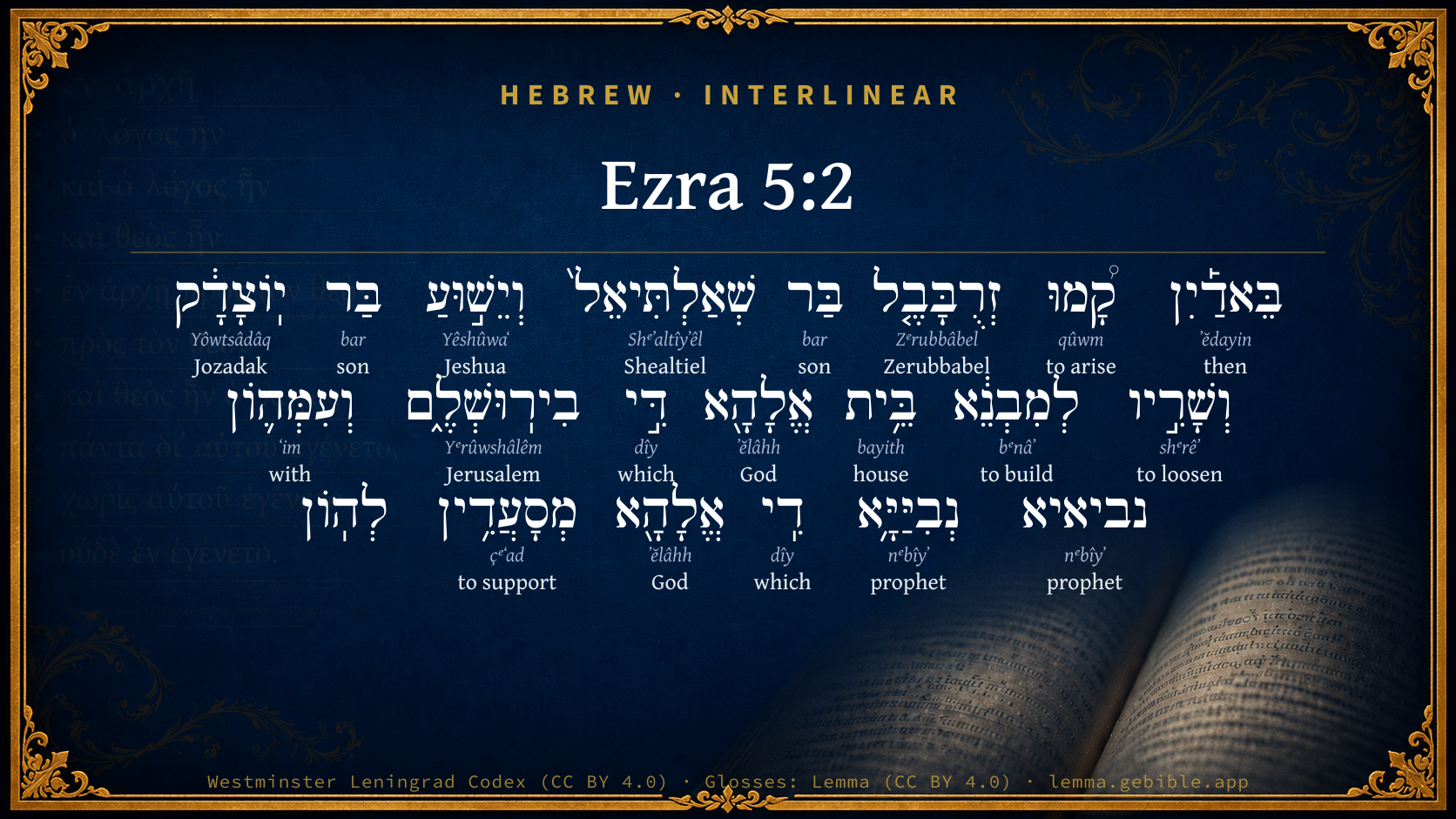
Ezra 5:2

Hebrew (Westminster Leningrad Codex) Ezra 5:2 appears in the Hebrew Old Testament. The text above is from the Westminster Leningrad Codex. Each word links to its Strong’s number, a concise gloss, and parsing drawn from the Open Scriptures Hebrew Bible morphology. Click any word for its full Brown-Driver-Briggs (BDB) entry.
Download image
Cite this verse

Ezra 5:2 (World English Bible). Public Domain. Lemma interlinear Bible study tool, https://lemma.gebible.app/v/ezra/5/2.

Show BibTeX & RIS
BibTeX
RIS
English Translation
Then rose up Zerubbabel the son of Shealtiel, and Jeshua the son of Jozadak, and began to build the house of God which is at Jerusalem; and with them were the prophets of God, helping them.
World English Bible · Public Domain
Highlights
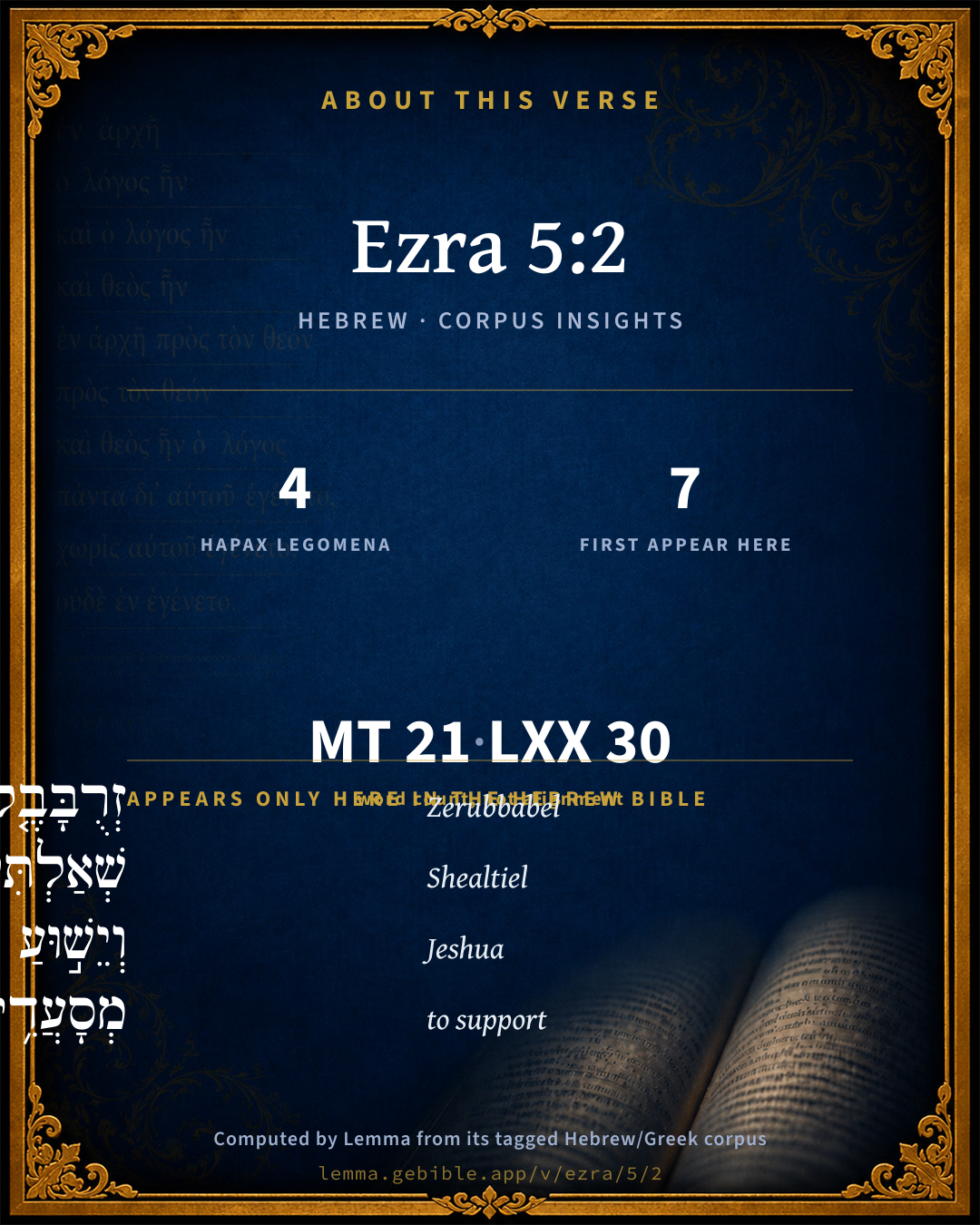
  • 4 hapax legomena — only here in the Hebrew Bible
  • 7 first appearances in the Hebrew Bible
Full analysis ↓
Download a study sheet

One document with this verse’s original text, its word-by-word gloss line, the meaning frame, cross-references with their text, attributed commentary, and full source and license credits — printable, and it pastes into notes with its structure intact.

This verse Autodidact and up

Study sheet (.html) Plain text (.txt)

A passage Seminary Student

Up to 50 verses in one chapter. A passage sheet keeps up to 6 commentary sources and 12 cross-references per verse, in the order this page ranks them, and says so on the sheet whenever that leaves anything out. Ask for a single verse and you get the Autodidact verse sheet above.

Everything on this page stays free to read, with no account — the sheet is a download of what is already on screen, not access to it.

Want to remove ads? Support Godless Engineer
Compare translations 3

The same verse in 3 English versions, stacked beneath the original-language interlinear above. Click any original word for its lexicon entry.

Each is an independent rendering of the whole verse — the interlinear is not word-aligned to these translations.

Highlighted words mark where these versions differ — a whole-verse word diff, not a word-by-word alignment.

  • World English Bible Public Domain
    Then rose up Zerubbabel the son of Shealtiel, and Jeshua the son of Jozadak, and began to build the house of God which is at Jerusalem; and with them were the prophets of God, helping them.
  • King James Version Public Domain
    Then rose up Zerubbabel the son of Shealtiel, and Jeshua the son of Jozadak, and began to build the house of God which is at Jerusalem: and with them were the prophets of God helping them.
  • unfoldingWord Literal Text CC BY-SA 4.0
    Then Zerubbabel, the son of Shealtiel, and Jeshua, the son of Jozadak, arose and began to build the house of God which is in Jerusalem, and the prophets of God were with them, supporting them.

unfoldingWord Literal Text — © unfoldingWord, licensed CC BY-SA 4.0. Word-aligned USFM3 via Door43 (git.door43.org/unfoldingWord/en_ult).

Versions to compare (up to 4)

3 of 4 selected

Show all 18 translations

Every available English version of this verse, each an independent rendering of the whole verse.

  • World English Bible Public Domain
    Then rose up Zerubbabel the son of Shealtiel, and Jeshua the son of Jozadak, and began to build the house of God which is at Jerusalem; and with them were the prophets of God, helping them.
  • Berean Standard Bible Public Domain
    Then Zerubbabel son of Shealtiel and Jeshua son of Jozadak rose up and began to rebuild the house of God in Jerusalem. And the prophets of God were with them, helping them.
  • Majority Standard Bible Public Domain
    Then Zerubbabel son of Shealtiel and Jeshua son of Jozadak rose up and began to rebuild the house of God in Jerusalem. And the prophets of God were with them, helping them.
  • King James Version Public Domain
    Then rose up Zerubbabel the son of Shealtiel, and Jeshua the son of Jozadak, and began to build the house of God which is at Jerusalem: and with them were the prophets of God helping them.
  • American Standard Version (1901) Public Domain
    Then rose up Zerubbabel the son of Shealtiel, and Jeshua the son of Jozadak, and began to build the house of God which is at Jerusalem; and with them were the prophets of God, helping them.
  • Revised Version (1885) Public Domain
    Then rose up Zerubbabel the son of Shealtiel, and Jeshua the son of Jozadak, and began to build the house of God which is at Jerusalem; and with them were the prophets of God, helping them.
  • Geneva Bible (1599) Public Domain
    Then Zerubbabel the sonne of Shealtiel, and Ieshua the sonne of Iozadak arose, and began to builde the house of God at Ierusalem, and with them were the Prophetes of God, which helped them.
  • Douay-Rheims (1899) Public Domain
    Then rose up Zorobabel the son of Salathiel, and Josue the son of Josedec, and began to build the temple of God in Jerusalem, and with them were the prophets of God helping them.
  • Young's Literal Translation Public Domain
    Then have Zerubbabel son of Shealtiel, and Jeshua son of Jozadak, risen, and begun to build the house of God, that `is' in Jerusalem, and with them are the prophets of God supporting them.
  • Literal Standard Version CC BY-SA 4.0
    Then Zerubbabel son of Shealtiel, and Jeshua son of Jozadak, have risen, and begun to build the house of God, that [is] in Jerusalem, and with them are the prophets of God supporting them.
  • Unlocked Literal Bible CC BY-SA 4.0
    Zerubbabel son of Shealtiel and Jeshua son of Jozadak rose up and began to build the house of God in Jerusalem with the prophets who supported them.
  • unfoldingWord Literal Text CC BY-SA 4.0
    Then Zerubbabel, the son of Shealtiel, and Jeshua, the son of Jozadak, arose and began to build the house of God which is in Jerusalem, and the prophets of God were with them, supporting them.
  • Darby Bible Public Domain
    Then rose up Zerubbabel the son of Shealtiel, and Jeshua the son of Jozadak, and began to build the house of God which is at Jerusalem; and with them were the prophets of God, who helped them.
  • World Messianic Bible Public Domain
    Then Zerubbabel the son of Shealtiel, and Yeshua the son of Jozadak rose up and began to build God’s house which is at Jerusalem; and with them were the prophets of God, helping them.
  • Webster's Bible Public Domain
    Then rose up Zerubbabel the son of Shealtiel, and Jeshua the son of Jozadak, and began to build the house of God which is at Jerusalem: and with them were the prophets of God helping them.
  • Free Bible Version CC BY-SA 4.0
    Then Zerubbabel, son of Shealtiel, and Jeshua, son of Jozadak, decided to start work on rebuilding God's Temple in Jerusalem. The prophets of God encouraged them and helped them.
  • Bible in Basic English Public Domain
    Then Zerubbabel, the son of Shealtiel, and Jeshua, the son of Jozadak, got up and made a start at building the house of God at Jerusalem: and the prophets of God were with them, helping them.
  • JPS Tanakh (1917) Public Domain
    Then rose up Zerubbabel the son of Shealtiel, and Jeshua the son of Jozadak, and began to build the house of God which is at Jerusalem; and with them were the prophets of God, helping them.

Literal Standard Version (2020), Covenant Press — licensed CC BY-SA 4.0. Text via the HelloAO Bible API (eBible.org). Unlocked Literal Bible (unfoldingWord) — licensed CC BY-SA 4.0. Text via the HelloAO Bible API (eBible.org). unfoldingWord Literal Text — © unfoldingWord, licensed CC BY-SA 4.0. Word-aligned USFM3 via Door43 (git.door43.org/unfoldingWord/en_ult). Free Bible Version, Dr. Jonathan Gallagher — licensed CC BY-SA 4.0. Text via the HelloAO Bible API (eBible.org).

Word by word

More ways to search: Search by grammar → Find every occurrence → Compare this word →

Practice this passage: Drill this verse → Learn its vocabulary →

זְרֻבָּבֶ֤ל
Zᵉrubbâbel
H2217
“Zerubbabel”
Adjective, N
Part of Speech
Adjective
Full BDB Definition

Origin: corresponding to H2216

TWOT: None

Zerubbabel = "sown in Babylon" - the grandson of king Jehoiachin and leader of the first group of returning exiles from Babylon
  1. בֵּאדַ֡יִן ʼĕdayin H116 “in/at · then” Adjective, R + Adverb
  2. קָ֠מוּ qûwm H6966 “to arise” Adjective, V, Plural
  3. בַּר bar H1247 “son of” Adjective, N, Common
  4. שְׁאַלְתִּיאֵל֙ Shᵉʼaltîyʼêl H7598 “Shealtiel” Adjective, N
  5. וְיֵשׁ֣וּעַ Yêshûwaʻ H3443 “and · Jeshua” Adjective, C + Noun, Proper
  6. בַּר bar H1247 “son of” Adjective, N, Common
  7. יֽוֹצָדָ֔ק Yôwtsâdâq H3136 “Jozadak” Adjective, N
  8. וְשָׁרִ֣יו shᵉrêʼ H8271 “and · to loosen” Adjective, C + Verb, Piel, Perfect, 3rd Person, Masculine, Plural
  9. לְמִבְנֵ֔א bᵉnâʼ H1124 “to build” Adjective, R + Verb, Qal, Infinitive Construct
  10. בֵּ֥ית bayith H1005 “house of” Adjective, N, Common
  11. אֱלָהָ֖א ʼĕlâhh H426 “God · the” Adjective, N, Common + Particle, Definite Article
  12. דִּ֣י dîy H1768 “which” Adjective, T
  13. בִירֽוּשְׁלֶ֑ם Yᵉrûwshâlêm H3390 “in/at · Jerusalem” Adjective, R + Noun, Proper
  14. וְעִמְּה֛וֹן ʻim H5974 “and · with · them” Adjective, C + Preposition + Suffix, Personal, 3rd Person, Masculine, Plural
  15. נביאיא nᵉbîyʼ H5029 “prophets · the” Adjective, N, Common + Particle, Definite Article
  16. נְבִיַּיָּ֥א nᵉbîyʼ H5029 “prophets · the” Adjective, N, Common + Particle, Definite Article
  17. דִֽי dîy H1768 “which” Adjective, T
  18. אֱלָהָ֖א ʼĕlâhh H426 “God · the” Adjective, N, Common + Particle, Definite Article
  19. מְסָעֲדִ֥ין çᵉʻad H5583 “supporting” Adjective, V

About this verse

These counts appear in no published source. They are computed here, from the morphology-tagged text and Lemma’s own curated glosses. What Lemma adds →

21
words
16
distinct lemmas
Historical
section

Notable vocabulary

4 hapax legomena — words that appear only here in the entire Hebrew Bible:

  • זְרֻבָּבֶ֤ל Zerubbabel H2217
  • שְׁאַלְתִּיאֵל֙ Shealtiel H7598
  • וְיֵשׁ֣וּעַ Jeshua H3443
  • מְסָעֲדִ֥ין to support H5583

First appearance in Scripture

These words make their first canonical appearance in the Hebrew Bible here:

  • קָ֠מוּ to arise H6966
  • זְרֻבָּבֶ֤ל Zerubbabel H2217
  • שְׁאַלְתִּיאֵל֙ Shealtiel H7598
  • וְיֵשׁ֣וּעַ Jeshua H3443
  • וְשָׁרִ֣יו to loosen H8271
  • וְעִמְּה֛וֹן with H5974
  • מְסָעֲדִ֥ין to support H5583

Shared distinctive vocabulary

יֽוֹצָדָ֔ק Jozadak H3136 occurs in 5 verses of the Hebrew Bible. Also found in:

Grammatical profile

  • 2 verbs
  • 2 nouns
  • 11 adjectives
  • 1 preposition
  • 1 adverb
  • 4 particles

Verb forms

  • וְשָׁרִ֣יו Piel · Perfect
  • לְמִבְנֵ֔א Qal · Infinitive Construct

Repetition

Words recur within this verse — often emphatic in Hebrew:

  • בַּר son H1247 ×2
  • אֱלָהָ֖א God H426 ×2
  • נביאיא prophet H5029 ×2
  • דִּ֣י which H1768 ×2

Hebrew & Septuagint length

In English translation the verse runs 36 words from the Hebrew and 36 from the Septuagint (LXX English) — the same length.

A rough comparison of the two English renderings, which tokenize alike — not a word-level alignment.

Word counts can differ between the Hebrew and the Greek without any difference in meaning — e.g. the Hebrew direct-object marker אֵת has no separate Greek word, and Greek often adds the article ὁ.

In the original languages it is 21 Hebrew tokens and 30 Greek tokens — but the two are counted differently (Hebrew bundles its prefixes and suffixes into one token; the Greek is in lemma form), so that isn’t a like-for-like length.

Cross-references

9

Topical passages linked to Ezra 5:2 in the Treasury of Scripture Knowledge — connected by theme and wording, ordered by reader-vote popularity; previews shown in the World English Bible.

  • Ezra 3:2 Then stood up Jeshua the son of Jozadak, and his brothers the priests, and Zerubbabel the son of Shealtiel, and his brothers, and built the altar of the God of Israel, to offer burnt offerings thereon, as it is written in the law of Moses the man of God.
  • Ezra 6:14 The elders of the Jews built and prospered, through the prophesying of Haggai the prophet and Zechariah the son of Iddo. They built and finished it, according to the commandment of the God of Israel, and according to the decree of Cyrus, and Darius, and Artaxerxes king of Persia.
  • Zechariah 3:1–4 He showed me Joshua the high priest standing before the angel of Yahweh, and Satan standing at his right hand to be his adversary.
  • Haggai 1:12–15 Then Zerubbabel, the son of Shealtiel, and Joshua, the son of Jehozadak, the high priest, with all the remnant of the people, obeyed the voice of Yahweh, their God, and the words of Haggai, the prophet, as Yahweh, their God, had sent him; and the people feared Yahweh.
  • Haggai 2:4–9 Yet now be strong, Zerubbabel,' says Yahweh. 'Be strong, Joshua, son of Jehozadak, the high priest. Be strong, all you people of the land,' says Yahweh, 'and work, for I am with you,' says Yahweh of Hosts.
  • Haggai 2:20–23 The Word of Yahweh came the second time to Haggai in the twenty-fourth day of the month, saying,
  • Zechariah 4:6–9 Then he answered and spoke to me, saying, "This is the word of Yahweh to Zerubbabel, saying, 'Not by might, nor by power, but by my Spirit,' says Yahweh of Hosts.
  • Zechariah 6:11 Yes, take silver and gold, and make crowns, and set them on the head of Joshua the son of Jehozadak, the high priest;
  • 2 Corinthians 1:24 Not that we have lordship over your faith, but are fellow workers with you for your joy. For you stand firm in faith.

Cross-references courtesy of OpenBible.info (CC BY 4.0).

Hebrew and Greek witnesses Masoretic Hebrew ↔ Greek Septuagint

The same verse in the two great witnesses to the Old Testament, shown verse-for-verse.

These are two independent witnesses, not word-aligned to each other, and the Septuagint is shown in lemma (dictionary) form.

Hebrew Ezra 5:2 Masoretic · Westminster Leningrad Codex

בֵּאדַ֡יִן קָ֠מוּ זְרֻבָּבֶ֤ל בַּר שְׁאַלְתִּיאֵל֙ וְיֵשׁ֣וּעַ בַּר יֽוֹצָדָ֔ק וְשָׁרִ֣יו לְמִבְנֵ֔א בֵּ֥ית אֱלָהָ֖א דִּ֣י בִירֽוּשְׁלֶ֑ם וְעִמְּה֛וֹן נביאיא נְבִיַּיָּ֥א דִֽי אֱלָהָ֖א מְסָעֲדִ֥ין לְהֽוֹן

Then rose up Zerubbabel the son of Shealtiel, and Jeshua the son of Jozadak, and began to build the house of God which is at Jerusalem; and with them were the prophets of God, helping them.

World English Bible · Public Domain

Greek LXX Ezra 5:2 Septuagint · lemma form

τότε ἀναἵστημι ζοροβαβελ ὁ ὁ σαλαθιηλ καί ἰησοῦς ὁ υἱός ιωσεδεκ καί ἄρχω οἰκοδομέω ὁ οἶκος ὁ θεός ὁ ἐν ἰερουσαλήμ καί μετά αὐτός ὁ προφήτης ὁ θεός βοηθέω αὐτός

Then rose up Zorobabel the son of Salathiel, and Jesus the son of Josedec, and began to build the house of God that was in Jerusalem: and with them were the prophets of God assisting them.

LXX2012 (modern English Septuagint) · Public Domain

In the Septuagint this is one book — Esdras B (2 Esdras): Ezra is chapters 1–10, Nehemiah 11–23.

Hebrew: Westminster Leningrad Codex (CC BY 4.0). Greek: Septuagint (public domain); English from LXX2012 (modern English Septuagint) (Public Domain). How the Septuagint differs from the Hebrew →

Commentary

Notes on Ezra 5:2 from classic Christian and Jewish commentators (each source and its license shown beneath its notes). The classic Christian expositions comment on the surrounding passage and are grouped to its opening verse, so a note may address several verses; the Jewish commentaries on the Tanakh (Rashi and others) are per-verse, so they appear only where the commentator wrote on this verse.

Lemma curates 59 commentaries, every one of them public domain or Creative Commons licensed, each selected and text-cleaned for this edition rather than reprinted as found. About our sources →

Trapp's Complete Commentary

John Trapp

Ezr 5:2 Then rose up Zerubbabel the son of Shealtiel, and Jeshua the son of Jozadak, and began to build the house of God which [is] at Jerusalem: and with them [were] the prophets of God helping them.

Ver. 2. Then rose up Zerubbabel] Called before Sheshbazzar, the Tirshata. Philo calleth him Barachias. Men in those days had sundry names; which must be noted, or else confusion will not be avoided; according to the notation of Zerubbabel’s name, Alienus a confusione, ut quidam perhibent. It is said of him, that he brought back some of the people in the seventeenth year of his age; that he continued governor fifty-eight years (some say many more), and that he began to make use of the ministry of these prophets in the thirty-fourth year of his life. His rising up here implieth his forwardness, speed, and diligence in the work.

And Jeshua the son of Jozadak] Colleague to Zerubbabel and συμπαραστατης, as Aaron was to Moses. This Johoshua or Jeshua began his office of high priest in 536 BC, and held it thirty-six years, eight whereof were spent in an embassage to Darius, king of Persia, say historians.

And began to build the house of God] i. e. They went on with the building begun before, Ezr 3:10, and not forbidden by the king of Persia to be finished; only he commanded them to desist from building the city, Ezr 4:12; Ezr 4:21. It was therefore the people’s sloth and self-seeking that kept back the work. See the notes on Hag 1:2; Hag 1:4. {See Trapp on "Hag 1:2"} {See Trapp on "Hag 1:4"}

And with them were the prophets of God helping them] Verbo et opere, saith Junius; both by word and deed. "The words of the wise are as goads," Ecc 12:11, pricking men forward to duty; and especially when themselves set sides and shoulders to the work, as haply these prophets did, for the people’s greater encouragement, Exemplis sciola hac aetate magis aedificant ministri, quam concionibus.

John Trapp, A Commentary or Exposition upon All the Books of the Old and New Testament (1647–1656) — public domain. Text from a community e-Sword module.

Joseph Benson's Commentary

Ezr 5:2. Then rose up Zerubbabel and Jeshua, and began to build the house — It had been begun to be built long before, but from the first had gone on very slowly, and afterward had been quite intermitted, till those great men, excited by the prophets, set the work forward again. With them were the prophets of God helping them — Encouraging them by their presence, and by assuring them that God would be with them to protect them from their enemies, and give them success. It is supposed the work had been stopped about fifteen years. The first chapter of Haggai is the best comment on these two verses.

Joseph Benson's Commentary on the Old and New Testaments (1811–1818) — public domain. Text from a community e-Sword module.

Tyndale Open Study Notes

Tyndale Open Resources

5:2 The Jewish leaders had not led by faith (see Hag 1:1, 12). Now God’s Spirit stirred them up (Hag 1:14), and they obeyed by getting to work. • Zerubbabel and Jeshua figure prominently in the books of Haggai and Zechariah.

Tyndale Open Study Notes — © Tyndale Open Resources, licensed CC BY-SA 4.0. Text via the HelloAO Bible API.

Geneva Bible (1599)

Geneva Bible translators

Which encouraged them to go forward, and accused them that they were more careful to build their own houses, than zealous to build the Temple of God.

Geneva Bible (1599) marginal notes — public domain. Text via Bolls.life.

Jamieson, Fausset & Brown

Robert Jamieson, A. R. Fausset & David Brown

Then rose up Zerubbabel . . . and Jeshua . . . began to build the house of God--The strong appeals and animating exhortations of these prophets gave a new impulse to the building of the temple. It was in the second year of the reign of Darius Hystaspes that the work, after a long interruption, was resumed.

Jamieson, Fausset & Brown — Commentary Critical and Explanatory on the Whole Bible (1871) — public domain (CC PDM 1.0). Text via the HelloAO Bible API.

Adam Clarke's Commentary

Verse 2. Then rose up Zerubbabel] Here we find three classes of men joining in the sacred work: Zerubbabel the civil governor; Jeshua the high priest or ecclesiastical governor; and Haggai and Zechariah the prophets. How glorious it is when we see the civil government joining with the sacerdotal and prophetic for the establishment and extension of true religion!

Adam Clarke's Commentary on the Bible (1810–1826) — public domain. Text from a community e-Sword/MySword module.

Ellicott's Commentary for English Readers

(2) Then rose up.—This does not intimate that they had become indifferent. But the voice of prophecy inspirited them to go on without formal permission of Darius, who was known secretly to favour them already.

The prophets of God helping them.—In these two prophets we can read the invigorating sayings that encouraged the people almost from day to day and from stage to stage of their work.

A Bible Commentary for English Readers, edited by Charles John Ellicott (1878–1897) — public domain. Text from a community e-Sword module.

The Cambridge Bible for Schools and Colleges

gen. ed. J. J. S. Perowne

2. Zerubbabel—Jeshua] see notes on Ezr_3:1; Ezr_3:8, Ezr_4:3.

began to build] The building had been begun in the second year of Cyrus, 537–6 (chap. Ezr_3:8; Ezr_3:10, Ezr_5:16). The work was now recommenced. The voice of the prophets supplied the needed encouragement. The effect of Haggai’s witness is described in Hag_1:12-14.

The Cambridge Bible for Schools and Colleges (gen. ed. J. J. S. Perowne; Cambridge University Press, 1878–1918) — public domain. Text from a community e-Sword module.

John Gill's Exposition

Then rose up Zerubbabel the son of Shealtiel, and Jeshua the son of Jozadak,.... Whose spirits were stirred up and quickened by the ministry of the prophets, the Lord accompanying it by his Spirit, Hag 1:12,

and began to build the house of God which is at Jerusalem; to go on with the building of it; for they had laid the foundation before, and perhaps had carried it up to some little height, at least, before they ceased from it, Ezr 3:10

and with them were the prophets of God helping them; with words of counsel, comfort, and exhortation, directing and encouraging them, and promising them protection and success: these are the prophets before named.

John Gill's Exposition of the Whole Bible (1746–1763) — public domain (CC PDM 1.0). Text via the HelloAO Bible API.

Albert Barnes' Notes on the Bible

Began to build - i. e., “made a second beginning” - recommenced the uncompleted work.

Helping them - By infusing zeal into the people (see Hag 1:12).

Albert Barnes' Notes on the Bible (1834–1885) — public domain. Text from a community e-Sword/MySword module.

Haydock's Catholic Bible Commentary

Them. Aggeus had rebuked the people for building houses for themselves, while they neglected the temple. The work was hereupon resumed without any fresh order from the king; as the edicts of the usurper, Oropastes, were considered as null, and the Jews only answer the governor, that they had been authorized by Cyrus, ver. 13, 17. Josephus, and 3 Esdras iii., and iv. 47., assert that Darius had given leave. (Calmet) (Menochius)

George Leo Haydock (1774–1849), Haydock's Catholic Family Bible and Commentary, 1859 edition — public domain. Excludes Psalms (Douay-Rheims chapter numbering differs from Protestant) and Deuterocanonical books (Catholic canon only).

Matthew Poole's English Annotations

Encouraging the people to work by their presence, and assurance of success.

Matthew Poole's English Annotations on the Holy Bible (1683–1685) — public domain. Text from a community e-Sword/MySword module.

Whedon's Commentary on the Bible

Daniel D. Whedon

2. Then rose up — It seems from Hag_1:2, that the people had become discouraged at the opposition they met in rebuilding the temple, and after being hindered by royal authority, they concluded that the time for rebuilding the Lord’s house had not yet come. But when the Magian usurper was deposed, and Darius began to restore the Zoroastrian temples and worship, of which he speaks in his great Behistun inscription, the prophets discerned that things had changed, and the people should feel encouraged to resume their work again.

The prophets… helping them — Urging and inspiring them to action by such exhortations and appeals as are found in the first chapter of Haggai.

Daniel D. Whedon (gen. ed.), Commentary on the Old and New Testaments (1874–1909) — public domain. Text from a community e-Sword module.

The Pulpit Commentary

Then rose up Zerubbabel and Jeshua. Haggai"s preaching was especially addressed to these two leaders, (Hag_1:1) and their spirit was especially "stirred up" (ibid. ver. 14) by his preaching. The prophets of God Haggai and Zechariah were with them, throughout their work, helping them; and that in various ways.

1. By direct command to the people up to the mountain, and bring wood, and build the house"; (Hag_1:8)

2. By warnings of mine house that is waste therefore the heaven over you is stayed from dew, and the earth is stayed from her fruit" (ibid. vers. 9, 10);

3. By exhortations strong, O Zerubbabel, saith the Lord; and be strong, O Joshua, son of Josedech, the high priest; and be ye strong, all ye people of the land, saith the Lord, and work"; (Hag_2:4) and

4. By encouraging prophecy hands of Zerubbabel have laid the foundation of this house; his hands shall also finish it"; (Zec_4:9) and "the glory of this latter house shall be greater than that of the former, saith the Lord of Hosts: and in this place will I give peace, saith the Lord of Hosts". (Hag_2:9) By these and similar means the two prophets aroused a spirit of enthusiasm, which caused the work to make rapid progress, and was an invaluable assistance.

The Pulpit Commentary (1880–1919), ed. H.D.M. Spence-Jones & Joseph S. Exell — public domain. Text from a community e-Sword module.

John Wesley's Explanatory Notes

Helping - Encouraging the people to work by their presence, and assurance of success. It is supposed, the work had stopt about fifteen years. The first chapter of Haggai is the best comment on these two verses.

John Wesley, Explanatory Notes Upon the Whole Bible (1754–1765) — public domain. Text via the GEBible commentary corpus.

Rashi

Rabbi Shlomo Yitzchaki (Rashi)

Then [as translated,] then.

and commenced They began to build the House of the Holy One, blessed be He, which is in Jerusalem, and with them were the prophets of the Holy One, blessed be He, helping and assisting them.

Rashi on the Tanakh — English translations: “The Judaica Press complete Tanach with Rashi, translated by A. J. Rosenberg” (CC BY 4.0); “Pentateuch with Rashi's commentary by M. Rosenbaum and A.M. Silbermann, 1929-1934” (public domain); “The Metsudah Tanach series, Lakewood, N.J” (CC BY 4.0); and “The Book of Joshua, Metsudah Publications, 1997” (CC BY 4.0). Text via Sefaria.

Lesson kit

Teaching starters — assembled from the data on this page, not authored interpretation. Every prompt links to the verse data it draws on. Edit before teaching.

Ezra, in the Historical, opens this verse with 21 words (16 distinct Hebrew lemmas). Its most distinctive word is Zᵉrubbâbel (“Zerubbabel”). A historical commentator’s framing appears above. Read the whole chapter for the surrounding context.

Discussion questions

  1. How does “Zerubbabel” (Zᵉrubbâbel) shape what this verse is saying?
  2. 4 words here appear nowhere else in the Hebrew Bible. Why might the author reach for such rare wording?
  3. 7 words make their first appearance in Scripture here. What does this debut establish?
  4. How does Ezra 3:2, which shares the word «Jozadak», read alongside this verse?
  5. What does the repetition of “son” (2× in this one verse) do in this verse?
  6. The translations on this page render this verse differently — a whole-verse word diff, not a word-by-word alignment. What might account for the different wordings?
  7. «וְשָׁרִ֣יו» is a Piel Perfect verb. How does that grammatical form shape the action described?
  8. Compare how Trapp's Complete Commentary and Joseph Benson's Commentary read this verse. Where do they agree or differ?

Things to notice

  • 4 words in this verse appear nowhere else in the Hebrew Bible.
  • 7 words make their first canonical appearance in Scripture here.
  • This verse counts 21 Hebrew ↔ 30 Greek words.
  • These translations choose different wording for 5 words in this verse.
  • “son” occurs 2× in this single verse.

Reading settings

Reading text

Shown beneath each verse's original-language words.

Old Testament
Old Testament edition

Read the OT as the Masoretic Hebrew (MT) or the Greek Septuagint (LXX).

English shown for the Greek Septuagint (in the Hebrew ↔ Greek comparison).

Comparing translations? Open the Compare panel on any verse page to stack up to four side by side.