
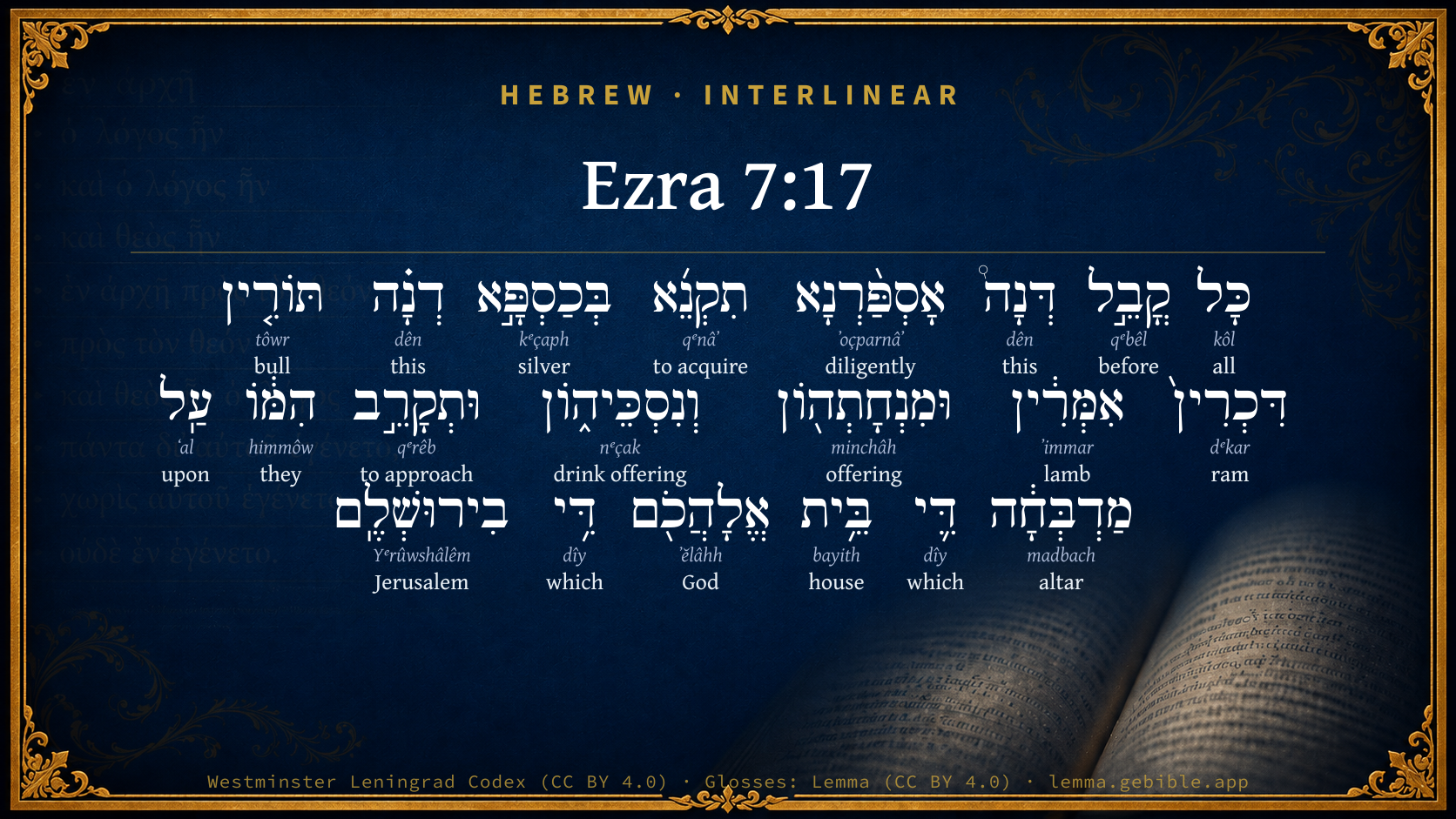
Ezra 7:17

Hebrew (Westminster Leningrad Codex) Ezra 7:17 appears in the Hebrew Old Testament. The text above is from the Westminster Leningrad Codex. Each word links to its Strong’s number, a concise gloss, and parsing drawn from the Open Scriptures Hebrew Bible morphology. Click any word for its full Brown-Driver-Briggs (BDB) entry.
Download image
Cite this verse

Ezra 7:17 (World English Bible). Public Domain. Lemma interlinear Bible study tool, https://lemma.gebible.app/v/ezra/7/17.

Show BibTeX & RIS
BibTeX
RIS
English Translation
therefore you shall with all diligence buy with this money bulls, rams, lambs, with their meal-offerings and their drink-offerings, and shall offer them on the altar of the house of your God which is in Jerusalem.
World English Bible · Public Domain
Highlights
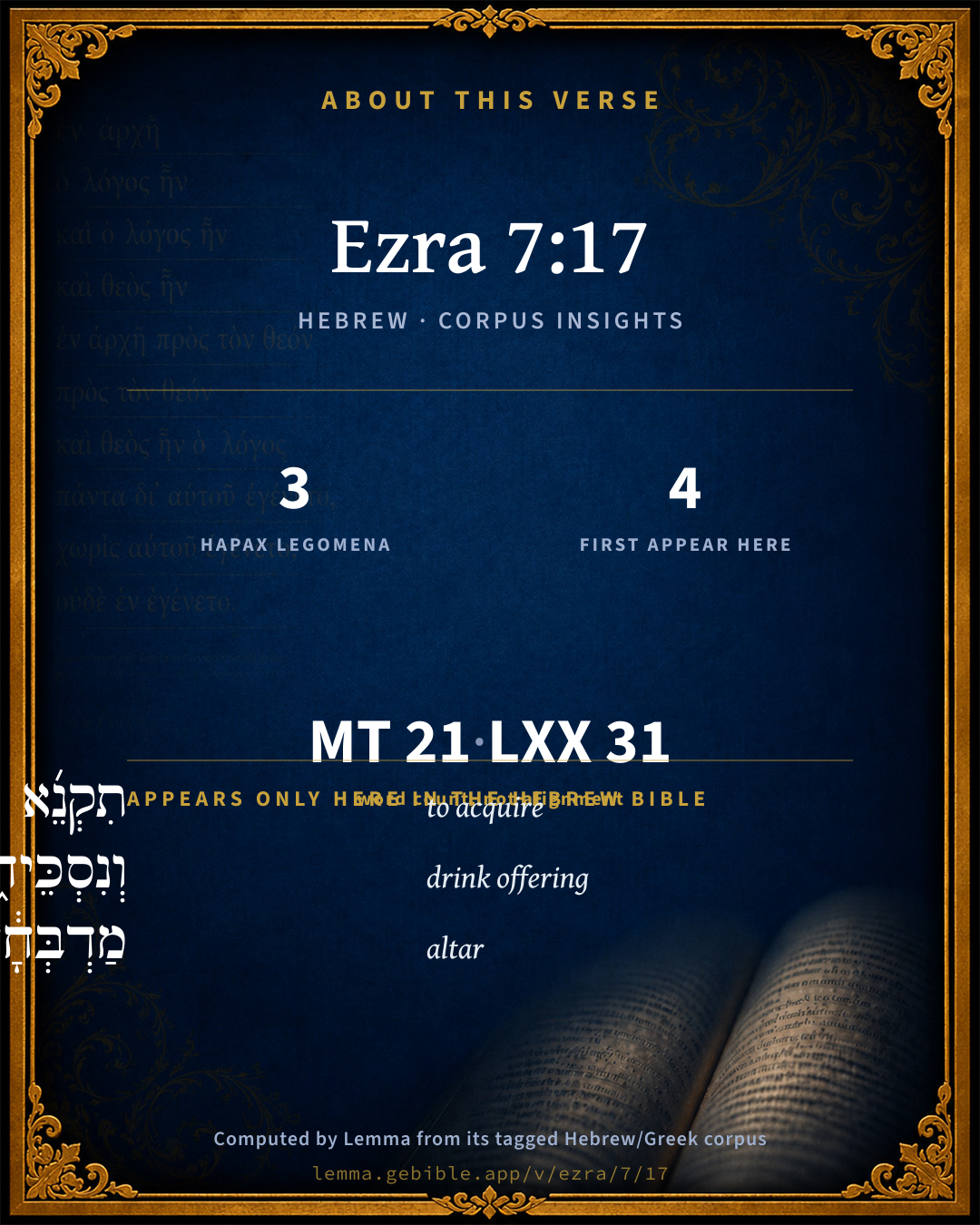
  • 3 hapax legomena — only here in the Hebrew Bible
  • 4 first appearances in the Hebrew Bible
Full analysis ↓
Download a study sheet

One document with this verse’s original text, its word-by-word gloss line, the meaning frame, cross-references with their text, attributed commentary, and full source and license credits — printable, and it pastes into notes with its structure intact.

This verse Autodidact and up

Study sheet (.html) Plain text (.txt)

A passage Seminary Student

Up to 50 verses in one chapter. A passage sheet keeps up to 6 commentary sources and 12 cross-references per verse, in the order this page ranks them, and says so on the sheet whenever that leaves anything out. Ask for a single verse and you get the Autodidact verse sheet above.

Everything on this page stays free to read, with no account — the sheet is a download of what is already on screen, not access to it.

Want to remove ads? Support Godless Engineer
Compare translations 3

The same verse in 3 English versions, stacked beneath the original-language interlinear above. Click any original word for its lexicon entry.

Each is an independent rendering of the whole verse — the interlinear is not word-aligned to these translations.

Highlighted words mark where these versions differ — a whole-verse word diff, not a word-by-word alignment.

  • World English Bible Public Domain
    therefore you shall with all diligence buy with this money bulls, rams, lambs, with their meal-offerings and their drink-offerings, and shall offer them on the altar of the house of your God which is in Jerusalem.
  • King James Version Public Domain
    That thou mayest buy speedily with this money bullocks, rams, lambs, with their meat offerings and their drink offerings, and offer them upon the altar of the house of your God which is in Jerusalem.
  • unfoldingWord Literal Text CC BY-SA 4.0
    therefore, diligently you shall buy with this money bulls, rams, lambs, and their grain offerings and their drink offerings; and you shall offer them on the altar of the house of your God, which is in Jerusalem.

unfoldingWord Literal Text — © unfoldingWord, licensed CC BY-SA 4.0. Word-aligned USFM3 via Door43 (git.door43.org/unfoldingWord/en_ult).

Versions to compare (up to 4)

3 of 4 selected

Show all 18 translations

Every available English version of this verse, each an independent rendering of the whole verse.

  • World English Bible Public Domain
    therefore you shall with all diligence buy with this money bulls, rams, lambs, with their meal-offerings and their drink-offerings, and shall offer them on the altar of the house of your God which is in Jerusalem.
  • Berean Standard Bible Public Domain
    With this money, therefore, you are to buy as many bulls, rams, and lambs as needed, together with their grain offerings and drink offerings, and offer them on the altar at the house of your God in Jerusalem.
  • Majority Standard Bible Public Domain
    With this money, therefore, you are to buy as many bulls, rams, and lambs as needed, together with their grain offerings and drink offerings, and offer them on the altar at the house of your God in Jerusalem.
  • King James Version Public Domain
    That thou mayest buy speedily with this money bullocks, rams, lambs, with their meat offerings and their drink offerings, and offer them upon the altar of the house of your God which is in Jerusalem.
  • American Standard Version (1901) Public Domain
    therefore thou shalt with all diligence buy with this money bullocks, rams, lambs, with their meal-offerings and their drink-offerings, and shalt offer them upon the altar of the house of your God which is in Jerusalem.
  • Revised Version (1885) Public Domain
    therefore thou shalt with all diligence buy with this money bullocks, rams, lambs, with their meal offerings and their drink offerings, and shalt offer them upon the altar of the house of your God which is in Jerusalem.
  • Geneva Bible (1599) Public Domain
    That thou mayest bye speedily with this siluer, bullocks, rammes, lambes, with their meate offrings and their drinke offrings: and thou shalt offer them vpon the altar of the house of your God, which is in Ierusalem.
  • Douay-Rheims (1899) Public Domain
    Take freely, and buy diligently with this money, calves, rams, lambs, with the sacrifices and libations of them, and offer them upon the altar of the temple of your God, that is in Jerusalem.
  • Young's Literal Translation Public Domain
    therefore thou dost speedily buy with this money, bullocks, rams, lambs, and their presents, and their libations, and dost bring them near to the altar of the house of your God that `is' in Jerusalem,
  • Literal Standard Version CC BY-SA 4.0
    therefore you speedily buy with this money, bullocks, rams, lambs, and their presents, and their drink-offerings, and bring them near to the altar of the house of your God that [is] in Jerusalem,
  • Unlocked Literal Bible CC BY-SA 4.0
    So buy in full the oxen, rams and lambs, and grain and drink offerings. Offer them on the altar that is in the house of your God in Jerusalem.
  • unfoldingWord Literal Text CC BY-SA 4.0
    therefore, diligently you shall buy with this money bulls, rams, lambs, and their grain offerings and their drink offerings; and you shall offer them on the altar of the house of your God, which is in Jerusalem.
  • Darby Bible Public Domain
    Therefore thou shalt buy diligently with this money bullocks, rams, lambs, with their oblations and their drink-offerings, and offer them upon the altar of the house of your God which is at Jerusalem.
  • World Messianic Bible Public Domain
    Therefore you shall with all diligence buy with this money bulls, rams, and lambs with their meal offerings and their drink offerings, and shall offer them on the altar of the house of your God which is in Jerusalem.
  • Webster's Bible Public Domain
    That thou mayest buy speedily with this money bullocks, rams, lambs, with their meat-offerings and their drink-offerings, and offer them upon the altar of the house of your God which is in Jerusalem.
  • Free Bible Version CC BY-SA 4.0
    You are to use this money first to buy as many bulls, rams, and lambs as necessary, along with their grain offerings and drink offerings, and present them on the altar at the Temple of your God in Jerusalem.
  • Bible in Basic English Public Domain
    So with this money get with care oxen, sheep, and lambs, with their meal offerings and their drink offerings, to be offered on the altar of the house of your God, which is in Jerusalem.
  • JPS Tanakh (1917) Public Domain
    therefore thou shalt with all diligence buy with this money bullocks, rams, lambs, with their meal-offerings and their drink-offerings, and shalt offer them upon the altar of the house of your God which is in Jerusalem.

Literal Standard Version (2020), Covenant Press — licensed CC BY-SA 4.0. Text via the HelloAO Bible API (eBible.org). Unlocked Literal Bible (unfoldingWord) — licensed CC BY-SA 4.0. Text via the HelloAO Bible API (eBible.org). unfoldingWord Literal Text — © unfoldingWord, licensed CC BY-SA 4.0. Word-aligned USFM3 via Door43 (git.door43.org/unfoldingWord/en_ult). Free Bible Version, Dr. Jonathan Gallagher — licensed CC BY-SA 4.0. Text via the HelloAO Bible API (eBible.org).

Word by word

More ways to search: Search by grammar → Find every occurrence → Compare this word →

Practice this passage: Drill this verse → Learn its vocabulary →

תִקְנֵ֜א
qᵉnâʼ
H7066
“to acquire”
Adjective, V
Part of Speech
Adjective
Full BDB Definition

Origin: corresponding to H7069

TWOT: 2974

(Peal) to acquire, buy, purchase
  1. כָּל kôl H3606 “all” Adjective, C + Conjunction
  2. קֳבֵ֣ל qᵉbêl H6903 “before” Adjective, C
  3. דְּנָה֩ dên H1836 “this” Adjective, C
  4. אָסְפַּ֨רְנָא ʼoçparnâʼ H629 “diligently” Adjective, D
  5. בְּכַסְפָּ֣א kᵉçaph H3702 “in/at · silver · the” Adjective, R + Noun, Common, Masculine, Singular, Determined + Particle, Definite Article
  6. דְנָ֗ה dên H1836 “this” Adjective, P
  7. תּוֹרִ֤ין tôwr H8450 “bulls” Adjective, N, Common
  8. דִּכְרִין֙ dᵉkar H1798 “rams” Adjective, N, Common
  9. אִמְּרִ֔ין ʼimmar H563 “lambs” Adjective, N, Common
  10. וּמִנְחָתְה֖וֹן minchâh H4504 “and · offerings · their” Adjective, C + Noun, Common, Feminine, Plural, Construct + Suffix, Personal, 3rd Person, Masculine, Plural
  11. וְנִסְכֵּיה֑וֹן nᵉçak H5261 “and · drink offerings · their” Adjective, C + Noun, Common, Masculine, Plural, Construct + Suffix, Personal, 3rd Person, Masculine, Plural
  12. וּתְקָרֵ֣ב qᵉrêb H7127 “and · to approach” Adjective, C + Verb, Piel, Imperfect, 2nd Person, Masculine, Singular
  13. הִמּ֔וֹ himmôw H1994 “they” Adjective, P
  14. עַֽל ʻal H5922 “upon” Adjective, R
  15. מַדְבְּחָ֔ה madbach H4056 “altar · the” Adjective, N, Common + Particle, Definite Article
  16. דִּ֛י dîy H1768 “which” Adjective, T
  17. בֵּ֥ית bayith H1005 “house of” Adjective, N, Common
  18. אֱלָהֲכֹ֖ם ʼĕlâhh H426 “God · your” Adjective, N, Common + Suffix, Personal, 2nd Person, Masculine, Plural
  19. דִּ֥י dîy H1768 “which” Adjective, T
  20. בִירוּשְׁלֶֽם Yᵉrûwshâlêm H3390 “in/at · Jerusalem” Adjective, R + Noun, Proper

About this verse

These counts appear in no published source. They are computed here, from the morphology-tagged text and Lemma’s own curated glosses. What Lemma adds →

21
words
19
distinct lemmas
Historical
section

Notable vocabulary

3 hapax legomena — words that appear only here in the entire Hebrew Bible:

  • תִקְנֵ֜א to acquire H7066
  • וְנִסְכֵּיה֑וֹן drink offering H5261
  • מַדְבְּחָ֔ה altar H4056

First appearance in Scripture

These words make their first canonical appearance in the Hebrew Bible here:

  • תִקְנֵ֜א to acquire H7066
  • וּמִנְחָתְה֖וֹן offering H4504
  • וְנִסְכֵּיה֑וֹן drink offering H5261
  • מַדְבְּחָ֔ה altar H4056

Shared distinctive vocabulary

וּמִנְחָתְה֖וֹן offering H4504 occurs in 2 verses of the Hebrew Bible. Also found in:

Grammatical profile

  • 1 verb
  • 3 nouns
  • 14 adjectives
  • 1 conjunction
  • 2 particles

Verb forms

  • וּתְקָרֵ֣ב Piel · Imperfect

Repetition

Words recur within this verse — often emphatic in Hebrew:

  • דְּנָה֩ this H1836 ×2
  • דִּ֛י which H1768 ×2

Hebrew & Septuagint length

In English translation the verse runs 36 words from the Hebrew and 43 from the Septuagint (LXX English) — closely comparable.

A rough comparison of the two English renderings, which tokenize alike — not a word-level alignment.

Word counts can differ between the Hebrew and the Greek without any difference in meaning — e.g. the Hebrew direct-object marker אֵת has no separate Greek word, and Greek often adds the article ὁ.

In the original languages it is 21 Hebrew tokens and 31 Greek tokens — but the two are counted differently (Hebrew bundles its prefixes and suffixes into one token; the Greek is in lemma form), so that isn’t a like-for-like length.

Cross-references

6

Topical passages linked to Ezra 7:17 in the Treasury of Scripture Knowledge — connected by theme and wording, ordered by reader-vote popularity; previews shown in the World English Bible.

  • Deuteronomy 12:5–11 But to the place which Yahweh your God shall choose out of all your tribes, to put his name there, even to his habitation shall you seek, and there you shall come;
  • Numbers 15:4–13 then shall he who offers his offering offer to Yahweh a meal-offering of a tenth part [of an ephah] of fine flour mixed with the fourth part of a hin of oil:
  • Ezra 6:9–10 That which they have need of, both young bulls, and rams, and lambs, for burnt offerings to the God of heaven; [also] wheat, salt, wine, and oil, according to the word of the priests who are at Jerusalem, let it be given them day by day without fail;
  • Deuteronomy 14:24–26 If the way be too long for you, so that you are not able to carry it, because the place is too far from you, which Yahweh your God shall choose, to set his name there, when Yahweh your God shall bless you;
  • Matthew 21:12–13 Jesus entered into the temple of God, and drove out all of those who sold and bought in the temple, and overthrew the money-changers' tables and the seats of those who sold the doves.
  • John 2:14 He found in the temple those who sold oxen, sheep, and doves, and the changers of money sitting.

Cross-references courtesy of OpenBible.info (CC BY 4.0).

Hebrew and Greek witnesses Masoretic Hebrew ↔ Greek Septuagint

The same verse in the two great witnesses to the Old Testament, shown verse-for-verse.

These are two independent witnesses, not word-aligned to each other, and the Septuagint is shown in lemma (dictionary) form.

Hebrew Ezra 7:17 Masoretic · Westminster Leningrad Codex

כָּל קֳבֵ֣ל דְּנָה֩ אָסְפַּ֨רְנָא תִקְנֵ֜א בְּכַסְפָּ֣א דְנָ֗ה תּוֹרִ֤ין דִּכְרִין֙ אִמְּרִ֔ין וּמִנְחָתְה֖וֹן וְנִסְכֵּיה֑וֹן וּתְקָרֵ֣ב הִמּ֔וֹ עַֽל מַדְבְּחָ֔ה דִּ֛י בֵּ֥ית אֱלָהֲכֹ֖ם דִּ֥י בִירוּשְׁלֶֽם

therefore you shall with all diligence buy with this money bulls, rams, lambs, with their meal-offerings and their drink-offerings, and shall offer them on the altar of the house of your God which is in Jerusalem.

World English Bible · Public Domain

Greek LXX Ezra 7:17 Septuagint · lemma form

καί πᾶς προςπορεύομαι οὗτος ἑτοίμως ἐντάσσω ἐν βιβλίον οὗτος μόσχος κριός ἀμνός καί θυσία αὐτός καί σπονδή αὐτός καί προςφέρω αὐτός ἐπί θυσιαστήριον ὁ οἶκος ὁ θεός σύ ὁ ἐν ἰερουσαλήμ

And as for every one that arrives there, speedily order him by this letter to bring calves, rams, lambs, and their meat-offerings, and their drink-offerings; and you shall offer them on the altar of the house of your God which is in Jerusalem.

LXX2012 (modern English Septuagint) · Public Domain

In the Septuagint this is one book — Esdras B (2 Esdras): Ezra is chapters 1–10, Nehemiah 11–23.

Hebrew: Westminster Leningrad Codex (CC BY 4.0). Greek: Septuagint (public domain); English from LXX2012 (modern English Septuagint) (Public Domain). How the Septuagint differs from the Hebrew →

Commentary

Notes on Ezra 7:17 from classic Christian and Jewish commentators (each source and its license shown beneath its notes). The classic Christian expositions comment on the surrounding passage and are grouped to its opening verse, so a note may address several verses; the Jewish commentaries on the Tanakh (Rashi and others) are per-verse, so they appear only where the commentator wrote on this verse.

Lemma curates 59 commentaries, every one of them public domain or Creative Commons licensed, each selected and text-cleaned for this edition rather than reprinted as found. About our sources →

Trapp's Complete Commentary

John Trapp

Ezr 7:17 That thou mayest buy speedily with this money bullocks, rams, lambs, with their meat offerings and their drink offerings, and offer them upon the altar of the house of your God which [is] in Jerusalem.

Ver. 17. That thou mayest buy speedily] Illico. immediately, God is himself a pure act, and hateth dulness in duty. What thou doest, do quickly, said Christ, even to the very traitor that did seek and suck his blood.

John Trapp, A Commentary or Exposition upon All the Books of the Old and New Testament (1647–1656) — public domain. Text from a community e-Sword module.

Ellicott's Commentary for English Readers

(17) Buy speedily.—Provide first of all for the sacrificial ceremonial. Every sacrifice had its own meat-offerings and drink-offerings (Numbers 15). These phrases in the commission of course Ezra dictated.

A Bible Commentary for English Readers, edited by Charles John Ellicott (1878–1897) — public domain. Text from a community e-Sword module.

The Cambridge Bible for Schools and Colleges

gen. ed. J. J. S. Perowne

17. Purpose of the gifts and offerings: (i) sacrifices.

that thou mayest buy speedily] R.V. therefore thou shalt buy with all diligence; ‘therefore’, i.e. because of the gifts received from the crown, the Babylonians and the Jews.

‘with all diligence’, see note on Ezr_5:8. The sacrifices here mentioned, as in Ezr_6:9-10, consist of burnt offerings (bullocks, rams, lambs), with their accompanying ‘meal’ and ‘drink-offerings’, Num_15:1-16.

meat offerings] R.V. meal offerings (i.e. ‘Minkhah’, as always in R.V.).

The Cambridge Bible for Schools and Colleges (gen. ed. J. J. S. Perowne; Cambridge University Press, 1878–1918) — public domain. Text from a community e-Sword module.

John Gill's Exposition

The vessels also that were given thee for the service of the house of thy God,.... These were vessels of silver, basins of gold, and vessels of fine copper; not what formerly belonged to the temple, they were delivered by Cyrus to Sheshbazzar; but what the present king and his counsellors freely offered at this time, see Ezr 8:25, those

deliver thou before the God of Jerusalem; perfect and complete, the full number of them, as the word signifies (t); meaning not to be delivered before him, or in his presence, as a witness thereof, but that they should be dedicated and devoted to his service, who was worshipped in the temple at Jerusalem, and by the inhabitants of it; he seems as if he thought him a topical deity, the God of that particular place, which was the notion of the Heathens, see Kg1 20:23, though he also speaks of him as the God of heaven.

(t) "integra et pleno numero redde", Michaelis.

John Gill's Exposition of the Whole Bible (1746–1763) — public domain (CC PDM 1.0). Text via the HelloAO Bible API.

The Pulpit Commentary

That thou mayest buy speedily with this money bullocks, etc. The primary application of the money sent by Ezra was to be the maintenance of the Jewish ritual in its full splendour. (compare the decree of Darius, Ezr_6:9, Ezr_6:10) The residue was, however, to be employed in any way that Ezra, acting under Divine guidance, might direct (see below, ver. 18). Apparently, this residue was actually employed on beautifying the temple (see ver. 27).

The Pulpit Commentary (1880–1919), ed. H.D.M. Spence-Jones & Joseph S. Exell — public domain. Text from a community e-Sword module.

unfoldingWord translationNotes

Door43 World Missions Community

Connecting Statement:

This continues the decree that King Artaxerxes gave to Ezra.

So buy in full ... offerings

The phrase "in full" means as many as are necessary to complete the task. They were to use the gold and silver to buy all they needed in order to worship God in the temple. AT: "Buy as many of the oxen, rams, lambs, grain and drink offerings as are needed" (See: Assumed Knowledge and Implicit Information)

you and your brothers

The phrase "your brothers" refers to the people who were doing this work with Ezra. AT: "your co-workers" or "your companions" (See: Metaphor)

translationWords

cow

ewe

lamb

grain

drink offering

altar

house of God

brother

unfoldingWord translationNotes — © Distant Shores Media and the Door43 World Missions Community, licensed CC BY-SA 4.0. Source: git.door43.org/Door43/en_tn.

Rashi

Rabbi Shlomo Yitzchaki (Rashi)

Because of this And because of this, because it is for the service of the Sanctuary, you shall quickly purchase with this money cattle, rams and lambs; sacrifices, meal-offerings, and libations, and you shall offer them up on the altar of the Holy One, blessed be He.

Rashi on the Tanakh — English translations: “The Judaica Press complete Tanach with Rashi, translated by A. J. Rosenberg” (CC BY 4.0); “Pentateuch with Rashi's commentary by M. Rosenbaum and A.M. Silbermann, 1929-1934” (public domain); “The Metsudah Tanach series, Lakewood, N.J” (CC BY 4.0); and “The Book of Joshua, Metsudah Publications, 1997” (CC BY 4.0). Text via Sefaria.

Lesson kit

Teaching starters — assembled from the data on this page, not authored interpretation. Every prompt links to the verse data it draws on. Edit before teaching.

Ezra, in the Historical, opens this verse with 21 words (19 distinct Hebrew lemmas). Its most distinctive word is qᵉnâʼ (“to acquire”). A historical commentator’s framing appears above. Read the whole chapter for the surrounding context.

Discussion questions

  1. How does “to acquire” (qᵉnâʼ) shape what this verse is saying?
  2. 3 words here appear nowhere else in the Hebrew Bible. Why might the author reach for such rare wording?
  3. 4 words make their first appearance in Scripture here. What does this debut establish?
  4. How does Daniel 2:46, which shares the word «offering», read alongside this verse?
  5. What does the repetition of “this” (2× in this one verse) do in this verse?
  6. The translations on this page render this verse differently — a whole-verse word diff, not a word-by-word alignment. What might account for the different wordings?
  7. «וּתְקָרֵ֣ב» is a Piel Imperfect verb. How does that grammatical form shape the action described?
  8. Compare how Trapp's Complete Commentary and Ellicott's Commentary for English Readers read this verse. Where do they agree or differ?

Things to notice

  • 3 words in this verse appear nowhere else in the Hebrew Bible.
  • 4 words make their first canonical appearance in Scripture here.
  • This verse counts 21 Hebrew ↔ 31 Greek words.
  • These translations choose different wording for 17 words in this verse.
  • “this” occurs 2× in this single verse.

Reading settings

Reading text

Shown beneath each verse's original-language words.

Old Testament
Old Testament edition

Read the OT as the Masoretic Hebrew (MT) or the Greek Septuagint (LXX).

English shown for the Greek Septuagint (in the Hebrew ↔ Greek comparison).

Comparing translations? Open the Compare panel on any verse page to stack up to four side by side.