
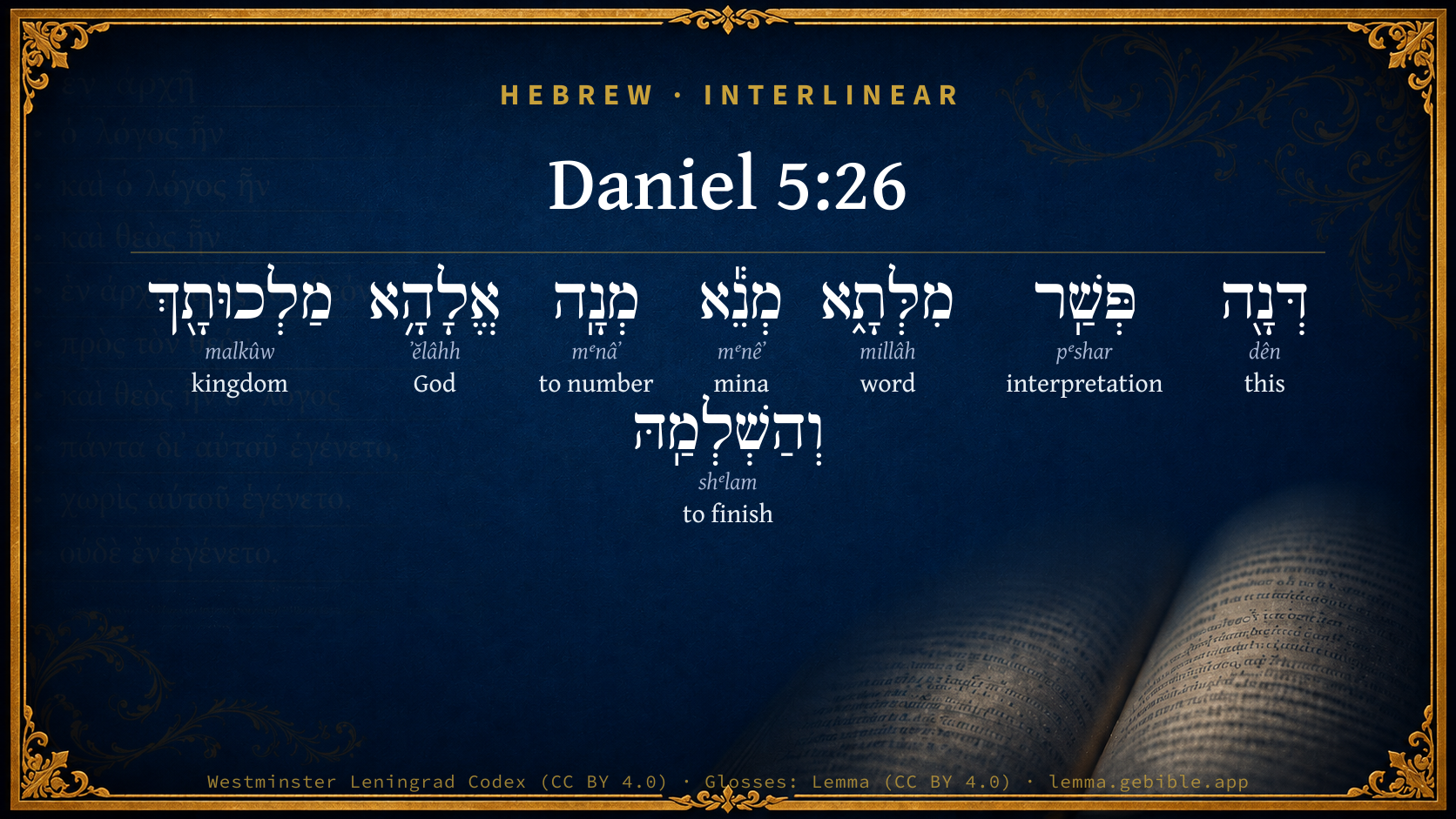
Daniel 5:26

Hebrew (Westminster Leningrad Codex) Daniel 5:26 appears in the Hebrew Old Testament. The text above is from the Westminster Leningrad Codex. Each word links to its Strong’s number, a concise gloss, and parsing drawn from the Open Scriptures Hebrew Bible morphology. Click any word for its full Brown-Driver-Briggs (BDB) entry.
Download image
Cite this verse

Daniel 5:26 (World English Bible). Public Domain. Lemma interlinear Bible study tool, https://lemma.gebible.app/v/daniel/5/26.

Show BibTeX & RIS
BibTeX
RIS
English Translation
This is the interpretation of the thing: MENE; God has numbered your kingdom, and brought it to an end;
World English Bible · Public Domain
Download a study sheet

One document with this verse’s original text, its word-by-word gloss line, the meaning frame, cross-references with their text, attributed commentary, and full source and license credits — printable, and it pastes into notes with its structure intact.

This verse Autodidact and up

Study sheet (.html) Plain text (.txt)

A passage Seminary Student

Up to 50 verses in one chapter. A passage sheet keeps up to 6 commentary sources and 12 cross-references per verse, in the order this page ranks them, and says so on the sheet whenever that leaves anything out. Ask for a single verse and you get the Autodidact verse sheet above.

Everything on this page stays free to read, with no account — the sheet is a download of what is already on screen, not access to it.

Want to remove ads? Support Godless Engineer
Compare translations 3

The same verse in 3 English versions, stacked beneath the original-language interlinear above. Click any original word for its lexicon entry.

Each is an independent rendering of the whole verse — the interlinear is not word-aligned to these translations.

Highlighted words mark where these versions differ — a whole-verse word diff, not a word-by-word alignment.

  • World English Bible Public Domain
    This is the interpretation of the thing: MENE; God has numbered your kingdom, and brought it to an end;
  • King James Version Public Domain
    This is the interpretation of the thing: MENE; God hath numbered thy kingdom, and finished it.
  • unfoldingWord Literal Text CC BY-SA 4.0
    This is the interpretation of the matter: ‘Mene,’ ‘God has numbered your kingdom and brought it to an end.’

unfoldingWord Literal Text — © unfoldingWord, licensed CC BY-SA 4.0. Word-aligned USFM3 via Door43 (git.door43.org/unfoldingWord/en_ult).

Versions to compare (up to 4)

3 of 4 selected

Show all 18 translations

Every available English version of this verse, each an independent rendering of the whole verse.

  • World English Bible Public Domain
    This is the interpretation of the thing: MENE; God has numbered your kingdom, and brought it to an end;
  • Berean Standard Bible Public Domain
    And this is the interpretation of the message: MENE means that God has numbered the days of your reign and brought it to an end.
  • Majority Standard Bible Public Domain
    And this is the interpretation of the message: MENE means that God has numbered the days of your reign and brought it to an end.
  • King James Version Public Domain
    This is the interpretation of the thing: MENE; God hath numbered thy kingdom, and finished it.
  • American Standard Version (1901) Public Domain
    This is the interpretation of the thing: MENE; God hath numbered thy kingdom, and brought it to an end;
  • Revised Version (1885) Public Domain
    This is the interpretation of the thing: MENE; God hath numbered thy kingdom, and brought it to an end.
  • Geneva Bible (1599) Public Domain
    This is the interpretation of the thing, MENE, God hath nombred thy kingdome, and hath finished it.
  • Douay-Rheims (1899) Public Domain
    And this is the interpretation of the word. MANE: God hath numbered thy kingdom, and hath finished it.
  • Young's Literal Translation Public Domain
    This `is' the interpretation of the thing: Numbered -- God hath numbered thy kingdom, and hath finished it.
  • Literal Standard Version CC BY-SA 4.0
    This [is] the interpretation of the thing: Numbered—God has numbered your kingdom, and has finished it.
  • Unlocked Literal Bible CC BY-SA 4.0
    This is its meaning: 'Mene,' 'God has numbered your kingdom and brought it to an end.'
  • unfoldingWord Literal Text CC BY-SA 4.0
    This is the interpretation of the matter: ‘Mene,’ ‘God has numbered your kingdom and brought it to an end.’
  • Darby Bible Public Domain
    This is the interpretation of the thing: MENE, God hath numbered thy kingdom, and finished it;
  • World Messianic Bible Public Domain
    “This is the interpretation of the thing: MENE: God has counted your kingdom, and brought it to an end.
  • Webster's Bible Public Domain
    This is the interpretation of the thing: MENE; God hath numbered thy kingdom, and finished it.
  • Free Bible Version CC BY-SA 4.0
    Here is the meaning: Number—God has numbered your reign and brought it to an end.
  • Bible in Basic English Public Domain
    This is the sense of the words: Mene; your kingdom has been numbered by God and ended.
  • JPS Tanakh (1917) Public Domain
    This is the interpretation of the thing: MENE, God hath numbered thy kingdom, and brought it to an end.

Literal Standard Version (2020), Covenant Press — licensed CC BY-SA 4.0. Text via the HelloAO Bible API (eBible.org). Unlocked Literal Bible (unfoldingWord) — licensed CC BY-SA 4.0. Text via the HelloAO Bible API (eBible.org). unfoldingWord Literal Text — © unfoldingWord, licensed CC BY-SA 4.0. Word-aligned USFM3 via Door43 (git.door43.org/unfoldingWord/en_ult). Free Bible Version, Dr. Jonathan Gallagher — licensed CC BY-SA 4.0. Text via the HelloAO Bible API (eBible.org).

Word by word

More ways to search: Search by grammar → Find every occurrence → Compare this word →

Practice this passage: Drill this verse → Learn its vocabulary →

About this verse

These counts appear in no published source. They are computed here, from the morphology-tagged text and Lemma’s own curated glosses. What Lemma adds →

8
words
8
distinct lemmas
Prophets
section

Notable vocabulary

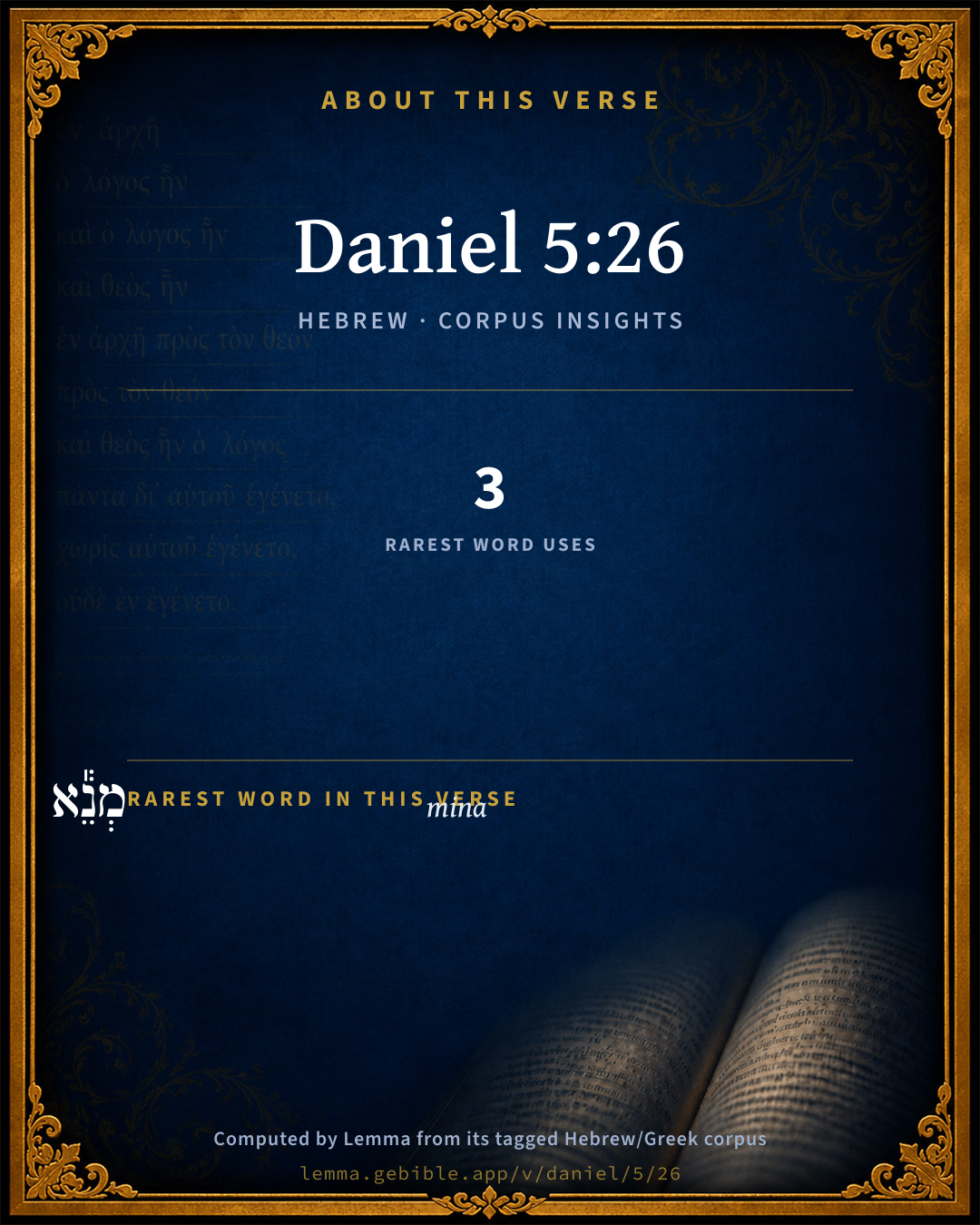
The rarest word here is מְנֵ֕א mina H4484 — appearing just 3 times in the whole Hebrew Bible.

Shared distinctive vocabulary

מְנֵ֕א mina H4484 occurs in 2 verses of the Hebrew Bible. Also found in:

Grammatical profile

  • 1 verb
  • 5 adjectives
  • 2 particles

Verb forms

  • וְהַשְׁלְמַֽהּ Hiphil · Perfect

Hebrew & Septuagint length

In English translation the verse runs 19 words from the Hebrew and 16 from the Septuagint (LXX English) — closely comparable.

A rough comparison of the two English renderings, which tokenize alike — not a word-level alignment.

Word counts can differ between the Hebrew and the Greek without any difference in meaning — e.g. the Hebrew direct-object marker אֵת has no separate Greek word, and Greek often adds the article ὁ.

Cross-references

9

Topical passages linked to Daniel 5:26 in the Treasury of Scripture Knowledge — connected by theme and wording, ordered by reader-vote popularity; previews shown in the World English Bible.

  • Isaiah 47:1–15 Come down, and sit in the dust, virgin daughter of Babylon; sit on the ground without a throne, daughter of the Chaldeans: for you shall no more be called tender and delicate.
  • Jeremiah 25:11–12 This whole land shall be a desolation, and an astonishment; and these nations shall serve the king of Babylon seventy years.
  • Jeremiah 27:7 All the nations shall serve him, and his son, and his son's son, until the time of his own land come: and then many nations and great kings shall make him their bondservant.
  • Job 14:14 If a man dies, shall he live again? All the days of my warfare would I wait, Until my release should come.
  • Isaiah 13:1–14 The burden of Babylon, which Isaiah the son of Amoz did see.
  • Isaiah 21:1–10 The burden of the wilderness of the sea. As whirlwinds in the South sweep through, it comes from the wilderness, from an awesome land.
  • Jeremiah 50:1–46 The word that Yahweh spoke concerning Babylon, concerning the land of the Chaldeans, by Jeremiah the prophet.
  • Daniel 9:2 in the first year of his reign I, Daniel, understood by the books the number of the years about which the word of Yahweh came to Jeremiah the prophet, for the accomplishing of the desolations of Jerusalem, even seventy years.
  • Acts 15:18 All his works are known to God from eternity.'

Cross-references courtesy of OpenBible.info (CC BY 4.0).

Hebrew and Greek witnesses Masoretic Hebrew ↔ Greek Septuagint

The same verse in the two great witnesses to the Old Testament, shown verse-for-verse.

These are two independent witnesses, not word-aligned to each other, and the Septuagint is shown in lemma (dictionary) form.

Hebrew Daniel 5:26 Masoretic · Westminster Leningrad Codex

דְּנָ֖ה פְּשַֽׁר מִלְּתָ֑א מְנֵ֕א מְנָֽה אֱלָהָ֥א מַלְכוּתָ֖ךְ וְהַשְׁלְמַֽהּ

This is the interpretation of the thing: MENE; God has numbered your kingdom, and brought it to an end;

World English Bible · Public Domain

Greek LXX Daniel 5:26 Septuagint · lemma form
This is the interpretation of the sentence: Mane; God has measured your kingdom, and finished it.

LXX2012 (modern English Septuagint) · Public Domain

Hebrew: Westminster Leningrad Codex (CC BY 4.0). Greek: Septuagint (public domain); English from LXX2012 (modern English Septuagint) (Public Domain). How the Septuagint differs from the Hebrew →

Commentary

Notes on Daniel 5:26 from classic Christian and Jewish commentators (each source and its license shown beneath its notes). The classic Christian expositions comment on the surrounding passage and are grouped to its opening verse, so a note may address several verses; the Jewish commentaries on the Tanakh (Rashi and others) are per-verse, so they appear only where the commentator wrote on this verse.

Lemma curates 59 commentaries, every one of them public domain or Creative Commons licensed, each selected and text-cleaned for this edition rather than reprinted as found. About our sources →

Trapp's Complete Commentary

John Trapp

Dan 5:26 This [is] the interpretation of the thing: MENE; God hath numbered thy kingdom, and finished it.

Ver. 26. MENE; God hath numbered thy kingdom.] He hath cast up thy reckonings, taken account of thy maladministration, and calleth for satisfaction. So he dealt with Pharaoh, king of Egypt. Cum duplicarentur lateres, venit Moses, when the tale of bricks was doubled, then came Moses; and when the four hundred, or the four hundred and thirty, years of their captivity in Egypt were exactly expired, the same night were the firstborn slain. So the tyranny of the Roman emperors was numbered at the end of three hundred years after Christ, when they, sounding the triumph before the victory, had foolishly engraven upon pillars of marble these bubbles of words, Nomine Christianorum deleto qui Remp, evertebant, we have utterly rooted out the name of Christians, those traitors to the commonwealth. So, lastly, God hath numbered the Pope’s kingdom, and well-nigh finished it. Let him look to the year 1666. It is plain Satan shall be tied up a thousand years; 666 is the number of the beast; Antichrist shaft so long reign; these two together make the just number. {a}

{a} Time has made a fool of Trapp as it has of many others. Ed.

John Trapp, A Commentary or Exposition upon All the Books of the Old and New Testament (1647–1656) — public domain. Text from a community e-Sword module.

Tyndale Open Study Notes

Tyndale Open Resources

5:26 Mene means ‘numbered’: In this context, it means “reckoned, scrutinized.”

Tyndale Open Study Notes — © Tyndale Open Resources, licensed CC BY-SA 4.0. Text via the HelloAO Bible API.

Jamieson, Fausset & Brown

Robert Jamieson, A. R. Fausset & David Brown

God hath fixed the number of years of thine empire, and that number is now complete.

Jamieson, Fausset & Brown — Commentary Critical and Explanatory on the Whole Bible (1871) — public domain (CC PDM 1.0). Text via the HelloAO Bible API.

The Cambridge Bible for Schools and Colleges

gen. ed. J. J. S. Perowne

26. finished it] completed it, given it its full and complete measure of time. Cp. the cognate adj. in Gen_15:16 (‘full,’ ‘complete’).

The Cambridge Bible for Schools and Colleges (gen. ed. J. J. S. Perowne; Cambridge University Press, 1878–1918) — public domain. Text from a community e-Sword module.

John Gill's Exposition

This is the interpretation of the thing,.... Or, "word" (z); for they might all seem as one word; or this is the sense of the whole:

MENE; as for this word, it signifies,

God hath numbered thy kingdom, and finished it; God had fixed the number of years, how long that monarchy should last, which he was now at the head of, and which was foretold, Jer 25:1, and also the number of years that he should reign over it; and both these numbers were now completed; for that very night Belshazzar was slain, and the kingdom translated to another people: and a dreadful thing it is to be numbered to the sword, famine, and pestilence, or any sore judgment of God for sin, as sometimes men are; so more especially to be appointed to everlasting wrath, and to be numbered among transgressors, among the devils and damned in hell.

(z) "sermonis", V. L. Pagninus, Montanus; "verborum", Junius & Tremellius, Piscator, Broughtonus; "verbi", Cocceius; "illius verbi", Michaelis.

John Gill's Exposition of the Whole Bible (1746–1763) — public domain (CC PDM 1.0). Text via the HelloAO Bible API.

Albert Barnes' Notes on the Bible

This is the interpretation of the thing - It may seem not to have been difficult to interpret the meaning of the communication, when one was able to read the words, or when the sense of the words was understood. But, if the words are placed together, and considered in their abstract form, the whole communication would be so enigmatical that the interpretation would not be likely to occur to anyone without a Divine guidance. This will appear more clearly by arranging the words together, as has been done by Hales:

MENE, number,

MENE, number,

TEKEL, weight,

(PERES) (division)

UPHARSIN, division.

Or, as it is explained more accurately by Berholdt and Gesenius:

Mene, Numbered,

Mene, Numbered,

Tekel, Weighted,

Upharsin. Divided.

From this arrangement it will be at once seen that the interpretation proposed by Daniel was not one that would have been likely to have occurred to anyone.

Mene - מנא menê'. This word is a passive participle from מנה menâh - “to number, to review.” - Gesenius, “Lex.” The verb is also written מנא menâ' - Buxtorf, “Lex.” It would be literally translated “numbered,” and would apply to that of which an estimate was taken by counting. We use now an expression which would convey a similar idea, when we say of one that “his days are numbered;” that is, he has not long to live, or is about to die. The idea seems to be taken from the fact, that the duration of a man’s life cannot usually be known, and in the general uncertainty we can form no correct estimate of it, but when he is old, or when he is dangerously sick, we feel that we can with some degree of probability number his days, since he cannot now live long. Such is the idea here, as explained by Daniel. All uncertainty about the duration of the kingdom was now removed, for, since the evil had come, an exact estimate of its whole duration - of the number of the years of its continuance - could be made. In the Greek of Theodotion there is no attempt to translate this word, and it is retained in Greek letters - Μανὴ Manē. So also in the Codex Chisianus and in the Latin Vulgate.

God hath numbered thy kingdom - The word which is used here, and rendered “numbered” - מנה menâh - is the verb of which the previous word is the participle. Daniel applies it to the “kingdom” or “reign” of the monarch, as being a thing of more importance than the life of the king himself. It is evident, if, according to the common interpretation of Dan 5:30, Belshazzar was slain that very night, it “might” have been applied to the king himself, meaning that his days were numbered, and that he was about to die. But this interpretation (see Notes) is not absolutely certain, and perhaps the fact that Daniel did not so apply the word may be properly regarded as one circumstance showing that such an interpretation is not necessary, though probably it is the correct one.

And finished it - This is not the meaning of the word “Mene,” but is the explanation by Daniel of the thing intended. The word in its interpretation fairly implied that; or that might be understood from it. The fact that the “kingdom” in its duration was “numbered,” properly expressed the idea that it was now to come to an end. It did actually then come to an end by being merged in that of the Medes and Persians.

Albert Barnes' Notes on the Bible (1834–1885) — public domain. Text from a community e-Sword/MySword module.

Matthew Poole's English Annotations

Mene, Mene; He hath numbered, or, It is numbered, it is numbered. These words are doubled for the greater confirmation, to note that the number of his sins and of his days, both of life and reign, are full. It relates to the number of the seventy years’ captivity now completed, or to the seventy years for the overthrow of the Babylonish empire, or the translation of it to the Medes and Persians, foretold Isa 13; Isa 14; Jer 1;, and in the dream, Dan 2:32.

Matthew Poole's English Annotations on the Holy Bible (1683–1685) — public domain. Text from a community e-Sword/MySword module.

John Wesley's Explanatory Notes

MENE - MENE MENE, it is numbered, it is numbered; the words are doubled for the greater confirmation. It relates to the number of the seventy years for the overthrow of the Babylonish empire.

John Wesley, Explanatory Notes Upon the Whole Bible (1754–1765) — public domain. Text via the GEBible commentary corpus.

Rashi

Rabbi Shlomo Yitzchaki (Rashi)

MENE God has counted i.e., MENE means that God has counted your kingdom.

and has brought it to an end He calculated the end of the allotted time for the kingdom of your father and his seed, and found that it has already been completed.

Rashi on the Tanakh — English translations: “The Judaica Press complete Tanach with Rashi, translated by A. J. Rosenberg” (CC BY 4.0); “Pentateuch with Rashi's commentary by M. Rosenbaum and A.M. Silbermann, 1929-1934” (public domain); “The Metsudah Tanach series, Lakewood, N.J” (CC BY 4.0); and “The Book of Joshua, Metsudah Publications, 1997” (CC BY 4.0). Text via Sefaria.

Lesson kit

Teaching starters — assembled from the data on this page, not authored interpretation. Every prompt links to the verse data it draws on. Edit before teaching.

Daniel, in the Prophets, opens this verse with 8 words (8 distinct Hebrew lemmas). Its most distinctive word is mᵉnêʼ (“mina”). A historical commentator’s framing appears above. Read the whole chapter for the surrounding context.

Discussion questions

  1. How does “mina” (mᵉnêʼ) shape what this verse is saying?
  2. Daniel 5:25 shares the word «mina» with this verse. How do the two illuminate each other?
  3. The translations on this page render this verse differently — a whole-verse word diff, not a word-by-word alignment. What might account for the different wordings?
  4. The verb «וְהַשְׁלְמַֽהּ» is Hiphil Perfect. How does its form color the action?
  5. Reading how Trapp's Complete Commentary and Tyndale Open Study Notes read this verse, where do the two commentators agree and where do they part?

Things to notice

Reading settings

Reading text

Shown beneath each verse's original-language words.

Old Testament
Old Testament edition

Read the OT as the Masoretic Hebrew (MT) or the Greek Septuagint (LXX).

English shown for the Greek Septuagint (in the Hebrew ↔ Greek comparison).

Comparing translations? Open the Compare panel on any verse page to stack up to four side by side.