
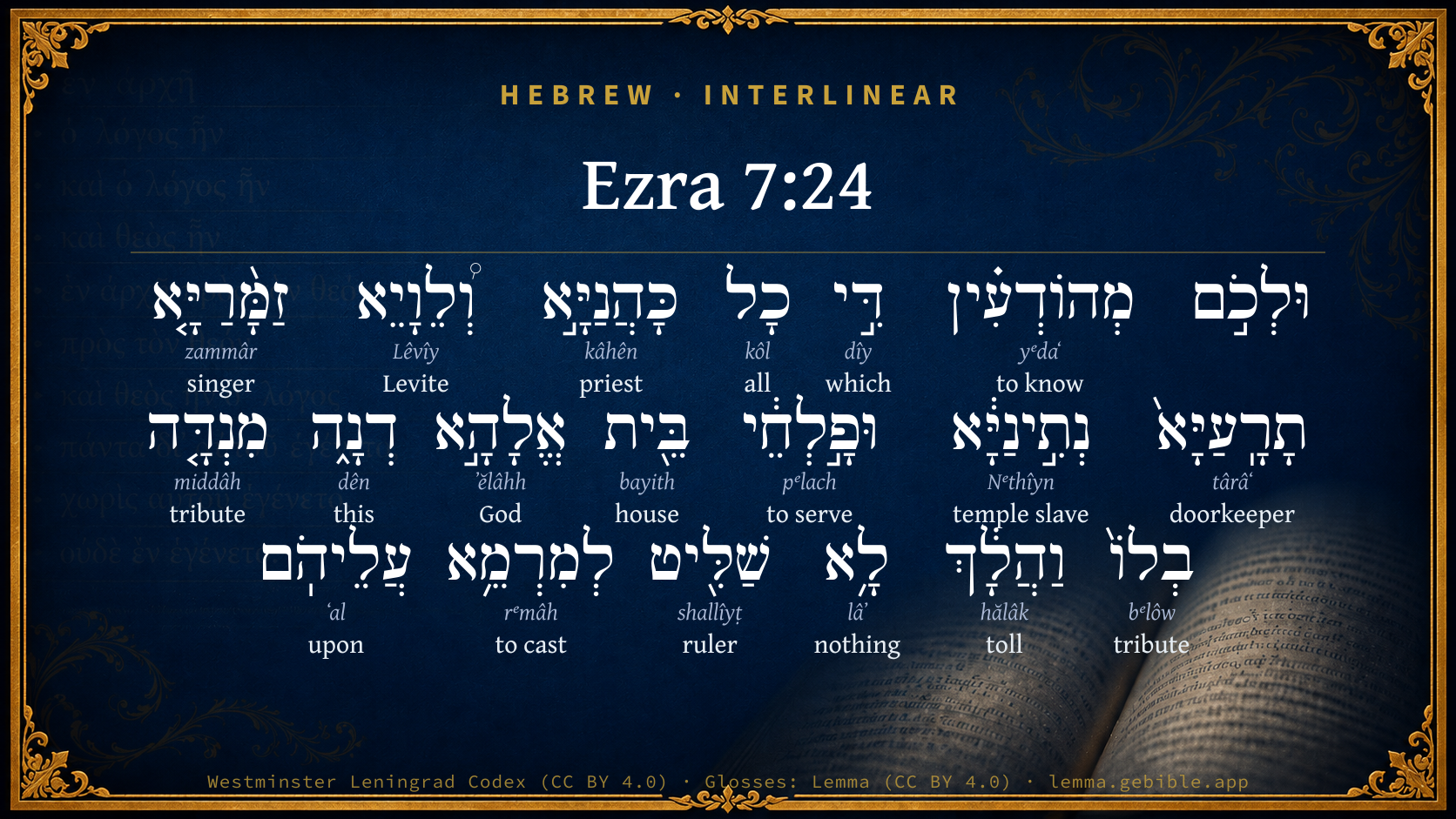
Ezra 7:24

Hebrew (Westminster Leningrad Codex) Ezra 7:24 appears in the Hebrew Old Testament. The text above is from the Westminster Leningrad Codex. Each word links to its Strong’s number, a concise gloss, and parsing drawn from the Open Scriptures Hebrew Bible morphology. Click any word for its full Brown-Driver-Briggs (BDB) entry.
Download image
Cite this verse

Ezra 7:24 (World English Bible). Public Domain. Lemma interlinear Bible study tool, https://lemma.gebible.app/v/ezra/7/24.

Show BibTeX & RIS
BibTeX
RIS
English Translation
Also we inform you, that touching any of the priests and Levites, the singers, porters, Nethinim, or servants of this house of God, it shall not be lawful to impose tribute, custom, or toll, on them.
World English Bible · Public Domain
Highlights
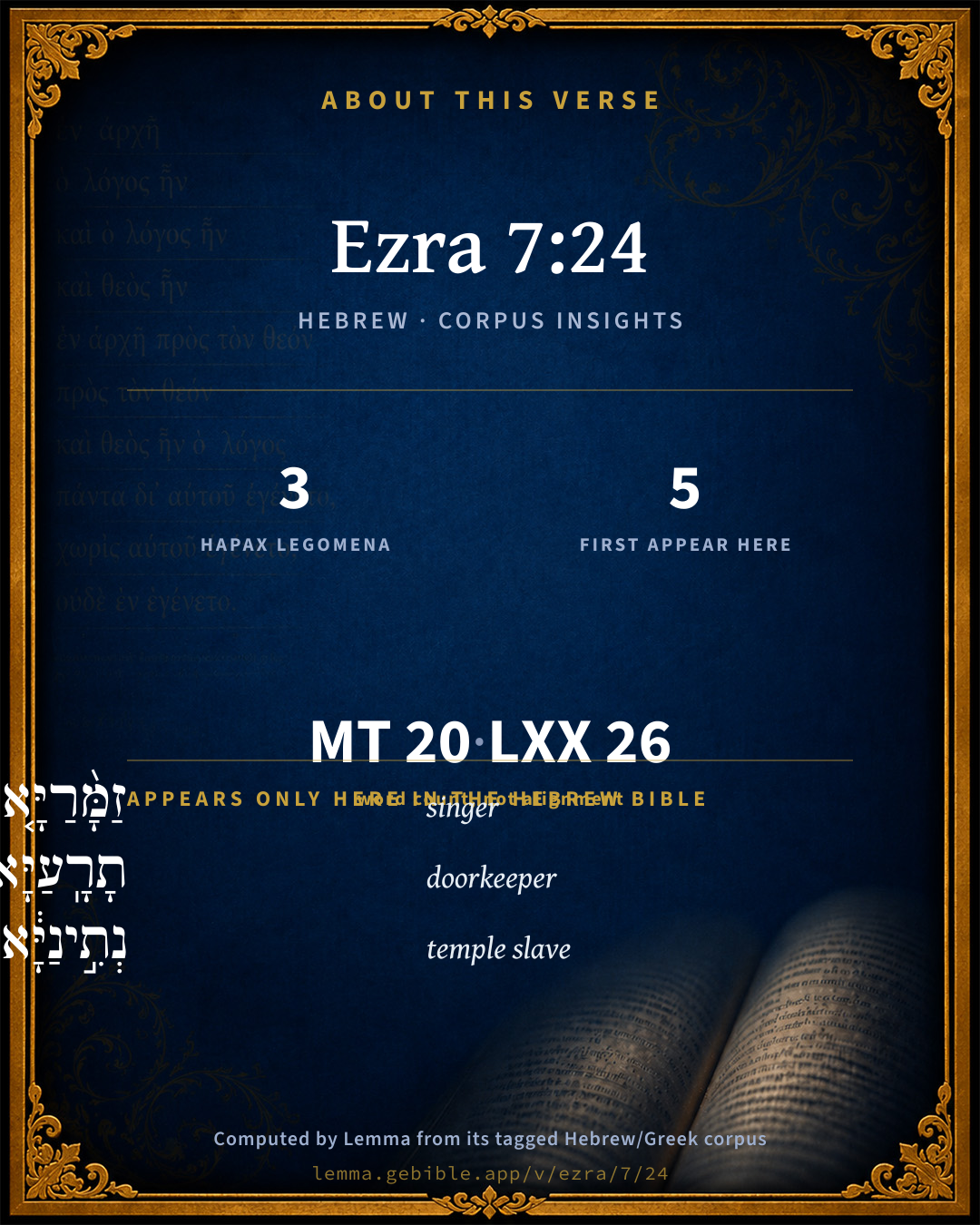
  • 3 hapax legomena — only here in the Hebrew Bible
  • 5 first appearances in the Hebrew Bible
Full analysis ↓
Download a study sheet

One document with this verse’s original text, its word-by-word gloss line, the meaning frame, cross-references with their text, attributed commentary, and full source and license credits — printable, and it pastes into notes with its structure intact.

This verse Autodidact and up

Study sheet (.html) Plain text (.txt)

A passage Seminary Student

Up to 50 verses in one chapter. A passage sheet keeps up to 6 commentary sources and 12 cross-references per verse, in the order this page ranks them, and says so on the sheet whenever that leaves anything out. Ask for a single verse and you get the Autodidact verse sheet above.

Everything on this page stays free to read, with no account — the sheet is a download of what is already on screen, not access to it.

Want to remove ads? Support Godless Engineer
Compare translations 3

The same verse in 3 English versions, stacked beneath the original-language interlinear above. Click any original word for its lexicon entry.

Each is an independent rendering of the whole verse — the interlinear is not word-aligned to these translations.

Highlighted words mark where these versions differ — a whole-verse word diff, not a word-by-word alignment.

  • World English Bible Public Domain
    Also we inform you, that touching any of the priests and Levites, the singers, porters, Nethinim, or servants of this house of God, it shall not be lawful to impose tribute, custom, or toll, on them.
  • King James Version Public Domain
    Also we certify you, that touching any of the priests and Levites, singers, porters, Nethinims, or ministers of this house of God, it shall not be lawful to impose toll, tribute, or custom, upon them.
  • unfoldingWord Literal Text CC BY-SA 4.0
    And to you is made known that there is no authority to set tax, tribute, or custom upon all the priests, and the Levites, the singers, the gatekeepers, the temple servants, and the servants of that house of God.

unfoldingWord Literal Text — © unfoldingWord, licensed CC BY-SA 4.0. Word-aligned USFM3 via Door43 (git.door43.org/unfoldingWord/en_ult).

Versions to compare (up to 4)

3 of 4 selected

Show all 18 translations

Every available English version of this verse, each an independent rendering of the whole verse.

  • World English Bible Public Domain
    Also we inform you, that touching any of the priests and Levites, the singers, porters, Nethinim, or servants of this house of God, it shall not be lawful to impose tribute, custom, or toll, on them.
  • Berean Standard Bible Public Domain
    And be advised that you have no authority to impose tribute, duty, or toll on any of the priests, Levites, singers, doorkeepers, temple servants, or other servants of this house of God.
  • Majority Standard Bible Public Domain
    And be advised that you have no authority to impose tribute, duty, or toll on any of the priests, Levites, singers, doorkeepers, temple servants, or other servants of this house of God.
  • King James Version Public Domain
    Also we certify you, that touching any of the priests and Levites, singers, porters, Nethinims, or ministers of this house of God, it shall not be lawful to impose toll, tribute, or custom, upon them.
  • American Standard Version (1901) Public Domain
    Also we certify you, that touching any of the priests and Levites, the singers, porters, Nethinim, or servants of this house of God, it shall not be lawful to impose tribute, custom, or toll, upon them.
  • Revised Version (1885) Public Domain
    Also we certify you, that touching any of the priests and Levites, the singers, porters, Nethinim, or servants of this house of God, it shall not be lawful to impose tribute, custom, or toll, upon them.
  • Geneva Bible (1599) Public Domain
    And we certifie you, that vpon any of the Priestes, Leuites, singers, porters, Nethinims, or Ministers in this house of God, there shall no gouernour laye vpon them tolle, tribute nor custome.
  • Douay-Rheims (1899) Public Domain
    We give you also to understand concerning all the priests, and the Levites, and the singers, and the porters, and the Nathinites, and ministers of the house of this God, that you have no authority to impose toll or tribute, or custom upon them.
  • Young's Literal Translation Public Domain
    `And to you we are making known, that upon any of the priests and Levites, singers, gatekeepers, Nethinim, and servants of the house of God, tribute and custom there is no authority to lift up.
  • Literal Standard Version CC BY-SA 4.0
    And to you we are making known, that on any of the priests and Levites, singers, gatekeepers, Nethinim, and servants of the house of God, tribute and custom there is no authority to lift up.
  • Unlocked Literal Bible CC BY-SA 4.0
    We are informing them about you not to impose any tribute or taxes on any of the priests, Levites, musicians, gatekeepers, or on the people assigned to the service of the temple and servants of the house of this God.
  • unfoldingWord Literal Text CC BY-SA 4.0
    And to you is made known that there is no authority to set tax, tribute, or custom upon all the priests, and the Levites, the singers, the gatekeepers, the temple servants, and the servants of that house of God.
  • Darby Bible Public Domain
    Also we inform you, as regards all the priests and Levites, singers, doorkeepers, Nethinim, and ministers of this house of God, it shall not be lawful to impose tribute, tax, and toll upon them.
  • World Messianic Bible Public Domain
    Also we inform you that it shall not be lawful to impose tribute, custom, or toll on any of the priests, Levites, singers, gatekeepers, temple servants, or laborers of this house of God.
  • Webster's Bible Public Domain
    Also we certify you, that concerning any of the priests and Levites, singers, porters, Nethinims, or ministers of this house of God, it shall not be lawful to impose toll, tribute, or custom upon them.
  • Free Bible Version CC BY-SA 4.0
    Also be aware that all of the priests, Levites, singers, doorkeepers, Temple servants, or other workers of this Temple are exempt from paying any tax, tribute, or fees, and you are not authorized to charge them.
  • Bible in Basic English Public Domain
    In addition, we make it clear to you, that it will be against the law to put any tax or payment in goods or forced payment on any of the priests or Levites, the music-makers, door-keepers, Nethinim, or any servants of this house of God.
  • JPS Tanakh (1917) Public Domain
    Also we announce to you, that touching any of the priests and Levites, the singers, porters, Nethinim, or servants of this house of God, it shall not be lawful to impose tribute, impost, or toll, upon them.

Literal Standard Version (2020), Covenant Press — licensed CC BY-SA 4.0. Text via the HelloAO Bible API (eBible.org). Unlocked Literal Bible (unfoldingWord) — licensed CC BY-SA 4.0. Text via the HelloAO Bible API (eBible.org). unfoldingWord Literal Text — © unfoldingWord, licensed CC BY-SA 4.0. Word-aligned USFM3 via Door43 (git.door43.org/unfoldingWord/en_ult). Free Bible Version, Dr. Jonathan Gallagher — licensed CC BY-SA 4.0. Text via the HelloAO Bible API (eBible.org).

Word by word

More ways to search: Search by grammar → Find every occurrence → Compare this word →

Practice this passage: Drill this verse → Learn its vocabulary →

זַמָּ֨רַיָּ֤א
zammâr
H2171
“singers · the”
Adjective, N, Common + Particle, Definite Article
Part of Speech
Adjective + Particle
Type
Definite Article
Full BDB Definition

Origin: from the same as H2170

TWOT: 2710b

singer
  1. מְהוֹדְעִ֗ין yᵉdaʻ H3046 “knowing” Adjective, V
  2. דִּ֣י dîy H1768 “which” Adjective, T
  3. כָל kôl H3606 “all of” Adjective, N, Common
  4. כָּהֲנַיָּ֣א kâhên H3549 “priests · the” Adjective, N, Common + Particle, Definite Article
  5. וְ֠לֵוָיֵא Lêvîy H3879 “and · Levites · the” Adjective, C + Noun, Gentilic, Masculine, Plural, Determined + Particle, Definite Article
  6. תָרָֽעַיָּא֙ târâʻ H8652 “doorkeepers · the” Adjective, N, Common + Particle, Definite Article
  7. נְתִ֣ינַיָּ֔א Nᵉthîyn H5412 “temple slaves · the” Adjective, N, Common + Particle, Definite Article
  8. וּפָ֣לְחֵ֔י pᵉlach H6399 “and · serving” Adjective, C + Verb, Qal, Participle Active, Masculine, Plural, Construct
  9. בֵּ֖ית bayith H1005 “house of” Adjective, N, Common
  10. אֱלָהָ֣א ʼĕlâhh H426 “God · the” Adjective, N, Common + Particle, Definite Article
  11. דְנָ֑ה dên H1836 “this” Adjective, P
  12. מִנְדָּ֤ה middâh H4061 “tribute” Adjective, N, Common
  13. בְלוֹ֙ bᵉlôw H1093 “tribute” Adjective, N, Common
  14. וַהֲלָ֔ךְ hălâk H1983 “and · toll” Adjective, C + Noun, Common, Masculine, Singular, Absolute
  15. לָ֥א lâʼ H3809 “nothing” Adjective, T
  16. שַׁלִּ֖יט shallîyṭ H7990 “ruler” Adjective, A
  17. לְמִרְמֵ֥א rᵉmâh H7412 “to cast” Adjective, R + Verb, Qal, Infinitive Construct
  18. עֲלֵיהֹֽם ʻal H5922 “upon · them” Adjective, R + Suffix, Personal, 3rd Person, Masculine, Plural

About this verse

These counts appear in no published source. They are computed here, from the morphology-tagged text and Lemma’s own curated glosses. What Lemma adds →

20
words
19
distinct lemmas
Historical
section

Notable vocabulary

3 hapax legomena — words that appear only here in the entire Hebrew Bible:

  • זַמָּ֨רַיָּ֤א singer H2171
  • תָרָֽעַיָּא֙ doorkeeper H8652
  • נְתִ֣ינַיָּ֔א temple slave H5412

First appearance in Scripture

These words make their first canonical appearance in the Hebrew Bible here:

  • זַמָּ֨רַיָּ֤א singer H2171
  • תָרָֽעַיָּא֙ doorkeeper H8652
  • נְתִ֣ינַיָּ֔א temple slave H5412
  • וּפָ֣לְחֵ֔י to serve H6399
  • לְמִרְמֵ֥א to cast H7412

Shared distinctive vocabulary

בְלוֹ֙ tribute H1093 occurs in 3 verses of the Hebrew Bible. Also found in:

Grammatical profile

  • 2 verbs
  • 1 noun
  • 10 adjectives
  • 1 preposition
  • 6 particles

Verb forms

  • וּפָ֣לְחֵ֔י Qal · Participle Active
  • לְמִרְמֵ֥א Qal · Infinitive Construct

Hebrew & Septuagint length

In English translation the verse runs 36 words from the Hebrew and 41 from the Septuagint (LXX English) — closely comparable.

A rough comparison of the two English renderings, which tokenize alike — not a word-level alignment.

Word counts can differ between the Hebrew and the Greek without any difference in meaning — e.g. the Hebrew direct-object marker אֵת has no separate Greek word, and Greek often adds the article ὁ.

In the original languages it is 20 Hebrew tokens and 26 Greek tokens — but the two are counted differently (Hebrew bundles its prefixes and suffixes into one token; the Greek is in lemma form), so that isn’t a like-for-like length.

Cross-references

4

Topical passages linked to Ezra 7:24 in the Treasury of Scripture Knowledge — connected by theme and wording, ordered by reader-vote popularity; previews shown in the World English Bible.

  • Ezra 4:13 Be it known now to the king that if this city is built, and the walls finished, they will not pay tribute, custom, or toll, and in the end it will be hurtful to the kings.
  • Ezra 7:7 There went up some of the children of Israel, and of the priests, and the Levites, and the singers, and the porters, and the Nethinim, to Jerusalem, in the seventh year of Artaxerxes the king.
  • Ezra 2:36–55 The priests: the children of Jedaiah, of the house of Jeshua, nine hundred seventy-three.
  • Ezra 4:20 There have been mighty kings also over Jerusalem, who have ruled over all [the country] beyond the River; and tribute, custom, and toll, was paid to them.

Cross-references courtesy of OpenBible.info (CC BY 4.0).

Hebrew and Greek witnesses Masoretic Hebrew ↔ Greek Septuagint

The same verse in the two great witnesses to the Old Testament, shown verse-for-verse.

These are two independent witnesses, not word-aligned to each other, and the Septuagint is shown in lemma (dictionary) form.

Hebrew Ezra 7:24 Masoretic · Westminster Leningrad Codex

וּלְכֹ֣ם מְהוֹדְעִ֗ין דִּ֣י כָל כָּהֲנַיָּ֣א וְ֠לֵוָיֵא זַמָּ֨רַיָּ֤א תָרָֽעַיָּא֙ נְתִ֣ינַיָּ֔א וּפָ֣לְחֵ֔י בֵּ֖ית אֱלָהָ֣א דְנָ֑ה מִנְדָּ֤ה בְלוֹ֙ וַהֲלָ֔ךְ לָ֥א שַׁלִּ֖יט לְמִרְמֵ֥א עֲלֵיהֹֽם

Also we inform you, that touching any of the priests and Levites, the singers, porters, Nethinim, or servants of this house of God, it shall not be lawful to impose tribute, custom, or toll, on them.

World English Bible · Public Domain

Greek LXX Ezra 7:24 Septuagint · lemma form

καί σύ γνωρίζω ἐν πᾶς ὁ ἱερεύς καί ὁ λευείτης ᾄδω πυλωρός ναθινιμ καί λειτουργός οἶκος θεός οὗτος φόρος μή εἰμί σύ οὐ ἐξουσιάζω καταδουλόω αὐτός

Also this has been declared to you, with respect to all the priests, and Levites, the singers, porters, Nathinim and ministers of the house of God, let no tribute be paid to you; you shall not have power to oppress them.

LXX2012 (modern English Septuagint) · Public Domain

In the Septuagint this is one book — Esdras B (2 Esdras): Ezra is chapters 1–10, Nehemiah 11–23.

Hebrew: Westminster Leningrad Codex (CC BY 4.0). Greek: Septuagint (public domain); English from LXX2012 (modern English Septuagint) (Public Domain). How the Septuagint differs from the Hebrew →

Commentary

Notes on Ezra 7:24 from classic Christian and Jewish commentators (each source and its license shown beneath its notes). The classic Christian expositions comment on the surrounding passage and are grouped to its opening verse, so a note may address several verses; the Jewish commentaries on the Tanakh (Rashi and others) are per-verse, so they appear only where the commentator wrote on this verse.

Lemma curates 59 commentaries, every one of them public domain or Creative Commons licensed, each selected and text-cleaned for this edition rather than reprinted as found. About our sources →

Trapp's Complete Commentary

John Trapp

Ezr 7:24 Also we certify you, that touching any of the priests and Levites, singers, porters, Nethinims, or ministers of this house of God, it shall not be lawful to impose toll, tribute, or custom, upon them.

Ver. 24. And also we certify you, that touching any of the priests] These he taketh special order for, that they be freed from public payments; and the like care was taken by our ancestors for the ministers of the Church of England, as appeareth by Magna Charta, chpat. 14. Their maintenance is of the law of nature, Gen 47:22. Jezebel provided for her priests; idolatrous Micah for his Levite; the Papists for their shavelings, granting them many and great immunities, and being so free to them, that there was need of a statute of Mortmain providing that men should give no more to the Church. But tempera mutantur, &c. Seasons be changed.

John Trapp, A Commentary or Exposition upon All the Books of the Old and New Testament (1647–1656) — public domain. Text from a community e-Sword module.

Joseph Benson's Commentary

Ezr 7:24. It shall not be lawful to impose tolls, &c. — Thus he discharged all the ministers of religion, from the greatest of the priests to the least of the Nethinims, from paying taxes to the government, and made it unlawful for the king’s officers to impose any taxes on them. This was putting a great honour upon them, as free denizens of the empire, and would gain them respect as favourites of the crown, at the same time that it gave them liberty to attend on their ministry with freedom and cheerfulness.

Joseph Benson's Commentary on the Old and New Testaments (1811–1818) — public domain. Text from a community e-Sword module.

Tyndale Open Study Notes

Tyndale Open Resources

7:24 The tax exemptions given to Temple personnel in Jerusalem were similar to the conciliatory gestures made to those in other nations.

Tyndale Open Study Notes — © Tyndale Open Resources, licensed CC BY-SA 4.0. Text via the HelloAO Bible API.

Adam Clarke's Commentary

Verse 24. It shall not be lawful to impose toll] As these persons had no private revenues, it would have been unreasonable to have laid them under taxation.

Adam Clarke's Commentary on the Bible (1810–1826) — public domain. Text from a community e-Sword/MySword module.

Ellicott's Commentary for English Readers

(24) We certify you.—The exemption of so large a number as the entire ministry of the Temple from all kinds of taxation is emphatically introduced.

A Bible Commentary for English Readers, edited by Charles John Ellicott (1878–1897) — public domain. Text from a community e-Sword module.

The Cambridge Bible for Schools and Colleges

gen. ed. J. J. S. Perowne

24. Nethinims] R.V. Nethinim, cf. Ezr_2:43.

ministers] R.V. servants. The word in the original connected with that rendered “service” (Ezr_7:19). The expression “or servants” would cover any other branch (e.g. Solomon’s servants, Ezr_2:55) of attendants on the Temple.

toll, tribute, or custom] R.V. tribute, custom, or toll. See on Ezr_5:13.

Compare immunity from all taxation described by Josephus as having been granted to the priests and Levites by Antiochus the Great (Ant. XII. 3. 3), “And let the senate and the priests and the scribes of the Temple and the sacred singers be discharged from all poll-money and he crown tax, and other taxes also.” (Tran. Whiston.)

The Cambridge Bible for Schools and Colleges (gen. ed. J. J. S. Perowne; Cambridge University Press, 1878–1918) — public domain. Text from a community e-Sword module.

John Gill's Exposition

And whosoever will not do the law of thy God, and the law of the king,.... Either the judge who delays judgment, or does not execute it according to the law of God, and of the king; or the people, that do not obey the law of God in matters of religion, and the law of the king in civil things, Judea being now a province of the Persian empire; though some think the law of the king only refers to this law or decree of the king, which gave the Jews power to execute their own laws:

let judgment be executed speedily upon him; immediately, without delay, according to the nature of his crime:

whether it be unto death; if guilty of a capital crime, deserving death, let him be put to death:

or to banishment; from his native country to a foreign distant land:

or to rooting out (y), as the word signifies; an utter extirpation of him and his family, a destroying him root and branch; or, as Jarchi expresses it, a rooting him out of the world, his seed and family:

or to confiscation of goods; to payment of mulcts and fines:

or to imprisonment; for such a term of time; all according to the breach of what law he may be guilty of; thus far the king's decree.

(y) "ad eradicationem ejus", Pagninus, Montanus; "ad eradicationem", Tigurine version, Vatablus, De Dieu, Michaelis.

John Gill's Exposition of the Whole Bible (1746–1763) — public domain (CC PDM 1.0). Text via the HelloAO Bible API.

Albert Barnes' Notes on the Bible

The decree of Artaxerxes was more favorable to the Jews than those of all previous Persian monarchs. We hear of a similar exemption of ecclesiastics from tribute, only to a less extent, under the Seleucidae.

Ministers - The rare word here used, which in Daniel has the sense of “worshippers,” appears to designate in this place the lowest class of persons employed in the service of the temple.

Albert Barnes' Notes on the Bible (1834–1885) — public domain. Text from a community e-Sword/MySword module.

Haydock's Catholic Bible Commentary

Nathinites. 3 Esdras, "sacred slaves." (Haydock) --- Artaxerxes confirms the immunities granted by the law of God, (Numbers iii. 6, 12,) by the kings of Egypt, (Genesis xlvii. 22,) and by all nations to the ministers of religion. (Calmet)

George Leo Haydock (1774–1849), Haydock's Catholic Family Bible and Commentary, 1859 edition — public domain. Excludes Psalms (Douay-Rheims chapter numbering differs from Protestant) and Deuterocanonical books (Catholic canon only).

Whedon's Commentary on the Bible

Daniel D. Whedon

24. Toll, tribute, or custom — See note on Ezr_4:13.

Daniel D. Whedon (gen. ed.), Commentary on the Old and New Testaments (1874–1909) — public domain. Text from a community e-Sword module.

The Pulpit Commentary

We certify you. The use of the plural is curious. Hitherto the king has made every permission and command to rest on his own sole authority (see vers. 12, 13, 21). Now that he reaches the most important point in the whole of his decree the permanent exemption of a large part of the people from liability to taxation of any kind, his style changes, and he says, We certify you." Perhaps he speaks in the name of himself and his successors; or possibly he means to say that in this matter he has asked and obtained the assent and consent of his council (compare ver. 28). Or ministers. Rather, "and ministers." It is generally allowed that the word here translated "ministers" is not applied to the Nethinim, but to that still lower grade of attendants in the sanctuary called "Solomon"s servants" in Ezr_2:55-58, and Neh_7:57-60. It shall not be lawful to impose toll, tribute, or custom upon them It may be suspected from this proviso that the Persians exempted from taxation their own (Magian) priests, though of this there is no other evidence. But they would scarcely have placed a foreign priesthood on a higher level of favour than their own.

The Pulpit Commentary (1880–1919), ed. H.D.M. Spence-Jones & Joseph S. Exell — public domain. Text from a community e-Sword module.

unfoldingWord translationNotes

Door43 World Missions Community

Connecting Statement:

This continues the decree that King Artaxerxes gave to Ezra.

We are informing them about you not to impose any tribute or taxes

"We are telling them not to impose any tribute or taxes"

musicians

people who play musical instruments

translationWords

tax

priest

Levi

temple

servant

unfoldingWord translationNotes — © Distant Shores Media and the Door43 World Missions Community, licensed CC BY-SA 4.0. Source: git.door43.org/Door43/en_tn.

Rashi

Rabbi Shlomo Yitzchaki (Rashi)

And we are making known to you And we are making known to you that [over] all the priests, the Levites, the musicians, the gatekeepers, and the Nethinites, who are wood cutters and water drawers for the altar, and those who serve in this House of the Holy One, no man shall be empowered over them to levy upon them any tribute or head tax, but they shall be free from the service of the king.

Rashi on the Tanakh — English translations: “The Judaica Press complete Tanach with Rashi, translated by A. J. Rosenberg” (CC BY 4.0); “Pentateuch with Rashi's commentary by M. Rosenbaum and A.M. Silbermann, 1929-1934” (public domain); “The Metsudah Tanach series, Lakewood, N.J” (CC BY 4.0); and “The Book of Joshua, Metsudah Publications, 1997” (CC BY 4.0). Text via Sefaria.

Lesson kit

Teaching starters — assembled from the data on this page, not authored interpretation. Every prompt links to the verse data it draws on. Edit before teaching.

Ezra, in the Historical, opens this verse with 20 words (19 distinct Hebrew lemmas). Its most distinctive word is zammâr (“singer”). A historical commentator’s framing appears above. Read the whole chapter for the surrounding context.

Discussion questions

  1. The word zammâr carries the sense “singer.” How does it shape the verse?
  2. 3 words here appear nowhere else in the Hebrew Bible. Why might the author reach for such rare wording?
  3. 5 words make their first appearance in Scripture here. What does this debut establish?
  4. How does Ezra 4:13, which shares the word «tribute», read alongside this verse?
  5. These translations render this verse differently. What is at stake in choosing one wording over another?
  6. «וּפָ֣לְחֵ֔י» is a Qal Participle Active verb. How does that grammatical form shape the action described?
  7. Compare how Trapp's Complete Commentary and Joseph Benson's Commentary read this verse. Where do they agree or differ?

Things to notice

Reading settings

Reading text

Shown beneath each verse's original-language words.

Old Testament
Old Testament edition

Read the OT as the Masoretic Hebrew (MT) or the Greek Septuagint (LXX).

English shown for the Greek Septuagint (in the Hebrew ↔ Greek comparison).

Comparing translations? Open the Compare panel on any verse page to stack up to four side by side.