
Ezra 5:16

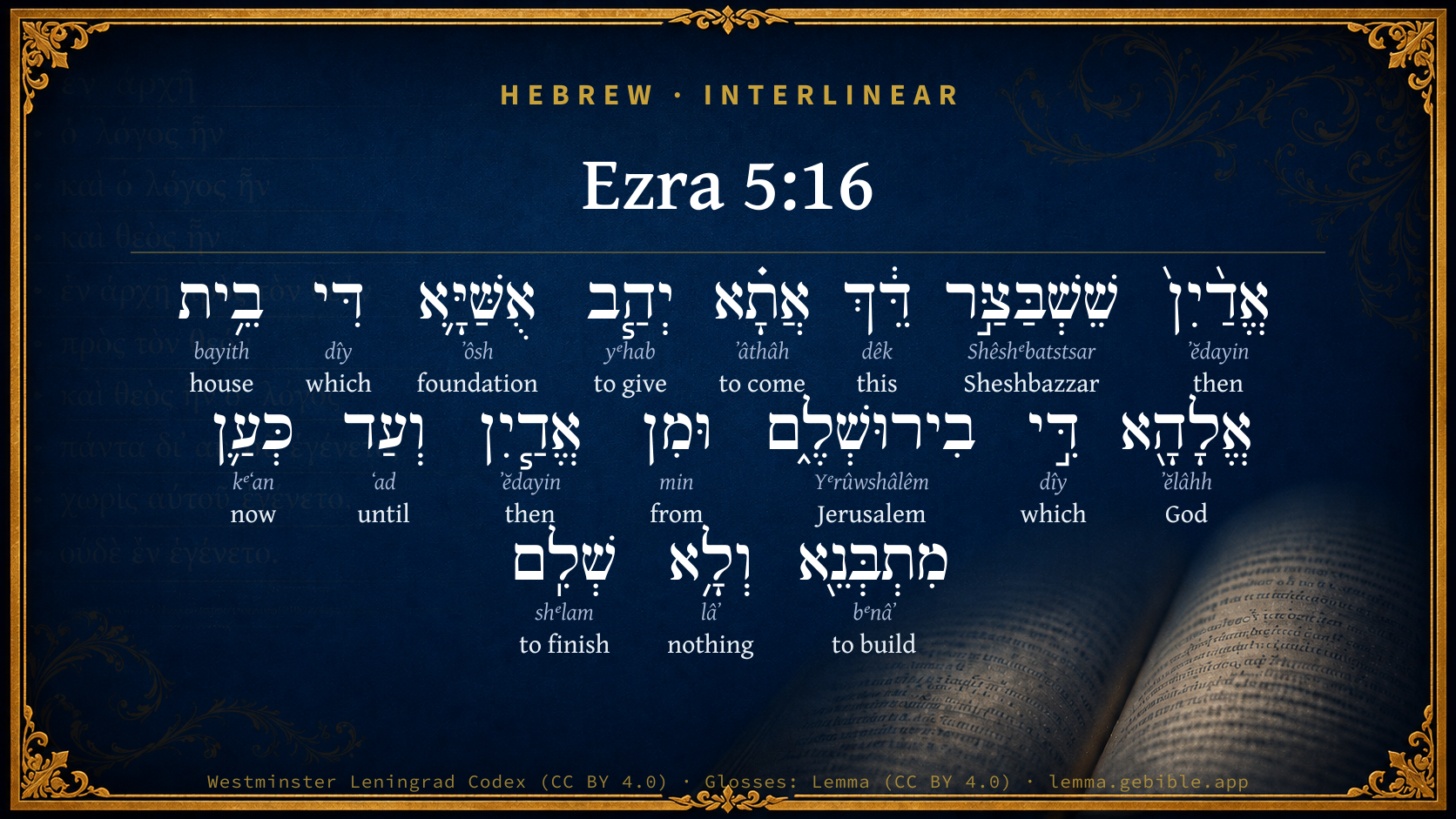
Hebrew (Westminster Leningrad Codex) Ezra 5:16 appears in the Hebrew Old Testament. The text above is from the Westminster Leningrad Codex. Each word links to its Strong’s number, a concise gloss, and parsing drawn from the Open Scriptures Hebrew Bible morphology. Click any word for its full Brown-Driver-Briggs (BDB) entry.
Download image
Cite this verse

Ezra 5:16 (World English Bible). Public Domain. Lemma interlinear Bible study tool, https://lemma.gebible.app/v/ezra/5/16.

Show BibTeX & RIS
BibTeX
RIS
English Translation
Then came the same Sheshbazzar, and laid the foundations of the house of God which is in Jerusalem: and since that time even until now has it been in building, and yet it is not completed.
World English Bible · Public Domain
Highlights
  • 1 first appearance in the Hebrew Bible
Full analysis ↓
Download a study sheet

One document with this verse’s original text, its word-by-word gloss line, the meaning frame, cross-references with their text, attributed commentary, and full source and license credits — printable, and it pastes into notes with its structure intact.

This verse Autodidact and up

Study sheet (.html) Plain text (.txt)

A passage Seminary Student

Up to 50 verses in one chapter. A passage sheet keeps up to 6 commentary sources and 12 cross-references per verse, in the order this page ranks them, and says so on the sheet whenever that leaves anything out. Ask for a single verse and you get the Autodidact verse sheet above.

Everything on this page stays free to read, with no account — the sheet is a download of what is already on screen, not access to it.

Want to remove ads? Support Godless Engineer
Compare translations 3

The same verse in 3 English versions, stacked beneath the original-language interlinear above. Click any original word for its lexicon entry.

Each is an independent rendering of the whole verse — the interlinear is not word-aligned to these translations.

Highlighted words mark where these versions differ — a whole-verse word diff, not a word-by-word alignment.

  • World English Bible Public Domain
    Then came the same Sheshbazzar, and laid the foundations of the house of God which is in Jerusalem: and since that time even until now has it been in building, and yet it is not completed.
  • King James Version Public Domain
    Then came the same Sheshbazzar, and laid the foundation of the house of God which is in Jerusalem: and since that time even until now hath it been in building, and yet it is not finished.
  • unfoldingWord Literal Text CC BY-SA 4.0
    Then that Sheshbazzar came; he laid the foundation of the house of God which is in Jerusalem. And from then even until now it is being built, but it is not complete.’

unfoldingWord Literal Text — © unfoldingWord, licensed CC BY-SA 4.0. Word-aligned USFM3 via Door43 (git.door43.org/unfoldingWord/en_ult).

Versions to compare (up to 4)

3 of 4 selected

Show all 18 translations

Every available English version of this verse, each an independent rendering of the whole verse.

  • World English Bible Public Domain
    Then came the same Sheshbazzar, and laid the foundations of the house of God which is in Jerusalem: and since that time even until now has it been in building, and yet it is not completed.
  • Berean Standard Bible Public Domain
    So this Sheshbazzar came and laid the foundation of the house of God in Jerusalem, and from that time until now it has been under construction, but it has not yet been completed.”
  • Majority Standard Bible Public Domain
    So this Sheshbazzar came and laid the foundation of the house of God in Jerusalem, and from that time until now it has been under construction, but it has not yet been completed.”
  • King James Version Public Domain
    Then came the same Sheshbazzar, and laid the foundation of the house of God which is in Jerusalem: and since that time even until now hath it been in building, and yet it is not finished.
  • American Standard Version (1901) Public Domain
    Then came the same Sheshbazzar, and laid the foundations of the house of God which is in Jerusalem: and since that time even until now hath it been in building, and yet it is not completed.
  • Revised Version (1885) Public Domain
    Then came the same Sheshbazzar, and laid the foundations of the house of God which is in Jerusalem: and since that time even until now hath it been in building, and yet it is not completed.
  • Geneva Bible (1599) Public Domain
    Then came the same Sheshbazzar and layde the foundation of the house of God, which is in Ierusalem, and since that time euen vntill nowe, hath it bene in buylding, yet is it not finished.
  • Douay-Rheims (1899) Public Domain
    Then came this same Sassabasar, and laid the foundations of the temple of God in Jerusalem, and from that time until now it is in building, and is not yet finished.
  • Young's Literal Translation Public Domain
    Then hath this Sheshbazzar come -- he hath laid the foundations of the house of God that `is' in Jerusalem, and from thence even till now it hath been building, and is not finished.
  • Literal Standard Version CC BY-SA 4.0
    Then this Sheshbazzar has come—he has laid the foundations of the house of God that [is] in Jerusalem, and from there even until now it has been building, and is not finished.
  • Unlocked Literal Bible CC BY-SA 4.0
    Then this Sheshbazzar came and laid the foundation for the house of God in Jerusalem; and it is being constructed, but is not yet complete.'
  • unfoldingWord Literal Text CC BY-SA 4.0
    Then that Sheshbazzar came; he laid the foundation of the house of God which is in Jerusalem. And from then even until now it is being built, but it is not complete.’
  • Darby Bible Public Domain
    Then came the same Sheshbazzar, [and] laid the foundation of the house of God which is at Jerusalem; and since that time even until now has it been in building, and it is not completed.
  • World Messianic Bible Public Domain
    Then the same Sheshbazzar came and laid the foundations of God’s house which is in Jerusalem. Since that time even until now it has been being built, and yet it is not completed.
  • Webster's Bible Public Domain
    Then came the same Sheshbazzar, and laid the foundation of the house of God which is in Jerusalem: and since that time even until now hath it been in building, and yet it is not finished.
  • Free Bible Version CC BY-SA 4.0
    So Sheshbazzar came and laid the foundation of God's Temple in Jerusalem. It has been under construction since then, but hasn't yet been completed.’
  • Bible in Basic English Public Domain
    Then this same Sheshbazzar came and put the house of God in Jerusalem on its bases: and from that time till now the building has been going on, but it is still not complete.
  • JPS Tanakh (1917) Public Domain
    Then came the same Sheshbazzar, and laid the foundations of the house of God which is in Jerusalem; and since that time even until now hath it been in building, and yet it is not completed.

Literal Standard Version (2020), Covenant Press — licensed CC BY-SA 4.0. Text via the HelloAO Bible API (eBible.org). Unlocked Literal Bible (unfoldingWord) — licensed CC BY-SA 4.0. Text via the HelloAO Bible API (eBible.org). unfoldingWord Literal Text — © unfoldingWord, licensed CC BY-SA 4.0. Word-aligned USFM3 via Door43 (git.door43.org/unfoldingWord/en_ult). Free Bible Version, Dr. Jonathan Gallagher — licensed CC BY-SA 4.0. Text via the HelloAO Bible API (eBible.org).

Word by word

More ways to search: Search by grammar → Find every occurrence → Compare this word →

Practice this passage: Drill this verse → Learn its vocabulary →

שֵׁשְׁבַּצַּ֣ר
Shêshᵉbatstsar
H8340
“Sheshbazzar”
Adjective, N
Part of Speech
Adjective
Full BDB Definition

Origin: corresponding to H8339

TWOT: None

Sheshbazzar = "worshipper of fire" - the prince of Judah at the first return from exile in Babylon; usually identified as the Babylonian name for Zerubbabel
  1. אֱדַ֨יִן֙ ʼĕdayin H116 “then” Adjective, D
  2. דֵּ֔ךְ dêk H1791 “this” Adjective, P
  3. אֲתָ֗א ʼâthâh H858 “to come” Adjective, V, Plural
  4. יְהַ֧ב yᵉhab H3052 “to give” Adjective, V, Plural
  5. אֻשַּׁיָּ֛א ʼôsh H787 “foundations · the” Adjective, N, Common + Particle, Definite Article
  6. דִּי dîy H1768 “which” Adjective, T
  7. בֵ֥ית bayith H1005 “house of” Adjective, N, Common
  8. אֱלָהָ֖א ʼĕlâhh H426 “God · the” Adjective, N, Common + Particle, Definite Article
  9. דִּ֣י dîy H1768 “which” Adjective, T
  10. בִירוּשְׁלֶ֑ם Yᵉrûwshâlêm H3390 “in/at · Jerusalem” Adjective, R + Noun, Proper
  11. וּמִן min H4481 “and · from” Adjective, C + Preposition
  12. אֱדַ֧יִן ʼĕdayin H116 “then” Adjective, D
  13. וְעַד ʻad H5705 “and · until” Adjective, C + Preposition
  14. כְּעַ֛ן kᵉʻan H3705 “now” Adjective, D
  15. מִתְבְּנֵ֖א bᵉnâʼ H1124 “building” Adjective, V
  16. וְלָ֥א lâʼ H3809 “and · nothing” Adjective, C + Particle, Negative
  17. שְׁלִֽם shᵉlam H8000 “finished” Adjective, V, Singular

About this verse

These counts appear in no published source. They are computed here, from the morphology-tagged text and Lemma’s own curated glosses. What Lemma adds →

18
words
16
distinct lemmas
Historical
section

Notable vocabulary

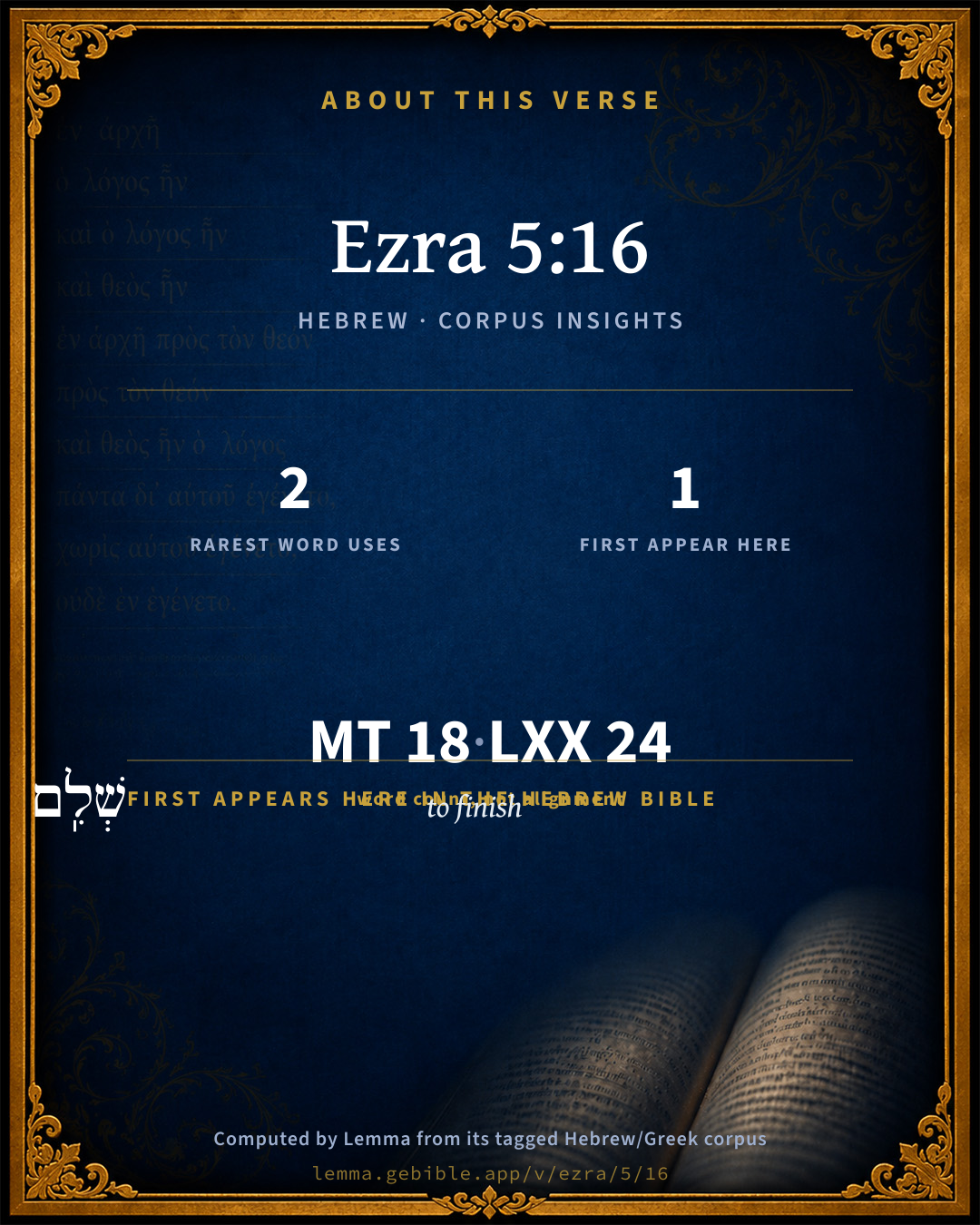
The rarest word here is שֵׁשְׁבַּצַּ֣ר Sheshbazzar H8340 — appearing just 2 times in the whole Hebrew Bible.

First appearance in Scripture

This word makes its first canonical appearance in the Hebrew Bible here:

  • שְׁלִֽם to finish H8000

Shared distinctive vocabulary

שֵׁשְׁבַּצַּ֣ר Sheshbazzar H8340 occurs in 2 verses of the Hebrew Bible. Also found in:

Grammatical profile

  • 1 noun
  • 12 adjectives
  • 2 prepositions
  • 3 particles

Repetition

Words recur within this verse — often emphatic in Hebrew:

  • אֱדַ֨יִן֙ then H116 ×2
  • דִּי which H1768 ×2

Hebrew & Septuagint length

In English translation the verse runs 36 words from the Hebrew and 31 from the Septuagint (LXX English) — closely comparable.

A rough comparison of the two English renderings, which tokenize alike — not a word-level alignment.

Word counts can differ between the Hebrew and the Greek without any difference in meaning — e.g. the Hebrew direct-object marker אֵת has no separate Greek word, and Greek often adds the article ὁ.

In the original languages it is 18 Hebrew tokens and 24 Greek tokens — but the two are counted differently (Hebrew bundles its prefixes and suffixes into one token; the Greek is in lemma form), so that isn’t a like-for-like length.

Cross-references

7

Topical passages linked to Ezra 5:16 in the Treasury of Scripture Knowledge — connected by theme and wording, ordered by reader-vote popularity; previews shown in the World English Bible.

  • Ezra 3:10 When the builders laid the foundation of the temple of Yahweh, they set the priests in their clothing with trumpets, and the Levites the sons of Asaph with cymbals, to praise Yahweh, after the order of David king of Israel.
  • Ezra 6:15 This house was finished on the third day of the month Adar, which was in the sixth year of the reign of Darius the king.
  • Ezra 3:8 Now in the second year of their coming to the house of God at Jerusalem, in the second month, began Zerubbabel the son of Shealtiel, and Jeshua the son of Jozadak, and the rest of their brothers the priests and the Levites, and all those who were come out of the captivity to Jerusalem, and appointed the Levites, from twenty years old and upward, to have the oversight of the work of the house of Yahweh.
  • Ezra 5:2 Then rose up Zerubbabel the son of Shealtiel, and Jeshua the son of Jozadak, and began to build the house of God which is at Jerusalem; and with them were the prophets of God, helping them.
  • Haggai 1:12–14 Then Zerubbabel, the son of Shealtiel, and Joshua, the son of Jehozadak, the high priest, with all the remnant of the people, obeyed the voice of Yahweh, their God, and the words of Haggai, the prophet, as Yahweh, their God, had sent him; and the people feared Yahweh.
  • Haggai 2:18 'Consider, please, from this day and backward, from the twenty-fourth day of the ninth month, since the day that the foundation of Yahweh's temple was laid, consider it.
  • Zechariah 4:10 Indeed, who despises the day of small things? For these seven shall rejoice, and shall see the plumb line in the hand of Zerubbabel. These are the eyes of Yahweh, which run back and forth through the whole earth."

Cross-references courtesy of OpenBible.info (CC BY 4.0).

Hebrew and Greek witnesses Masoretic Hebrew ↔ Greek Septuagint

The same verse in the two great witnesses to the Old Testament, shown verse-for-verse.

These are two independent witnesses, not word-aligned to each other, and the Septuagint is shown in lemma (dictionary) form.

Hebrew Ezra 5:16 Masoretic · Westminster Leningrad Codex

אֱדַ֨יִן֙ שֵׁשְׁבַּצַּ֣ר דֵּ֔ךְ אֲתָ֗א יְהַ֧ב אֻשַּׁיָּ֛א דִּי בֵ֥ית אֱלָהָ֖א דִּ֣י בִירוּשְׁלֶ֑ם וּמִן אֱדַ֧יִן וְעַד כְּעַ֛ן מִתְבְּנֵ֖א וְלָ֥א שְׁלִֽם

Then came the same Sheshbazzar, and laid the foundations of the house of God which is in Jerusalem: and since that time even until now has it been in building, and yet it is not completed.

World English Bible · Public Domain

Greek LXX Ezra 5:16 Septuagint · lemma form

τότε σασαβασαρ ἐκεῖνος ἔρχομαι καί δίδωμι θεμέλιος ὁ οἶκος ὁ θεός ὁ ἐν ἰερουσαλήμ καί ἀπό τότε ἕως ὁ νῦν οἰκοδομέω καί οὐ τελέω

Then that Sabanazar came, and laid the foundations of the house of God in Jerusalem: and from that time even until now it has been building, and has not been finished.

LXX2012 (modern English Septuagint) · Public Domain

In the Septuagint this is one book — Esdras B (2 Esdras): Ezra is chapters 1–10, Nehemiah 11–23.

Hebrew: Westminster Leningrad Codex (CC BY 4.0). Greek: Septuagint (public domain); English from LXX2012 (modern English Septuagint) (Public Domain). How the Septuagint differs from the Hebrew →

Commentary

Notes on Ezra 5:16 from classic Christian and Jewish commentators (each source and its license shown beneath its notes). The classic Christian expositions comment on the surrounding passage and are grouped to its opening verse, so a note may address several verses; the Jewish commentaries on the Tanakh (Rashi and others) are per-verse, so they appear only where the commentator wrote on this verse.

Lemma curates 59 commentaries, every one of them public domain or Creative Commons licensed, each selected and text-cleaned for this edition rather than reprinted as found. About our sources →

Trapp's Complete Commentary

John Trapp

Ezr 5:16 Then came the same Sheshbazzar, [and] laid the foundation of the house of God which [is] in Jerusalem: and since that time even until now hath it been in building, and [yet] it is not finished.

Ver. 16. Then came the same Sheshbazzar] All this is truly and fairly related (as was likewise that of Doeg to Saul, against Ahimelech), but with no good intent. Now to speak the truth not for any love to the truth, nor for respect to justice, nor for the bettering of the hearer or of the offender, but only to incense the one and prejudice the other, this is plain slandering.

And yet it is not finished] And all by reason of such ill conditioned persons as yourselves, who retarded it.

John Trapp, A Commentary or Exposition upon All the Books of the Old and New Testament (1647–1656) — public domain. Text from a community e-Sword module.

Joseph Benson's Commentary

Ezr 5:16. Then came the same Sheshbazzar, and laid the foundation, &c. — The building was begun according to this order, as soon as ever we were returned, so that we have not forfeited the benefit of the order, for want of pursuing it in time; still it has been in building; but because we have met with opposition, it is not finished. But observe, they mention not the falsehood and malice of the former governors, nor make any complaint of that, (though they had cause enough,) to teach us not to render bitterness for bitterness; nor the most just reproach for that which is most unjust; but to think it enough if we can obtain fair treatment for the future, without an invidious repetition of former injuries. Let us learn hence, with meekness and fear to give a reason of the hope that is within us, 1Pe 3:15; rightly to understand, and then readily to declare what we do in God’s service, and why we do it.

Joseph Benson's Commentary on the Old and New Testaments (1811–1818) — public domain. Text from a community e-Sword module.

Tyndale Open Study Notes

Tyndale Open Resources

5:16 Most likely, Sheshbazzar began the work and Zerubbabel finished it (see study note on 1:8).

Tyndale Open Study Notes — © Tyndale Open Resources, licensed CC BY-SA 4.0. Text via the HelloAO Bible API.

Jamieson, Fausset & Brown

Robert Jamieson, A. R. Fausset & David Brown

Then came . . . Shesh-bazzar . . . since that time even until now hath it been in building--This was not a part of the Jews' answer--they could not have said this, knowing the building had long ceased. But Tatnai used these expressions in his report, either looking on the stoppage as a temporary interruption, or supposing that the Jews were always working a little, as they had means and opportunities.

Next: Ezra Chapter 6

Jamieson, Fausset & Brown — Commentary Critical and Explanatory on the Whole Bible (1871) — public domain (CC PDM 1.0). Text via the HelloAO Bible API.

Adam Clarke's Commentary

Verse 16. Sheshbazzar] Probably the military officer that conducted the people from Babylon, and had the oversight of the work; but some think that Ezra is meant.

Adam Clarke's Commentary on the Bible (1810–1826) — public domain. Text from a community e-Sword/MySword module.

Ellicott's Commentary for English Readers

(16) Since that time.—No account is taken of the long interruption. Whether these words are part of the answer given to Tatnai by the Jewish leaders, or his own statement to Darius, it is evident that the unfinished building of a house decreed to be built by Cyrus is regarded as demanding investigation as to the nature and validity of the decree itself.

A Bible Commentary for English Readers, edited by Charles John Ellicott (1878–1897) — public domain. Text from a community e-Sword module.

The Cambridge Bible for Schools and Colleges

gen. ed. J. J. S. Perowne

16. Then came the same Sheshbazzar] The work here ascribed to Sheshbazzar is evidently that over which Zerubbabel presided in chap. 3.

the foundation] R.V. ‘the foundations’; so the Aramaic and Ezr_4:12.

since that time &c.] A sentence showing that the cessation of the work mentioned in Ezr_4:5; Ezr_4:24 must not be taken perfectly literally. Building was carried on from time to time, but no longer on any effective scale. The interval of time was from 536 to 520.

finished] R.V. completed. A different word in the original from that rendered ‘finish’ in Ezr_5:3; Ezr_5:9; Ezr_5:11, Ezr_6:14.

The Cambridge Bible for Schools and Colleges (gen. ed. J. J. S. Perowne; Cambridge University Press, 1878–1918) — public domain. Text from a community e-Sword module.

John Gill's Exposition

Now therefore, if it seem good to the king, let there be search made in the king's treasure house, which is there at Babylon,.... Where were the archives of the kingdom, where the laws, decrees, edicts, and proclamations, and other things relating to the state, were laid up, that recourse might be had to them upon occasion:

whether it be so, that a decree was made of Cyrus the king to build this house of God at Jerusalem; which the Jews affirmed was made by him, and upon which they proceeded:

and let the king send his pleasure to us concerning this matter; whether the Jews should be allowed to go on with the building of their temple, and finish it, or whether they should be restrained from it; signifying they were ready to do his will and pleasure either way, as he thought fit.

Next: Ezra Chapter 6

John Gill's Exposition of the Whole Bible (1746–1763) — public domain (CC PDM 1.0). Text via the HelloAO Bible API.

Albert Barnes' Notes on the Bible

Since that time even until now - Sixteen years - from 536 B.C. to 520 B.C. The adversaries of the Jews here overstep the truth; since, in point of fact, the work had been suspended for a while Ezr 4:24.

Albert Barnes' Notes on the Bible (1834–1885) — public domain. Text from a community e-Sword/MySword module.

Haydock's Catholic Bible Commentary

In building, being pretty far advanced, though for some time past it had been at a stand. (Haydock) --- It is not probable that Zorobabel said this, but the author of the letter added it, as he supposed the Jews continued to do some little. (Calmet) --- He desired to favour their cause, yet so as not to irritate the Samaritans. (Menochius)

George Leo Haydock (1774–1849), Haydock's Catholic Family Bible and Commentary, 1859 edition — public domain. Excludes Psalms (Douay-Rheims chapter numbering differs from Protestant) and Deuterocanonical books (Catholic canon only).

Matthew Poole's English Annotations

Even until now; allowing for some interruptions.

Matthew Poole's English Annotations on the Holy Bible (1683–1685) — public domain. Text from a community e-Sword/MySword module.

Whedon's Commentary on the Bible

Daniel D. Whedon

16. Since that time even until now hath it been in building — It seems that in some way the building had been going on all through those years of trouble, and the year or a little more that it had entirely ceased, after the order of the pseudo-Smerdis, (Ezr_4:24, note,) was not of sufficient importance to be noticed in this letter.

Daniel D. Whedon (gen. ed.), Commentary on the Old and New Testaments (1874–1909) — public domain. Text from a community e-Sword module.

The Pulpit Commentary

Since that time even until now hath it been in building. It is not quite clear whether these words are part of the answer given by the Jews to Tatnai, which he reports to Darius (see ver. 11), or Tatnai"s own statement of what he believes to have been the fact. Perhaps the latter view is the more probable; and we may suppose Tatnai not to have been aware that from the second year of Cyrus to the commencement of the reign of Smerdis, and again during the latter part of this reign and the first eighteen months of the reign of Darius, the work had been suspended.

The Pulpit Commentary (1880–1919), ed. H.D.M. Spence-Jones & Joseph S. Exell — public domain. Text from a community e-Sword module.

Keil & Delitzsch

C. F. Keil & F. Delitzsch

In virtue of this command of Cyrus, this Sheshbazzar came (from Babylon to Jerusalem), and laid then the foundations of the house of God, and from that time till now it has been building, and is not (yet) finished. שׁלים, part. pass. of שׁלם, often used in the Targums and in Syriac for the Hebrew תּמם; hence in Dan 5:26 the Aphel, in the meaning of to finish, and Eze 7:19, to restore. This statement does not exclude the cessation from building from the last year of Cyrus to the second of Darius, narrated Ezra 4-6:7, as Bertheau and others suppose, but only leaves the unmentioned circumstance which had been the cause of the delay. If the section Ezra 4:6-23 does not refer to the building of the temple, then neither is a "forcible interruption" of the building spoken of in Ezra 4; but it is only said that the adversaries frustrated the purpose of the Jews to rebuild the temple till the time of Darius, and weakened the hands of the people, so that the work of the house of God ceased.

Keil & Delitzsch — Biblical Commentary on the Old Testament (1861–1891) — public domain (CC PDM 1.0). Text via the HelloAO Bible API. (Old Testament only.)

unfoldingWord translationNotes

Door43 World Missions Community

General Information:

The letter from Tattenai to the king that began in Esra 5:7 continues. Tattenai continues to tell the king what the Judeans had told him beginning in (Esra 5:11).

it is being constructed, but is not yet complete

This can be translated in active form. AT: "people are now constructing it, but they have not done all the work yet" (See: Active or Passive)

constructed

built

translationWords

found

house of God

unfoldingWord translationNotes — © Distant Shores Media and the Door43 World Missions Community, licensed CC BY-SA 4.0. Source: git.door43.org/Door43/en_tn.

Rashi

Rabbi Shlomo Yitzchaki (Rashi)

then [as translated,] then.

this Sheshbazzar Aram. דֵּךְ, came and built the walls of the House of the Holy One, blessed be He, that is in Jerusalem, and from then until now, the House has been built, but the building has not been completed.

Rashi on the Tanakh — English translations: “The Judaica Press complete Tanach with Rashi, translated by A. J. Rosenberg” (CC BY 4.0); “Pentateuch with Rashi's commentary by M. Rosenbaum and A.M. Silbermann, 1929-1934” (public domain); “The Metsudah Tanach series, Lakewood, N.J” (CC BY 4.0); and “The Book of Joshua, Metsudah Publications, 1997” (CC BY 4.0). Text via Sefaria.

Lesson kit

Teaching starters — assembled from the data on this page, not authored interpretation. Every prompt links to the verse data it draws on. Edit before teaching.

Ezra, in the Historical, opens this verse with 18 words (16 distinct Hebrew lemmas). Its most distinctive word is Shêshᵉbatstsar (“Sheshbazzar”). A historical commentator’s framing appears above. Read the whole chapter for the surrounding context.

Discussion questions

  1. How does “Sheshbazzar” (Shêshᵉbatstsar) shape what this verse is saying?
  2. The word “to finish” first appears here in Scripture. What is being introduced at this debut?
  3. Ezra 5:14 shares the word «Sheshbazzar» with this verse. How do the two illuminate each other?
  4. “then” occurs 2× in this one verse. What is the effect of the repetition?
  5. The translations on this page render this verse differently — a whole-verse word diff, not a word-by-word alignment. What might account for the different wordings?
  6. Reading how Trapp's Complete Commentary and Joseph Benson's Commentary read this verse, where do the two commentators agree and where do they part?

Things to notice

Reading settings

Reading text

Shown beneath each verse's original-language words.

Old Testament
Old Testament edition

Read the OT as the Masoretic Hebrew (MT) or the Greek Septuagint (LXX).

English shown for the Greek Septuagint (in the Hebrew ↔ Greek comparison).

Comparing translations? Open the Compare panel on any verse page to stack up to four side by side.