
Ezra 6:9

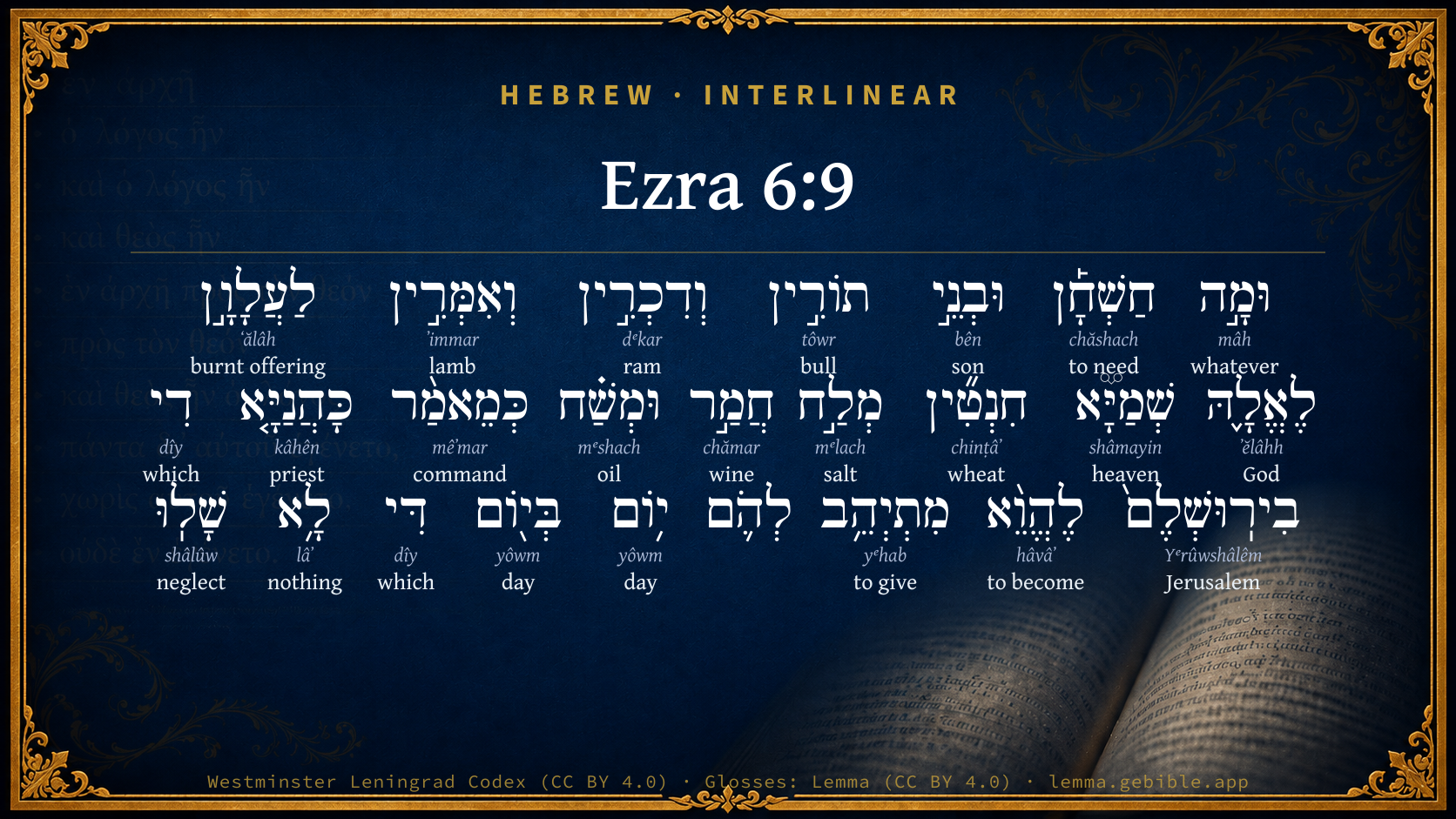
Hebrew (Westminster Leningrad Codex) Ezra 6:9 appears in the Hebrew Old Testament. The text above is from the Westminster Leningrad Codex. Each word links to its Strong’s number, a concise gloss, and parsing drawn from the Open Scriptures Hebrew Bible morphology. Click any word for its full Brown-Driver-Briggs (BDB) entry.
Download image
Cite this verse

Ezra 6:9 (World English Bible). Public Domain. Lemma interlinear Bible study tool, https://lemma.gebible.app/v/ezra/6/9.

Show BibTeX & RIS
BibTeX
RIS
English Translation
That which they have need of, both young bulls, and rams, and lambs, for burnt offerings to the God of heaven; [also] wheat, salt, wine, and oil, according to the word of the priests who are at Jerusalem, let it be given them day by day without fail;
World English Bible · Public Domain
Highlights
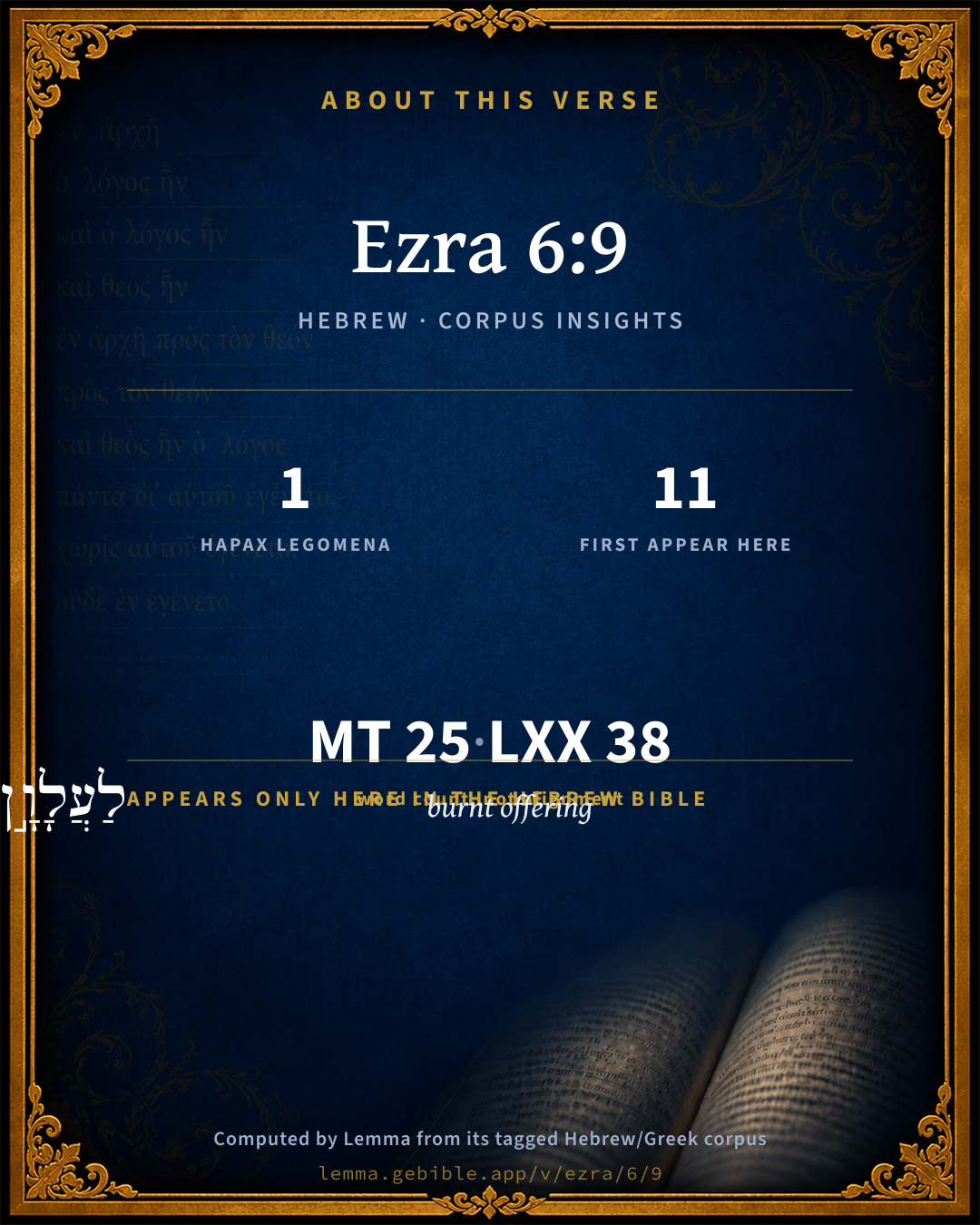
  • 1 hapax legomenon — only here in the Hebrew Bible
  • 11 first appearances in the Hebrew Bible
Full analysis ↓
Download a study sheet

One document with this verse’s original text, its word-by-word gloss line, the meaning frame, cross-references with their text, attributed commentary, and full source and license credits — printable, and it pastes into notes with its structure intact.

This verse Autodidact and up

Study sheet (.html) Plain text (.txt)

A passage Seminary Student

Up to 50 verses in one chapter. A passage sheet keeps up to 6 commentary sources and 12 cross-references per verse, in the order this page ranks them, and says so on the sheet whenever that leaves anything out. Ask for a single verse and you get the Autodidact verse sheet above.

Everything on this page stays free to read, with no account — the sheet is a download of what is already on screen, not access to it.

Want to remove ads? Support Godless Engineer
Compare translations 3

The same verse in 3 English versions, stacked beneath the original-language interlinear above. Click any original word for its lexicon entry.

Each is an independent rendering of the whole verse — the interlinear is not word-aligned to these translations.

Highlighted words mark where these versions differ — a whole-verse word diff, not a word-by-word alignment.

  • World English Bible Public Domain
    That which they have need of, both young bulls, and rams, and lambs, for burnt offerings to the God of heaven; [also] wheat, salt, wine, and oil, according to the word of the priests who are at Jerusalem, let it be given them day by day without fail;
  • King James Version Public Domain
    And that which they have need of, both young bullocks, and rams, and lambs, for the burnt offerings of the God of heaven, wheat, salt, wine, and oil, according to the appointment of the priests which are at Jerusalem, let it be given them day by day without fail:
  • unfoldingWord Literal Text CC BY-SA 4.0
    And whatever is needed (whether sons of bulls, or rams, or lambs for burnt up offerings to the God of heaven, wheat, salt, wine, or oil, according to the command of the priests who are in Jerusalem), let it be given to them day by day (that is, without neglect),

unfoldingWord Literal Text — © unfoldingWord, licensed CC BY-SA 4.0. Word-aligned USFM3 via Door43 (git.door43.org/unfoldingWord/en_ult).

Versions to compare (up to 4)

3 of 4 selected

Show all 18 translations

Every available English version of this verse, each an independent rendering of the whole verse.

  • World English Bible Public Domain
    That which they have need of, both young bulls, and rams, and lambs, for burnt offerings to the God of heaven; [also] wheat, salt, wine, and oil, according to the word of the priests who are at Jerusalem, let it be given them day by day without fail;
  • Berean Standard Bible Public Domain
    Whatever is needed—young bulls, rams, and lambs for burnt offerings to the God of heaven, as well as wheat, salt, wine, and oil, as requested by the priests in Jerusalem—must be given to them daily without fail.
  • Majority Standard Bible Public Domain
    Whatever is needed—young bulls, rams, and lambs for burnt offerings to the God of heaven, as well as wheat, salt, wine, and oil, as requested by the priests in Jerusalem—must be given to them daily without fail.
  • King James Version Public Domain
    And that which they have need of, both young bullocks, and rams, and lambs, for the burnt offerings of the God of heaven, wheat, salt, wine, and oil, according to the appointment of the priests which are at Jerusalem, let it be given them day by day without fail:
  • American Standard Version (1901) Public Domain
    And that which they have need of, both young bullocks, and rams, and lambs, for burnt-offerings to the God of heaven; `also' wheat, salt, wine, and oil, according to the word of the priests that are at Jerusalem, let it be given them day by day without fail;
  • Revised Version (1885) Public Domain
    And that which they have need of, both young bullocks, and rams, and lambs, for burnt offerings to the God of heaven, wheat, salt, wine, and oil, according to the word of the priests which are at Jerusalem, let it be given them day by day without fail:
  • Geneva Bible (1599) Public Domain
    And that which they shall haue neede of, let it be giuen vnto them day by day, whether it be yong bullockes, or rammes, or lambes for the burnt offrings of the God of heauen, wheate, salt, wine, and oyle, according to the appoyntment of the Priestes that are in Ierusalem, that there bee no fault,
  • Douay-Rheims (1899) Public Domain
    And if it shall be necessary, let calves also, and lambs, and kids, for holocausts to the God of heaven, wheat, salt, wine, and oil, according to the custom of the priests that are in Jerusalem, be given them day by day, that there be no complaint in any thing.
  • Young's Literal Translation Public Domain
    and what they are needing -- both young bullocks, and rams, and lambs for burnt-offerings to the God of heaven, wheat, salt, wine, and oil according to the saying of the priests who `are' in Jerusalem -- let be given to them day by day without fail,
  • Literal Standard Version CC BY-SA 4.0
    and what they are needing—both young bullocks, and rams, and lambs for burnt-offerings to the God of the heavens, wheat, salt, wine, and oil according to the saying of the priests who [are] in Jerusalem—let be given to them day by day without fail,
  • Unlocked Literal Bible CC BY-SA 4.0
    Whatever is needed—young bulls, rams, or lambs for the burnt offerings to the God of Heaven, grain, salt, wine, or oil according to the command of the priests in Jerusalem—give these things to them every day without fail.
  • unfoldingWord Literal Text CC BY-SA 4.0
    And whatever is needed (whether sons of bulls, or rams, or lambs for burnt up offerings to the God of heaven, wheat, salt, wine, or oil, according to the command of the priests who are in Jerusalem), let it be given to them day by day (that is, without neglect),
  • Darby Bible Public Domain
    And that which they have need of, both young bullocks and rams and lambs, for the burnt-offerings to the God of the heavens, wheat, salt, wine, and oil, according to the appointment of the priests that are at Jerusalem, let it be given them day by day without fail;
  • World Messianic Bible Public Domain
    That which they have need of, including young bulls, rams, and lambs, for burnt offerings to the God of heaven; also wheat, salt, wine, and oil, according to the word of the priests who are at Jerusalem, let it be given them day by day without fail,
  • Webster's Bible Public Domain
    And that which they have need of, both young bullocks, and rams, and lambs, for the burnt-offerings of the God of heaven, wheat, salt, wine, and oil, according to the appointment of the priests who are at Jerusalem, let it be given to them day by day without fail:
  • Free Bible Version CC BY-SA 4.0
    Provide whatever is needed by the priests in Jerusalem: young bulls, rams, and lambs for burnt offerings to the God of heaven, and wheat, salt, wine, and olive oil. Make sure to give them this each day without fail.
  • Bible in Basic English Public Domain
    And whatever they have need of, young oxen and sheep and lambs, for burned offerings to the God of heaven, grain, salt, wine, and oil, whatever the priests in Jerusalem say is necessary, is to be given to them day by day regularly:
  • JPS Tanakh (1917) Public Domain
    And that which they have need of, both young bullocks, and rams, and lambs, for burnt-offerings to the God of heaven, wheat, salt, wine, and oil, according to the word of the priests that are at Jerusalem, let it be given them day by day without fail;

Literal Standard Version (2020), Covenant Press — licensed CC BY-SA 4.0. Text via the HelloAO Bible API (eBible.org). Unlocked Literal Bible (unfoldingWord) — licensed CC BY-SA 4.0. Text via the HelloAO Bible API (eBible.org). unfoldingWord Literal Text — © unfoldingWord, licensed CC BY-SA 4.0. Word-aligned USFM3 via Door43 (git.door43.org/unfoldingWord/en_ult). Free Bible Version, Dr. Jonathan Gallagher — licensed CC BY-SA 4.0. Text via the HelloAO Bible API (eBible.org).

Word by word

More ways to search: Search by grammar → Find every occurrence → Compare this word →

Practice this passage: Drill this verse → Learn its vocabulary →

לַעֲלָוָ֣ן
ʻălâh
H5928
“to/for · burnt offerings”
Adjective, R + Noun, Common, Feminine, Plural, Absolute
Part of Speech
Adjective + Noun
Type
Common
Gender
Feminine
Number
Plural
State
Absolute
Full BDB Definition

Origin: corresponding to H5930

TWOT: 2909e

burnt offering, holocaust
  1. וּמָ֣ה mâh H4101 “and · whatever” Adjective, C + Pronoun, Indefinite, Common, Singular
  2. חַשְׁחָ֡ן chăshach H2818 “needed” Adjective, N, Common
  3. וּבְנֵ֣י bên H1123 “and · sons of” Adjective, C + Noun, Common, Masculine, Plural, Construct
  4. תוֹרִ֣ין tôwr H8450 “bulls” Adjective, N, Common
  5. וְדִכְרִ֣ין dᵉkar H1798 “and · rams” Adjective, C + Noun, Common, Masculine, Plural, Absolute
  6. וְאִמְּרִ֣ין ʼimmar H563 “and · lambs” Adjective, C + Noun, Common, Masculine, Plural, Absolute
  7. לֶאֱלָ֪הּ ʼĕlâhh H426 “to/for · God of” Adjective, R + Noun, Common, Masculine, Singular, Construct
  8. שְׁמַיָּ֟א shâmayin H8065 “heaven(s) · the” Adjective, N, Common + Particle, Definite Article
  9. חִנְטִ֞ין chinṭâʼ H2591 “wheat” Adjective, N, Common
  10. מְלַ֣ח mᵉlach H4416 “salt” Adjective, N, Common
  11. חֲמַ֣ר chămar H2562 “wine” Adjective, N, Common
  12. וּמְשַׁ֗ח mᵉshach H4887 “and · oil” Adjective, C + Noun, Common, Masculine, Singular, Absolute
  13. כְּמֵאמַ֨ר mêʼmar H3983 “like/as · command of” Adjective, R + Noun, Common, Masculine, Singular, Construct
  14. כָּהֲנַיָּ֤א kâhên H3549 “priests · the” Adjective, N, Common + Particle, Definite Article
  15. דִי dîy H1768 “which” Adjective, T
  16. בִירֽוּשְׁלֶם֙ Yᵉrûwshâlêm H3390 “in/at · Jerusalem” Adjective, R + Noun, Proper
  17. לֶהֱוֵ֨א hâvâʼ H1934 “to become” Adjective, V
  18. מִתְיְהֵ֥ב yᵉhab H3052 “given” Adjective, V, Singular
  19. י֥וֹם yôwm H3118 “day” Adjective, N, Common
  20. בְּי֖וֹם yôwm H3118 “in/at · day” Adjective, R + Noun, Proper
  21. דִּי dîy H1768 “which” Adjective, C
  22. לָ֥א lâʼ H3809 “nothing” Adjective, T
  23. שָׁלֽוּ shâlûw H7960 “neglect” Adjective, N, Common

About this verse

These counts appear in no published source. They are computed here, from the morphology-tagged text and Lemma’s own curated glosses. What Lemma adds →

25
words
22
distinct lemmas
Historical
section

Notable vocabulary

1 hapax legomenon — a word that appears only here in the entire Hebrew Bible:

  • לַעֲלָוָ֣ן burnt offering H5928

First appearance in Scripture

These words make their first canonical appearance in the Hebrew Bible here (11 in total — showing 8):

  • חַשְׁחָ֡ן to need H2818
  • וּבְנֵ֣י son H1123
  • תוֹרִ֣ין bull H8450
  • וְדִכְרִ֣ין ram H1798
  • וְאִמְּרִ֣ין lamb H563
  • לַעֲלָוָ֣ן burnt offering H5928
  • חִנְטִ֞ין wheat H2591
  • חֲמַ֣ר wine H2562

Shared distinctive vocabulary

חַשְׁחָ֡ן to need H2818 occurs in 2 verses of the Hebrew Bible. Also found in:

Grammatical profile

  • 9 nouns
  • 13 adjectives
  • 1 pronoun
  • 2 particles

Repetition

Words recur within this verse — often emphatic in Hebrew:

Hebrew & Septuagint length

In English translation the verse runs 48 words from the Hebrew and 53 from the Septuagint (LXX English) — closely comparable.

A rough comparison of the two English renderings, which tokenize alike — not a word-level alignment.

Word counts can differ between the Hebrew and the Greek without any difference in meaning — e.g. the Hebrew direct-object marker אֵת has no separate Greek word, and Greek often adds the article ὁ.

In the original languages it is 25 Hebrew tokens and 38 Greek tokens — but the two are counted differently (Hebrew bundles its prefixes and suffixes into one token; the Greek is in lemma form), so that isn’t a like-for-like length.

Cross-references

11

Topical passages linked to Ezra 6:9 in the Treasury of Scripture Knowledge — connected by theme and wording, ordered by reader-vote popularity; previews shown in the World English Bible.

  • Leviticus 1:10 "'If his offering is from the flock, from the sheep, or from the goats, for a burnt offering, he shall offer a male without blemish.
  • Psalms 50:9–13 I have no need for a bull from your stall, Nor male goats from your pens.
  • Exodus 29:38–42 "Now this is that which you shall offer on the altar: two lambs a year old day by day continually.
  • Leviticus 1:3–5 "'If his offering is a burnt offering from the herd, he shall offer a male without blemish. He shall offer it at the door of the Tent of Meeting, that he may be accepted before Yahweh.
  • Leviticus 2:1–16 "'When anyone offers an offering of a meal offering to Yahweh, his offering shall be of fine flour; and he shall pour oil on it, and put frankincense on it.
  • Leviticus 9:2 and he said to Aaron, "Take a calf from the herd for a sin offering, and a ram for a burnt offering, without blemish, and offer them before Yahweh.
  • Numbers 15:4–31 then shall he who offers his offering offer to Yahweh a meal-offering of a tenth part [of an ephah] of fine flour mixed with the fourth part of a hin of oil:
  • Numbers 28:1–29 Yahweh spoke to Moses, saying,
  • 1 Chronicles 9:29 Some of them also were appointed over the furniture, and over all the vessels of the sanctuary, and over the fine flour, and the wine, and the oil, and the frankincense, and the spices.
  • Isaiah 49:23 Kings shall be your nursing fathers, and their queens your nursing mothers: they shall bow down to you with their faces to the earth, and lick the dust of your feet; and you shall know that I am Yahweh; and those who wait for me shall not be disappointed.
  • Mark 9:49 For everyone will be salted with fire, and every sacrifice will be seasoned with salt.

Cross-references courtesy of OpenBible.info (CC BY 4.0).

Hebrew and Greek witnesses Masoretic Hebrew ↔ Greek Septuagint

The same verse in the two great witnesses to the Old Testament, shown verse-for-verse.

These are two independent witnesses, not word-aligned to each other, and the Septuagint is shown in lemma (dictionary) form.

Hebrew Ezra 6:9 Masoretic · Westminster Leningrad Codex

וּמָ֣ה חַשְׁחָ֡ן וּבְנֵ֣י תוֹרִ֣ין וְדִכְרִ֣ין וְאִמְּרִ֣ין לַעֲלָוָ֣ן לֶאֱלָ֪הּ שְׁמַיָּ֟א חִנְטִ֞ין מְלַ֣ח חֲמַ֣ר וּמְשַׁ֗ח כְּמֵאמַ֨ר כָּהֲנַיָּ֤א דִי בִירֽוּשְׁלֶם֙ לֶהֱוֵ֨א מִתְיְהֵ֥ב לְהֹ֛ם י֥וֹם בְּי֖וֹם דִּי לָ֥א שָׁלֽוּ

That which they have need of, both young bulls, and rams, and lambs, for burnt offerings to the God of heaven; [also] wheat, salt, wine, and oil, according to the word of the priests who are at Jerusalem, let it be given them day by day without fail;

World English Bible · Public Domain

Greek LXX Ezra 6:9 Septuagint · lemma form

καί ὅς ἄν ὑστέρημα καί υἱός βοῦς καί κριός καί ἀμνός εἰς ὁλοκαύτωσις ὁ θεός ὁ οὐρανός πυρός ἅλς οἶνος ἔλαιον κατά ὁ ῥῆμα ὁ ἱερεύς ὁ ἐν ἰερουσαλήμ εἰμί δίδωμι αὐτός ἡμέρα ἐν ἡμέρα ὅς ἐάν αἰτέω

And whatever need there may be, you⌃ shall give both the young of bulls and rams, and lambs for whole burnt offerings to the God of heaven, wheat, salt, wine, oil:—let it be given them according to the word of the priests that are in Jerusalem, day by day whatever they shall ask;

LXX2012 (modern English Septuagint) · Public Domain

In the Septuagint this is one book — Esdras B (2 Esdras): Ezra is chapters 1–10, Nehemiah 11–23.

On this verse, The Cambridge Bible for Schools and Colleges discusses the Septuagint’s reading. Read the note in Commentary ↓

Hebrew: Westminster Leningrad Codex (CC BY 4.0). Greek: Septuagint (public domain); English from LXX2012 (modern English Septuagint) (Public Domain). How the Septuagint differs from the Hebrew →

Commentary

Notes on Ezra 6:9 from classic Christian and Jewish commentators (each source and its license shown beneath its notes). The classic Christian expositions comment on the surrounding passage and are grouped to its opening verse, so a note may address several verses; the Jewish commentaries on the Tanakh (Rashi and others) are per-verse, so they appear only where the commentator wrote on this verse.

Lemma curates 59 commentaries, every one of them public domain or Creative Commons licensed, each selected and text-cleaned for this edition rather than reprinted as found. About our sources →

Trapp's Complete Commentary

John Trapp

Ezr 6:9 And that which they have need of, both young bullocks, and rams, and lambs, for the burnt offerings of the God of heaven, wheat, salt, wine, and oil, according to the appointment of the priests which [are] at Jerusalem, let it be given them day by day without fail:

Ver. 9. Of the God of heaven] Heathens have this notion by nature, that God is the God of heaven, and that there he is, as in his place; howbeit we must not conceive that God is commensurable by any place, since he filleth all places, and is everywhere all-present, totally present wheresoever present; but in heaven is his glory most manifested, and on earth is he alone to be worshipped.

John Trapp, A Commentary or Exposition upon All the Books of the Old and New Testament (1647–1656) — public domain. Text from a community e-Sword module.

The Biblical Illustrator

Joseph S. Exell

Ezr_6:9-10

That they may offer sacrifices of sweet savours unto the God of heaven.

Sacrifice as a rule of supplication unto God

I have made choice of this passage to show that sacrifice was a rite of supplication to God, wherein the supplicant came not with his naked prayer, but presented something unto God whereby to find favour in His sight. The thing presented was a federal gift, consisting of meat and drink, in the tender whereof as a sinner he recognised himself to be his Gods vassal and servant, so by acceptance of the same he was reconciled and restored to His covenant by the atonement and forgiveness of his sins. For as according to the custom of mankind, to receive meat and drink from the hand of another was a sign of amity and friendship, much more to make another partaker of his table, as the sinner was here of Gods, by eating of His oblation: hence those who came to make supplication of the Divine Majesty whom they had offended were wont by this rite to make way for their suit by removing the obstacle of His offence.

1. It is often said of Abraham and Isaac that where they pitched their tents they also built an altar, and there called upon the name of the Lord; but an altar is a place for sacrifice; therefore sacrifice must be a rite whereby they called upon the name of God.

2. The same appears by the speech of Saul (1Sa_13:12), which shows that to offer a burnt-offering was to make supplication (1Sa_7:8-9).

3. This is further proved by Psa_116:13 : I will take the cup of salvation (or drink offering) and call upon the name of the Lord.

4. The same is implied in Mic_6:6 and also in Pro_15:1, where sacrifice and prayer are taken the one for the other.

5. The like may be inferred out of Solomons prayer at the dedication of the temple and the Lords answer thereto. In the prayer no mention is made of sacrifice to be there offered, but only that God would be pleased to hear the prayers that should be made in that place or towards it. Nevertheless, when God appeared to Solomon in the night, He said unto him, I have heard thy prayer, and have chosen this place to Myself for a house of sacrifice (2Ch_7:12). From what has been said we can understand in what sense the ancient Church called the Eucharist a sacrifice, and how harmless that notion was, viz., they took this sacrament to have been ordained by Christ to succeed the bloody sacrifices of the law, and to be a means of supplication and address to God, in the New Testament as they were in the Old, by representing the body and blood of Christ unto His Father, according to His appointment. (J. Mede, B. D.)

The Biblical Illustrator, edited by Joseph S. Exell (c. 1880s–1900s) — public domain. Text from a community e-Sword module.

Ellicott's Commentary for English Readers

(9) Both young bullocks, and rams, and lambs.—An accurate account of the provision required for the sacrifices and meat-offerings of the daily service of the Temple: how accurate will be seen by consulting Exodus 29 and Leviticus 2.

Appointment here is simply the word: that is, of direction.

A Bible Commentary for English Readers, edited by Charles John Ellicott (1878–1897) — public domain. Text from a community e-Sword module.

The Cambridge Bible for Schools and Colleges

gen. ed. J. J. S. Perowne

9. (b) Material for the maintenance of the worship.

young bullocks, &c.] Cf. Ezr_7:17.

for the burnt offerings of] R.V. for burnt offerings to. The king is speaking generally of burnt offerings as one chief class of offering, and not particularly of the Levitical system.

wheat, salt, wine, and oil] Cf. Exo_29:40 (flour, oil, wine); Lev_2:1-16 (flour, oil, salt, &c., the meal offering). The king alludes to the other chief class of offering.

according to the appointment] R.V. according to the word, i.e. the priests at Jerusalem were to specify what their system most required.

day by day] See on chap. Ezr_3:4.

without fail] i.e. without intermission. Literally ‘which is to be no intermission’. The LXX. must have had another reading in which the negative was dropped, and a similarly sounding word ‘to ask’ substituted for that rendered ‘fail’. LXX. ‘whatsoever they shall ask’ (ὅ ἐὰν αἰτήσωσιν). The Vulg. ‘lest there be room for complaint in aught’ (ne sit in aliquo querimonia) and 1Es_6:30 ‘without further question’ seem also to have translated the more familiar root.

The Cambridge Bible for Schools and Colleges (gen. ed. J. J. S. Perowne; Cambridge University Press, 1878–1918) — public domain. Text from a community e-Sword module.

John Gill's Exposition

That they may offer sacrifices of sweet savours unto the God of heaven,.... Such as will be acceptable to him, Gen 8:21

and pray for the life of the king, and of his sons; prayer being wont to be made at the time of the morning and evening incense; and the Jews used to pray for other people besides themselves, and especially when desired, and particularly for kings and civil magistrates, to whom they were subject, see Jer 29:7, the sons of Darius Hystaspis, for whose life, as well as his own, he would have prayer made, were, according to Herodotus (d), three by his first wife, the daughter of Gobryas, before he began to reign, the eldest of which was Artobazanes; which sons must be here meant, since this was towards the beginning of his reign; he had afterwards four more by Atossa the daughter of Cyrus, the eldest of which was Xerxes, who succeeded him: many of the Heathens had an high opinion of the God of the Jews, and of their prayers to him for them; even the Emperor Julian (e) styles him the best of all the gods, and desired the Jews to pray to him for the welfare of his kingdom; nor need it seem strange that Darius should desire the same, since he was a devout prince; his father Hystaspes is supposed by some to be the same that was one of the most famous among the Persian Magi, or ministers in sacred things; and Darius himself had so great a veneration for the men of that sacred order, that he commanded that it should be put upon his sepulchral monument, that he was master of the Magi (f); and by his familiarity with the priests of Egypt, and learning their divinity, had the honour, while alive, to have deity ascribed to him (g).

(d) Polymnia, sive, l. 7. c. 2. (e) Opera, par. 2. ep. 25. p. 153. (f) Porphyr. de abstinentia, l. 4, c. 16. (g) Diodor. Sic. l. 1. p. 85.

John Gill's Exposition of the Whole Bible (1746–1763) — public domain (CC PDM 1.0). Text via the HelloAO Bible API.

Haydock's Catholic Bible Commentary

Complaint. Protestants, "without fail," (Haydock) or "delay." (Montanus) (Calmet)

George Leo Haydock (1774–1849), Haydock's Catholic Family Bible and Commentary, 1859 edition — public domain. Excludes Psalms (Douay-Rheims chapter numbering differs from Protestant) and Deuterocanonical books (Catholic canon only).

The Pulpit Commentary

Both young bullocks, and rams, and lambs. These were the chief sacrificial animals of the Jews a lamb being required every morning and evening, two more on the sabbath, seven at each of the great feasts and at the beginning of each mouth, and fourteen on every day during the feast of tabernacles, altogether more than a thousand in the course of the year; and rams and bullocks being joined with the lambs on the more solemn occasions. The only other ordinary sacrificial animal was "a kid of the goats." Wheat, salt, wine, and oil were needed for the "meat offerings" by which every burnt offering was accompanied (Exo_29:40, Exo_29:41; Lev_2:13, etc.) Let it be given them day by day . Since sacrifice was offered every day.

The Pulpit Commentary (1880–1919), ed. H.D.M. Spence-Jones & Joseph S. Exell — public domain. Text from a community e-Sword module.

Rashi

Rabbi Shlomo Yitzchaki (Rashi)

And what they require and what they are concerned about.

and young bulls young bulls, rams and lambs for burnt offerings to the God of heaven.

wheat for fine flour. salt for sacrifices. wine for libations. and oil for the meal-offerings. When the priests who are in Jerusalem will say [what they need], that shall be given to them the requirements of each day on its day.

without delay Aram. דִּי לָא שָּׁלוּ (son destorber in Old French).

Rashi on the Tanakh — English translations: “The Judaica Press complete Tanach with Rashi, translated by A. J. Rosenberg” (CC BY 4.0); “Pentateuch with Rashi's commentary by M. Rosenbaum and A.M. Silbermann, 1929-1934” (public domain); “The Metsudah Tanach series, Lakewood, N.J” (CC BY 4.0); and “The Book of Joshua, Metsudah Publications, 1997” (CC BY 4.0). Text via Sefaria.

Lesson kit

Teaching starters — assembled from the data on this page, not authored interpretation. Every prompt links to the verse data it draws on. Edit before teaching.

Ezra, in the Historical, opens this verse with 25 words (22 distinct Hebrew lemmas). Its most distinctive word is ʻălâh (“burnt offering”). A historical commentator’s framing appears above. Read the whole chapter for the surrounding context.

Discussion questions

  1. What does “burnt offering” (ʻălâh) contribute to the verse as a whole?
  2. 1 word here appears nowhere else in the Hebrew Bible. Why might the author reach for such rare wording?
  3. 11 words make their first appearance in Scripture here. What does this debut establish?
  4. How does Daniel 3:16, which shares the word «to need», read alongside this verse?
  5. What does the repetition of “day” (2× in this one verse) do in this verse?
  6. The translations on this page render this verse differently — a whole-verse word diff, not a word-by-word alignment. What might account for the different wordings?
  7. Compare how Trapp's Complete Commentary and The Biblical Illustrator read this verse. Where do they agree or differ?

Things to notice

  • 1 word in this verse appears nowhere else in the Hebrew Bible.
  • 11 words make their first canonical appearance in Scripture here.
  • This verse counts 25 Hebrew ↔ 38 Greek words.
  • These translations choose different wording for 19 words in this verse.
  • “day” occurs 2× in this single verse.

Reading settings

Reading text

Shown beneath each verse's original-language words.

Old Testament
Old Testament edition

Read the OT as the Masoretic Hebrew (MT) or the Greek Septuagint (LXX).

English shown for the Greek Septuagint (in the Hebrew ↔ Greek comparison).

Comparing translations? Open the Compare panel on any verse page to stack up to four side by side.