
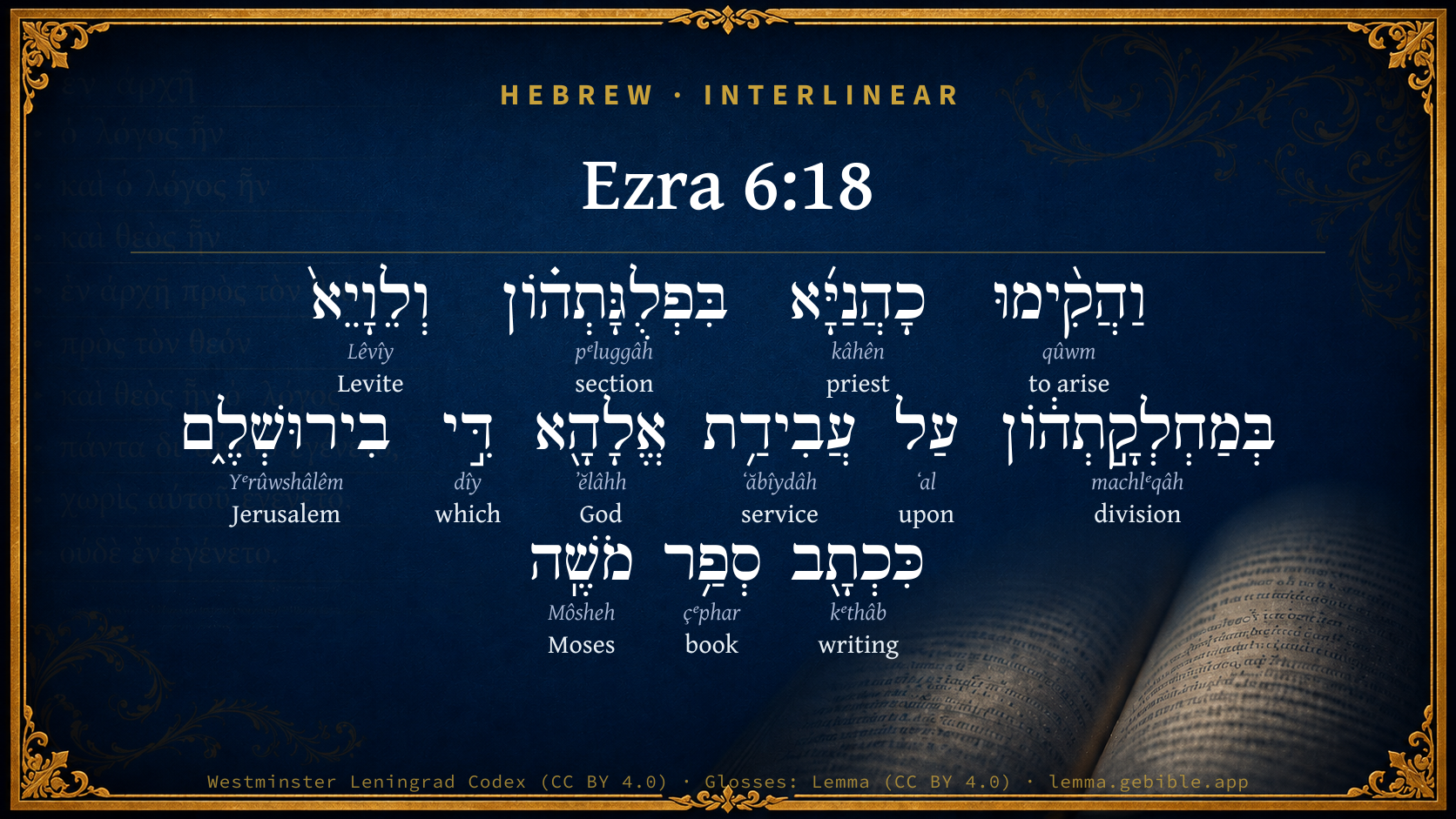
Ezra 6:18

Hebrew (Westminster Leningrad Codex) Ezra 6:18 appears in the Hebrew Old Testament. The text above is from the Westminster Leningrad Codex. Each word links to its Strong’s number, a concise gloss, and parsing drawn from the Open Scriptures Hebrew Bible morphology. Click any word for its full Brown-Driver-Briggs (BDB) entry.
Download image
Cite this verse

Ezra 6:18 (World English Bible). Public Domain. Lemma interlinear Bible study tool, https://lemma.gebible.app/v/ezra/6/18.

Show BibTeX & RIS
BibTeX
RIS
English Translation
They set the priests in their divisions, and the Levites in their courses, for the service of God, which is at Jerusalem; as it is written in the book of Moses.
World English Bible · Public Domain
Highlights
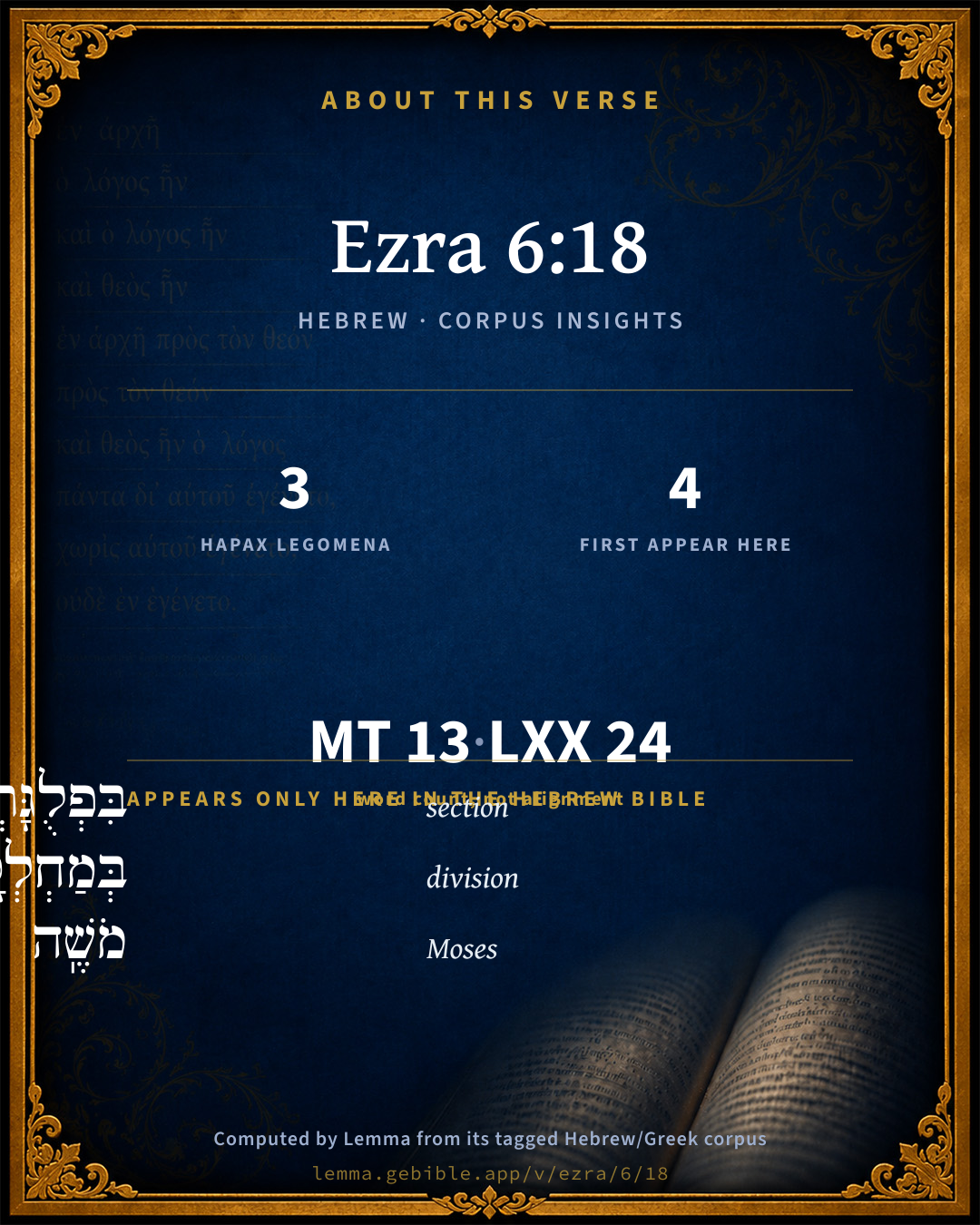
  • 3 hapax legomena — only here in the Hebrew Bible
  • 4 first appearances in the Hebrew Bible
Full analysis ↓
Download a study sheet

One document with this verse’s original text, its word-by-word gloss line, the meaning frame, cross-references with their text, attributed commentary, and full source and license credits — printable, and it pastes into notes with its structure intact.

This verse Autodidact and up

Study sheet (.html) Plain text (.txt)

A passage Seminary Student

Up to 50 verses in one chapter. A passage sheet keeps up to 6 commentary sources and 12 cross-references per verse, in the order this page ranks them, and says so on the sheet whenever that leaves anything out. Ask for a single verse and you get the Autodidact verse sheet above.

Everything on this page stays free to read, with no account — the sheet is a download of what is already on screen, not access to it.

Want to remove ads? Support Godless Engineer
Compare translations 3

The same verse in 3 English versions, stacked beneath the original-language interlinear above. Click any original word for its lexicon entry.

Each is an independent rendering of the whole verse — the interlinear is not word-aligned to these translations.

Highlighted words mark where these versions differ — a whole-verse word diff, not a word-by-word alignment.

  • World English Bible Public Domain
    They set the priests in their divisions, and the Levites in their courses, for the service of God, which is at Jerusalem; as it is written in the book of Moses.
  • King James Version Public Domain
    And they set the priests in their divisions, and the Levites in their courses, for the service of God, which is at Jerusalem; as it is written in the book of Moses.
  • unfoldingWord Literal Text CC BY-SA 4.0
    And they caused the priests to stand in their divisions, and the Levites in their sections, for the service of the God who is in Jerusalem, according to the writing of the book of Moses.

unfoldingWord Literal Text — © unfoldingWord, licensed CC BY-SA 4.0. Word-aligned USFM3 via Door43 (git.door43.org/unfoldingWord/en_ult).

Versions to compare (up to 4)

3 of 4 selected

Show all 18 translations

Every available English version of this verse, each an independent rendering of the whole verse.

  • World English Bible Public Domain
    They set the priests in their divisions, and the Levites in their courses, for the service of God, which is at Jerusalem; as it is written in the book of Moses.
  • Berean Standard Bible Public Domain
    They also appointed the priests by their divisions and the Levites by their groups to the service of God in Jerusalem, according to what is written in the Book of Moses.
  • Majority Standard Bible Public Domain
    They also appointed the priests by their divisions and the Levites by their groups to the service of God in Jerusalem, according to what is written in the Book of Moses.
  • King James Version Public Domain
    And they set the priests in their divisions, and the Levites in their courses, for the service of God, which is at Jerusalem; as it is written in the book of Moses.
  • American Standard Version (1901) Public Domain
    And they set the priests in their divisions, and the Levites in their courses, for the service of God, which is at Jerusalem; as it is written in the book of Moses.
  • Revised Version (1885) Public Domain
    And they set the priests in their divisions, and the Levites in their courses, for the service of God, which is at Jerusalem; as it is written in the book of Moses.
  • Geneva Bible (1599) Public Domain
    And they set the Priests in their order, and the Leuites in their courses ouer the seruice of God in Ierusalem, as it is written in the booke of Moses.
  • Douay-Rheims (1899) Public Domain
    And they set the priests in their divisions, and the Levites in their courses over the works of God in Jerusalem, as it is written in the book of Moses.
  • Young's Literal Translation Public Domain
    and they have established the priests in their divisions, and the Levites in their courses, over the service of God that `is' in Jerusalem, as it is written in the book of Moses.
  • Literal Standard Version CC BY-SA 4.0
    and they have established the priests in their divisions, and the Levites in their courses, over the service of God that [is] in Jerusalem, as it is written in the scroll of Moses.
  • Unlocked Literal Bible CC BY-SA 4.0
    They also assigned the priests and Levites to work divisions for the service of God in Jerusalem, as it was written in the Book of Moses.
  • unfoldingWord Literal Text CC BY-SA 4.0
    And they caused the priests to stand in their divisions, and the Levites in their sections, for the service of the God who is in Jerusalem, according to the writing of the book of Moses.
  • Darby Bible Public Domain
    And they set the priests in their classes, and the Levites in their divisions, for the service of God, which is at Jerusalem: as it is written in the book of Moses.
  • World Messianic Bible Public Domain
    They set the priests in their divisions and the Levites in their courses, for the service of God which is at Jerusalem, as it is written in the book of Moses.
  • Webster's Bible Public Domain
    And they set the priests in their divisions, and the Levites in their courses, for the service of God, who is at Jerusalem; as it is written in the book of Moses.
  • Free Bible Version CC BY-SA 4.0
    They organized the priests and Levites by their divisions to serve God in the Temple at Jerusalem, in accordance with the Book of Moses.
  • Bible in Basic English Public Domain
    And they put the priests in their divisions and the Levites in their order, for the worship of God at Jerusalem; as it is recorded in the book of Moses.
  • JPS Tanakh (1917) Public Domain
    And they set the priests in their divisions, and the Levites in their courses, for the service of God, which is at Jerusalem; as it is written in the book of Moses.

Literal Standard Version (2020), Covenant Press — licensed CC BY-SA 4.0. Text via the HelloAO Bible API (eBible.org). Unlocked Literal Bible (unfoldingWord) — licensed CC BY-SA 4.0. Text via the HelloAO Bible API (eBible.org). unfoldingWord Literal Text — © unfoldingWord, licensed CC BY-SA 4.0. Word-aligned USFM3 via Door43 (git.door43.org/unfoldingWord/en_ult). Free Bible Version, Dr. Jonathan Gallagher — licensed CC BY-SA 4.0. Text via the HelloAO Bible API (eBible.org).

Word by word

More ways to search: Search by grammar → Find every occurrence → Compare this word →

Practice this passage: Drill this verse → Learn its vocabulary →

בִּפְלֻגָּתְה֗וֹן
pᵉluggâh
H6392
“in/at · sections · their”
Adjective, R + Noun, Common, Feminine, Plural, Construct + Suffix, Personal, 3rd Person, Masculine, Plural
Part of Speech
Adjective + Noun
Type
Common
Gender
Feminine
Number
Plural
State
Construct
Full BDB Definition

Origin: corresponding to H6391

TWOT: 2939b

division, section
  1. וַהֲקִ֨ימוּ qûwm H6966 “and · to arise” Adjective, C + Verb, Hiphil, Perfect, 3rd Person, Masculine, Plural
  2. כָהֲנַיָּ֜א kâhên H3549 “priests · the” Adjective, N, Common + Particle, Definite Article
  3. וְלֵוָיֵא֙ Lêvîy H3879 “and · Levites · the” Adjective, C + Noun, Gentilic, Masculine, Plural, Determined + Particle, Definite Article
  4. בְּמַחְלְקָ֣תְה֔וֹן machlᵉqâh H4255 “in/at · divisions · their” Adjective, R + Noun, Common, Feminine, Plural, Construct + Suffix, Personal, 3rd Person, Masculine, Plural
  5. עַל ʻal H5922 “upon” Adjective, R
  6. עֲבִידַ֥ת ʻăbîydâh H5673 “service of” Adjective, N, Common
  7. אֱלָהָ֖א ʼĕlâhh H426 “God · the” Adjective, N, Common + Particle, Definite Article
  8. דִּ֣י dîy H1768 “which” Adjective, T
  9. בִירוּשְׁלֶ֑ם Yᵉrûwshâlêm H3390 “in/at · Jerusalem” Adjective, R + Noun, Proper
  10. כִּכְתָ֖ב kᵉthâb H3792 “like/as · writing of” Adjective, R + Noun, Common, Masculine, Singular, Construct
  11. סְפַ֥ר çᵉphar H5609 “book of” Adjective, N, Common
  12. מֹשֶֽׁה Môsheh H4873 “Moses” Adjective, N

About this verse

These counts appear in no published source. They are computed here, from the morphology-tagged text and Lemma’s own curated glosses. What Lemma adds →

13
words
13
distinct lemmas
Historical
section

Notable vocabulary

3 hapax legomena — words that appear only here in the entire Hebrew Bible:

  • בִּפְלֻגָּתְה֗וֹן section H6392
  • בְּמַחְלְקָ֣תְה֔וֹן division H4255
  • מֹשֶֽׁה Moses H4873

First appearance in Scripture

These words make their first canonical appearance in the Hebrew Bible here:

  • בִּפְלֻגָּתְה֗וֹן section H6392
  • בְּמַחְלְקָ֣תְה֔וֹן division H4255
  • כִּכְתָ֖ב writing H3792
  • מֹשֶֽׁה Moses H4873

Shared distinctive vocabulary

וְלֵוָיֵא֙ Levite H3879 occurs in 4 verses of the Hebrew Bible. Also found in:

Grammatical profile

  • 1 verb
  • 4 nouns
  • 5 adjectives
  • 3 particles

Verb forms

  • וַהֲקִ֨ימוּ Hiphil · Perfect

Hebrew & Septuagint length

In English translation the verse runs 31 words from the Hebrew and 31 from the Septuagint (LXX English) — the same length.

A rough comparison of the two English renderings, which tokenize alike — not a word-level alignment.

Word counts can differ between the Hebrew and the Greek without any difference in meaning — e.g. the Hebrew direct-object marker אֵת has no separate Greek word, and Greek often adds the article ὁ.

In the original languages it is 13 Hebrew tokens and 24 Greek tokens — but the two are counted differently (Hebrew bundles its prefixes and suffixes into one token; the Greek is in lemma form), so that isn’t a like-for-like length.

Cross-references

5

Topical passages linked to Ezra 6:18 in the Treasury of Scripture Knowledge — connected by theme and wording, ordered by reader-vote popularity; previews shown in the World English Bible.

  • Numbers 3:6 "Bring the tribe of Levi near, and set them before Aaron the priest, that they may minister to him.
  • 1 Chronicles 24:1 Thes were the divisions of the sons of Aaron. The sons of Aaron: Nadab and Abihu, Eleazar and Ithamar.
  • 2 Chronicles 35:4–5 Prepare yourselves after your fathers' houses by your divisions, according to the writing of David king of Israel, and according to the writing of Solomon his son.
  • Numbers 8:9–26 You shall present the Levites before the Tent of Meeting. You shall assemble the whole congregation of the children of Israel.
  • 1 Chronicles 23:1–26 Now David was old and full of days; and he made Solomon his son king over Israel.

Cross-references courtesy of OpenBible.info (CC BY 4.0).

Hebrew and Greek witnesses Masoretic Hebrew ↔ Greek Septuagint

The same verse in the two great witnesses to the Old Testament, shown verse-for-verse.

These are two independent witnesses, not word-aligned to each other, and the Septuagint is shown in lemma (dictionary) form.

Hebrew Ezra 6:18 Masoretic · Westminster Leningrad Codex

וַהֲקִ֨ימוּ כָהֲנַיָּ֜א בִּפְלֻגָּתְה֗וֹן וְלֵוָיֵא֙ בְּמַחְלְקָ֣תְה֔וֹן עַל עֲבִידַ֥ת אֱלָהָ֖א דִּ֣י בִירוּשְׁלֶ֑ם כִּכְתָ֖ב סְפַ֥ר מֹשֶֽׁה

They set the priests in their divisions, and the Levites in their courses, for the service of God, which is at Jerusalem; as it is written in the book of Moses.

World English Bible · Public Domain

Greek LXX Ezra 6:18 Septuagint · lemma form

καί ἵστημι ὁ ἱερεύς ἐν διαίρεσις αὐτός καί ὁ λευείτης ἐν μερισμός αὐτός ἐπί δουλεία θεός ὁ ἐν ἰερουσαλήμ κατά ὁ γραφή βιβλίον μωυσῆς

And they set the priests in their divisions, and the Levites in their separate orders, for the services of God in Jerusalem, according to the writing of the book of Moses.

LXX2012 (modern English Septuagint) · Public Domain

In the Septuagint this is one book — Esdras B (2 Esdras): Ezra is chapters 1–10, Nehemiah 11–23.

Hebrew: Westminster Leningrad Codex (CC BY 4.0). Greek: Septuagint (public domain); English from LXX2012 (modern English Septuagint) (Public Domain). How the Septuagint differs from the Hebrew →

Commentary

Notes on Ezra 6:18 from classic Christian and Jewish commentators (each source and its license shown beneath its notes). The classic Christian expositions comment on the surrounding passage and are grouped to its opening verse, so a note may address several verses; the Jewish commentaries on the Tanakh (Rashi and others) are per-verse, so they appear only where the commentator wrote on this verse.

Lemma curates 59 commentaries, every one of them public domain or Creative Commons licensed, each selected and text-cleaned for this edition rather than reprinted as found. About our sources →

The Cambridge Bible for Schools and Colleges

gen. ed. J. J. S. Perowne

18. the priests in their divisions, &c.] The verse refers to the organization of the priests and Levites described in 1 Chronicles 23-26. According to this arrangement, the service of the Temple was distributed by periods, of a week each, among the courses and divisions of priests and Levites (see 2Ki_11:9; 2Ch_23:4).

On the “divisions” of the priests, see Luk_1:5; Luk_1:8-9.

for the service of God] ‘Service’, the same word as that rendered ‘work’ in Ezr_4:24. But there ‘the work of the house of God’ refers to he building; here ‘the work or service of God’ refers to the worship. Compare the word ‘liturgy’ (λειτουργία) and the growth of its special application.

as it is written in the book of Moses] The reference seems to be to the Levitical arrangements generally upon which the Davidic and Solomonic organization was founded, as described in the books of Chronicles. Special mention of the ordering of the priests and Levites occurs in Numbers 3, 8.

This verse concludes the Aramaic section (Ezr_4:8 to Ezr_6:18).

The Cambridge Bible for Schools and Colleges (gen. ed. J. J. S. Perowne; Cambridge University Press, 1878–1918) — public domain. Text from a community e-Sword module.

Trapp's Complete Commentary

John Trapp

Ezr 6:18 And they set the priests in their divisions, and the Levites in their courses, for the service of God, which [is] at Jerusalem; as it is written in the book of Moses.

Ver. 18. For the service of God] According to that, Exo 12:25, Ye shall keep this service, where the same word (Gnabhodah) is used that elsewhere serveth to set forth their servile service, their bondage in Egypt. God lets them know that they must serve still, though another master, and after another manner. So Christ calleth upon his, to take his yoke upon them: free though they be, yet they must not look to be yokeless, lawless, aweless, but to serve God with reverence and godly fear, Heb 12:28.

As it is written in the book of Moses] Moses then was the penman of the Pentateuch, and not Ezra, as some have said; grounding upon that Apocryphal Esdras.

John Trapp, A Commentary or Exposition upon All the Books of the Old and New Testament (1647–1656) — public domain. Text from a community e-Sword module.

Joseph Benson's Commentary

Ezr 6:18. They set the priests in their divisions, &c. — When they had dedicated the house, they settled the household: they would have had small comfort in the temple, however solemnly dedicated, without the temple- service: and therefore having set up the worship of God in it, in this dedication of it, they took measures for keeping it up, and in doing so made the book of Moses their rule, to which they had a regard in this establishment. Though the temple-service could not be performed with so much pomp, and such a multitude of sacrifices, and other oblations, as formerly, because of their poverty; yet perhaps it was performed with as much purity, and close adherence to the divine institution, as ever, which was the true glory of it.

Joseph Benson's Commentary on the Old and New Testaments (1811–1818) — public domain. Text from a community e-Sword module.

Tyndale Open Study Notes

Tyndale Open Resources

6:18 prescribed in the Book of Moses: See Exod 29; Lev 8; Num 3. The Temple personnel operated according to the organization instituted by David (1 Chr 23–27). • This verse concludes the Aramaic section that began in Ezra 4:8.

Tyndale Open Study Notes — © Tyndale Open Resources, licensed CC BY-SA 4.0. Text via the HelloAO Bible API.

Jamieson, Fausset & Brown

Robert Jamieson, A. R. Fausset & David Brown

they set the priests in their divisions, and the Levites in their courses . . . as it is written in the book of Moses--Although David arranged the priests and Levites in courses according to their families, it was Moses who assigned to the priests and Levites their rights and privileges, their stations and several duties.

Jamieson, Fausset & Brown — Commentary Critical and Explanatory on the Whole Bible (1871) — public domain (CC PDM 1.0). Text via the HelloAO Bible API.

Adam Clarke's Commentary

Verse 18. And they set the priests] With this verse the Chaldee or Aramitic part of this chapter ends.

Adam Clarke's Commentary on the Bible (1810–1826) — public domain. Text from a community e-Sword/MySword module.

Ellicott's Commentary for English Readers

(18) In the book of Moses.—The general arrangements only were given in the Pentateuch. The “courses” were of David’s time; and their restoration must have been imperfect, as neither were the twenty-four courses of priests complete nor were the Levites in full force.

A Bible Commentary for English Readers, edited by Charles John Ellicott (1878–1897) — public domain. Text from a community e-Sword module.

John Gill's Exposition

And the children of the captivity kept the passover upon the fourteenth day of the first month. The month Nisan or Abib, which was the month following that in which the temple was finished, Ezr 6:15, this passover was kept at the exact time the law commanded, Exo 12:2.

.

Ezra 6:20

ezr 6:20

ezr 6:20

ezr 6:20For the priests and the Levites were purified together, all of them were pure,.... They were all to a man pure, and all purified as one man; all were of one mind to purify themselves, and took care to do it, and did it with as much dispatch as if only one man was purified; so that they were more generally prepared for service now than in the times of Hezekiah, Ch2 29:34

and killed the passover for all the children of the captivity, and for their brethren the priests and for themselves; which seems to have been done by the Levites, for themselves and for the priests, and for all the people, who were not so pure as the priests and Levites; or otherwise they might have killed it themselves, Exo 12:6, as Bochart (n) thinks.

(n) Hierozoic. par. 1. l. 2. c. 50. col. 576.

John Gill's Exposition of the Whole Bible (1746–1763) — public domain (CC PDM 1.0). Text via the HelloAO Bible API.

Haydock's Catholic Bible Commentary

Moses. (Numbers iii. 8.) David had perfected the plan, 1 Paralipomenon xxiii., &c. (Haydock)

George Leo Haydock (1774–1849), Haydock's Catholic Family Bible and Commentary, 1859 edition — public domain. Excludes Psalms (Douay-Rheims chapter numbering differs from Protestant) and Deuterocanonical books (Catholic canon only).

Whedon's Commentary on the Bible

Daniel D. Whedon

18. Priests in their divisions — As described in 1 Chronicles 24.

Levites in their courses — As described in 1 Chronicles 23.

As it is written in the book of Moses — Especially in Numbers 3, 4, , 8. See the note on Ezr_3:2.

Daniel D. Whedon (gen. ed.), Commentary on the Old and New Testaments (1874–1909) — public domain. Text from a community e-Sword module.

The Pulpit Commentary

They set the priests in their divisions, and the Levites in their courses. The completion of the new temple was naturally followed by an arrangement of the ministers corresponding to that which had been originally made by David, and afterwards adopted by Solomon, for the service of the old temple. (see 1Ch_23:6-23 1Ch_24:1-19) This arrangement was based upon the ordinances of the law with respect to the respective offices of the two orders, as given in the Book of Numbers, (Num_3:6-10 Num_8:6-26) and, so far, was according to the writing of the book of Moses. But the "courses" themselves were not established till David"s time.

The Pulpit Commentary (1880–1919), ed. H.D.M. Spence-Jones & Joseph S. Exell — public domain. Text from a community e-Sword module.

Rashi

Rabbi Shlomo Yitzchaki (Rashi)

Now they set up the priests in their divisions for the priests were divided in their service and the Levites in their watches.

Rashi on the Tanakh — English translations: “The Judaica Press complete Tanach with Rashi, translated by A. J. Rosenberg” (CC BY 4.0); “Pentateuch with Rashi's commentary by M. Rosenbaum and A.M. Silbermann, 1929-1934” (public domain); “The Metsudah Tanach series, Lakewood, N.J” (CC BY 4.0); and “The Book of Joshua, Metsudah Publications, 1997” (CC BY 4.0). Text via Sefaria.

Lesson kit

Teaching starters — assembled from the data on this page, not authored interpretation. Every prompt links to the verse data it draws on. Edit before teaching.

Ezra, in the Historical, opens this verse with 13 words (13 distinct Hebrew lemmas). Its most distinctive word is pᵉluggâh (“section”). A historical commentator’s framing appears above. Read the whole chapter for the surrounding context.

Discussion questions

  1. The word pᵉluggâh carries the sense “section.” How does it shape the verse?
  2. 3 words here appear nowhere else in the Hebrew Bible. Why might the author reach for such rare wording?
  3. 4 words make their first appearance in Scripture here. What does this debut establish?
  4. How does Ezra 6:16, which shares the word «Levite», read alongside this verse?
  5. The translations on this page render this verse differently — a whole-verse word diff, not a word-by-word alignment. What might account for the different wordings?
  6. «וַהֲקִ֨ימוּ» is a Hiphil Perfect verb. How does that grammatical form shape the action described?
  7. Compare how The Cambridge Bible for Schools and Colleges and Trapp's Complete Commentary read this verse. Where do they agree or differ?

Things to notice

Reading settings

Reading text

Shown beneath each verse's original-language words.

Old Testament
Old Testament edition

Read the OT as the Masoretic Hebrew (MT) or the Greek Septuagint (LXX).

English shown for the Greek Septuagint (in the Hebrew ↔ Greek comparison).

Comparing translations? Open the Compare panel on any verse page to stack up to four side by side.