Daniel 6:11

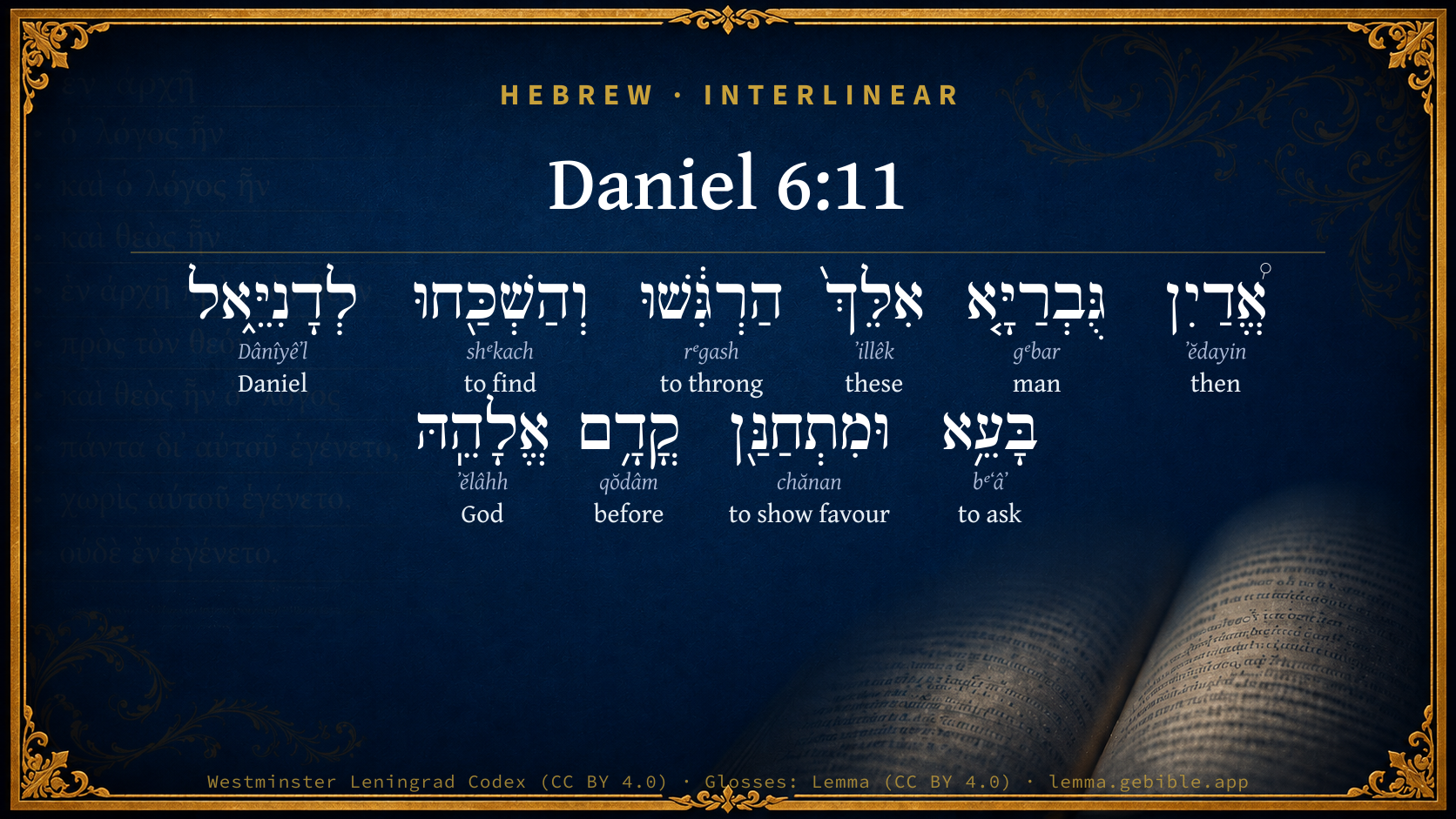
Hebrew (Westminster Leningrad Codex) Daniel 6:11 appears in the Hebrew Old Testament. The text above is from the Westminster Leningrad Codex. Each word links to its Strong’s number, a concise gloss, and parsing drawn from the Open Scriptures Hebrew Bible morphology. Click any word for its full Brown-Driver-Briggs (BDB) entry.
Download image
Cite this verse

Daniel 6:11 (World English Bible). Public Domain. Lemma interlinear Bible study tool, https://lemma.gebible.app/v/daniel/6/11.

Show BibTeX & RIS
BibTeX
RIS
English Translation
Then these men assembled together, and found Daniel making petition and supplication before his God.
World English Bible · Public Domain
Download a study sheet

One document with this verse’s original text, its word-by-word gloss line, the meaning frame, cross-references with their text, attributed commentary, and full source and license credits — printable, and it pastes into notes with its structure intact.

This verse Autodidact and up

Study sheet (.html) Plain text (.txt)

A passage Seminary Student

Up to 50 verses in one chapter. A passage sheet keeps up to 6 commentary sources and 12 cross-references per verse, in the order this page ranks them, and says so on the sheet whenever that leaves anything out. Ask for a single verse and you get the Autodidact verse sheet above.

Everything on this page stays free to read, with no account — the sheet is a download of what is already on screen, not access to it.

Want to remove ads? Support Godless Engineer
Compare translations 3

The same verse in 3 English versions, stacked beneath the original-language interlinear above. Click any original word for its lexicon entry.

Each is an independent rendering of the whole verse — the interlinear is not word-aligned to these translations.

Highlighted words mark where these versions differ — a whole-verse word diff, not a word-by-word alignment.

  • World English Bible Public Domain
    Then these men assembled together, and found Daniel making petition and supplication before his God.
  • King James Version Public Domain
    Then these men assembled, and found Daniel praying and making supplication before his God.
  • unfoldingWord Literal Text CC BY-SA 4.0
    Then these men went as a group and found Daniel making petition and imploring favor before his God.

unfoldingWord Literal Text — © unfoldingWord, licensed CC BY-SA 4.0. Word-aligned USFM3 via Door43 (git.door43.org/unfoldingWord/en_ult).

Versions to compare (up to 4)

3 of 4 selected

Show all 18 translations

Every available English version of this verse, each an independent rendering of the whole verse.

  • World English Bible Public Domain
    Then these men assembled together, and found Daniel making petition and supplication before his God.
  • Berean Standard Bible Public Domain
    Then these men went as a group and found Daniel petitioning and imploring his God.
  • Majority Standard Bible Public Domain
    Then these men went as a group and found Daniel petitioning and imploring his God.
  • King James Version Public Domain
    Then these men assembled, and found Daniel praying and making supplication before his God.
  • American Standard Version (1901) Public Domain
    Then these men assembled together, and found Daniel making petition and supplication before his God.
  • Revised Version (1885) Public Domain
    Then these men assembled together, and found Daniel making petition and supplication before his God.
  • Geneva Bible (1599) Public Domain
    Then these men assembled, and founde Daniel praying, and making supplication vnto his God.
  • Douay-Rheims (1899) Public Domain
    Wherefore those men carefully watching him, found Daniel praying and making supplication to his God.
  • Young's Literal Translation Public Domain
    Then these men have assembled, and found Daniel praying and entreating grace before his God;
  • Literal Standard Version CC BY-SA 4.0
    Then these men have assembled, and found Daniel praying and pleading grace before his God;
  • Unlocked Literal Bible CC BY-SA 4.0
    Then these men who had formed the plot together saw Daniel make requests and seek help from God.
  • unfoldingWord Literal Text CC BY-SA 4.0
    Then these men went as a group and found Daniel making petition and imploring favor before his God.
  • Darby Bible Public Domain
    But those men came in a body, and found Daniel praying and making supplication before his God.
  • World Messianic Bible Public Domain
    Then these men assembled together, and found Daniel making petition and supplication before his God.
  • Webster's Bible Public Domain
    \\6:10\\Now when Daniel knew that the writing was signed, he went into his house; and his windows being open in his chamber towards Jerusalem, he kneeled upon his knees three times a day, and prayed, and gave thanks before his God, as he did before.
  • Free Bible Version CC BY-SA 4.0
    Then the men who had plotted against Daniel went together and found him praying to his God and asking for help.
  • Bible in Basic English Public Domain
    And Daniel, on hearing that the writing had been signed, went into his house; (now he had windows in his room on the roof opening in the direction of Jerusalem;) and three times a day he went down on his knees in prayer and praise before his God, as he had done before.
  • JPS Tanakh (1917) Public Domain
    (6-12) Then these men came tumultuously, and found Daniel making petition and supplication before his God.

Literal Standard Version (2020), Covenant Press — licensed CC BY-SA 4.0. Text via the HelloAO Bible API (eBible.org). Unlocked Literal Bible (unfoldingWord) — licensed CC BY-SA 4.0. Text via the HelloAO Bible API (eBible.org). unfoldingWord Literal Text — © unfoldingWord, licensed CC BY-SA 4.0. Word-aligned USFM3 via Door43 (git.door43.org/unfoldingWord/en_ult). Free Bible Version, Dr. Jonathan Gallagher — licensed CC BY-SA 4.0. Text via the HelloAO Bible API (eBible.org).

Word by word

More ways to search: Search by grammar → Find every occurrence → Compare this word →

Practice this passage: Drill this verse → Learn its vocabulary →

וּמִתְחַנַּ֖ן
chănan
H2604
“and · showing favour”
Adjective, C + Verb, Poal, Participle Active, Masculine, Singular, Absolute
Part of Speech
Adjective + Verb
Stem
Poal
Form
Participle Active
Gender
Masculine
Number
Singular
State
Absolute
Full BDB Definition

Origin: corresponding to H2603

TWOT: 2737

to show favour - (Peal) to show favour - (Ithpael) to implore favour
  1. אֱ֠דַיִן ʼĕdayin H116 “then” Adjective, D
  2. גֻּבְרַיָּ֤א gᵉbar H1400 “men · the” Adjective, N, Common + Particle, Definite Article
  3. אִלֵּךְ֙ ʼillêk H479 “these” Adjective, P
  4. הַרְגִּ֔שׁוּ rᵉgash H7284 “to throng” Adjective, V, Plural
  5. וְהַשְׁכַּ֖חוּ shᵉkach H7912 “and · to find” Adjective, C + Verb, Hiphil, Perfect, 3rd Person, Masculine, Plural
  6. לְדָנִיֵּ֑אל Dânîyêʼl H1841 “to/for · Daniel” Adjective, T + Noun, Proper
  7. בָּעֵ֥א bᵉʻâʼ H1156 “asking” Adjective, V
  8. קֳדָ֥ם qŏdâm H6925 “before” Adjective, R
  9. אֱלָהֵֽהּ ʼĕlâhh H426 “God · his” Adjective, N, Common + Suffix, Personal, 3rd Person, Masculine, Singular

About this verse

These counts appear in no published source. They are computed here, from the morphology-tagged text and Lemma’s own curated glosses. What Lemma adds →

10
words
10
distinct lemmas
Prophets
section

Notable vocabulary

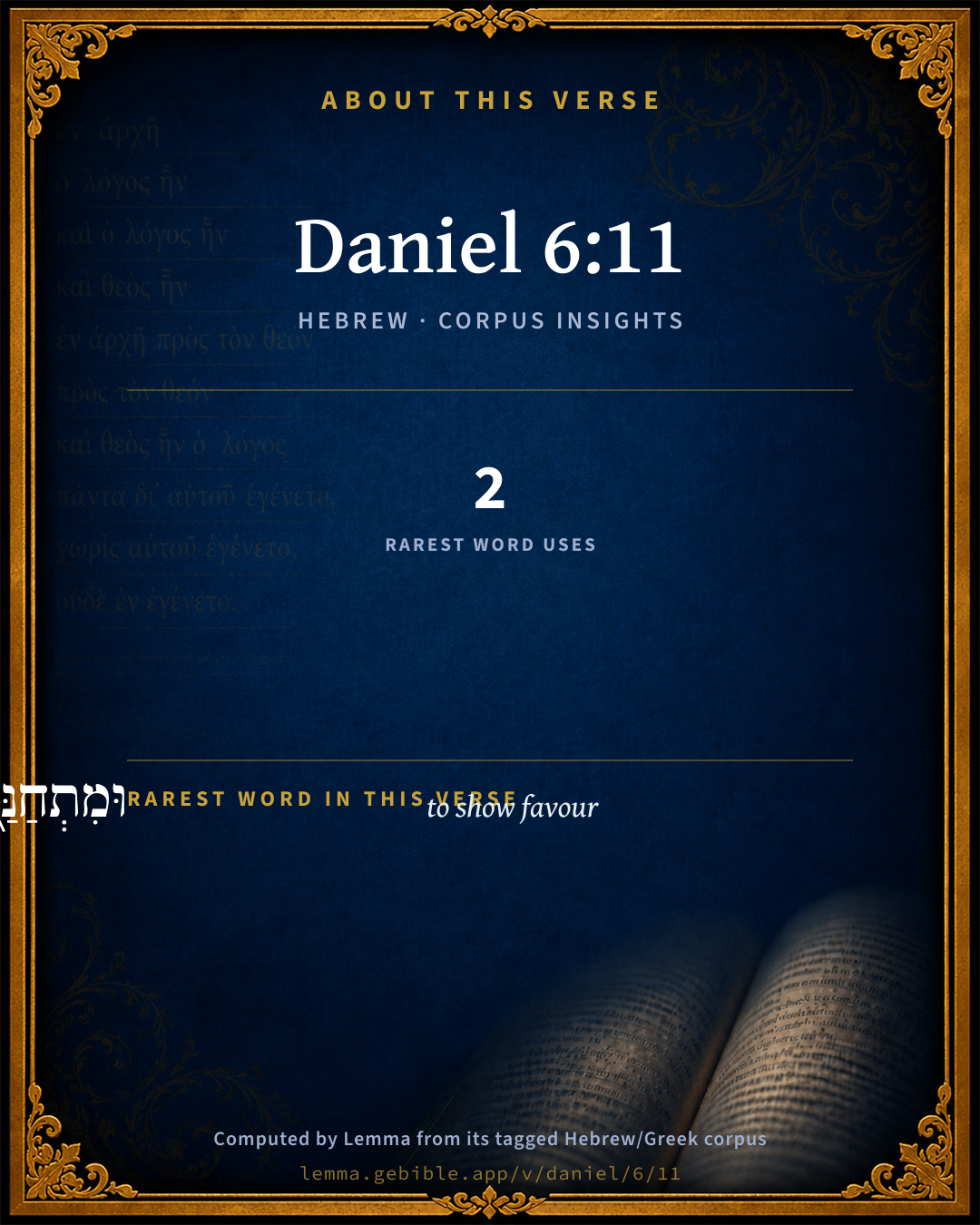
The rarest word here is וּמִתְחַנַּ֖ן to show favour H2604 — appearing just 2 times in the whole Hebrew Bible.

Shared distinctive vocabulary

וּמִתְחַנַּ֖ן to show favour H2604 occurs in 2 verses of the Hebrew Bible. Also found in:

Grammatical profile

  • 2 verbs
  • 1 noun
  • 6 adjectives
  • 1 particle

Verb forms

  • וְהַשְׁכַּ֖חוּ Hiphil · Perfect
  • וּמִתְחַנַּ֖ן Poal · Participle Active

Hebrew & Septuagint length

In English translation the verse runs 15 words from the Hebrew and 13 from the Septuagint (LXX English) — closely comparable.

A rough comparison of the two English renderings, which tokenize alike — not a word-level alignment.

Word counts can differ between the Hebrew and the Greek without any difference in meaning — e.g. the Hebrew direct-object marker אֵת has no separate Greek word, and Greek often adds the article ὁ.

Cross-references

3

Topical passages linked to Daniel 6:11 in the Treasury of Scripture Knowledge — connected by theme and wording, ordered by reader-vote popularity; previews shown in the World English Bible.

  • Psalms 37:32–33 The wicked watches the righteous, And seeks to kill him.
  • Psalms 10:9 He lurks in secret as a lion in his ambush. He lies in wait to catch the helpless. He catches the helpless, when he draws him in his net.
  • Daniel 6:6 Then these presidents and satraps assembled together to the king, and said thus to him, King Darius, live forever.

Cross-references courtesy of OpenBible.info (CC BY 4.0).

Hebrew and Greek witnesses Masoretic Hebrew ↔ Greek Septuagint

The same verse in the two great witnesses to the Old Testament, shown verse-for-verse.

These are two independent witnesses, not word-aligned to each other, and the Septuagint is shown in lemma (dictionary) form.

Hebrew Daniel 6:11 Masoretic · Westminster Leningrad Codex

אֱ֠דַיִן גֻּבְרַיָּ֤א אִלֵּךְ֙ הַרְגִּ֔שׁוּ וְהַשְׁכַּ֖חוּ לְדָנִיֵּ֑אל בָּעֵ֥א וּמִתְחַנַּ֖ן קֳדָ֥ם אֱלָהֵֽהּ

Then these men assembled together, and found Daniel making petition and supplication before his God.

World English Bible · Public Domain

Greek LXX Daniel 6:11 Septuagint · lemma form

ἐπιγιγνώσκω δέ δανιηλ ὁ ὁρισμός ὅς ἵστημι κατά αὐτός θυρίς ἀναοἴγω ἐν ὁ ὑπερῷον αὐτός κατέναντι ἰερουσαλήμ καί πίπτω ἐπί πρόσωπον αὐτός τρίς ὁ ἡμέρα καθώς ποιέω ἔμπροσθεν καί δέω

Then these men watched, and found Daniel praying and supplicating to his God.

LXX2012 (modern English Septuagint) · Public Domain

On this verse, Keil & Delitzsch discusses the Septuagint’s reading. Read the note in Commentary ↓

Hebrew: Westminster Leningrad Codex (CC BY 4.0). Greek: Septuagint (public domain); English from LXX2012 (modern English Septuagint) (Public Domain). How the Septuagint differs from the Hebrew →

Commentary

Notes on Daniel 6:11 from classic Christian and Jewish commentators (each source and its license shown beneath its notes). The classic Christian expositions comment on the surrounding passage and are grouped to its opening verse, so a note may address several verses; the Jewish commentaries on the Tanakh (Rashi and others) are per-verse, so they appear only where the commentator wrote on this verse.

Lemma curates 59 commentaries, every one of them public domain or Creative Commons licensed, each selected and text-cleaned for this edition rather than reprinted as found. About our sources →

Matthew Henry's Commentary

Here is 1. Proof made of Daniel's praying to his God, notwithstanding the late edict to the contrary (Dan 6:11): These men assembled; the came tumultuously together, so the word is, the same that was used Dan 6:6, borrowed from Psa 2:1, Why do the heathen rage? They came together to visit Daniel, perhaps under pretence of business, at that time which they knew to be his usual hour of devotion; and, if they had not found him so engaged, they would have upbraided him with his faint-heartedness and distrust of his God, but (which they rather wished to do) they found him on his knees praying and making supplication before his God. For his love they are his adversaries; but, like his father David, he gives himself unto prayer, Psa 109:4. 2. Complaint made of it to the king. When they had found occasion against Daniel concerning the law of his God they lost no time, but applied to the king (Dan 6:12), and having appealed to his whether there was not such a law made, and gained from him a recognition of it, and that it was so ratified that it might not be altered, they proceeded to accuse Daniel, Dan 6:13. They so describe him, in the information they give, as to exasperate the king and incense him the more against him: "He is of the children of the captivity of Judah; he is of Judah, that despicable people, and now a captive in a despicable state, that can call nothing his own but what he has by the king's favour, and yet he regards not thee, O king! nor the decree that thou hast signed." Note, It is no new thing for that which is done faithfully, in the conscience towards God, to be misrepresented as done obstinately and in contempt of the civil powers, that is, for the best saints to be reproached as the worst men. Daniel regarded God, and therefore prayed, and we have reason to think prayed for the king and his government, yet this is construed as not regarding the king. That excellent spirit which Daniel was endued with, and that established reputation which he had gained, could not protect him from these poisonous darts. They do not say, He makes his petition to his God, lest Darius should take notice of that to his praise, but only, He makes his petition, which is the thing the law forbids. 3. The great concern the king was in hereupon. He now perceived that, whatever they pretended, it was not to honour him, but in spite to Daniel, that they had proposed that law, and now he is sorely displeased with himself for gratifying them in it, Dan 6:14. Note, When men indulge a proud vain-glorious humour, and please themselves with that which feeds it, they know not what vexations they are preparing for themselves; their flatterers may prove their tormentors, and are but spreading a net for their feet. Now, the king sets his heart to deliver Daniel; both by argument and by authority he labours till the going down of the sun to deliver him, that is, to persuade his accusers not to insist upon his prosecution. Note, We often do that, through inconsideration, which afterwards we see cause a thousand times to wish undone again, which is a good reason why we should ponder the path of our feet, for then all our ways will be established. 4. The violence with which the prosecutors demanded judgment, Dan 6:15. We are not told what Daniel said; the king himself is his advocate, he needs not plead his own cause, but silently commits himself and it to him that judges righteously. But the prosecutors insist upon it that the law must have its course; it is a fundamental maxim in the constitution of the government of the Medes and Persians, which had now become the universal monarchy, that no decree or statute which the king establishes may be changed. The same we find Est 1:19; Est 8:8. The Chaldeans magnified the will of their king, by giving him a power to make and unmake laws at his pleasure, to slay and keep alive whom he would. The Persians magnified the wisdom of their king, by supposing that whatever law he solemnly ratified it was so well made that there could be no occasion to alter it, or dispense with it, as if any human foresight could, in framing a law, guard against all inconveniences. But, if this maxim be duly applied to Daniel's case (as I am apt to think it is not, but perverted), while it honours the king's legislative power it hampers his executive power, and incapacitates him to show that mercy which upholds the throne, and to pass acts of indemnity, which are the glories of a reign. Those who allow not the sovereign's power to dispense with a disabling statute, yet never question his power to pardon an offence against a penal statute. But Darius is denied this power. See what need we have to pray for princes that God would give them wisdom, for they are often embarrassed with great difficulties, even the wisest and best are. 5. The executing of the law upon Daniel. The king himself, with the utmost reluctance, and against his conscience, signs the warrant for his execution; and Daniel, that venerable grave man, who carried such a mixture of majesty and sweetness in his countenance, who had so often looked great upon the bench, and at the council-board, and greater upon his knees, who had power with God and man, and had prevailed, is brought, purely for worshipping his God, as if he had been one of the vilest of malefactors, and thrown into the den of lions, to be devoured by them, Dan 6:16. One cannot think of it without the utmost compassion to the gracious sufferer and the utmost indignation at the malicious prosecutors. To make sure work, the stone laid upon the mouth of the den is sealed, and the king (an over-easy man) is persuaded to seal it with his own signet (Dan 6:17), that unhappy signet with which he had confirmed the law that Daniel falls by. But his lords cannot trust him, unless they add their signets too. Thus, when Christ was buried, his adversaries sealed the stone that was rolled to the door of his sepulchre. 6. The encouragement which Darius gave to Daniel to trust in God: Thy God whom thou servest continually, he will deliver thee, Dan 6:16. Here (1.) He justifies Daniel from guilt, owning all his crime to be serving his God continually, and continuing to do so even when it was made a crime. (2.) He leaves it to God to free him from punishment, since he could not prevail to do it: He will deliver thee. He is sure that his God can deliver him, for he believes him to be an almighty God, and he has reason to think he will do it, having heard of his delivering Daniel's companions in a like case from the fiery furnace, and concluding him to be always faithful to those who approve themselves faithful to him. Note, Those who serve God continually he will continually preserve, and will bear them out in his service.

Matthew Henry's Commentary on the Whole Bible (1708–1710) — public domain (CC PDM 1.0). Text via the HelloAO Bible API.

Trapp's Complete Commentary

John Trapp

Dan 6:11 Then these men assembled, and found Daniel praying and making supplication before his God.

Ver. 11. Then these men assembled.] But for ill purpose: as did also our Saviour’s enemies, {Luk 22:6} and Stephen’s, {Act 6:9-15} the Popish counsels. At Rome they have a meeting weekly de propaganda fide, for the propagating of the Romish religion, and abolishing of heresy, as they call it.

And found Daniel praying.] The sun shall sooner stand still in heaven, than Daniel give over to pray to his Father in heaven.

John Trapp, A Commentary or Exposition upon All the Books of the Old and New Testament (1647–1656) — public domain. Text from a community e-Sword module.

The Biblical Illustrator

Joseph S. Exell

Dan_6:11-14

Then the king, when he heard these words, was sore displeased with himself.

The Nemesis of Flattery

Daniel sought neither publicity, nor avoided it. He was too well acquainted with the methods of Oriental government to suppose that his disobedience to the Kings decree could be concealed. Because he had given God his, heart, he sought no evasions. He would have been untrue to his own feelings if he had cared for his own selfish ease and safety more than for Gods honour. But he made no parade, or ostentatious exhibition of his piety. Amidst all the weighty cares and pressure of public business, this holy man found time for regular prayer. (verses 12-14) Alas! Poor King! But a day or two ago he had scaled the giddiest height of human ambition. His courtiers had made him divine. Darius the infallible! It must be very trying to an infallible personage to have any of the ills that flesh is heir to--such as a headache--and not be able to predicate for certain what will cure it. There was something worse here. These courtiers had snared Darius with his own vanity. So much adulation for bait, and when it was taken the trap would fall, and the King be caged. The Persian law rendered him impotent. He might repent, but repentance availed nothing. As a rule this Medo-Persian law probably worked well. It was intended as an obstacle to the too hasty enactment of a law. But the tumultuous entry of the conspirators demanding leave to pay him extravagant honour, was too much for Dariuss prudence. He fondly imagined that their flattery was genuine, and that it arose from heartfelt respect for his great qualities. And now he was sore displeased with himself, for he felt that he had been weak indeed. He had let himself be duped. Our sins, and even our follies, punish us with just retribution. For vain Darius there was self-contempt. By a just retribution God uses our own vices and weakness as the scourge wherewith He punishes us. Were we wise we should take the warning. But it is in vain that the moralist warns us that only the edge of follys cup is tinged with honey, and that the long drought which follows ever grows in bitterness, and must be drained to the last foul dregs. But this, with us, is not inevitable. We do not stand, like Darius, sorrowful, reluctant, displeased with ourselves, labouring to escape, but with no outlet for deliverance. For us Christ has died, and he is our way of safety, our door for admittance into the fold of the free, and also our strength. He gives swiftness to the weary feet, power to the feeble arms, peace to the aching heart. (Dean Payne Smith.)

Conscience at Work

Why this uneasiness? Is he afraid of foreign invasion? Does he dread some internal rebellion or has disease assailed his constitution? No. His uneasiness arises, not from his body, but from his soul; not from his kingdom, but from his conscience. In the matter of Daniels condemnation, he had acted a most unworthy, most unkingly, most unmanly part. No sooner is the act completed, than his heart reproached him with his weakness, and his conscience accused him of his sin. Why was he, on any account, accessory to the death of an innocent man? Why did he suffer a faithful servant to be basely betrayed and murdered? Why did he consent to tarnish his honour, to compromise his dignity, by becoming the reluctant accomplice, and the degraded tool, of envious and perfidious men? The more he broods over the matter, he becomes the more excited, till the fever of his mind was communicated to his physical frame, and rendered sleep impossible. From this we may learn, that sin, even when yielded to from weakness, will leave guilt upon the conscience, which sooner or later will cause uneasiness and pain. Conscience, it is true, may be so debilitated and exhausted by habits of sin, that it may allow the sinner to lie long under guilt without raising an accusing voice. God, however, can at any moment quicken it by one single beam of light, and so kindle and inflame it, that the most hardened sinners in Zion shall tremble, and fearfulness seize the most seared and hardened among the hypocrites. And when conscience is once quickened, the guilty man cannot escape from its accusations. Wherever he goes, he carries his accuser in his bosom. And the conscience will never be truly pacified, until it is sprinkled by the atoning blood of Jesus, and purified by the sanctifying influences of the Holy Ghost. When in this state of mind, Darius used no carnal methods to silence the voice of his inward monitor. He gave it full scope. He communed with his heart in the night season. Then the king went to his palace, and passed the night fasting: neither were instruments of music brought before him. The conduct of this heathen king reproves many, who, when their consciences are quickened by the word read or preached, or by some dispensation in providence, use means to lull it asleep, such as pleasure, or company, or dissipation. When conscience speaks, let us ever attend. Give ear to her faintest whispers. Be not afraid to listen to her loudest accusations. These may work your souls eternal health. Those times, when a mans conscience is specially awakened, ought to be regarded as constituting eras of incalculable importance in his history as an immortal being. Let us, in such cases, looking up to God for wisdom to guide, and for grace to strengthen, endeavour to perform the first duty pointed out by the light which we have, and in the way of doing so, we will ever see the light shining before us, as we advance, and ever shining more and more, the farther we proceed. (W. White.)

The Conscience of the Wicked King

Study the character of Darius.

I. HIS VANITY. He was proud of his position and power. He was attacked on his weak side. He would not make himself a god, but merely assumes Gods prerogative for thirty days. But the one bad step brought its calamity; for sins are social--one of them is never alone. One of his presidents would worship his God all the time. The king sees the evil, but too late. He had done wrong, and he is now the slave of wrong. So with every man. Selfishness is his weakness. If he gives way, the first stone of his dungeon is laid. Then comes the unexpected evil; that one sin brings another. In any crisis, small or great, when the question is between Christ and ourselves, if we do not crucify self, we open the long avenues of guilt, of which often there is no shutting afterwards.

II. HIS PERPLEXITY. The kings conscience is aroused. Daniel! he cannot do such a thing with him, he must not do it. But he cannot help it. Surely Daniel can be saved. No--not even that. Then comes the actual evil. He cannot go back, he must go forward. He sinks lower, to sins of deed--weakness, cowardice, and even blasphemy.

III. HIS REMORSE AND GOOD INTENTIONS. The king was sorry. Surely he was penitent. Now the tide was turned. Darius makes a new decree: the God of Daniel must be served, and no other. But we are not told that he turned to the Lord, that he learned His law, or kept it. So with us when the cloud breaks and the passion has spent its force, then the reaction comes, and repentance and remorse. If we repent partially, not because we have sinned against God, but have disturbed our own conscience or brought disgrace upon ourselves, if we are ready to go back to temptation afresh, then a new cloud hangs, threatening night. Come, not to boast, but to be forgiven; not to offer, but to receive. (W. Murdoch Johnston, M.A.)

And set his heart on Daniel to deliver him.

Darius and Daniel; or the Necessity of an Atonement

Why could not Darius deliver Daniel? He was an absolute monarch, and had the whole power of the realm at his control. His inability did not arise frown a want of disposition. The king was most sincerely disposed to deliver him, if he could. He passed sentence upon Daniel with great and evident reluctance. There are many things which a monarch, however powerful, cannot consistently perform. An absolute monarch may be so surrounded with checks and restraints, that he has really less liberty than almost any of his subjects. He cannot abrogate his own laws, or trifle with his own authority, or introduce principles of administration which shall go to encourage transgression, or to release his subjects from their obligations el obedience. There were but two ways in which Darius could deliver Daniel. The one was by rescinding and disowning his rash decree; and the other by forbearing to execute it, or, which is the same, by pardoning Daniel. In the first case he would have dishonoured the law, and disgraced himself for passing such a law. Could he not forbear to execute his rash decree? Could he not give this beloved officer a full and free pardon? Nay, he could not pardon Daniel, even if Daniel would consent to be pardoned, without dishonouring his entire system of government, weakening its authority, and exposing it to contempt. The consequence was, that the transgressor of the law must feel its penalty, and Daniel must go into the den of lions. The case of Darius and Daniel goes to illustrate another case, in which we are personally and immensely interested. We are the rightful subjects of an absolute Monarch--the mighty Monarch of the universe. He has issued good laws for the regulations of our hearts and lives, and has annexed to them a just, but a dreadful penalty. These laws we have broken; this penalty we have all incurred. In what way can we be delivered? True, our Sovereign has physical power enough to deliver us, for He is omnipotent. And He can have no pleasure in our ruin, for He is infinitely benevolent. Still, there are some things which He cannot with propriety do. He cannot deny Himself. He cannot disgrace Himself. He cannot bring dishonour upon His holy law. He cannot do anything to weaken His authority in the eyes of those whom He rules, anything to invite or encourage transgression. How then are we, who have broken the law of God, and incurred its penalty, to be delivered? The laws of God are perfectly good laws; to set them aside would be inconsistent with His holiness. If God were not infinitely wiser than men, and infinitely more benignant and merciful, there would be no hope. What Darius could not do for Daniel, God has been able to do for us. He has devised a way in which His holy law can be honoured, and its authority maintained, and yet the penalty be remitted to penitent transgressors. By the voluntary sufferings and death of Christ, in place of the transgressor, the violated law has been honoured, and a way of deliverance opened. Sinners cannot be saved without an atonement, and they can be saved in no other way than by an atonement. (E. Pond, D.D.)

The Biblical Illustrator, edited by Joseph S. Exell (c. 1880s–1900s) — public domain. Text from a community e-Sword module.

Joseph Benson's Commentary

Dan 6:11-12. Then these men assembled and found Daniel praying — Their design being laid, they watched narrowly, and found, as they expected, Daniel upon his knees, making supplication, not to Darius, but to Jehovah, in flat opposition to the law signed by the king, and not to be violated without suffering its penalty. Then they came near, and spake before the king — Having now got what they wanted, an unanswerable plea against Daniel, they came with open mouth, and urged that the king’s law was broken, a law which he had solemnly signed and ratified, and so rendered unalterable; pleading that the king’s authority, and the honour of the nation, lay at stake. The king answered, The thing is true, &c. — He owned such a law had been made, and signed by him, and that therefore it must be put in force.

Joseph Benson's Commentary on the Old and New Testaments (1811–1818) — public domain. Text from a community e-Sword module.

Keil & Delitzsch

C. F. Keil & F. Delitzsch

Daniel's offence against the law; his accusation, condemnation, and miraculous deliverance from the den of lions; and the punishment of his accusers.

The satraps did not wait long for Daniel's expected disregard of the king's prohibition. It was Daniel's custom, on bended knees, three times a day to offer prayer to his God in the upper chamber of his house, the window thereof being open towards Jerusalem. He continued this custom even after the issuing of the edict; for a discontinuance of it on account of that law would have been a denying of the faith and a sinning against God. On this his enemies had reckoned. They secretly watched him, and immediately reported his disregard of the king's command. In Dan 6:10 the place where he was wont to pray is more particularly described, in order that it might be shown how they could observe him. In the upper chamber of his house (עלּית, Hebr. עליּה, Kg1 17:19; Sa2 19:1), which was wont to be resorted to when one wished to be undisturbed, e.g., wished to engage in prayer (cf. Act 1:13; Act 10:9), the windows were open, i.e., not closed with lattice-work (cf. Eze 40:16), opposite to, i.e., in the direction of, Jerusalem. להּ does not refer to Daniel: he had opened windows, but to לביתהּ: his house had open windows. If להּ referred to Daniel, then the הוּא following would be superfluous. The custom of turning in prayer toward Jerusalem originated after the building of the temple at Jerusalem as the dwelling-place of Jehovah; cf. Kg1 8:33, Kg1 8:35; Psa 5:8; Psa 28:2. The offering of prayer three times a day, - namely, at the third, sixth, and ninth hour, i.e., at the time of the morning and the evening sacrifices and at mid-day, - was not first introduced by the men of the Great Synagogue, to whom the uncritical rabbinical tradition refers all ancient customs respecting the worship of God, nor is the opinion of v. Leng., Hitz., and others, that it is not of later origin than the time of the Median Darius, correct; but its origin is to be traced back to the times of David, for we find the first notice of it in Psa 55:18. If Daniel thus continued to offer prayer daily (מודא = מהודא, Dan 2:23) at the open window, directing his face toward Jerusalem, after the promulgation of the law, just as he had been in the habit of doing before it, then there was neither ostentation nor pharisaic hypocrisy, nor scorn and a tempting of God, as Kirmiss imagines; but his conduct was the natural result of his fear of God and of his religion, under the influence of which he offered prayers not to make an outward show, for only secret spies could observe him when so engaged. דּי כּל־קבל does not mean altogether so as (Rosenmller, v. Leng., Maur., Hitzig), but, as always, on this account because, because. Because he always did thus, so now he continues to do it.

Daniel 6:12 (Dan 6:11)

When Daniel's enemies had secretly observed him prayer, they rushed into the house while he was offering his supplications, that they might apprehend him in the very act and be able to bring him to punishment. That the act of watching him is not particularly mentioned, since it is to be gathered from the context, does not make the fact itself doubtful, if one only does not arbitrarily, with Hitzig, introduce all kinds of pretences for throwing suspicion on the narrative; as e.g., by inquiring whether the 122 satraps had placed themselves in ambush; why Daniel had not guarded against them, had not shut himself in; and the lie. הרגּישׁ, as Dan 6:7, to rush forward, to press in eagerly, here "shows the greatness of the zeal with which they performed their business" (Kran.).

Daniel 6:13-14 (Dan 6:12-13)

They immediately accused him to the king. Reminding the king of the promulgation of the prohibition, they showed him that Daniel, one of the captive Jews, had not regarded the king's command, but had continued during the thirty days to pray to his own God, and thus had violated the law. In this accusation they laid against Daniel, we observe that his accusers do not describe him as one standing in office near to the king, but only as one of a foreign nation, one of the Jewish exiles in Babylon, in order that they may thereby bring his conduct under the suspicion of being a political act of rebellion against the royal authority.

Daniel 6:15 (Dan 6:14)

But the king, who knew and highly valued (cf. v. 2 [1]) Daniel's fidelity to the duties of his office, was so sore displeased by the accusation, that he laboured till the going down of the sun to effect his deliverance. The verb באשׁ has an intransitive meaning: to be evil, to be displeased, and is not joined into one sentence with the subject מלכּא, which stands here absolute; and the subject to עלוהי באשׁ is undefined: it, namely, the matter displeased him; cf. Gen 21:11. בּל שׂם corresponds to the Hebr. לב שׁית, Pro 22:17, to lay to heart. The word בּל, cor, mens, is unknown in the later Chaldee, but is preserved in the Syr. bālā̀ and the Arab. bâlun.

Daniel 6:16-17 (Dan 6:15-16)

When the king could not till the going down of the sun resolve on passing sentence against Daniel, about this time his accusers gathered themselves together into his presence for the purpose of inducing him to carry out the threatened punishment, reminding him that, according to the law of the Medes and Persians, every prohibition and every command which the king decreed (יהקים), i.e., issued in a legal form, could not be changed, i.e., could not be recalled. There being no way of escape out of the difficulty for the king, he had to give the command that the punishment should be inflicted, and Daniel was cast into the den of lions, v. 17 (Dan 6:16). On the Aphel היתיו, and the pass. from (Dan 6:17) היתית, see at Dan 3:13. The execution of the sentence was carried out, according to Oriental custom, on the evening of the day in which the accusation was made; this does not, however, imply that it was on the evening in which, at the ninth hour, he had prayed, as Hitzig affirms, in order that he may thereby make the whole matter improbable. In giving up Daniel to punishment, the king gave expression to the wish, "May thy God whom thou servest continually, deliver thee!" not "He will deliver thee;" for Darius could not have this confidence, but he may have had the feeble hope of the possibility of the deliverance which from his heart he wished, inasmuch as he may have heard of the miracles of the Almighty God whom Daniel served in the days of Belshazzar and Nebuchadnezzar.

Daniel 6:18 (Dan 6:17)

After Daniel had been thrown into the lions' den, its mouth was covered with a flat stone, and the stone was sealed with the king's seal and that of the great officers of state, that nothing might change or be changed (בּּדּניּאל צבוּ) concerning Daniel (צבוּ, affair, matter), not that the device against Daniel might not be frustrated (Hv., v. Leng., Maur., Klief.). This thought required the stat. emphat. צנוּתא, and also does not correspond with the application of a double seal. The old translator Theodot. is correct in his rendering: ὅπως μὴ ἀλλοιωθῇ πρᾶγμα ἐν τῷ Δανιήλ, and the lxx paraphrasing: ὅπως μὴ απ ̓αὐτῶν (μεγιστάνων) αρθῇ ὁ Δανιήλ, ἤ ὁ βασιλεύς αὐτὸν ἀνασπάσῃ ἐκ τοῦ λακκοῦ. Similarly also Ephr. Syr. and others.

The den of lions is designated by גּבּא, which the Targg. use for the Hebr. בור, a cistern. From this v. Leng., Maur., and Hitzig infer that the writer had in view a funnel-shaped cistern dug out in the ground, with a moderately small opening or mouth from above, which could be covered with a stone, so that for this one night the lions had to be shut in, while generally no stone lay on the opening. The pit also into which Joseph, the type of Daniel, was let down was a cistern (Gen 37:24), and the mouth of the cistern was usually covered with a stone (Gen 29:3; Lam 3:53). It can hence scarcely be conceived how the lions, over which no angel watched, could have remained in such a subterranean cavern covered with a stone. "The den must certainly have been very capacious if, as it appears, 122 men with their wives and children could have been thrown into it immediately after one another (v. 25 [Dan 6:24]); but this statement itself only shows again the deficiency of every view of the matter," - and thus the whole history is a fiction fabricated after the type of the history of Joseph! But these critics who speak thus have themselves fabricated the idea of the throwing into the den of 122 men with women and children - for the text states no number - in order that they might make the whole narrative appear absurd.

We have no account by the ancients of the construction of lions' dens. Ge. Hst, in his work on Fez and Morocco, p. 77, describes the lions' dens as they have been found in Morocco. According to his account, they consist of a large square cavern under the earth, having a partition-wall in the middle of it, which is furnished with a door, which the keeper can open and close from above. By throwing in food they can entice the lions from the one chamber into the other, and then, having shut the door, they enter the vacant space for the purpose of cleaning it. The cavern is open above, its mouth being surrounded by a wall of a yard and a half high, over which one can look down into the den. This description agrees perfectly with that which is here given in the text regarding the lions' den. Finally, גּבּא does not denote common cisterns. In Jer 41:7, Jer 41:9, גּוּבא (Hebr. בור) is a subterranean chamber into which seventy dead bodies were cast; in Isa 14:15, the place of Sheol is called גּוב. No reason, therefore, exists for supposing that it is a funnel-formed cistern. The mouth (פּוּם) of the den is not its free opening above by which one may look down into it, but an opening made in its side, through which not only the lions were brought into it, but by which also the keepers entered for the purpose of cleansing the den and of attending to the beasts, and could reach the door in the partition-wall (cf. Hst, p. 270). This opening was covered with a great flat stone, which was sealed, the free air entering to the lions from above. This also explains how, according to Dan 6:20 ff., the king was able to converse with Daniel before the removal of the stone (namely, by the opening above).

Daniel 6:19-21 (Dan 6:18-20)

Then the king went to his palace, and passed the night fasting: neither were any of his concubines brought before him; and this sleep went from him. The king spent a sleepless night in sorrow on account of Daniel. טות, used adverbially, in fasting, i.e., without partaking of food in the evening. דּחוה, concubina; cf. The Arab. dahâ and dahâ=, subigere faeminam, and Gesen. Thes. p. 333. On the following morning (v. 20 [Dan 6:19]) the king rose early, at the dawn of day, and went to the den of lions, and with lamentable voice called to him feebly hoping that Daniel might be delivered by his God whom he continually served. Daniel answered the king, thereby showing that he had been preserved; whereupon the king was exceeding glad. The future or imperf. יקוּם (Dan 6:19) is not to be interpreted with Kranichfeld hypothetically, he thought to rise early, seeing he did actually rise early, but is used instead of the perf. to place the clause in relation to the following, meaning: the king, as soon as he arose at morning dawn, went hastily by the early light. בּנגהא, at the shining of the light, serves for a nearer determination of the בּשׁפרפּרא, at the morning dawn, namely, as soon as the first rays of the rising sun appeared. The predicate the living God is occasioned by the preservation of life, which the king regarded as possible, and probably was made known to the king in previous conversations with Daniel; cf. Psa 42:3; Psa 84:3; Sa1 17:36, etc.

Daniel 6:22-24 (Dan 6:21-23)

In his answer Daniel declares his innocence, which God had recognised, and on that account had sent His angel (cf. Psa 34:8; Psa 91:11.) to shut the mouths of the lions; cf. Heb 10:33. ואף, and also (concluding from the innocence actually testified to by God) before the king, i.e., according to the king's judgment, he had done nothing wrong or hurtful. By his transgression of the edict he had not done evil against the king's person. This Daniel could the more certainly say, the more he perceived how the king was troubled and concerned about his preservation, because in Daniel's transgression he himself had seen no conspiracy against his person, but only fidelity toward his own God. The king hereupon immediately gave command that he should be brought out of the den of lions. The Aph. הנסקה and the Hoph. הסּק, to not come from נסק, but from סלק; the נis merely compensative. סלק, to mount up, Aph. to bring out; by which, however, we are not to understand a being drawn up by ropes through the opening of the den from above. The bringing out was by the opened passage in the side of the den, for which purpose the stone with the seals was removed. To make the miracle of his preservation manifest, and to show the reason of it, v. 24 (Dan 6:23) states that Daniel was found without any injury, because he had trusted in his God.

Daniel 6:25 (Dan 6:24)

But now the destruction which the accusers of Daniel thought to bring upon him fell upon themselves. The king commanded that they should be cast into the den of lions, where immediately, before they had reached the bottom, they were seized and torn to pieces by the lions. On קרצוהי אכל see at Dan 3:8. By the accusers we are not (with Hitzig) to think of the 120 satraps together with the two chief presidents, but only of a small number of the special enemies of Daniel who had concerned themselves with the matter. The condemning to death of the wives and children along with the men was in accordance with Persian custom, as is testified by Herodotus, iii. 119, Amm. Marcell. xxiii. 6. 81, and also with the custom of the Macedonians in the case of treason (Curtius, vi. ii.), but was forbidden in the law of Moses; cf. Deu 24:16.

Keil & Delitzsch — Biblical Commentary on the Old Testament (1861–1891) — public domain (CC PDM 1.0). Text via the HelloAO Bible API. (Old Testament only.)

Jamieson, Fausset & Brown

Robert Jamieson, A. R. Fausset & David Brown

assembled--as in Dan 6:6, "assembled" or "ran hastily," so as to come upon Daniel suddenly and detect him in the act.

Jamieson, Fausset & Brown — Commentary Critical and Explanatory on the Whole Bible (1871) — public domain (CC PDM 1.0). Text via the HelloAO Bible API.

John Calvin's Commentaries

Here the nobles of Darius display their fraud when they observe Daniel, and unite in a conspiracy against him: for no other object but the death of Daniel could have induced them to dictate this edict. Hence they agree together, and find Daniel uttering prayers and supplications to his God If Daniel had prayed with the slightest secrecy, he would not have been a victim to their snares; but he did not refuse the prospect of death. He knew the object of the edict, and expected the arrival of the nobles. We see, then, how willingly he submitted to instant death, and for no other purpose than to retain the pure worship of God, together with its outward profession. Go to, now, ye who desire to shield your perfidy, pretending that you ought not to incur danger rashly, and when the wicked surround you on all sides! You become cautious lest you should rashly throw away your lives! For Daniel, in their opinion, was to be blamed for too great simplicity and folly, since he willingly and knowingly encountered certain danger. But we have already said, he could not escape from their snare without indirectly revolting from God, for he might have been immediately reproached — Why do you desist from your accustomed habit? Why do you close your windows? Why do you not dare to pray to your God? It appears, then, you regard the king of more importance than the reverence and fear of God. Because God’s honor would have been thus sullied, Daniel, as we have already seen, spontaneously offered himself to death as a sacrifice. We are taught, also, by this example, how snares are prepared for the sons of God, however circumspectly they act, and however soberly they conduct themselves. But they ought to conduct themselves so prudently as neither to be too cunning nor too anxious, that is, they should not regard their own security so as in the meantime to forget God’s requirements, and the preciousness of his name, and the necessity of a confession of faith in the proper place and time. It now follows:

John Calvin's Commentaries (1540-1563) — public domain. Text from the Calvin Translation Society English edition (1840s-50s) via the Christian Classics Ethereal Library (ccel.org). Calvin's coverage is partial (roughly two-thirds of the Bible); uncommented books and verses are honest gaps, never fabricated. The 19th-century editor's footnotes and remarks are omitted so the notes are faithfully Calvin's own voice.

The Cambridge Bible for Schools and Colleges

gen. ed. J. J. S. Perowne

11. assembled] came thronging (Dan_6:6),—flocking tumultuously about Daniel’s house.

The Cambridge Bible for Schools and Colleges (gen. ed. J. J. S. Perowne; Cambridge University Press, 1878–1918) — public domain. Text from a community e-Sword module.

John Gill's Exposition

Then they came near,.... They went immediately from Daniel's house to the king's palace, and into the king's presence; which they could do, either by virtue of their offices, or being admitted by the proper officer in waiting:

and spake before the king concerning the king's decree; at first they said nothing about Daniel, but about the decree, to get it recognized, and afresh ratified and confirmed; lest, under some pretence or another, the king should change it:

hast thou not signed a decree, that every man that shall ask a petition of any god or man within thirty days, save of thee, O king, shall be cast into the den of lions? they do not say peremptorily that he had signed such a decree, but put the question to him, that they might have it affirmed by himself:

the king answered and said, the thing is true, according to the law of the Medes and Persians, which altereth not; it is true that such a decree is made and signed, and it is an unalterable one; such as is every established and signed decree of the Medes and Persians: it is as if he had said, it is very true what you put me in mind of, and I will never recede from it, or nullify and make it void.

John Gill's Exposition of the Whole Bible (1746–1763) — public domain (CC PDM 1.0). Text via the HelloAO Bible API.

Albert Barnes' Notes on the Bible

Then these men assembled ... - Evidently with a design of finding him at his devotions.

Albert Barnes' Notes on the Bible (1834–1885) — public domain. Text from a community e-Sword/MySword module.

Haydock's Catholic Bible Commentary

Carefully. Chaldee: "came in a tumultuous manner." as verses 6 & 15. (Calmet)

George Leo Haydock (1774–1849), Haydock's Catholic Family Bible and Commentary, 1859 edition — public domain. Excludes Psalms (Douay-Rheims chapter numbering differs from Protestant) and Deuterocanonical books (Catholic canon only).

Matthew Poole's English Annotations

This design being laid by them, they watched narrowly, and it took; they came and found all open. He feared not to be found praying, he prevented their breaking open doors, and rushing in, or making proof; he owned all, and freely offered himself.

Matthew Poole's English Annotations on the Holy Bible (1683–1685) — public domain. Text from a community e-Sword/MySword module.

Whedon's Commentary on the Bible

Daniel D. Whedon

11. Instead of “then these men came tumultuously, and found Daniel” the old Greek version has “and they watched Daniel.”

Daniel D. Whedon (gen. ed.), Commentary on the Old and New Testaments (1874–1909) — public domain. Text from a community e-Sword module.

The Pulpit Commentary

Then these men assembled, and found Daniel praying and making supplication before his God. The Septuagint reading is very different, "And they watched Daniel, and found him praying three times a day every day." It is difficult to decide which is the preferable reading, and almost as difficult to deduce the one reading from the other. Thcodotion has a reading akin to that of the Septuagint, "Then those men watched, and found Daniel praying, and. making entreaty to his God." This is akin to the Septuagint at the beginning, but is close to the Massoretic at the end. The Peshitta is in close agreement with Theodotion. It seems more in accordance with the plan of these presidents that they should not, as the Massoretic text asserts, rush tumultuously into the house of Daniel, but rather, as the three versions represent them doing, setting a watch, and then, when information reached them of Daniel"s habits, acting accordingly. Nothing in the narrative makes it probable that there was a general assembling of the governors against Daniel; it was the action of his colleagues in the presidency.

The Pulpit Commentary (1880–1919), ed. H.D.M. Spence-Jones & Joseph S. Exell — public domain. Text from a community e-Sword module.

Rashi

Rabbi Shlomo Yitzchaki (Rashi)

when he knew and when he found out.

where there were open windows in his upper chamber Aram. בְּעִלִּיתֵהּ, in his upper story.

opposite Jerusalem toward the side of the Temple, and although it was in ruins, he did as Solomon said (I Kings 8:48): “and pray to You toward their land.”

and three times the evening prayer, the morning prayer and the afternoon prayer.

kneeled on his knees [as translated,] kneeled on his knees.

as he had done prior to this just as all that he had done before this.

Rashi on the Tanakh — English translations: “The Judaica Press complete Tanach with Rashi, translated by A. J. Rosenberg” (CC BY 4.0); “Pentateuch with Rashi's commentary by M. Rosenbaum and A.M. Silbermann, 1929-1934” (public domain); “The Metsudah Tanach series, Lakewood, N.J” (CC BY 4.0); and “The Book of Joshua, Metsudah Publications, 1997” (CC BY 4.0). Text via Sefaria.

Lesson kit

Teaching starters — assembled from the data on this page, not authored interpretation. Every prompt links to the verse data it draws on. Edit before teaching.

Daniel, in the Prophets, opens this verse with 10 words (10 distinct Hebrew lemmas). Its most distinctive word is chănan (“to show favour”). A historical commentator’s framing appears above. Read the whole chapter for the surrounding context.

Discussion questions

  1. What does “to show favour” (chănan) contribute to the verse as a whole?
  2. How does Daniel 4:27, which shares the word «to show favour», read alongside this verse?
  3. These translations render this verse differently; the difference is in the English rendering, not the original. What questions does that raise?
  4. «וְהַשְׁכַּ֖חוּ» is a Hiphil Perfect verb. How does that grammatical form shape the action described?
  5. Compare how Matthew Henry's Commentary and Trapp's Complete Commentary read this verse. Where do they agree or differ?

Things to notice

Reading settings

Reading text

Shown beneath each verse's original-language words.

Old Testament
Old Testament edition

Read the OT as the Masoretic Hebrew (MT) or the Greek Septuagint (LXX).

English shown for the Greek Septuagint (in the Hebrew ↔ Greek comparison).

Comparing translations? Open the Compare panel on any verse page to stack up to four side by side.