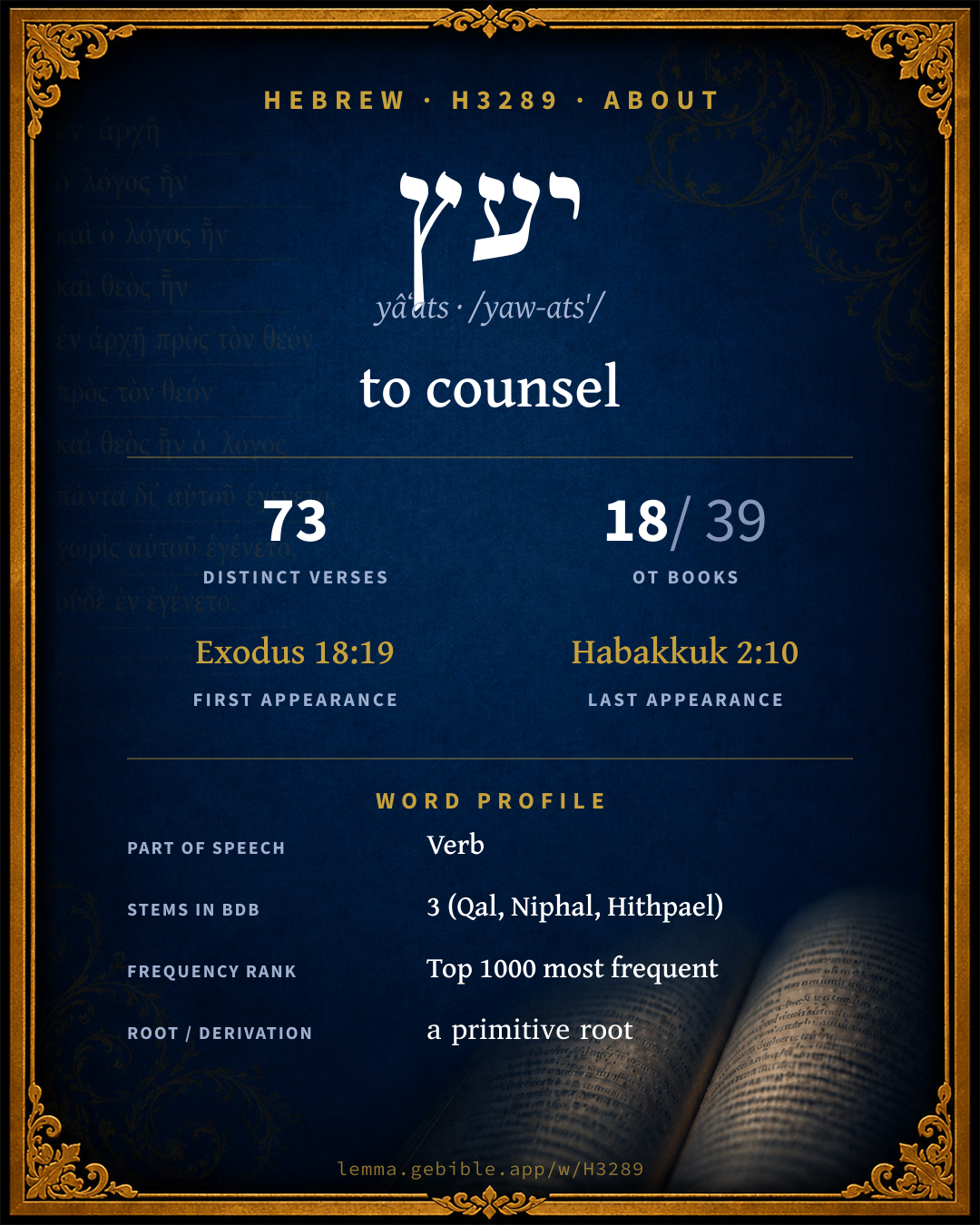
יָעַץ
to counsel
‘to counsel’ is one of 3 main senses fuller range ↓
Full lexicon entry — Brown-Driver-Briggs (BDB)
From Brown-Driver-Briggs (BDB)
Where this word appears
See every Qal verb in the Hebrew Bible →
Grammar key — what these labels mean
Part of speech
- Verb
- An action or state-of-being word.
Stem
- Qal
- The basic, simple active stem — the plain form of the verb (“he wrote”).
- Niphal
- Usually the simple passive or reflexive of the Qal (“he was written”).
- Hithpael
- The reflexive or reciprocal stem (the subject acts on itself).
Form
- Perfect
- A completed action or state — Hebrew marks aspect (completeness) more than strict tense (“he wrote”).
- Sequential Imperfect
- An imperfect with prefixed waw — the standard past-narrative form (waw-consecutive imperfect).
- Participle Active
- A verbal adjective expressing ongoing or characteristic action (“writing / one who writes”).
- Imperfect
- An incomplete, ongoing, or future action (“he will / would write”).
- Cohortative
- A first-person volitional form expressing wish or resolve (“let me / let us write”).
- Participle Passive
- A verbal adjective expressing action received (“written”).
State
- Absolute
- The independent form of a noun, not bound to a following word.
- Construct
- A noun bound to a following noun in a possessive / “of” relationship (the construct chain).
Person
- 3rd Person
- The one spoken about (“he / she / it / they”).
- 1st Person
- The speaker (“I / we”).
- 2nd Person
- The one addressed (“you”).
Gender
- Masculine
- Grammatically masculine.
- Common
- Either gender — not distinguished for this form.
- Feminine
- Grammatically feminine.
Number
- Singular
- One.
- Plural
- More than one (in Hebrew, generally three or more).
Grammatical forms 20 distinct
- Verb, Qal, Perfect, 3rd Person, Masculine, Singular 17 times (22%)
- Verb, Niphal, Sequential Imperfect, 3rd Person, Masculine, Singular 11 times (14%)
- Verb, Qal, Participle Active, Masculine, Singular, Absolute 10 times (13%)
- Verb, Niphal, Participle Active, Masculine, Plural, Absolute 5 times (6%)
- Verb, Qal, Participle Active, Masculine, Plural, Absolute 5 times (6%)
- Verb, Qal, Participle Active, Masculine, Plural, Construct 5 times (6%)
- Verb, Qal, Perfect, 3rd Person, Common, Plural 4 times (5%)
- Verb, Qal, Imperfect, 1st Person, Common, Singular 3 times (4%)
+12 more forms (19 occurrences)
Parsed forms decoded from the imported morphology (morphhb / Westminster Leningrad Codex — WLC text public domain, morphhb tagging CC BY 4.0), counted across 79 parsed occurrences — not distinct verses.
Every verse where H3289 appears — 73 distinct verses across 18 books. Click any verse to open its interlinear word-by-word view. Verse text shown in the World English Bible for context — . Each verse’s Hebrew form is shown with its reference; the English is not keyword-highlighted, since the data carries no word-level English alignment. Use “Compare translations” on any verse to read it across multiple English versions. This concordance covers the Hebrew Bible; Septuagint (Greek Old Testament) occurrences are not indexed here.
Exodus 1 verse
Numbers 1 verse
2 Samuel 6 verses
- 2 Samuel 15:12 יוֹעֵ֣ץ Qal ptcp.act ms cs Absalom sent for Ahithophel the Gilonite, David's counselor, from his city, even from Giloh, while he was offering the sacrifices. The conspiracy was strong; for the people increased continually with Absalom.
- 2 Samuel 16:23 יָעַץ֙ Qal pf 3ms The counsel of Ahithophel, which he gave in those days, was as if a man inquired at the oracle of God: so was all the counsel of Ahithophel both with David and with Absalom.
- 2 Samuel 17:7 יָעַ֥ץ Qal pf 3ms Hushai said to Absalom, The counsel that Ahithophel has given this time is not good.
- 2 Samuel 17:11 יָעַ֗צְתִּי Qal pf 1cs But I counsel that all Israel be gathered together to you, from Dan even to Beersheba, as the sand that is by the sea for multitude; and that you go to battle in your own person.
- 2 Samuel 17:15 יָעַ֤ץ יָעַ֥צְתִּי Qal pf 3ms Qal pf 1cs Then said Hushai to Zadok and to Abiathar the priests, Thus and thus did Ahithophel counsel Absalom and the elders of Israel; and thus and thus have I counseled.
- 2 Samuel 17:21 יָעַ֥ץ Qal pf 3ms It happened, after they had departed, that they came up out of the well, and went and told king David; and they said to David, Arise you, and pass quickly over the water; for thus has Ahithophel counseled against you.
1 Kings 6 verses
- 1 Kings 1:12 אִיעָצֵ֥/ךְ Qal coh 1cs + sfx pers 2fs Now therefore come, please let me give you counsel, that you may save your own life, and the life of your son Solomon.
- 1 Kings 12:6 וַ/יִּוָּעַ֞ץ נֽוֹעָצִ֔ים conj + Niphal wimpf 3ms Niphal ptcp.act mp King Rehoboam took counsel with the old men, who had stood before Solomon his father while he yet lived, saying, What counsel give you me to return answer to this people?
- 1 Kings 12:8 יְעָצֻ֑/הוּ וַ/יִּוָּעַ֗ץ Qal pf 3cp + sfx pers 3ms conj + Niphal wimpf 3ms But he forsook the counsel of the old men which they had given him, and took counsel with the young men who had grown up with him, who stood before him.
- 1 Kings 12:9 נֽוֹעָצִ֔ים Niphal ptcp.act mp He said to them, What counsel do you give, that we may return answer to this people, who have spoken to me, saying, Make the yoke that your father did put on us lighter?
- 1 Kings 12:13 יְעָצֻֽ/הוּ Qal pf 3cp + sfx pers 3ms The king answered the people roughly, and forsook the counsel of the old men which they had given him,
- 1 Kings 12:28 וַ/יִּוָּעַ֣ץ conj + Niphal wimpf 3ms Whereupon the king took counsel, and made two calves of gold; and he said to them, It is too much for you to go up to Jerusalem: see your gods, Israel, which brought you up out of the land of Egypt.
2 Kings 1 verse
1 Chronicles 4 verses
- 1 Chronicles 13:1 וַ/יִּוָּעַ֣ץ conj + Niphal wimpf 3ms David consulted with the captains of thousands and of hundreds, even with every leader.
- 1 Chronicles 26:14 יוֹעֵ֣ץ Qal ptcp.act ms The lot eastward fell to Shelemiah. Then for Zechariah his son, a wise counselor, they cast lots; and his lot came out northward.
- 1 Chronicles 27:32 יוֹעֵ֔ץ Qal ptcp.act ms Also Jonathan, David's uncle, was a counselor, a man of understanding, and a scribe: and Jehiel the son of Hachmoni was with the king's sons:
- 1 Chronicles 27:33 יוֹעֵ֣ץ Qal ptcp.act ms Ahithophel was the king's counselor: and Hushai the Archite was the king's friend:
2 Chronicles 11 verses
- 2 Chronicles 10:6 וַ/יִּוָּעַ֞ץ נֽוֹעָצִ֔ים conj + Niphal wimpf 3ms Niphal ptcp.act mp King Rehoboam took counsel with the old men, who had stood before Solomon his father while he yet lived, saying, What counsel give you me to return answer to this people?
- 2 Chronicles 10:8 יְעָצֻ֑/הוּ וַ/יִּוָּעַ֗ץ Qal pf 3cp + sfx pers 3ms conj + Niphal wimpf 3ms But he forsook the counsel of the old men which they had given him, and took counsel with the young men who had grown up with him, who stood before him.
- 2 Chronicles 10:9 נֽוֹעָצִ֔ים Niphal ptcp.act mp He said to them, What counsel give you, that we may return answer to this people, who have spoken to me, saying, Make the yoke that your father did put on us lighter?
- 2 Chronicles 20:21 וַ/יִּוָּעַץ֙ conj + Niphal wimpf 3ms When he had taken counsel with the people, he appointed those who should sing to Yahweh, and give praise in holy array, as they went out before the army, and say, Give thanks to Yahweh; for his loving kindness endures forever.
- 2 Chronicles 22:3 יֽוֹעַצְתּ֖/וֹ Qal ptcp.act fs cs + sfx pers 3ms He also walked in the ways of the house of Ahab; for his mother was his counselor to do wickedly.
- 2 Chronicles 22:4 יֽוֹעֲצִ֗ים Qal ptcp.act mp He did that which was evil in the sight of Yahweh, as did the house of Ahab; for they were his counselors after the death of his father, to his destruction.
- 2 Chronicles 25:16 הַ/לְ/יוֹעֵ֤ץ יָעַ֤ץ ptcl inter + prep + Qal ptcp.act ms Qal pf 3ms It happened, as he talked with him, that [the king] said to him, Have we made you of the king's counsel? Stop! Why should you be struck down? Then the prophet stopped, and said, I know that God has determined to destroy you, because you have done this, and have not listened to my counsel.
- 2 Chronicles 25:17 וַ/יִּוָּעַ֗ץ conj + Niphal wimpf 3ms Then Amaziah king of Judah took advice, and sent to Joash, the son of Jehoahaz the son of Jehu, king of Israel, saying, Come, let us look one another in the face.
- 2 Chronicles 30:2 וַ/יִּוָּעַ֨ץ conj + Niphal wimpf 3ms For the king had taken counsel, and his princes, and all the assembly in Jerusalem, to keep the Passover in the second month.
- 2 Chronicles 30:23 וַ/יִּוָּֽעֲצוּ֙ conj + Niphal wimpf 3mp The whole assembly took counsel to keep other seven days; and they kept [other] seven days with gladness.
- 2 Chronicles 32:3 וַ/יִּוָּעַ֗ץ conj + Niphal wimpf 3ms he took counsel with his princes and his mighty men to stop the waters of the springs which were outside of the city; and they helped him.
Ezra 3 verses
- Ezra 4:5 יוֹעֲצִ֖ים Qal ptcp.act mp and hired counselors against them, to frustrate their purpose, all the days of Cyrus king of Persia, even until the reign of Darius king of Persia.
- Ezra 7:28 וְ/יֽוֹעֲצָ֔י/ו conj + Qal ptcp.act mp cs + sfx pers 3ms and has extended loving kindness to me before the king, and his counselors, and before all the king's mighty princes. I was strengthened according to the hand of Yahweh my God on me, and I gathered together out of Israel chief men to go up with me.
- Ezra 8:25 וְ/יֹעֲצָ֣י/ו conj + Qal ptcp.act mp cs + sfx pers 3ms and weighed to them the silver, and the gold, and the vessels, even the offering for the house of our God, which the king, and his counselors, and his princes, and all Israel there present, had offered:
Nehemiah 1 verse
Job 3 verses
- Job 3:14 וְ/יֹ֣עֲצֵי conj + Qal ptcp.act mp cs With kings and counselors of the earth, Who built up waste places for themselves;
- Job 12:17 יוֹעֲצִ֣ים Qal ptcp.act mp He leads counselors away stripped. He makes judges fools.
- Job 26:3 יָּ֭עַצְתָּ Qal pf 2ms How have you counseled him who has no wisdom, And plentifully declared sound knowledge!
Psalms 6 verses
- Psalms 16:7 יְעָצָ֑/נִי Qal pf 3ms + sfx pers 1cs I will bless Yahweh, who has given me counsel. Yes, my heart instructs me in the night seasons.
- Psalms 32:8 אִֽיעֲצָ֖ה Qal coh 1cs I will instruct you and teach you in the way which you shall go. I will counsel you with my eye on you.
- Psalms 62:4 יָעֲצ֣וּ Qal pf 3cp They fully intend to throw him down from his lofty place. They delight in lies. They bless with their mouth, but they curse inwardly. Selah.
- Psalms 71:10 נוֹעֲצ֥וּ Niphal pf 3cp For my enemies talk about me. Those who watch for my soul conspire together,
- Psalms 83:3 וְ֝/יִתְיָעֲצ֗וּ conj + Hithpael impf 3mp They conspire with cunning against your people. They plot against your cherished ones.
- Psalms 83:5 נוֹעֲצ֣וּ Niphal pf 3cp For they have conspired together with one mind. They form an alliance against you.
Proverbs 5 verses
- Proverbs 11:14 יוֹעֵֽץ Qal ptcp.act ms Where there is no wise guidance, the nation falls, But in the multitude of counselors there is victory.
- Proverbs 12:20 וּֽ/לְ/יֹעֲצֵ֖י conj + prep + Qal ptcp.act mp cs Deceit is in the heart of those who plot evil, But joy comes to the promoters of peace.
- Proverbs 13:10 נ֖וֹעָצִ֣ים Niphal ptcp.act mp Pride only breeds quarrels, But with ones who take advice is wisdom.
- Proverbs 15:22 יוֹעֲצִ֣ים Qal ptcp.act mp Where there is no counsel, plans fail; But in a multitude of counselors they are established.
- Proverbs 24:6 יוֹעֵֽץ Qal ptcp.act ms For by wise guidance you wage your war; And victory is in many advisors.
Isaiah 16 verses
- Isaiah 1:26 וְ/יֹעֲצַ֖יִ/ךְ conj + Qal ptcp.act mp cs + sfx pers 2fs I will restore your judges as at the first, And your counselors as at the beginning. Afterward you shall be called 'The city of righteousness, A faithful town.'
- Isaiah 3:3 וְ/יוֹעֵ֛ץ conj + Qal ptcp.act ms The captain of fifty, The honorable man, The counselor, The skilled craftsman, And the clever enchanter.
- Isaiah 7:5 יָעַ֥ץ Qal pf 3ms Because Syria, Ephraim, and the son of Remaliah, have plotted evil against you, saying,
- Isaiah 9:6 יוֹעֵץ֙ Qal ptcp.act ms For to us a child is born, to us a son is given; and the government shall be on his shoulder: and his name shall be called Wonderful, Counselor, Mighty God, Everlasting Father, Prince of Peace.
- Isaiah 14:24 יָעַ֖צְתִּי Qal pf 1cs Yahweh of Hosts has sworn, saying, Surely, as I have thought, so shall it happen; and as I have purposed, so shall it stand:
- Isaiah 14:26 הַ/יְּעוּצָ֖ה ptcl def.art + Qal ptcp.pass fs This is the purpose that is purposed on the whole earth; and this is the hand that is stretched out on all the nations.
- Isaiah 14:27 יָעָ֖ץ Qal pf 3ms For Yahweh of Hosts has purposed, and who shall annul it? and his hand is stretched out, and who shall turn it back?
- Isaiah 19:12 יָּעַ֛ץ Qal pf 3ms Where then are your wise men? and let them tell you now; and let them know what Yahweh of Hosts has purposed concerning Egypt.
- Isaiah 19:17 יוֹעֵ֥ץ Qal ptcp.act ms The land of Judah shall become a terror to Egypt; everyone to whom mention is made of it shall be afraid, because of the purpose of Yahweh of Hosts, which he purposes against it.
- Isaiah 23:8 יָעַ֣ץ Qal pf 3ms Who has purposed this against Tyre, the giver of crowns, whose merchants are princes, whose traffickers are the honorable of the earth?
- Isaiah 23:9 יְעָצָ֑/הּ Qal pf 3ms + sfx pers 3fs Yahweh of hosts has purposed it, to stain the pride of all glory, to bring into contempt all the honorable of the earth.
- Isaiah 32:7 יָעָ֔ץ Qal pf 3ms The instruments of the churl are evil: he devises wicked devices to destroy the humble with lying words, even when the needy speaks right.
- Isaiah 32:8 יָעָ֑ץ Qal pf 3ms But the noble devises noble things; and in noble things shall he continue.
- Isaiah 40:14 נוֹעָץ֙ Niphal pf 3ms With whom took he counsel, and who instructed him, and taught him in the path of justice, and taught him knowledge, and shown to him the way of understanding?
- Isaiah 41:28 יוֹעֵ֑ץ Qal ptcp.act ms When I look, there is no man: even among them there is no counselor who, when I ask of them, can answer a word.
- Isaiah 45:21 יִֽוָּעֲצ֖וּ Niphal impf 3mp Declare you, and bring [it] forth; yes, let them take counsel together: who has shown this from ancient time? who has declared it of old? Haven't I, Yahweh? and there is no God else besides me, a just God and a Savior; there is no one besides me.
Jeremiah 4 verses
- Jeremiah 38:15 אִיעָ֣צְ/ךָ֔ Qal impf 1cs + sfx pers 2ms Then Jeremiah said to Zedekiah, If I declare it to you, will you not surely put me to death? and if I give you counsel, you will not listen to me.
- Jeremiah 49:20 יָעַץ֙ Qal pf 3ms Therefore hear the counsel of Yahweh, that he has taken against Edom; and his purposes, that he has purposed against the inhabitants of Teman: Surely they shall drag them away, [even] the little ones of the flock; surely he shall make their habitation desolate over them.
- Jeremiah 49:30 יָעַ֨ץ Qal pf 3ms Flee you, wander far off, dwell in the depths, you inhabitants of Hazor, says Yahweh; for Nebuchadrezzar king of Babylon has taken counsel against you, and has conceived a purpose against you.
- Jeremiah 50:45 יָעַץ֙ Qal pf 3ms Therefore hear the counsel of Yahweh, that he has taken against Babylon; and his purposes, that he has purposed against the land of the Chaldeans: Surely they shall drag them away, [even] the little ones of the flock; surely he shall make their habitation desolate over them.
Ezekiel 1 verse
Micah 2 verses
- Micah 4:9 יוֹעֲצֵ/ךְ֙ Qal ptcp.act ms cs + sfx pers 2fs Now why do you cry out aloud? Is there no king in you? Has your counselor perished, That pains have taken hold of you as of a woman in travail?
- Micah 6:5 יָּעַ֗ץ Qal pf 3ms My people, remember now what Balak king of Moab devised, And what Balaam the son of Beor answered him from Shittim to Gilgal, That you may know the righteous acts of Yahweh."
Nahum 1 verse
Habakkuk 1 verse
About this entry
At a glance — auto-summarized from this page’s data, not written by a person. Every figure links to its source below. This summary describes the numbers; it doesn’t interpret them.
“to counsel” is the headline sense of the Hebrew verb יעץ (yâʻats). The King James Version usually renders it “counsellors,” while modern versions prefer “counselor” (Berean Standard Bible) and “and” (unfoldingWord Literal Text) — see the renderings breakdown. With 73 verses in 18 books, it is a moderately common word in the Hebrew Bible. Scripture first uses it in Exodus 18:19. As a verb its force shifts by stem, across 3 stems (Qal, Niphal, and more). See the sense tree, 73-verse concordance, and the renderings breakdown below.
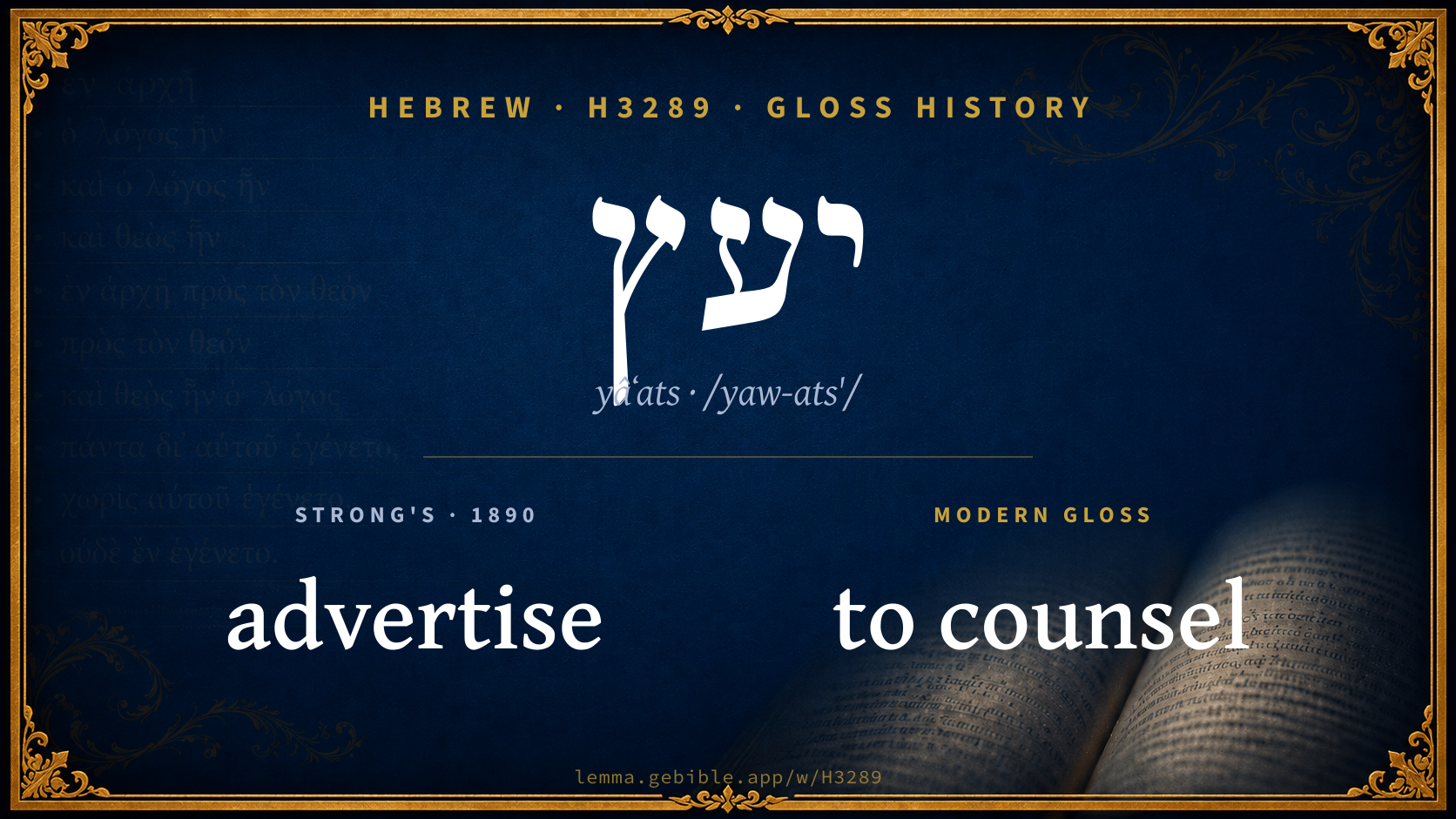
Gloss history
Strong's 1890 vs modern scholarship
About this word
Strong's H3289 catalogs a Hebrew word from the Hebrew Old Testament.
These counts are not copied from any lexicon or concordance. They are computed here, from the morphology-tagged Hebrew Old Testament. What Lemma adds →
- 73
- distinct verses
- The word appears in 73 distinct verses.
- 18 / 39
- OT books
- The word appears in 18 of 39 Old Testament books.
- #506
- by frequency
- Top 1000 most frequent Hebrew words (rank 506 of 8,640 Hebrew words by occurrence).
View all 73 occurrences in the concordance →
Most concentrated in
- Isaiah 16 verses 22%
- 2 Chronicles 11 verses 15%
- 2 Samuel 6 verses 8%
By section of the Old Testament
By traditional corpus
Conventional, traditional groupings — biblical authorship is debated, so this is a traditional corpus grouping, not an authorship claim. Each share is this word’s portion of its verses in that division of the Hebrew canon. Each figure is a share of the word’s 73 distinct verses.
- Prophets (Nevi'im) 38 verses · 52%
- Writings (Ketuvim) 33 verses · 45%
- Torah (Pentateuch) 2 verses · 3%
How translations render this word
Counts come from each version’s own published word-to-Strong’s tagging or interlinear alignment — an approximate guide to how each version renders this word, not a word-level alignment the data otherwise carries. Because each total is that version’s own tagged count, the per-version totals vary from one another and need not match the appearance or distinct-verse counts above. These counts may also differ from a printed concordance because Lemma counts each distinctly tagged rendering and does not collapse phrase taggings into a single head-word total. This is a fixed set of word-tagged versions (KJV, ASV, BSB, ULT) and does not change with the reading translation you choose elsewhere. Each version’s license is shown beside its name below (and on Sources).
- King James Version: Counsellors 11×, Counsellor 6×, Consulted 5×
- American Standard Version: Counsellors 11×, Hath purposed 4×, Took counsel 4×
- Berean Standard Bible: Counselor 9×, Counselors 9×, Consulted 3×
- unfoldingWord Literal Text: And 7×, Consulted 6×, Counselors 5×
King James Version Public Domain
Renders H3289 across 79 tagged occurrences — most commonly:
Plus 42 renderings that appear only once — usually multi-word phrases or single function words the recovered tagging swept in, not distinct renderings. Not rendered by a distinct English word in 1 further occurrence.
American Standard Version Public Domain
Renders H3289 across 79 tagged occurrences — most commonly:
Plus 43 renderings that appear only once — usually multi-word phrases or single function words the recovered tagging swept in, not distinct renderings.
Berean Standard Bible Public Domain
Renders H3289 across 73 tagged occurrences — most commonly:
Plus 41 renderings that appear only once — usually multi-word phrases or single function words the recovered tagging swept in, not distinct renderings. Not rendered by a distinct English word in 5 further occurrences.
unfoldingWord Literal Text CC BY-SA 4.0
Renders H3289 across 88 tagged occurrences — most commonly:
Plus other, less common renderings. Plus 40 renderings that appear only once — usually multi-word phrases or single function words the recovered tagging swept in, not distinct renderings.
Senses in the full BDB
Hebrew verbs can shift meaning by stem (binyan): Qal is the basic action, Niphal is often passive or reflexive, Piel often intensifies or makes it factitive, and Hiphil is typically causative. The senses below are grouped under the stem BDB assigns to each. This entry also uses Hithpael (reflexive or reciprocal).
What do BDB’s symbols mean?
BDB uses these scholarly abbreviations:
| Symbol | Meaning |
|---|---|
| 𝔊 | the Septuagint (the ancient Greek translation, LXX) |
| 𝔙 | the Vulgate (the Latin translation) |
| 𝔖 | the Syriac version (the Peshitta) |
| 𝔗 | the Targum (the Aramaic translation) |
| ψ | the Psalms |
| √ | root (the underlying root or stem) |
| ‖ | parallel passage (a synonymous or contrasted parallel) |
| † | the dagger: every passage where the word occurs is cited |
The 3 senses and sub-senses the full Brown-Driver-Briggs lexicon distinguishes for this word, in lexicon order (not ranked by frequency), with BDB’s own verbatim wording and sub-sense lettering. Shown in Hebrew script with BDB’s own scholarly abbreviations. The condensed entry is in the Lexicon Entry tab. See also the Forms in the corpus table below.
Qal
- Pf. 3 ms. יָעַץ Is 7:5 + 11 times; יָעָ֑ץ 14:27 + 2 times; sf. יְעָצָ֑נִי ψ 16:7; יְעָצָהּ Is 23:9 + יְעָצָהוּ Baer 2 Ch 10:8; 3 pl. יָֽעֲצוּ ψ 62:5; sf. יְעָצֻהוּ 1 K 12:8 + 2 times (incl. 2 Ch 10:8, Baer יְעָצָ֑הוּ), etc.; Impf. אִיעֲצָה ψ 32:8 (Ol Che אִיעָֽצְךָ); אִיעָֽצְךָ Ex 18:19; Nu 24:14 (not elsewhere Hex), Je 38:15, cf. also foregoing; אִיעָצֵךְ 1 K 1:12; Pt. act. יוֹעֵץ Is 3:3 + 9 times; cstr. יֹעֵץ Na 1:11, יוֹעֵץ 2 S 15:12; יוֹעֲצֵךְ Mi 4:9; pl. יוֹעֲצִים Jb 12:17 + 3 times; יֹעֲצִים Ez 11:2; cstr. יֹעֲצֵי Is 19:11 + 2 times, etc.; fs. sf. יוֹעַצְתּוֹ 2 Ch 22:3; Pt. pass. f. יְעוּצָה Is 14:26;—advise, counsel, c. acc. Is 32:7, 8; 23:9 (subj. י׳) Mi 6:5; sq. בְּלִיַּ֫עַל Na 1:11 רָעָה Is 7:5 (sq. עַל), 19:12 (sq. id.), 23:8 (sq. id.), Hb 2:10 (sq. לְ); often c. acc. cogn. 2 S 16:23; 17:7 Ez 11:2; sq. אֶל against Je 49:20; 50:45 (in both of י׳); sq. עַל against 49:30 Is 19:17 (of י׳); cf. pass. pt. Is 14:26; c. acc. cogn. + sf. pers. 1 K 12:8, 13 2 Ch 10:8; c. acc. pers. 2 S 17:15 ψ 16:7 Ex 18:19 Nu 24:14 (+ rel. cl.) Je 38:15; abs. (of י׳) Is 14:24 (c. adv. כאשׁר), v 27; of man 2 S 17:15 (כזאת וכזאת), v 21 (ככה + על); sq. inf. ψ 62:5 2 Ch 25:16 (of אלהים); sq. cl. without connective 2 S 17:11; sq. לְלֹא חָכְמָה Jb 26:3;—אִיעֲצָה עליך עיני ψ 32:8 (v. supr.).—Pt. act. as subst. = counsellor, king’s adviser 2 S 15:12; 1 Ch 27:33; 2 Ch 22:4; 25:16; Ezr 7:28; 8:25; Is 19:11; so fem. 2 Ch 22:3; prob. also 1 Ch 27:32 (‖ אִישׁ מֵבִין וְסוֹפֵר); cf. Mi 4:9, also Is 1:26 (‖ שֹׁפְטִים), Jb 12:17 (‖ id.);—in these three, of importance for people; so also Is 3:3; Pr 11:4 = 24:6; cf. Jb 3:14, and particularly פֶּלֶא יוֹעֵץ Is 9:5 wonder of a counsellor, of the ideal ruler predicted. More generally, counsellor, adviser Pr 15:22; יו׳ בְּשֶׂכֶל 1 Ch 26:14 (specific reason for title unknown); יֹעֲ׳ שָׁלוֹם Pr 12:20; = prophet Is 41:28, nearly = agents (hired by adversaries of Judah) Ezr 4:5. e.g. Isaiah 7:5
Niphal
- (reflex. or recipr.) Pf. נֵוֹעַץ Is 40:14; נוֹעֲצוּ ψ 71:10; 83:6; Impf. וַיִּוָּעַץ 1 K 12:6 + 10 times; יִוָּֽעֲצוּ Is 45:21; וַיִּוָּֽעֲצוּ 2 Ch 30:23; נִוָּֽעֲצָה Ne 6:7; Pt. pl. נוֹעָצִים 1 K 12:6 + 4 times;—consult together, exchange counsel, of king with advisers, sq. אֶת־ 1 K 12:6, 8 = 2 Ch 10:6, 8; and so of י׳ Is 40:14; sq. אֶל־ 2 K 6; 2 Ch 20:21; sq. עִם 1 Ch 13:1; 2 Ch 32:3; abs. consider 1 K 12:28; 2 Ch 25:17; 30:2; cf. 1 K 12:6 (sq. inf.) = 2 Ch 10:6, 1 K 12:9 (sq. Impf. + ו subord.) = 2 Ch 10:9; gen. consult, take counsel, abs. Pr 13:10; יַחְדָּו ψ 71:10; Ne 6:7; Is 45:21; sq. לֵב יַחְדָּו (with heart together) ψ 83:6 nearly = determine, sq. inf. 2 Ch 30:23. e.g. Isaiah 40:14
Hithpael
- Impf. יִתְיָעֲצוּ ψ 83:4 conspire against, sq. עַל (‖ יַעֲרִימוּ סוֹד על). e.g. Psalms 83:4
Senses from the full Brown-Driver-Briggs lexicon (Brown, Driver, Briggs; Oxford 1906 — public domain), digitized via Sefaria, supplemented by the OpenScriptures HebrewLexicon (CC BY 4.0). Full attribution on Sources.
Word origin
vb. advise, counsel (only twice in Hex) (Aramaic יְעַט; Arabic وَعَظَ exhort, admonish)—
— Brown-Driver-Briggs (Oxford 1906, public domain), digitized via Sefaria, supplemented by the OpenScriptures HebrewLexicon (CC BY 4.0). See Sources.
Origin: a primitive root
Jastrow Dictionary
A second Hebrew/Aramaic lexicon for comparison, covering Aramaic and post-biblical (Talmudic, Targumic, Midrashic) usage that the biblical-Hebrew BDB does not. Matched by lemma rather than by Strong’s number, so a lemma may carry more than one Jastrow headword (shown separately below), and the entries cover usage well beyond the Bible.
יָעַץ
- v. עוּץ, [to press,] to encourage, plan; to advise. Ber. 61ᵃ כליות יוֹעֲצוֹת the kidneys are the seat of deliberation. Ib. אחת יוֹעַצְתּוֹ לטובה וכ׳ one (kidney) urges him to do good etc.—Snh. 76ᵇ היוֹעֶצְךָ וכ׳, v. זָהִיר. Ber. 8ᵇ וכשיוֹעֲצִים אין יועצים וכ׳ and when they (the Medians) hold council, they meet in open air. Snh. 87ᵃ ממך זה יוֹעֵץ ‘hidden from thee’ (Deut. XVII, 8) that means (the need of) a counselor (Sifré Deut. 152 זו עצה). Ḥull. 11ᵃ (expl. לעמת הֶעָצֶה, Lev. III, 9) ממקים שהכליות יועצות from where the deliberating kidneys are seated, v. supra.—Tem. 16ᵃ (play on י̇ע̇ב̇ץ̇, I Chr. IV, 9) שי̇ע̇ץ וריב̇ץ̇ וכ׳ he advised and advanced the study of the Law &c. Snh. 106ᵃ, a. e. בלעם שי׳ Balaam who gave his advice (encouraging the oppression of the Israelites); a. fr.—[Ber. 3ᵇ; Snh. 16ᵃ, v. infra.] e.g. Deuteronomy 17:8
- , Nithpa. נִתְיָעֵץ to ask advice; to consult with (with ב). Yalk. Ps. 776 מִתְיָעֲצִים באחיתופל (Ber. 3ᵇ; Snh. 16ᵃ יועצין, read: נוֹעָצִין, Nif.) they deliberated with Ah.—Erub. 53ᵇ (in enigmatic speech) נתי׳ במכתיר took counsel of the Nasi (v. כָּתַר). Sifré Num. 157 שהיו מתייעצים על וכ׳ they were planning against Israel; Yalk. Num. 785 מִיָּעֲצִים.
יְעַץ
- Targ. Prov. XII, 20.
- same. Meg. 15ᵇ עצה קא מְיַיעֲצֵי עילויה וכ׳ Ms. M. (ed. שקלי) they plan against this man (me).
- to take counsel. Targ. Jud. XIX, 30.—V. עוּץ.
A Dictionary of the Targumim, the Talmud Babli and Yerushalmi, and the Midrashic Literature (Marcus Jastrow; London, Luzac, 1903) — Public Domain. Digitized via Sefaria. Digitized via Sefaria. Full attribution on Sources.
Forms in the corpus
The 58 distinct written forms H3289 takes in the Hebrew Bible, most frequent first — each parse links to that stem’s occurrences in the concordance. Hebrew forms include their vowel points and cantillation, so a single lemma takes many written forms.
Same root — word family
Other BDB entries built from the same root as H3289, grouped by Strong’s listed origin. These share a root / origin per the lexicon — not necessarily a shared meaning. Each links to that word’s own entry.
Derived from this word
Compare all same-root words → They share a root, not necessarily a meaning.
Septuagint verse parallels
This word appears in 70 verses that also exist in the Greek Old Testament (Septuagint), out of the 73 Hebrew verses it occurs in. You can read those verses in Greek by switching the Old Testament edition to the Septuagint.
Read these verses in the Septuagint
- Exodus 18:19
- Numbers 24:14
- 2 Samuel 15:12
- 1 Kings 1:12
- 2 Kings 6:8
- 1 Chronicles 13:1
- 2 Chronicles 10:6
- Ezra 4:5
- Job 3:14
- Psalms 16:7
- Proverbs 11:14
- Isaiah 1:26
This is a verse-level parallel only — the same verses exist in both the Hebrew and Greek Old Testaments. No word-level Hebrew↔Greek correspondence is claimed: the data carries no such alignment, so no Greek word is shown as this Hebrew word’s translation. Coverage is not total — the Septuagint omits the deuterocanon and renumbers the Psalms, so some Hebrew verses have no direct Greek parallel.