
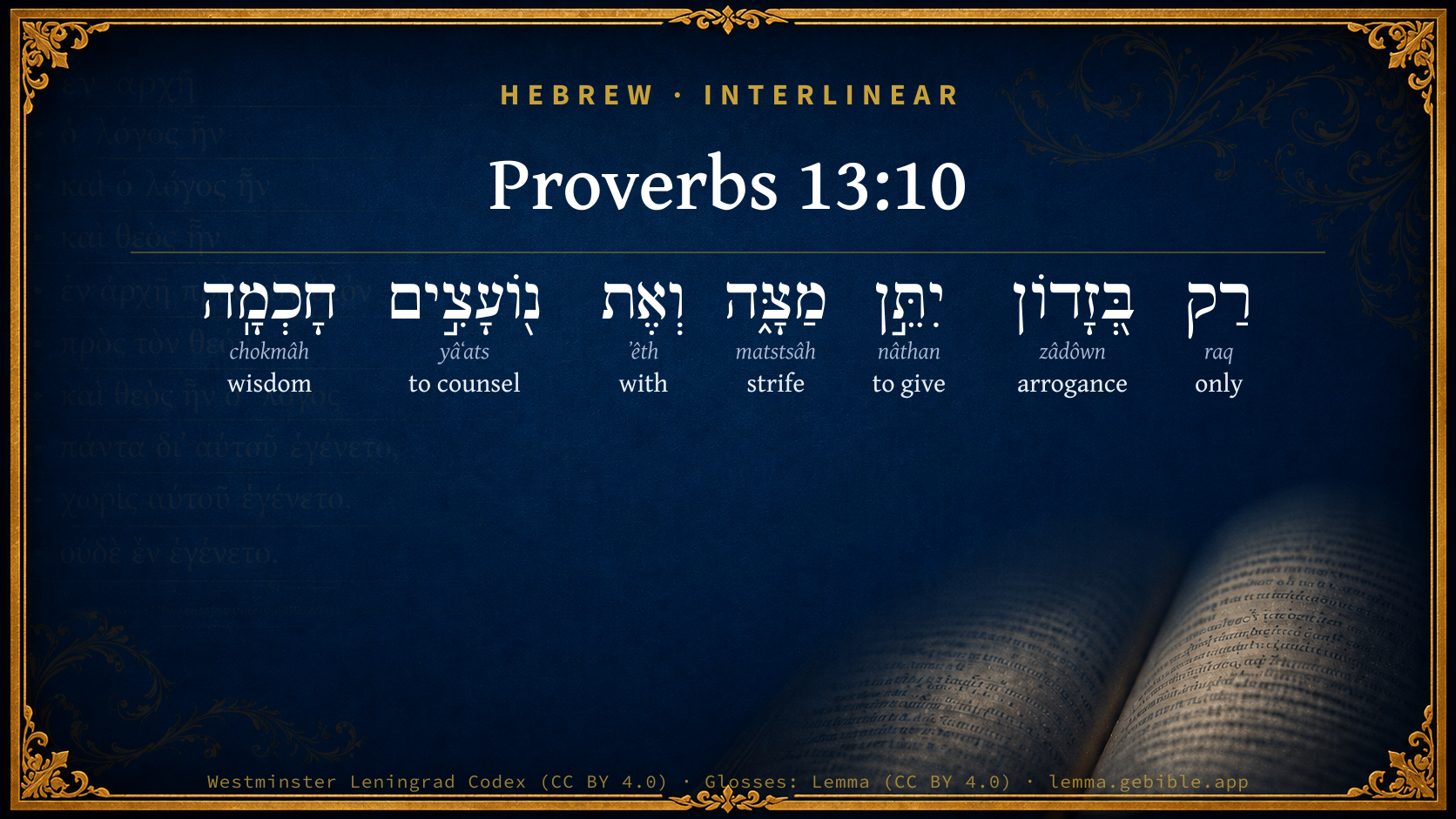
Proverbs 13:10

Hebrew (Westminster Leningrad Codex) Proverbs 13:10 appears in the Hebrew Old Testament. The text above is from the Westminster Leningrad Codex. Each word links to its Strong’s number, a concise gloss, and parsing drawn from the Open Scriptures Hebrew Bible morphology. Click any word for its full Brown-Driver-Briggs (BDB) entry.
Download image
Cite this verse

Proverbs 13:10 (World English Bible). Public Domain. Lemma interlinear Bible study tool, https://lemma.gebible.app/v/proverbs/13/10.

Show BibTeX & RIS
BibTeX
RIS
English Translation
Pride only breeds quarrels, But with ones who take advice is wisdom.
World English Bible · Public Domain
Highlights
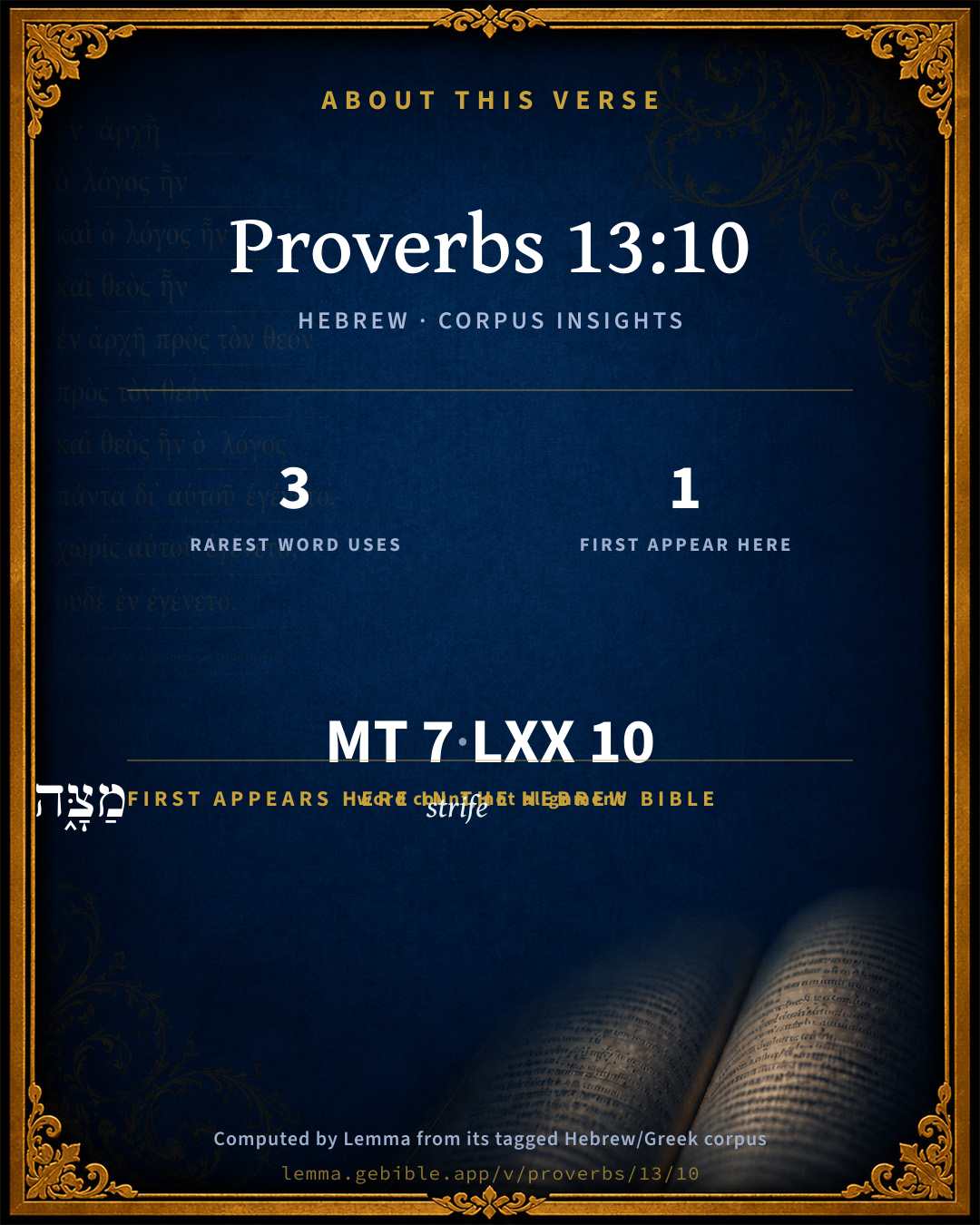
  • 1 first appearance in the Hebrew Bible
Full analysis ↓
Download a study sheet

One document with this verse’s original text, its word-by-word gloss line, the meaning frame, cross-references with their text, attributed commentary, and full source and license credits — printable, and it pastes into notes with its structure intact.

This verse Autodidact and up

Study sheet (.html) Plain text (.txt)

A passage Seminary Student

Up to 50 verses in one chapter. A passage sheet keeps up to 6 commentary sources and 12 cross-references per verse, in the order this page ranks them, and says so on the sheet whenever that leaves anything out. Ask for a single verse and you get the Autodidact verse sheet above.

Everything on this page stays free to read, with no account — the sheet is a download of what is already on screen, not access to it.

Want to remove ads? Support Godless Engineer
Compare translations 3

The same verse in 3 English versions, stacked beneath the original-language interlinear above. Click any original word for its lexicon entry.

Each is an independent rendering of the whole verse — the interlinear is not word-aligned to these translations.

Highlighted words mark where these versions differ — a whole-verse word diff, not a word-by-word alignment.

  • World English Bible Public Domain
    Pride only breeds quarrels, But with ones who take advice is wisdom.
  • King James Version Public Domain
    Only by pride cometh contention: but with the well advised is wisdom.
  • unfoldingWord Literal Text CC BY-SA 4.0
    With presumptuousness comes only contention, but with those who are counseled, wisdom.

unfoldingWord Literal Text — © unfoldingWord, licensed CC BY-SA 4.0. Word-aligned USFM3 via Door43 (git.door43.org/unfoldingWord/en_ult).

Versions to compare (up to 4)

3 of 4 selected

Show all 18 translations

Every available English version of this verse, each an independent rendering of the whole verse.

  • World English Bible Public Domain
    Pride only breeds quarrels, But with ones who take advice is wisdom.
  • Berean Standard Bible Public Domain
    Arrogance leads only to strife, but wisdom is with the well-advised.
  • Majority Standard Bible Public Domain
    Arrogance leads only to strife, but wisdom is with the well-advised.
  • King James Version Public Domain
    Only by pride cometh contention: but with the well advised is wisdom.
  • American Standard Version (1901) Public Domain
    By pride cometh only contention; But with the well-advised is wisdom.
  • Revised Version (1885) Public Domain
    By pride cometh only contention: but with the well advised is wisdom.
  • Geneva Bible (1599) Public Domain
    Onely by pride doeth man make contention: but with the well aduised is wisdome.
  • Douay-Rheims (1899) Public Domain
    Among the proud there are always contentions: but they that do all things with counsel, are ruled by wisdom.
  • Young's Literal Translation Public Domain
    A vain man through pride causeth debate, And with the counselled `is' wisdom.
  • Literal Standard Version CC BY-SA 4.0
    A vain man causes debate through pride, || And wisdom [is] with the counseled.
  • Unlocked Literal Bible CC BY-SA 4.0
    Pride only breeds conflict, but for those who listen to good advice there is wisdom.
  • unfoldingWord Literal Text CC BY-SA 4.0
    With presumptuousness comes only contention, but with those who are counseled, wisdom.
  • Darby Bible Public Domain
    By pride there only cometh contention; but with the well-advised is wisdom.
  • World Messianic Bible Public Domain
    Pride only breeds quarrels, but wisdom is with people who take advice.
  • Webster's Bible Public Domain
    Only by pride cometh contention: but with the well-advised is wisdom.
  • Free Bible Version CC BY-SA 4.0
    Pride only causes conflict; but those who take advice are wise.
  • Bible in Basic English Public Domain
    The only effect of pride is fighting; but wisdom is with the quiet in spirit.
  • JPS Tanakh (1917) Public Domain
    By pride cometh only contention; but with the well-advised is wisdom.

Literal Standard Version (2020), Covenant Press — licensed CC BY-SA 4.0. Text via the HelloAO Bible API (eBible.org). Unlocked Literal Bible (unfoldingWord) — licensed CC BY-SA 4.0. Text via the HelloAO Bible API (eBible.org). unfoldingWord Literal Text — © unfoldingWord, licensed CC BY-SA 4.0. Word-aligned USFM3 via Door43 (git.door43.org/unfoldingWord/en_ult). Free Bible Version, Dr. Jonathan Gallagher — licensed CC BY-SA 4.0. Text via the HelloAO Bible API (eBible.org).

Word by word

More ways to search: Search by grammar → Find every occurrence → Compare this word →

Practice this passage: Drill this verse → Learn its vocabulary →

About this verse

These counts appear in no published source. They are computed here, from the morphology-tagged text and Lemma’s own curated glosses. What Lemma adds →

7
words
7
distinct lemmas
Wisdom
section

Notable vocabulary

The rarest word here is מַצָּ֑ה strife H4683 — appearing just 3 times in the whole Hebrew Bible.

First appearance in Scripture

This word makes its first canonical appearance in the Hebrew Bible here:

  • מַצָּ֑ה strife H4683

Shared distinctive vocabulary

מַצָּ֑ה strife H4683 occurs in 3 verses of the Hebrew Bible. Also found in:

Grammatical profile

  • 2 verbs
  • 3 nouns
  • 1 preposition
  • 1 particle

Verb forms

  • יִתֵּ֣ן Qal · Imperfect
  • נ֖וֹעָצִ֣ים Niphal · Participle Active

Hebrew & Septuagint length

In English translation the verse runs 12 words from the Hebrew and 16 from the Septuagint (LXX English) — closely comparable.

A rough comparison of the two English renderings, which tokenize alike — not a word-level alignment.

Word counts can differ between the Hebrew and the Greek without any difference in meaning — e.g. the Hebrew direct-object marker אֵת has no separate Greek word, and Greek often adds the article ὁ.

In the original languages it is 7 Hebrew tokens and 10 Greek tokens — but the two are counted differently (Hebrew bundles its prefixes and suffixes into one token; the Greek is in lemma form), so that isn’t a like-for-like length.

Cross-references

19

Topical passages linked to Proverbs 13:10 in the Treasury of Scripture Knowledge — connected by theme and wording, ordered by reader-vote popularity; previews shown in the World English Bible.

  • Proverbs 19:20 Listen to counsel and receive instruction, That you may be wise in your latter end.
  • Proverbs 12:15–16 The way of a fool is right in his own eyes, But he who is wise listens to counsel.
  • Proverbs 17:14 The beginning of strife is like breaching a dam, Therefore stop contention before quarreling breaks out.
  • 1 Timothy 6:4 he is conceited, knowing nothing, but obsessed with arguments, disputes, and word battles, from which come envy, strife, reviling, evil suspicions,
  • Luke 22:24 There arose also a contention among them, which of them was considered to be greatest.
  • James 3:14–16 But if you have bitter jealousy and selfish ambition in your heart, don't boast and don't lie against the truth.
  • James 4:1 Where do wars and fightings among you come from? Don't they come from your pleasures that war in your members?
  • 3 John 1:9–10 I wrote to the assembly, but Diotrephes, who loves to be first among them, doesn't accept what we say.
  • Judges 8:1–3 The men of Ephraim said to him, Why have you served us thus, that you didn't call us, when you went to fight with Midian? They did chide with him sharply.
  • Judges 12:1–6 The men of Ephraim were gathered together, and passed northward; and they said to Jephthah, Why did you pass over to fight against the children of Ammon, and didn't call us to go with you? we will burn your house on you with fire.
  • 1 Kings 12:10–11 The young men who had grown up with him spoke to him, saying, Thus shall you tell this people who spoke to you, saying, Your father made our yoke heavy, but make you it lighter to us; thus shall you speak to them, My little finger is thicker than my father's loins.
  • 1 Kings 12:16 When all Israel saw that the king didn't listen to them, the people answered the king, saying, What portion have we in David? neither have we inheritance in the son of Jesse: to your tents, Israel: now see to your own house, David. So Israel departed to their tents.
  • 2 Kings 14:10 You have indeed struck Edom, and your heart has lifted you up: glory of it, and abide at home; for why should you meddle to [your] hurt, that you should fall, even you, and Judah with you?
  • Proverbs 20:18 Plans are established by advice; By wise guidance you wage war!
  • Proverbs 21:24 The proud and haughty man, "scoffer" is his name; He works in the arrogance of pride.
  • Proverbs 25:8 Don't be hasty in bringing charges to court. What will you do in the end when your neighbor shames you?
  • Luke 14:28–32 For which of you, desiring to build a tower, doesn't first sit down and count the cost, to see if he has enough to complete it?
  • Acts 6:1–5 Now in those days, when the number of the disciples was multiplying, a complaint arose from the Grecian Jews against the Hebrews because their widows were neglected in the daily service.
  • James 4:5–6 Or do you think that the Scripture says in vain, "The Spirit who lives in us yearns jealously"?

Cross-references courtesy of OpenBible.info (CC BY 4.0).

Hebrew and Greek witnesses Masoretic Hebrew ↔ Greek Septuagint

The same verse in the two great witnesses to the Old Testament, shown verse-for-verse.

These are two independent witnesses, not word-aligned to each other, and the Septuagint is shown in lemma (dictionary) form.

Hebrew Proverbs 13:10 Masoretic · Westminster Leningrad Codex

רַק בְּ֭זָדוֹן יִתֵּ֣ן מַצָּ֑ה וְאֶת נ֖וֹעָצִ֣ים חָכְמָֽה

Pride only breeds quarrels, But with ones who take advice is wisdom.

World English Bible · Public Domain

Greek LXX Proverbs 13:10 Septuagint · lemma form

κακός μετά ὕβρις πράσσω κακός ὁ δέ ἑαυτοῦ ἐπιγνώμων σοφός

A bad man does evil with insolence: but they that are judges of themselves are wise.

LXX2012 (modern English Septuagint) · Public Domain

On this verse, The Pulpit Commentary discusses the Septuagint’s reading. Read the note in Commentary ↓

Hebrew: Westminster Leningrad Codex (CC BY 4.0). Greek: Septuagint (public domain); English from LXX2012 (modern English Septuagint) (Public Domain). How the Septuagint differs from the Hebrew →

Commentary

Notes on Proverbs 13:10 from classic Christian and Jewish commentators (each source and its license shown beneath its notes). The classic Christian expositions comment on the surrounding passage and are grouped to its opening verse, so a note may address several verses; the Jewish commentaries on the Tanakh (Rashi and others) are per-verse, so they appear only where the commentator wrote on this verse.

Lemma curates 59 commentaries, every one of them public domain or Creative Commons licensed, each selected and text-cleaned for this edition rather than reprinted as found. About our sources →

Trapp's Complete Commentary

John Trapp

Pro 13:10 Only by pride cometh contention: but with the well advised [is] wisdom.

Ver. 10. Only by pride cometh contention.] Heb., Dabit iurgium. Pride, if there be no cause of contention given, will make it. Transcendo, non obedio, perturbo, is the motto written upon pride’s triple crown. A proud person is full of discontent; nothing can please him. Just like one that hath a swelling in his hands, something or other toucheth it still, and driveth him to outcries. Pride maketh a man drunk with his own conceit. "The proud man" is as he that "hath transgressed by wine." {Hab 2:5} And drunkards, we know, are quarrelsome. The Corinthians had riches and gifts and learning; and carried aloft by these waxen wings, they domineered and despised others; {1Co 4:8} they were divided and discontented; {1Co 3:3} and these overflowings of the gall and spleen came from a fulness of bad humour. Pride is a dividing distemper; gouty swollen legs keep at a distance; bladders blown up with wind spurt one from another, and will not close; but prick them, and you may pack a thousand of them in a little room.

But with the well advised is wisdom.] The "meekness of wisdom," as St James hath it; {Jas 3:13} of the which we may well say, as Tertullus said to Felix, "By thee we enjoy great quietness." {Act 24:2} It was a great trouble to Haman to lead Mordecai’s horse, which another man would not have thought so. The moving of a straw troubleth proud flesh; whereas humility, if compelled to go one mile, will go two for a need - yea, as far as the shoes of the gospel of peace can carry it. "The wisdom from above is peaceable." {Jas 3:17}

John Trapp, A Commentary or Exposition upon All the Books of the Old and New Testament (1647–1656) — public domain. Text from a community e-Sword module.

The Biblical Illustrator

Joseph S. Exell

Pro_13:10

Only by pride cometh contention, but with the well-advised is wisdom.

Pride and humility

By a proud man we mean one who esteems himself better than others; by a humble man, one who esteems others better than himself. What are the evil effects of pride?

1. It cuts off a man from all the salutary effects of reproof, rebuke, criticism, and counsel, without which it is not possible for any of us to become wise.

2. By pride comes nothing but strife, and he loveth transgression that loveth strife. It is the pride of monarchs and nations that produces war. In the affairs of private life our pride, rather than our sense of right, usually creates, fosters, and embitters divisions, alienations, and quarrels. All the foolish extravagances of social competition are to be traced to the same source. From first to last the haughty spirit is a curse and a torment to every one, and not least to itself. It is like a cold and biting wind. It breaks the heart of the humble, it excites the passions of the wrathful, it corrupts the conduct of the weak.

3. Pride is hateful to God. The proud man, whether he knows it or not, comes into direct conflict with God; he is pitting himself against the Omnipotent. If God is to dwell in a human heart at all, it must be in one which has been emptied of all pride, one which has, as it were, thrown down all the barriers of self-importance, and laid itself open to the incoming Spirit. (R. F. Horton, D. D.)

Pride and contention

When pride and passion meet on both sides, it cannot but be that a fire will be kindled; when hard flints strike together, the sparks will fly about; but a soft, mild spirit is a great preserver of its own peace, kills the power of contests, as woolpacks, or such-like soft matter, most deaden the force of bullets. (T. Leighton.)

The Biblical Illustrator, edited by Joseph S. Exell (c. 1880s–1900s) — public domain. Text from a community e-Sword module.

Joseph Benson's Commentary

Pro 13:10. Only by pride cometh contention — This is not to be understood exclusively, as to all other causes of contention; for contentions often spring from ignorance, or mistake, or covetousness, or other passions; but eminently, because, as pride bloweth up those coals of contention, which other passions kindle, so oftentimes pride alone, without any other cause, stirreth up strife; which it doth by making a man self-conceited in his opinions, and obstinate in his resolutions, and impatient of any opposition: and many other ways; but with the well-advised — Who are not governed by their own passions, but by prudent consideration, and the good counsel of others; is wisdom — Which teacheth them to avoid and abhor all contention. “Melancthon,” says Bishop Patrick, “singled out for the observation of his scholars two remarkable sentences of this chapter, of which this is one; and upon it he reminds them of the Greek proverb, Ορος ορειου μιγνυται, A mountain cannot mix with a mountain, that is, two high men will never agree together; and of another excellent saying among the Latins, Crede mihi, sapere est non multum sapere, Believe me, to be wise, is not to be over wise. For they whose minds are infected with a vain opinion of themselves, either cannot see the truth, if it be against their thoughts; or, if they do, they will not acknowledge it, for fear they should yield and confess themselves overcome.”

Joseph Benson's Commentary on the Old and New Testaments (1811–1818) — public domain. Text from a community e-Sword module.

The Preacher's Complete Homiletical Commentary

Joseph S. Exell (gen. ed.)

CRITICAL NOTES.—

Pro_13:10. This may be read “Only by pride cometh contention,” or “by pride cometh only (nothing but) contention.”

MAIN HOMILETICS OF Pro_13:10

THE PARENT OF STRIFE

I. Unlawful contention is the offspring of pride. If she is not her only child, she is her eldest-born. Scripture language more than hints that pride was the beginning of contention among the angels. Paul, speaking of the qualifications of a “bishop” or teacher, tells Timothy that such an one is in danger of “being lifted up with pride,” and thus falling “into the condemnation of the devil” (1Ti_3:6), thus seeming to indicate that pride was at the bottom of all the contention that is at present going on in the universe between light and darkness, between good and evil. From the pride of this fallen star has come contention in heaven, and earth, and hell.

He it was whose guile,

Stirred up with envy and revenge, deceived

The mother of mankind; what time his pride

Had cast him out from heaven, with all his host

Of rebel angels, by whose aid aspiring

To set himself in glory ’bove his peers,

He trusted to have equalled the Most High,

If he opposed, and with ambitious aim,

Against the throne and monarchy of God,

Raised impious war in heaven, and battle proud,

With vain attempt.

And in the history of man’s dealings with man pride is the root of contention. “Whence come wars and fightings among you?” come they not hence, even of your lusts that war in your members?” (Jas_4:1). And is not the lust of pride, or envy, which is her foster-sister, the great cause of all domestic, and social, and national contentions? Has it not been the cause of every unrighteous war from the days of Chedorlaomer to the present century? And pride breeds contention on a narrower battle-ground still. It often creates war in the human spirit. Pride brings contention between duty and inclination, and, although there is no bloodshed, the contest is often very sharp and painful. The fact that “by pride cometh contention” is so plain that it may be said to be written upon the scroll of time, like Ezekiel’s roll, within and without. It is impossible that it should be otherwise. Pride is a thinking more of ourselves than we are—an over-estimation of our own worth. This must lead us to strive for supremacy over others who are our equals, or even our superiors. This must bring contention, for they will not willingly accord to us that to which we have no lawful claim. Therefore, while there is pride in the universe contention will never end. The fountain must be dried up before the streams cease to flow. When a human soul is emptied of pride there will be peace within. In proportion as it ceases to be a ruling force in the world contention will cease. Pride keeps the fallen principalities in contention with heaven, keeps the sinner in contention with his Saviour, and keeps man in contention with man.

II. Thoso who are not ruled by pride are well advised.

1. Because of the consequences that obedience to the dictates of pride must bring to men themselves. There is in all men a wholesome fear of the consequences which flow from certain actions. If a child sees another burnt from playing with the fire, he will avoid doing that which he has seen to bring such pain and deformation to his brother. Self-love deters him from the act. Those who are well advised, because advised by the highest wisdom, know what the consequences of pride have been, and take cognisance of the deformation of character which it works in men around them. Therefore, the natural and spiritual instinct of wholesome self-love leads them to dread that which would bring such an additional scar to their already too much deformed character. The children of wisdom are well advised to be afraid of pride on account of its consequences to themselves.

2. Because of the misery it would bring to those nearly related to them. Isolation is not possible in this world. Every man, woman, and child is more or less nearly related to some others. The relation may be physical, intellectual, political, or moral—in some instances all are combined. A proud man, or woman, or child, makes those who belong to them miserable. A proud father makes his children miserable, a proud king involves his country in war, and brings misery upon his subjects. How many friends has pride severed. How many homes and countries has family or national pride blighted. Surely, then, those are well advised who shun it for the sake of those related to them.

3. Because of its consequences to humanity, The miseries of the human race are increased by pride, and the progress of the gospel is hindered by it. The man who does not scruple to pour oil upon a burning house, not only shows that he has no intention to help to extinguish the flames, but that he intends to widen their influence. Each drop that he pours upon the fire increases its intensity, and spreads the destruction. There are men who do not hesitate, by the indulgence of pride, to increase that war of passions which burns so fiercely and destructively in the world and desolates ten thousand hearts and homes. But the well advised, by the exercise of the grace of humility, endeavour to quench the conflagration which, first kindled by hell, has devastated the earth for so many generations.

OUTLINES AND SUGGESTIVE COMMENTS

Pride, if there be no cause of contention given, will make it. Transcendo non obedio perturbo is the motto written upon pride’s triple crown.… Pride is a dividing distemper. Bladders blown up with wind spurt one from another, and will not close; but prick them, and you may pack a thousand of them in a little room.… It was a great trouble to Haman to lead Mordecai’s horse, which another man would not have thought so. The moving of a straw troubleth proud flesh; whereas, humility, if compelled to go one mile, will go two for a need; yea, as far as the shoes of the gospel of peace can carry it. “The wisdom from above is peaceable.”—Trapp.

As to the great quarrel with God, which needs the ransom (Pro_13:8), and which is mended by the righteousness (Pro_13:6), how long would that last, if we abandoned pride?—Miller.

The Preacher's Complete Homiletical Commentary (gen. ed. Joseph S. Exell; Funk & Wagnalls, c. 1892) — public domain (pre-1929). A full-Bible homiletical/sermon-outline anthology covering 65 of 66 books (2 John is absent from the source module). Text from a community e-Sword module.

Geneva Bible (1599)

Geneva Bible translators

When as every man contendeth to have the preeminence, and will not give place to another.

Geneva Bible (1599) marginal notes — public domain. Text via Bolls.life.

Matthew Henry's Commentary

Note, 1. Foolish pride is the great make-bate. Would you know whence come wars and fightings? They come from this root of bitterness. Whatever hand other lusts may have in contention (passion, envy, covetousness), pride has the great hand; it is its pride that it will itself sow discord and needs no help. Pride makes men impatient of contradiction in either their opinions or their desires, impatient of competition and rivalship, impatient of contempt, or any thing that looks like a slight, and impatient of concession, and receding, from a conceit of certain right and truth on their side; and hence arise quarrels among relations and neighbours, quarrels in states and kingdoms, in churches and Christian societies. Men will be revenged, will not forgive, because they are proud. 2. Those that are humble and peaceable are wise and well advised. Those that will ask and take advice, that will consult their own consciences, their Bibles, their ministers, their friends, and will do nothing rashly, are wise, as in other things, so in this, that they will humble themselves, will stoop and yield, to preserve quietness and prevent quarrels.

Matthew Henry's Commentary on the Whole Bible (1708–1710) — public domain (CC PDM 1.0). Text via the HelloAO Bible API.

Jamieson, Fausset & Brown

Robert Jamieson, A. R. Fausset & David Brown

The obstinacy which attends self-conceit, produces contention, which the well-advised, thus evincing modesty, avoid.

Jamieson, Fausset & Brown — Commentary Critical and Explanatory on the Whole Bible (1871) — public domain (CC PDM 1.0). Text via the HelloAO Bible API.

Adam Clarke's Commentary

Verse 10. By pride cometh contention] Perhaps there is not a quarrel among individuals in private life, nor a war among nations, that does not proceed from pride and ambition. Neither man nor nation will be content to be less than another; and to acquire the wished-for superiority all is thrown into general confusion, both in public and private life. It was to destroy this spirit of pride, that Jesus was manifested in the extreme of humility and humiliation among men. The salvation of Christ is a deliverance from pride, and a being clothed with humility. As far as we are humble, so far we are saved.

Adam Clarke's Commentary on the Bible (1810–1826) — public domain. Text from a community e-Sword/MySword module.

Ellicott's Commentary for English Readers

(10) Only by pride cometh contention.—Rather, by pride cometh nothing but contention. A man who is too proud to receive counsel is sure to fall out with others; they are wise who suffer themselves to be advised.

A Bible Commentary for English Readers, edited by Charles John Ellicott (1878–1897) — public domain. Text from a community e-Sword module.

The Cambridge Bible for Schools and Colleges

gen. ed. J. J. S. Perowne

10. Only by pride cometh] Rather, By pride cometh only, R.V. Pride is sure to rouse opposition and lead to contention; whereas wisdom belongs to those who accept advice and avoid disputes.

The Cambridge Bible for Schools and Colleges (gen. ed. J. J. S. Perowne; Cambridge University Press, 1878–1918) — public domain. Text from a community e-Sword module.

John Gill's Exposition

Only by pride cometh contention,.... Though it comes by other things, yet by this chiefly, and there are no contentions without it: or "truly", "verily", "certainly (d), by pride", &c. Unless the words may be better rendered, "an empty man through pride will give contention" (e), or make it; such as are empty of knowledge and wisdom; and such are generally the most proud, and are very apt to raise contentions, and foment divisions: contentions in families, in neighbourhoods, in towns, cities, and countries, and in churches, are generally owing to pride; what contentions and confusions has the pride of the pope of Rome brought into kingdoms and states, into councils, and into the church of God!

but with the well advised is wisdom: such who are humble and modest will seek counsel of God; will consult the sacred oracles, and ask advice of those who are superior to them in knowledge and understanding; and so will neither raise contentions themselves, nor join with those that make them, but do all they can to lay them; these show that true wisdom is with them.

(d) "certe", Vatablus; "vere", Pagninus, Montanus, Merecrus. (e) "Levis per superbiam dabit contentionam", Gejerus.

John Gill's Exposition of the Whole Bible (1746–1763) — public domain (CC PDM 1.0). Text via the HelloAO Bible API.

Albert Barnes' Notes on the Bible

Either:

(1) “By pride alone comes contention” - that is the one unfailing spring of quarrels; or

(2) “By pride comes contention only” - it, and it alone, is the fruit of pride.

Albert Barnes' Notes on the Bible (1834–1885) — public domain. Text from a community e-Sword/MySword module.

Haydock's Catholic Bible Commentary

Contentions. As none will yield. (Menochius) --- Hebrew, "only by pride cometh contention." (Protestants) --- "Pride is the mother of all sects." (St. Augustine)

George Leo Haydock (1774–1849), Haydock's Catholic Family Bible and Commentary, 1859 edition — public domain. Excludes Psalms (Douay-Rheims chapter numbering differs from Protestant) and Deuterocanonical books (Catholic canon only).

Matthew Poole's English Annotations

Only by pride cometh contention; which is not to be understood exclusively as to all other causes; for contentions oft spring from ignorance, or mistake, or covetousness, or other passions: but eminently, because as pride bloweth up those coals of contention which other lusts kindle, so ofttimes pride alone, without any other cause, stirreth up strife; which it doth by making a man self-conceited in his opinions, and obstinate in his resolutions, and impatient of any opposition, and many other ways.

With the well-advised, who are not governed by their own passions, but by prudent consideration, and the good counsel of others, is wisdom; which teacheth them to avoid and abhor all contention.

Matthew Poole's English Annotations on the Holy Bible (1683–1685) — public domain. Text from a community e-Sword/MySword module.

Whedon's Commentary on the Bible

Daniel D. Whedon

10. Only by pride — Such pride as prevents men from taking wise and wholesome advice.

With the well advised — those who both receive and profit by good counsel — is wisdom. On this verse Melanchthon reminds his pupils of the old Greek adage, “A mountain cannot mix with a mountain.” that is, two high-minded or proud men will never agree: but with the lowly, (comp. Pro_11:2,) — those sufficiently humble to be advised — is practical wisdom, or prudence in avoiding dissensions. “It is uncertain what word the ‘only’ qualities. We may have, 1. By pride alone comes contention: that is the one unfailing spring of quarrels; or, 2. By pride comes contention only: it, and it alone, is the fruit of pride. The latter construction is preferable.” — Speaker’s Commentary. The Geneva Bible version renders the first clause, “Only by pride doth man make contention,” and makes this marginal note: “Whereas every man contendeth to have the pre-eminence, and will not give place to another.”

Daniel D. Whedon (gen. ed.), Commentary on the Old and New Testaments (1874–1909) — public domain. Text from a community e-Sword module.

The Pulpit Commentary

Only by pride cometh contention. Some render "surely" (raq) for only, as in Gen_20:11. Others rightly translate, "By pride cometh only, nothing but, contention." Vulgate, "Between the proud disputes are always rife." One who is haughty and overbearing, or who is too conceited to receive advice, is sure to quarrel with others. Septuagint, "An evil man with insult doeth evil." With the well advised is wisdom; those who are not, like the proud, above taking advice and following it, are wise. (Pro_11:2 Pro_12:15) As the Vulgate puts it, "They who do all things with counsel are directed by wisdom." The LXX, reading differently, has, "They who know themselves are wise," which implies that the wise know their own weakness and imperfection, and hearken humbly to good counsel.

Pride and contention.

I THE REASONS WHY PRIDE PRODUCES CONTENTION.

1. It is self-assertive. The proud man claims a large and prominent place for himself. He will not endure a secondary position. He demands his fights not so much because he really wishes to enjoy them, as because they are his rights. He will not forego them even when he gains no advantage by the exercise of them. Now, this self-assertiveness threatens the supposed rights of others where the boundary line is as yet uncertain. It also provokes a similar spirit in a man"s neighbours.

2. It is exacting. Pride claims its dues. The proud lord will have every ounce of respect from his underlings. Even those who are met on equal terms are narrowly scrutinized to see if they withhold a shadow of the supposed rights from the jealousy of pride.

3. It is overbearing, It will not endure opposition; it is intolerant of differences of opinion; it would rather trespass on the rights of others than surrender any of its own claims. Thus it is perpetually challenging all who cross its path.

II THE REGIONS IN WHICH PRIDE PRODUCES CONTENTION,

1. Among nations. It was thought that war sprang from the pride and jealousy of monarchs, and that when the people gained power war would cease. But republics declare war. There is a dangerous form of national pride. It is possible for a whole people to be carried away by unreasoning elation, and to make inordinate claims for itself, or to be unduly sensitive to affront.

2. In society. Pride is here one of the chief dangers to the order and peace of cities. The poor would endure the sight of the prosperity of the rich if they were not goaded by the more irritating spectacle of insulting pride. The least that they can do who have more than their share of the good things of life is to hold them with quiet humility. To flaunt their superiority of good fortune in the face of their miserable fellow citizens, and to make it a ground for scorn and contempt, is to rouse the latent rage of men who are already chafing under what whether rightly or wrongly they regard as a grossly unjust social order.

3. In private life. Pride is the most direful source of family quarrels. It separates the best friends, and it sets up the most invincible barriers against a speedy reconciliation. When love would hold out the hand of forgiveness, pride hangs back in gloomy resentfulness.

III THE WAY TO PREVENT PRIDE FROM PRODUCING CONTENTION. There is but one way; pride must be humiliated and cast out. This monster sin is directly aimed at in the preaching of the gospel of the cross. It is found lurking in the breasts of men who are regarded as saints; but it is no part of their saintliness. It is still a sin in the sight of God. Christ cannot endure it, and one who would follow Christ must forsake it.

There is no better way. of destroying it than by submission to the yoke of him who was "meek and lowly.

Pride and teachableness.

I PRIDE BEGETS CONTROVERSY, WHICH CAN SELDOM BE CARRIED ON LONG WITHOUT DEGENERATING INTO EGOTISM.

1. There is contention for contention"s sake, which is ever idle and baneful.

2. There is contention for truth"s sake. But in the latter lie many dangers to purity of temper. Whenever we become angry in controversy, as a great man said, we cease to contend for the truth, and begin to contend for ourselves. J.

The Pulpit Commentary (1880–1919), ed. H.D.M. Spence-Jones & Joseph S. Exell — public domain. Text from a community e-Sword module.

John Wesley's Explanatory Notes

Pride - It is chiefly, pride which blows up the coals of contention. Well-advised - Who are not governed by their passions, but by prudent considerations. Wisdom - Which teaches them to avoid contention.

John Wesley, Explanatory Notes Upon the Whole Bible (1754–1765) — public domain. Text via the GEBible commentary corpus.

Keil & Delitzsch

C. F. Keil & F. Delitzsch

10 Nothing comes by pride but contention;

But wisdom is with those who receive counsel.

The restrictive רק (only) does not, according to the sense, belong to בּזדון (by pride), but to מצּה, vid., under Psa 32:6 and Job 2:10. Of יתּן = there is, vid., under Pro 10:24. Bertheau's "one causes" is not exact, for "one" [man] is the most general personal subject, but יתן is in such cases to be regarded as impersonal: by pride is always a something which causes nothing but quarrel and strife, for the root of pride is egoism. Line second is a variant to Pro 11:2. Bescheidenheit (modesty) is in our old [German] language exactly equivalent to Klugheit (prudence). But here the צנועים are more exactly designated as permitting themselves to be advised; the elsewhere reciprocal נועץ has here once a tolerative signification, although the reciprocal is also allowable: with such as reciprocally advise themselves, and thus without positiveness supplement each his own knowledge by means of that of another. Most interpreters regard 10b as a substantival clause, but why should not יתן be carried forward? With such as permit themselves to be advised, or are not too proud to sustain with others the relation of giving and receiving, there is wisdom, since instead of hatred comes wisdom - the peaceful fruit resulting from an interchange of views.

Keil & Delitzsch — Biblical Commentary on the Old Testament (1861–1891) — public domain (CC PDM 1.0). Text via the HelloAO Bible API. (Old Testament only.)

Bridges on Proverbs

Charles Bridges

Most accurately is contention here traced to its proper source. (Pro 28:25 .) All the crudities of the day, all the novelties of doctrine producing contention (1Ti 1:4 . 2Ti 2:23 ), originate in the proud swelling of "the fleshly mind." (Col 2:18 . 1Ti 6:3-4 .) Men scorn the beaten track. They must strike out a new path. Singularity and extravagance are primary charms. They are ready to quarrel with every one, who does not value their notions as highly as they do. The desire of pre-eminence (Mat 20:21 . 3Jn 1:9 ); revolt from authority (Num 12:2 ) or sound doctrine (2Ti 4:3-4 ); party spirit, with the pride of knowledge and gifts (1Co 3:3-4, with 1Co 4:8 ) — all produce the same results. Is it too much to say, that vain-glory hath lighted up all the sinful contentions, that have ever kindled in the Church? We must indeed "contend for the faith" (Gal 2:5 . 1Th 2:2 . Jud 1:3 ), though it be with our own compromising brethren. (Gal 2:11 .) But even here how yet imperceptibly may pride insinuate itself under the cover of glorifying God! Truly ’is it the inmost coat, which we put on first, and put off last.’†1

This mischievous principle spreads in families, or among friends. ’Some point of honour must be maintained; some affront must be resented; some rival must be crushed or eclipsed; some renowned character emulated; or some superior equalled and surpassed.’†2 Even in trifling disputes between relatives or neighbours — perhaps between Christians — each party contends vehemently for his rights, instead of satisfying himself with the testimony of his conscience, and submitting rather to be misunderstood and misjudged, than to break the bond of the Divine brotherhood. (1Co 6:7 .) In the wide field of the world we may well ask — "From whence come wars and fightings among you? Come they not from this lust?" (Jas 4:1 .) Often has wounded pride (Jdg 12:1 ), even without any proved injury (2Ki 14:10 ), brought destructive contention upon a land.

The proud man conceives himself wise enough. He asks no counsel, and thus proves his want of wisdom. But with the modest, well-advised, there is the wisdom that is from above, "which is first pure, then peaceable." (Jas 3:17, with Jas 3:14-16 .) Many a rising contention has it quelled. (Gen 13:8 . Jdg 8:1-3 . Act 6:1-6 .) "Let nothing be done through strife or vain-glory; but in lowliness of mind let each esteem other better than themselves." (Php 2:3 .) Christian wisdom will keep us within our own line; knowing our own measure and bounds (2Co 10:13-16 ); and — whatever be our place, parts, or gifts — humble, active, loving, constant, thankful, in the improvement of them.

Footnotes:

†1 Bishop Hall.

†2 Scott in loco.

Charles Bridges, An Exposition of the Book of Proverbs (1846) — public domain. Text from a community e-Sword module.

Kretzmann's Popular Commentary

Paul E. Kretzmann

v. 10. Only by pride cometh contention, for those who are arrogantly ambitious always fear rivalry and therefore are always picking quarrels; but with the well-advised, those who are willing to accept counsel, is wisdom.

Paul E. Kretzmann, Popular Commentary of the Bible (1921–1924) — public domain. Text from a community e-Sword module.

Rashi

Rabbi Shlomo Yitzchaki (Rashi)

Only with wickedness does one cause quarrels Heb. מצה, controversy.

but there is wisdom with those who take counsel But wisdom lies with those who behave with counsel.

Rashi on the Tanakh — English translations: “The Judaica Press complete Tanach with Rashi, translated by A. J. Rosenberg” (CC BY 4.0); “Pentateuch with Rashi's commentary by M. Rosenbaum and A.M. Silbermann, 1929-1934” (public domain); “The Metsudah Tanach series, Lakewood, N.J” (CC BY 4.0); and “The Book of Joshua, Metsudah Publications, 1997” (CC BY 4.0). Text via Sefaria.

Lesson kit

Teaching starters — assembled from the data on this page, not authored interpretation. Every prompt links to the verse data it draws on. Edit before teaching.

Proverbs, in the Wisdom, opens this verse with 7 words (7 distinct Hebrew lemmas). Its most distinctive word is matstsâh (“strife”). A historical commentator’s framing appears above. Read the whole chapter for the surrounding context.

Discussion questions

  1. The word matstsâh carries the sense “strife.” How does it shape the verse?
  2. The word “strife” first appears here in Scripture. What is being introduced at this debut?
  3. Proverbs 17:19 shares the word «strife» with this verse. How do the two illuminate each other?
  4. The translations on this page render this verse differently — a whole-verse word diff, not a word-by-word alignment. What might account for the different wordings?
  5. The verb «יִתֵּ֣ן» is Qal Imperfect. How does its form color the action?
  6. Reading how Trapp's Complete Commentary and The Biblical Illustrator read this verse, where do the two commentators agree and where do they part?

Things to notice

Reading settings

Reading text

Shown beneath each verse's original-language words.

Old Testament
Old Testament edition

Read the OT as the Masoretic Hebrew (MT) or the Greek Septuagint (LXX).

English shown for the Greek Septuagint (in the Hebrew ↔ Greek comparison).

Comparing translations? Open the Compare panel on any verse page to stack up to four side by side.