
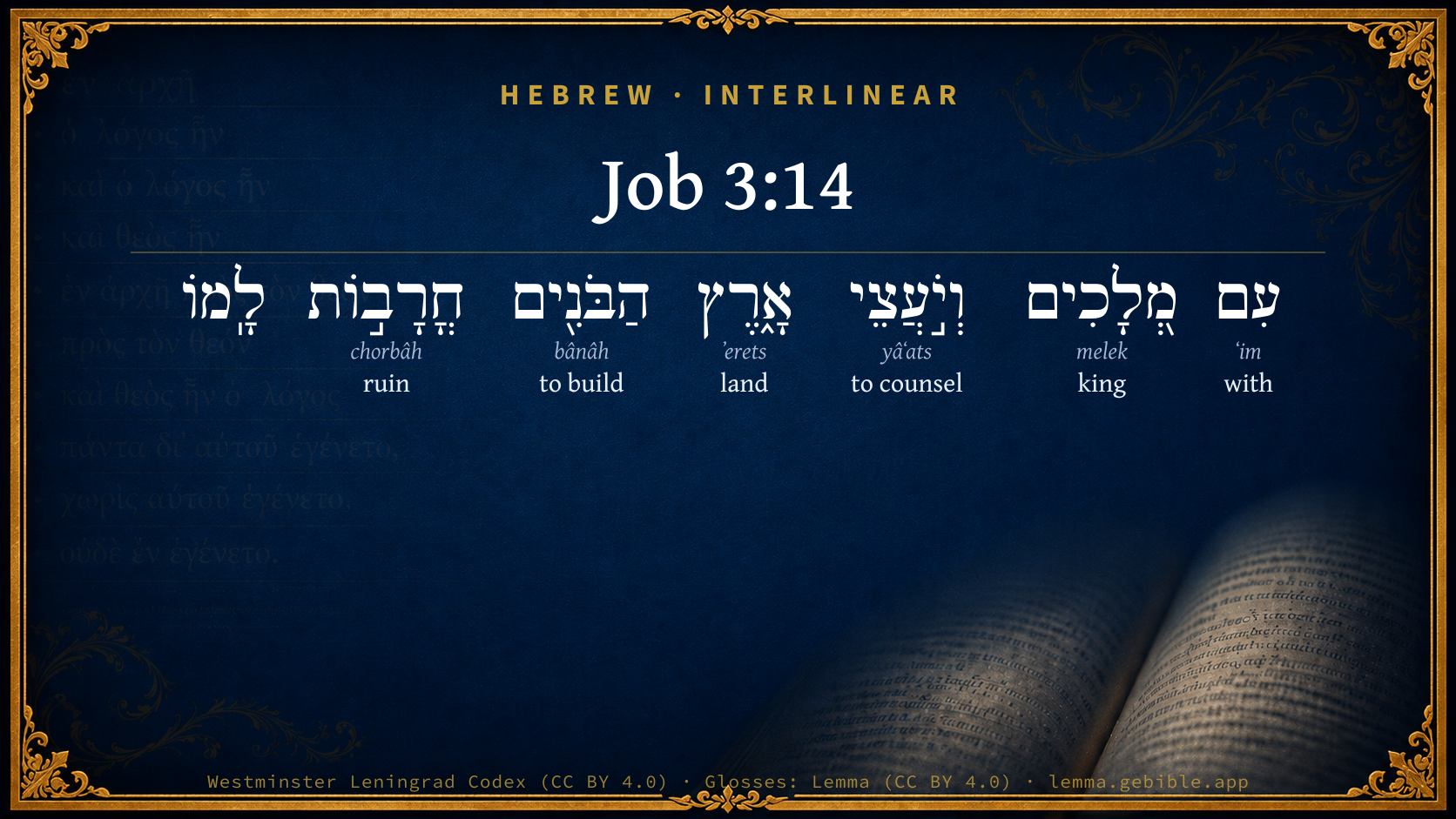
Job 3:14

Hebrew (Westminster Leningrad Codex) Job 3:14 appears in the Hebrew Old Testament. The text above is from the Westminster Leningrad Codex. Each word links to its Strong’s number, a concise gloss, and parsing drawn from the Open Scriptures Hebrew Bible morphology. Click any word for its full Brown-Driver-Briggs (BDB) entry.
Download image
Cite this verse

Job 3:14 (World English Bible). Public Domain. Lemma interlinear Bible study tool, https://lemma.gebible.app/v/job/3/14.

Show BibTeX & RIS
BibTeX
RIS
English Translation
With kings and counselors of the earth, Who built up waste places for themselves;
World English Bible · Public Domain
Download a study sheet

One document with this verse’s original text, its word-by-word gloss line, the meaning frame, cross-references with their text, attributed commentary, and full source and license credits — printable, and it pastes into notes with its structure intact.

This verse Autodidact and up

Study sheet (.html) Plain text (.txt)

A passage Seminary Student

Up to 50 verses in one chapter. A passage sheet keeps up to 6 commentary sources and 12 cross-references per verse, in the order this page ranks them, and says so on the sheet whenever that leaves anything out. Ask for a single verse and you get the Autodidact verse sheet above.

Everything on this page stays free to read, with no account — the sheet is a download of what is already on screen, not access to it.

Want to remove ads? Support Godless Engineer
Compare translations 3

The same verse in 3 English versions, stacked beneath the original-language interlinear above. Click any original word for its lexicon entry.

Each is an independent rendering of the whole verse — the interlinear is not word-aligned to these translations.

Highlighted words mark where these versions differ — a whole-verse word diff, not a word-by-word alignment.

  • World English Bible Public Domain
    With kings and counselors of the earth, Who built up waste places for themselves;
  • King James Version Public Domain
    With kings and counsellors of the earth, which build desolate places for themselves;
  • unfoldingWord Literal Text CC BY-SA 4.0
    with kings and counselors of the earth, the ones having built monuments for themselves,

unfoldingWord Literal Text — © unfoldingWord, licensed CC BY-SA 4.0. Word-aligned USFM3 via Door43 (git.door43.org/unfoldingWord/en_ult).

Versions to compare (up to 4)

3 of 4 selected

Show all 18 translations

Every available English version of this verse, each an independent rendering of the whole verse.

  • World English Bible Public Domain
    With kings and counselors of the earth, Who built up waste places for themselves;
  • Berean Standard Bible Public Domain
    with kings and counselors of the earth, who built for themselves cities now in ruins,
  • Majority Standard Bible Public Domain
    with kings and counselors of the earth, who built for themselves cities now in ruins,
  • King James Version Public Domain
    With kings and counsellors of the earth, which build desolate places for themselves;
  • American Standard Version (1901) Public Domain
    With kings and counsellors of the earth, Who built up waste places for themselves;
  • Revised Version (1885) Public Domain
    With kings and counsellors of the earth, which built up waste places for themselves;
  • Geneva Bible (1599) Public Domain
    With the Kings and counselers of the earth, which haue buylded themselues desolate places:
  • Douay-Rheims (1899) Public Domain
    With kings and consuls of the earth, who build themselves solitudes:
  • Young's Literal Translation Public Domain
    With kings and counsellors of earth, These building wastes for themselves.
  • Literal Standard Version CC BY-SA 4.0
    With kings and counselors of earth, || These building ruins for themselves.
  • Unlocked Literal Bible CC BY-SA 4.0
    with kings and counselors of the earth, who built up tombs for themselves that are now in ruins.
  • unfoldingWord Literal Text CC BY-SA 4.0
    with kings and counselors of the earth, the ones having built monuments for themselves,
  • Darby Bible Public Domain
    With kings and counsellors of the earth, who build desolate places for themselves,
  • World Messianic Bible Public Domain
    with kings and counselors of the earth, who built up waste places for themselves;
  • Webster's Bible Public Domain
    With kings and counselors of the earth, who built desolate places for themselves;
  • Free Bible Version CC BY-SA 4.0
    along with the kings of this world and their officials whose palaces now lie in ruins,
  • Bible in Basic English Public Domain
    With kings and the wise ones of the earth, who put up great houses for themselves;
  • JPS Tanakh (1917) Public Domain
    With kings and counsellors of the earth, who built up waste places for themselves;

Literal Standard Version (2020), Covenant Press — licensed CC BY-SA 4.0. Text via the HelloAO Bible API (eBible.org). Unlocked Literal Bible (unfoldingWord) — licensed CC BY-SA 4.0. Text via the HelloAO Bible API (eBible.org). unfoldingWord Literal Text — © unfoldingWord, licensed CC BY-SA 4.0. Word-aligned USFM3 via Door43 (git.door43.org/unfoldingWord/en_ult). Free Bible Version, Dr. Jonathan Gallagher — licensed CC BY-SA 4.0. Text via the HelloAO Bible API (eBible.org).

Word by word

More ways to search: Search by grammar → Find every occurrence → Compare this word →

Practice this passage: Drill this verse → Learn its vocabulary →

About this verse

These counts appear in no published source. They are computed here, from the morphology-tagged text and Lemma’s own curated glosses. What Lemma adds →

7
words
6
distinct lemmas
Wisdom
section

Shared distinctive vocabulary

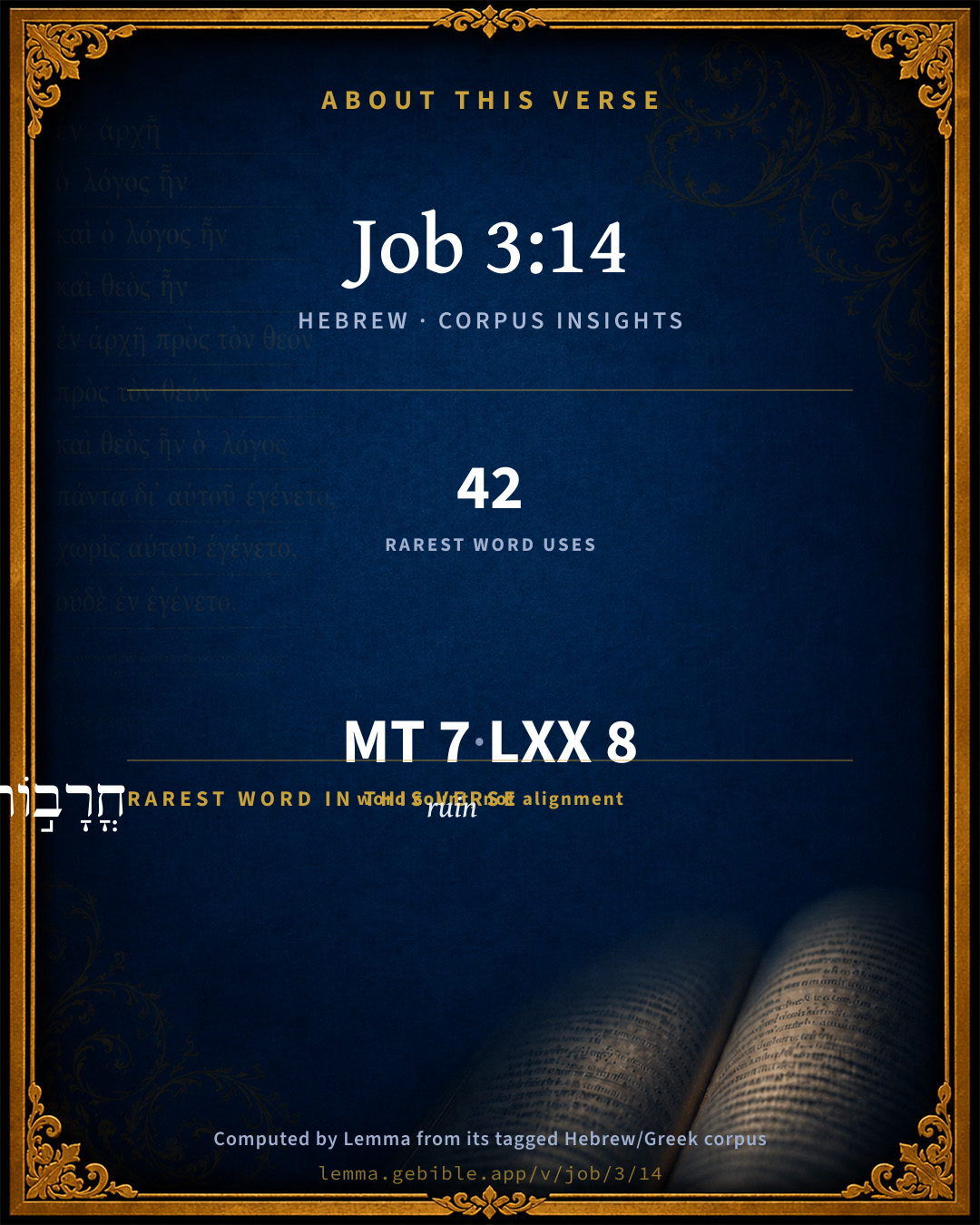
חֳרָב֣וֹת ruin H2723 occurs in 42 verses of the Hebrew Bible. Also found in:

Grammatical profile

  • 2 verbs
  • 3 nouns
  • 2 prepositions

Verb forms

  • וְיֹ֣עֲצֵי Qal · Participle Active
  • הַבֹּנִ֖ים Qal · Participle Active

Hebrew & Septuagint length

In English translation the verse runs 14 words from the Hebrew and 12 from the Septuagint (LXX English) — closely comparable.

A rough comparison of the two English renderings, which tokenize alike — not a word-level alignment.

Word counts can differ between the Hebrew and the Greek without any difference in meaning — e.g. the Hebrew direct-object marker אֵת has no separate Greek word, and Greek often adds the article ὁ.

In the original languages it is 7 Hebrew tokens and 8 Greek tokens — but the two are counted differently (Hebrew bundles its prefixes and suffixes into one token; the Greek is in lemma form), so that isn’t a like-for-like length.

Cross-references

14

Topical passages linked to Job 3:14 in the Treasury of Scripture Knowledge — connected by theme and wording, ordered by reader-vote popularity; previews shown in the World English Bible.

  • Job 15:28 He has lived in desolate cities, In houses which no one inhabited, Which were ready to become heaps.
  • Psalms 49:14 They are appointed as a flock for Sheol. Death shall be their shepherd. The upright shall have dominion over them in the morning. Their beauty shall decay in Sheol, Far from their mansion.
  • Psalms 89:48 What man is he who shall live and not see death, Who shall deliver his soul from the power of Sheol? Selah.
  • Isaiah 14:10–16 All they shall answer and tell you, Are you also become weak as we? are you become like us?
  • 1 Kings 11:43 Solomon slept with his fathers, and was buried in the city of David his father: and Rehoboam his son reigned in his place.
  • Job 12:17 He leads counselors away stripped. He makes judges fools.
  • Job 30:23 For I know that you will bring me to death, To the house appointed for all living.
  • Psalms 49:6–10 Those who trust in their wealth, And boast in the multitude of their riches--
  • Ecclesiastes 8:8 There is no man who has power over the spirit to contain the spirit; neither does he have power over the day of death. There is no discharge in war; neither shall wickedness deliver those who practice it.
  • Isaiah 5:8 Woe to those who join house to house, Who lay field to field, until there is no room, And you are made to dwell alone in the midst of the land!
  • Isaiah 58:12 Those who shall be of you shall build the old waste places; you shall raise up the foundations of many generations; and you shall be called The repairer of the breach, The restorer of paths to dwell in.
  • Ezekiel 26:20 then will I bring you down with those who descend into the pit, to the people of old time, and will make you to dwell in the lower parts of the earth, in the places that are desolate of old, with those who go down to the pit, that you be not inhabited; and I will set glory in the land of the living:
  • Ezekiel 27:18–32 Damascus was your merchant for the multitude of your handiworks, by reason of the multitude of all kinds of riches, with the wine of Helbon, and white wool.
  • 1 Kings 2:10 David slept with his fathers, and was buried in the city of David.

Cross-references courtesy of OpenBible.info (CC BY 4.0).

Hebrew and Greek witnesses Masoretic Hebrew ↔ Greek Septuagint

The same verse in the two great witnesses to the Old Testament, shown verse-for-verse.

These are two independent witnesses, not word-aligned to each other, and the Septuagint is shown in lemma (dictionary) form.

Hebrew Job 3:14 Masoretic · Westminster Leningrad Codex

עִם מְ֭לָכִים וְיֹ֣עֲצֵי אָ֑רֶץ הַבֹּנִ֖ים חֳרָב֣וֹת לָֽמוֹ

With kings and counselors of the earth, Who built up waste places for themselves;

World English Bible · Public Domain

Greek LXX Job 3:14 Septuagint · lemma form

μετά βασιλεύς βουλευτής γῆ ὅς ἀγαυριάω ἐπί ξίφος

with kings and councillors of the earth, who gloried in their swords;

LXX2012 (modern English Septuagint) · Public Domain

On this verse, Haydock's Catholic Bible Commentary discusses the Septuagint’s reading. Read the note in Commentary ↓

Hebrew: Westminster Leningrad Codex (CC BY 4.0). Greek: Septuagint (public domain); English from LXX2012 (modern English Septuagint) (Public Domain). How the Septuagint differs from the Hebrew →

Commentary

Notes on Job 3:14 from classic Christian and Jewish commentators (each source and its license shown beneath its notes). The classic Christian expositions comment on the surrounding passage and are grouped to its opening verse, so a note may address several verses; the Jewish commentaries on the Tanakh (Rashi and others) are per-verse, so they appear only where the commentator wrote on this verse.

Lemma curates 59 commentaries, every one of them public domain or Creative Commons licensed, each selected and text-cleaned for this edition rather than reprinted as found. About our sources →

Trapp's Complete Commentary

John Trapp

Job 3:14 With kings and counsellors of the earth, which built desolate places for themselves;

Ver. 14. With kings and counsellors of the earth] q.d. Those that here have been most negotious, and (as the nobles of the earth) have had greatest matters in hand, with those should I have been coupled in the grave, that congregation house of all living (πανηγυρις), as it is called, Job 30:23. That long or old home, Ecc 12:5. Heaven is called the congregation house of God’s firstborn, Heb 12:23, and their house not made with hands, 2Co 5:1. But not many kings or nobles meet here, 1Co 1:26, because strait is the gate and narrow the way that leadeth to it; there must be stripping and stopping, which great men cannot frame to. It was a poor comfort to Henry VIII to be told upon his death bed, that he should now go to the place of kings. And a small commendation to Henry II, that some few hours before he died, seeing a list of their names who had conspired against him, and finding therein two of his own sons, he fell into a grievous passion, both cursing his sons, and the day wherein himself was born; and in that distemperature departed the world, which himself had so often distempered. He went indeed to his grave, and slept with his fathers; yea, he was royally interred under a stately monument, meant here, haply, by building desolate places for themselves: Absalom had erected a pillar for this purpose; and the Egyptian kings their pyramids, to perpetuate their memories. The Spanish friar was wont to say, there were but few princes in hell; for why? because there were but few in all. Confer Eze 26:20. With these Job, had he died prematurely, or never seen the light, might have been fellowed: for death is the only king against whom there is no rising up, Pro 30:31, and the mortal since his master of the royal sceptre, mowing down the lilies of the crown as well as the grass of the field, Sceptra igonibus aequat. The unknown scepter makes equal.

John Trapp, A Commentary or Exposition upon All the Books of the Old and New Testament (1647–1656) — public domain. Text from a community e-Sword module.

Whedon's Commentary on the Bible

Daniel D. Whedon

b. This rest he would have shared with all grades of conscious existence, not only the most prosperous in life, but the mere excrescences of being, Job_3:14-16.

14. Desolate places — חרבות. Michaelis translates temples; Umbreit, ruins; Renan, mausolea; the Vulgate and Targum, solitudes. The word cannot mean ruins, in the proper sense of the term. Hitzig well remarks, that “such work is not characteristic of kings, and if it were, it is here unsuitable to the sense.” Nor is the idea of ruins applied proleptically to palaces and other structures they may have built, as some (Umbreit, Hahn, Noyes, etc.) have thought. To turn aside and speak of buildings that in time should become ruins, would not only be an unreasonable interruption of the thought, but introduce “a sense which does not magnify, but minishes, the reputation of the great dead.” If the idea of desolation be accepted, which is certainly one of the root meanings of the word, it must be applied to the purpose of the structure. This can be none other than the voidness, the desolation, of death. The context unquestionably points to some kind of burial structure. The sentence itself indicates the same: they built for themselves (למו) the house of desolation. Compare the “sepulchre for thyself;” three times repeated, Isa_22:16. With this (if we may accept the views of Ewald, Dillmann, and Delitzsch) agrees the derivation of the word horaboth. They regard it as kindred with hiram or ahram, the Arabic, and pi-chram, the Coptic, for pyramids. For the possible transition of the word, consult Dillmann in loc. Job’s frequent allusions to Egyptian matters justify us in presuming that he must have known of the pyramids as burial places of the mighty dead. They built for themselves — They strove to transfer the aristocracy of life into the sad regions of the grave. They separated themselves from “the common herd” of the unknown dead, and by various devices strove to hide their sarcophagus in safety forever from human eye. It is a ghastly pre-eminence to which power and wealth lifted them, that of “lying in state” alone in the grave. These pyramidal and protective structures for the dead do not necessarily, as Sharpe maintains, speak of a resurrection, but of the foreboding, if not despair, under which their builders bent to the behest of death. For their hope was to a great extent, and perhaps entirely, wrapped up in the continued identity of the mummified body. Its destruction entailed a vague but sure calamity upon the soul. In the eighty-ninth chapter of the Egyptian “Book of the Dead,”

the body prays that “the guardians of heaven may not be ordered to destroy it… so as to send away my soul from my corpse,” in allusion to the expected re-union of the two. “Fully acknowledging the immortality of the soul,” says Osburn, (Mon. Egypt, 1:446,) “the inventors of the idolatry of Egypt debased this doctrine by teaching that it was closely linked with, and contingent upon, the indestructibility of the lifeless body.” In contrast to the proud isolation of these, the great ones of earth, how simple the God’s-acre where rest the humble and pious dead.

Daniel D. Whedon (gen. ed.), Commentary on the Old and New Testaments (1874–1909) — public domain. Text from a community e-Sword module.

Tyndale Open Study Notes

Tyndale Open Resources

3:14 The dead were thought to continue their identities and social status after death. Perhaps Job wanted the world’s kings and prime ministers to acknowledge his own princely status (1:3).

Tyndale Open Study Notes — © Tyndale Open Resources, licensed CC BY-SA 4.0. Text via the HelloAO Bible API.

Geneva Bible (1599)

Geneva Bible translators

He noteth the ambition of them, which for their pleasure as it were change the order of nature, and build in most barren places, because they would hereby make their names immortal.

Geneva Bible (1599) marginal notes — public domain. Text via Bolls.life.

Jamieson, Fausset & Brown

Robert Jamieson, A. R. Fausset & David Brown

With kings . . . which built desolate places for themselves--who built up for themselves what proved to be (not palaces, but) ruins! The wounded spirit of Job, once a great emir himself, sick of the vain struggles of mortal great men, after grandeur, contemplates the palaces of kings, now desolate heaps of ruins. His regarding the repose of death the most desirable end of the great ones of earth, wearied with heaping up perishable treasures, marks the irony that breaks out from the black clouds of melancholy [UMBREIT]. The "for themselves" marks their selfishness. MICHAELIS explains it weakly of mausoleums, such as are found still, of stupendous proportions, in the ruins of Petra of Idumea.

Jamieson, Fausset & Brown — Commentary Critical and Explanatory on the Whole Bible (1871) — public domain (CC PDM 1.0). Text via the HelloAO Bible API.

Adam Clarke's Commentary

Verse 14. With kings and counsellors of the earth] I believe this translation to be perfectly correct. The counsellors, יעצי yoatsey, I suppose to mean the privy council, or advisers of kings; those without whose advice kings seldom undertake wars, expeditions, &c. These mighty agitators of the world are at rest in their graves, after the lives of commotion which they have led among men: most of whom indeed have been the troublers of the peace of the globe.

Which built desolate places] Who erect mausoleums, funeral monuments, sepulchral pyramids, &c., to keep their names from perishing, while their bodies are turned to corruption. I cannot think, with some learned men, that Job is here referring to those patriotic princes who employed themselves in repairing the ruins and desolations which others had occasioned. His simple idea is, that, had he died from the womb, he would have been equally at rest, neither troubling nor troubled, as those defunct kings and planners of wars and great designs are, who have nothing to keep even their names from perishing, but the monuments which they have raised to contain their corrupting flesh, mouldering bones, and dust.

Adam Clarke's Commentary on the Bible (1810–1826) — public domain. Text from a community e-Sword/MySword module.

Ellicott's Commentary for English Readers

(14) Desolate places—i.e., gorgeous tombs and splendid sepulchres, which, being tenanted only by the dead, are desolate; or it may mean that the places so built of old are now ruined and desolate. In the former sense it is possible that the Pyramids may here be hinted at.

A Bible Commentary for English Readers, edited by Charles John Ellicott (1878–1897) — public domain. Text from a community e-Sword module.

The Cambridge Bible for Schools and Colleges

gen. ed. J. J. S. Perowne

14. which built desolate places] The expression seems to be that which occurs several times in Scripture, e.g. Isa_58:12; Isa_61:4; Eze_36:10; Eze_36:33; Mal_1:4, and means to build up or rebuild ruins, i. e. cities or habitations desolated or abandoned, and make them again inhabited. If this be the meaning the phrase must be used in a general way to indicate the greatness of those kings and counsellors when they were alive and the renown they won. To this idea the words in Job_3:15, princes who had gold, form a parallel. The speaker wishes to indicate that instead of lying in squalor and being the contempt of the low-born race of men as he now is (ch. 30), if he had died he would have been in company of the great dead who played famous parts in life. This appears to be the general idea of the words, but the phrase “built desolate places for themselves” is too vague in such a connexion, and the words “for themselves” suggest something definite and well-known as that which they built, as does the parallel expression “who filled their houses with silver.” The Hebrew word “desolate places” has a distant resemblance in sound to the Egyptian word Pyramids, and some adopt this sense here. There may be some corruption of the Text.

The Cambridge Bible for Schools and Colleges (gen. ed. J. J. S. Perowne; Cambridge University Press, 1878–1918) — public domain. Text from a community e-Sword module.

John Gill's Exposition

With the kings and counsellors of the earth,.... From whom he might descend, he being a person of great distinction and figure; and so, had he died, he would have been buried in the sepulchres of his ancestors, and have lain in great pomp and state: or rather this he says, to observe that death spares none, that neither the power of kings, who have long hands, nor the wisdom of counsellors, who have long heads, can secure them from death; and that after death they are upon a level with others; and even he suggests, that children that die as soon as born, and have made no figure in the world, are equal to them:

which built desolate places for themselves; either that rebuilt houses and cities that had lain in ruins, or built such in desolate places, where there had been none before, or formed colonies in places before uninhabited; and all this to get a name, and to perpetuate it to posterity: or rather sepulchral monuments are meant, such as the lofty pyramids of the Egyptians, and superb mausoleums of others; which, if not built in desolate places, yet are so themselves, being only the habitations of the dead, and so they are called the desolations of old, Eze 26:20; and this is the sense of many interpreters (q); if any man desires, says Vansleb (r), a prospect and description of such ancient burying places, let him think on a boundless plain, even, and covered with sand, where neither trees, nor grass, nor houses, nor any such thing, is to be seen.

(q) Pineda, Bolducius, Patrick, Caryll, Schultens, and others. (r) Relation of a Voyage to Egypt, p. 91.

John Gill's Exposition of the Whole Bible (1746–1763) — public domain (CC PDM 1.0). Text via the HelloAO Bible API.

Albert Barnes' Notes on the Bible

With kings - Reposing as they do. This is the language of calm meditation on what would have been the consequence if he had died when he was an infant. He seems to delight to dwell on it. He contrasts it with his present situation. He pauses on the thought that that would have been an honorable repose. He would have been numbered with kings and princes. Is there not here a little spice of ambition even in his sorrows and humilation? Job had been an eminently rich man; a man greatly honored; an emir; a magistrate; one in whose presence even princes refrained talking, and before whom nobles held their peace; Job 29:9. Now he was stripped of his honors, and made to sit in ashes. But had he died when an infant, he would have been numbered with kings and courtsellers, and would have shared their lot. Death is repulsive; but Job takes comfort in the thought that he would have been associated with the most exalted and honorable among people. There is some consolation in the idea that when an infant dies he is associated with the most honored and exalted of the race; there is consolation in the reflection that when we die we shall lie down with the good and the great of all past times, and that though our bodies shall moulder back to dust, and be forgotten, we are sharing the same lot with the most beautiful, lovely, wise, pious, and mighty of the race. To Christians there is the richest of all consolations in the thought that they will sleep as their Savior did in the tomb, and that the grave, naturally so repulsive, has been made sacred and even attractive by being the place where the Redeemer reposed.

Why should we tremble to convey

Their bodies to the tomb?

There the dear flesh of Jesus lay,

And left a long perfume.

The graves of all his saints he blessed,

And softened every bed:

Where should the dying members rest

But with the dying Head?

And counsellors of the earth - Great and wise men who were qualified to give counsel to kings in times of emergency.

Which built desolate places for themselves - Gesenius supposes that the word used here (חרבה chorbâh) means palaces which would soon be in ruins. So Noyes renders it, “Who build up for themselves - ruins!” That is, they build splendid palaces, or perhaps tombs, which are destined soon to fall to ruin. Dr. Good renders it, “Who restored to themselves the ruined wastes;” that is, the princes who restored to their former magnificence the ruins of ancient cities, and built their palaces in them But it seems to me that the idea is different. It is, that kings constructed for their own burial, magnificent tombs or mausoleums, which were lonely and desolate places, where they might lie in still and solemn grandeur; compare the notes at Isa 14:18. Sometimes these were immense excavations from rocks; and sometimes they were stupendous structurcs built as tombs. What more desolate and lonely places could be conceived than the pyramids of Egypt - reared probably as the burial places of kings?

What more lonely and solitary than the small room in the center of one of those immense structures, where the body of the monarch is supposed to have been deposited? And what more emphatic than the expression - though” so nearly pleonastic that it may be omitted” (“Noyes”) - “for themselves?” To my view, that is far from being pleonastic. It is full of emphasis. The immense structure was made for “them.” It was not to be a common burial-place; it was not for the public good; it was not to be an abode for the living and a contributor to their happiness: it was a matter of supreme selfishness and pride - an immense structure built only run themselves. With such persons lying in their places of lonely grandeur, Job felt it would be an honor to be associated. Compared with his present condition it was one of dignity; and he earnestly wished that it might have been his lot thus early to have been consigned to the fellowship of the dead. It may be some confirmation of this view to remark, that the land of Edom, near which Job is supposed to have lived, contains at this day some of the most wonderful sepulchral monuments of the world; comp the notes at Isa 17:1.

Albert Barnes' Notes on the Bible (1834–1885) — public domain. Text from a community e-Sword/MySword module.

Haydock's Catholic Bible Commentary

Consuls. Hebrew, "counsellors," or any in great authority. Septuagint, "kings, the counsellors of the land, who rejoiced, boasting of their swords." The same word, choraboth, (Haydock) means both swords and solitudes. (Du Hamel) --- Those great ones had prepared their own tombs, which were usually in solitary places; (Calmet) or they had filled all with their extensive palaces; and removed the people to a distance. (Haydock)

George Leo Haydock (1774–1849), Haydock's Catholic Family Bible and Commentary, 1859 edition — public domain. Excludes Psalms (Douay-Rheims chapter numbering differs from Protestant) and Deuterocanonical books (Catholic canon only).

Matthew Poole's English Annotations

With kings; I had then been as happy as the proudest monarchs, who after all their great achievements and enjoyments go down into their graves, where I also should have been sweetly reposed.

Which built desolate places for themselves; which, to show their great wealth and power, or to leave behind them a glorious name, rebuilt ruined cities, or built new cities and palaces, and other monuments, in places where before there was mere solitude and wasteness.

Matthew Poole's English Annotations on the Holy Bible (1683–1685) — public domain. Text from a community e-Sword/MySword module.

The Pulpit Commentary

With kings and counsellers of the earth. As a great man himself, nobly born probably, Job expects that his place in another world would have been with kings and nobles. (see Isa_14:9-11, where the King of Babylon, on entering Sheol, finds himself among "all the kings of the nations Which built desolate places for themselves. Some understand "restorers of cities which had become waste and desolate;" others, "builders of edifices which, since they built them, have become desolate;" others, again, "builders of desolate and dreary piles," such as the Pyramids, and the rock-tombs common in Arabia, which were desolate and dreary from the time that they were built. The brevity studied by the writer makes his meaning somewhat obscure.

The pyramids.

The rock-tombs, mausoleums, and pyramids, which are most striking features of Eastern and especially of Egyptian architecture, are noted by Job with some feeling of envy. It is not that the splendour of these strange works excites his admiration. His thought dwells rather on their desolation, but this desolation is brought out the more vividly by contrast with their vastness and original magnificence. To be associated with such imposing embodiments of the idea of death is just the most enviable goal of despair. Job thus directs our attention to the pyramids. Let us note their significant features.

I THEIR USE. What was the object of the builders of these monstrous structures? For a long while men regarded the question as an insoluble riddle. Some suggested that the pyramids contained mystic prophecies shaped in symbolical measurements of architecture. Others saw in them astronomical records and libraries of science. But whatever subsidiary ends they may have served, it is now generally agreed that the primary object of the pyramids was to serve as tombs for their builders. Thus they emphasize the importance of death. We strive to banish the thought of our end; the Egyptians kept it most prominently before their eyes. We toil for the present ministry of life; the Egyptians toiled for the dead. A Pharaoh spent far more in constructing a home for his corpse than in building a palace for his present life. Here was a strange perversion of the idea that we should prepare for death and look forward to existence beyond.

II THEIR VASTNESS. The great Pyramid of Gizeh was one of the wonders of the world, and already of hoary antiquity when the Book of Job was written. It is now certainly the most stupendous structure that has ever been built.

1. A sign of patient toil. Thousands of poor slaves must have been sacrificed to the construction of such a building. There is scarcely any limit to the results that may be produced by unremitting labour.

2. A proof of concentration of effort. Only a Pharaoh could build a pyramid in those old days. It needed the master of a nation to gather together the materials and the workmen. The greatest works come from combination of efforts. The highest spiritual efforts must not be in isolation. We must learn to unite and concentrate our spiritual service.

III THEIR DESOLATION. These pyramids were "desolate places" from the first. They were never beautiful. The dismal use to which they were put must always have given to them an atmosphere of gloom. They were and are the most enduring structures in the world; yet their polished surface has been stripped off, and on near approach they appear like massive ruins. They were designed to preserve the mummied remains of their masters in safety; but their secret chambers are emptied, robbed by unknown hands of their carefully concealed contents. We cannot disguise the fact that death is desolation. We may build a splendid tomb, but it will only cover loathsome corruption. We cannot cheat death and decay by any earthly device. True immortality cannot be found on earth. But the Christian looks forward to a more solid and enduring home than any pyramid to "a house not made with hands, eternal in the heavens. W.F.A.

The Pulpit Commentary (1880–1919), ed. H.D.M. Spence-Jones & Joseph S. Exell — public domain. Text from a community e-Sword module.

John Wesley's Explanatory Notes

Kings - I had then been as happy as the proudest monarchs, who after all their great achievements and enjoyments, go down into their graves. Built - Who to shew their wealth and power, or to leave behind them a glorious name, rebuilt ruined cities, or built new cities and palaces, in places where before there was mere solitude and wasteness.

John Wesley, Explanatory Notes Upon the Whole Bible (1754–1765) — public domain. Text via the GEBible commentary corpus.

Rashi

Rabbi Shlomo Yitzchaki (Rashi)

who build ruins for themselves It is customary for those who seek fame to rebuild ruined cities as a memorial for themselves, as in (Isa. 58: 12), “And those coming from you shall be called the repairer of the breaches.” That is to say, with princes and famous people. Or, would that I was unknown, and I would be like a stillborn. What Scripture states: I was not like a hidden stillborn, is because it continues with the language with which it started to speak, viz. in the interrogative, and it refers to “Why did knees receive me...or why was I not like a hidden stillborn child?”

Rashi on the Tanakh — English translations: “The Judaica Press complete Tanach with Rashi, translated by A. J. Rosenberg” (CC BY 4.0); “Pentateuch with Rashi's commentary by M. Rosenbaum and A.M. Silbermann, 1929-1934” (public domain); “The Metsudah Tanach series, Lakewood, N.J” (CC BY 4.0); and “The Book of Joshua, Metsudah Publications, 1997” (CC BY 4.0). Text via Sefaria.

Lesson kit

Teaching starters — assembled from the data on this page, not authored interpretation. Every prompt links to the verse data it draws on. Edit before teaching.

Job, in the Wisdom, opens this verse with 7 words (6 distinct Hebrew lemmas). Its most distinctive word is chorbâh (“ruin”). A historical commentator’s framing appears above. Read the whole chapter for the surrounding context.

Discussion questions

  1. The word chorbâh carries the sense “ruin.” How does it shape the verse?
  2. How does Leviticus 26:31, which shares the word «ruin», read alongside this verse?
  3. These translations render this verse differently; the difference is in the English rendering, not the original. What questions does that raise?
  4. «וְיֹ֣עֲצֵי» is a Qal Participle Active verb. How does that grammatical form shape the action described?
  5. Compare how Trapp's Complete Commentary and Whedon's Commentary on the Bible read this verse. Where do they agree or differ?

Things to notice

Reading settings

Reading text

Shown beneath each verse's original-language words.

Old Testament
Old Testament edition

Read the OT as the Masoretic Hebrew (MT) or the Greek Septuagint (LXX).

English shown for the Greek Septuagint (in the Hebrew ↔ Greek comparison).

Comparing translations? Open the Compare panel on any verse page to stack up to four side by side.