
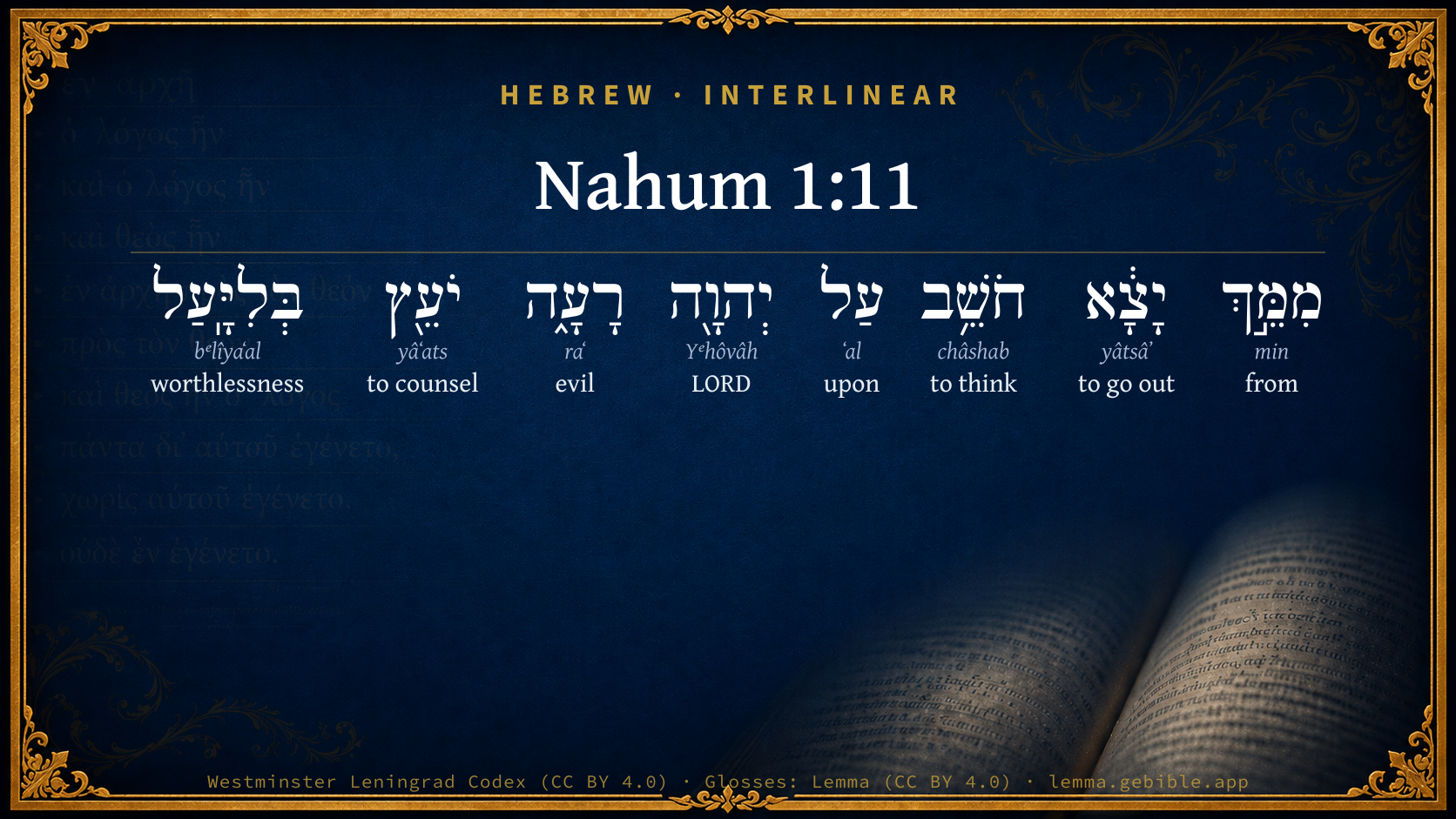
Nahum 1:11

Hebrew (Westminster Leningrad Codex) Nahum 1:11 appears in the Hebrew Old Testament. The text above is from the Westminster Leningrad Codex. Each word links to its Strong’s number, a concise gloss, and parsing drawn from the Open Scriptures Hebrew Bible morphology. Click any word for its full Brown-Driver-Briggs (BDB) entry.
Download image
Cite this verse

Nahum 1:11 (World English Bible). Public Domain. Lemma interlinear Bible study tool, https://lemma.gebible.app/v/nahum/1/11.

Show BibTeX & RIS
BibTeX
RIS
English Translation
There is one gone forth out of you, who devises evil against Yahweh, who counsels wickedness.
World English Bible · Public Domain
Download a study sheet

One document with this verse’s original text, its word-by-word gloss line, the meaning frame, cross-references with their text, attributed commentary, and full source and license credits — printable, and it pastes into notes with its structure intact.

This verse Autodidact and up

Study sheet (.html) Plain text (.txt)

A passage Seminary Student

Up to 50 verses in one chapter. A passage sheet keeps up to 6 commentary sources and 12 cross-references per verse, in the order this page ranks them, and says so on the sheet whenever that leaves anything out. Ask for a single verse and you get the Autodidact verse sheet above.

Everything on this page stays free to read, with no account — the sheet is a download of what is already on screen, not access to it.

Want to remove ads? Support Godless Engineer
Compare translations 3

The same verse in 3 English versions, stacked beneath the original-language interlinear above. Click any original word for its lexicon entry.

Each is an independent rendering of the whole verse — the interlinear is not word-aligned to these translations.

Highlighted words mark where these versions differ — a whole-verse word diff, not a word-by-word alignment.

  • World English Bible Public Domain
    There is one gone forth out of you, who devises evil against Yahweh, who counsels wickedness.
  • King James Version Public Domain
    There is one come out of thee, that imagineth evil against the LORD, a wicked counsellor.
  • unfoldingWord Literal Text CC BY-SA 4.0
    From you came out a plotter of evil against Yahweh, an advisor of wickedness.

unfoldingWord Literal Text — © unfoldingWord, licensed CC BY-SA 4.0. Word-aligned USFM3 via Door43 (git.door43.org/unfoldingWord/en_ult).

Versions to compare (up to 4)

3 of 4 selected

Show all 18 translations

Every available English version of this verse, each an independent rendering of the whole verse.

  • World English Bible Public Domain
    There is one gone forth out of you, who devises evil against Yahweh, who counsels wickedness.
  • Berean Standard Bible Public Domain
    From you, O Nineveh, comes forth a plotter of evil against the LORD, a counselor of wickedness.
  • Majority Standard Bible Public Domain
    From you, O Nineveh, comes forth a plotter of evil against the LORD, a counselor of wickedness.
  • King James Version Public Domain
    There is one come out of thee, that imagineth evil against the LORD, a wicked counsellor.
  • American Standard Version (1901) Public Domain
    There is one gone forth out of thee, that deviseth evil against Jehovah, that counselleth wickedness.
  • Revised Version (1885) Public Domain
    There is one gone forth out of thee, that imagineth evil against the LORD, that counselleth wickedness.
  • Geneva Bible (1599) Public Domain
    There commeth one out of thee that imagineth euill against the Lord, euen a wicked counsellour.
  • Douay-Rheims (1899) Public Domain
    Out of thee shall come forth one that imagineth evil against the Lord, contriving treachery in his mind.
  • Young's Literal Translation Public Domain
    From thee hath come forth a deviser of evil Against Jehovah -- a worthless counsellor.
  • Literal Standard Version CC BY-SA 4.0
    From you has come forth a deviser of evil || Against YHWH—a worthless counselor.
  • Unlocked Literal Bible CC BY-SA 4.0
    Someone arose among you, Nineveh, who planned evil against Yahweh, someone who promoted wickedness.
  • unfoldingWord Literal Text CC BY-SA 4.0
    From you came out a plotter of evil against Yahweh, an advisor of wickedness.
  • Darby Bible Public Domain
    Out of thee is gone forth one that imagineth evil against Jehovah, a wicked counsellor.
  • World Messianic Bible Public Domain
    One has gone out of you who devises evil against the LORD, who counsels wickedness.
  • Webster's Bible Public Domain
    There is one come out of thee, that imagineth evil against the LORD, a wicked counselor.
  • Free Bible Version CC BY-SA 4.0
    One of you is plotting evil against the Lord, someone who is planning wickedness.
  • Bible in Basic English Public Domain
    One has gone out from you who is designing evil against the Lord, whose purposes are of no value.
  • JPS Tanakh (1917) Public Domain
    Out of thee came he forth, that deviseth evil against the LORD, that counselleth wickedness.

Literal Standard Version (2020), Covenant Press — licensed CC BY-SA 4.0. Text via the HelloAO Bible API (eBible.org). Unlocked Literal Bible (unfoldingWord) — licensed CC BY-SA 4.0. Text via the HelloAO Bible API (eBible.org). unfoldingWord Literal Text — © unfoldingWord, licensed CC BY-SA 4.0. Word-aligned USFM3 via Door43 (git.door43.org/unfoldingWord/en_ult). Free Bible Version, Dr. Jonathan Gallagher — licensed CC BY-SA 4.0. Text via the HelloAO Bible API (eBible.org).

Word by word

More ways to search: Search by grammar → Find every occurrence → Compare this word →

Practice this passage: Drill this verse → Learn its vocabulary →

About this verse

These counts appear in no published source. They are computed here, from the morphology-tagged text and Lemma’s own curated glosses. What Lemma adds →

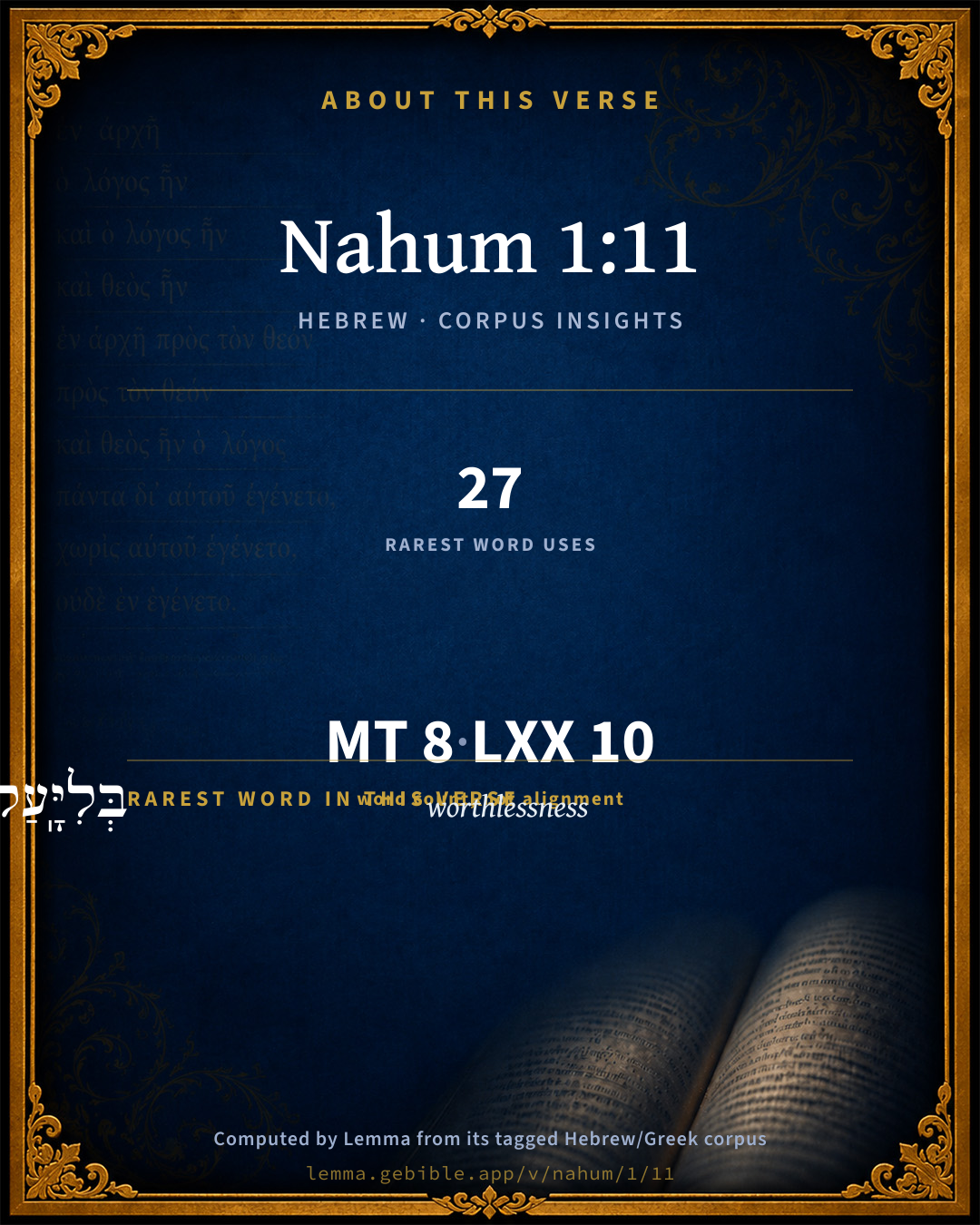
8
words
8
distinct lemmas
Prophets
section

Shared distinctive vocabulary

בְּלִיָּֽעַל worthlessness H1100 occurs in 26 verses of the Hebrew Bible. Also found in:

Grammatical profile

  • 3 verbs
  • 3 nouns
  • 2 prepositions

Verb forms

  • יָצָ֔א Qal · Perfect
  • חֹשֵׁ֥ב Qal · Participle Active
  • יֹעֵ֖ץ Qal · Participle Active

Hebrew & Septuagint length

In English translation the verse runs 16 words from the Hebrew and 16 from the Septuagint (LXX English) — the same length.

A rough comparison of the two English renderings, which tokenize alike — not a word-level alignment.

Word counts can differ between the Hebrew and the Greek without any difference in meaning — e.g. the Hebrew direct-object marker אֵת has no separate Greek word, and Greek often adds the article ὁ.

In the original languages it is 8 Hebrew tokens and 10 Greek tokens — but the two are counted differently (Hebrew bundles its prefixes and suffixes into one token; the Greek is in lemma form), so that isn’t a like-for-like length.

Cross-references

9

Topical passages linked to Nahum 1:11 in the Treasury of Scripture Knowledge — connected by theme and wording, ordered by reader-vote popularity; previews shown in the World English Bible.

  • Nahum 1:9 What do you plot against Yahweh? He will make a full end. Affliction won't rise up the second time.
  • 2 Chronicles 13:7 There were gathered to him worthless men, base fellows, who strengthened themselves against Rehoboam the son of Solomon, when Rehoboam was young and tender-hearted, and could not withstand them.
  • 1 Samuel 2:12 Now the sons of Eli were base men; they didn't know Yahweh.
  • 2 Samuel 20:1 There happened to be there a base fellow, whose name was Sheba, the son of Bichri, a Benjamite: and he blew the trumpet, and said, We have no portion in David, neither have we inheritance in the son of Jesse: every man to his tents, Israel.
  • 2 Kings 18:13–14 Now in the fourteenth year of king Hezekiah did Sennacherib king of Assyria come up against all the fortified cities of Judah, and took them.
  • 2 Kings 18:30 neither let Hezekiah make you trust in Yahweh, saying, Yahweh will surely deliver us, and this city shall not be given into the hand of the king of Assyria.
  • 2 Kings 19:22–25 Whom have you defied and blasphemed? and against whom have you exalted your voice and lifted up your eyes on high? [even] against the Holy One of Israel.
  • 2 Chronicles 32:15–19 Now therefore don't let Hezekiah deceive you, nor persuade you after this manner, neither believe you him; for no god of any nation or kingdom was able to deliver his people out of my hand, and out of the hand of my fathers: how much less shall your God deliver you out of my hand?
  • Isaiah 10:7–15 However he doesn't mean so, neither does his heart think so; but it is in his heart to destroy, and to cut off not a few nations.

Cross-references courtesy of OpenBible.info (CC BY 4.0).

Hebrew and Greek witnesses Masoretic Hebrew ↔ Greek Septuagint

The same verse in the two great witnesses to the Old Testament, shown verse-for-verse.

These are two independent witnesses, not word-aligned to each other, and the Septuagint is shown in lemma (dictionary) form.

Hebrew Nahum 1:11 Masoretic · Westminster Leningrad Codex

מִמֵּ֣ךְ יָצָ֔א חֹשֵׁ֥ב עַל יְהוָ֖ה רָעָ֑ה יֹעֵ֖ץ בְּלִיָּֽעַל

There is one gone forth out of you, who devises evil against Yahweh, who counsels wickedness.

World English Bible · Public Domain

Greek LXX Nahum 1:11 Septuagint · lemma form

ἐκ σύ ἐκἔρχομαι λογισμός κατά ὁ κύριος πονηρός λογίζομαι ἐναντίος

Out of you shall proceed a device against the Lord, counselling evil things hostile to him.

LXX2012 (modern English Septuagint) · Public Domain

On this verse, Haydock's Catholic Bible Commentary discusses the Septuagint’s reading. Read the note in Commentary ↓

Hebrew: Westminster Leningrad Codex (CC BY 4.0). Greek: Septuagint (public domain); English from LXX2012 (modern English Septuagint) (Public Domain). How the Septuagint differs from the Hebrew →

Targum (Aramaic paraphrase)

1

The Targum is the ancient Jewish Aramaic paraphrase of the Hebrew Scriptures — an interpretive translation, not the Hebrew text itself. Onkelos (literal) and Pseudo-Jonathan (expansive) render the Torah, and Jonathan the Prophets. Coverage is partial: where no permissively-licensed English translation exists for a verse, only the Aramaic is shown. This is verse-level text, not a word-by-word alignment to the Hebrew.

  1. Targum Jonathan Prophets (Joshua–Malachi)
    מִנֵיךְ נִינְוֵה נְפַק מַלְכָּא דְחָשֵׁיב עַל עַמֵיהּ דַייָ בִּישָׁא דְמָלַךְ מְלַךְ דִרְשַׁע:

    (no public-domain English translation for this verse)

    Targum Jonathan — Aramaic: “Mikraot Gedolot” (public domain). English: “Sefaria Community Translation” (CC0 1.0 (public-domain dedication)); “London "Chaldee Paraphrase," 1871” (public domain). Text via Sefaria.

Commentary

Notes on Nahum 1:11 from classic Christian and Jewish commentators (each source and its license shown beneath its notes). The classic Christian expositions comment on the surrounding passage and are grouped to its opening verse, so a note may address several verses; the Jewish commentaries on the Tanakh (Rashi and others) are per-verse, so they appear only where the commentator wrote on this verse.

Lemma curates 59 commentaries, every one of them public domain or Creative Commons licensed, each selected and text-cleaned for this edition rather than reprinted as found. About our sources →

Trapp's Complete Commentary

John Trapp

Nah 1:11 There is [one] come out of thee, that imagineth evil against the LORD, a wicked counsellor.

Ver. 11. There is one come out of thee that imagineth evil against the Lord] Many there are, but one among and above the rest; sc. Sennacherib, that bold Briareus, that lifteth up his hundred hands at once against heaven, and threateneth to cut off at a blow God’s people, as if they had all but one neck. See Nah 1:9. "He is come up over all his channels, and gone over all his banks," Isa 8:7; but God shall soon put a stop to him, and with an "overrunning flood" (that he may be even with him) "make an utter end of his place," as it is here, Nah 1:8.

A wicked counsellor] Heb. a counsellor of Belial, or of the devil, who lendeth him his seven heads to plot, and his ten horns to push God’s people. What pernicious counsel he gave them, see 2Ki 18:19-35 2Ch 32:9-19 Isa 36:4-10; Isa 36:13-20; sc. to cast off God as not able to deliver them out of his hands; and to make an agreement with him by a present, &c. This pestilent counsel he gave them by Rabshakeh, who was, say the rabbins, a renegade Jew. Every vizier and bashaw of state among the Turks useth to keep still a Jew for his private counsel; whose malice, wit, and experience of Christendom, with their continual intelligence, is thought to advise most of that mischief which the Turk at this day puts in execution against us (saith mine author), the Jews being found the most nimble and mercurial wits in the world, but counsellors of Belial. In all the shop of hell there is no anvil so well set, whereon to forge, no engine so apt, whereby to execute any choice piece of mischief, as that man, who is ingenuose nequam et publico male faeundus (as it is said of Gaius Curio the Roman), wittily wicked and pestilently eloquent. Such were Cardinal Pole to England, Cardinal Sadoletus to Geneva, and the Jesuits generally, great politicians and factors for Rome. They say, Satan sent Luther, and God sent them to withstand him. They destroy many souls, as the dragon doth the elephant, by biting his ear and sucking his blood; because he knows that to be the only place which the elephant cannot reach with his trunk to defend. They take crafty counsel against the Church, Psa 83:3.

John Trapp, A Commentary or Exposition upon All the Books of the Old and New Testament (1647–1656) — public domain. Text from a community e-Sword module.

The Biblical Illustrator

Joseph S. Exell

Nah_1:11-14

There is one come out of thee, that imagineth evil against the Lord, a wicked counsellor.

Corrupt kings

These words suggest a few thoughts concerning human kings and kingdoms.

I. Human kings are sometimes terribly corrupt. There is one come out of thee, that imagineth evil against the Lord, a wicked counsellor. This evidently means Sennacherib, the king of Nineveh.

II. Corrupt kings often ruin their kingdoms. Though they be quiet, and likewise many, yet thus shall they be cut down, when he shall pass through. Though I have afflicted thee, I will afflict thee no more. These words seemed to be addressed to Judah concerning the utter destruction that will befall their enemies, and their consequent deliverance from all fear from that quarter. It was here said they should be destroyed--

1. Notwithstanding their military completeness. Though they be quiet. The word quiet means complete. No doubt the military organisation, discipline, and equipment of Sennacheribs mighty army, as he led them up to attack Jerusalem, were as complete as the intelligence, the art, and the circumstances of the age could make them. Notwithstanding this, ruin befell them.

2. Notwithstanding their numerical force. Likewise many.

III. The ruin of corrupt kingdoms is a blessing to the oppressed. Yoke here refers to the tribute imposed upon Hezekiah by Sennacherib. And so it ever is, when despotism has fallen, the oppressed rise to liberty. Conclusion--

1. Realise the truth of prophecy.

2. Realise the importance of promoting education among the people. (Homilist.)

The Biblical Illustrator, edited by Joseph S. Exell (c. 1880s–1900s) — public domain. Text from a community e-Sword module.

Joseph Benson's Commentary

Nah 1:11-13. There is one come out of thee — Or, one hath gone forth of thee. This is probably meant of Sennacherib, who uttered so many reproaches and blasphemies against the true God, one of whose royal seats was Nineveh, and who probably went forth from thence to invade Judea. But the term, a wicked counsellor, seems to be intended of Rabshakeh, whom Sennacherib sent against Jerusalem, while he himself warred against Lachish, and who uttered those blasphemous speeches against God, of which we have an account 2Ki 18:19. Though they be quiet — Though the Assyrians be secure, and fear no danger. And likewise many — An immense host; yet shall they be cut down — Irresistibly, suddenly, and universally; when he shall pass through — When the angel of the Lord shall pass through their camp, in which he slew in one night 185,000 men: see Isa 37:36. Though I have afflicted thee — O Israel, I will afflict thee no more — I will no more chastise thee by the Assyrian, the rod of mine anger, by Sennacherib or his forces. For now I will break his yoke from off thee — Hezekiah and his people shall no longer be tributaries to the king of Assyria, as they have been for a considerable time: see 2Ki 18:14. The words may also be considered as promising relief to the Israelites of the ten tribes, who were in a state of actual captivity among them at this time.

Joseph Benson's Commentary on the Old and New Testaments (1811–1818) — public domain. Text from a community e-Sword module.

Tyndale Open Study Notes

Tyndale Open Resources

1:11 The wicked counselor is the Assyrian king. God had also dealt with the arrogant conceit of an Assyrian king in Hezekiah’s time (about 701 BC; see 2 Kgs 19:35-36). Assyria’s wicked counselor contrasts with the coming Messiah, the King who is a “Wonderful Counselor” (Isa 9:6).

Tyndale Open Study Notes — © Tyndale Open Resources, licensed CC BY-SA 4.0. Text via the HelloAO Bible API.

Geneva Bible (1599)

Geneva Bible translators

Which may be understood either of Sennacherib, or of the whole body of the people of Nineveh.

Geneva Bible (1599) marginal notes — public domain. Text via Bolls.life.

Jamieson, Fausset & Brown

Robert Jamieson, A. R. Fausset & David Brown

The cause of Nineveh's overthrow: Sennacherib's plots against Judah.

come out of thee--O Nineveh. From thyself shall arise the source of thy own ruin. Thou shalt have only thyself to blame for it.

imagineth evil--Sennacherib carried out the imaginations of his countrymen (Nah 1:9) against the Lord and His people (Kg2 19:22-23).

a wicked counsellor--literally, "a counsellor of Belial." Belial means "without profit," worthless, and so bad (Sa1 25:25; Co2 6:15).

Jamieson, Fausset & Brown — Commentary Critical and Explanatory on the Whole Bible (1871) — public domain (CC PDM 1.0). Text via the HelloAO Bible API.

Adam Clarke's Commentary

Verse 11. Imagineth evil against the Lord] Such were Pul, 2Kg 15:10, Tiglath-pileser, 2Kg 15:29; Shalmaneser, 2Kg 17:6; and Sennacherib, 2Kg 18:17; 2Kg 19:23.

A wicked counsellor.] Sennacherib and Rabshakeh.

Adam Clarke's Commentary on the Bible (1810–1826) — public domain. Text from a community e-Sword/MySword module.

John Calvin's Commentaries

The Prophet now shows why God was so exceedingly displeased with the Assyrians, and that was, because he would, as a protector of his Church, defend the distressed against those who unjustly oppressed them. The Prophet then designed here to give the Jews a firm hope, so that they might know that God had a care for their safety; for if he had only threatened the Assyrians without expressing the reason, of what avail could this have been to the Jews? It is indeed gratifying and pleasing when we see our enemies destroyed; but this would be a cold and barren comfort, except we were persuaded that it is done by God’s judgment, because he loves us, because he would defend us, having embraced us with paternal love; but when we know this, we then triumph even when in extreme evils. We are indeed certain of our salvation, when God testifies, and really proves also, that he is not only propitious to us, but that our salvation is an object of his care. This is the Prophet’s design when he thus addresses Nineveh.

From thee has gone forth a devisor of evil against Jehovah, an impious adviser The manner of speaking is much more emphatical, when he says, that the Assyrians consulted against God, than if he had said, that they had consulted against the Jews, or consulted against the chosen people of God.

But though this was said of the Jews, let us yet remember that it belongs also to us. The Prophet confirms the doctrine which I lately alluded to, that whenever the ungodly cause trouble to us, they carry on war with God himself, that whenever they devise any evil against us, they run headlong against him. For God sets up himself as a shield, and declares, that he will protect under the shadow of his wings all those who commit themselves to his protection. If we then lie hid under the guardianship of God, and flee to him in all our adversities, and while patiently enduring all wrongs, implore his protection and help, whosoever then will rise up against us will have God as his enemy. Why so? because he consults against him. And this reason shows, that whatever the Prophet has hitherto said against the Assyrians ought to be extended indiscriminately to all the enemies of the Church. For why did God threaten the Assyrians with a sudden inundation and with perpetual darkness? The reason is here subjoined, — because they consulted against him and his Church. The same thing then will also happen to our enemies, provided we remain quiet, as it has been said, under the protection of God.

But when he says that he had gone forth from that city who contrived evil against Jehovah, — this ought not to be confined to Sennacherib, but must rather be viewed as common to all the Assyrians; as though he said, “Thou produces the fruit which thou shalt eat; for from thee will arise the cause of thy ruin. There is no reason for thee to expostulate with God, as though he cruelly raged against thee; for from thee has gone forth he who devised evil against Jehovah: thou reapest now the reward worthy of thy bringing forth; for where have originated counsels against the Church of God, except in thine own bosom, and in thine own bowels? The evil then which has proceeded from thee shall return on thine own head.”

He then adds, An impious consulter, or counselor, בליעל יועף, ivots beliol. Respecting the word בליעל, beliol, the Hebrews themselves are not agreed. There are those who suppose it to be a compound word, בל יעל, It profits not; and they think that it is applied to designate things of nought as well as men of nought. There are others who, like Jerome, render it, Without a yoke, but without reason. Then Beliol, is properly a vain thing, which is wholly unsubstantial; and so it designates a man in whom there is no integrity. It is also applied to all the wicked, and to their crimes: hence a thing or work of Belial is said to be any heinous sin or a detestable crime; and the man who acts perversely and wickedly is called Belial. And Paul takes Belial simply for the very gravity of Satan, and of all the wicked; for he opposes Belial to Christ, (2 Corinthians 6:15.) We now then understand the meaning of the Prophet to be this, — that God denounces war on the Assyrians, because they made war unjustly on his people, and consulted not only against the Jews, but also against God, who had taken them, as it has been stated, under his own keeping and protection. It follows —

John Calvin's Commentaries (1540-1563) — public domain. Text from the Calvin Translation Society English edition (1840s-50s) via the Christian Classics Ethereal Library (ccel.org). Calvin's coverage is partial (roughly two-thirds of the Bible); uncommented books and verses are honest gaps, never fabricated. The 19th-century editor's footnotes and remarks are omitted so the notes are faithfully Calvin's own voice.

Ellicott's Commentary for English Readers

(11) Come out of thee.—Another possible rendering is, He has retired from thee [i.e., Jerusalem], who imagineth . . . We prefer the rendering of the Authorised Version, and regard the verse as addressed to Nineveh. The reference in the verses following is sufficiently plain for us to identify this enemy of God with Sennacherib. (Comp. the language used by his envoy Rabsbakeh in 2 Kings 18, 19)

A Bible Commentary for English Readers, edited by Charles John Ellicott (1878–1897) — public domain. Text from a community e-Sword module.

The Cambridge Bible for Schools and Colleges

gen. ed. J. J. S. Perowne

11. There is one come out] Rather: out of thee came he (or, one) forth who imagined … who counselled mischief. The reference is probably to Sennacherib. The words are addressed to Nineveh.

The Cambridge Bible for Schools and Colleges (gen. ed. J. J. S. Perowne; Cambridge University Press, 1878–1918) — public domain. Text from a community e-Sword module.

John Gill's Exposition

There is one come out of thee,.... That is, out of Nineveh, as the Targum explains it; meaning Sennacherib, who had his royal seat and palace there; or Rabshakeh that was sent from hence by him with a railing and blaspheming letter to the king of Judah, and the inhabitants of Jerusalem. This is said to be at the present time of writing this prophecy, though it was after it, because of the certainty of it, as is usual in prophetic language; unless it can be thought that this prophecy was delivered out exactly at the time when Sennacherib had entered Judea, and was before the walls of Jerusalem; but not yet discomfited, as after predicted:

that imagineth evil against the Lord; against the people of the Lord, as the Targum; formed a scheme to invade the land of Judea, take the fenced cities thereof, and seize upon Jerusalem the metropolis of the nation, and carry the king, princes, and all the people captive as Shalmaneser his father had carried away the ten tribes:

a wicked counsellor; or "a counsellor of Belial" (k); who, by Rabshakeh, advised Israel not to regard their king, nor trust in their God but surrender themselves up to him, Kg2 18:29.

(k) "consulens", Belijahai, Montanus; "consiliarius Belijaal", Burkius.

John Gill's Exposition of the Whole Bible (1746–1763) — public domain (CC PDM 1.0). Text via the HelloAO Bible API.

Albert Barnes' Notes on the Bible

There is one come out of thee - that is, Nineveh, “that imagineth” deviseth, , “evil, Lord, Sennacherib, against the the rod of God’s anger” Isa 10:5-7, yet who “meant not so,” as God meant. “And this was his counsel,” as is every counsel of Satan, “that they could not resist him, and so should withdraw themselves from the land of God, “into a land like their own” Isa 36:16-17, but whose joy and sweetness, its vines and its fig-trees, should not be from God, but from the Assyrian, i. e., from Satan.

Albert Barnes' Notes on the Bible (1834–1885) — public domain. Text from a community e-Sword/MySword module.

Haydock's Catholic Bible Commentary

Forth. Some understand this of Sennacherib. But as his attempt against the people seems to have been prior to the prophecy of Nahum, we may better understand it of Holofernes. (Challoner) --- One. Septuagint, "a most wicked thought against the Lord, devising opposition." (Haydock) --- We may render, "hath come," &c., alluding to Sennacherib and Rabsaces, Isaias xxxvi. 18. and xxxvii. 23. (Calmet)

George Leo Haydock (1774–1849), Haydock's Catholic Family Bible and Commentary, 1859 edition — public domain. Excludes Psalms (Douay-Rheims chapter numbering differs from Protestant) and Deuterocanonical books (Catholic canon only).

Matthew Poole's English Annotations

There is one: this is a very usual dialect to express an uncertain number; several are contained in such one; though if you will determine it to one single person, it is very like it may be Sennacherib or Rabshakeh. Come out: from Nineveh he set forth on that expedition against Judea in the days of Hezekiah.

Of thee; Nineveh. That imagineth evil against the Lord; consulteth, hath formed, and resolved upon it. So it is evident by his blasphemies against the Lord, Isa 36:7,18,20; 37:10,24,29; 2Ch 32:14,15,17,19. And he imagined evil against the people of the Lord, 2Ch 32:1.

A wicked counsellor; one whose counsels and projects are without any regard to right and equity, who by injustice and oppressions, who by frauds and deceits, by blood and slaughter, designs his own greatness, and the ruin of his neighbours.

Matthew Poole's English Annotations on the Holy Bible (1683–1685) — public domain. Text from a community e-Sword/MySword module.

The Pulpit Commentary

The reason of the destruction and of the punishment is told. There is one come out of thee. Nineveh is addressed; and we need not refer the words entirely to Sennacherib and his impious threats, but may take them generally as expressing the arrogant impiety of the Assyrians and their attitude towards Jehovah. A wicked counseller; literally, a councilor of Belial; i.e. of worthlessness. The expression, perhaps primarily applied to Sennacherib, also regards the plans prepared by the Assyrians for destroying the people of God, a type of the world arrayed against piety.

Vers. 11-14. Corrupt kings.

"There is one come out of thee, that imagineth evil against the Lord, a wicked counsellor. Thus saith the Lord; Though they be quiet, and likewise many, yet thus shall they be cut down, when he shall pass through," etc. These words suggest a few thoughts concerning human kings and kingdoms.

I HUMAN KINGS ARE SOMETIMES TERRIBLY CORRUPT. "There is one come out of thee, that imagineth evil against the Lord, a wicked counsellor." This evidently means Sennacherib, the King of Nineveh. He was one of the great moral monsters of the world. "He invaded the land of Judah with an immense army, besieged Lachish, and having reduced that city, threatened to invade Jerusalem itself. Hezekiah, dreading his power, sent him an obsequious embassy, and by paying three hundred talents of silver and thirty talents of gold, purchased an inglorious peace. But no sooner had Sennacherib received the money than, disdaining his engagements, he prosecuted the war with as much vigour as if no treaty had been in existence, sending three of his generals and a powerful army to besiege Jerusalem. Being informed that Tirhakah King of Ethiopia joined by the power of Egypt, was advancing to assist Hezekiah, he marched to meet the approaching armies, defeated them in a general engagement, ravaged their country, and returned with the spoil to finish the siege of Jerusalem. Hezekiah, in the extremity of his distress, implored the succour of Heaven; and the insolence and blasphemy of Sennacherib drew upon the Assyrians the vengeance of God. And, in perfect accordance with the prophecy of Isaiah, the sacred historian informs us that the angel of the Lord slew, in one night, one hundred and eighty-five thousand of the Assyrian army." Such is a brief and very partial sketch of this monster. Alas! he is only a type of the vast majority of men who have found their way to thrones! They have been in all ages the chief devils of the world. There are kings that have powers ordained of God; but such kings, and those only, are "a terror to evil doers and a praise to those that do well." We are commanded to honour the king; but such a king as this Sennacherib, who can honour? A king, to be honoured, must be honour worthy; he must be just, ruling in the fear of the Lord.

II CORRUPT KINGS OFTEN RUIN THEIR KINGDOMS. "Though they be quiet, and likewise many, yet thus shall they be cut down, when he shall pass through. Though I have afflicted thee, I will afflict thee no more." These words seem to be addressed to Judah concerning the utter destruction that will befall their enemies, and their consequent deliverance from all fear from that quarter. It was here said they should be destroyed:

1. Notwithstanding their military completeness. "Though they be quiet." The word "quiet" means complete. No doubt the military organization, discipline, and equipment of Sennacherib"s mighty army, as he led them up to attack Jerusalem, were as complete as the intelligence, the art, and the circumstances of the age could make them. Notwithstanding this, ruin befell them.

2. Notwithstanding their numerical force. "Likewise many." Their numbers were overwhelming, yet how complete their destruction! They were "cut down," and their name ceased. Nineveh has been long since blotted from the earth. The account given of the destruction you have in 2Ki_19:35, "And it came to pass that night, that the angel of the Lord went out, and smote in the camp of the Assyrians a hundred fourscore and five thousand: and when they arose early in the morning, behold, they were all dead corpses." Then followed, in due course, the complete destruction of Nineveh itself by the forces of the Medes and Babylonians. So utterly was it destroyed, that even the references of classical writers to it are to a city that is long since extinct. It was a wonderful city; it stood, according to the account of some, on an area ten times the size of London; its walls a hundred feet high, and so broad that three chariots could be driven on them abreast. It bad fifteen hundred towers, each two hundred feet in height. In 1842 Botta began to excavate, and three years afterwards Layard commenced his interesting and successful explorations. The remains which were discovered by these excavators filled the world with astonishment. "A city, an empire, had risen from the silent slumber of ages; its kings could be numbered, and its tongue mastered; while its history, manners, customs, and dwellings formed an unexpected revelation, wondrous in its variety and fulness." Who brought all this ruin on this grand old city? Sennacherib, a ruthless despot and a bloody warrior, and his successors, as savage as himself. And what cities and empires have been rained by such men in all ages! Who broke up ancient dynasties? Despots. And in modern times who has brought all the suffering, the disorder, and the spoliation that has befallen France during the last sixty years? Despots. Until despotism is put down, such will continue to be the case.

III THE RUIN OF CORRUPT KINGDOMS IS A BLESSING TO THE OPPRESSED. "For now will I break his yoke from off thee that is, "thee, Judah, and will burst thy bonds in sunder." "Yoke" here refers to the tribute imposed upon Hezekiah King of Judah by Sennacherib. (2Ki_18:14) And so it ever is when despotism has fallen, the oppressed rise to liberty. What teeming millions of men are groaning, not only in Asiatic countries, but in European countries, under the tyranny of despots! These arrogant, haughty autocracies must fail, as Assyria and other ancient despotisms fell, before the yoke shall be taken from the neck of the oppressed, and their bands burst asunder.

CONCLUSION.

1. Realize the truth of prophecy. When Nahum uttered these fearful predictions in relation to Nineveh, Nineveh shone in unabated splendor, and stood in unabated strength; but after a very few generations had passed away the predicted ruin came, and Nineveh has long since been buried in the oblivion of centuries. Have faith in the Wont of God. Heaven and earth shall pass away, but not one jot or tittle of his Word shall fail to be accomplished.

2. Realize the importance of promoting education among the people. By education I do not mean what is merely technical or scientific, but chiefly moral. The education that teaches the people the sense of personal independency and responsibility, the duty of self-respect, the inalienable right of private judgment, and a liberty of action circumscribed only by the rights of others. It is when such an education as this spreads among the peoples of the world that despotisms will moulder to dust. When men shall know the moral truth, the moral reality, then the truth shall make them free, "It"s coming yet for a" that, That man to man the warld o"er Shall brithers be for a" that. D.T.

The Pulpit Commentary (1880–1919), ed. H.D.M. Spence-Jones & Joseph S. Exell — public domain. Text from a community e-Sword module.

John Wesley's Explanatory Notes

Come - Sennacherib, or Rabshekah. Thee - From Nineveh. Against the Lord - Against the people of the Lord, 2 Chron. xxxii, 1.

John Wesley, Explanatory Notes Upon the Whole Bible (1754–1765) — public domain. Text via the GEBible commentary corpus.

Rashi

Rabbi Shlomo Yitzchaki (Rashi)

From you—you, Nineveh.

emanated—Sennacherib, who plots evil, who thought to destroy the earthly abode and the heavenly abode. One passage reads (II Kings 19:23): “And I will come to its remotest lodge”; and one passage reads (Isa. 37:24): “Its remotest height.” “First I will destroy His earthly abode, and then I will destroy His heavenly abode” - as found in the chapter “Chelek“ (Sanh. 94b).

Rashi on the Tanakh — English translations: “The Judaica Press complete Tanach with Rashi, translated by A. J. Rosenberg” (CC BY 4.0); “Pentateuch with Rashi's commentary by M. Rosenbaum and A.M. Silbermann, 1929-1934” (public domain); “The Metsudah Tanach series, Lakewood, N.J” (CC BY 4.0); and “The Book of Joshua, Metsudah Publications, 1997” (CC BY 4.0). Text via Sefaria.

Lesson kit

Teaching starters — assembled from the data on this page, not authored interpretation. Every prompt links to the verse data it draws on. Edit before teaching.

Nahum, in the Prophets, opens this verse with 8 words (8 distinct Hebrew lemmas). Its most distinctive word is bᵉlîyaʻal (“worthlessness”). A historical commentator’s framing appears above. Read the whole chapter for the surrounding context.

Discussion questions

  1. What does “worthlessness” (bᵉlîyaʻal) contribute to the verse as a whole?
  2. Deuteronomy 13:13 shares the word «worthlessness» with this verse. How do the two illuminate each other?
  3. These translations render this verse differently. What is at stake in choosing one wording over another?
  4. The verb «יָצָ֔א» is Qal Perfect. How does its form color the action?
  5. Reading how Trapp's Complete Commentary and The Biblical Illustrator read this verse, where do the two commentators agree and where do they part?

Things to notice

Reading settings

Reading text

Shown beneath each verse's original-language words.

Old Testament
Old Testament edition

Read the OT as the Masoretic Hebrew (MT) or the Greek Septuagint (LXX).

English shown for the Greek Septuagint (in the Hebrew ↔ Greek comparison).

Comparing translations? Open the Compare panel on any verse page to stack up to four side by side.