

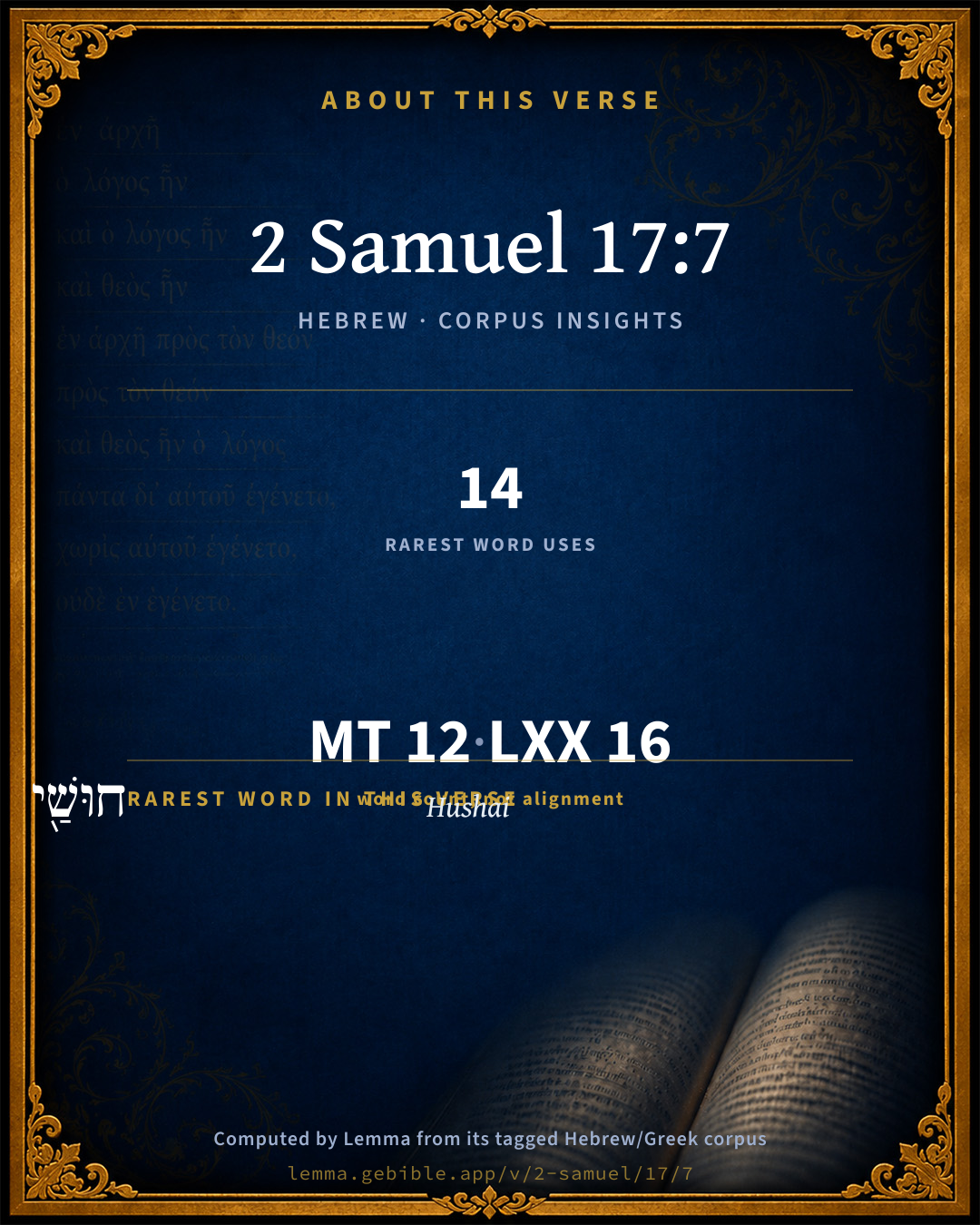
2 Samuel 17:7

Hebrew (Westminster Leningrad Codex) 2 Samuel 17:7 appears in the Hebrew Old Testament. The text above is from the Westminster Leningrad Codex. Each word links to its Strong’s number, a concise gloss, and parsing drawn from the Open Scriptures Hebrew Bible morphology. Click any word for its full Brown-Driver-Briggs (BDB) entry.
Download image
Cite this verse

2 Samuel 17:7 (World English Bible). Public Domain. Lemma interlinear Bible study tool, https://lemma.gebible.app/v/2-samuel/17/7.

Show BibTeX & RIS
BibTeX
RIS
English Translation
Hushai said to Absalom, The counsel that Ahithophel has given this time is not good.
World English Bible · Public Domain
Download a study sheet

One document with this verse’s original text, its word-by-word gloss line, the meaning frame, cross-references with their text, attributed commentary, and full source and license credits — printable, and it pastes into notes with its structure intact.

This verse Autodidact and up

Study sheet (.html) Plain text (.txt)

A passage Seminary Student

Up to 50 verses in one chapter. A passage sheet keeps up to 6 commentary sources and 12 cross-references per verse, in the order this page ranks them, and says so on the sheet whenever that leaves anything out. Ask for a single verse and you get the Autodidact verse sheet above.

Everything on this page stays free to read, with no account — the sheet is a download of what is already on screen, not access to it.

Want to remove ads? Support Godless Engineer
Compare translations 3

The same verse in 3 English versions, stacked beneath the original-language interlinear above. Click any original word for its lexicon entry.

Each is an independent rendering of the whole verse — the interlinear is not word-aligned to these translations.

Highlighted words mark where these versions differ — a whole-verse word diff, not a word-by-word alignment.

  • World English Bible Public Domain
    Hushai said to Absalom, The counsel that Ahithophel has given this time is not good.
  • King James Version Public Domain
    And Hushai said unto Absalom, The counsel that Ahithophel hath given is not good at this time.
  • unfoldingWord Literal Text CC BY-SA 4.0
    And Hushai said to Absalom, “The counsel that Ahithophel has counseled on this occasion is not good.”

unfoldingWord Literal Text — © unfoldingWord, licensed CC BY-SA 4.0. Word-aligned USFM3 via Door43 (git.door43.org/unfoldingWord/en_ult).

Versions to compare (up to 4)

3 of 4 selected

Show all 18 translations

Every available English version of this verse, each an independent rendering of the whole verse.

  • World English Bible Public Domain
    Hushai said to Absalom, The counsel that Ahithophel has given this time is not good.
  • Berean Standard Bible Public Domain
    Hushai replied, “This time the advice of Ahithophel is not sound.”
  • Majority Standard Bible Public Domain
    Hushai replied, “This time the advice of Ahithophel is not sound.”
  • King James Version Public Domain
    And Hushai said unto Absalom, The counsel that Ahithophel hath given is not good at this time.
  • American Standard Version (1901) Public Domain
    And Hushai said unto Absalom, The counsel that Ahithophel hath given this time is not good.
  • Revised Version (1885) Public Domain
    And Hushai said unto Absalom, The counsel that Ahithophel hath given this time is not good.
  • Geneva Bible (1599) Public Domain
    Hushai then answered vnto Absalom, The counsel that Ahithophel hath giuen, is not good at this time.
  • Douay-Rheims (1899) Public Domain
    And Chusai said to Absalom: The counsel that Achitophel hath given this time is not good.
  • Young's Literal Translation Public Domain
    And Hushai saith unto Absalom, `Not good `is' the counsel that Ahithophel hath counselled at this time.'
  • Literal Standard Version CC BY-SA 4.0
    And Hushai says to Absalom, “The counsel that Ahithophel has counseled [is] not good at this time.”
  • Unlocked Literal Bible CC BY-SA 4.0
    So Hushai said to Absalom, “The advice that Ahithophel has given this time is not good.”
  • unfoldingWord Literal Text CC BY-SA 4.0
    And Hushai said to Absalom, “The counsel that Ahithophel has counseled on this occasion is not good.”
  • Darby Bible Public Domain
    And Hushai said to Absalom, The counsel that Ahithophel has given this time is not good.
  • World Messianic Bible Public Domain
    Hushai said to Absalom, “The counsel that Ahithophel has given this time is not good.”
  • Webster's Bible Public Domain
    And Hushai said to Absalom, The counsel that Ahithophel hath given, is not good at this time.
  • Free Bible Version CC BY-SA 4.0
    “For once Ahithophel's advice isn't good,” Hushai replied.
  • Bible in Basic English Public Domain
    And Hushai said to Absalom, Ahithophel's idea is not a good one at this time.
  • JPS Tanakh (1917) Public Domain
    And Hushai said unto Absalom: 'The counsel that Ahithophel hath given this time is not good.'

Literal Standard Version (2020), Covenant Press — licensed CC BY-SA 4.0. Text via the HelloAO Bible API (eBible.org). Unlocked Literal Bible (unfoldingWord) — licensed CC BY-SA 4.0. Text via the HelloAO Bible API (eBible.org). unfoldingWord Literal Text — © unfoldingWord, licensed CC BY-SA 4.0. Word-aligned USFM3 via Door43 (git.door43.org/unfoldingWord/en_ult). Free Bible Version, Dr. Jonathan Gallagher — licensed CC BY-SA 4.0. Text via the HelloAO Bible API (eBible.org).

Word by word

More ways to search: Search by grammar → Find every occurrence → Compare this word →

Practice this passage: Drill this verse → Learn its vocabulary →

חוּשַׁ֖י
Chûwshay
H2365
“Hushai”
Noun, Proper
Part of Speech
Noun
Type
Proper
Full BDB Definition

Origin: from H2363

TWOT: None

Hushai = "hasting" - an Archite, a friend of David - the father of Baana, an officer of Solomon; probably the same as 1
  1. וַיֹּ֥אמֶר ʼâmar H559 “and · to say” Conjunction + Verb, Qal, Sequential Imperfect, 3rd Person, Masculine, Singular
  2. אֶל ʼêl H413 “to” Preposition
  3. אַבְשָׁל֑וֹם ʼĂbîyshâlôwm H53 “Absalom” Noun, Proper
  4. לֹֽא lôʼ H3808 “not” Particle, Negative
  5. טוֹבָ֧ה ṭôwb H2896 “good” Adjective, Adjective, Feminine, Singular, Absolute
  6. הָעֵצָ֛ה ʻêtsâh H6098 “the · counsel” Particle, Definite Article + Noun, Common, Feminine, Singular, Absolute
  7. אֲשֶׁר ʼăsher H834 “which” Particle, Relative
  8. יָעַ֥ץ yâʻats H3289 “to counsel” Verb, Qal, Perfect, 3rd Person, Masculine, Singular
  9. אֲחִיתֹ֖פֶל ʼĂchîythôphel H302 “Ahithophel” Noun, Proper
  10. בַּפַּ֥עַם paʻam H6471 “in/at the · time” Preposition, Determined + Noun, Common, Feminine, Singular, Absolute
  11. הַזֹּֽאת zôʼth H2063 “the · this” Particle, Definite Article + Pronoun, Demonstrative, Feminine, Singular

About this verse

These counts appear in no published source. They are computed here, from the morphology-tagged text and Lemma’s own curated glosses. What Lemma adds →

12
words
12
distinct lemmas
Historical
section

Notable vocabulary

The rarest word here is חוּשַׁ֖י Hushai H2365 — appearing just 14 times in the whole Hebrew Bible.

Shared distinctive vocabulary

חוּשַׁ֖י Hushai H2365 occurs in 13 verses of the Hebrew Bible. Also found in:

Grammatical profile

  • 2 verbs
  • 5 nouns
  • 1 adjective
  • 1 pronoun
  • 1 preposition
  • 2 particles

Verb forms

  • וַיֹּ֥אמֶר Qal · Sequential Imperfect
  • יָעַ֥ץ Qal · Perfect

Hebrew & Septuagint length

In English translation the verse runs 15 words from the Hebrew and 17 from the Septuagint (LXX English) — closely comparable.

A rough comparison of the two English renderings, which tokenize alike — not a word-level alignment.

Word counts can differ between the Hebrew and the Greek without any difference in meaning — e.g. the Hebrew direct-object marker אֵת has no separate Greek word, and Greek often adds the article ὁ.

In the original languages it is 12 Hebrew tokens and 16 Greek tokens — but the two are counted differently (Hebrew bundles its prefixes and suffixes into one token; the Greek is in lemma form), so that isn’t a like-for-like length.

Cross-references

1

Topical passages linked to 2 Samuel 17:7 in the Treasury of Scripture Knowledge — connected by theme and wording, ordered by reader-vote popularity; previews shown in the World English Bible.

  • Proverbs 31:8 Open your mouth for the mute, In the cause of all who are left desolate.

Cross-references courtesy of OpenBible.info (CC BY 4.0).

Hebrew and Greek witnesses Masoretic Hebrew ↔ Greek Septuagint

The same verse in the two great witnesses to the Old Testament, shown verse-for-verse.

These are two independent witnesses, not word-aligned to each other, and the Septuagint is shown in lemma (dictionary) form.

Hebrew 2 Samuel 17:7 Masoretic · Westminster Leningrad Codex

וַיֹּ֥אמֶר חוּשַׁ֖י אֶל אַבְשָׁל֑וֹם לֹֽא טוֹבָ֧ה הָעֵצָ֛ה אֲשֶׁר יָעַ֥ץ אֲחִיתֹ֖פֶל בַּפַּ֥עַם הַזֹּֽאת

Hushai said to Absalom, The counsel that Ahithophel has given this time is not good.

World English Bible · Public Domain

Greek LXX 2 Samuel 17:7 Septuagint · lemma form

καί εἶπον χουσι πρός αβεσσαλωμ οὐ ἀγαθός οὗτος ὁ βουλή ὅς βουλεύω αχιτοφελ ὁ ἅπαξ οὗτος

And Chusi said to Abessalom, This counsel which Achitophel has counselled this one time is not good.

LXX2012 (modern English Septuagint) · Public Domain

Hebrew: Westminster Leningrad Codex (CC BY 4.0). Greek: Septuagint (public domain); English from LXX2012 (modern English Septuagint) (Public Domain). How the Septuagint differs from the Hebrew →

Targum (Aramaic paraphrase)

1

The Targum is the ancient Jewish Aramaic paraphrase of the Hebrew Scriptures — an interpretive translation, not the Hebrew text itself. Onkelos (literal) and Pseudo-Jonathan (expansive) render the Torah, and Jonathan the Prophets. Coverage is partial: where no permissively-licensed English translation exists for a verse, only the Aramaic is shown. This is verse-level text, not a word-by-word alignment to the Hebrew.

  1. Targum Jonathan Prophets (Joshua–Malachi)
    וַאֲמַר חוּשַׁי לְאַבְשָׁלוֹם לָא תַקִין מִלְכָּא דִמְלַךְ אֲחִיתוֹפֶל בְּזִמְנָא הָדָא:

    (no public-domain English translation for this verse)

    Targum Jonathan — Aramaic: “Mikraot Gedolot” (public domain). English: “Sefaria Community Translation” (CC0 1.0 (public-domain dedication)); “London "Chaldee Paraphrase," 1871” (public domain). Text via Sefaria.

Commentary

Notes on 2 Samuel 17:7 from classic Christian and Jewish commentators (each source and its license shown beneath its notes). The classic Christian expositions comment on the surrounding passage and are grouped to its opening verse, so a note may address several verses; the Jewish commentaries on the Tanakh (Rashi and others) are per-verse, so they appear only where the commentator wrote on this verse.

Lemma curates 59 commentaries, every one of them public domain or Creative Commons licensed, each selected and text-cleaned for this edition rather than reprinted as found. About our sources →

Trapp's Complete Commentary

John Trapp

2Sa 17:7 And Hushai said unto Absalom, The counsel that Ahithophel hath given [is] not good at this time.

Ver. 7. Is not good at this time.] This was a bold speech, and such as if he had not made good by alleging to Absalom verisimilia, et ingenio illius superbo accommodata, arguments probable, and suitable to his ambitious disposition, there had been but one law for Hushai; not unlike that of the Locrians, who ordained that whoso would propose a new law, should come with a halter about his neck, that if it were not liked, he should be hanged. Here, then, he beginneth with his Errorem erravit non levem vir alioqui consultissimus Ahithophel. This most grave and wise counsellor is out in this particular; as well he may be, since

“Oυδεις ανθρωπων αυτος απαντα σοφος.”

John Trapp, A Commentary or Exposition upon All the Books of the Old and New Testament (1647–1656) — public domain. Text from a community e-Sword module.

The Biblical Illustrator

Joseph S. Exell

2Sa_17:7-23

And Hushai said unto Absalom.

Hushais advice preferred

The wisest man in the world is not wise at all times: though Achitophel commonly gives successful counsel, yet, with his good leave, he hath missed the mark at this time, and in this case.

I. Hushais grand design was first to invalidate the perilous counsel Achitophel had given, before he gave his own opinion he hereupon discovers the danger of Achitophels advice from three topics.

1. The first is taken from the valour of David, which he amplifies by a similitude of a bear robbed of her whelps.

2. The second argument m taken from the policy and prudence of David, as the first is from his courage and valour.

3. His third argument or topic is a periculoso from the dangerous consequences of this expedition of Achitophels. (2Sa_17:9-10.)

II. When Hushai had thus invalidated Achitophels counsel, then he produceth and introduceth his own to Absalom, and partly contrary and partly congruous and consentaneous to that of Achitophels. (2Sa_17:11-13.)

1. Hushais counsel was contrary to that of Achitophels in three respects.

(1) In respect of time; not in the night as he hath advised, seeing night-works are not only hazardous, but also no way glorious works, we scorn to steal a victory in the dark, let us fight David in clear-daylight that the sun may behold the valour and victory of our invincible army.

(2) The second respect is, Let not so small an handful as twelve thousand (according to his advice) be employed, but a mighty host made up of all Israel, from Dan to Beersheba, &c.

(3) And the third respect is, Thou thyself shalt go general of this numerous army, for thy presence will put life into thy soldiers, to fight lustily in the fight of their King, who bath power to punish or reward them according to their merit or demerit; beside the glory of the victory (which now Achitophel seeks to have to himself) shall be wholly thine by thy going in person to the battle.

2. Mark, it was congruous as to the effect, the same in the end with that Achitophel now had advised, to wit, the destruction of David, and of his despicable company, saying, David shall not be able to defend himself neither.

(1) In the open field, for we will fall upon him there, as the dew falleth upon the field, so largely, so suddenly, and so irresistibly upon all sides, as the drops of dew are innumerable: Nor

(2) Shall he be safe in, a fortified city, for we will bring ropes to it and draw it (and David in it) into the river, &c., so drown him, and all his, &c. Hushais whole oration was wholly accommodated to the ambitious humour of a vain-glorious prince, all along stuffed with the bombast of hyperbolical flourishes, both to fill up its own emptiness, and to puff up Absaloms proud mind with heading and leading a mighty army, &c. Hushai in his thrasonical expressions puts himself into the number of the actors of this tragedy, saying [So shall we come upon him, &c.] as if he had said [I will be one of the first of them,] that he might not seem to come short of Achitophel, who had offered Absalom his service both as a counsellor, and as a commander, and [We will not leave so much as one, &c.] This is opposed to Achitophels promise (v. 2.) that in no point he might seem to fall behind him, so is he the sooner believed. Whatever Hushai with all his florid flatteries pretended, yet his main design intended was, that David might gain more time to increase his army, and to prepare for the battle, and that the present paroxism or heat of the people being cooled by such delays (as Absaloms raising so vast an army did necessarily require) many of Davids subjects might at last bethink themselves of returning to their right allegiance, and thereby upon better consideration join to strengthen the Fathers forces against his unnatural rebellious son. In all these harangues both of Acbitophel and of Hushai, there is not one word of counselling Absalom to ask counsel of God, God was not in all their thoughts. (Psa_10:4.) Indeed Hushai purposely put Absalom upon trusting in an arm of flesh (a numberless number of soldiers) which he knew would bring a curse upon him (Jer_17:5), and therefore he pusheth him forward to be present in the fight to fetch in his own fall, &c. This counsel of Hushai was better approved of by Absalom and his courtieers than that of Achitophel, because the Lord purposed it should be foiled and defeated (verse 13, 14.)

III. How great is the power of faithful prayer; David had prayed, Lord, turn Achitophels counsel into folly. Achitophels counsel is rejected as foolish counsel, Davids prayer of faith and fervency was answered over and over again; for

1. Achitophels counsel was folly itself (2Sa_16:21.)

2. Tis here refused as such; and

3. he died as a fool (verse 28.)

IV. Achitophels counsel was infringed here by a double means,

1. by human help, namely, by Hushais prudence and policy, humouring an ambitious bigot to his own destruction, well knowing that his insolent temper would best be flushed up with flourishing flatteries, and

2. by a Divine hand, God giving Absalom up to believe lies, and so hasten his own end. (C. Ness.)

The best counsellors

Alphonsus, King of Anagon, being asked who were the best counsellors, answered, The dead (meaning books), which cannot flatter, but do without partiality, declare the truth. Now of all such dead counsellors, Gods testimonies have the preeminence. A poor, godly man, even then when he is deserted of all, and hath nobody to plead for him, he hath his senate, and his Council of State about him, the prophets and apostles, and other holy men of God, that spake as they were moved by the Holy Ghost. A man so furnished is never less alone than when alone; for he hath counsellors about him that tell him what is to be believed or done; and they are such counsellors as cannot err, as will not flatter him, nor applaud him in any sin, nor discourage or dissuade him from that which is good, whatever hazard it expose him to. And, truly, if we be wise we should choose such counsellors as these: Thy testimonies are the men of my counsel. (T. Manton.)

The Biblical Illustrator, edited by Joseph S. Exell (c. 1880s–1900s) — public domain. Text from a community e-Sword module.

Joseph Benson's Commentary

2Sa 17:7-8. The counsel of Ahithophel is not good at this time — Though he generally gives most wise and admirable counsel, yet he seems now to be under a mistake, and not sufficiently to consider all the present circumstances of this business. Thou knowest thy father and his men — Hushai, setting himself to oppose all the articles of Ahithophel’s advice, some openly, and others covertly, begins with giving a lively and dreadful description of the enemies Absalom had to deal with. That they be all mighty men — Of approved courage and strength, and not so easily vanquished as Ahithophel supposes. At all times they are terrible to the bravest foes, but much more so at this time; when they are chafed in their minds — Hebrew, bitter of soul, inflamed with rage; desperate, and therefore resolved to sell their lives at a dear rate. Being driven from their families, they are as so many enraged bears robbed of their whelps in the field — In the first furious efforts of their rage they will not fail to strike a terror into their assailants, and the panic will be easily diffused through the rest of the pursuing army, and will intimidate the bravest of them. Thy father is a man of war — A wise as well as brave prince and general, who, knowing of what importance it is to secure his person, and that your chief design is against his life, will, doubtless, use extraordinary care to keep out of your reach, which he may easily do.

Joseph Benson's Commentary on the Old and New Testaments (1811–1818) — public domain. Text from a community e-Sword module.

Geneva Bible (1599)

Geneva Bible translators

Hushai showeth himself faithful to David, in that he reproveth this wicked counsel and purpose.

Geneva Bible (1599) marginal notes — public domain. Text via Bolls.life.

Ellicott's Commentary for English Readers

(7) Not good at this time.—The words, at this time, should be transposed. What Hushai says is “This time the counsel of Ahithophel is not good,” implying that his previous advice (2Sa_16:21) had been wise, thus assuming an appearance of candour.

A Bible Commentary for English Readers, edited by Charles John Ellicott (1878–1897) — public domain. Text from a community e-Sword module.

The Cambridge Bible for Schools and Colleges

gen. ed. J. J. S. Perowne

7. The counsel, &c.] The counsel which Ahithophel hath counselled this time is not good: in contrast to his previous counsel (ch. 2Sa_16:21), which Hushai pretends to approve.

The Cambridge Bible for Schools and Colleges (gen. ed. J. J. S. Perowne; Cambridge University Press, 1878–1918) — public domain. Text from a community e-Sword module.

John Gill's Exposition

For (said Hushai) thou knowest thy father and his men, that they be mighty men,.... Men of courage and valour, and not such weak-handed and weak-hearted men, and so easily intimidated, as Ahithophel suggests:

and they be chafed in their minds; or "bitter in soul" (f); not merely filled with trouble and anguish, and depressed in their spirits, on account of that, as the phrase sometimes signifies; but enraged and full of wrath at the rebellion raised against their prince, which obliged them with him to leave their habitations; and now being desperate, their all lying at stake, their wives and children, their families and estates, they would fight furiously in the defence of the king and themselves, and not so soon flee as Ahithophel had represented:

as a bear robbed of her whelps in the field; a bear is a very furious creature, especially a she bear, and the more when it has whelps, and more so when deprived of them (g), when it ranges about in the field, and in its fury attacks whomsoever it meets with; See Gill on Hos 13:8,

and thy father is a man of war; not only bold and courageous, but expert and skilful in all the arts of war and not easy to be surprised and circumvented, as Ahithophel intimated:

and will not lodge with the people; in the camp, but at some distance from it; partly to prevent any traitorous design upon him in it, and partly that he might not be surprised by the enemy, knowing that their chief view was to seize his person; and therefore as it would not be easy to find him where he was, he could not be smitten alone, as Ahithophel proposed.

(f) "amari animo", Pagninus, Montanus; "amaro animo", V. L. Tigurine version, Junius & Tremellius, Piscator. (g) Aristot. Hist. Animal. l. 6. c. 18. & 9. 1.

John Gill's Exposition of the Whole Bible (1746–1763) — public domain (CC PDM 1.0). Text via the HelloAO Bible API.

Albert Barnes' Notes on the Bible

At this time - Rather, “The counsel which Ahithophel has given this time is not good.” He contrasts it with that given before 2Sa 16:21, which was good. This gave an appearance of candour to his conduct, and so gave weight to his dissent. Observe the working of David’s prayer 2Sa 15:31.

Albert Barnes' Notes on the Bible (1834–1885) — public domain. Text from a community e-Sword/MySword module.

Haydock's Catholic Bible Commentary

This time, though he displays such prudence on all other occasions; or, "at this time" the situation of affairs is such, that it may prove dangerous to push people, who are already desperate, to extremities. Here we behold, how different sentiments may appear equally plausible. (Haydock) --- Mind, reduced to despair. The maxim is beautiful, as well as the comparison. See Osee xiii. 7., Proverbs xvii. 12., and Lamentations iii. 10. --- People. Hebrew adds, "in the night;" or, "he will not suffer the people to pass the night" in repose. (Calmet) --- He will not entrust his person to a faithless multitude, but will be surrounded with a chosen band, with whom he may escape, even though the rest should flee. (Haydock) --- Achitophel had represented David abandoned by his men. (Menochius)

George Leo Haydock (1774–1849), Haydock's Catholic Family Bible and Commentary, 1859 edition — public domain. Excludes Psalms (Douay-Rheims chapter numbering differs from Protestant) and Deuterocanonical books (Catholic canon only).

Matthew Poole's English Annotations

Though at other times he generally gives most wise and admirable counsel; yet, as he is a man, he seems now to be under a mistake, and not sufficiently to consider all the present circumstances of this business.

Matthew Poole's English Annotations on the Holy Bible (1683–1685) — public domain. Text from a community e-Sword/MySword module.

The Pulpit Commentary

And Hushai said. Hushai gives his advice with much Oriental exaggeration, such as ought to have put Absalom on his guard. His main points are that David was too practised a soldier to let himself be surprised. In his adventures with Saul he and his men had been trained to hold large bodies of pursuers at bay, and evade them. The men, too, who were with him were warriors of desperate valour, whose first thought would be the king"s personal safety, and to ensure this they would conceal him in some pit, some cave or ravine, safe and inaccessible by nature; or in some place (omit the inserted word "other"), that is, in some camping place, made strong with ramparts, so as to resist the first attack. "To smite the king only" is, therefore, an impossibility; and if the attack fail, and David"s mighties, in their irritation, slaughter a large number of their assailants, and a panic be the result, men will hesitate before they attack such redoubtable champions a second time. A check is fatal to a rebellion, and Absalom, was staking his chance on one hasty encounter. Better leave the decision to all Israel. Their hearts were with Absalom, and, when there has been time for them to gather in their thousands, success is certain. Their numbers will be countless as the sands on the shore, or as the dew upon the grass; while David and his heroes will shrink to so small a body as to be scarcely able to man the walls of one small city. And fighting there will be none; for the myriads of Israel will drag city and fugitives with ropes down into the nearest torrent bed, where the next floods will wash all away. There was more in this than an appeal to Absalom"s vanity. If all Israel did take his side, then David"s cause would soon be hopeless, and there would be no need of parricide. David"s death would be the act of Israel, and not of Absalom. Evidently Absalom believed that all Israel was on his side, and his success hitherto had been so rapid as almost to justify the assumption. To us this success is almost unaccountable, but it suggests that there were great faults in David"s administration. Yet even so we wonder at the existence of such general dissatisfaction. At this time. A wrong translation. The Hebrew is, Ahithophel"s counsel this time is not good, whereas last time, what he advised about the concubines was good.

The Pulpit Commentary (1880–1919), ed. H.D.M. Spence-Jones & Joseph S. Exell — public domain. Text from a community e-Sword module.

Lesson kit

Teaching starters — assembled from the data on this page, not authored interpretation. Every prompt links to the verse data it draws on. Edit before teaching.

2 Samuel, in the Historical, opens this verse with 12 words (12 distinct Hebrew lemmas). Its most distinctive word is Chûwshay (“Hushai”). A historical commentator’s framing appears above. Read the whole chapter for the surrounding context.

Discussion questions

  1. The word Chûwshay carries the sense “Hushai.” How does it shape the verse?
  2. 2 Samuel 15:32 shares the word «Hushai» with this verse. How do the two illuminate each other?
  3. The translations on this page render this verse differently — a whole-verse word diff, not a word-by-word alignment. What might account for the different wordings?
  4. The verb «וַיֹּ֥אמֶר» is Qal Sequential Imperfect. How does its form color the action?
  5. Reading how Trapp's Complete Commentary and The Biblical Illustrator read this verse, where do the two commentators agree and where do they part?

Things to notice

Reading settings

Reading text

Shown beneath each verse's original-language words.

Old Testament
Old Testament edition

Read the OT as the Masoretic Hebrew (MT) or the Greek Septuagint (LXX).

English shown for the Greek Septuagint (in the Hebrew ↔ Greek comparison).

Comparing translations? Open the Compare panel on any verse page to stack up to four side by side.